Ryan Brook, PhD. Chairman of the Boar @ryankbrook.bsky.social Sept 12, 2025:
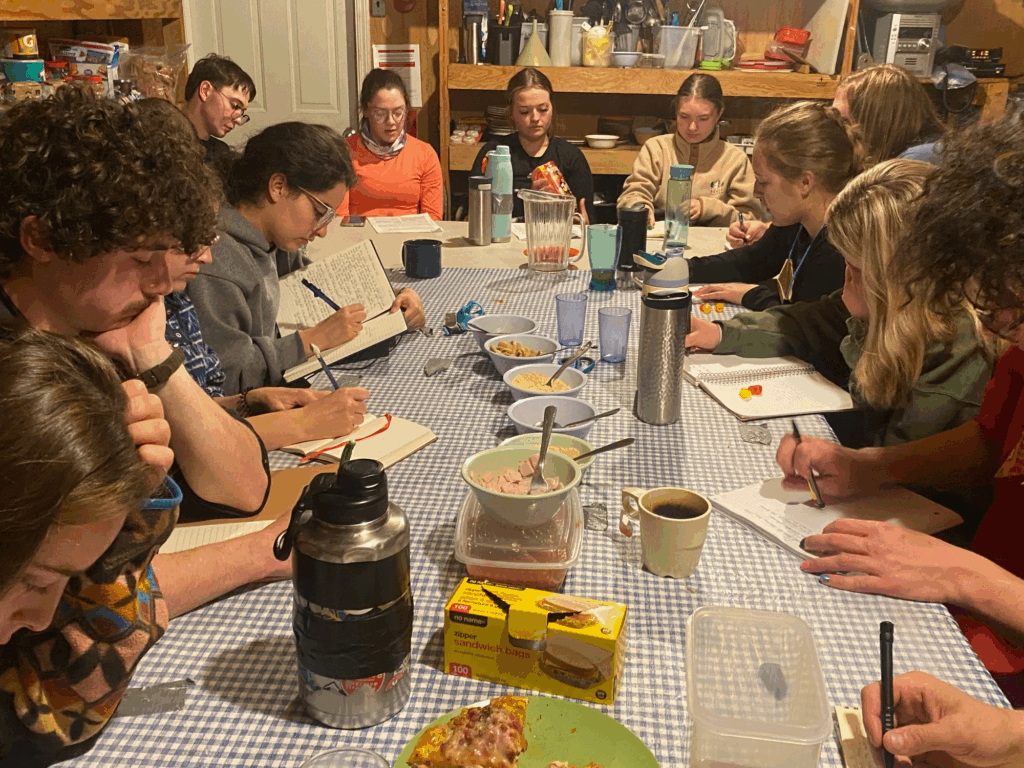
One of my favourite spots on the planet is being crammed around the dining room table at Nester One Field Camp in Wapusk National Park. Coffee is always on and food is everywhere. The room is always toasty warm and students are working furiously.
Most importantly — no internet!
 I have much respect for Dr. Ryan Brook, his work and his students.
Ryan Brook, PhD. Chairman of the Boar @ryankbrook.bsky.social:
Let me introduce myself. I’m a professor @usask.bsky.social at the University of Saskatchewan. My group works on invasive wild pigs, caribou, wolves, and other beasties. I take the responsibility of my academic freedom very seriously and use it and good science to hopefully have some influence.
Unrelated but related:
@joelwwood.bsky.social:
Not @thebeaverton.com
@moebiusstripper.bsky.social:
FIRE EVERYBODY
@allenbg.bsky.social:
The article is oddly vague as to who actually prepared this report.The report itself is too!
Education report calling for ethical AI use contains over 15 fake sources, Experts find fake sources in Canadian government report that took 18 months to complete by Benj Edwards, Sep 12, 2025, Arstechnica

A picturesque view of Rose Blanche Lighthouse in Channel-Port Aux Basques Newfoundland Canada. Credit: Deb Snelson via Getty Images
On Friday, CBC News reported that a major education reform document prepared for the Canadian province of Newfoundland and Labrador contains at least 15 fabricated citations that academics suspect were generated by an AI language model—despite the same report calling for “ethical” AI use in schools.
“A Vision for the Future: Transforming and Modernizing Education,” released August 28, serves as a 10-year roadmap for modernizing the province’s public schools and post-secondary institutions. The 418-page document took 18 months to complete and was unveiled by co-chairs Anne Burke and Karen Goodnough, both professors at Memorial University’s Faculty of Education, alongside Education Minister Bernard Davis.
One of the fake citations references a 2008 National Film Board movie called “Schoolyard Games” that does not exist, according to a board spokesperson. The exact citation reportedly appears in a University of Victoria style guide, a document that teaches students how to format references using fictional examples. The style guide warns on its first page that “Many citations in this guide are fictitious,” meaning they are made-up examples used only to demonstrate proper formatting. Yet someone (or some AI chatbot) copied the fake example directly into the Education Accord report as if it were a real source.
Aaron Tucker, a Memorial assistant professor whose research focuses on AI history in Canada, told CBC he could not find numerous sources cited in the report despite searching the MUN Library, other academic databases, and Google. “The fabrication of sources at least begs the question: did this come from generative AI?” Tucker told CBC.
“Whether that’s AI, I don’t know, but fabricating sources is a telltale sign of artificial intelligence.”Fucking wowza!
Since the inception of AI language models, generating fabricated citations has been a continuous problem. The tendency to confabulate academic citations often causes particular trouble in academic and legal contexts, where fabricated sources can easily slip past lazy human review because they appear properly formatted and contextually appropriate.
AI language models like the kind that power ChatGPT, Gemini, and Claude excel at producing exactly this kind of believable fiction because they first and foremost produce plausible outputs, not accurate ones. They always generate a statistical approximation based on patterns absorbed during training. When those patterns don’t align well with reality, the result is confident-sounding misinformation. Even AI models that can search the web for real sources can potentially fabricate citations, choose the wrong ones, or mischaracterize them.And Mark Carney wants to replace much of our public service with AmeriKKKan AI? Oh sweet homemade apple pie, are Canadians in for hell.
“Errors happen. Made-up citations are a totally different thing where you essentially demolish the trustworthiness of the material,” Josh Lepawsky, the former president of the Memorial University Faculty Association who resigned from the report’s advisory board in January, told CBC, citing a “deeply flawed process.”
The irony runs deep
The presence of potentially AI-generated fake citations becomes especially awkward given that one of the report’s 110 recommendations specifically states the provincial government should “provide learners and educators with essential AI knowledge, including ethics, data privacy, and responsible technology use.”Roaring laughter!
Sarah Martin, a Memorial political science professor who spent days reviewing the document, discovered multiple fabricated citations. “Around the references I cannot find, I can’t imagine another explanation,” she told CBC. “You’re like, ‘This has to be right, this can’t not be.‘ This is a citation in a very important document for educational policy.”
When contacted by CBC, co-chair Karen Goodnough declined an interview request, writing in an email: “We are investigating and checking references, so I cannot respond to this at the moment.”Louder roaring laughter
The Department of Education and Early Childhood Development acknowledged awareness of “a small number of potential errors in citations” in a statement to CBC from spokesperson Lynn Robinson. “We understand that these issues are being addressed, and that the online report will be updated in the coming days to rectify any errors.”