Deadly Toxic Trail: Thousands of miners left in danger by critical enforcement gaps
Toxic levels of dust can remain undetected for days — and even weeks — exposing workers to one of the deadliest hazards in mining.
In the battle against one of the deadliest outbreaks of black lung disease in decades, the federal mine inspectors play a critical role: testing the coal dust levels in the vast underground tunnels to protect the lives of the workers. In case after case, the inspectors found the air posed no dangers to the miners who were allowed to keep working in what were believed to be safe conditions.
But what the workers didn’t know was that the tests failed to pick up on another toxic substance — far more dangerous — that filled the caverns at levels that surpassed every known threshold of safety, a Post-Gazette investigation found.
MINE MAP PG
Days would pass before federal officials discovered some of the mines were choked with silica, a carcinogen that’s about 20 times more hazardous than ordinary coal dust and has contributed to the deaths of thousands in the last two decades.
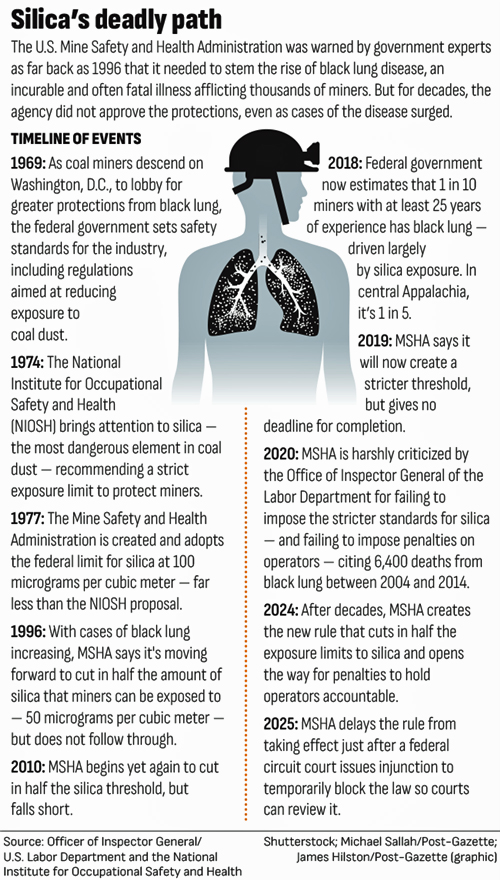
The lapse in detection by government regulators continues to pose risks to workers at a time when cases of advanced black lung disease are impacting young workers at rates never before seen. At least 500 times in the past decade, inspectors said that the mines were operating safely — the owners avoiding citations, costly fines and other penalties, a Post-Gazette analysis shows.
Silica sand test project proposed for La Salle, Sanford area by Jeff Keele, November 25, 2025, CTV news
CTV’s Jeff Keele has more on a silica sand company hoping to set up an extraction site in the La Salle area.
Another company wants a chance to pull silica sand from another area of Manitoba.
Silex Resource Corporation is holding an open house meeting in the RM of MacDonald to let people know about their plans. Donovan Toews is a partner with Landmark Planning and Design, who is consulting on the project.
“There’s a lot of silica sand in the entire area from the U.S. border all the way up to the Interlake,” said Toews. “There’s a layer.”
According to a map set to be presented at the open house, Silex has 13 land claims around 40 to 60 acres in size in the La Salle and Sanford area. They want to drill three to four holes to test the silica’s purity.
This would require a borehole license from the province.
“If people can picture a water well rake, comes on a property and then there’s a tall derrick or tower and then you drill down and go all the way down to where the silica is and you bring a sample up,” said Toews.
If the test results are pure enough, an environmental license process would begin for permission to extract silica, which is used for many industries like electronics, construction and glassmaking. But, it’s most likely going to be low purity sand for frac’ing.
Another, separate project with a different company became highly controversial. Sio Silica is taking a second crack at mining silica sand in the RM of Springfield. The province rejected their application following concerns about the potential impact on the area’s freshwater aquifer.
But in the RM of MacDonald, Toews said the aquifer there is saline.
“Nobody is using this water because it’s so saline, you can’t feed it to your animals, it will kill your plants, and no one is drinking it,” said Toews.
Reeve Brad Erb said he’s been fielding some questions about this project. He said it’s too soon to say whether he and his council will support this or not, or what are the potential impacts or benefits.
“We haven’t even given that any consideration in terms of what is the benefit to the RM,” said Erb. “Let’s really see…the open house first and the test hole.”
The open house is set for Wednesday evening at the Kingswood Golf Course.
Alberta opens up silica exploration and mining on public lands, Ministerial order significantly expands size of exploration and mining leases by Brett McKay, Local Journalism Initiative Reporter, 11 Nov 2025, Investigative Journalism Foundation
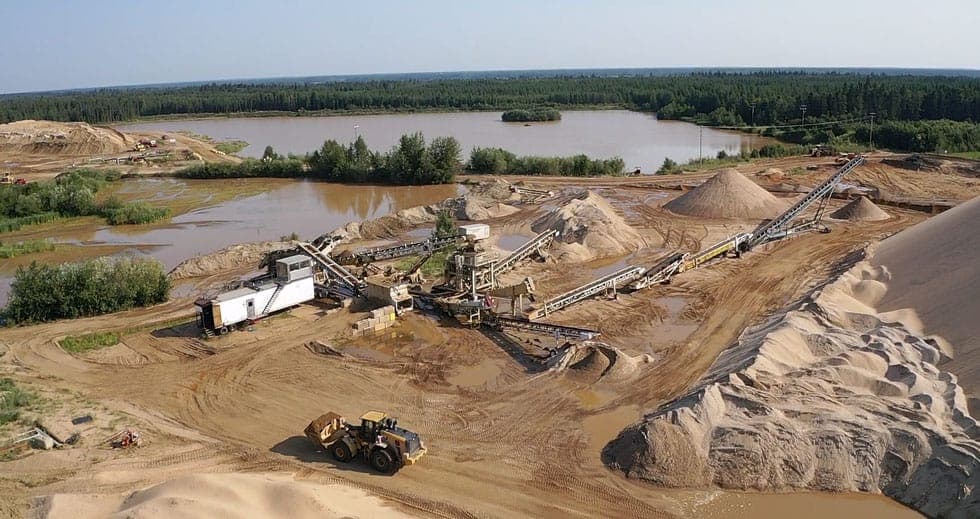
A sand mine operated by Peaskie Minerals in Alberta. (Peaskie Minerals)
It’s a critical mineral for the oil industry, but Alberta’s plan to vastly expand silica exploration and mining has environmentalists worried.
A ministerial directive issued by Minister of Forestry and Parks Todd Loewen in August creates new categories of “enhanced” silica exploration and mining leases. Alberta’s existing sand and gravel allocation policy allows a maximum size for surface material exploration (SME) approvals of 320 acres. Companies that meet financial and technical criteria in the ministerial directive can now be authorized to hold up to two enhanced SMEs for an area up to 5,700 acres each.
At the same time, the government will now allow companies to have surface mining leases of 200 acres, up from 80 acres.
The major sand deposits in Alberta are found along rivers and their tributaries. And the government’s intended expansion of silica mining in these areas brings added risk of environmental impacts, said Kennedy Halvorson, a conservation specialist with the Alberta Wilderness Association.
“Allowing exploration to happen at such a larger scale, without many boundaries, is not forward thinking, especially considering if these deposits are primarily near our major waterways and our tributaries,” she said.
When the tit for tat tariff dispute between the U.S. and Canada threatened to add millions to the cost of importing certain minerals, Alberta companies most of them Americanrallied to have the province loosen rules around mining and exploration in a bid to boost domestic production of silica and quartz sand — a required component in hydraulic fracturing.
Though the tariffs on silica were short-lived — the Government of Canada granted a “remission” in July — the province has pushed ahead with legislative changes enabling a massive expansion of silica mining on public lands.Humans take any opportunity to destroy vital habitats for other species in the name of profit raping and stupidity. This destruction will mostly profit Amerikkkans
An Oct. 16 joint news release from Alberta’s energy, environment and forestry ministers touted a new policy to increase investment in silica sand production, saying the government was “reducing red tape, shortening decision times and enhancing accessibility on public lands.” But the announcement included no details about which regulations had been rewritten.
“Our government is streamlining decision-making and expanding the size of available surface exploration and extraction leases for silica sand, creating conditions that attract long-term, larger-scalemassively destructive industry investment through faster approvals,” Loewen told the IJF in a statement.
To support what the province calls “efficient and appropriate decision-making,” the ministerial order says regulatory approvals for enhanced exploration permits or surface leases won’t include requirements and considerations addressed by Alberta’s Water Act or other statutes.
“I think the red tape language is always a bit of a red flag, because we want to make sure there is good oversight into these processes,” Halvorson said.
“If you’re mining near or in a river, you can deepen or widen channels. You can create bank and slope instability. You can increase erosion. You can change the hydrology that can lead to habitat loss and fragmentation. You can increase turbidity and the suspended solids in the water, which then can reduce the ability of aquatic species to breathe or for the plants to go through photosynthesis.”
Because sand deposits tend to sit close to the surface, sand mining companies often use strip-mining or pit-mining techniques that remove the top layers of soil and vegetation.
Halvorson said there is a pervasive notion that exploration, whether it’s related to mining or oil and gas development, is a non-destructive process. However, she said the act of going into a habitat, searching for minerals, and taking samples also has impacts on the landscape.
No changes to the Water Act were made related to the enhanced exploration and surface lease regulations, Forestry and Parks press secretary Michael Plenits told the IJF, but the act “continues to provide the same strong protection for Alberta’s water, and these silica sand dispositions continue to be fully subject to the Water Act.”Bullshit! No regulator held Encana/Ovintiv responsible for illegally frac’ing directly into Rosebud’s drinking water aquifers. Alberta is a fucking frac frenzied free for all, notably for Amerikkkan companies.
Plenits did not directly answer questions about how the government settled on the size limits of 5,700 acres for exploration leases and 200 acres for surface mine leases. Before introducing these changes, the ministry consulted with municipalities as well as current silica sand operators, he said.
Directors from Peaskie Minerals and Sil Industrial Minerals, two of the province’s biggest sand mining operators, were some of the industry players who met with representatives of Alberta’s forestry and environment ministries. As tariff costs spurred panic in the fracking industry, Peaskie board member and former Alberta cabinet minister Doug Horner worked the phones to set up meetings with government officials, according to an article published in the Edmonton Journal.
Among the hurdles industry operators said were holding back production were the 80-acre limit on public land leases and the requirement that companies complete reclamation of a site before beginning mining a new parcel of land.
Authorized companies can now hold up to four enhanced surface mine leases, or up to 800 acres, at any given time. A lease no longer counts towards the active limits once a notice of reclamation has been filed.
Loewen said in a statement that silica sand exploration and extraction will create well-paying jobs for Albertans, and the changes will promote investor confidence “while still ensuring Albertans receive a fair return for the use of their public lands.”He’s a life hating fucking quisling liar
Less red tape, more Alberta natural resources by Nazi UCP, Oct 16, 2025
Alberta’s government is supporting silica sand exploration and extraction on public land, reducing the province’s reliance on imports.
Alberta’s natural resources provide countless social, environmental and economic benefitsto Amerikkkans, the rich, while causing countless social, environmental and economic harms for Albertans and Canadians because law violating companies and those causing devastating harms and toxic pollution are never held accountable, and government is looking to expand the Alberta advantage by creating new opportunities for investment in silica sand production. Silica sand is necessary for many oil and gas production operations, and Alberta currently relies on imports to meet its needs.
“Expanding opportunities for silica sand exploration and extraction will create
good-payingour province’s economic independence. These changes will allow companies toinvestTodd Loewen, Minister of Forestry and Parks
“Silica sand is a critical ingredient in helping Alberta oil and gas companies in the Montney and the Duvernay formations. This oil, gas liquids and natural gas is critical to
meeting demand in Canada and around the world. The more we can improve Alberta-based supply chains, the more secure this resource will be while creatingjobs and opportunity.”Brian Jean, Minister of Energy and Minerals
“Reducing our reliance on imported silica sand is good for business
goodStreamlininghighstaying right here inRebecca Schulz, Minister of Environment and Protected Areas
New regulatory changes are making it easier for silica sand producers to conduct exploration and extraction bymassively deregulating to allow unchecked rape, pillage and destruction that will never be cleaned up by the rich profit raping reducing red tape, shortening decision times and enhancing accessibility on public lands. These changes will dramatically increase health harms to Alberta life, and permanently remove more water in already severely drought stricken Alberta, not create jobs because the oil, gas and frac industry is automating to get rid of having to pay workers and make the foreign (mostly Amerikkkan) rich richer while destroying lives of Albertansreduce the Alberta’s dependence on silica sand imports, create jobs and support economic growth.
“These changes will have significant impact on the ability to grow the industry in Alberta and provide security of supply for the oil and gas sector. Most of these operations are in rural Alberta, providing significant
economic benefits and employment opportunitiesKeith Arsenault, CEO, Peaskie Minerals Inc.
As tariffs continue to affect businesses and workers on both sides of the border, the province is prioritizing the strength and resilience of Alberta’s economy bydestroying our lands, counties, air, water, families, public health and more to make sure rich Americans get richerinvesting in natural resource development and Alberta producers.
“As a business that has been working in Alberta for over 50 years, we are excited to see this Alberta government continuing to support
Albertans and AlbertajobsMichael Leitch, General Manager, Sureway Construction Group of Companies
Quick facts
- Silica sand is an important tool used in the production of oil and gas.
- In 2024, Alberta required 8.4 million tonnes of silica sand for oil and gas, with 12 million tonnes predicted to be required by 2035.
- Alberta currently produces approximately one-third of the silica sands it requires.
Refer also to:
2025: Manitoba says “NO!” to Calgary’s Sio Silica Corp (but company appears to be deaf)
2021: MUST READ Letter by retired judge Tom Lister to Roberta Walls, DNR, frac sand “regulator”
2019: 400,000 gallons frac sand mine sludge spews into Class II trout stream in Wisconsin; Regulator knee high boots caked in yellowish muck, waits 3 days to take samples. Intentional waste management via dumping?As also frequently occurs in Canada, with regulators and politicos enabling it.
2013 Dr. Larysa Dyrszka warnings on frac’ing’s many health harms to workers and impacted communities: