Large page, takes time to load.
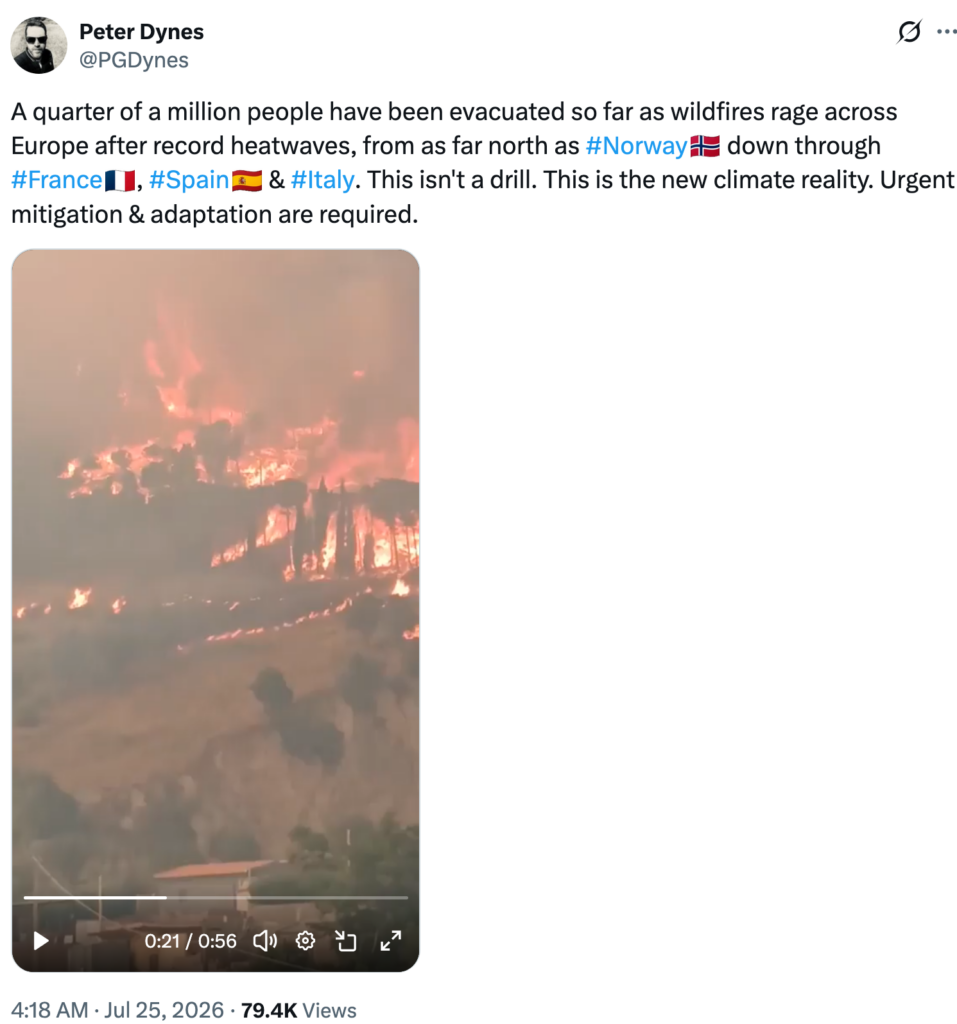
@MrMatthewTodd:
I don’t believe we are going to survive. Not because we can’t but because we refuse to act.
Our current situation is that of having a stage 4 cancer diagnosis and refusing to believe the doctors, leaving the hospital and ignoring the growing symptoms. By the time we face it it will likely be too late.
@MrMatthewTodd:
Wow. Finally, a media front page expressing some reality of how bad things are. Thank you @ScotNational
People should be apoplectic at the media who have so far refused to tell the public the full truth of the planetary crisis we are now in.
wildfires #heatwave
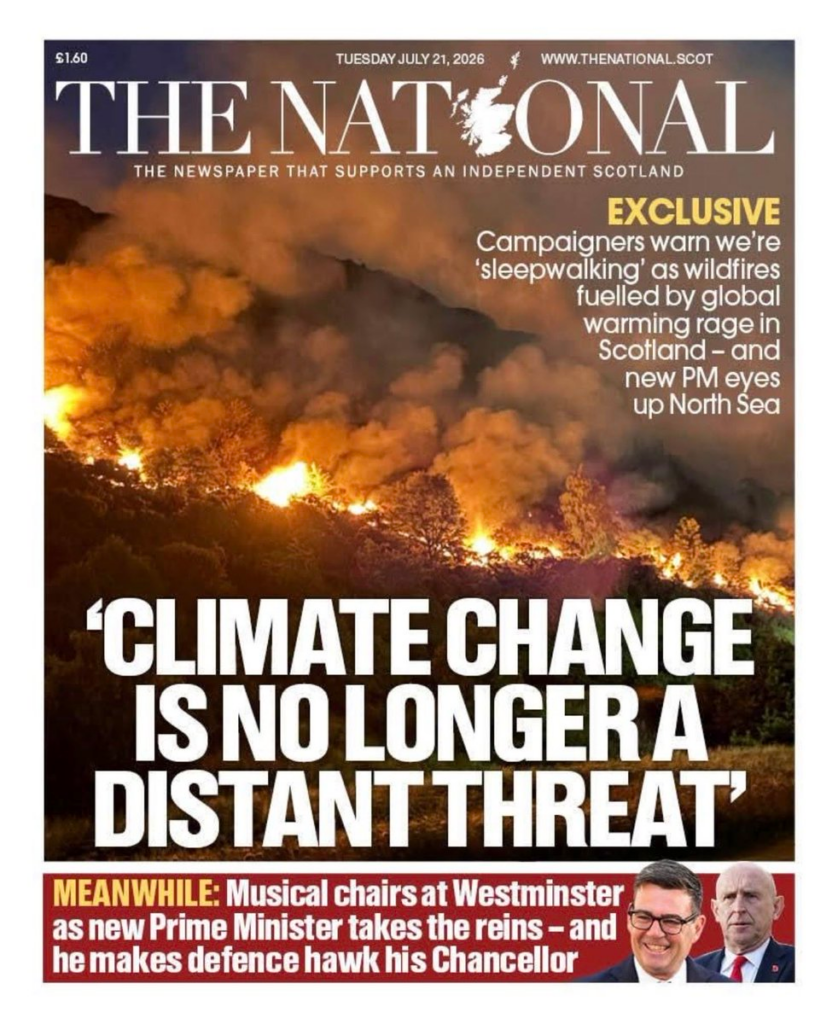
Front Page The National July 21 2026:
‘CLIMATE CHAGE IS NO LONGER A DISTANT THREAT’
“Campaigners warn we’re ‘sleepwalking’ as wildfires fuelled by global warming rage in Scotland – and new PM eyes up North Sea”
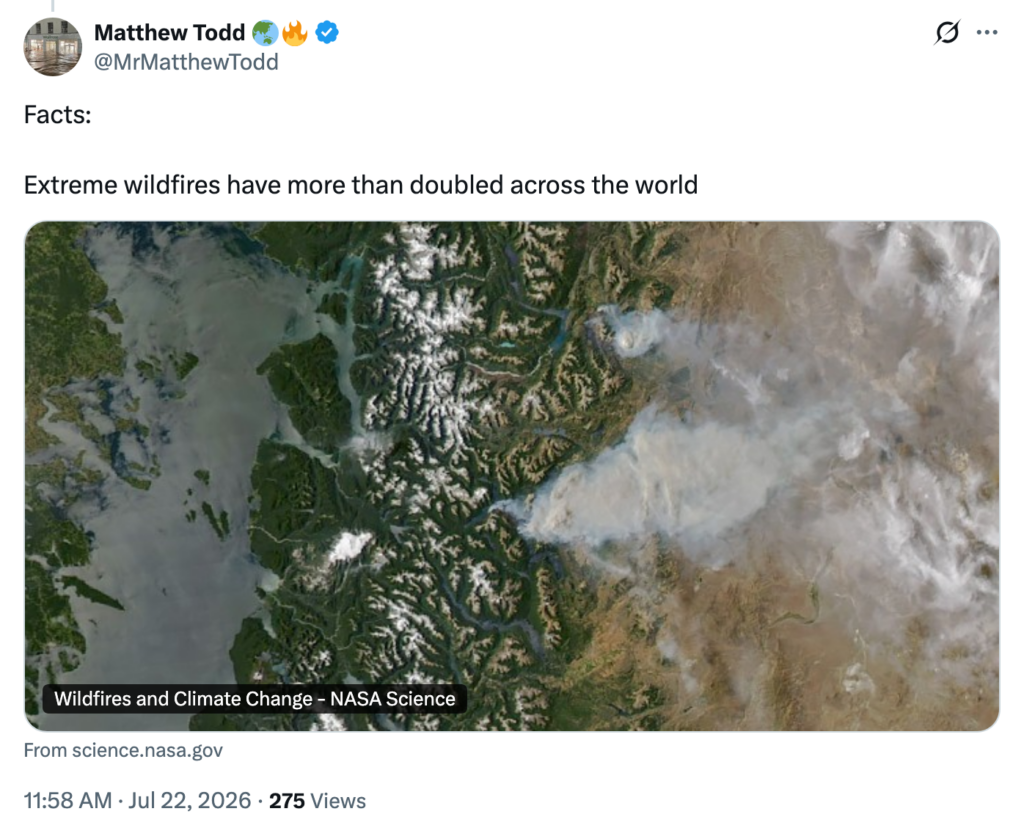
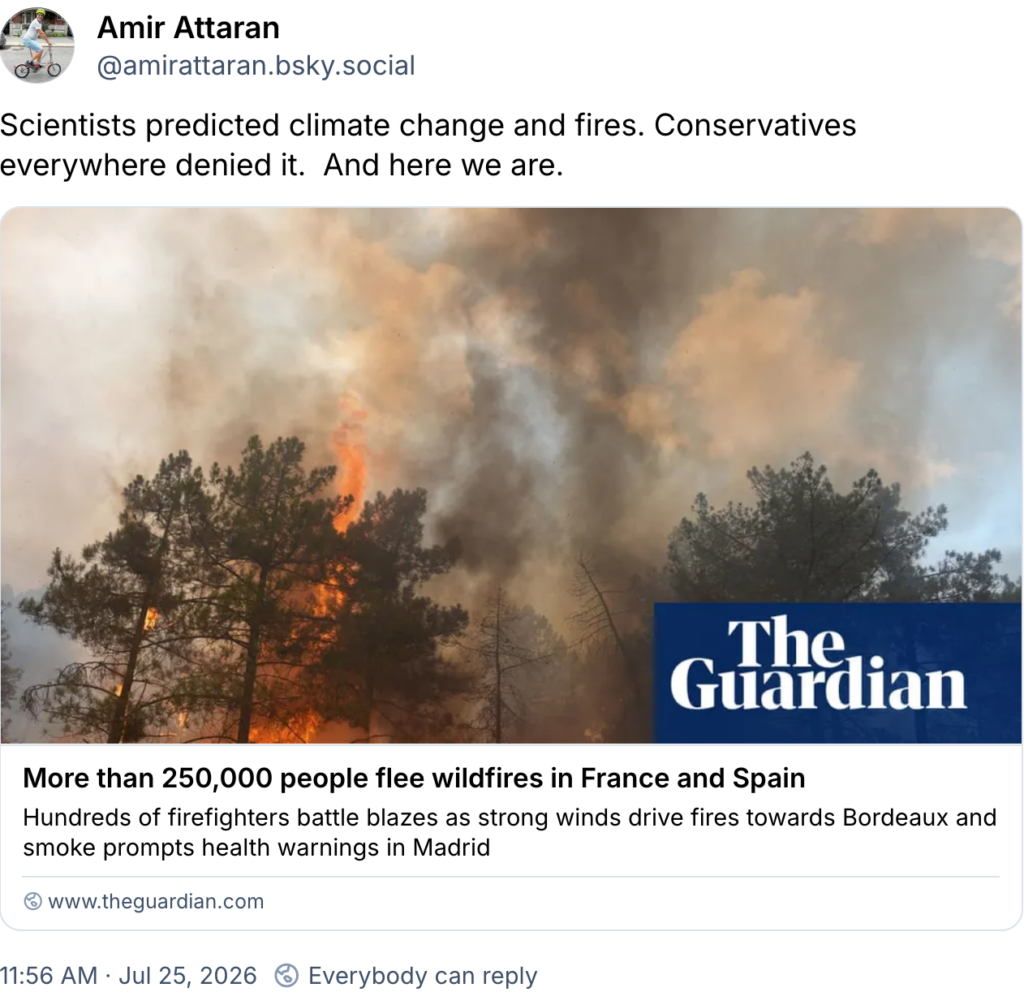
@thegodshow.com:
Thou shalt not blame Canada for wildfires caused by climate change you’ve spent your whole life denying and intensifying through your own greed and stupidity.
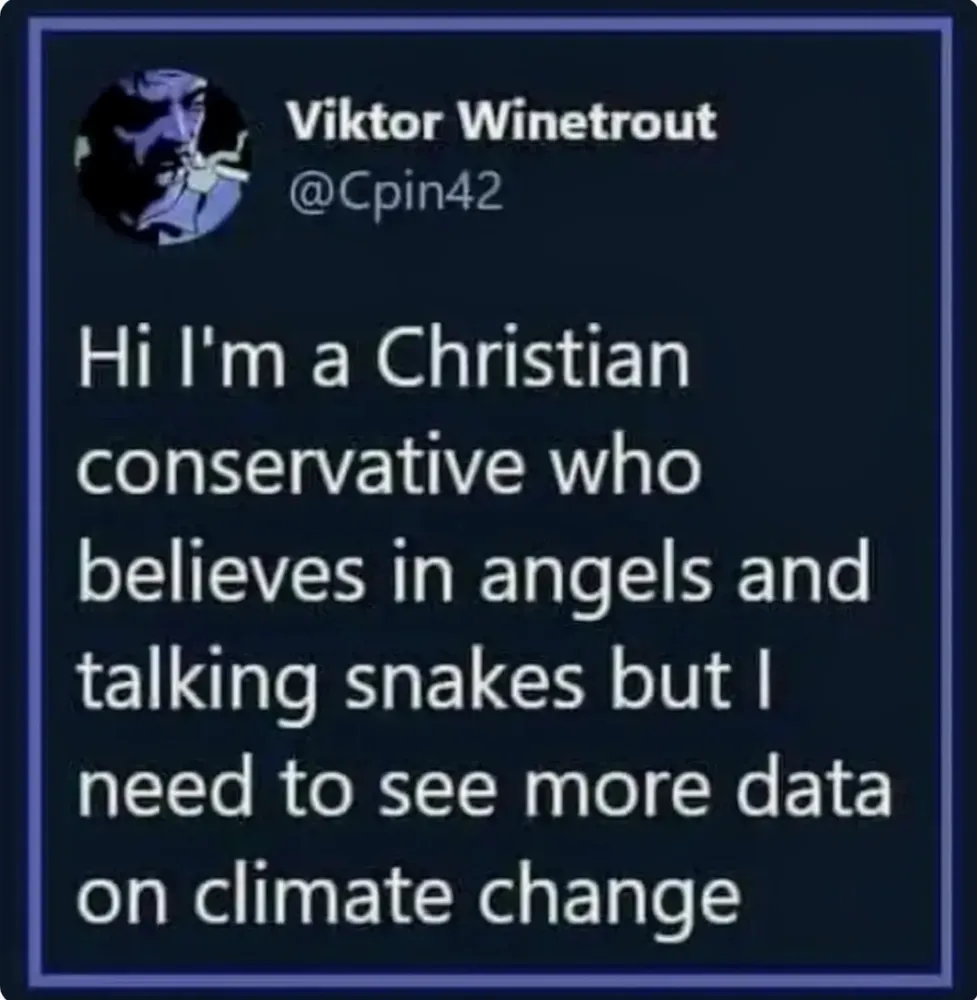
@nickofnz:
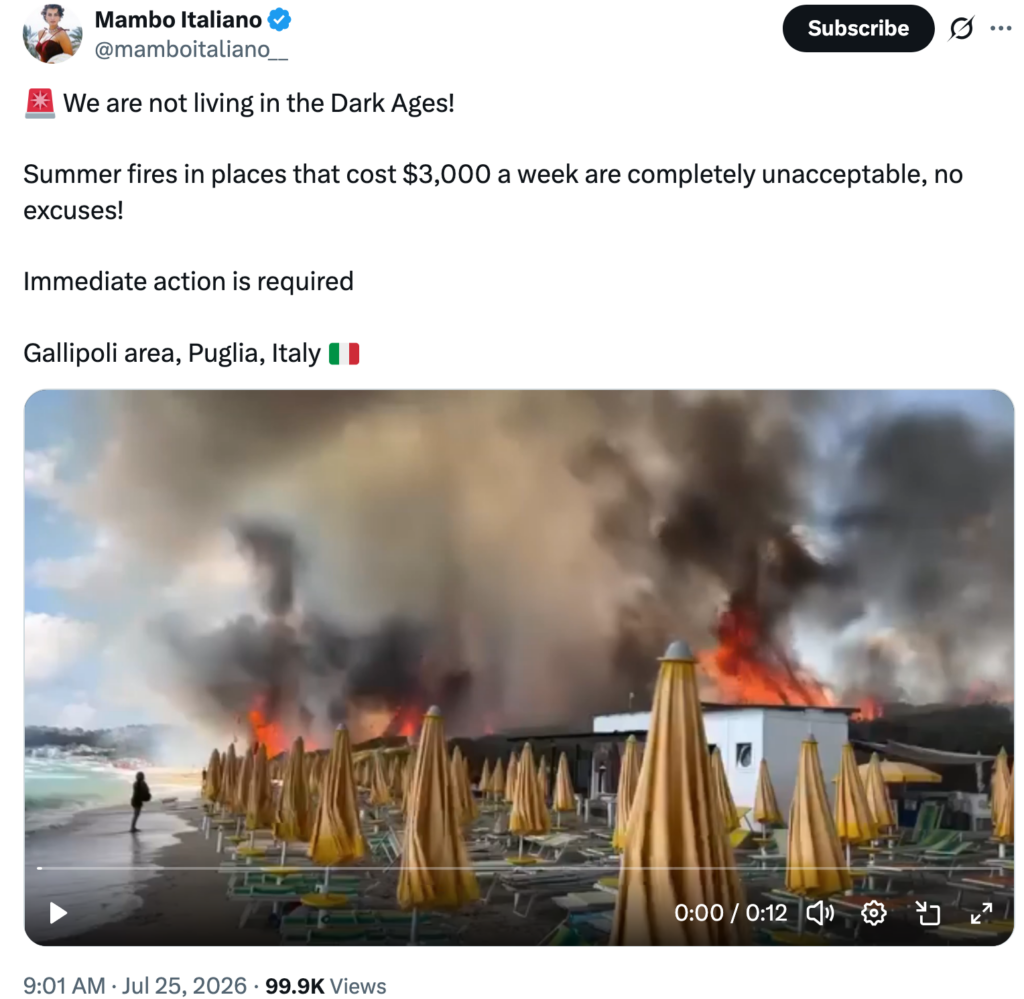
France is on fire.
Spain is on fire.
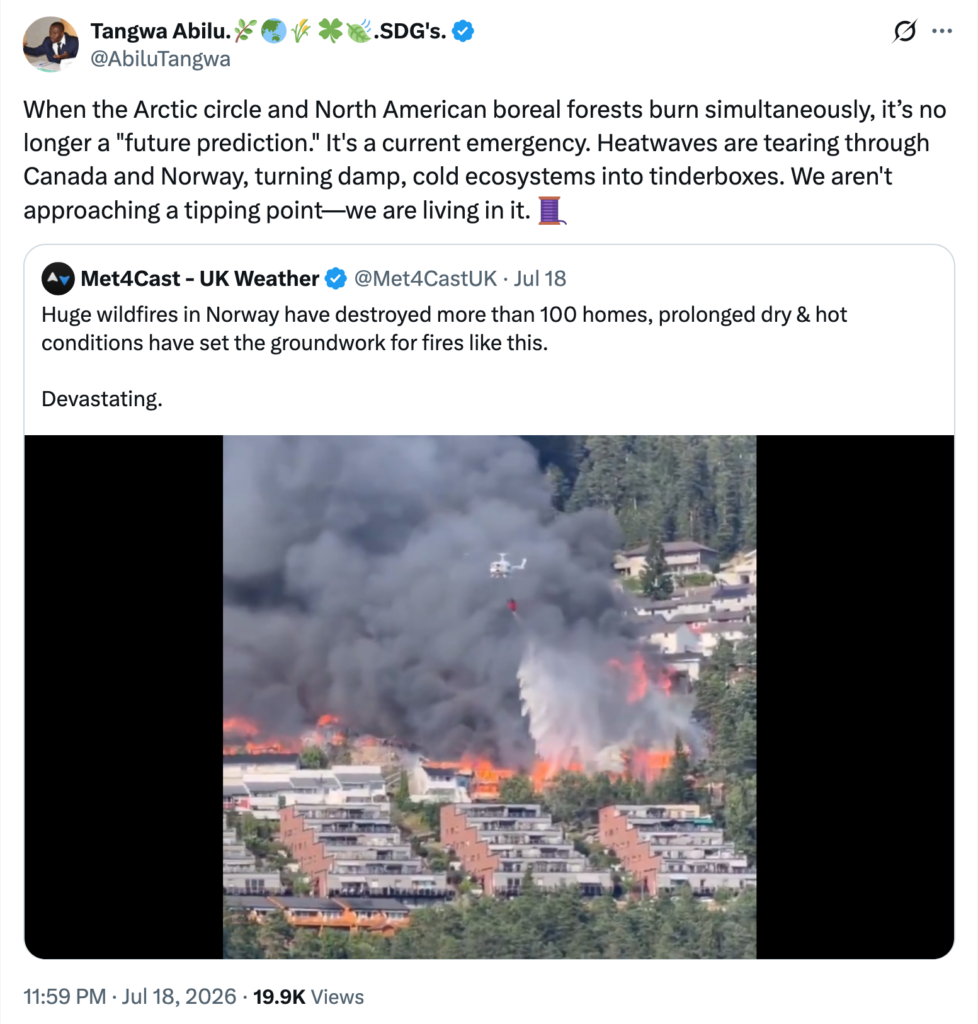
Norway is on fire.
Sicily is on fire.
Ontario is on fire.
Scotland is on fire.
Bolivia is on fire.
Algeria is on fire.
England is on fire.
Wales is on fire.
Tunisia is on fire.
Greta wasn’t wrong when she said our house was on fire
It’s time to make the oil industry pay for the damage they’ve done as we put them out of business FOR GOOD!
MakePollutersPay
If you think this can’t happen in the UK, America or where you live, you are wrong Just last year leading climate scientist Prof @HayleyJFowler warned that the UK at any time could now see 2/3 of a years worth of rain fall in a couple of days, enough to flood the tube system, wash away homes and cars. Her video is posted below this. None of this has been reported by the media.
@cwebbonline.com:
Reality doesn’t care about political talking points.
This isn’t because Spain and France forgot to rake the forest. This is climate change, plain and simple, and it’s only going to get worse.
Nearly 200,000 people are running for their lives from out-of-control wildfires.
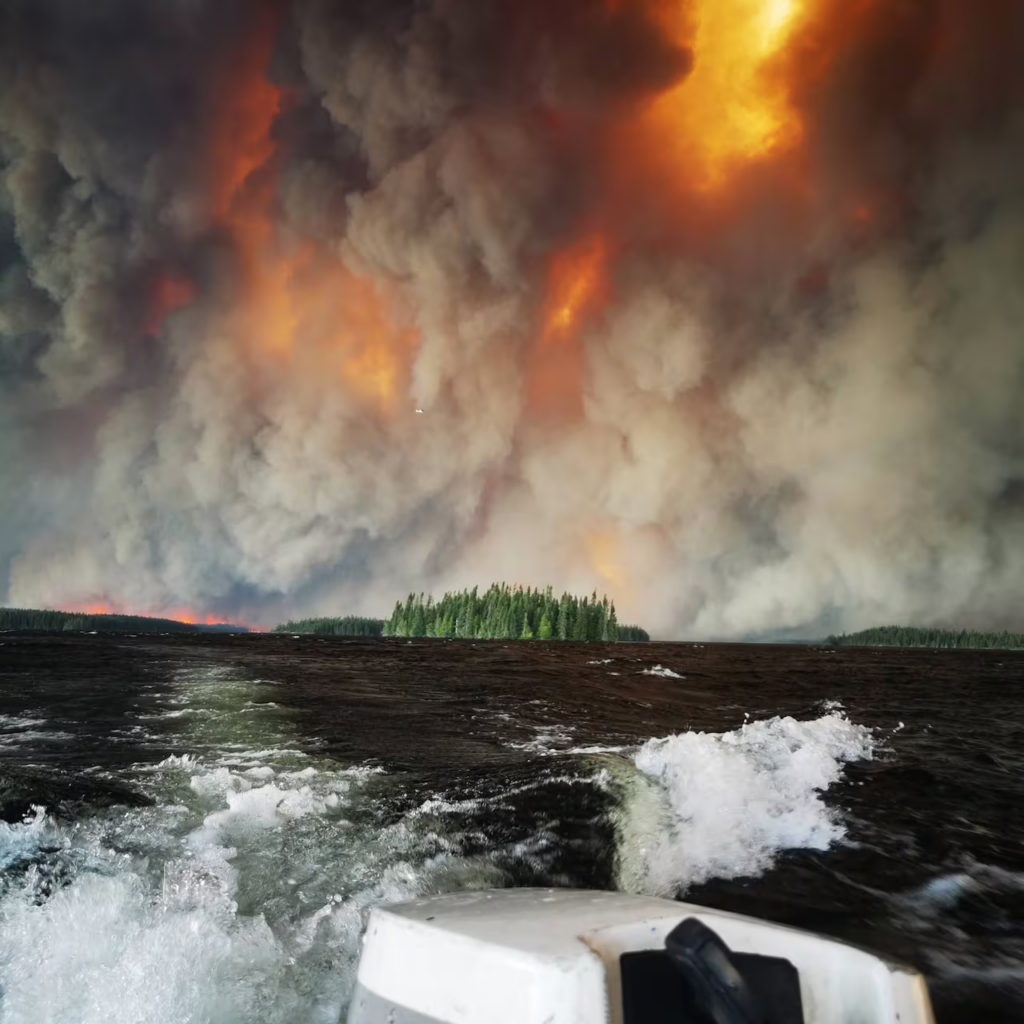
Members of First Nation destroyed by northwestern Ontario wildfire helped each other escape by boat, ‘Adrenalin definitely took over,’ Namaygoosisagagun First Nation resident says by Sarah Law, CBC News, Jul 16, 2026
Anishinabek Nation @AnishNation:
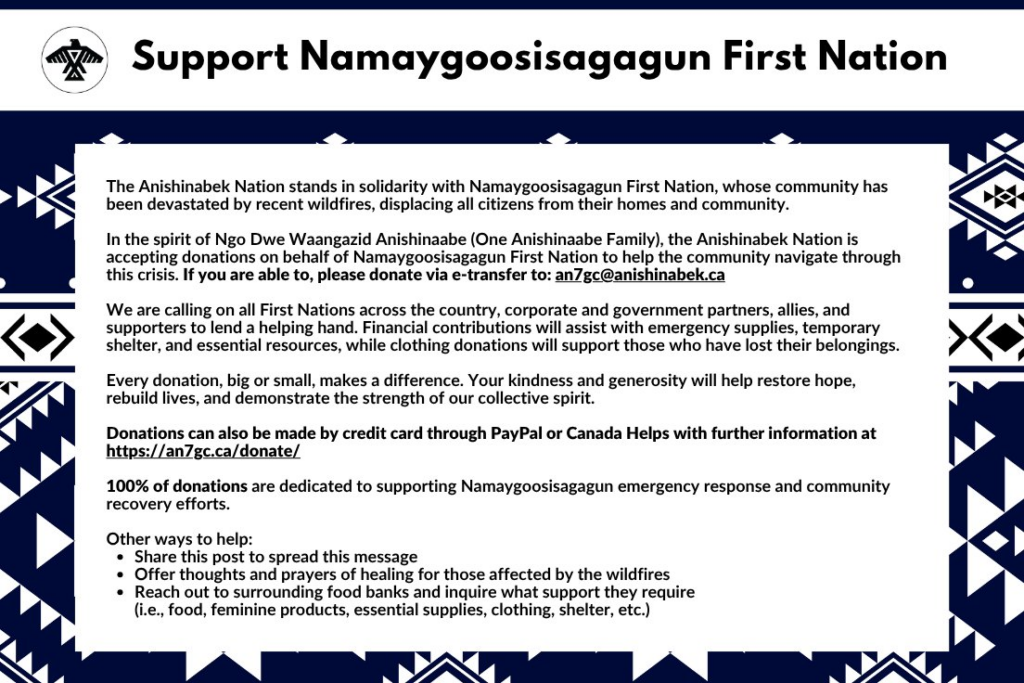
The Anishinabek Nation stands in solidarity with Namaygoosisagagun First Nation, which has experienced devastation from the recent wildfires, displacing all citizens from their homes and community.
In the spirit of Ngo Dwe Waangazid Anishinaabe (One Anishinaabe Family), the Anishinabek Nation is accepting donations on behalf of Namaygoosisagagun First Nation to help the community navigate through this crisis. If you are able to, please donate via e-transfer to: email hidden; JavaScript is required
Donations can also be made by credit card through PayPal or Canada Helps with further information at https://an7gc.ca/donate/
100% of donations are dedicated to supporting Namaygoosisagagun emergency response and community recovery efforts.
Other ways to help:
▪️Share this post to spread this message
▪️Offer thoughts and prayers of healing for those affected by the wildfires
▪️Reach out to surrounding food banks and inquire what support they require (i.e., food, feminine products, essential supplies, clothing, shelter, etc.)
@charlieangus104.bsky.social:
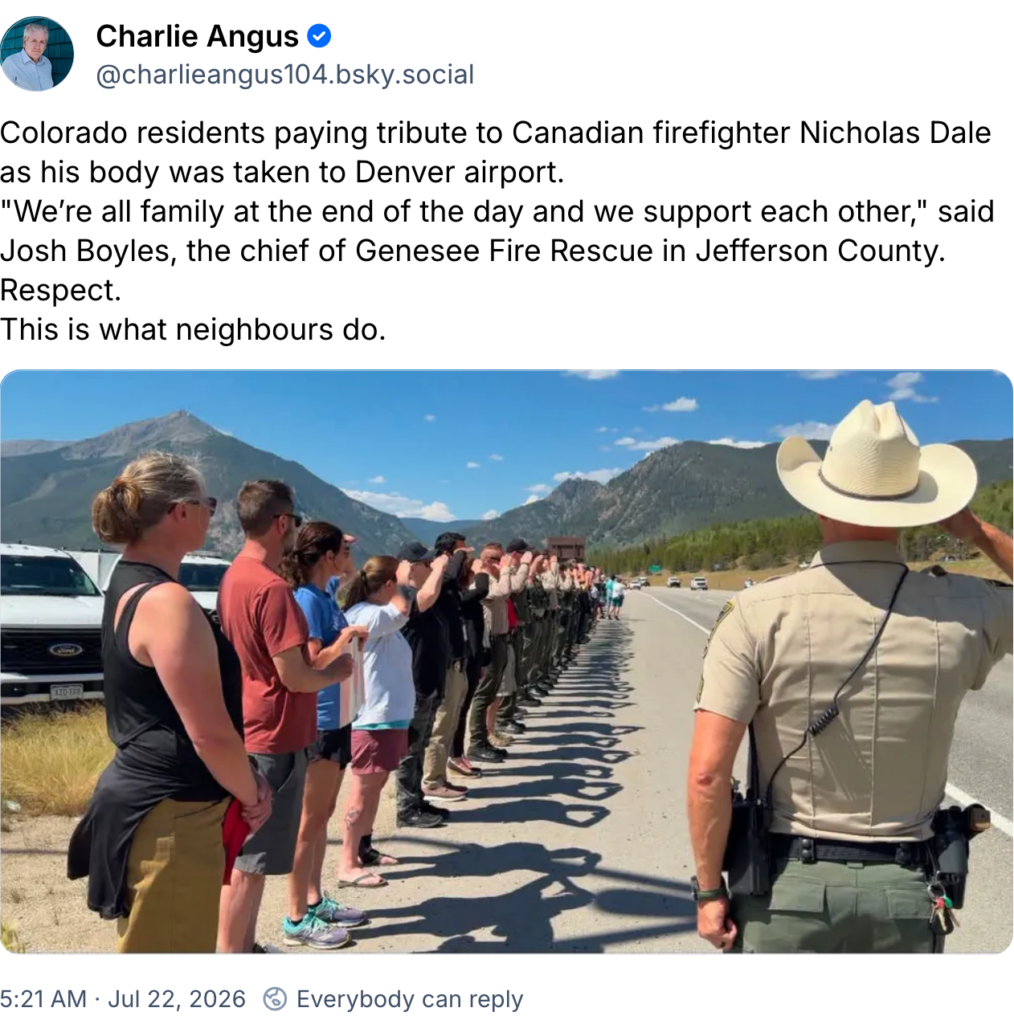
Colorado residents paying tribute to Canadian firefighter Nicholas Dale as his body was taken to Denver airport.
“We’re all family at the end of the day and we support each other,” said Josh Boyles, the chief of Genesee Fire Rescue in Jefferson County.
Respect.
This is what neighbours do.
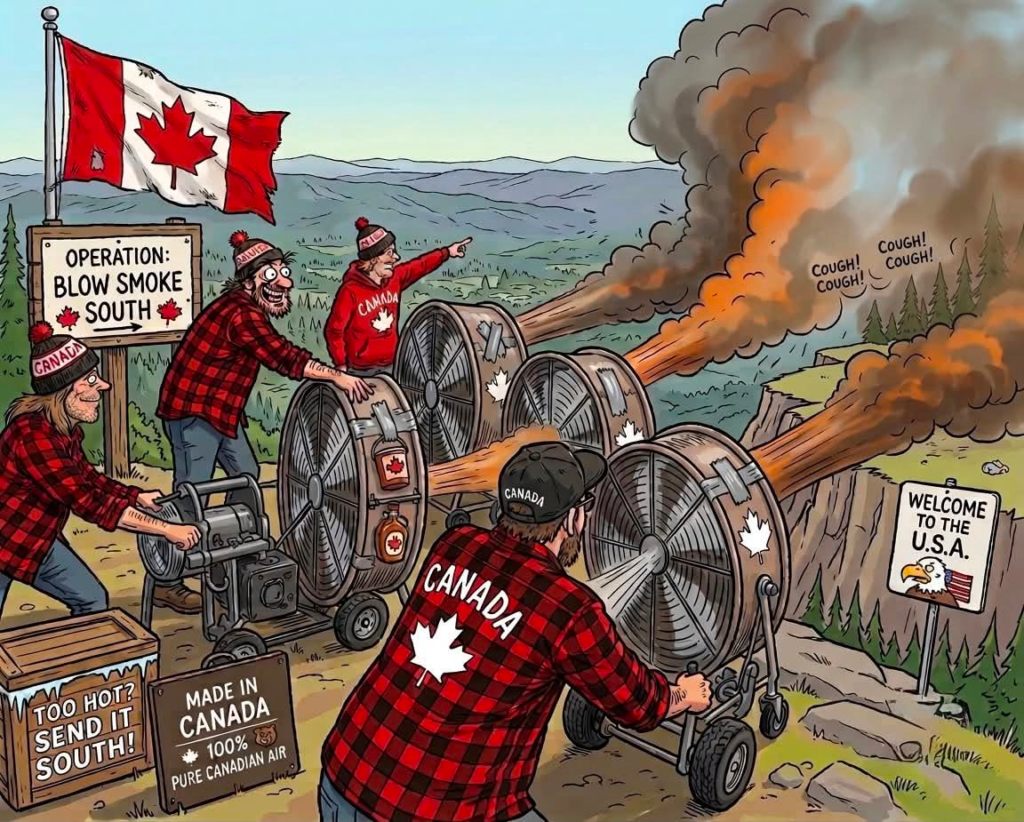
@theserfstv.bsky.social:
This week on twitter the prime minister of Canada made:
17 posts promoting the military industrial complex
6 posts promoting oil and gas interests
1 post talking about the wildfires
@katharinehayhoe.com:
I am a climate scientist and, same.
@kimischilling.bsky.social:
I am not a climate scientist but when I was a kid the number of times we couldn’t go outside because of Canadian wildfire smoke was zero times
@victorian-mutt.bsky.social:
oh, yeah, that’s because my French Canadian grandpa went out and raked all 1.9 billion acres of the boreal forest every weekend.
He worked very quickly. Didn’t care about the other 25% of the non-boreal forests though.
@davidrvetter.bsky.social:
Right now I’m in the epicentre of the heatwave, in southwest France, where the brutality of the heat has ground life to a halt.
And I have to keep reminding myself: this is only the beginning.
@leahstokes.bsky.social:
The heatwave in Europe is so extreme, it’s 25–32°F (14–18°C) above normal. You read that right.
France recorded it’s hottest day ever.
The UK had its hottest ever June day.
The ground is exceeding 122°F (50°C).
People are dying.
Tell me again why we shouldn’t talk about climate change??? because the billionaires want more money, big polluters – notably American oil and gas companies do not want to stop destroying water and rendering air toxic, and profiting $billions off destroying life on earth and Nazis and MAGAts want to talk bible and controlling women’s and girls’ bodies instead and using religion to justify Israel’s genocides, and raping women and kids. Repuglican Jeff Van Drew is a bullying abusive fucking anti reality Nazi asshole.
@rosewood1978.bsky.social:
This is devastating for the people involved. In Canada whole communities burned to the ground. Now France and Spain. It’s heartbreaking. Climate change is real and this won’t get better without huge changes.
@madgreek2024.bsky.social:
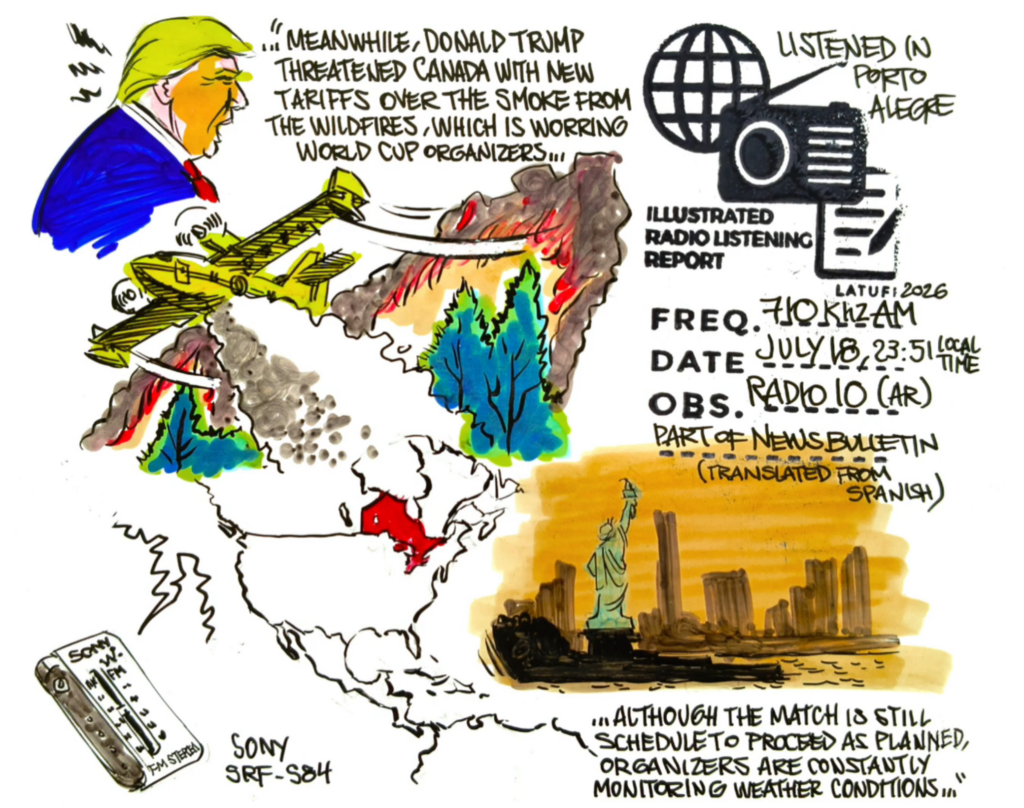
They better hope this smoke does not travel across the Atlantic and gets detected in the Southern states. Trump will impose more tariffs on these Europeans, who clearly never rake their Forests.
@firehorse60s.bsky.social:
Today I woke up to the strong smell of burnt plastic and haze in the sky from all the fires here in South France. Total devastation, animal, wildlife and all those caught up in this …scary times.
@bawley.bsky.social:
That gives me anxiety. It reminds me of wildfires we have had here on the east coast of Australia. Burnt down to black earth for miles and miles. I have never seen anything like that before in the 40 years of living here. The animals and birds, people who lose everything and the firefighters.
@bessieglass11.bsky.social:
it broke my heart when you had the fire that they said killed 2 billion animalsand severely harmed many more; the suffering humans cause is infinite
@emorwee.bsky.social:
Here’s a fun little coincidence I noticed:
Every Republican Congressmember loudly blaming Canada’s forest management policies for this year’s unprecedented wildfires (and ignoring climate change) is a massive recipient of fossil fuel funding.
Sen. Bernie Moreno introduced legislation to sanction Canada over the wildfires, blaming forest management.
Moreno has received $445,823 in direct campaign contributions from oil and gas since his election in 2024.
He was the 6th-largest Senate recipient of oil and gas funding in 2024.
Rep. John James led a group of Michigan Rs in a letter to Canada’s Prime Minister, blaming him for failing to manage forests.
James has received $692,343 from the oil and gas industry since his election in 2022.
He was among the top 5 percent of House recipients of oil and gas money in 2024.
Rep. August Pfluger is using these wildfires to promote a bill shielding fossil fuel producers from the Clean Air Act when they claim pollution comes from abroad.
Pfluger has received $2M+ from oil and gas since his 2020 election.
He was the House’s top recipient of oil funding in the 2024 cycle.
Rep. Tim Walberg led another group of Michigan Republicans in a letter to Canada’s U.S. ambassador claiming the wildfires are “largely driven by decades of inadequate forest management.”
Walberg has received $473,546 from the oil and gas industry since 2010.
Rep. Gabe Evans has been using the Canadian wildfires to argue for loosening air pollution requirements on American businesses.
Evans has received $112,929 from the oil and gas industry since his election in 2024.
He ranked among the top 12 percent of oil and gas recipients in the 2024 cycle.
@rgh1205.bsky.social:
The people denying human caused climate change do this for one reason and one reason only. So they do not have to do anything about it. It is that simple. Most know. But it will cost. So fuck you. Species-ending behavior. But that is what extreme egotism will lead to.
@rabidnid.bsky.social:
In 1985 I concluded we were fucked and decided to never have children. There were shows on TV about how fucked we would be in 2030 and no one cared, no government invested because that was a “future me” problem.
Now here we are.
@padedeux.bsky.social:
Pollution Carney, our Prime Minister, invests even more of our money in the dirty tar sands of Alberta.
I am very ashamed of what Canada is becoming.
We must get rid of Pollution Carney.
@snowfolk.bsky.social:
GOP game plan?
Cancel green energy and EV programs.
Drill, baby, Drill!
Subsidize the fossil fuel industry…
and then when their policies cause
climate catastrophes like wildfires-
Blame Canada!
@kc-momkin.bsky.social:
He is pretending his own administration has no responsibility for DOGE cuts to the US Forest Service, as well. The Minnesota fires are very bad, and could get much, much worse.
@kc-momkin.bsky.social:
DOGE is still impacting our response to wildfires in northern Minnesota. More fire with fewer resources to fight it.
@johnmarkr.bsky.social:
Scientist friends: how many people will die prematurely because of the high levels of particulate matter in the air in North America this week?
@johnmarkr.bsky.social:
I don’t know what I was expecting in answer to this question, but it wasn’t this:
“When monetized, climate-driven smoke deaths result in economic damages that exceed existing estimates of climate-driven damages from all other causes combined in the USA.”
@marygillis.bsky.social:
I think politicians should have to work outside or with open windows when the air quality is low. I think politicians should have to live beside data centers. I think politicians shouldn’t be allowed to use air conditioning.and all politicos must live frac’d, with toxic explosive water in their homes and at work, and in their kids’ daycares and schools
I think politicians live in bubbles and it’s literally killing us.
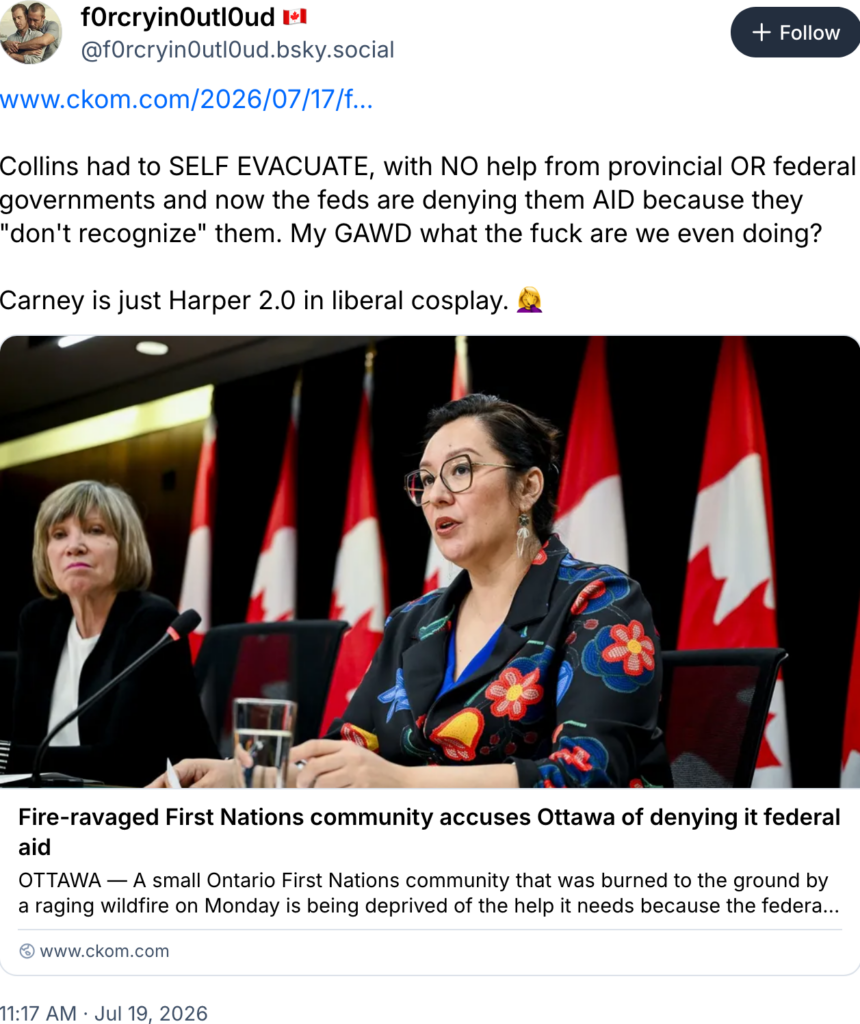
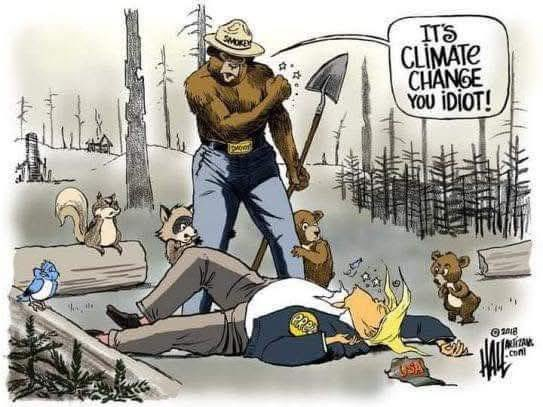
@EDenhoff:
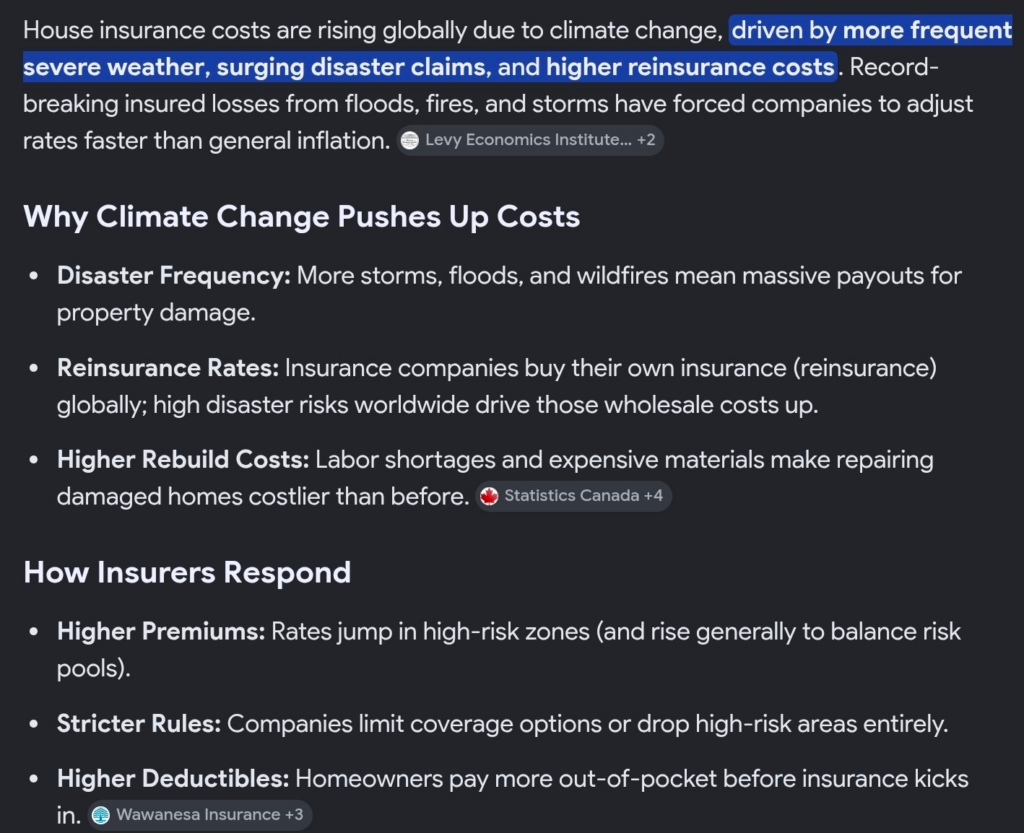
House insurance just jumped from $3000 to $5500!!! Almost double. No claims.. no changes.! What is going on?
@redsnoopy69:
Insurance companies aren’t ignoring climate change…
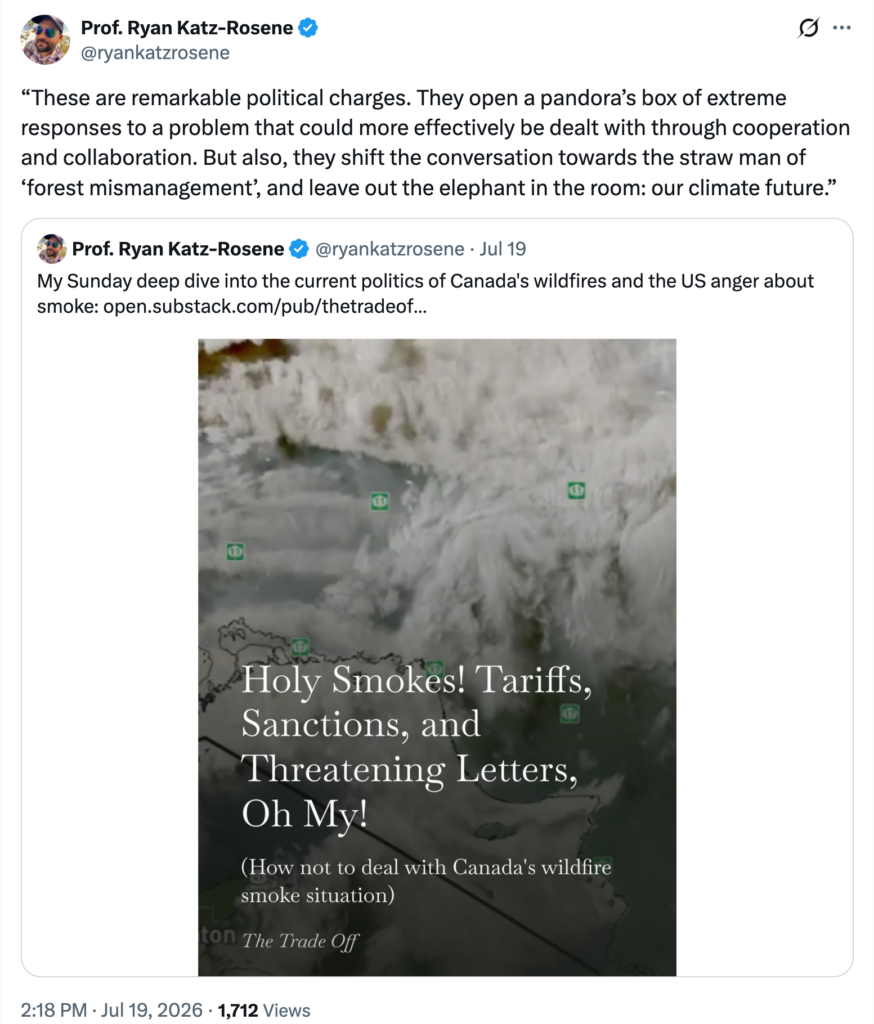
Holy Smokes! Tariffs, Sanctions, and Threatening Letters, Oh My! (How not to deal with Canada’s wildfire smoke situation) by Ryan Katz-Rosene, Jul 19, 2026
Kyle Brittain @BadWeatherKyle:
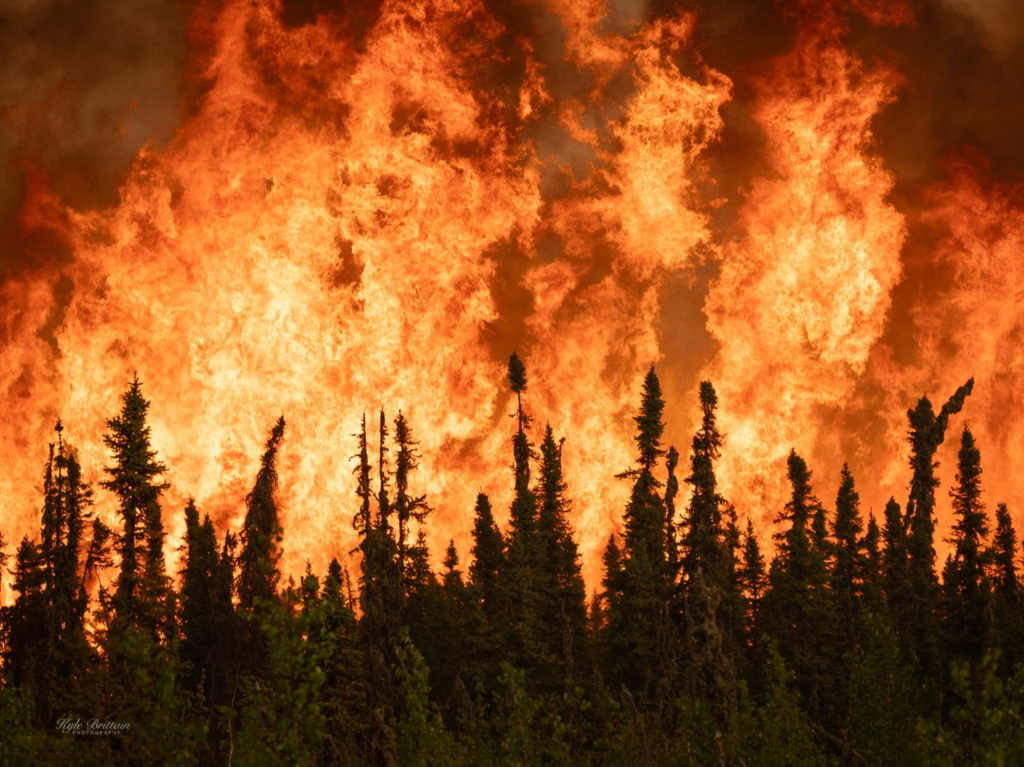
“Just put the fires out!”
Ever seen a boreal wildfire? I have. I used to fight them.
When fire behaviour becomes extreme, you’re not getting close to them.
The radiant heat from a crown fire is face-melting from hundreds of metres away.
All attempts at direct attack will fail, because dropping water on it becomes akin to trying to spit on a campfire…it evaporates before it even hits the flames.
Additionally, reduced visibility, high winds, and turbulence makes aerial attack hazardous.
As a wildland firefighter, I’ve been extracted off of wildfires twice as our fires blew up, both times having our gear burned over. We returned to find firehoses and metal melted into the ash.
I’ve seen fireballs launched hundreds of feet high, and fires intense enough to produce lightning, influencing the weather around them. I’ve seen wildfires grow to the size of a major city in a short period of time.
So no, we can’t just put the fire out.
Not being able to stop such a natural process is a truly humbling feeling.
Drastic Increase in U.S. Wildfires since 1984
We charted every wildfire since 1984. There’s been a drastic increase
A 2025 study found that, depending on the region, climate change can account for one-third to as much as 80% of the burned area in the Western United States between 1992 and 2020.
By Ignacio Calderon, Stephen J. Beard
USA TODAY | Updated July 18, 2026
A new heat wave will bring another round of scorching temperatures as several fires in the West continue to grow in what’s already been a deadly fire season. The Babylon fire burning in Utah now covers 100,000 acres and the Aspen Acres fire in Colorado is nearing that size.
This follows what had been a historically warm winter turned into a historically warm first half of the year: so far 2026 is the nation’s second warmest in 132 years of record keeping.
USA TODAY analyzed decades of wildfire data compiled by federal agencies, which includes fires of at least 1,000 acres for the western United States and at least 500 acres for the eastern United States, to see how things have changed.
The amount of land burned is not equally distributed over the years. By the early 2020s, the average annual acres burned had nearly tripled compared to the 1990s.

While summer is still the predominant season, the average acreage burned in winter, spring and fall have all increased too, according to the analysis.

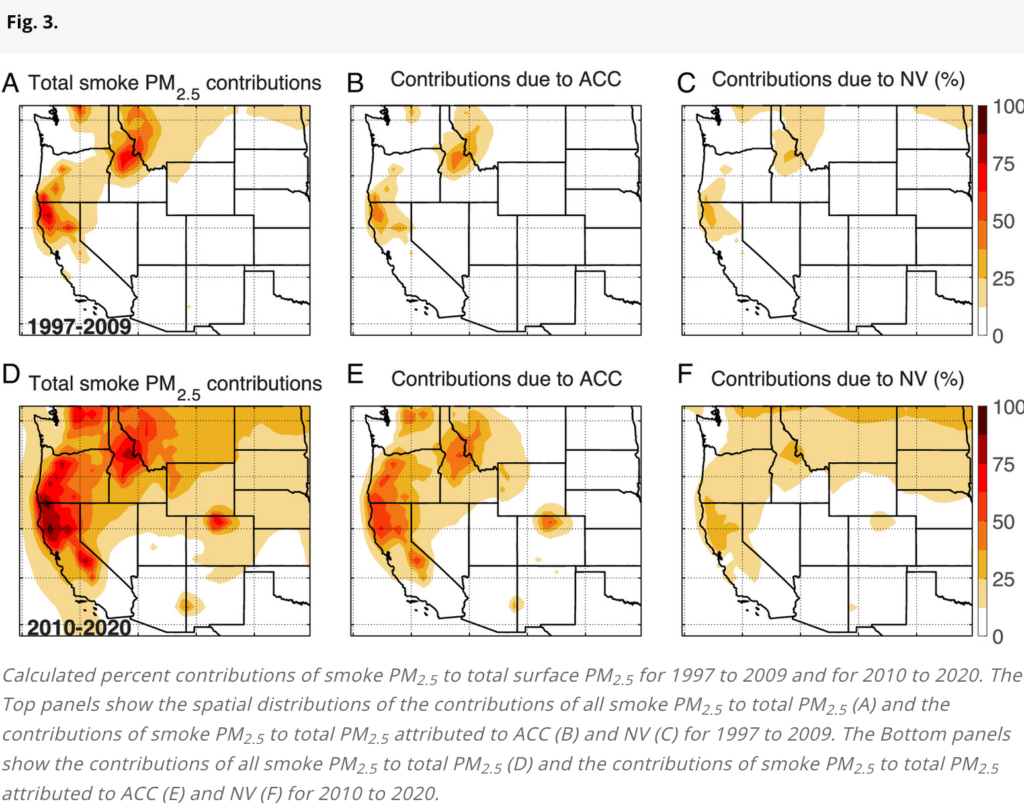
“About half of the smoke generated [between 1997 and 2020] could be linked to climate change, so that’s quite a large number. “If we zero in more recently from 2010 to 2020, those numbers increase.” Loretta Mickley, an atmospheric chemist at Harvard and coauthor of the study
PNAS – RESEARCH ARTICLE
Large role of anthropogenic climate change in driving smoke concentrations across the western United States from 1992 to 2020
By Xu Feng, Loretta J. Mickley, Jed O. Kaplan, and Tianjia Liu
Received December 4, 2024; accepted October 24, 2025
Significance
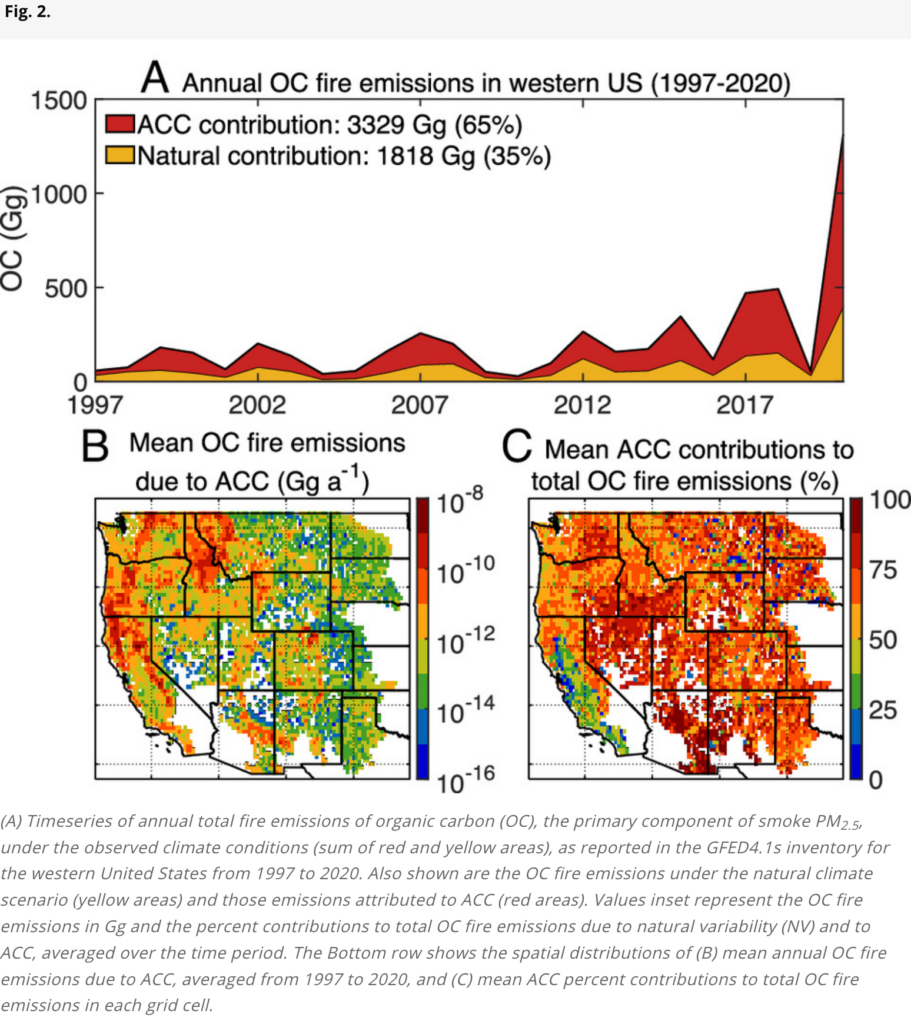
Wildfire activity has increased dramatically in the western United States over the last three decades, leading to a significant impact on air quality and human health. This study highlights the substantial role of anthropogenic climate change (ACC) in driving these wildfires and the subsequent smoke concentrations in the western United States. Our results suggest that ACC contributes 33 to 82% to observed burned area in the western United States from 1992 to 2020. Such climate change also accounts for nearly half of surface smoke PM2.5 concentrations from 1997 to 2020 and explains 58% of the increasing smoke trend from 2010 to 2020. Our study calls attention to the threat that wildfires have on smoke concentrations and human health under a changing climate regime.
Abstract
Wildfire activity has increased dramatically in the western United States over the last three decades, having a significant impact on air quality and human health. However, quantifying the drivers of trends in wildfires and subsequent smoke concentrations is challenging, as both natural variability (NV) and anthropogenic climate change (ACC) play important roles. Here, we devise an approach involving observed meteorology and vegetation and a range of models to determine the relative roles of ACC and NV in driving burned area across the western United States. We also examine the influence of ACC on smoke concentrations. We estimate that ACC accounts for 33 to 82% of observed total burned area, depending on the ecoregion, yielding 65% of total fire emissions on average across the western United States from 1992 to 2020. In all ecoregions except Mediterranean California, ACC contributes to a greater percentage of burned area in lightning-ignited wildfires than in human-ignited wildfires. On average, ACC contributes 49% to smoke PM2.5 concentrations in the western United States from 1997 to 2020, and explains 58% of the increasing trend in smoke PM2.5 from 2010 to 2020. Northern California and areas in Oregon, Washington, and Idaho experience the greatest smoke concentrations attributable to ACC, averaging 40 to 66% of total PM2.5 over 2010–2020. Our work highlights the significant role of ACC in degrading air quality in the western United States and identifies those regions most vulnerable to wildfire smoke and thus adverse health impacts.
Wildfire activity has increased dramatically across the western United States during recent decades (1–3). The increasing magnitude and interannual variability of wildfires has been traced to a combination of anthropogenic climate change (ACC), natural variability (NV), and human-caused ignitions (4–7).
…
…
…
@jmhamiltonblog:
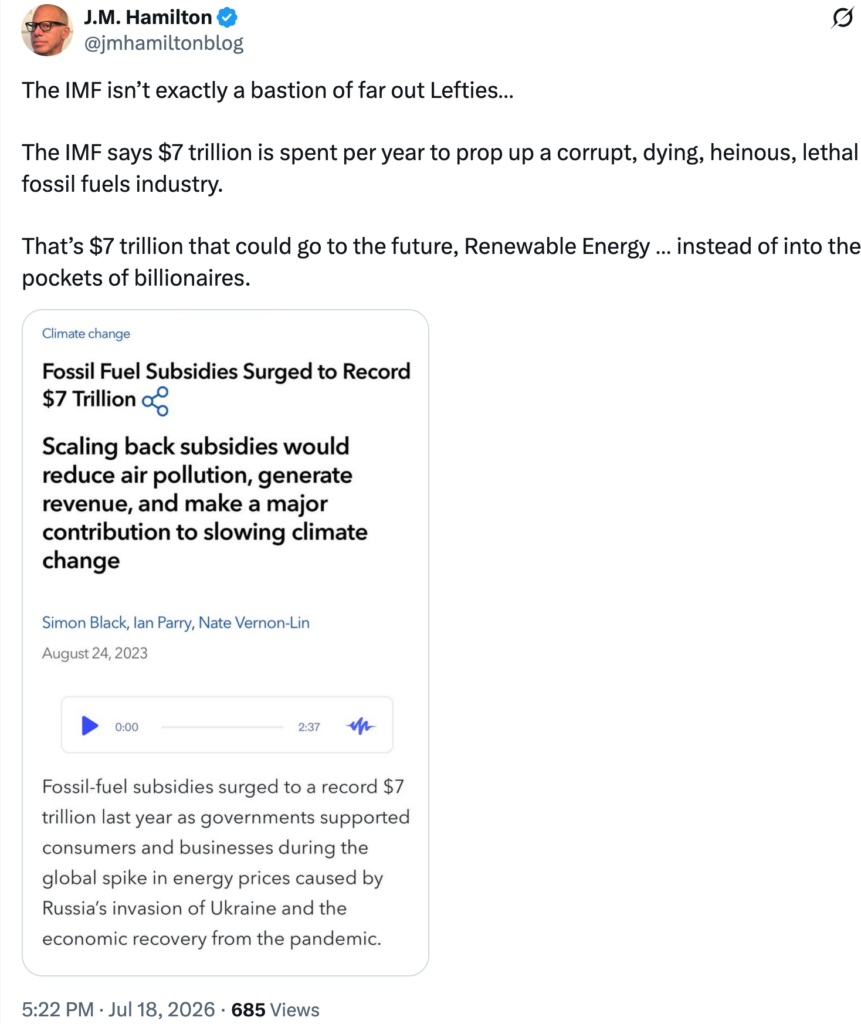
The IMF isn’t exactly a bastion of far out Lefties…
The IMF says $7 trillion is spent per year to prop up a corrupt, dying, heinous, lethal fossil fuels industry.
That’s $7 trillion that could go to the future, Renewable Energy … instead of into the pockets of billionaires.
Canada’s boreal wildfires aren’t just bad forest management, Higher fire season temperatures are strongly correlated with increased area burned by Zeke Hausfather, Jul 17, 2026, The Brink
Over the past week smoke from Canadian wildfires has once again poured into cities across Canada and the northern US. Toronto briefly had the worst air quality of any major city on Earth, Thunder Bay’s readings went off the top of Canada’s air quality health index scale, and unhealthy air alerts stretched from Minneapolis to New York City.
This smoke-pocalypse has renewed a long-standing debate online that these fires aren’t really about climate change at all, but about forest mismanagement. Decades of aggressive fire suppression, the argument goes, have let fuel pile up. We don’t log enough, thin enough, or do enough prescribed burning The forests are overgrown tinderboxes and we have only ourselves to blame. Climate is a distraction from a problem we created by listening to Smokey Bear’s insidious propaganda.
I want to take this argument seriously, because it has a real kernel of truth. The fire-deficit story is a genuine phenomenon in the dry conifer forests of the western United States. But most of what’s burning in Canada is boreal forest, and the boreal is a fundamentally different beast. So in this piece I’ll try to explain why the management argument, largely valid in a California pine stand, mostly falls apart when you move it a couple of thousand kilometers north, and explore what the fire data actually shows.
Here’s the short version. Canada’s area burned has surged, and it has surged in step with warming: hot, dry fire seasons burn far more forest, with area burned rises roughly 80% for each 1C increase in fire-season temperature (with a correlation coefficient of 0.61). This relationship is robust to a variety of statistical tests and controlling for confounding variables. The boreal burns in rare, high-intensity crown fires on a natural cycle measured in a century or more, across enormous remote areas that have never been logged, thinned, or effectively suppressed. Only about a fifth of Canada’s burned area over the past four decades was even inside forest regions that have ever been actively managed. You cannot have a fuel-buildup from forest mismanagement in a forest you were never managing.
Forest mis-management?
The forest-mismanagement argument was, in fairness, based on real evidence from some regions. In the frequent-fire dry forests of the western US that are dominated by ponderosa pine and mixed conifers the natural fire regime is low-to-moderate intensity surface fire returning every 5 to 30 years, historically stoked in part by Indigenous burning. A century of fire exclusion in those forests really did remove that frequent fire, let stands grow denser and more continuous, and build up a “fire deficit” that raises the odds of severe fire (Hagmann et al. 2021). And in that setting, fuel treatments work: Prichard et al. (2021) find wide agreement that mechanical thinning combined with prescribed burning measurably reduces subsequent fire severity. If you’re arguing about the Sierra Nevada, the management story is as important if not more important than the climate one.
The problem is that the Canadian boreal is not the Sierra Nevada. It burns in infrequent, high-intensity, stand-replacing crown fires that kill the whole stand on natural fire cycles measured in many decades to centuries (commonly a century or more, and two centuries or longer in the east), not 5 to 30 years. It is, ecologically speaking, supposed to burn this way; black spruce is practically built for it. Fire in this system was never the gentle recurring ground-clearing that suppression interrupted in California. And the burning is astonishingly concentrated: across the boreal, something like 3% of fires account for about 97% of the area burned. This is not a landscape full of many small fires that “used to clean out the fuel.” Rather, its a landscape that waits, and then burns catastrophically under extreme weather.
Why do we know that Canadian boreal forest fires are not being driven by mismanagement?
First, and most importantly, most of the boreal was never being managed in the first place. As University of Alberta fire scientist Jen Beverly has pointed out, only about one-fifth of Canada’s total burned area from 1986 to 2023 occurred within long-term forest tenure (the land that’s actually logged and managed). The vast majority burns in remote forest with no timber operations. In Canada’s so-called “extensive” fire-management zones there has been no serious suppression efforts historically. Fires there are monitored and largely left to burn unless they threaten people or infrastructure. You can’t blame overgrown, over-suppressed forests for fires in places nobody was suppressing.
Second, the fuel-buildup mechanism doesn’t fit the recent fires. If decades of suppression had loaded the forest with excess old fuel, you’d expect the big fire years to preferentially consume the oldest, most fuel-laden stands. But in Alberta’s brutal 2023 season, fires burned stands of essentially all ages in proportion to how much of each was on the landscape. That’s the signature of fire driven by weather, which doesn’t care how old the trees are, not by fuel accumulation.
Third, the proposed fixes don’t scale to the boreal even if you wanted them. This is the conclusion of the very scientists who documented Canada’s fire deficit. Coogan, Parisien and colleagues (2020) state it flatly: mechanical fuel treatments “require continued maintenance over time, are too expensive to apply across large boreal landscapes, and are usually not designed to halt extreme wildfires.” The boreal is on the order of three million square kilometers. You are not going to thin or prescribe-burn your way across it, and the crown fires that produce the smoke wouldn’t stop at a fuel break anyway.
So if it’s not mismanagement, what is it? Let’s look at the data.
The Canadian fire record
To start with, here is the long-term record of area burned, combing the satellite-mapped NBAC composite from 1972 on with the less-complete point-based records before that shown in grey (note that this is primarily for illustration; I don’t compute any statistics across the 1972 splice to avoid potential bias from changing measurement approaches).
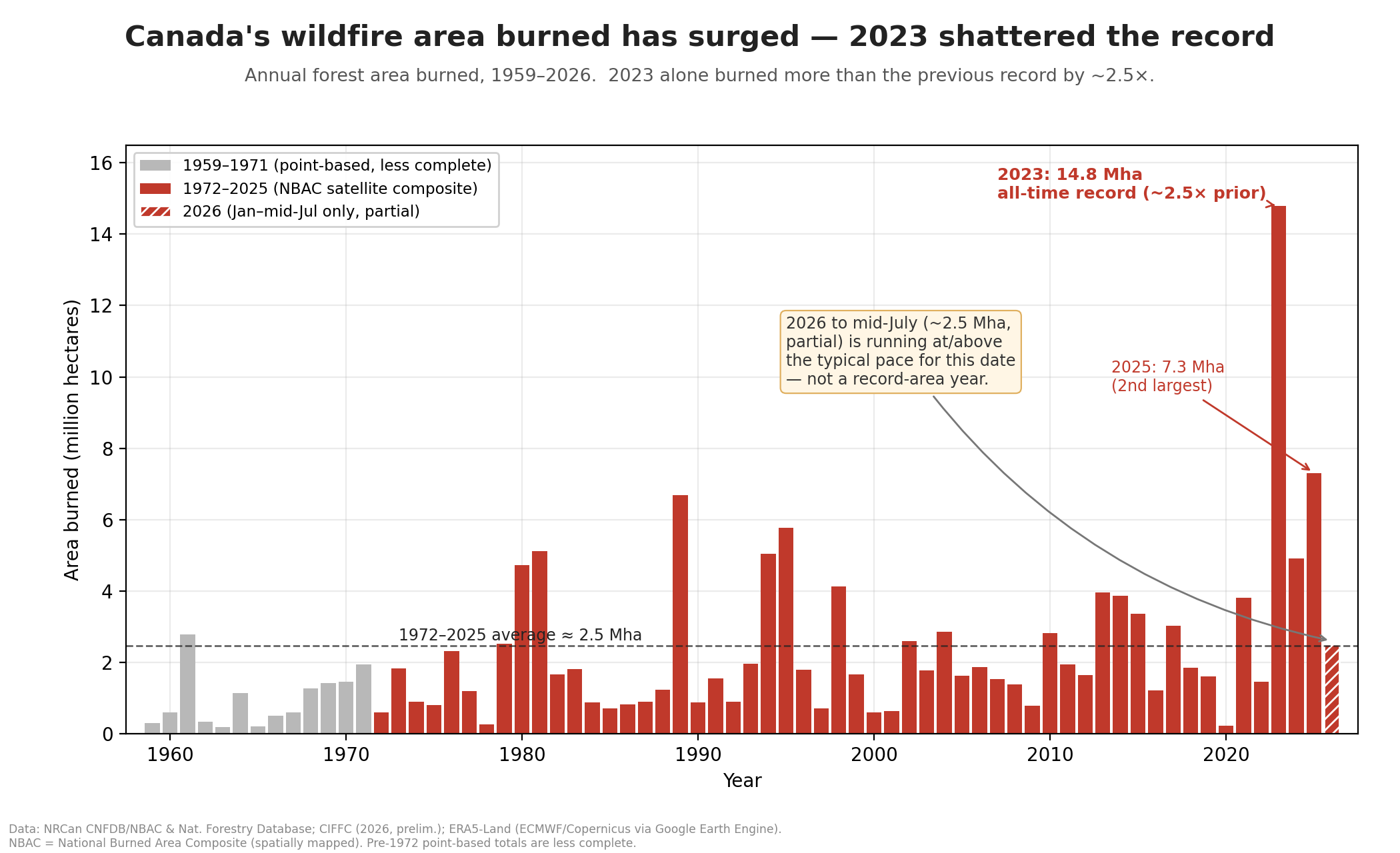
2023 stands out like a sore thumb with 14.8 million hectares in the satellite-mapped data (Canadian agency tallies actually run higher at 17–18 Mha as different products count differently),1 roughly 2.5 times the previous record. 2025 came in second at ~7.3 Mha in the satellite data. And 2026 so far is about 2.8 Mha by mid-July, a bit above the typical pace for this date, but far below the last few extreme years.
One caveat around how unprecedented this actually is. A recent tree-ring reconstruction back to 1800 (Danneyrolles et al. 2025) found that while 2023 itself was off the charts in most regions they studied, the decadal burn rate for 2014–2023 still sits within the range of the past two centuries in several zones, especially in the eastern boreal. We are not necessarily seeing more fire than ever everywhere, but rather a rapid rate of increase with the increasing prevalence of fire weather driving it. In addition, parts of the northwestern boreal are now burning at rates that do appear to exceed anything in thousands of years.
One important driver: higher temperatures
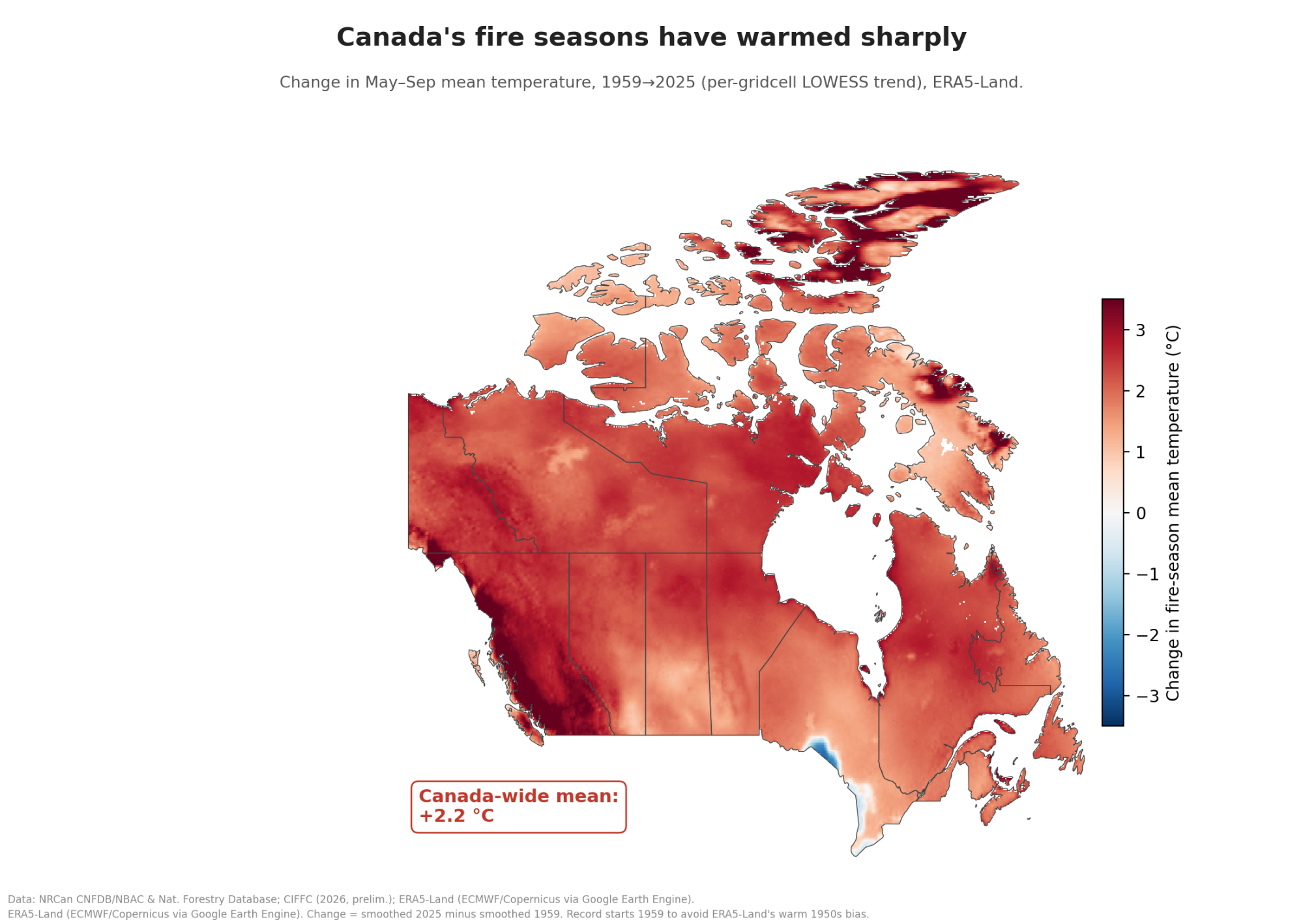
Canadian fire seasons (May through September) have warmed about 2.2C on average since 1959. Canada warms at roughly twice the global rate, and its north at roughly three times. That warming matters for fire through a well-understood mechanism: warmer air is exponentially “thirstier” (saturation vapor pressure rises ~7% per degree), so it pulls moisture out of live vegetation and dead fuels alike, priming the landscape to burn. It’s the same fuel-drying pathway that Abatzoglou and Williams (2016) found had roughly doubled cumulative forest area burned in the western US.
Hanes et al. (2019), examining the Canadian record from 1959 to 2015, found fire seasons starting earlier and ending later, more days with conditions suitable for fire spread, and increases in both annual area burned and the frequency of large fires. They found that these trends were consistent with human-caused warming, not with changes in forest management (which have been broadly stable since the 1980s even as the fire seasons have gotten dramatically worse).
Hot and dry years burn
A few years ago my Berkeley Earth colleague Robert Rohde made a lovely figure plotting each California fire season by its temperature and precipitation. Here is my Canadian version: every year from 1959 to 2025 placed in climate space, with dot size proportional to national area burned and the ten largest fire years outlined in black.
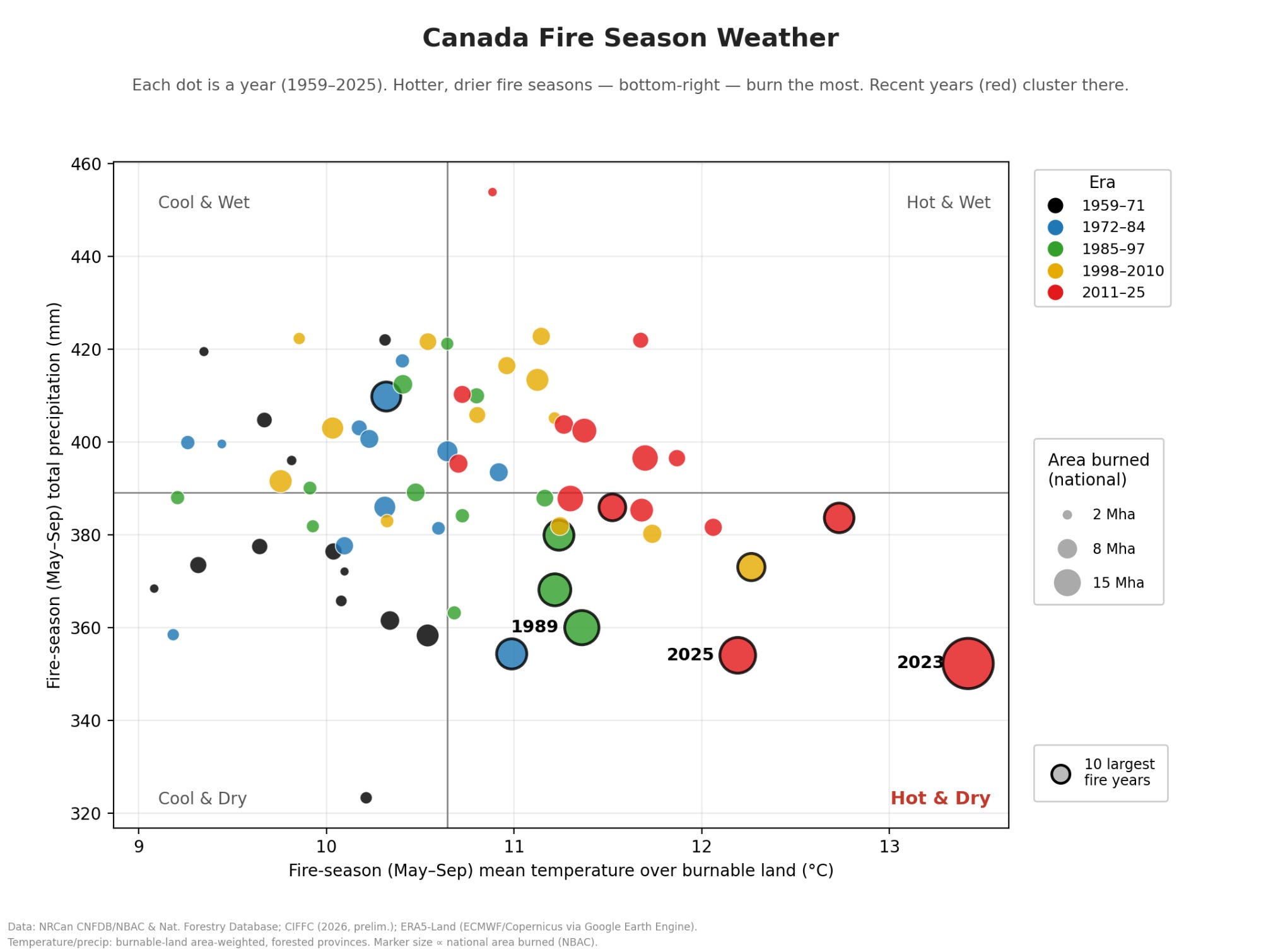
The pattern is hard to miss. The biggest fire years pile up in the hot-and-dry corner with 2023 really standing out, and the recent era (red dots, 2011–2025) has shifted visibly toward that corner relative to the black dots of the 1960s. Canada’s fire seasons are migrating into the part of weather-space where the big burns happen.
We can also try and more directly quantify the relationship between area burned and temperature. Nationally, fire-season temperature correlates with log area burned at r = 0.61 (1972–2025), which means that a fire season 1C warmer sees ~80% more area burned. I want to be careful about what this does and doesn’t show, so I stress-tested it: the correlation survives detrending (r = 0.57), first-differencing (r = 0.46), and partialling out precipitation (r = 0.58). It isn’t just two things drifting upward together, and it isn’t a rebranded precipitation effect.2
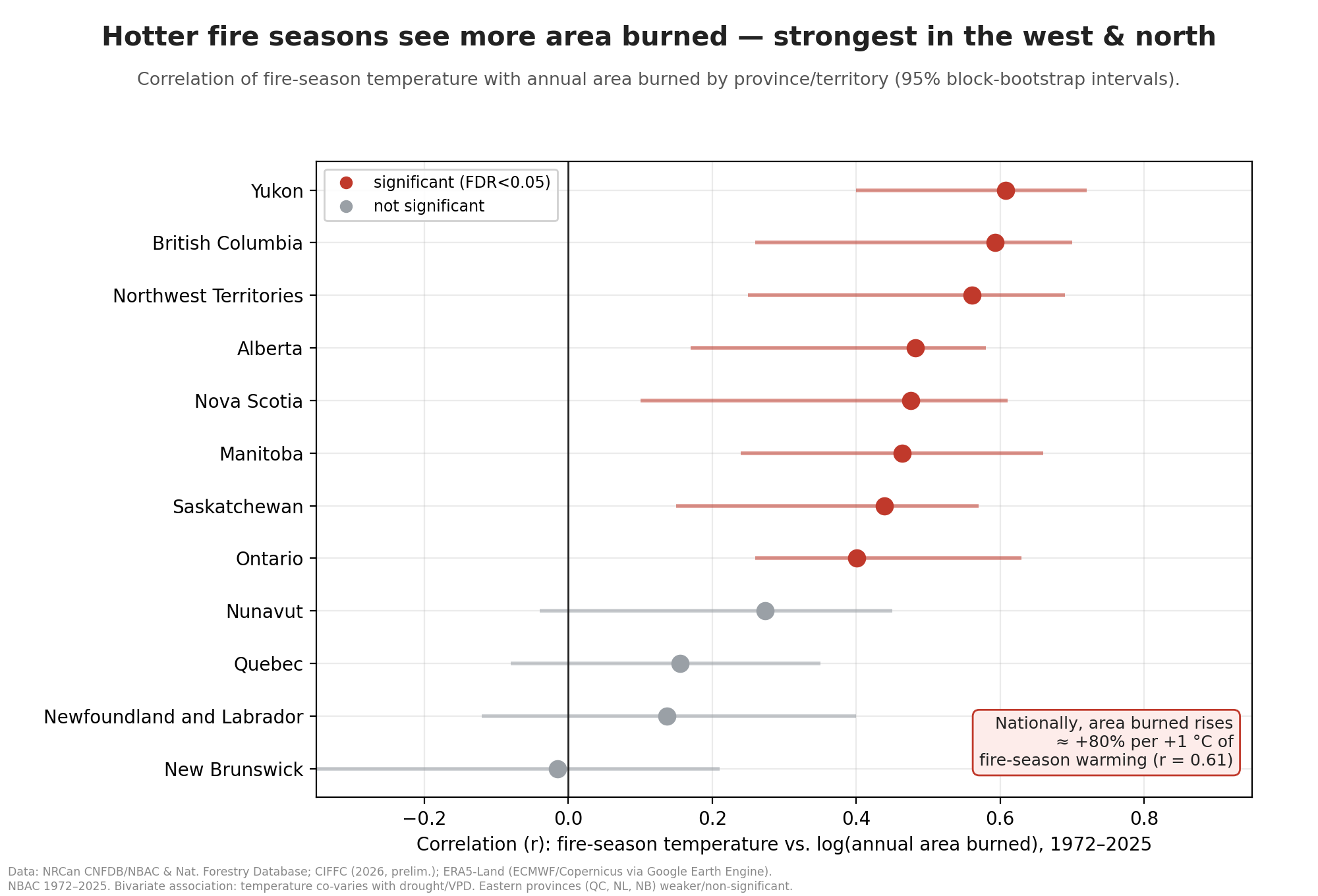
The relationship is strongest in the western and northern boreal – Yukon, BC, the Northwest Territories, the Prairie provinces, Ontario – and weak to non-significant in Nunavet, Quebec, Newfoundland, and New Brunswick, matching the literature’s finding that eastern boreal fire is generally less temperature-limited.
Lightning in the middle of nowhere
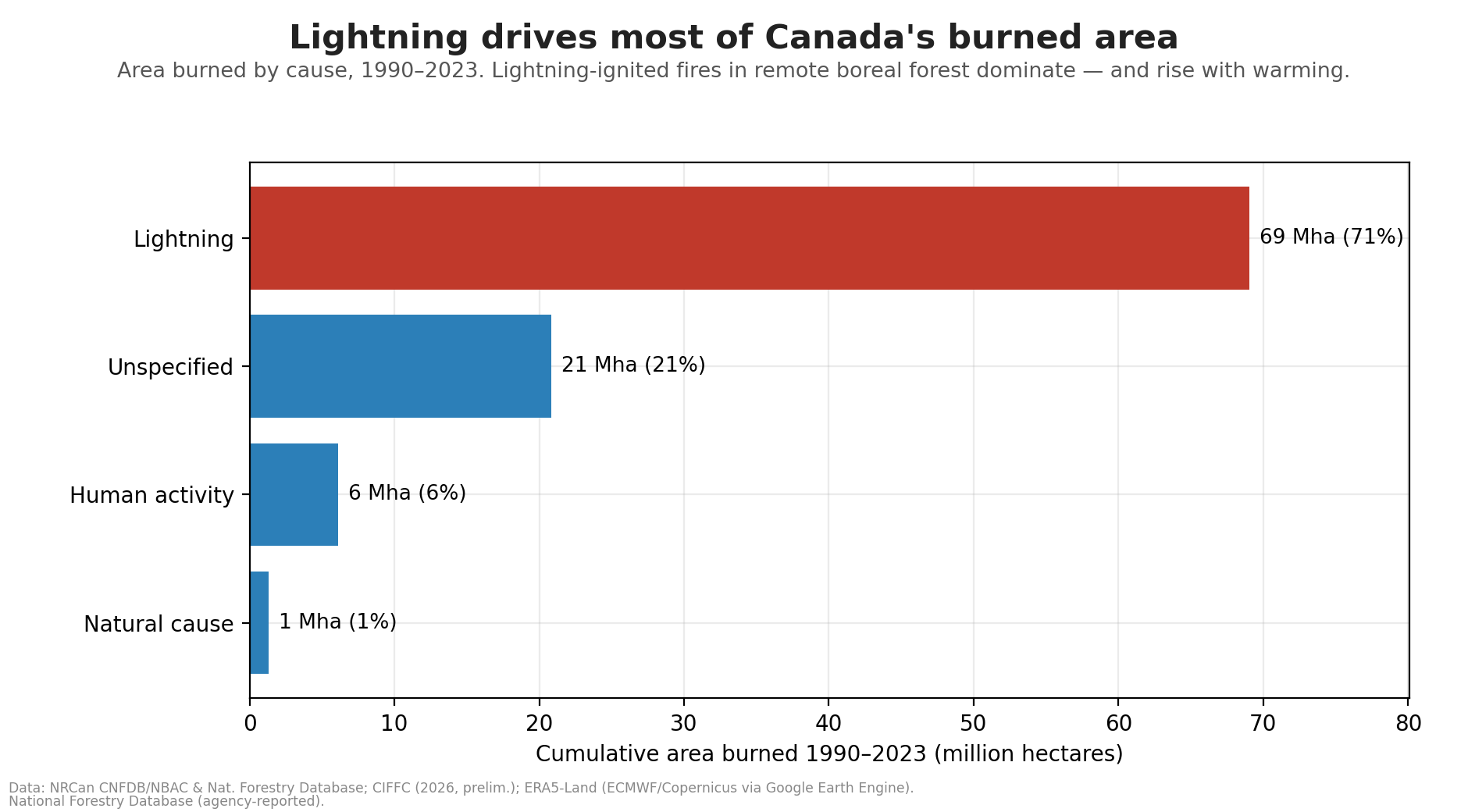
About 71% of Canada’s area burned over 1990–2023 came from lightning-ignited fires, and in the record 2023 season it was ~93%. These are remote boreal megafires, ignited by lightning far from any road, timber lease, or fuel-treatment crew. This is worth considering in the context of the management debate: the fires driving the smoke are not escaped campfires or mismanaged plantations. They are lightning strikes into a drying landscape, often burning in exactly the places no one was managing. And because warming is expected to increase high-latitude lightning, climate change can contribute to both the fuel dryness and the ignition side of the equation.
What attribution science actually says
This week the National Academies released a major report on the attribution of extreme weather events and their impacts, updating their influential 2016 assessment. Its wildfire findings are careful, and they land almost exactly on the distinction I’ve been trying to make in this piece.
On the general question, the report concludes it is very likely that climate change has increased the likelihood and severity of extreme fire weather: the hot, dry, windy conditions that let fires ignite and spread. At the same time it assigns low confidence to attributing any specific individual wildfire, because fires are irreducibly multivariate: ignition, fuels, land management, and suppression all mediate the on-the-ground relationship between fire weather and hectares burned. Notably, the report also flags that no attribution study has yet isolated the role of fuel or ignition changes, precisely because those human factors are so entangled. The science is much stronger on “climate change made conditions like these more likely” than on “climate change, specifically, caused this fire.”
For Canada’s exceptional 2023 fire year the evidence is unusually strong, and the report devotes a whole box to it. Kirchmeier-Young et al. (2024) found the record burned area was 2–5 times more likely thanks to human influence in Canada’s eastern and western ecozones, and the extraordinarily long fire season more than 5 times more likely. World Weather Attribution found the cumulative fire-weather severity at least 7 times more likely and ~50% more intense. Jones et al. (2024) put the fire-weather likelihood increase at ~2.9–3.6x and burned area ~10% higher (95% CI: 3-40%) than without warming. And Barnes et al. (2025) found the James Bay severity rating at least 32% more intense, while noting the season was amplified by an extreme run of atmospheric blocking (~50 blocking days versus an average of 15), a reminder that in any single year the weather still matter enormously.
Where management does matter
The prior sections are about the physical science of what’s driving the fire trend. What we should do about it is a policy question, and here the management crowd is not wrong so much as aiming at the wrong target.
There genuinely is a fire deficit in parts of boreal Canada — but it’s local, and it’s about people, not country or regional fire totals. Parisien, Coogan and colleagues (2020) found that of 160 boreal communities they studied, 54% were surrounded by less recently-burned forest than their fire regime would predict reflecting a suppression legacy that leaves older, more flammable forest ringing towns. This is a place where thinning, fuel breaks, and prescribed burning could genuinely help.
Fuel management is valuable around communities, but is essentially useless across the remote boreal. But in Canada it does not explain and cannot reverse the rise in area burned that’s filling the sky with smoke. Treating the wildland-urban interface and cutting the emissions that are drying the forest should be seen as complementary rather than as competitors.
Why the smokey skies
One last point on the thing thats actually dominating the news a the moment. Even a year like 2026 that appears not to be headed for a top-5 record for area burned in Canada can still have catastrophic air pollution impacts.
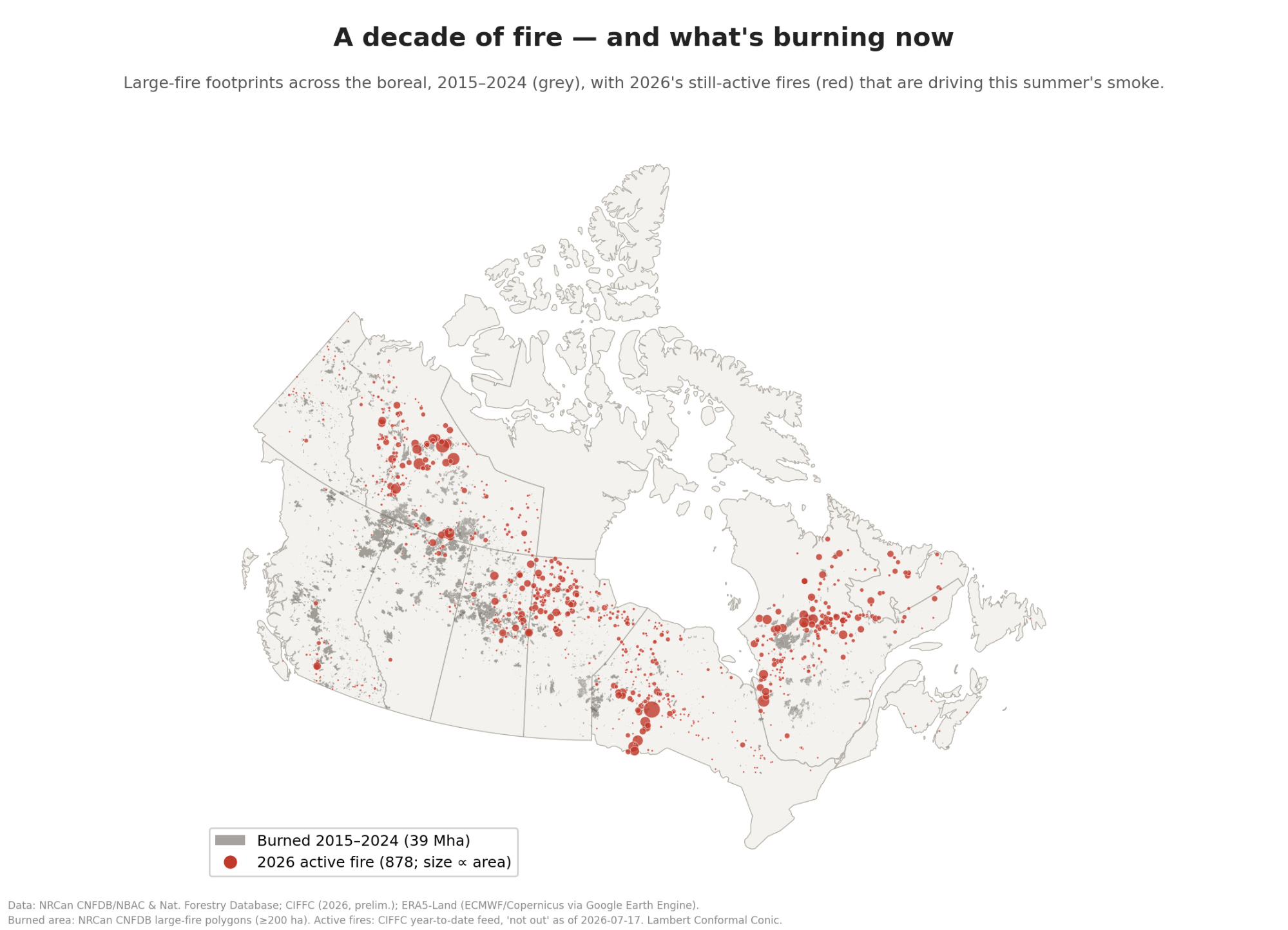
Whether a given city chokes on smoke depends on where fires burn, how high their plumes loft, which way the wind blows, and how many people live downwind, not on total hectares burned nationwide. This July, fires across northwestern Ontario, the Prairies, and Quebec have sat upwind of the Great Lakes population corridor under a persistent transporting flow. A modest fire season in the wrong place can choke tens of millions, while a record season in the remote north can have much smaller impacts on populated regions. While overall area burned is the climate-linked trend, who breathes the smoke on a given week in July is mostly driven by the weather.
A few takeaways
So what are the takeaways here?
First, the forest-mismanagement explanation is borrowed from the wrong forest. Its a real problem in the frequent-fire dry forests of the western US, but the Canadian boreal is a rare-crown-fire system, mostly unmanaged and unsuppressed, where only about a fifth of the burned area is even on managed land and where the fire scientists themselves say landscape-scale fuel treatments can’t scale or stop the megafires.
Second, the surge in Canadian burning tracks temperature with striking consistency, and hotter, drier fire seasons burn far more forest (+80% per 1C), the biggest fire years are almost universally hotter and drier, over 90% of the record 2023 burn was remote lightning fire, and the attribution studies tie these extremes to a warmer atmosphere without needing to invoke forest management at all.
And third, where management does matter like for the forests ringing communities it’s a genuine and worthy fix. But here it just protects towns; it doesn’t solve the underlying factors driving area burned or wildfire smoke pollution.
So next time someone tells you Canada’s fires can be solved by raking the forests, you can point out that the thing filling their sky with smoke is a lightning-struck, drought-primed boreal forest doing what a warming climate is making it do more and more often.
In case its helpful, I’ve put the code and data to reproduce this analysis on my GitHub here.
Thanks for reading The Climate Brink! Subscribe for free to receive new posts and support our work.
Burned-area products genuinely differ: the National Burned Area Composite (NBAC) maps fire perimeters from satellite imagery and is more conservative, while agency/CIFFC tallies are reported figures with different cutoff dates (2023 is 14.8 Mha in NBAC vs ~17–18 Mha in agency totals). I use NBAC as the primary series and avoid computing statistics across the 1972 data-source splice; the 2026 number is a preliminary CIFFC year-to-date figure.
The gory methodological details: correlations use the homogeneous NBAC record (1972–2025), with effective sample sizes adjusted for autocorrelation (Bretherton et al. 1999), 95% moving-block bootstrap confidence intervals, and Benjamini–Hochberg false-discovery-rate control across jurisdictions. The national relationship also holds when refit excluding 2023 and 2025 (r = 0.52), so it is not an artifact of the two recent extreme years. Temperature and precipitation are area-weighted over each jurisdiction’s forested/woody land (MODIS IGBP classes 1–9) from ERA5-Land. Fire-season precipitation correlates with area burned at r = −0.49.
Pointing Fingers at Canada
Ohio Senator Bernie Moreno plans to introduce a bill to sanction Canada for wildfires affecting air quality in the U.S.
@geoffypjohnston.bsky.social:
Using the Trump threat as an excuse to ignore GHG emissions & bolster the fossil fuel industry isn’t in Canada’s best interests. The rich get richer while the vulnerable suffer & Canada burns.
Wildfires destroy homes in First Nation, prompt large evacuations
www.aptnnews.ca/national-new…
@truthout.org:
“We need Nuremberg trials for Big Oil,” the Sunrise Movement wrote on social media as wildfires rage across Canada. The fossil fuel industry knew for decades that its products were largely responsible for the climate crisis, yet chose to push climate denial instead.
@globalcatastrophe.bsky.social:
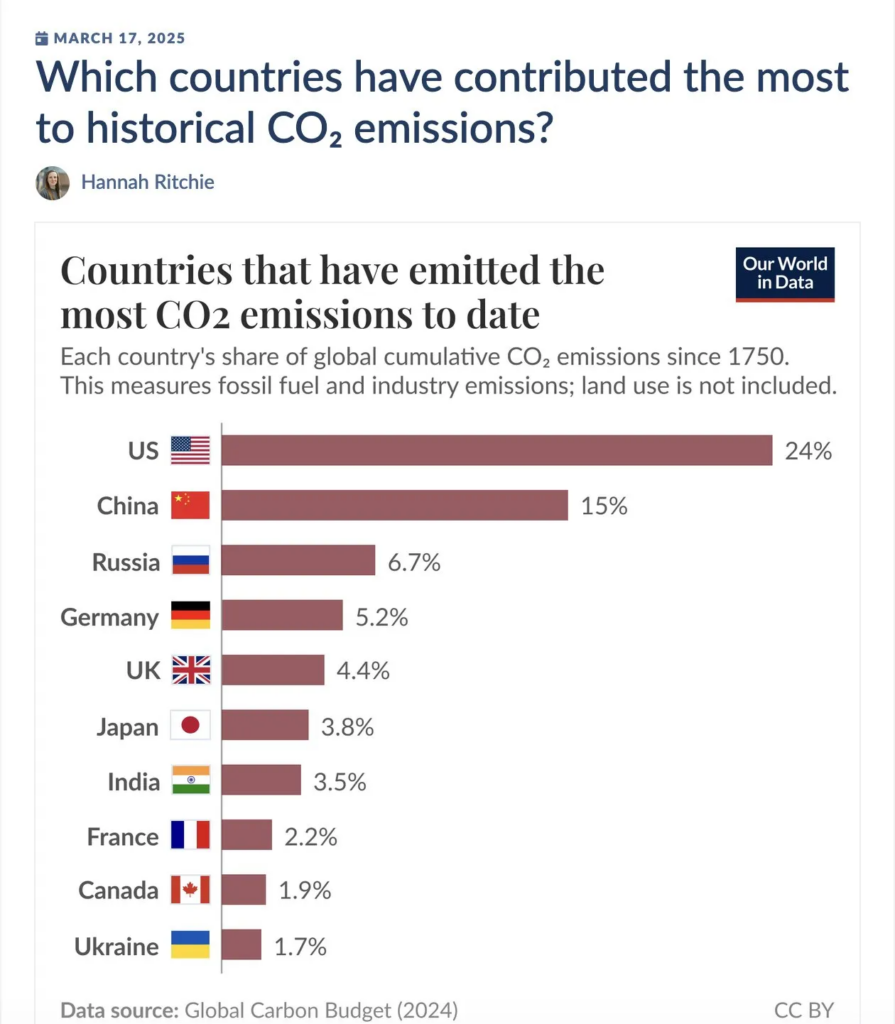
US Big Oil and dirty US industry is mostly to blame.
@esunaproxy.solidarity.social:
These emissions also exclude the USA military by the way.
@ryankbrook.bsky.social:
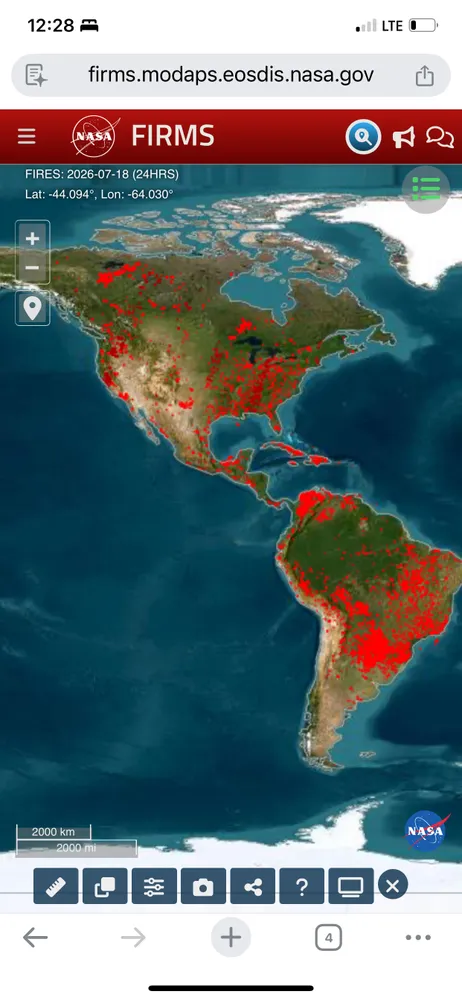
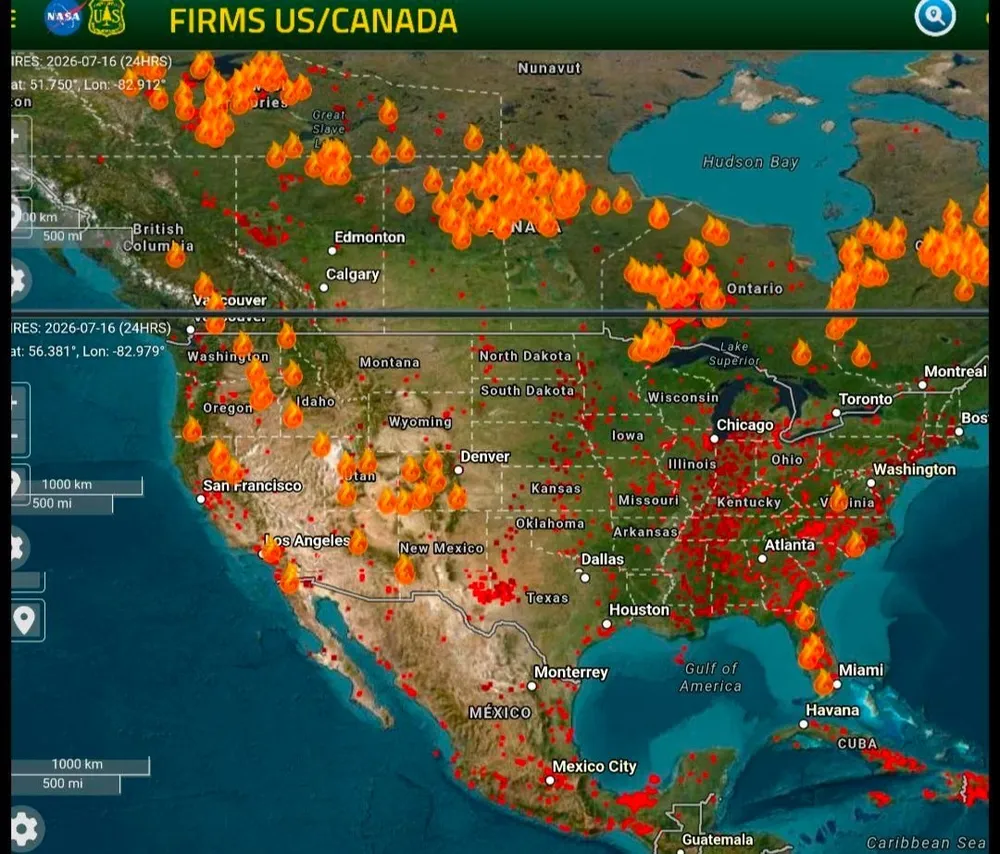
NASA maps confirm that all fires on the planet are only in Canada.
sarcasm
@catblack69.bsky.social:
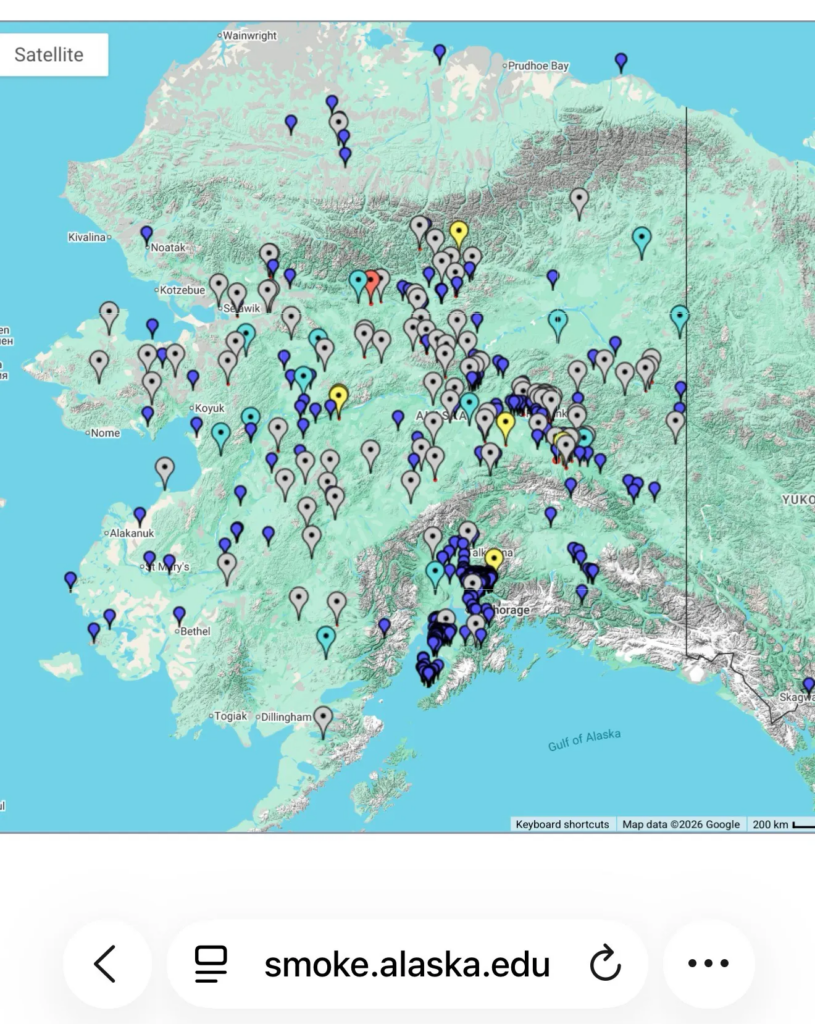
Seems to have left out Alaska.
Over 400 fires burning at the moment.
@jbendery.bsky.social:
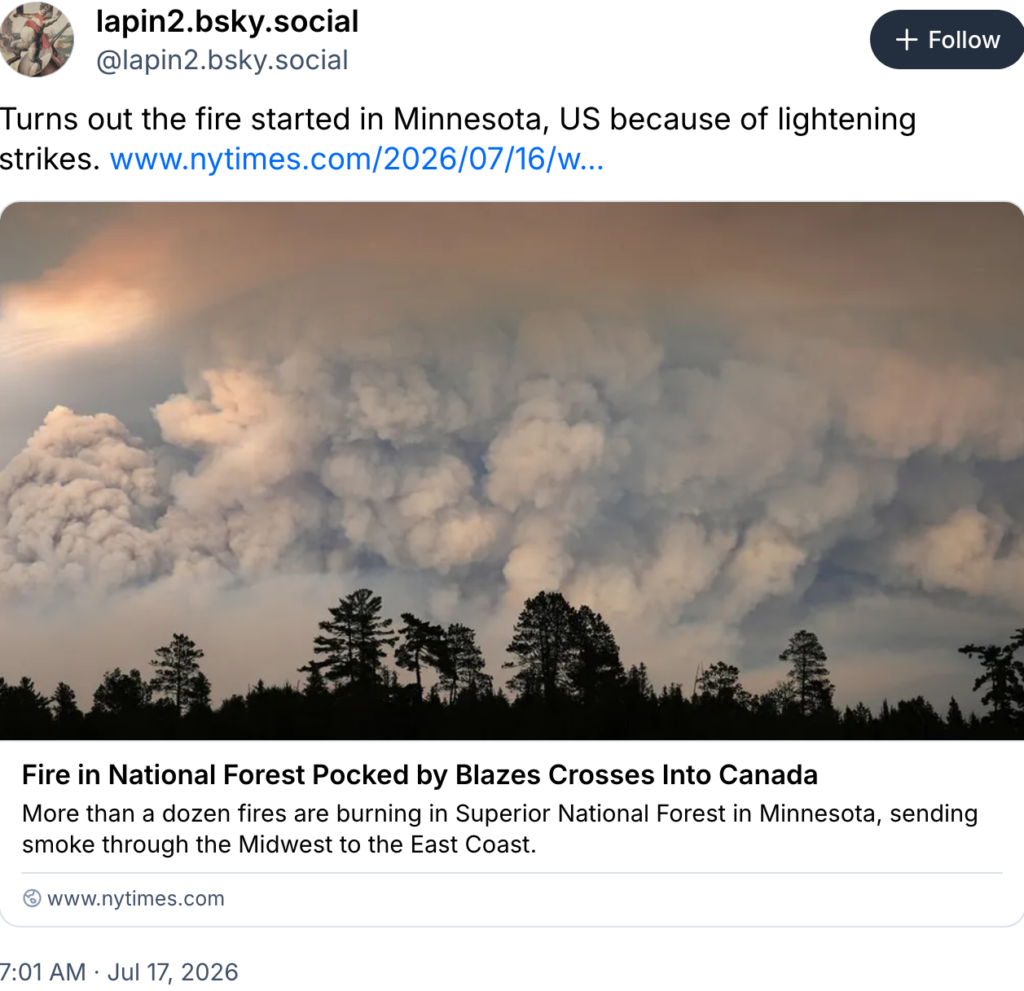
NEW: Trump is now threatening to punish Canada for wildfire smoke blowing into the U.S., as a GOP senator intros a bill to sanction Canadian officials “responsible” for the fires driven by climate change.
… www.huffpost.com/entry/bernie…
Sen. Bernie Moreno (R-Ohio) intro’d a bill to revoke visas from Canadian officials + express a sense of Congress that the Canadian ambassador is a “persona non grata” til the smoke is gone.That’ll be until centuries after humans have wiped themselves out
“We will not tolerate this incompetence,” vowed Moreno, who may not understand how climate change works
“The false rhetoric about the cause of wildfires is not constructive,” says Tim Gray, exec director of Environmental Defence Canada. “It helps to further underscore the sense Canadians have that the U.S. has lost its way.”
Canada sent water bombers + teams to help with last year’s CA fires.
Canada’s fires were started by a combo of lightning strikes, human activity + extreme and long-lasting heat, which created bone-dry vegetation that can act as fuel for fires.
Throw in some trapped hot air, more storms, whipped-up winds, and voila: climate change-induced wildfires.
Climate change has dried out Canada’s forests so dramatically over the past decade, Gray said, that once an arboreal fire starts, it creates its own weather system and generates lightning within it. Fire crews can’t even get close to the source of these fires b/c they’re too hot.
Terrifying stuff.
@redsnoopy69:
Canada will be able to sanction American retroactively.
Ontarians have been exposed to air pollution from industrial plants in Ohio, Michigan, Indiana and Pennsylvania will over a century.
Also the United States has contributed more than any other country to climate change…
@jamieclimate:
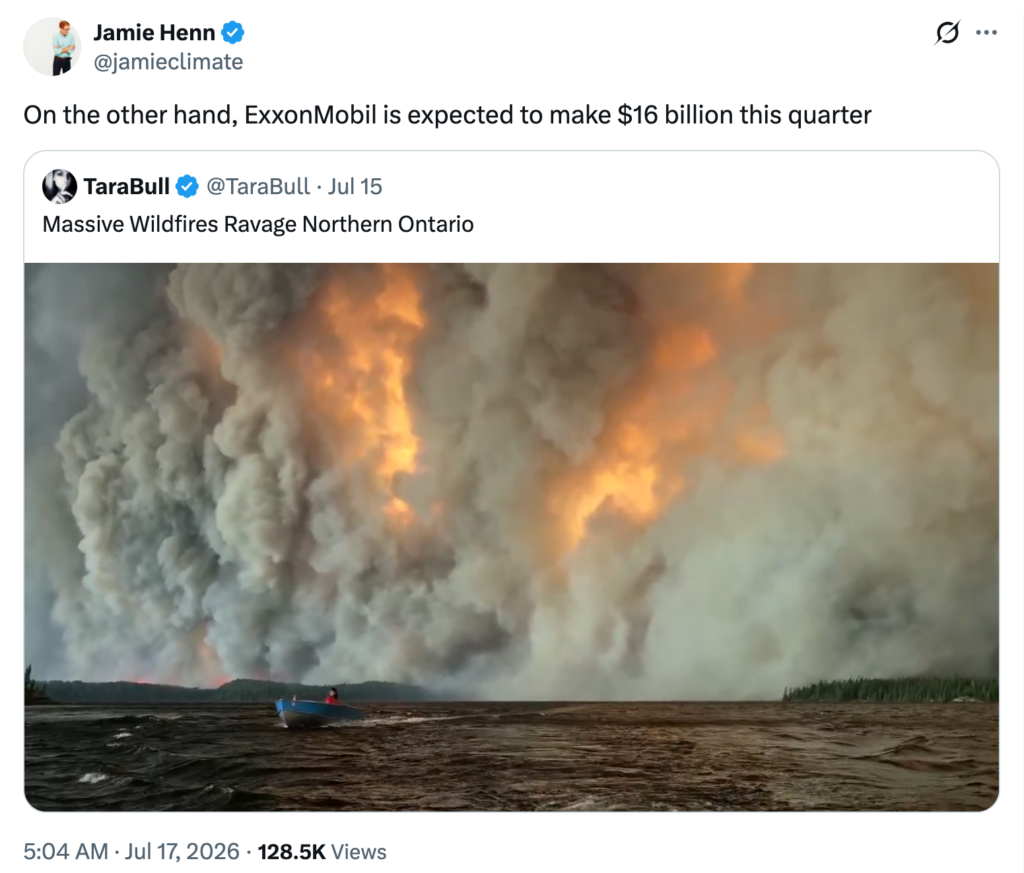
Blaming Canada for these wildfires is like blaming a homeowner when an arsonist sets their house on fire. Let’s go after the fossil fuel companies who are setting the world ablaze.
@redsnoopy69:
Climate Change driven by our consumption of fossil-fuels undeniably exacerbates Wildfires. Why is this so hard to understand?
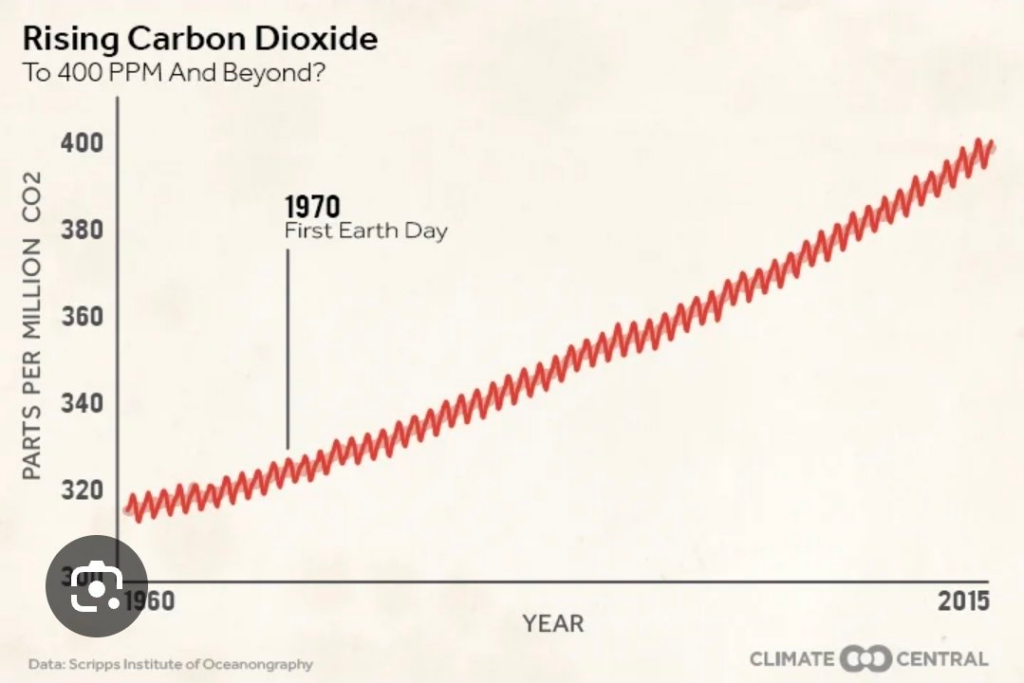
The Canadian boreal forest evolved for a climate that no longer exists.
It eventually will evolve to meet the requirements of a new climate.
Desertification is the most logical outcome…
Big Tobacco knew their products caused lung cancer and they denied it and continued to profit from it.
Fossil-fuel corps are doing the exact same thing but on a scale a 10,000x larger.
Oil and Gas CEO’s receive ≈30 million a year, and you simply get to suffer in their smoke…
Read John Vaillant’s Fire Weather for more gruelling details of climate change reality
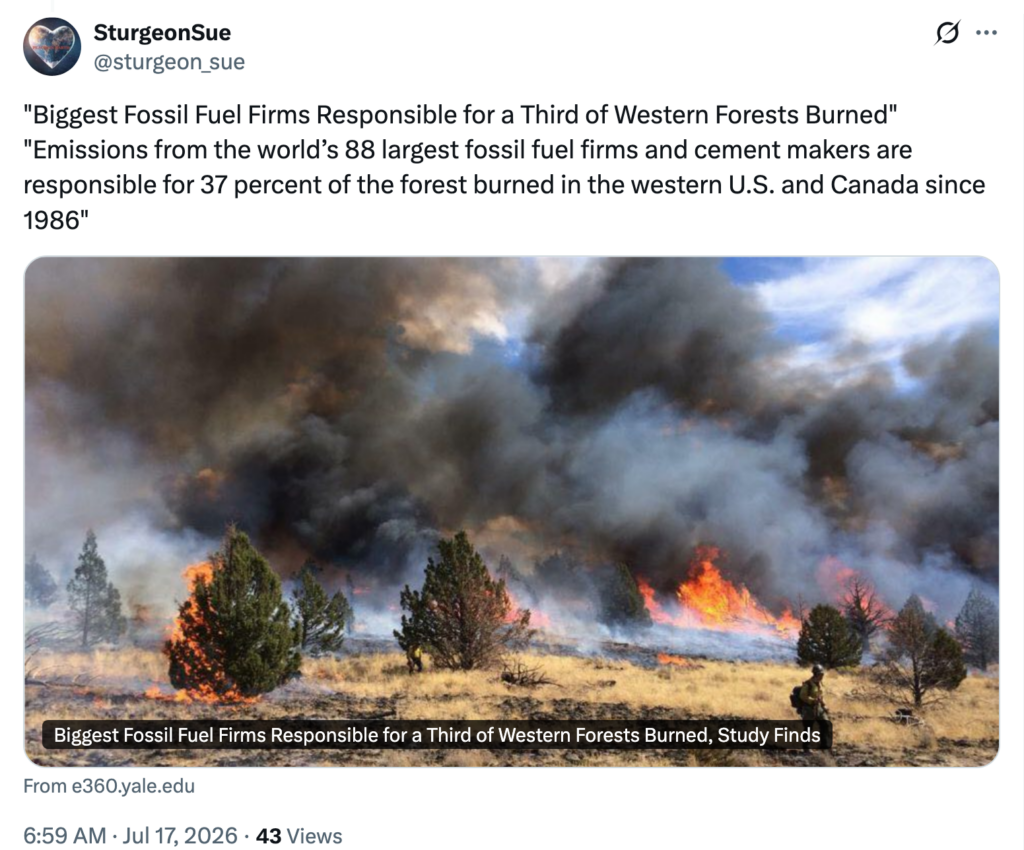
“Biggest Fossil Fuel Firms Responsible for a Third of Western Forests Burned”
“Emissions from the world’s 88 largest fossil fuel firms and cement makers are responsible for 37 percent of the forest burned in the western U.S. and Canada since 1986”
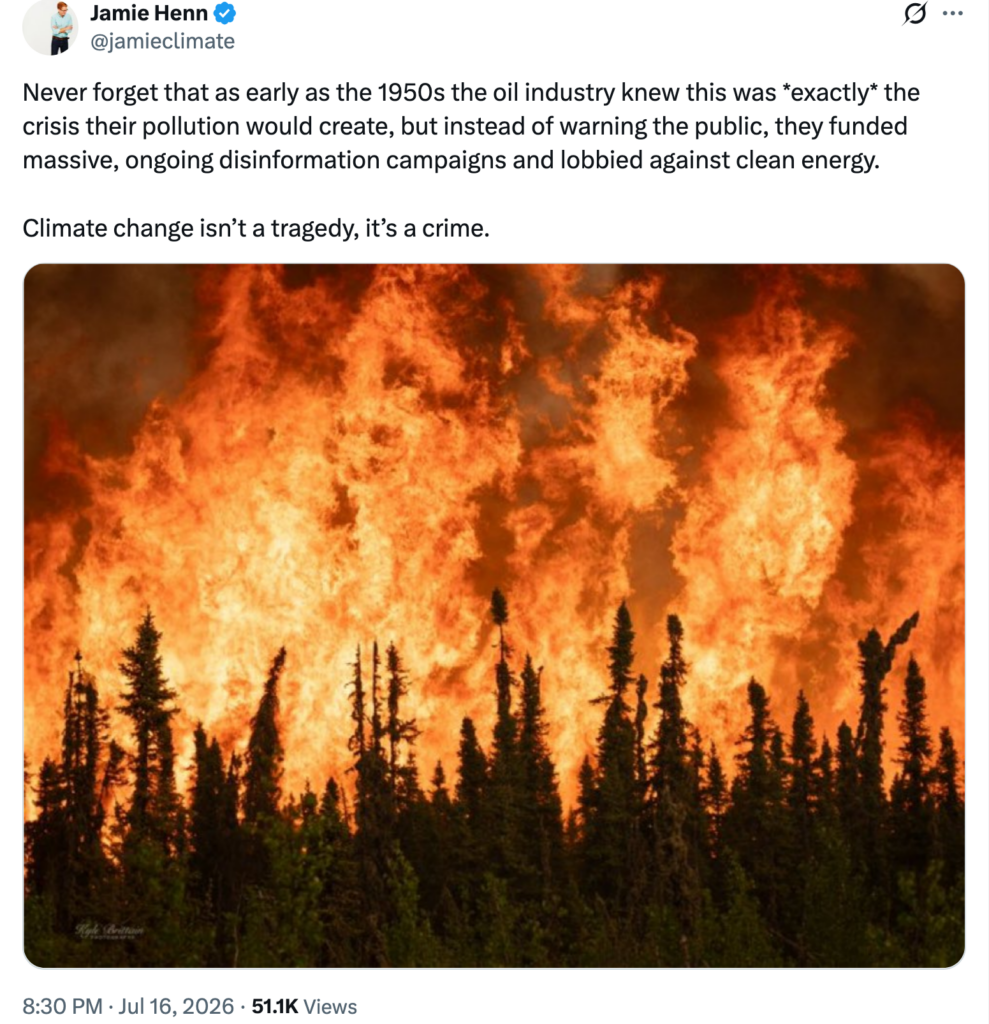
@jamieclimate:
Never forget that as early as the 1950s the oil industry knew this was exactly the crisis their pollution would create, but instead of warning the public, they funded massive, ongoing disinformation campaigns and lobbied against clean energy.
Climate change isn’t a tragedy, it’s a crime.as is the massive amounts of fresh and ocean water the oil industry contaminated, and the water they permanently removed from the hydrogeological cycle during frac’ing and enhanced oil recovery.
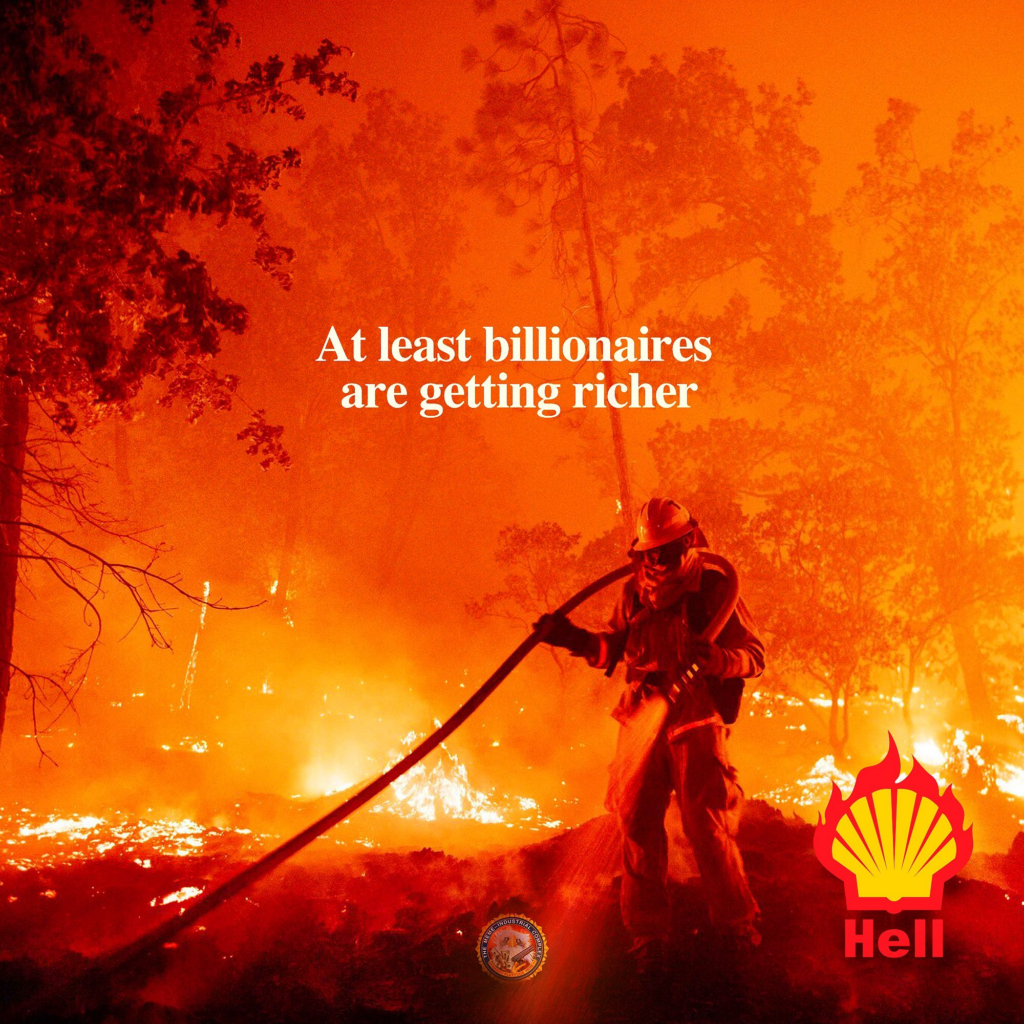
@jvsylvester.bsky.social:
Wildfire smoke tariffs??? These guys are beyond stupid and insane.
What I think of is how the Canadians did everything they could to help fight the fires in California in 2020 and 2025.
@theblindmelon.bsky.social:
And how a Canadian firefighter recently died fighting forest fires in Colorado..
Blind Melon
Name: Nicholas Dale
Age: 56
Home: Sooke, British Columbia
Date of death: July 12, 2026
Fire: Gold Mountain Fire in southwestern Colorado
Role: Flying a Kaman K-MAX (K-1200) helicopter that was dropping water on the wildfire. He was the sole occupant of the aircraft.
@queentmg.bsky.social:
When I lived in WA a few years ago and the smoke from the fires there drifted into Canada, did Canada say, hey! Sweep your forests? No. Trump is beyond stupid.
@hole1in.bsky.social:
T has a whole following of stupid
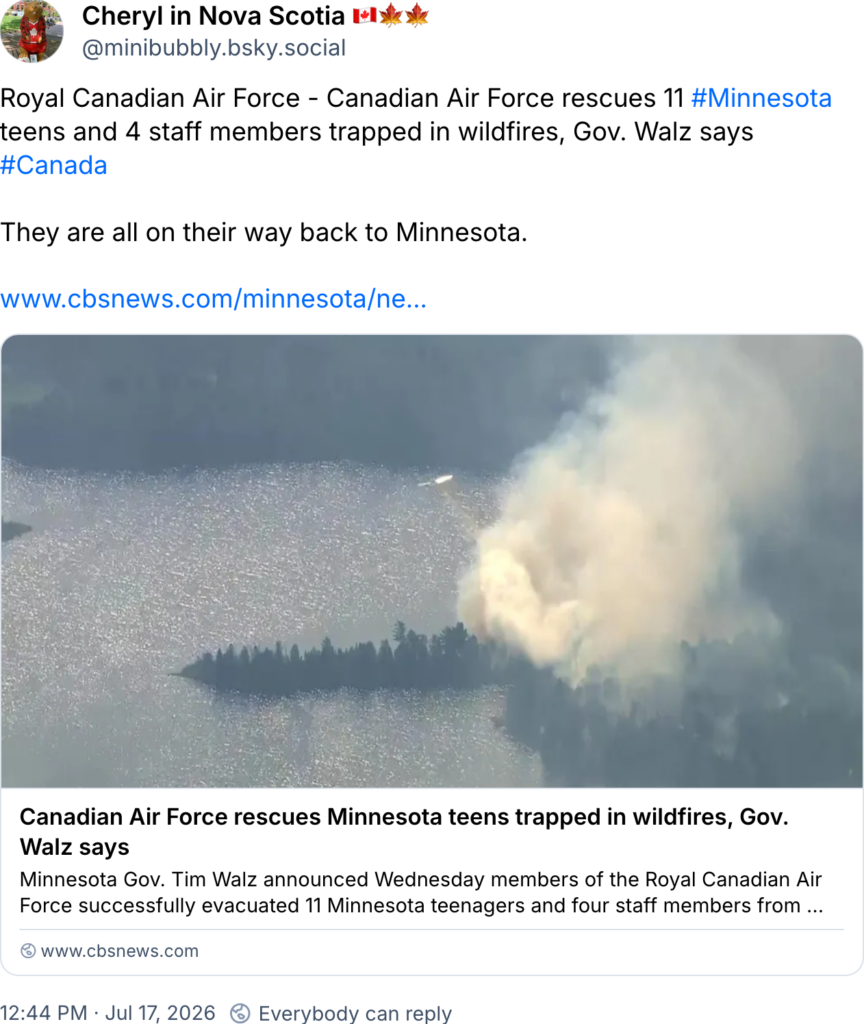
@jefftrnka.bsky.social:
When Canada has a fire that devastates communities and families: The U.S, “keep your smoke to yourself Canada you ruined our beach day.”
When the U.S has a devastating fire: Canada sends firefighters, hydro trucks, fire engines, and water bombers to help.
Canadians have died fighting YOUR fires.
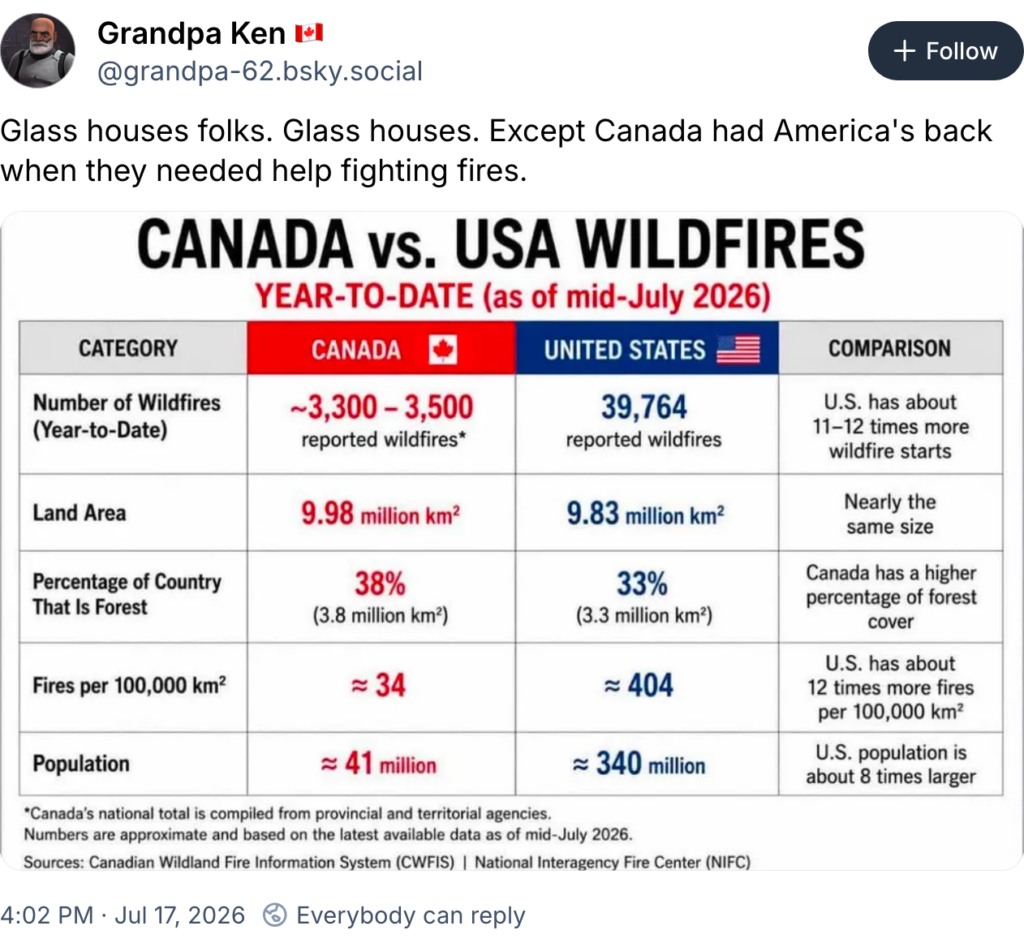
@sleepygardener.bsky.social:
Considering the US has a significantly higher output of carbon dioxide emissions than Canada, and therefore contributes much more to climate change, the impertinence of the US is mind blowing – but sadly not surprising.
@macgyyver.bsky.social:
… They HAVE fewer forests left to burn. They cut them all down which is why they are so dependent on us for lumber.
What morons.
@gregory-c-leavitt.bsky.social:
we need to hold the fossil fuel industry accountable for the billions in damages they have inflicted on the public
@rdmorris.bsky.social:
But let’s blame Canada for the fires.
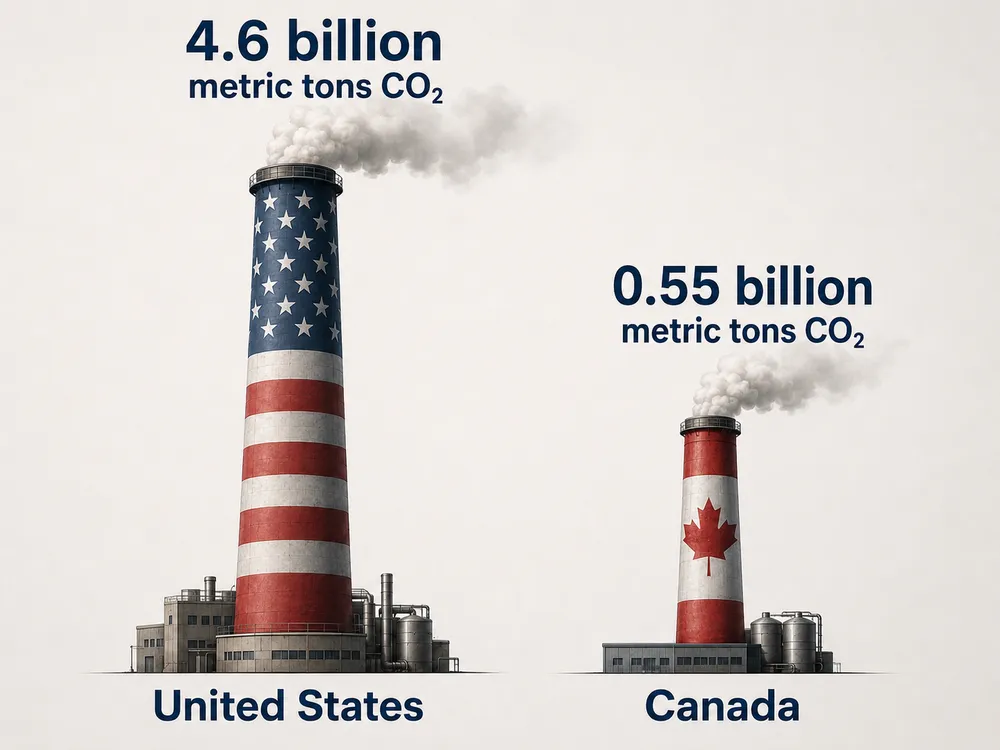
And much of Canada’s emissions are caused by greedy assed American oil and gas companies raping out billions in profits, year after year after year.
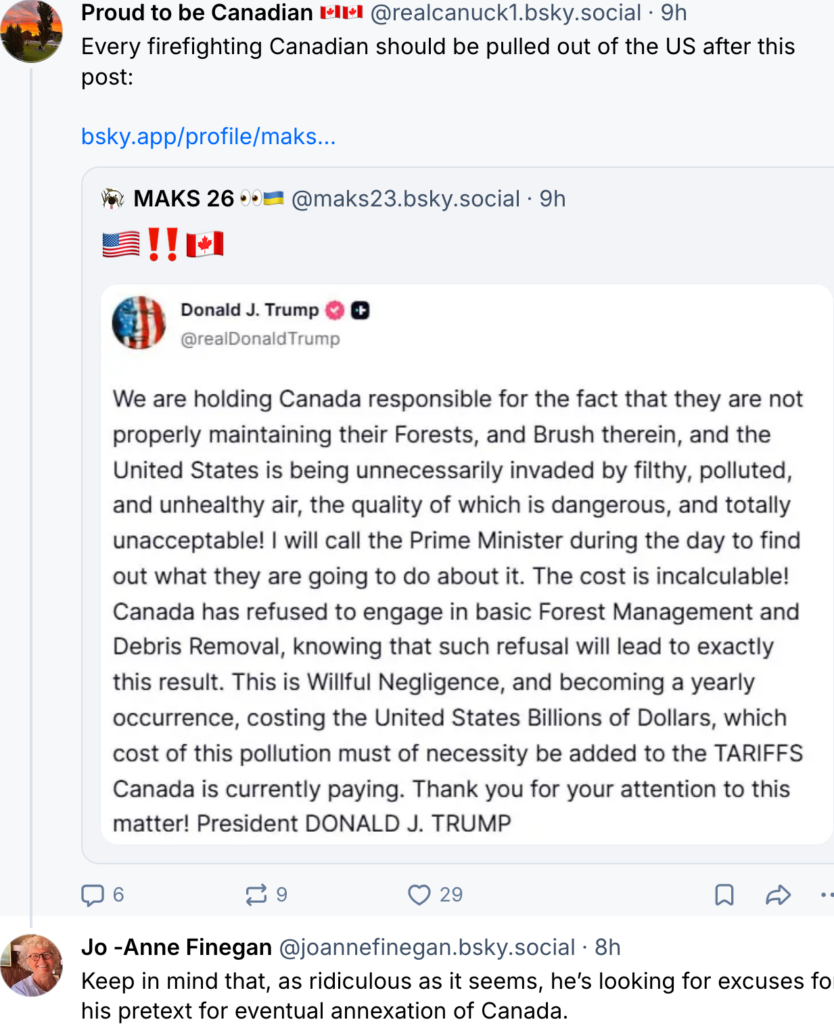
@jamieclimate:
So now we have Trump saying pollution is costing the US billions of dollars. If that’s the case, what should we be charging oil and gas companies who pump out far more pollution each year than these fires?
Democrats should introduce a Make Polluters Pay bill that taxes oil and gas companies’ record profits and uses the revenue for wildfire relief, air purifiers, and all the adaptations we need to need to deal with these climate disasters they helped create.
@scwinner.bsky.social:
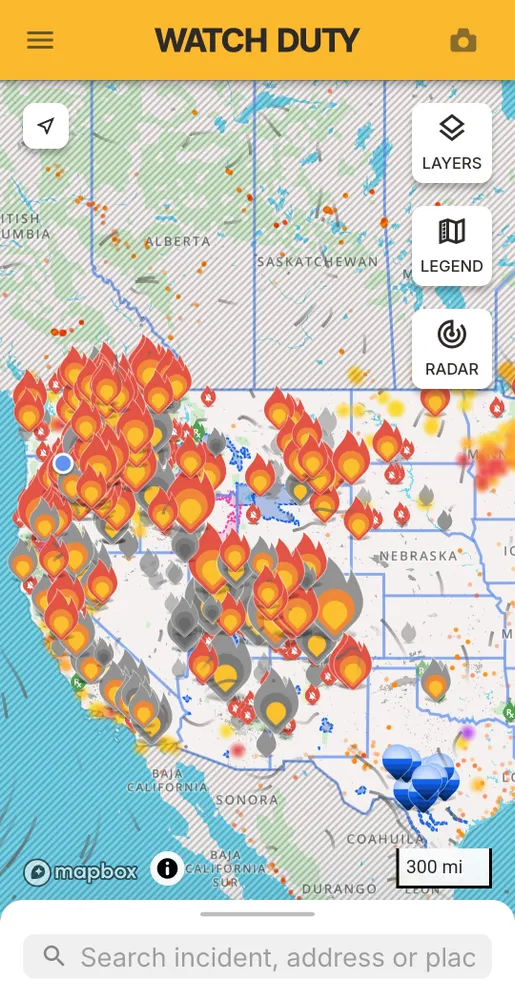
Meanwhile
@thinman.bsky.social:
Meanwhile there are roughly 468 active wildfires being tracked right now across 28 US states, covering about 760,134 acres.
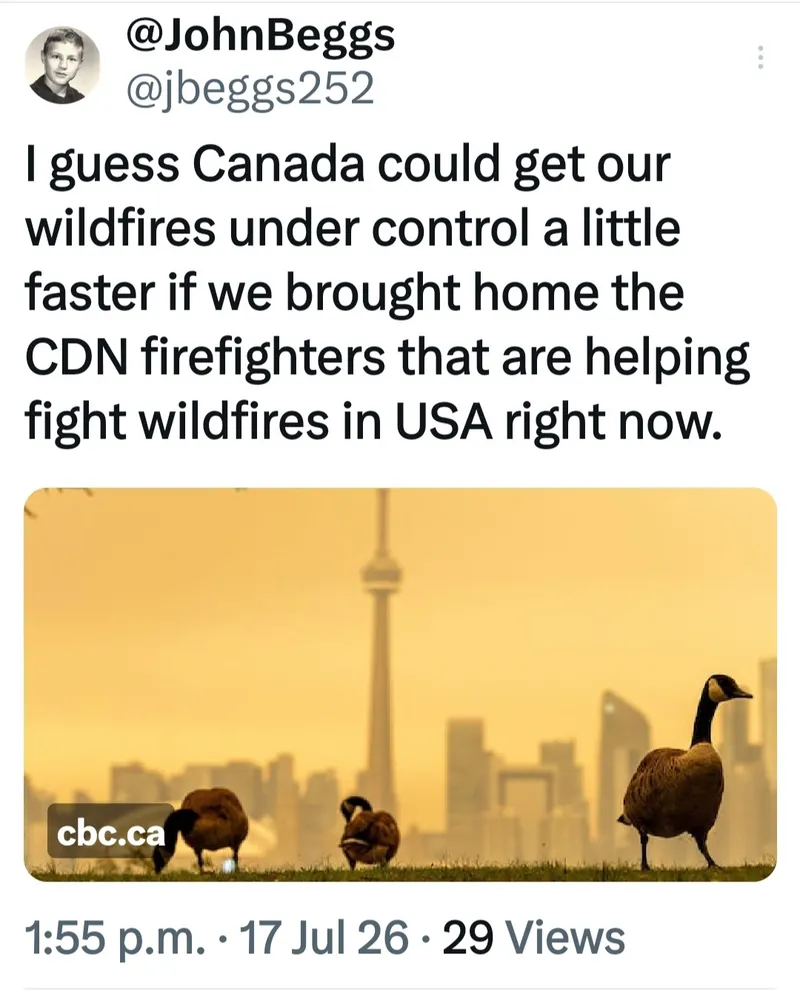
@heather-feather.bsky.social:
So the orange menace is now an environmentalist and concerned about clean air?
Fucking bullying moronic science and realty hating convicted felon pedophile rapist (where is his offer to help cut his emissions and those of his Pedo Regime?) Trump threatens increased tariffs for wildfire smoke that has ‘unnecessarily invaded’ U.S., Stop ‘chirping’ about wildfire smoke and send help like Canada has, Premier Ford tells Republican politicians by Darren Major, Peter Zimonjic · CBC News · Posted: Jul 17, 2026

@jjtubs65.bsky.social:
30+ Years of Scientific Warnings being completely fucking ignored, to start.I’ve known for sixty years
@teleportnow.bsky.social:
I live in Michigan. A raccoon is sitting in my dogs drinking pool in the middle of the afternoon. It looks confused and unwell. The animals have no escape.
@ronickel.bsky.social:
its breaking my heart. most of the birds are silent and there are no squirrels about
@teleportnow.bsky.social:
I agree. Depressing and terrible.
@skedgehammer.bsky.social:
Birds often go silent when there is danger nearby.
They also go silent when they are gone.
@per2.bsky.social:
drill baby drill…
Are large swaths of Canada burning?
Yes Are large swaths of USA burning? Also yes
This is what global warming looks like.
We were warned decades ago. wildfiretrackers.com/f/map
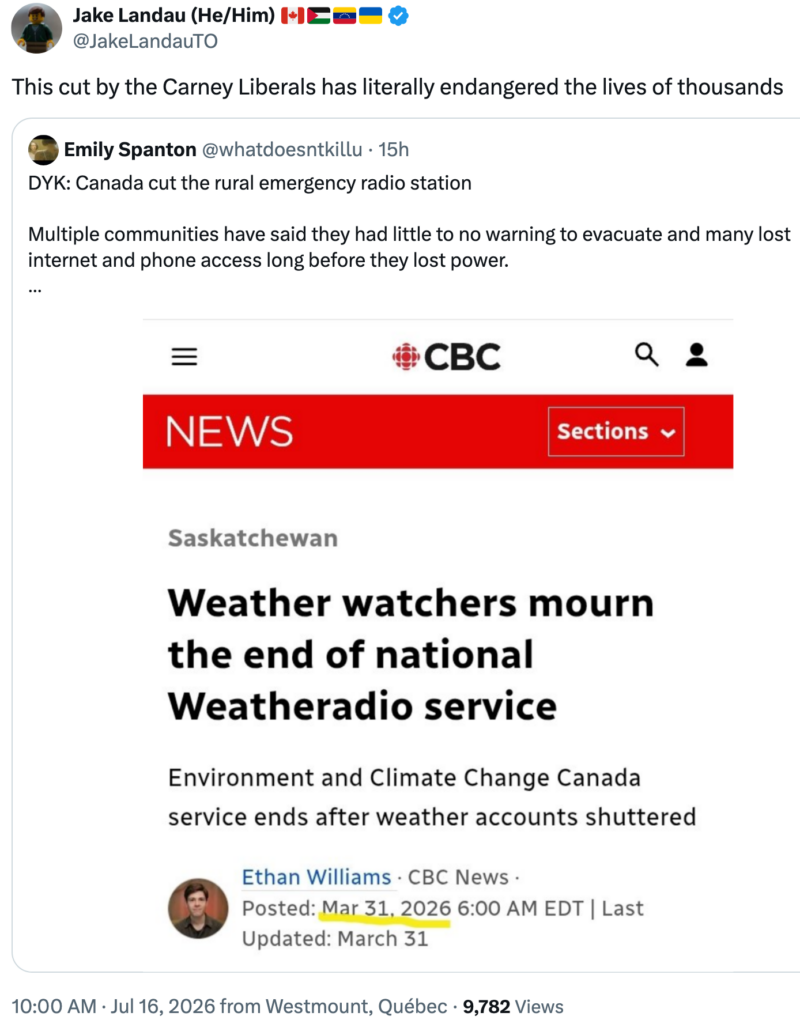
@ClimateDefiance:
Nuremberg style trials are in order for the fossil fuel executives who knew what they were doing to our children’s futures and did anyway
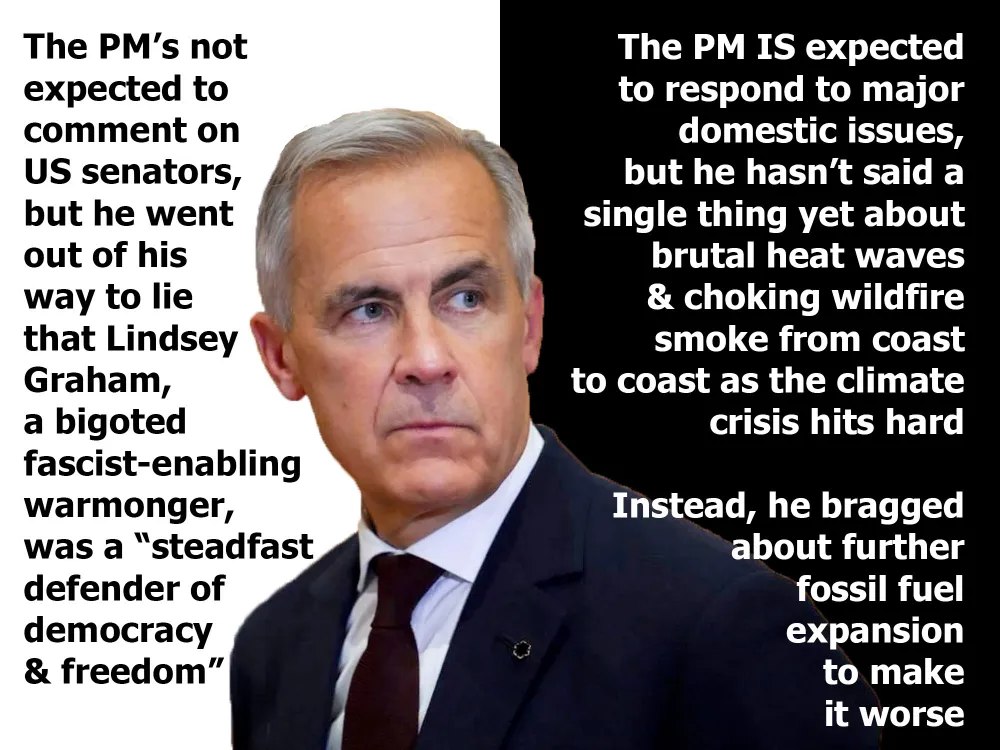
@youcaughtscott.com:
That would work except Carney loves reversing climate change initiatives and damaging Canada.
@virussucks.com:
Canada should sue the US for reversing climate change initiatives and the resulting damage to Canada.
What if Canada threatened to cut oil supply to the US, due to uncontrolled climate change?
@joedmills2.bsky.social:
Time for a reminder:
Big Oil gave millions to get Trump electedand big oil supports the Alberta separatists/Fucker Truckers
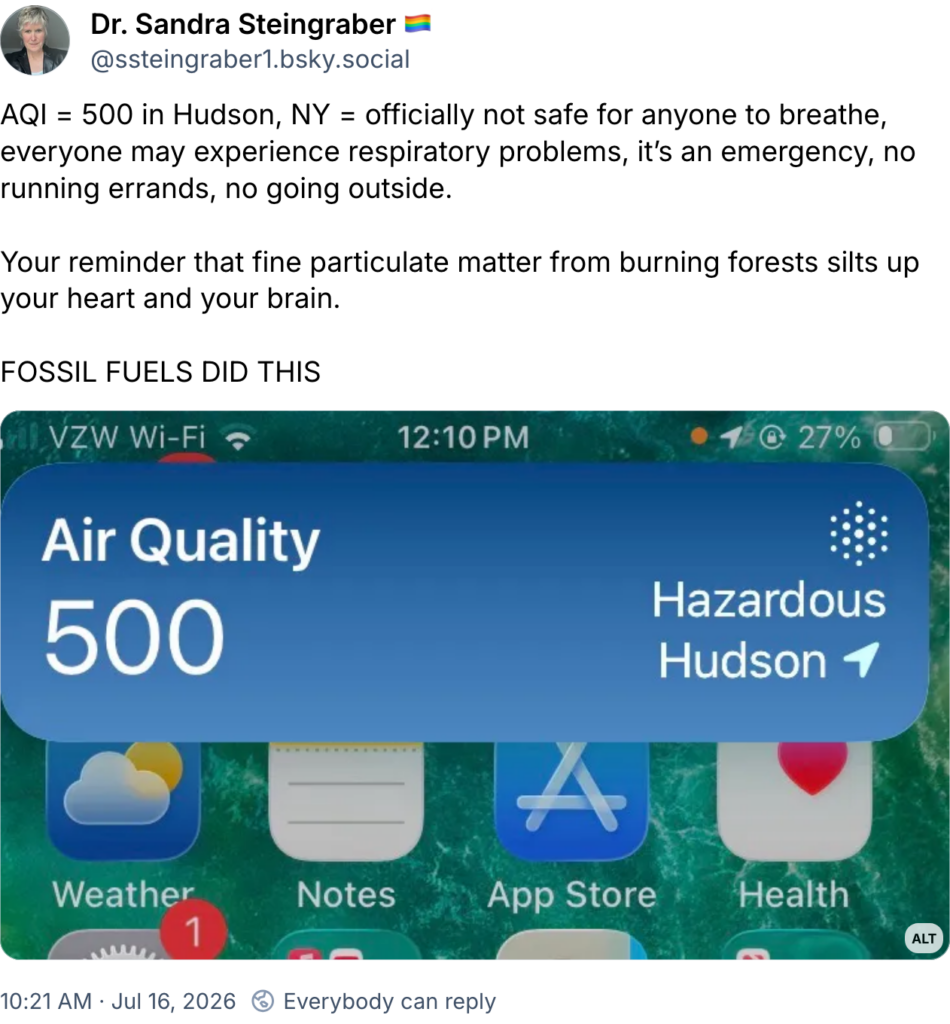
@ssteingraber1.bsky.social:
AQI = 500 in Hudson, NY = officially not safe for anyone to breathe, everyone may experience respiratory problems, it’s an emergency, no running errands, no going outside.
Your reminder that fine particulate matter from burning forests silts up your heart and your brain.
FOSSIL FUELS DID THIS
@johnmarkr.bsky.social:
Scientist friends: how many people will die prematurely because of the high levels of particulate matter in the air in North America this week?
@pammcelwee.bsky.social:
My daughter’s Girl Scout camp in NJ just cancelled their overnight camping due to poor air quality. Our kids deserve to have fun outdoors, not be punished for grownups’ failures to tackle climate change.
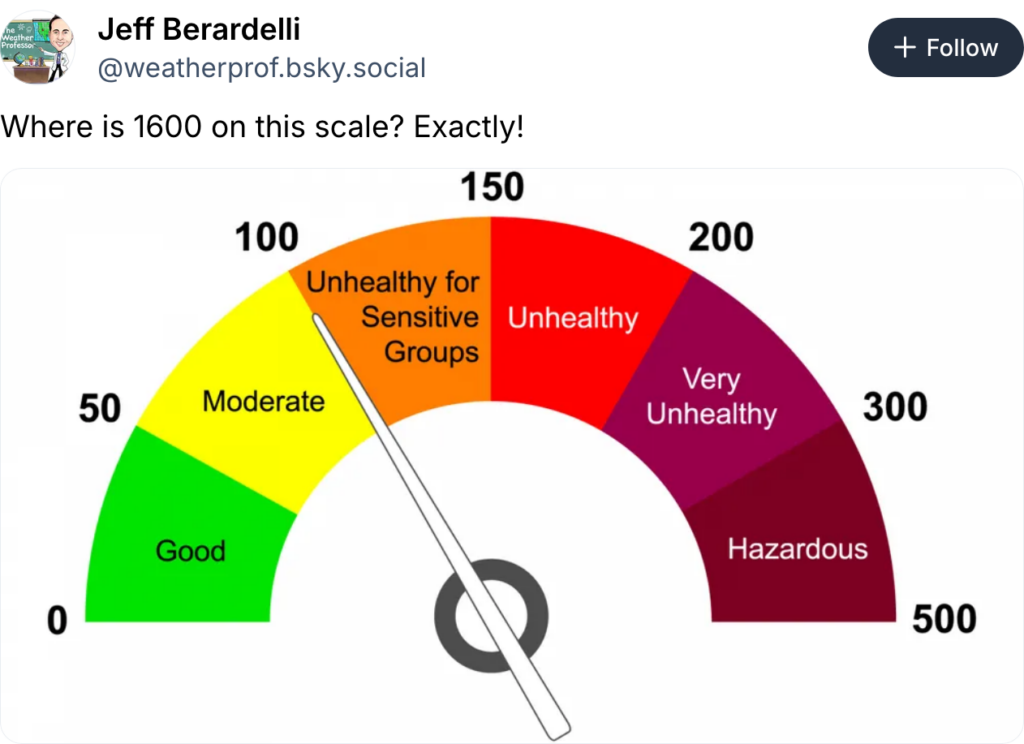
The Sea Gull Lake site is very close to one of the fires near Boundary Waters in Minnesota, and registered an AQI over 2000 this morning. Anything over an AQI of 300 is Hazardous — the highest level on the AQI scale.
@drted77.bsky.social:
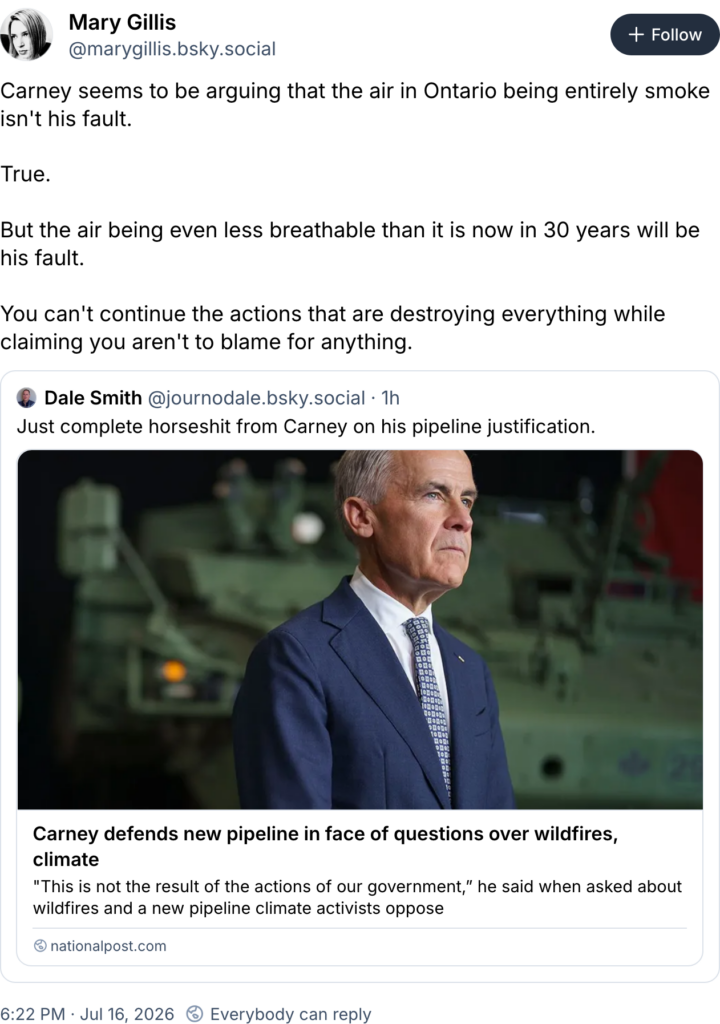
Conservative government (and now Carney Liberal More extreme con than Harper cons) come with a body count.
@Conn1F:
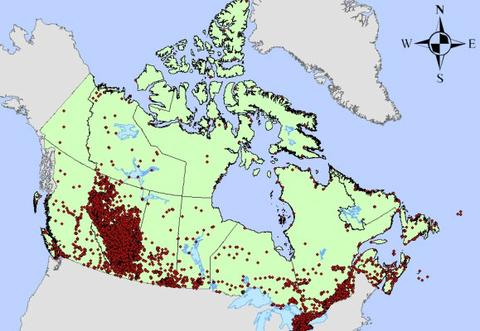
Ignoring once again the role of American companies in forest logging and “management” for profit, as well as the changing climate caused by US oil companies in Alberta.and elsewhere in Canada, eg BC, SK, MB, Ont, Quebec, etcKeep the oil in the ground for a better future.
@virussucks.com:
Canada should sue the US for reversing climate change initiatives and the resulting damage to Canada.
What if Canada threatened to cut oil supply to the US, due to uncontrolled climate change?Much of our oil is owned by American oil companies. Trump would bomb us if we dared cut off the Americans’ cocaine supply.
@tryangregory.bsky.social:
Canada has no leg to stand on whatsoever in this regard because Carney is also reversing climate change initiatives and is pushing for more fossil fuel use.
@uvmike.bsky.social:
The obvious solution is for Canada to cut down all the forests and sell wood pellets to the UK for “green” power generation. No more forest fires, lots of power. What’s not to like? /sIf we were stupid enough to do that, Trump would also bomb us, to steal . all . the pellets.
@BadWeatherKyle:
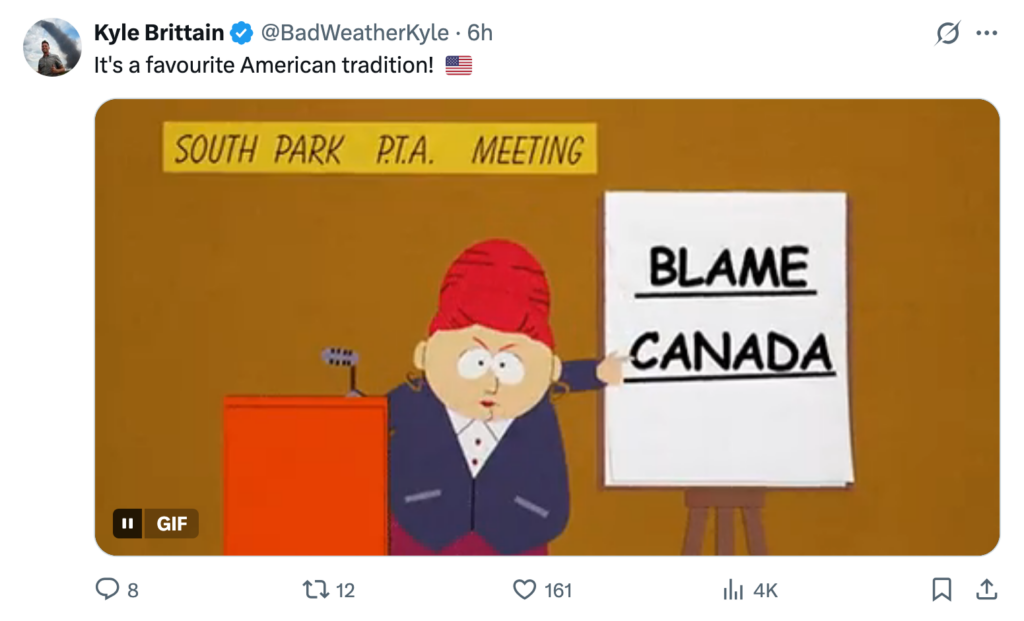
It seems like many Americans, especially in the eastern United States, can’t wrap their minds around the sheer size and remoteness of the Canadian wild – nor the humbling size and violence of a boreal wildfire.
A teachable moment, to be sure.
@binkysmum55.bsky.social:
They obviously have not spent time in Annapolis Valley, NS, where smog from the Eastern Seaboard states, travels north and hangs in the valley. So thick at times you can’t make out the house across the street. The Valley is referred to as the “tailpipe of the Eastern Seaboard” for a reason.
@jnetty.bsky.social:
Some of the fires were sparked by lightning, some human activity, and others by ongoing dry conditions. Canada doesn’t blame other countries when disasters happen, they just sent help! That’s what good people do in time of crisis
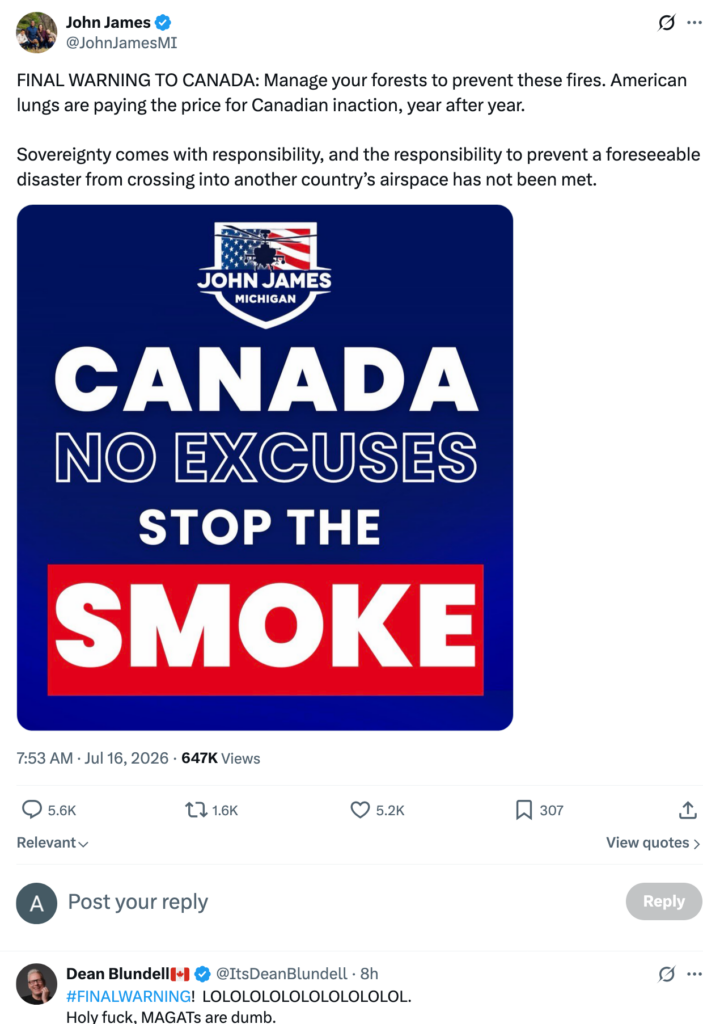

@emmettmacfarlane.com:
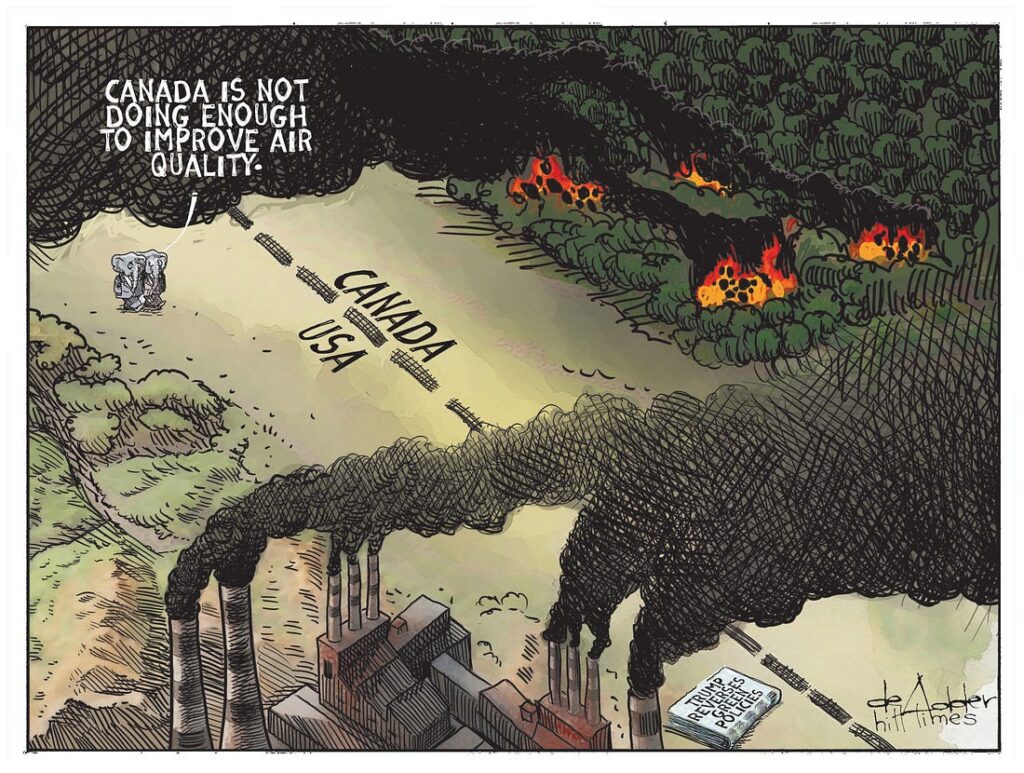
How about you fix your dumpster fire of a country first, you absolute pieces of shit.
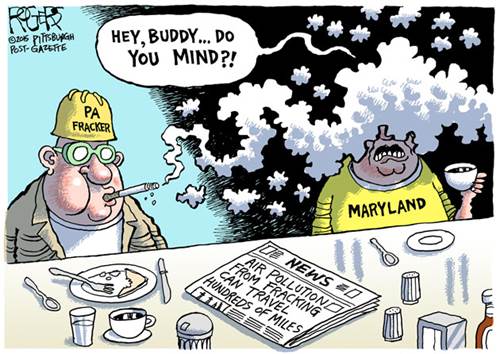
@alantperry.bsky.social:
Sorry, when was it when Canada sent water bombers to California to help with their forest fires?
@salinger.bsky.social:
We really need to stop helping them.
wuzzyto.bsky.social:
America, which is tripling down on its climate destruction, is mad that Canada isn’t preventing the effects of climate change. Fuck America.
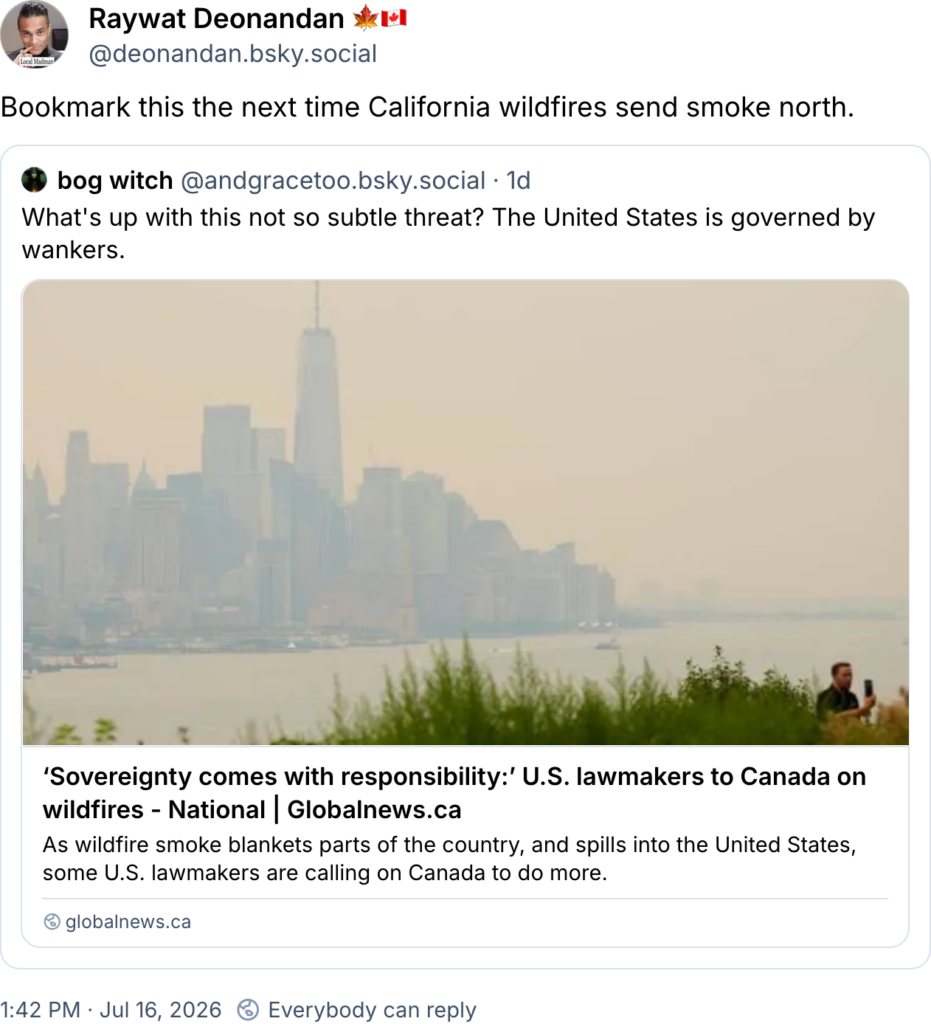
@thesurplusjayerich.bsky.social:
“Why can’t you manage the 1.5 billion acres of the boreal we dehydrated with unprecedented environmental destruction?”
@dw2112.bsky.social:
“That attitude is unacceptable from a neighbor and an ally,” Michigan Republicans wrote.
Yet ongoing trashing, trolling, and eyeballing us from the executive office are perfectly acceptable.
@youcaughtscott.com:
They did this last year too. MAGA is going to use the forest fires to further pressure the Canadian government and even push for annexation. Thanks Carney!
@davidnich.bsky.social:
They should stop sending us their hurricanes.
@dmfox.bsky.social:
And completely ignores the Ohio-valley acid rain that fell on central Canada for decades until both countries worked together to solve the problem. …
@SilentSnow89:
Whiny little bitch crying about some smoke from Northern Ontario like half of Canada isn’t affected by it too…
And much of the other half is affected by fires in America.
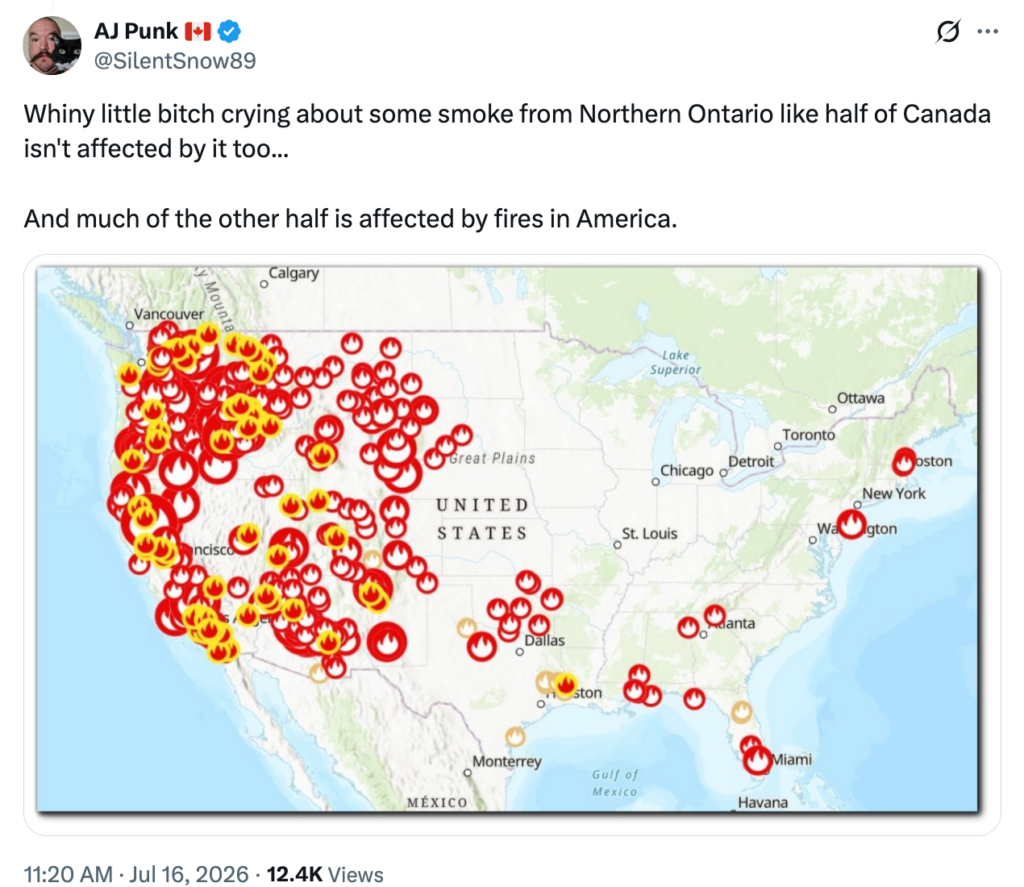
@deonandan.bsky.social:
Air quality in Southern Ontario is atrocious right now. Those of us in houses with good MERV filters will be fine. But I fear for the unhoused, people working outdoors, people in housing with lesser quality HVAC, and of course all the animals.
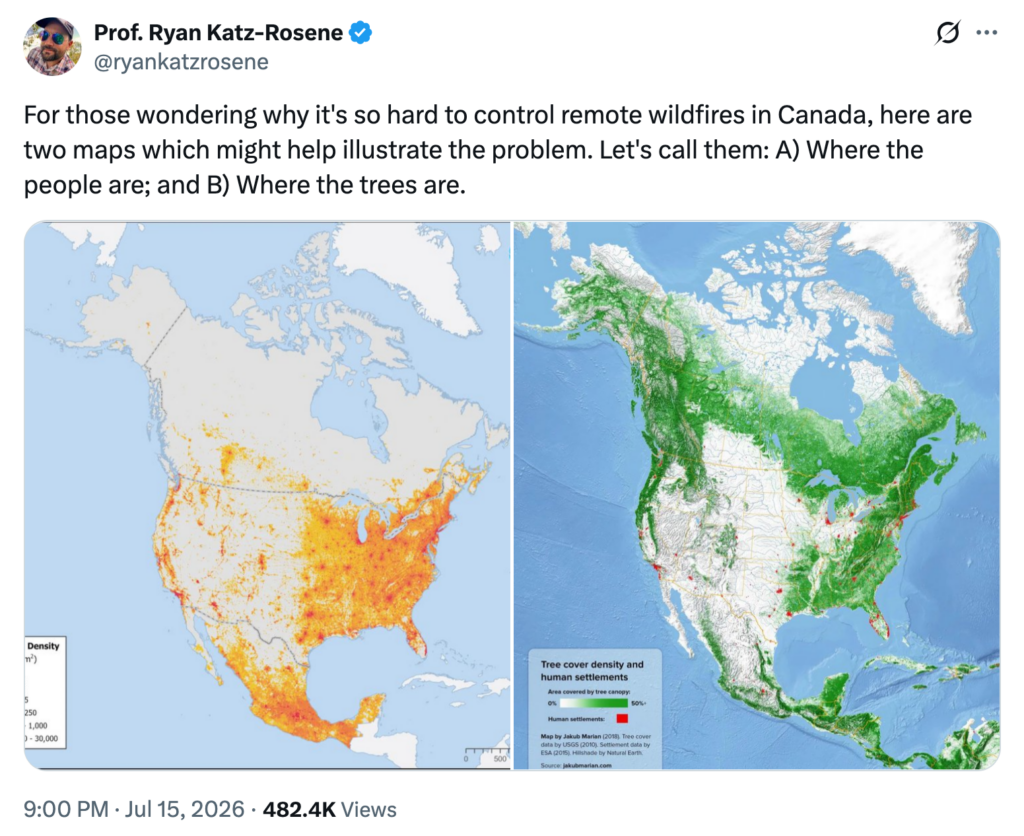
@danwalker9999:
C) Where glyphosate (Roundup) has been sprayed on forests to reduce growth of deciduous trees and favour growth of commercially-valuable coniferous trees.
Deciduous trees, esp. poplar, are fire-resistant.they used to be, human pollution caused global warming is causing extreme heat, spring and summer after spring and summer, drying continents and killing many aspen.
Conifers, esp. spruce, burn like they were soaked in gasoline.
@uncivil-servant.bsky.social:
Climate change and Ontario’s forestry practice of aerial spraying of glyphosate (Roundup) to create monoculture of spruce for the forestry industry. Poplar stands which act as firebreaks are considered “competing vegetation” and eliminated. This is exacerbating fire intensity. USA does it too
@TracyKo42161423:
Southern Alberta smokey skies today coming from a fire in Idaho.
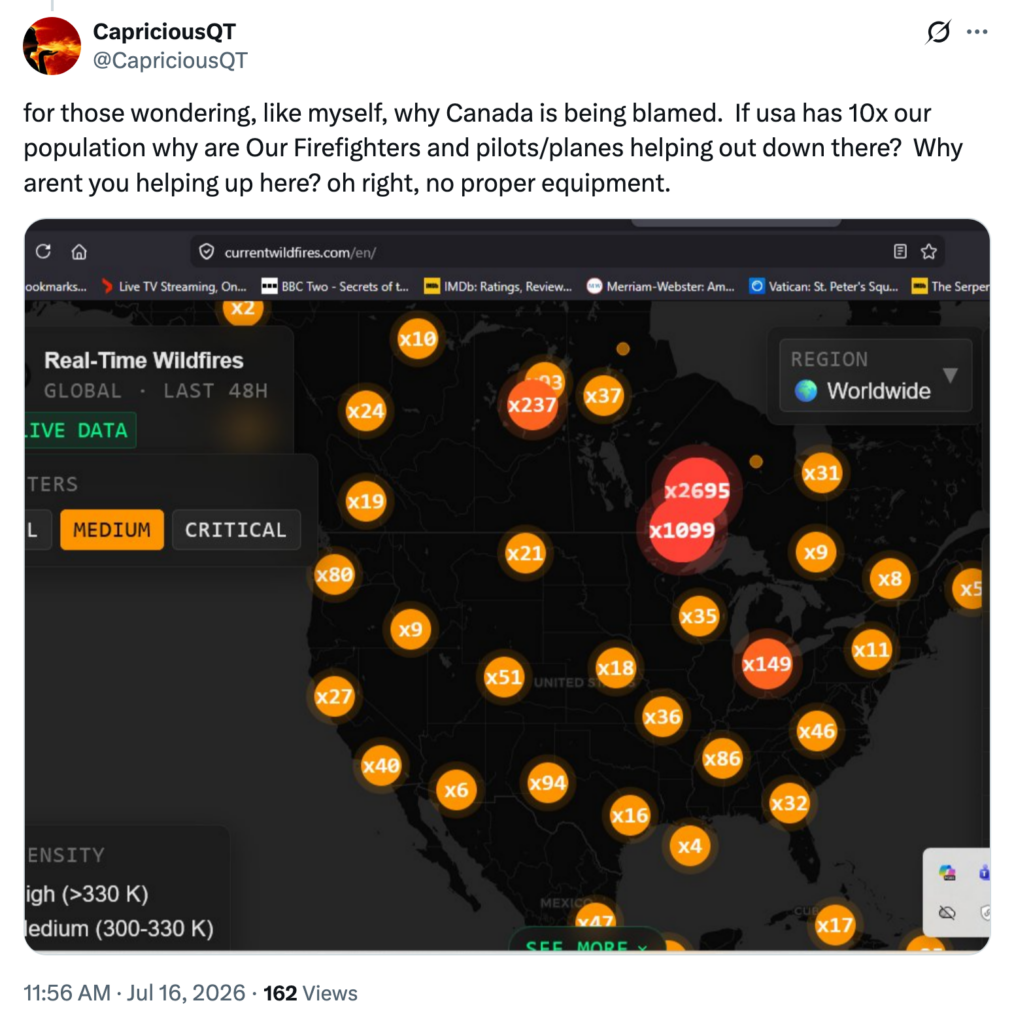
@ryankatzrosene:
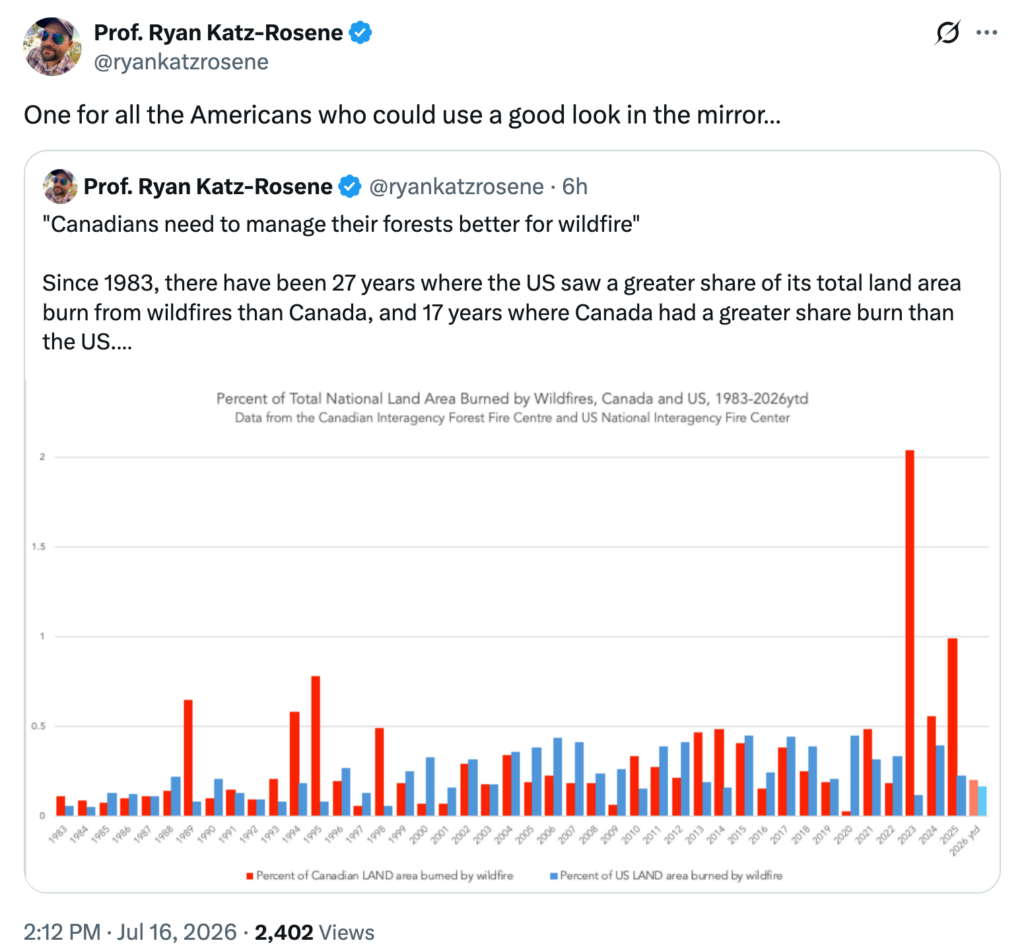
One for all the Americans who could use a good look in the mirror…
“Canadians need to manage their forests better for wildfire”
Since 1983, there have been 27 years where the US saw a greater share of its total land area burn from wildfires than Canada, and 17 years where Canada had a greater share burn than the US.
@hiddenagenda.bsky.social:
I appreciate the messaging, but please wear a mask right now for the sake of your lungs.and heart and brain and and and
Republicans blast Canada over wildfire smoke, air quality in northern U.S., ‘American lungs are paying the price for Canadian inaction,’ say 4 members from Michigan by Mike Crawley, CBC News, Jul 16, 2026
Environment Canada issues air quality warnings as wildsmoke blankets Ontario
Duration 5:14Thick smoke has settled over much of Ontario as wildfires burn in the northwestern part of the province. Environment Canada has issued yellow and orange air quality warnings for many regions.
Social Sharing
Republican members of U.S. Congress are slamming Canada’s federal and provincial governments over what they claim is inaction in preventing the wildfires currently spreading smoke and poor air quality across much of the northeastern U.S., in addition to Central Canada.
The criticism comes in a sharply worded letter from four Michigan members of the House of Representatives, addressed to Prime Minister Mark Carney.
It accuses Canada of failing to conduct adequate forest maintenance to reduce the risk of wildfires and warns that the U.S. “will look elsewhere, and act on our own” if more action isn’t taken.What are the gross super polluting American asshats going to do? Bomb Canada’s forests and grasslands?
“This is the third consecutive year we have had to write to Canadian officials about a crisis that Canada has the tools to prevent and has chosen not to,” write the four Michigan Republicans — John James, Jack Bergman, John Moolenaar and Lisa McClain — in a letter dated Wednesday.What tools are there to stop Americans polluting the earth and atmosphere so much?
“Our hospitals are once again treating children, dialysis patients and older residents for the effects of smoke that did not originate anywhere near them.”There’s plenty fucking deadly smoke created by burning forests and cities in USA too, harming the health of Canadians, others and killing some of them. The origin of the smoke is not the source of the problem. The problem lies mostly with fucking polluting Americans and Trump massively deregulating the polluters, and law violating greedy American oil and gas companies frac’ing, sucking, polluting Canada to death.
The Republican lawmakers say they are “done accepting apologies in place of action,” and float the idea of taking cross-border fire prevention into U.S. hands.Dense assholes. Stop polluting! That’s the action that is needed; then go do fire prevention in fucking America first. We often breath the smoke from your fires.
“Sovereignty comes with responsibility, and the responsibility to prevent a foreseeable disaster from crossing into another country’s airspace has not been met,” they wrote.Dirty fuckers. Shove your threats up your evil polluting Pedo leader’s raping ass who is massively lying and quitting climate change mitigation, and deregulating America’s worst polluters!
“Our constituents are breathing the consequences of this failure right now, and they deserve better than to be told, again, that it will be handled.”Anyone with a functioning brain knows the wildfires will only get worse if we do not stop fossil fuel pollution!
More than 800 active fires
There were 858 active fires across Canada as of Thursday, according to data from the Canadian Interagency Forest Fire Centre.
Smoke from wildfires in northwestern Ontario has been causing poor air quality and reduced visibility across for much of the southern parts of the province, according to Environment Canada.
The smoke has also triggered air quality warnings for states close to the Great Lakes, stretching from Minnesota to Maryland, with the U.S. air quality index ranging from unhealthy to hazardous.
Ontario’s forest fire officials say there are 136 active fires in the northwest region, with 63 classified as out of control. Another 44 fires are burning in the northeast.
The province has said there have been 483 fires in Ontario so far this year, up from 351 as of this time last year and above the province’s 10-year average by mid-July of 320.
Neighbouring Manitoba’s latest official figures show 137 active fires, and a total of 261 so far this year.

Wildfire challenge ‘knows no borders’: Hoekstra
The letter’s tone strikes a direct contrast with the far more collaborative way that U.S. Ambassador Pete Hoekstra has described Canada’s wildfire situation.
“This challenge knows no borders,” said Hoekstra, who also hails from Michigan, in a statement on Wednesday. “This is a shared challenge, and it demands a shared response.
- Fast-moving fires destroy homes in northern Ontario as crews fight flames
- Toronto air quality may ‘temporarily improve’ Friday, but conditions could persist into weekend
“I commend the outstanding co-operation between the United States and Canada as we confront these fires together. Our two governments are monitoring and sharing information in real time — co-ordination that reflects our partnership at its best.”
Michigan Republicans made similar complaints about Canada last summer, prompting Manitoba Premier Wab Kinew to brand them as attention seekers throwing a “timber tantrum.”
WATCH | Ontario asks Ottawa to assist with wildfire evacuations:
Ontario seeks federal help as wildfires force more evacuations
Duration 2:47Ontario has formally asked the federal government to ensure aircraft and crews could be deployed in 24 hours or less for evacuations, as wildfires continue to force people from their homes in First Nations and northern Ontario communities.
In the new letter, the Michigan Republicans criticized unnamed provincial leaders for “offering excuses instead of results” and dismissing the health concerns of Americans.I’ve never heard American politicians apologize to Canada for being one of the world’s worst polluters, if not the worst, and agent of climate chaos, and having disgusting oil and gas companies pollute in Canada. The result that is needed, is to stop burning, producing fossil fuels, and stop carbon capture which is a massively evil con job by industry to get more $billions in freebies from taxpayers. This means not only shutting down the oil and gas industry, but also the AI and data centre industry which is largely American and the fucking wars, which USA is the worst instigator of.
“That attitude is unacceptable from a neighbour and an ally,” they wrote.Well, America’s horrific fossil fuel pollution and wildfire pollution and fucking threats to take us over, are unacceptable from a neighbour and what used to be an ally. I will never consider USA an ally again; you are bad neighbours, just like Encana/Ovintiv.
‘Canada: No Excuses. Stop The Smoke’
Two of the politicians have gone even further on social media.
In a video posted to X, McClain said she has been in touch with the White House, noting that U.S. sent foresters and firefighters last year to Canada “since they aren’t really doing much.”
James, who is running for governor in Michigan, posted excerpts from the letter and added an image saying, “Canada: No Excuses. Stop The Smoke.”
Carney did not directly address the letter when asked about it by reporters on Thursday, but took a jab at the Trump administration’s climate change policies.
“Climate change is everyone’s responsibility — truly everyone’s — including the United States,” Carney said in French during a news conference in London, Ont.
He contrasted Canada’s investments in clean energy with U.S. prohibitions on clean energy, including wind power — a particular target of U.S. Donald Trump.
Another Republican blaming Canada is Sen. Bernie Moreno of Ohio.
Reacting to a social media post about the air quality in Cleveland, Moreno wrote: “I’ll be introducing a bill next week to sanction Canada and the responsible Canadian government officials for this atrocity.”Pointing right back smack at ya, in your Nazi face, Mr. Moreno. America has one hell of a lot of pollution to clean up. Let’s see you get started cleaning your shit up first.
Moreno did not specify what sort of sanction he has in mind.
“Canada’s government failed to invest in wildfire prevention methods including forest thinning, fuel reduction, prescribed burns, and stronger enforcement against arson,” Moreno said in a news release, directly echoing a line in the letter from his Michigan congressional colleagues.American Repuglicons listening to liar Danielle Smith? Arson is the least of the the wildfire problems, given that American oil and gas companies are the biggest and worst polluters in Canada, and that America is a much worse climate polluter than Canada, has much more polluting industry, and there are millions more Americans than Canadians driving fossil fuel polluting trucks and cars and heating their homes with fossil fuels. FFS. Americans are much more at fault for the worsening climate chaos, continental drying and subsequent worsening wildfires and smoke, than Canada is. Think of the climate pollution from USA financing Israel’s crimes against humanity and genocides and Trump’s illegal bombing of Iran and USA’s in the past elsewhere. Do/did Republicans care about the lungs of Iranians, Lebanese, Palestinians, etc? No, of course not.

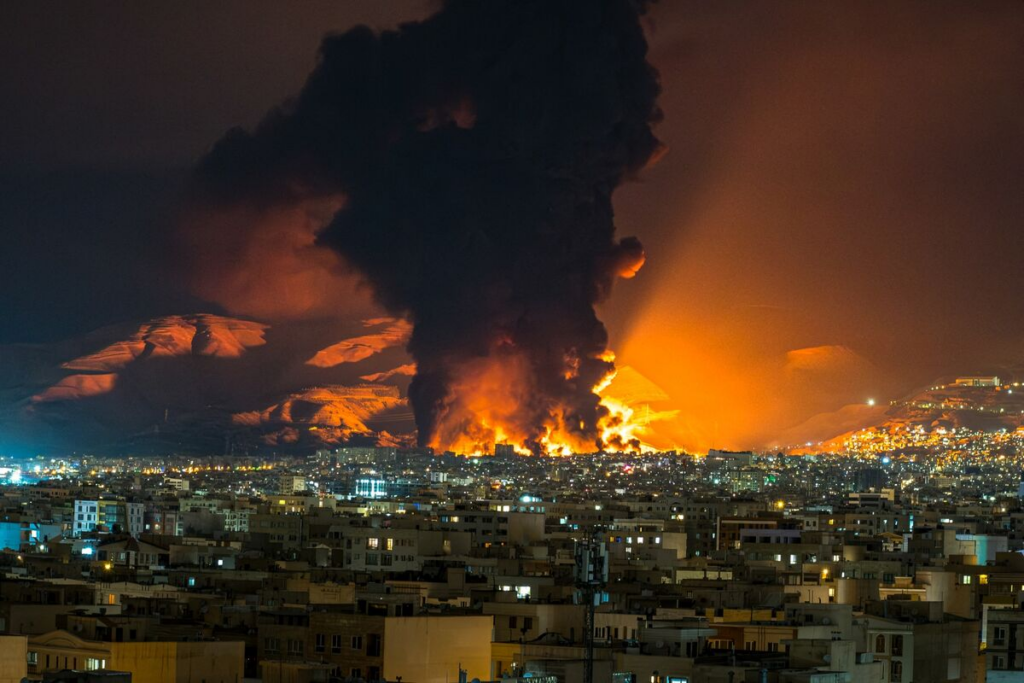
Then, there’s Nazi Musk’s hideous spacex and grok, both massive climate polluters harming the health of Americans and the rest of the world, including Canadians. Besides, none of the measures listed by Moreno seem to be taking place in USA, and not a one will stop the ravages of fossil fuel pollution. Worsening wildfire is but one dire consequence of many caused by human greed, over population and pollution.
@baja-hacker.bsky.social:
Republicans just LOVE giving subsidies to oil companies . . .
@DougJBalloon:
I can’t breathe the air, I can’t eat lettuce, I can’t afford gas, and my kids have measles. But at least now our soldiers will have enough testosterone.
Why not make your pipeline announcement with this video playing in the background? At least you would be honest for a change.
@leeram.bsky.social:
Doug Ford and Mark Carney…posted about pipelines today.
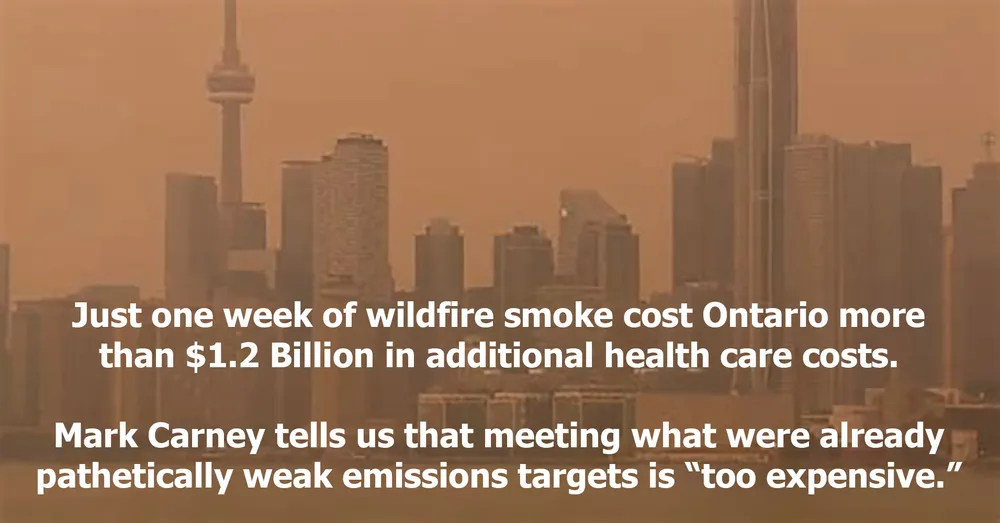
While Prime Minister Full-Speed-Ahead-On-Climate-Arson-Without-Even-Pretending-To-Care-About-Our-Climate-Obligations eliminates our already weak climate targets, Toronto has the very worst air quality on Earth today due to climate-worsened extreme wildfires.
Canada’s PM’s fierce determination to appease separatists & fatten short term foreign fossil fuel shareholder profits with a pipeline is going to come with a huge body count.
It’s anti-leadership. Deliberate failure on the climate is the most irresponsible policy choice in all of human history. and worse, Herr Worse-than-Harper Carney knows it.
IPCC science tells us ANY new pipelines or fossil fuel expansion guarantees that the Paris Agreement climate goals can never be met & the world cannot possibly avoid the very worst climate scenarios.
Also that carbon capture is a problem rather than a solution.
Whenever you remember that the PM said meeting what were already pathetically low climate targets would be “too expensive,” ask yourself how expensive it will feel when escalating climate impacts cut all of global GDP in half.
actuaries.org.uk/media/qeydew…
…
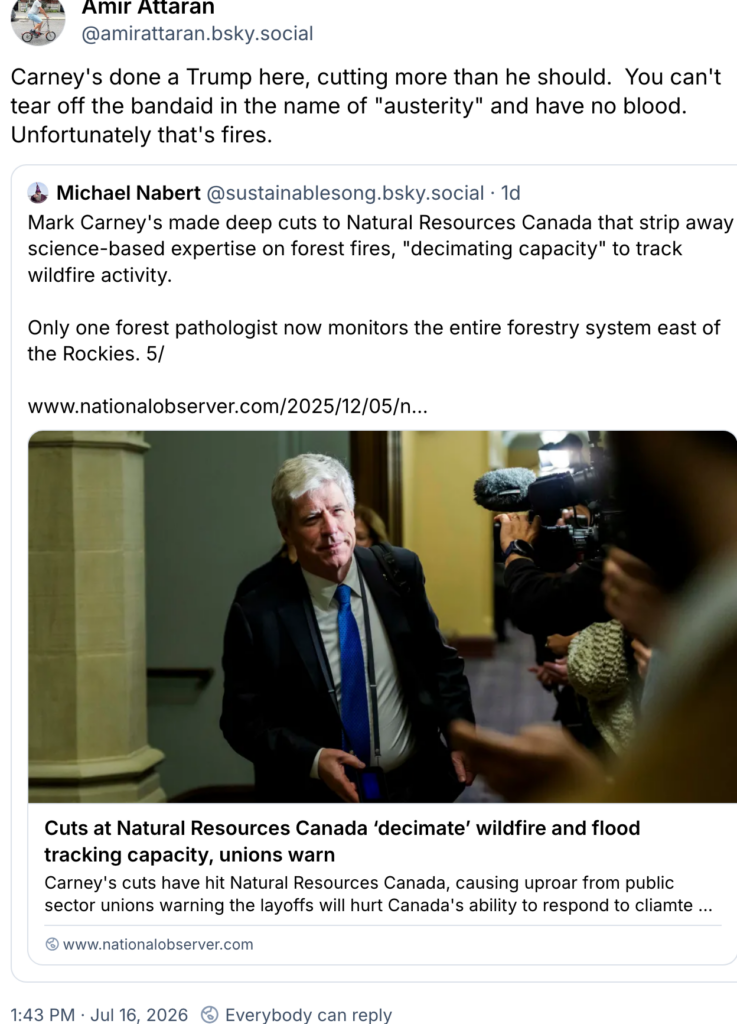
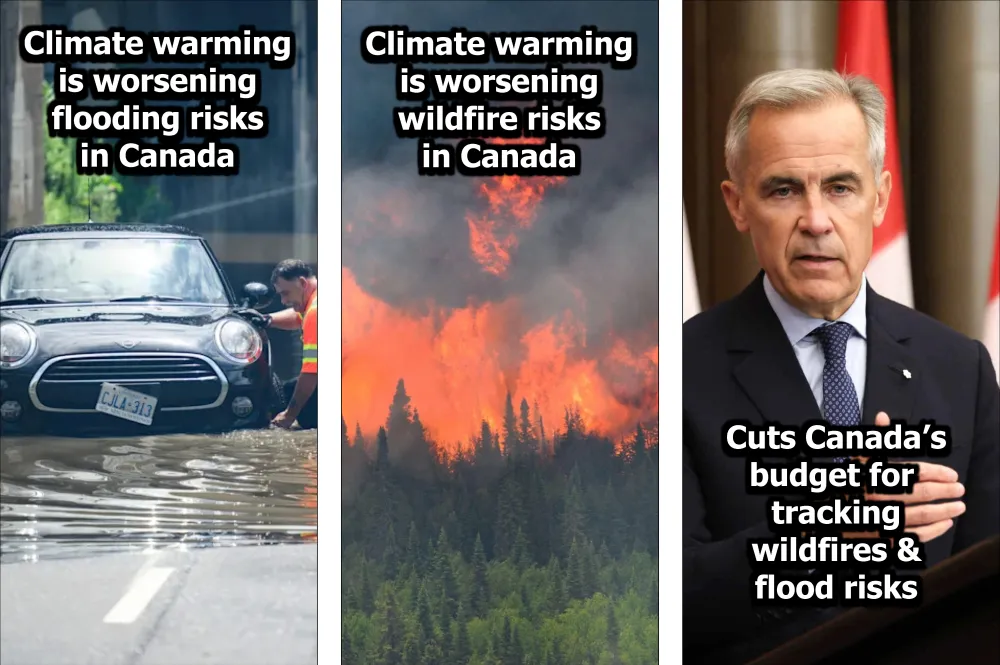
In the face of growing wildfire risks, Mark Carney has cut funding for tracking wildfire risks.
Because when you’re deliberately worsening a gigantic public risk, the very best way to follow that up is by also reducing the public capacity to reduce that risk.
Carney seems to have a fetish for making climate harms as big as he possibly can.
www.nationalobserver.com/2025/12/05/n…
…
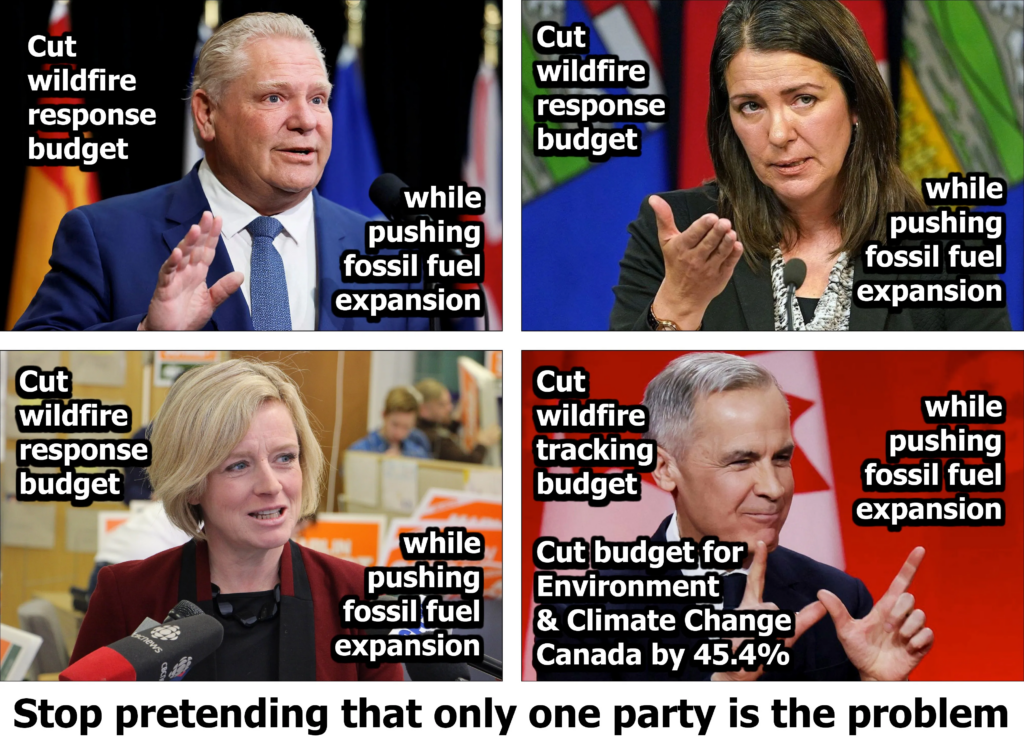
Stop pretending that only one party is responsible for making us more vulnerable to wildfire risks. The escalating danger we are in is a multi-party effort. NONE of Canada’s major political parties has thus far taken this increasing risk seriously.
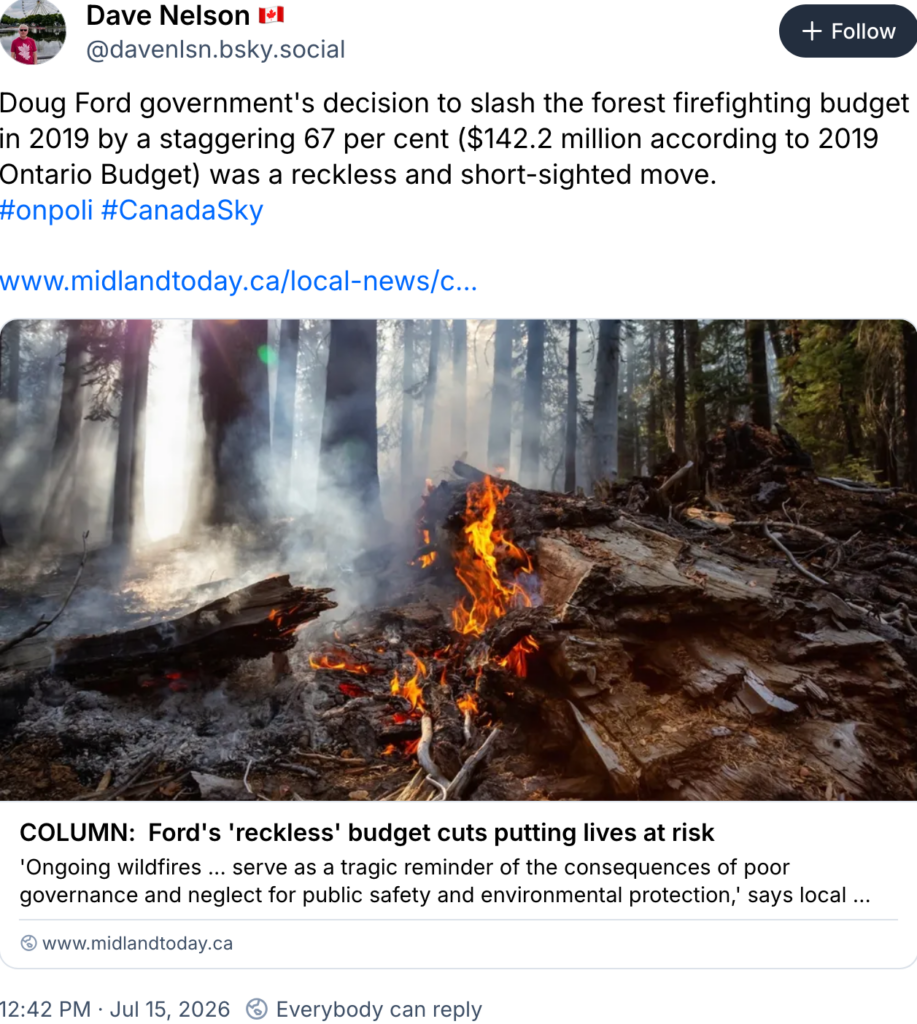
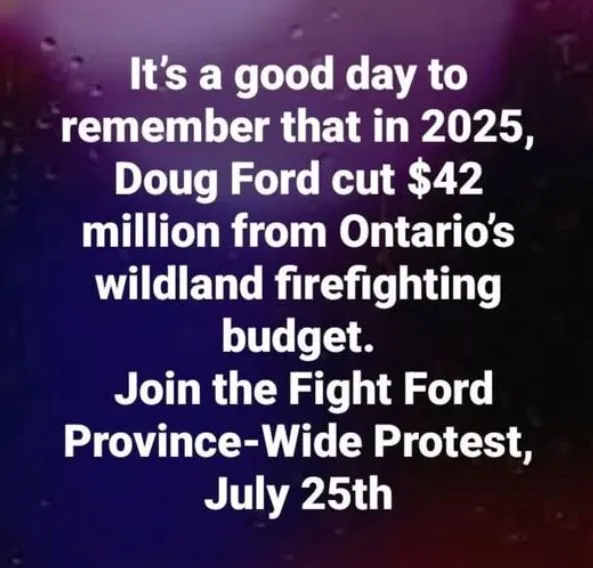
Here we see Doug Ford cutting funding at Ontario’s Ministry of Natural Resources and Forestry, with by far the biggest cuts coming from the Emergency Forest Firefighting budget. While fire risks went up. It’s awful anti-leadership, but it he’s hardly the only one.
Provincial budget cuts hit MNRF hard – Ontario Out of Doors
The Ford government’s provincial budget, released on April 11, has reduced the Ministry of Natural Resources and Forestry’s budget by $161.7 million…oodmag.com
No one at all should be surprised to see that Alberta’s Danielle Smith, and Jason Kenney before her, both similarly took an axe to the budget aimed at protecting Alberta from wildfires.
Alberta’s UCP Government Has Cut Tens of Millions of Dollars From Wildfire Preparedness Programs
Danielle Smith is promising a ‘more nimble’ response to wildfirespressprogress.ca
The only problem with the completely appropriate anger aimed at them for doing so is the partisan fiction that this is something *only* Conservatives or UCP do. Alberta’s only NDP government ALSO cut the province’s wildfire fighting budget. An NDP government.
Alberta Premier Rachel Notley defends cut in wildfire budget
The government says it’s committed to fighting wildfires in Alberta.edmontonjournal.com
Mark Carney’s made deep cuts to Natural Resources Canada that strip away science-based expertise on forest fires, “decimating capacity” to track wildfire activity. Only one forest pathologist now monitors the entire forestry system east of the Rockies.
Cuts at Natural Resources Canada ‘decimate’ wildfire and flood tracking capacity, unions warn
Carney’s cuts have hit Natural Resources Canada, causing uproar from public sector unions warning the layoffs will hurt Canada’s ability to respond to cliamte change and protect Canadians from wildfir…www.nationalobserver.com
Troubling cuts to Natural Resources are a pittance next to Carney cutting the total budget for Environment & Climate Change Canada roughly in HALF, devastating Canada’s management of not only wildfire risks but also flooding & other climate impact risks. IN HALF.
2026–27 Estimates – Canada.cawww.canada.ca
NO government in Canada is the hero here. NONE of these people is taking Canada’s increasing wildfire risks remotely seriously.
@strawbbjam.bsky.social:
who up crying bc all of canada is on fire and the animals are probably so scared and don’t know what’s going on and my heart just hurts bro
@nottodisappear.bsky.social:
Will a mask even help with THIS MUCH SMOKE? It looks like you’re trapped inside a house fire in NYC!
@madgreek2024.bsky.social:
You’ll need a N95 mask. But it’s better not to go out at all if you can.
@millicentlake.bsky.social:
Imagine being a bird or animal with zero recourse. Or a newborn nesting creature.
@internethuman.bsky.social:
AQI is >400 today where I’m at. I’m hesitant to even let my dog outside to pee, I’m not going out without the same mask combo I used during the peak of covid.
I see birds flying, squirrels running around and I cant help but wonder about the damage to their tiny lungs.
@uncommon-grackle.bsky.social:
Here in metro Detroit, we’re at 469 right now. I got back from running errands — masked outside but not in my car — and I’ve been lightly coughing since I got back.
@internethuman.bsky.social:
Also saw a dude running down the street shirtless and unmasked… which really baffled me. Like do you care about your health or not?
@classicnal.bsky.social:
‘m in western NY, and it’s bad even indoors. I have a headache, stomach ache, dry eyes, and a runny nose. Homes are not hermetically sealed, so it does get in through tiny cracks, crevices, outside vents. It gets inside cars too.
@thankgod4ever.bsky.social:
it’s really bad today where I live. can’t go outside or have the windows open. smells terrible and hard to breathe
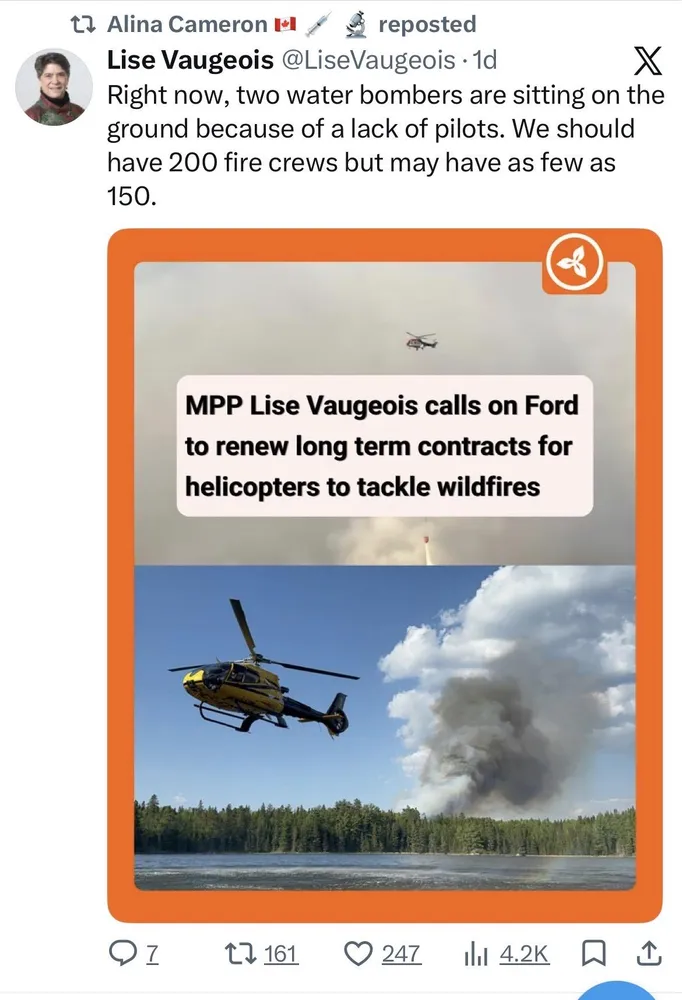
@drted77.bsky.social:
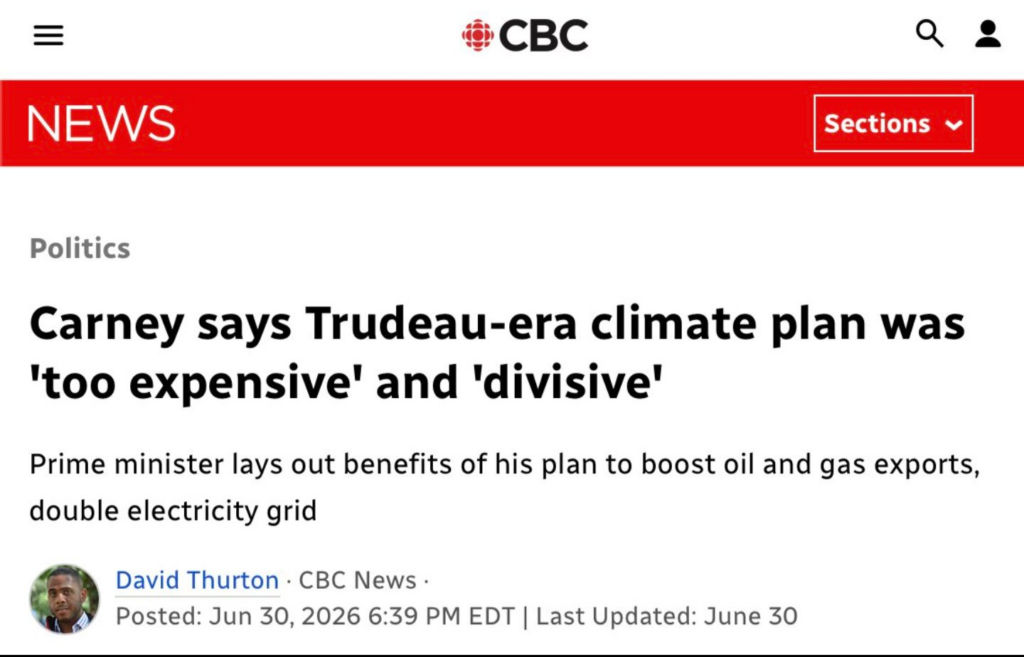
I’m just so gosh darn happy that our governments have decided that having a viable living environment is too expensive to maintain. Yeah, let’s just burn it all to the ground!
Such scenes are playing out all over Canada, so if you complain of firesmoke — absolutely understandable; it is an apocalyptic hellscape — please be mindful you are literally surrounded by the ashes of other people’s lives and dreams. It, too, is an unthinkable horror. It’s all so wrong.
Castanet.net @castanet.net:
Town site of Boston Bar, B.C., ordered to evacuate as wildfire flares #Kamloops

Town site of Boston Bar, B.C., ordered to evacuate as wildfire flares – Kamloops News
Residents of Boston Bar have been ordered to evacuate due to a wildfire that flared overnight.www.castanet.net
In case I’m being subtle: “Blaming Canada” for firesmoke is an asshole move. Obviously we didn’t go, KNOW WHAT WE WANT FOR SUMMER? CANADA GOING UP IN FLAMES. So, there are a lot of American comments that are pissing us off. (Luckily, lotsa nice Americans are donating to Red Cross, too. We ♥️ you.)
Cindy Bloom @cbloom57.bsky.social:
Za Lord of the Rings of Fires of Heaven @angeloleary.bsky.social:
Seriously, the blame falls on climate change deniers. If anyone is going to complain, go to the root source. These fires are tragic, lives destroyed. The consequences of these fires are lasting and far-flung.
curiouskittyk.bsky.social @curiouskittyk.bsky.social:
There’s a name for this man made climate change. All of this is knowable, the sad part is on the trajectory we are on we will look upon this as one of the better years. Yet, drill baby, drill. For some reason we seem unable to break free of our addiction to mindless consumption and fossil fuels.
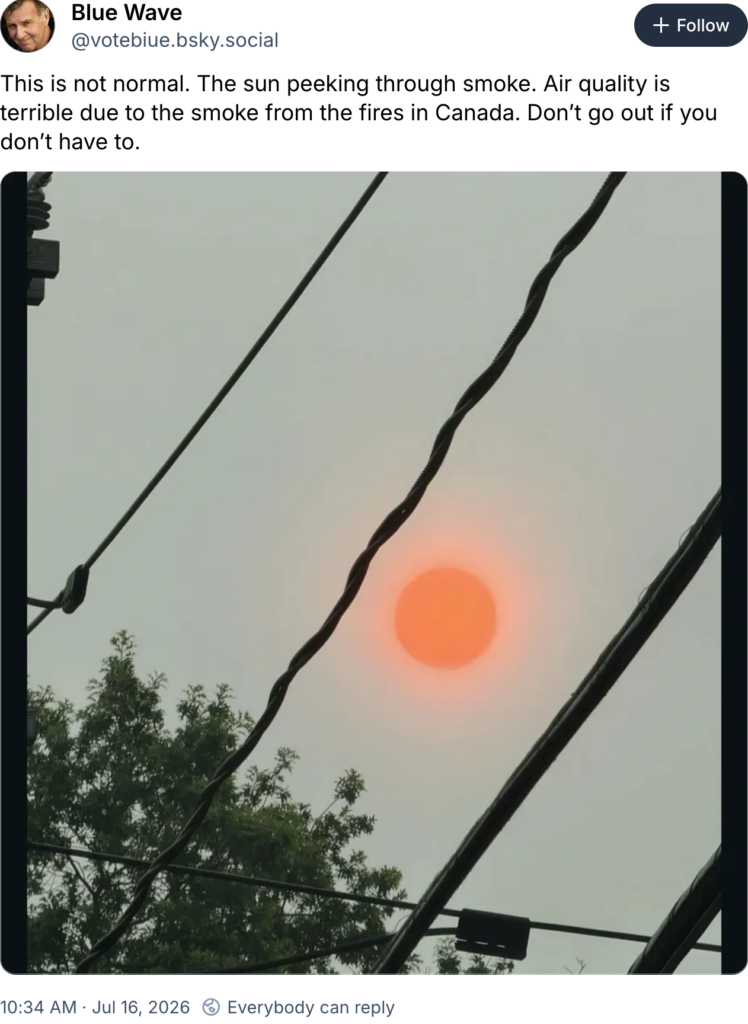
@chitownstrong.bsky.social:
It’s bonkers to me that the sunrise is not even visible…
@votebiue.bsky.social:
Yeah it’s like Science Fiction.
@curiouskittyk.bsky.social:
I’m afraid this IS the new NORMAL !
Yet we ignore the cause
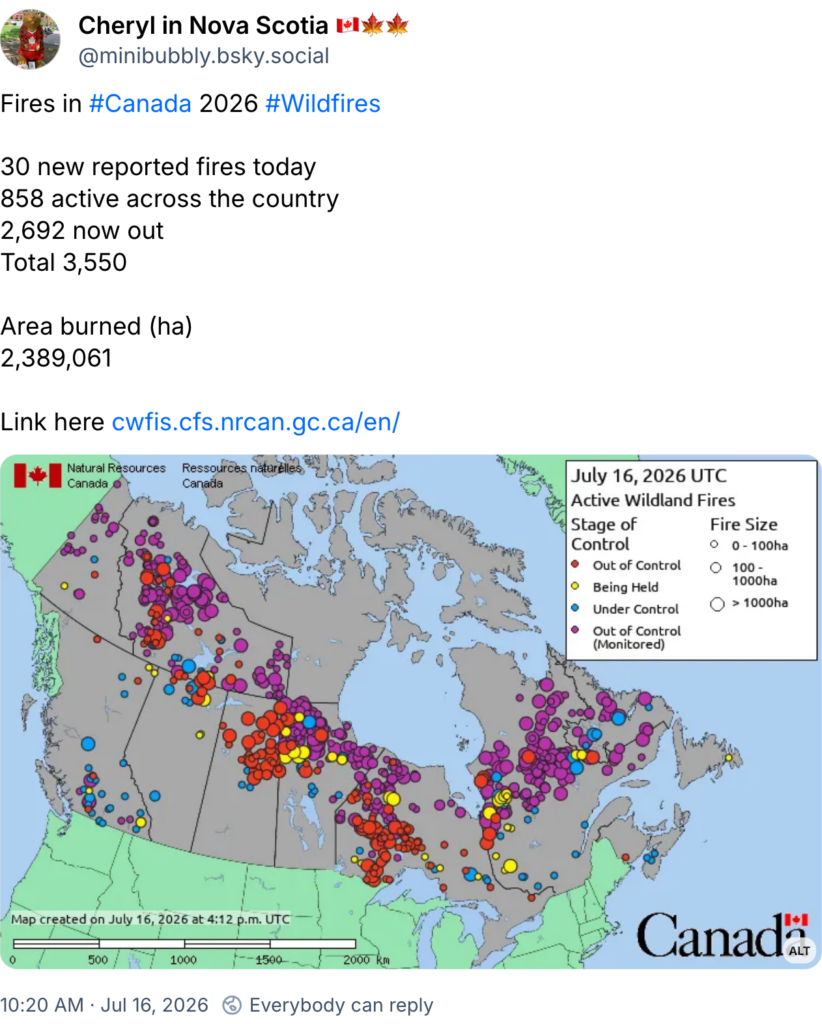
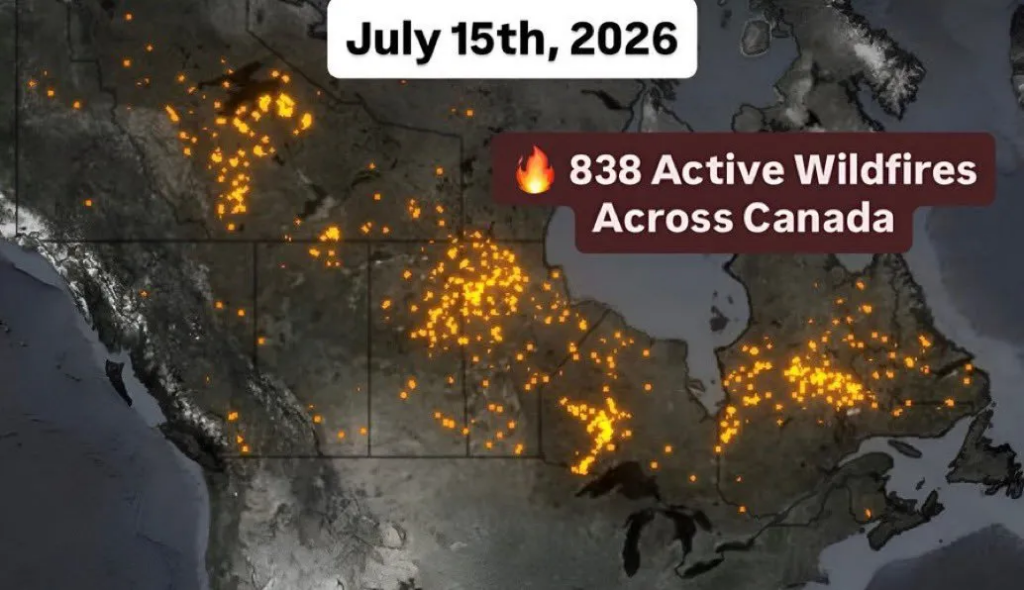
Fires in #Canada 2026 #Wildfires
30 new reported fires today
858 active across the country
2,692 now out
Total 3,550
Area burned (ha) 2,389,061
Link here cwfis.cfs.nrcan.gc.ca/en/
Columnist Wildfire Smoke Can Hurt You in Surprising Ways, Scientists are making connections between burning forests and a host of health problems, from dementia to premature birth. by Lisa Jarvis, Aug 26, 2024, Bloomberg
Lisa Jarvis is a Bloomberg Opinion columnist covering biotech, health care and the pharmaceutical industry. Previously, she was executive editor of Chemical & Engineering News.
Just don’t inhale. Photographer: Eduardo Munoz Alvarez/Getty Images
Spring and summer in the US now come with a new normal: days and even weeks where the acrid overhang of wildfire smoke forces us indoors. At its worst, not even shuttered windows can protect us from its effects — the stinging eyes, runny noses and burning lungs.
As the Earth’s climate warms, wildfires tear through a larger swath of land each year. As my Bloomberg Opinion colleague Mark Gongloff has explained, in some parts of the US, the fire season now stretches a month longer than in 1973. These more intense, longer wildfire seasons are pushing this specific brand of pollution into parts of the country not accustomed to orange skies and unbreathable air.
That’s compromising our health — not just when the smoke is thick, but for years after. Researchers are increasingly recognizing that wildfire smoke can bring health problems wherever it drifts.
Many of the near-term problems with wildfire smoke exposure are by now well understood.
The most serious, of course, is death. A recent working paper for the National Bureau of Economic Research estimated that the US would see nearly 28,000 more deaths each year by 2050 due to the climate-driven rise in wildfire smoke — that’s 76% higher than the average annual deaths between 2011 and 2020.
It’s Getting Harder to Breathe in the US
Cumulative wildfire smoke exposure per person
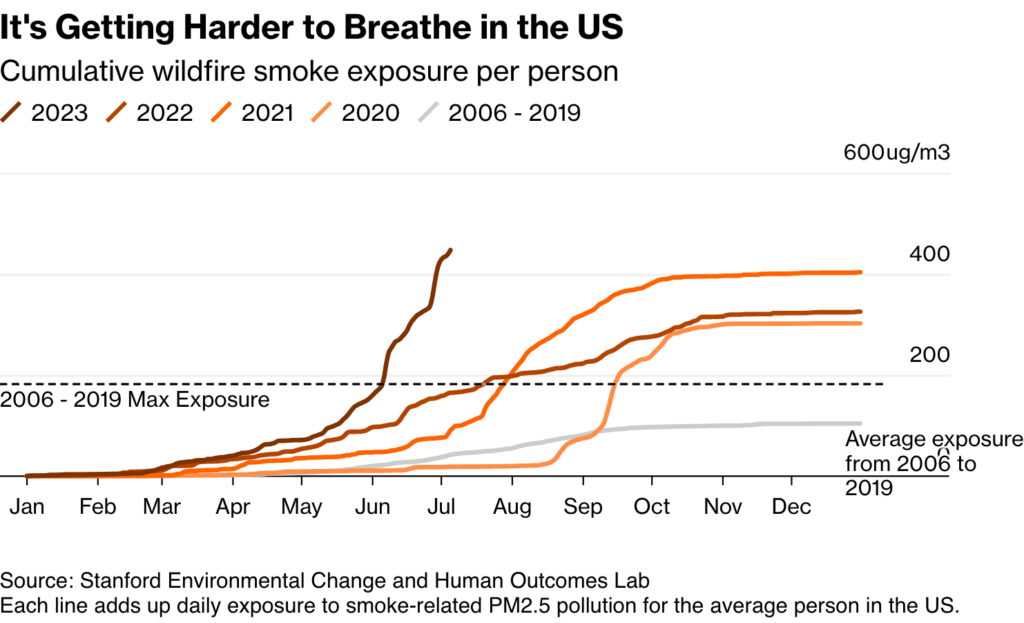
Each line adds up daily exposure to smoke-related PM2.5 pollution for the average person in the US.
Source: Stanford Environmental Change and Human Outcomes Lab
More of us experience milder but still serious consequences, like worsening asthma and debilitating headaches. When smoke from Canadian wildfires wafted thousands of miles to hang over large tracts of the US last summer, it led to a 17% rise in asthma-related ER visits, according to the Centers for Disease Control and Prevention.
More recently, less-obvious health issues have come to light. Multiple studies have found a connection between wildfire smoke and pregnancy complications, including preeclampsia (a form of dangerously high blood pressure) and premature births.
But unraveling the long-term health effects has been trickier. For much of the year, we aren’t exposed to any wildfire smoke, and then it can suddenly surge. “How the human body handles that and what the long-term repercussions are remain very understudied and somewhat unknown,” says Joan Casey, an environmental epidemiologist at the University of Washington.
And of course, we’re also exposed to other forms of air pollution that affect our health. Separating the impact of wildfire smoke from that of other pollutants has been challenging. One problem is that most air-quality monitors are in cities, creating a frustrating information gap for researchers. “We have these huge, rural areas where we really don’t know what the air quality is like — and that’s where people are often most exposed to wildfires,” Casey says.
Ideally, researchers trying to unravel the health impacts of wildfire smoke want to understand how often someone was exposed to the smallest particles, known as PM2.5, how intense the exposure was, and how many days it lasted. And then they’d want to follow them over time and compare to them to a similar group that has had the advantage of a smoke-free environment.
But nothing is ever that cut and dried in the real world. For example, wildland firefighters are an obvious choice, but less obvious is who they should be compared to, says Marshall Burke, deputy director of Stanford University’s Center on Food Security and the Environment. They could be compared to regular firefighters, but the two groups also might make lifestyle choices — take more risks or be more outdoorsy, for example — that could factor into their long-term health. Researchers can try to control for those differences, but “that’s really hard to do in a convincing way,” Burke says. Another limitation is that wildland firefighters, overwhelmingly White and male, don’t represent the US population at large
Nevertheless, researchers are finding creative ways to disentangle the effects of wildfire smoke from those of other pollutants. Recent work led by Casey, for example, linked geographical information to a decade of insurance data for some 1.2 million Californians over the age of 60. That allowed researchers to estimate how much of their PM2.5 exposure came from wildfire smoke compared to other forms of pollution. They found inhaling wildfire smoke raised the risk of dementia — a risk exacerbated by someone’s poverty level.
The best information would come from tracking people exposed to wildfire smoke over time. An ambitious project in Hawaii is studying people living near the wildfires that devastated parts of Maui in 2023. This kind of prospective study will take time to get answers, and also faces a challenge: it needs long-term, sustainable funding to keep tabs on people for decades.
While we wait for better data, the bottom line is that longer, more extreme wildfire seasons that blanket the country in smoke are bad for our health — in both the short and long run.
“Everything we found in our work, consistent with other work on air pollution more broadly, is that there’s no safe exposure. The more you get, the worse the outcome is,” Burke says.
So yes, we must more aggressively fight climate change. But we also have to help people mitigate the effects of smoke right now. Here, lessons from the pandemic can be reinforced. Wearing a high quality mask can greatly reduce your exposure outside. But we also need to pay much more attention to air quality where we spend most of our time: indoors. Investing in HEPA filtration for schools, workplaces and homes may be our best chance to give our lungs respite from the smoke.