
@MatthewBehren11:
Elbows UP does not include continued close collaboration with the most violent military on the planet. If, as Carney says, Canada is under attack, why are we co-hosting a war gathering with the head of US Pacific Command?
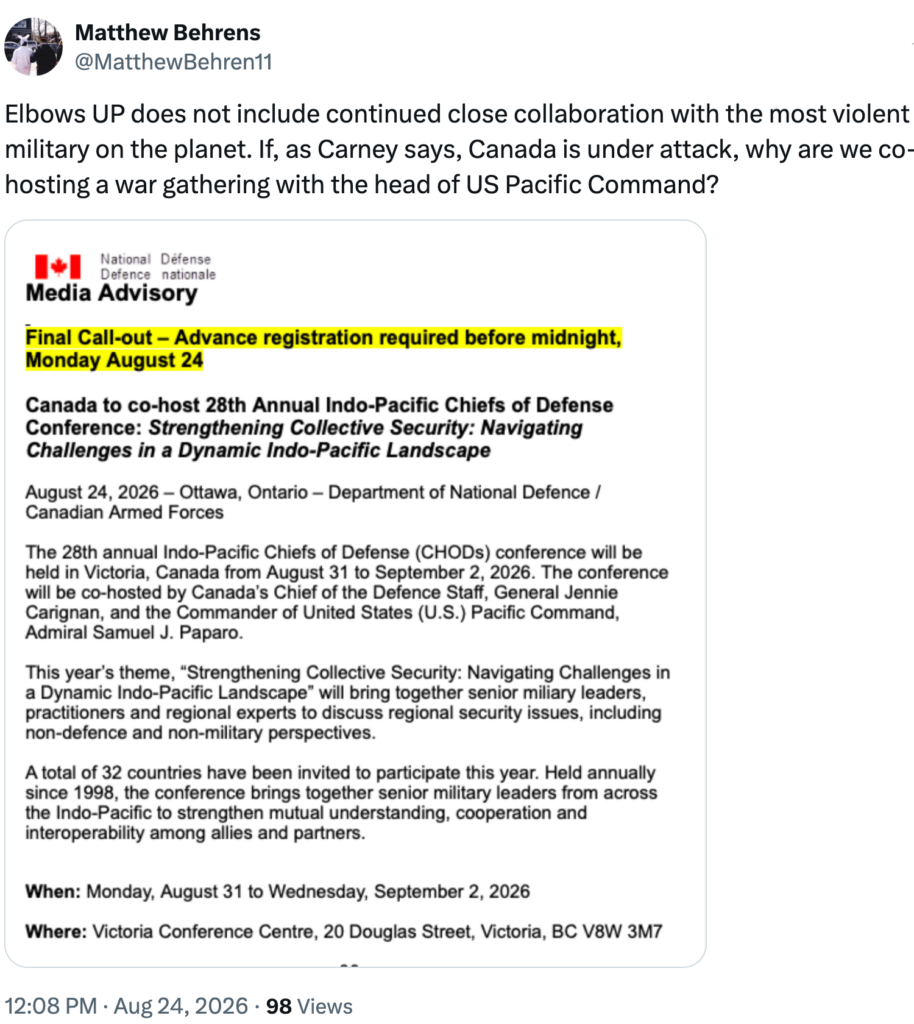
From: National Defence
Media advisory
Final Call-out – Advance registration required before midnight, Monday August 24
August 24, 2026 – Ottawa, Ontario – Department of National Defence / Canadian Armed Forces Carney stated we are under attack by USA two days earlier; plenty of time to cancel Carney’s diddling with the enemy.
The 28th annual Indo-Pacific Chiefs of Defense (CHODs) conference will be held in Victoria, Canada from August 31 to September 2, 2026. The conference will be co-hosted by Canada’s Chief of the Defence Staff, General Jennie Carignan, and the Commander of United States (U.S.) Pacific Command, Admiral Samuel J. Paparo.
This year’s theme, “Strengthening Collective Security: Navigating Challenges in a Dynamic Indo-Pacific Landscape” will bring together senior miliary leaders, practitioners and regional experts to discuss regional security issues, including non-defence and non-military perspectives.
A total of 32 countries have been invited to participate this year. Held annually since 1998, the conference brings together senior military leaders from across the Indo-Pacific to strengthen mutual understanding, cooperation and interoperability among allies and partners.
When: Monday, August 31 to Wednesday, September 2, 2026
Where: Victoria Conference Centre, 20 Douglas Street, Victoria, BC V8W 3M7
Notes to editor
Due to space and security considerations, a maximum of 100 media badges will be issued for the conference, including camera operators and producers. Media accreditation is required in advance.
Please consult the conference webpage for the registration details and information about media opportunities. The application period closes on Monday, August 24, at midnight. Applications received after this deadline will not be considered.
For questions, please email: email hidden; JavaScript is required
Contacts
Media Relations Team
2026 Indo-Pacific Chiefs of Defense Conference
Email: email hidden; JavaScript is required
Search for related information by keyword: Military | National Defence | Canada | National security and defence | general public | media advisories
Page details
Date modified: 2026-08-24
Canada ready to further distance itself from U.S. on military procurementReally? I bet ya Carney’s lying about this too., Trade war has strengthened resolve to boost military co-operation with Europe, Asia by Daniel Leblanc · CBC News · Aug 29, 2026
The flareup in the Canada-U.S. tariff war has not only strengthened Ottawa’s resolve to boost military co-operation with Europe and Asia — it’s also hurting prospects of major military purchases from the United States.
In an interview, the head of the Defence Investment Agency says the Canadian public would have no appetite for sole-source military contracts to American firms.
“That’s just me reading the room,” said Stephen Fuhr, secretary of state for defence procurement. “I think that would be a very difficult thing to do, especially after this last week. I think that people would not be happy about that.”
- Canada announces Defence Investment Agency to manage purchase, delivery of military equipment
- Ottawa to expand defence buying powers when national, economic security at stake
Canada’s retaliatory tariff response announced this week did not directly target the defence sector. However, Fuhr’s comments suggest a growing reluctance toward potential acquisitions of U.S. military hardware.
He added that Canada must not act as though relations will simply return to normal after U.S. President Donald Trump leaves office in January 2029.
While Canada has pledged tens of billions of dollars in additional defence spending over the coming years, it wants to put an end to the era during which 70 per cent of those funds flowed south of the border.
“We are in a situation that we didn’t provoke, we’re in a position that we don’t deserve,” Fuhr said. “We’re on the receiving end of this change, and it’s our job to look for new opportunities and pivot as fast as we can to meet the moment, and never put ourselves back in this position again.”
Canada ‘carefully considering’ its options
Fuhr still describes the United States as a key defence ally, but insists that Canada has learned the perils of “putting all our eggs in one basket.” Above all, he wants Canada to become increasingly self-reliant in terms of military production, or to forge new strategic alliances.
“So working with others who want to work with us and add value to what we’re doing, I think we’re carefully considering that a lot more. Again, not to diminish the relationship with our traditional partner, but things are different now, and it’s been very clear that the relationship that we had will be different moving forward,” Fuhr said.
Justin Massie, a military affairs expert at l’Université du Québec à Montréal, said Canada has no choice but to adjust its defence policy to align with the new American reality.
“The United States wants the burden of defending its allies to rest squarely on the shoulders of its allies,” Massie said. “They are tired of calling on American taxpayers to fund the defence of Europe and Canada.”
Richard Shimooka, a senior fellow at the Macdonald-Laurier Institute, says Canada will still need to find a way to keep working with the United States on continental defence, even as the country’s defence budget is heading to more than two per cent of GDP.
“Canadians don’t understand you can’t do this alone. We could have a 10 per cent defence budget and it wouldn’t be enough,” he said.
Fuhr did not single out any specific military project that might be delayed or stalled by the trade dispute.
Nevertheless, major military helicopter procurements currently in the works could be impacted, including a potential sole-source purchase of American-made Black Hawks, which are widely considered the preferred option for Canada’s special forces.
Furthermore, the results of a review of the planned purchase of 88 F-35 fighter jets, manufactured by U.S. defense giant Lockheed Martin, have yet to be disclosed, and Prime Minister Mark Carney has given no indication of his intentions.I bet he’ll betray Canadians and buy them. His actions show he serves Trump, American military and AI, polluters and the rich, while his words make his cult orgasmic.
Canada has placed a firm order for 16 F-35s and has begun paying for critical equipment for 14 additional aircraft, but there is currently no indication of how many fighters will ultimately be purchased beyond that initial count.
- Ottawa’s mixed fleet of F-35s and Gripens could total more than 100 aircraft, sources say
- Saab’s surveillance jet deal with Canada faces a U.S. stealth tech hurdle
Meanwhile, Canada remains interested in acquiring a second fleet of Gripen fighter jets, manufactured by Swedish firm Saab.
Ottawa is also in negotiations with Saab to procure GlobalEye radar aircraft, developed in partnership with Canadian manufacturer Bombardier, despite a lobbying campaign in favour of Boeing’s E-7 Wedgetail.
‘Thrilled’ with $2.3B Telesat contract
Fuhr added that he was “thrilled” with the recent $2.3-billion contract awarded to Telesat for Arctic military satellite communications. The project reduces Canada’s reliance on Elon Musk’s Starlink network, operated by U.S.-based SpaceX.
Fuhr said the federal government plans to continue doing business with Canadian subsidiaries of foreign contractors.
“We consider those folks in the tent,” he said. “They employ hundreds and hundreds of Canadians, they pay taxes in Canada, they have their headquarters in Canada, they do engineering in Canada, they retain IP in Canada — all that really matters.”
However, he pointed to growing discussions about the need to move away from strict U.S. controls over key military technology, which fall under the International Traffic in Arms Regulations (ITAR) framework.
“Is there a world in which we can operate with less ITAR restrictions? I think there is,” Fuhr said, citing expanded co-operation with partners across Europe, Asia and Oceania.
“Nobody can do it all on their own like the U.S. can. Let’s get real about this. But collectively we certainly can, and I think people are trying to move in that direction.”