
AI Bubble: ‘This could be OpenAI’s death spiral’ | Ed Zitron june 26, 2026, 40 Riveting Min by The Tech Report
“I think it’s very funny to see the plagiarism machine get plagiarized”
“Rich people are so goddamned stupid” … “The rich people don’t know what they’re doing”
“So we’re sitting on this series of time bombs and the fact the people with the money haven’t been asking the questions is genuinely dangerous.”
Ed Zitron joins The Tech Report’s Isaac Pound to talk about OpenAI delaying their IPO and the multi-trillion dollar tech stock sell off that has followed a souring in public an investors confidence in AI.
 I howled at Zitron’s response to tech report’s statement about investors wondering when AI will finally turn profit.
It’ll be a grand day when AI pops, and head-up-his-ass Mark Carney and his dear Brookfield lose their fucking minds and shirts
@garyerskine.bsky.social:
If your business model can’t survive without endless bail outs and subsidies of billions trillionsof dollars then it is not a sustainable venture and deserves to fail. That’s even before you get to the stolen data used to build said model and refusal to compensate artists and others fairly.
Anthopic, OpenAI Should Not Be Allowed to IPO, Says Ed Zitron MUST WATCH 11 min by Bloomberg Podcasts, June 2, 2026
Ed Zitron, CEO at EZ Primary Research, said that the risk of balancing the equity market on record public offerings for AI companies that have never reported profit is a dangerous proposition and that those companies should not be allowed to IPO. Zitron, an AI skeptic, said that many of these companies will not last in the long term.
@nikitagill.bsky.social:
Okay. Ai can go bankrupt then. This is not our problem, this sounds like a rich tech billionaire problem.
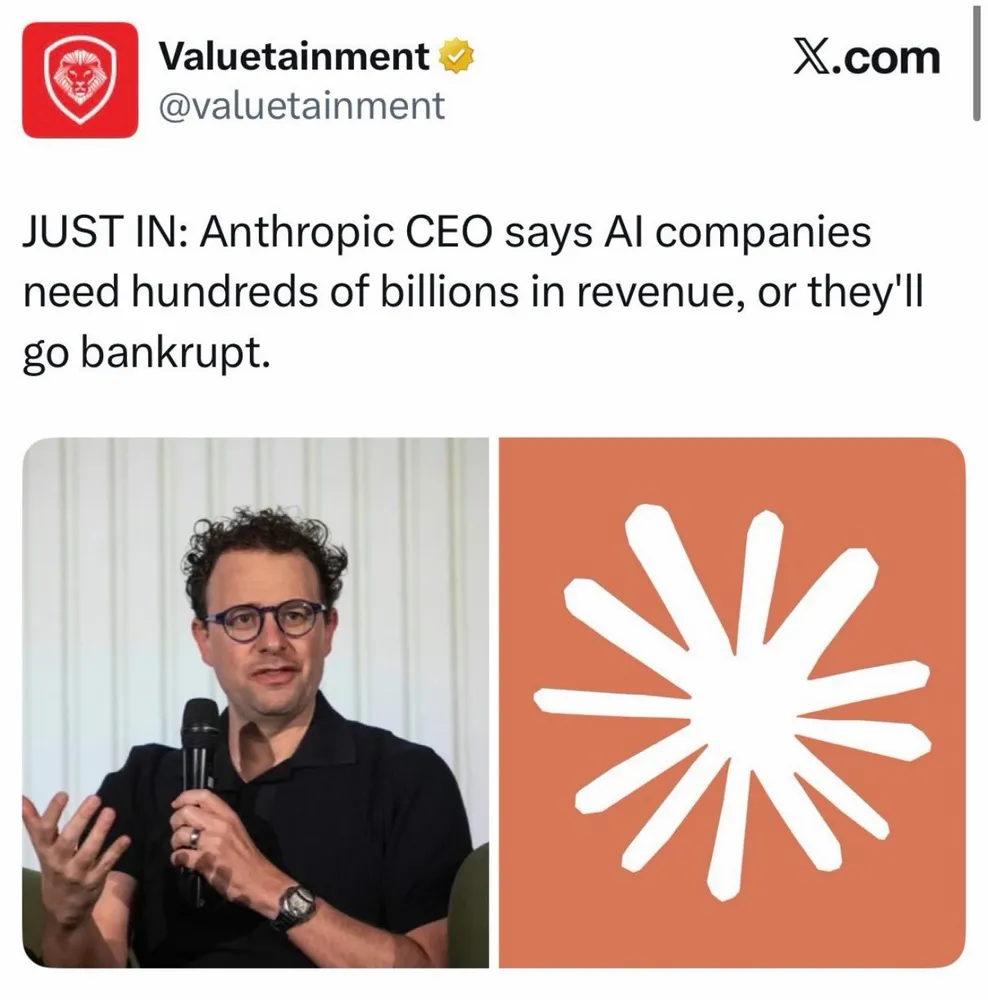
Is it “revenue” the Nazi AI billionaire shits want, or to steal from the commons to stuff more into their already too fat pockets
@neilturkewitz.bsky.social:
“The public seems to agree that DATA CENTERS ARE GIANT, UGLY, SMELLY ALTARS TO INDUSTRIAL-SCALE HOSTILE ARCHITECTURE.”
Brava @tressiemcphd.bsky.social That’s perfect. And this “hostility” isn’t limited to physical architecture. AI is hostile to our very humanity, borne of strip-mining our souls.
@parismarx.com:
It’s not Canadians that need to become more literate on AI; it’s Mark Carney. He needs to see the reality of the technology and the harms it’s causing to the people he’s supposed to serve, not just buying industry narratives based on hype instead of reality.I believe Carney knows the harms he’s inflicting on us all, notably kids. He wants to harm Canadians, because the more we are harmed, the more money is pals make. He doesn’t care about ordinary families, he only cares about rich polluters, Nazis, traitors (Danielle Smith and her separatists), and the fucking rich, eg Brookfield and its crass 100B investment in stupid stolen Nazi AI.
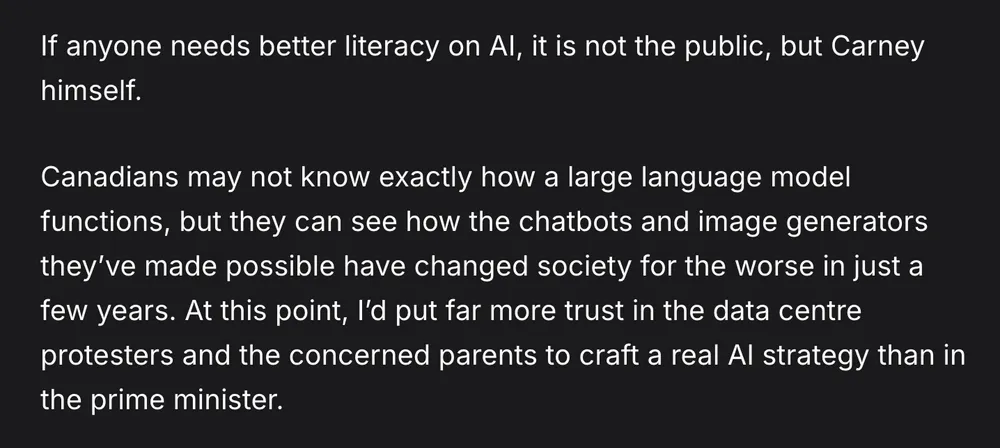
Canada is seeing growing opposition to the rollout of generative AI tools and to the data centers that power them, in the face of growing evidence of the social harm the technology causes.
But for Mark Carney and his AI minister, that opposition is unacceptable. Canadians must adopt AI, and they need to be taught why it’s so great for them: so the government is spending big to roll out AI education throughout society.It’s a dreadful waste by Carney, horrendously cruel and polluting.
Canadians’ skepticism is justified. Even as Canadian governments have sought to push chatbots on the public sector, they’ve been failing: giving incorrect tax information, making up parts of immigration applications, and recording incorrect medical information.
As the government pushes “AI for All,” companies are in the middle of pulling back on their AI spending because the return on investment simply isn’t there. They’re burning money and not seeing the benefits.
@noorlovelace.bsky.social:
Well, yeah. And a bunch of people will die because of it.

@anniegirl.bsky.social:
This has the potential to derail him because people the more AI is forced on people, the more they hate it. It’s not “illiteracy”. It’s the fact it’s being forced on us with no discernible benefit to us
Where are the rules and guardrails for the data centres? Where are the safeguards for the communities whose water rates and electricity are going to become massively expensive? Just to name 2things that are actually being ignored.
@adam-crocker.bsky.social:
Yes, this is a baaaaddd bandwagon to jump on, especially when it looks increasingly like a bubble industry.
@yulnative.bsky.social:
Especially when, so far, it’s all based on US models.
Many Western governments seemed to have bought the same BS and are making the same foolhardy mistakes.
@calvindragon.bsky.social:
Vichy Banker doesn’t seem to understand that he has an obligation to reduce unemployment, not to create more of it.
@snailbunnydesigns.bsky.social
These governments and so many other people consider those of us opposed to ai ignorant or ill informed when the truth is we know exactly what ai is about. God knows we do more research on the subject than others
@parismarx.com:
Governments are chasing AI investment, even as their publics turn against the technology and the data centers that power it.
Canada’s Mark Carney has chosen a shameless approach: to cast the opposition as a lack of “literacy” as he sets out to (re)educate Canadians about the benefits of AI.
@greggbeever.bsky.social:
The slop will continue until morale improves.
@snailbunnydesigns.bsky.social:
They hawk the “benefit” while ignoring the drawbacks. Ai js extremely detrimental to critical thinking.and that’s the main reason cons like Carney and Smith are forcing it on us all. Critical thinkers don’t vote stupidly like non critical thinkers in Alberta do, e.g. the separatists/Fucker Truckers swallow every fucking lie and all disinformation thrown at them by their handlers (eg Trump and Smith). It’s basically a machine that makes people more prone to misinformation that also kicks artists in the jimmies
@snailbunnydesigns.bsky.social:
For that matter I find it ironic that often the same politicians claiming ai is so wonderful for kids also see little issue in kids being banned from using social media til they are 16. I cannot fathom social media being any more dangerous than generative ai.
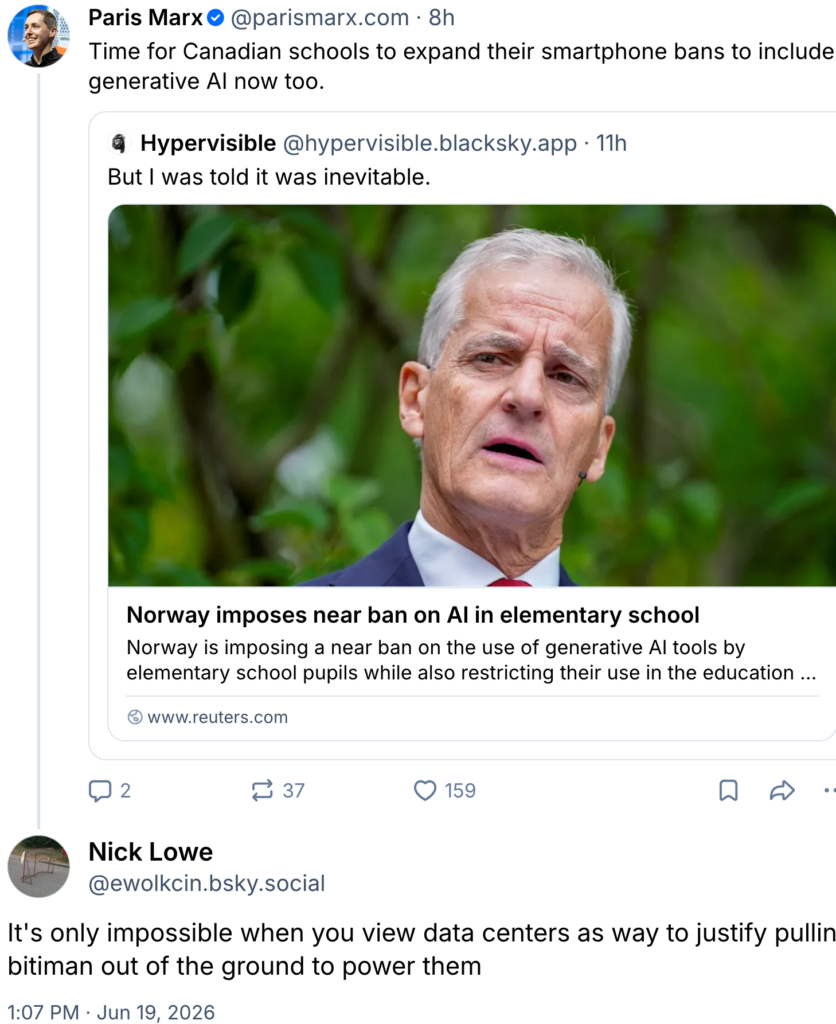
@snailbunnydesigns.bsky.social
Honestly this is probably one of the most blatant signs of tech companies bribing politicians I’ve seen, as even parents oppose this. Carney took on the job of conning the world to believing he’s Mr. Nice Guy, Mr. Environment, and became PM to rape Canada dry (his AI is fuelled by frac’d fucking polluting water destroying natural gas) because his Brookfield is betting big on fucking AI, cruel idiots that they are. I notice Carney isn’t pretending anymore to be anything but the cruel piece of fraudulent hateful Zionist genocidaire that he is. The con cruelty now screams from his eyes, like it does from Steve Harper’s and Trump’s.
@reyturner.bsky.social:
AI for all (menacing)
@melhogan.bsky.social:
door wide open for ndp to get it
@merrittk.com:
good evening, “Mark Carney” was a 15 month long sociological experiment conducted by the IMF. we are now complete with the study. thank you for your time
AI opposition isn’t the product of a lack of “literacy”, The many problems with Mark Carney’s AI strategy for Canadians
Don’t buy the AI hypeCanada, eh?
by Paris Marx, June 19, 2026, disconnect

Paris Marx is a Canadian tech critic and host of the award-winning Tech Won’t Save Us podcast. He writes the Disconnect newsletter and is the author of Road to Nowhere: What Silicon Valley Gets Wrong about the Future of Transportation.
Getting off US tech: a guide
Social media must be reined in How I became a tech critic
Around the world, governments are going hard to present themselves as AI leaders willing to do whatever the industry wants to attract investment.
Last month, I spoke to Will Dunn on Tech Won’t Save Us about how this is playing out in the UK, where the government has gone so far as to use chatbots to drafts laws. France has gone all in too, presenting itself as the third pole of AI leadership between the United States and China. Now, my own country is making its bid to join the fray.
Canadian prime minister Mark Carney rolled out his government’s AI strategy earlier this month, annoyingly titled “AI for All.” But in it, I saw something novel: not just the aggressive pursuit of AI dollars by giving industry what it wants, but also reframing opposition to AI and hyperscale data centers as the product of a lack of AI “literacy.” If only the Canadian public was taught to use AI tools, the strategy suggests, they’ll come around to backing them.
As you won’t be surprised to hear, I think that’s a poor judgement that misunderstands why people have turned against AI so aggressively. I wrote up my thoughts recently for The Tyee, a fantastic progressive publication based in British Columbia. They’ve been kind enough to let me share them with Disconnect subscribers.
In late May protesters marched through Vancouver in an attempt to halt two AI data centres that Telus is planning for the city.
They called out the massive energy demands to power all the computers inside the centres and the vast quantities of water that would be used to keep them cool, especially as the region faces water restrictions. The demonstration came just weeks after the federal government threw its support behind the project.
Of course, they were focused on not just data centres, but the chatbots and generative AI tools they were being built to power.
By early June, the Vancouver School Board started rolling out chatbot accounts for students aged 13 and over, despite the research suggesting it could affect students’ critical thinking skills and cognition, not to mention ongoing media reports about the effects chatbots have had on teens’ mental health.
Those details should have been red flags for administrators; they certainly were for some parents.
A group called Parents for AI Caution in Education Spaces is now seeking signatures to demand a two-year pause on the rollout of chatbots in Vancouver schools until there’s better data on the technology’s effects on students. Those ideas are spreading, not just in British Columbia but across Canada. But you might not get that impression if you listen to the federal government.
On June 4, Prime Minister Mark Carney rolled out his long-awaited AI strategy. Called “AI for All,” it laid out an ambition to invest in domestic AI infrastructure such as data centres, significantly increase the adoption of AI by Canadian businesses and begin to address some of the concerns with generative AI that are stymying what the government described as people’s trust in the technology.
The centrepiece of the strategy revolved around the concept of AI literacy. Carney acknowledged that trust needs to be established, which at this point is an understatement. Recent polling from the Angus Reid Institute suggests 68 per cent of Canadians want to see strict regulation of artificial intelligence, even if it slows development. But the prime minister is not seriously trying to address the concerns of those in the streets who oppose data centres, or of parents concerned about what chatbots might mean for their children.
Instead, the government is positioning the disconnect over the exuberance of industry — not to mention Carney himself and Artificial Intelligence Minister Evan Solomon — and the public’s skepticism as the product of a knowledge gap. The plan seeks to invest millions to educate Canadians on how to use AI, in effect increasing their “literacy” of the technology. They will give chatbots to every university student, train 90,000 young people to be advocates of the technology in small and medium-sized businesses, and equip more than 3,000 educators to provide AI training accessible by all Canadians.
The government acknowledges that the sector will need to be regulated, but the changes to privacy legislation, measures to protect children and their data, and restrictions on the production of deepfake images are only the tip of the iceberg of the concerns that civil society groups and many ordinary people have with generative AI.
Canadians are seeing their own social media feeds filled with AI slop and misinformation. They’re reading stories of people taking their lives after forming dependencies on chatbots. People who live in quiet small towns fear that proposed data centres will threaten their quality of life. Artists are seeing their work ripped off by AI companies. And who can forget how OpenAI refused to report the troubled 18-year-old shooter in Tumbler Ridge months before that devastating tragedy took place?
There’s so much more than a literacy gap leading Canadians to push back against having generative AI forced on them in so many areas of their lives. The government itself should know better. It has already tried to roll out a chatbot to give Canadians tax advice, only for the auditor general to find it provided incorrect information 66 per cent of the time. More recently, its use of generative AI in immigration was found to have denied a woman’s permanent residency application after the system made up parts of her submission.
Just weeks before Carney stood in front of medical workers from the University Health Network in Toronto to announce his strategy and talk about how beneficial AI will be in health care, the auditor general of Ontario had released a scathing report on AI scribes. Those chatbots, used to transcribe conversations between doctors and patients, are currently used by over 5,000 doctors in the province. But the technology sold as a means to save time had been regularly registering incorrect information and making up details about patients’ health. It was so bad that the AI scribes were recording the wrong drug prescribed to patients 60 per cent of the time.
This isn’t just a problem in the public sector. As Carney’s strategy seeks to boost business adoption of AI from 12 per cent today to 60 per cent in eight years, there are growing reports in the United States of companies pulling back on AI spending as the growing costs are not delivering the expected benefits or efficiencies. In May, the president of Uber even admitted that AI spending was becoming “harder to justify” as the company burned through its annual AI budget in just four months.
It’s clear that Carney and Solomon have bought the industry narrative hook, line and sinker. They seem to firmly believe that chatbots are the foundation of the next industrial revolution, but that claim is based more on faith — and the hype needed to boost the valuations of AI companies — than on hard data. In fact, it requires actively ignoring the stories of the very real harms of the technology that continue to pile up.
There’s a certain irony in the federal government’s belated focus on legislation to address the harms of social media, beginning with plans for a higher age limit to keep those 16 and under off the platforms — because even as that delayed online harms legislation moves forward, the age limit won’t be extended to cover AI chatbots.
We’re now playing catch-up on social media safety because we believed the companies’ narratives for far longer than we ought to have, and now our society is paying the price. Instead of being proactive on generative AI, the government is failing us all over again — all in the name of trying to attract some of the many billions flooding into AI investment to Canada.
If anyone needs better literacy on AI, it is not the public, but Carney himself.
Canadians may not know exactly how a large language model functions, but they can see how the chatbots and image generators they’ve made possible have changed society for the worse in just a few years. At this point, I’d put far more trust in the data centre protesters and the concerned parents to craft a real AI strategy than in the prime minister.
Dear Mark Carney: Feel free to grow a pair and deal with Donald Trump like this, you pandering little weasel.
@carlquintanilla.bsky.social:
MELONI: “.. Trump’s statements are completely fabricated. I’m frankly shocked. I don’t know why the president of the United States behaves this way towards his own allies, and it’s not the first time it’s happened.” @cnn.com www.cnn.com/2026/06/19/p…
***
Dank @dkildey.bsky.social:
Even if AI lived up to the hype; the people and organizations who control it and profit off of it should be enough to convince most of us to oppose any government involvement, use or investment.
@snailbunnydesigns.bsky.social:
Absolutly. Frankly i dont know how people dont see this. Its not like they are even trying to hide it anymore..
@mezentine.bsky.social:
I am very curious what, exactly, about generative AI survives the next three years. The Facebook backlash in the 2010s didn’t make a dent because Facebook was a wildly profitable company, but AI is facing a growing public revulsion without a strong financial footing.
The UK’s social media ban for under-16s has just empowered big tech, Age verification means that the sector’s biggest players will now have access to information that will only make them richer and more powerful by Taylor Lorenz, June 19, 2026, The Guardian
This week, the UK announced a wide-ranging ban on social media that will soon block users from communicating or accessing information on apps such as X, Instagram, YouTube, Facebook, TikTok and Snapchat unless they prove that they’re over the age of 16.
The prime minister, Keir Starmer, called the policy “a line in the sand”. “Tech giants had their chance and failed,” he said, “but we’re stepping in to protect children, back parents and set a new normal for future generations.”
All internet users, especially children, should be protected from exploitative systems online, but this new law will only foster more harm and help the largest and most powerful tech companies consolidate power and influence over everyone’s lives.
Details are yet to be confirmed, but in order to verify the age of a user, tech companies may require them to upload government ID along with an image for AI to verify. Soon, in addition to basic login information, tech companies could gather facial scans, detailed biometric data and highly sensitive info from millions of users. This is data that big tech companies previously may not have had access to.and which the Nazi tech billionaires are lusting to get their evil hands on, enter Nazis Carney and Starmer to hand it to them on silver platters we the public not only pay for, but suffer for.
The data is then used to build consumer profiles which are sold to advertisers for a profit or, more recently, used to train AI systems. To maximise profits, tech companies also use this data to deliver hypertargeted content to keep us engaged. Mark Zuckerberg explained this business model succinctly in April 2018 while being interrogated by members of Congress amid the Cambridge Analytica scandal. In response to a question from Senator Orrin Hatch, who asked how Facebook could possibly sustain a business model where users don’t pay for the service, Zuckerberg responded: “Senator, we run ads.”
All data is subject to protection laws when harvested and sold between companies, but it can also be stolen and exploited by bad actors.E.g The Alberta separatists who stole the private voter data of nearly three million Albertans, and worse, publicly posted it, and fucking gave or sold it to American Nazis to exploit. No one in authority and no politician, not Smith or Carney, are doing a damned thing to protect those citizens and our data. In my view, the separatists (especially their lying leaders and lawyers), tech billionaires and their maids, our politicians, are all bad actors, Nazis. Our gov’ts need to fucking regulate and or ban the bad actors, not ordinary citizens using social media and the Internet, but of course, corrupt gov’ts like Carneys do not want to do that because they serve America, American corps, and the rich Intimate user data can be weaponised against people in myriad ways, including for identity theft, blackmail, abuse, or by governments seeking to crack down on free expression. Children are significantly more likely to experience these harms under age verification.

Proponents of age verification will say that instead of allowing these big tech platforms to harvest and collect data themselves, they can be forced to leverage third-party ID verification software. But rewarding third-party age-verification vendors with potentially billions of dollars’ worth of new business only creates another layer of big tech. Third-party ID verification platforms are not separate from the powerful Silicon Valley ecosystem politicians claim to want to curtail.Politicians are lying when they say they want to curtail the power of the sick and evil Silicon Valley abusers; if they wanted to curtail that power, they’d fucking ban Elon Musk’s AI and ban all the other kid and women abusing AI, not regulate the citizenry with age restrictions and digital ID for ALL. Typical fucking Harper Cons like Mark Carney, regulate the abused, not the abusers. Persona, the leading third-party identity verification company, recently announced a $2bn valuation after its latest funding round co-led by Peter Thiel’s Founders Fund.
Despite such concerns, some advocates have been calling for the government to go further still and enact tighter speech restrictions alongside age gating. They correctly point out that many children will still access content by circumventing the age restrictions or gravitate to even more harmful, less-regulated spaces on the internet. So, they seek to ban objectionable content from being uploaded in the first place or restrict its distribution by seizing control of algorithms.
But restricting content does not undermine big tech’s core business model. All the major social platforms already abide by these types of censorship mandates elsewhere in the world and have shown repeated willingness to restrict content based on what a country’s government does or doesn’t like. They do this in order to retain a friendly regulatory environment and increase their scope, power and influence around the globe. In 2024, X suspended dozens of protesters’ accounts in India after threats of fines and imprisonment if it did not comply.
In 2020, Facebook agreed to mass restrict anti-government content in Vietnam after the government throttled its services. According to TechCrunch, the company made the following statement in response: “We believe freedom of expression is a fundamental human right, and work hard to protect and defend this important civil liberty around the world. However, we have taken this action to ensure our services remain available and usable for millions of people in Vietnam, who rely on them every day.”
Earlier this year, Meta and Snapchat began blocking the accounts of a slew of Saudi Arabian dissidents after orders by Saudi authorities. Meta told the Guardian at the time that when “something happens” on one of its platforms that is reported as violating local law but not the companies’ own community standards, the company may restrict the content’s availability in the country where it is alleged to be unlawful. Snapchat declined to comment. When governments have the ability to ask tech companies to monitor and censor content, there will always be the risk that authoritarians will use this power to suppress free speech.
If we actually want to curb big tech’s power and make the internet safer for us all, including children, we must start by passing comprehensive data privacy regulation. Effectively, the exact opposite of what these “online safety” policies propose. We must rein in big tech the same way we have always effectively reined in corporate power: through antitrust litigation and targeting predatory, exploitative and anti-competitive business practices. Removing big tech’s monopolistic control over our online lives would give adults and children access to a wider range of apps and online experiences tailored to meet their differing needs.