
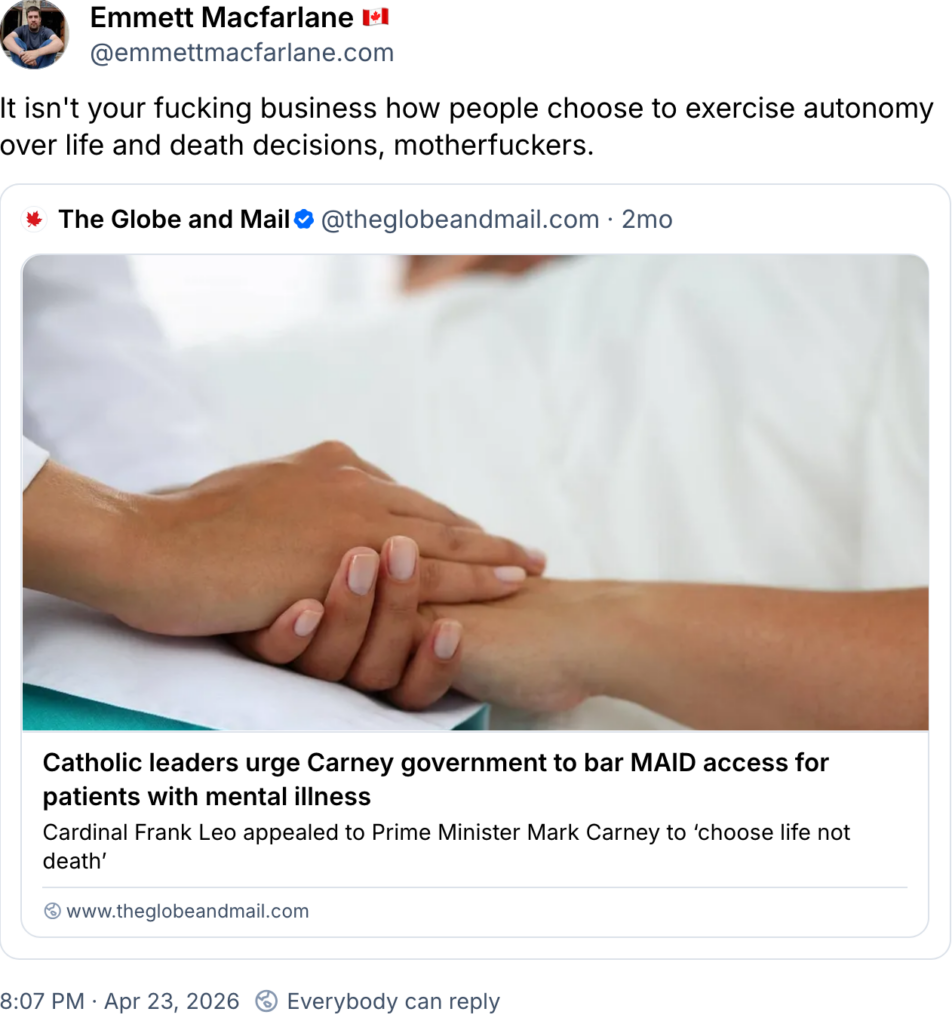
Emmett Macfarlane: It isn’t your fucking business how people choose to exercise autonomy over life and death decisions, motherfuckers.
@mrtmrsnrd.bsky.social:
We can’t continue to let the “pro life” movement get away with this bullshit branding.
They stand for “slow painful death” and “forced pregnancy”. That’s it. It’s mostly misogyny by the catholic church – women mostly tend to the dying, notably those dying cruel suffering decades worth of dying, and women risk their bodies and lives making babies. Pure catholic hatred and love of causing cruelty and suffering to others is why I believe catholics do not want Canadians to have access to MAID. Disgusting. but, I’ve never seen a religion that isn’t disgusting and cruel, especially to women and girls.
@clearwater2025.bsky.social:
If we fail to give support in a meaningful way- social support, housing, access to mental healthcare then we should be called out. Because our Canadian society/government does nothing we can be legitimately be shamed . So maybe your comments on autonomy in a crap system misplaced?Canadians voted for a Nazi Zionist to be PM – Carney, and he’s busy destroying our public health care so that he can steal OUR money to give it to fucking American Nazi military, American oil and gas, and kid and women abusing American AI. There will never be proper supports. Women, ordinary women, must do most of the care on top of taking care of homes and families, for no pay or benefits because fucking men do not want to share.
@emmettmacfarlane.com:
The failure to provide supports and whether people should lose access to MAID are two distinct questions. You can’t protect people by imposing suffering on others.
@apaltrysnow.bsky.social:
They need to spend time with some Alzheimer’s patients who wake up thinking they’re already dead. When you tell them they are alive and they ask where their wive is, you remind them that she’s dead. Bonus prize: you get to watch that person relive their grief everyday until they fall back to sleep.Just wait. COVID damages the brain and nervous system, badly, as do many pesticides like glyphosate, and fossil fuel pollution which is getting worse every day. Data centres are incredibly toxic polluters, many violate the regs and get away with it because the creators are fucking billionaires. Extreme heat and wildfire smoke also wrecks brains.
@tinkiegurl.bsky.social:
That was my mom it was heartbreaking to watch.
@apaltrysnow.bsky.social:
Currently living it with father in law. Proper restful happy times are in his dreams. Awake is his nightmare. It’s the worst to watch him relive shock and grief over and over and over again. To listen to him be confused over his own state of consciousness would humble any Catholic leader I’m sure.
@barbguise.bsky.social:
Let’s keep religion out of this!Too late!!!! Canadians voted a catholic PM. I fully expect him to completely take MAID away to please his religious masters.
@irish-druid.bsky.social:
I do wonder
who slid that nasty
clause into the mix
@drkristopherwells.bsky.social:
Picard is right again. There was no consensus and the final report and recommendation have no credibility.
André Picard @picardonhealth.bsky.social:
Politicians can’t seem to make a clear decision on MAID, so leave it to the Supreme Court. The committee report on MAID for mental disorders is a dog’s breakfast, and the court will weigh in eventually www.theglobeandmail.com/opinion/arti…But, WTF are we paying big wasted dollars in pay, pensions and expenses for politicians refusing to do their jobs? And, as intended by our disgusting cowardly religion and cruelty corrupted anti MAID politicians and anti MAID “experts” on panels, the courts will take years, perhaps decades, notably with endless interference by kid raping pro suffering religions, like the worst one, the catholic church, which will cause immeasurable suffering for many over many more years, which could easily be prevented if not for the religions and conservatives and catholic Carney lovingly in their “christianity” forcing suffering on us.

Look at the hideous inhumane religious douche fuckers in photo below. Unfuckingforgivable, as inhumane and disgusting as Danielle Smith 100% run by data thieving Nazi USA loving separatist Nazi fucks
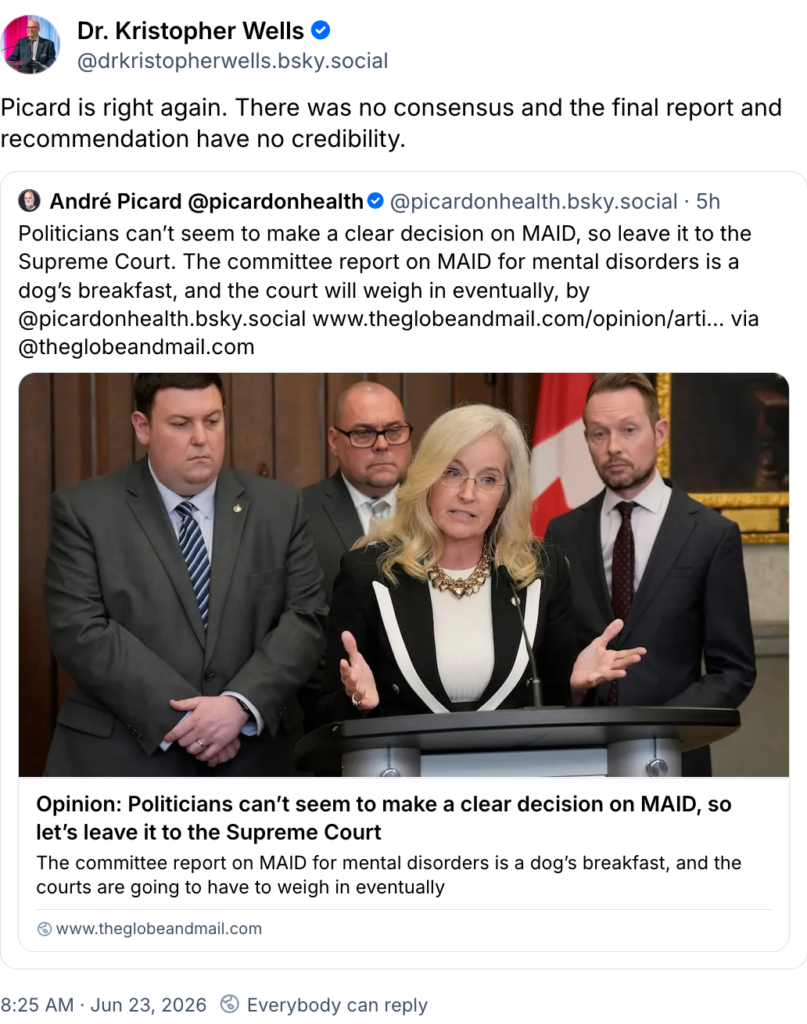
Politicians can’t seem to make a clear decision on MAID, so let’s leave it to the Supreme Court by André Picard, Health Columnist, June 23, 2026, The Globe and Mail
 Horrid abusive cruel suffering pimping Charter-violating dirt biased anti- Medical assistance in dying committee vice-chair Tamara Jansen speaks as members Andrew Lawton, Todd Doherty and Michael Cooper look on in the foyer of the House of Commons on Parliament Hill in Ottawa on June 17.Adrian Wyld/The Canadian Press
The 17-member Special Joint Committee on Medical Assistance in Dying has spoken. Its 88-page final report features a single recommendation: “That the Government of Canada amend the Criminal Code to indefinitely exclude persons whose sole underlying medical condition is a mental illness from eligibility for medical assistance in dying.”Which sane compassionate loving Canadians knew the biased clearly religion controlled and propagadized hate-filled “christian” fuckers were going to say.
The gist of the report is that Canada is not ready to offer MAID MD-SUMC, and likely never will be.

It’s a spectacular example of the “can’t do” spirit of our legislators. Several other countries, like The Netherlands and Switzerland, have figured this out. But we can’t?Of course we can, we could have years ago – there’s nothing to figure out, without paying any of these nasty religious fuckers our hard earned tax dollars, and without violating the charter rights of so many suffering Canadians. Fuckers!
Cruelty Pimp SupremeCo-chair of MAID committee defends recommendation to shelve procedure for mental health
The report focuses on two main questions: Can “irremediability” of mental illness be predicted accurately? Can clinicians distinguish between a rational request for MAID and suicidality?
The committee’s answer to those questions is “no.”Not because that’s the true answer, because these evil fuckers want suffering Canadians to suffer for no fucking reason but the hate and religion of these douche fucking anti MAIDers.
Yet, according to the Canadian Psychiatric Association, “clinicians are already required to conduct rigorous, individualized assessments to determine whether a person has the decisional capacity to make health–care choices,” and there is no reason they could not do so for MAID.
Accurately predicting how a disease will progress, whether it is cancer or bipolar disorder, is not a precise science but, by and large, clinicians can figure out if someone has a reasonable hope of recovery.
If someone’s treatment has failed for three decades – which is the kind of MAID MD-SUMC request we will see – you can pretty safely say their illness is “irremediable.”
Opponents of MAID like to pretend that people with a touch of the blues are going to walk in off the street and get a lethal injection, but the assessment process for Track 2 (not “reasonably foreseeable”) is already rigorous, and will be more so for MAID MD-SUMC. Experience from other countries tells us very few people would be approved.
The parliamentary report discusses at length the need for more and better access to mental health services. Nobody disagrees with that, but it’s not a reason to deny access to MAID.or to use to violate our charter rights FFS. Besides, we all know selfish extremely cruel bigoted religious politicians like Carney are slashing health care by $billions to give the money to fucking Nazi kid and women abusing American AI billionaires and oil and gas rich. Pray more, and god (which does not exist) will heal you they cruel ones love to abuse us with
As the group speaking for Canada’s 3,700 psychiatrists says: “The CPA emphasizes that mental disorders alone must not be used as a proxy for incapacity or vulnerability, and that people with mental illness deserve the same considerations and approach to health-care decision-making as all Canadians.”
Editorial: A beginning, not an end, to fixing MAID
The other problem with the committee’s report is that it leaves the impression that there is consensus, unanimity even.
But, in addition to the central report, which is a long summary of the “on the one hand, but on the other hand” testimony to the committee, there are five other “supplementary reports.”
Senator Pierre Dalphond, a long-time Quebec judge, says denying access to MAID for people with mental illness is unconstitutional. He suggests creating a “Track 3” in the law, where an independent review board determine if a person whose sole underlying condition is a mental disorder is eligible.
There is a dissenting opinion from four independent Senators calling the committee process “fundamentally flawed, highly irregular, biased, and lacking evidentiary rigour.”
The solution, for them, is to refer the proposed law directly to the Supreme Court of Canada to determine if it is constitutional, thus avoiding years of litigation.
There is a supplementary report from the Liberal Party (which seems to be penned solely by committee co-chair Marcus Powlowski) essentially repeating what’s in the main report but adding some eyebrow-raising opinions, including citing the Ten Commandments’ “thow (sic) shall not kill” and arguing that no one is being denied the right to die because they can always kill themselves, using fentanyl no less.
There is a supplementary report from the Conservative Party arguing that expanding the MAID law would be “reckless and dangerous,” but which mostly trashes the Liberals for going too far. It also urges the government to support Bill C-218, a private member’s bill that would prevent MAID for mental illness.
Finally, there is a dissenting report from Luc Thériault of the Bloc Québécois decrying the committee for being partisan and dysfunctional. He trashes the lone recommendation as “discriminatory and unconstitutional” and the committee’s majority for lacking the courage to refer the issue to the Supreme Court.
In short, it’s a dog’s breakfast.
What is Justice Minister Sean Fraser to do with this advice?
There is no question that, like every other MAID-related issue, the fate of the law will eventually be determined by the courts.
So, Mr. Fraser should get it over with and refer the issue directly to the Supreme Court.
Justices, after all, actually make reasoned decisions. Something our politicians seem to struggle with mightily.
An important statement from the Association of Quebec Psychiatrists rejecting the exclusion of persons with mental illness as their sole underlying medical condition. Grounded in principles of equity, respect for individual autonomy & existing clinical expertise. www.newswire.ca/fr/news-rele…
/CNW/ – L’Association des médecins psychiatres du Québec (AMPQ) prend acte des recommandations du Comité mixte spécial sur l’aide médicale à mourir concernant…www.newswire.ca
“A modern approach to mental health is based on individualized clinical assessment of situations and person-centered practice. These principles should remain at the heart of discussions surrounding the evolution of the Canadian legislative framework,” argues Dr. Gamache.
Shame on Alberta Views for “both-sidzing” the feds violating our charter rights by not preparing for the right of the mentally ill to access MAID. It’s not a fucking both sides matter, it’s our charter right to access MAID for suffering, and to prepare for dementia (expected to vastly increase as our gov’ts slather us with more and more toxic chemicals via AI, frac’ing, big brutal toxic agriculture, deregulating brain damaging pesticides, etc.) via allowing advanced directives. Fucking cruel corrupt cowards, interfering in our charter rights, from fucking coast to fucking coast to fucking coast.
Should we expand eligibility for MAID? A dialogue between Donna Wilson and Trudo Lemmens by Donna Wilson and Trudo Lemmens, July 1, 2025, Alberta Views
Donna Wilson says YES
Registered nurse and professor of nursing at the University of Alberta
I finished my first nursing program in 1976 and began working in hospitals. At that time, we were witnessing an explosion in life-saving medications and other healthcare technologies. It was so very exciting to think that people would no longer die of injuries and common illnesses.
What we now call “avoidable” deaths were normal occurences before today’s healthcare technologies became readily available. It wasn’t that long ago that life support became possible. Antibiotics only came into wide use after the Second World War. Canada’s first intensive care unit opened in 1958, but it wasn’t until the 1970s that all larger hospitals routinely had ventilators and heart monitors.
These and other lifesaving technologies were welcome, but a major issue quickly surfaced: the belief that physicians had a moral obligation to use these interventions, even if they were considered futile and even if the patient didn’t want them. Much broad-based concern subsequently arose over patient rights and persistent vegetative states.
The 1975 Karen Ann Quinlan case in the US brought these matters into stark view, as her physicians refused to stop her ventilator despite her irreversible brain damage. In 1976 her parents fought successfully in court to discontinue her ventilator. Quinlan lived another nine years in a coma in a nursing home because of daily tube feeding.
In 1984 the Canadian Nurses Association, Canadian Medical Association, Catholic Health Association and other legal/health groups issued the Joint Statement on Terminal Illness, saying “in conditions of ill health and inevitable death… no resuscitation is appropriate and ethically acceptable. It is also recognized that it is the patient’s right to accept or refuse treatment.”
Life extension remained the norm, however. My first research study in 1991/1992 was on long-term tube feeding, a common practice then in nursing homes and hospitals.
The turning point in Canada was our first widely covered “right to die” case, when Sue Rodriguez requested assisted suicide. Her request was denied in 1994, although four of the nine Supreme Court judges sided with her over changing Canada’s Criminal Code so that adults who wanted to die could have their death assisted by other people.
Additional citizen petitions to the courts led to the June 2016 legalization of MAID for people whose death was reasonably foreseeable. In March 2021 MAID eligibility was expanded, because more citizens petitioned for MAID access. Ill people who were uncertain about when they would naturally die gained the right to have MAID approved for later possible use.
Healthcare technology will improve and society will ever evolve. So it doesn’t surprise me that more people would like the right to apply for and receive assistance to end their life earlier than if nature took its course. We are each best able to determine if our own death is preferable to living longer.
Trudo Lemmens says No
Professor and Scholl Chair in Health Law and Policy at the University of Toronto
We need to refocus MAID on its original purpose: allowing patients who are approaching death to ask healthcare providers to end their life in exceptional circumstances. This means withdrawing Track 2 MAID, the consensual killing of disabled persons whose natural death is not reasonably foreseeable, and strengthening other safeguards, as urged by the UN Committee on the Rights of Persons with Disabilities.
When the Supreme Court ruled in Carter that an absolute prohibition on euthanasia and assisted suicide violated the Charter, it instructed Parliament to balance protecting people against premature death with some form of access to physician-assisted dying. Parliament therefore initially focused its MAID law on end-of-life, with reasonably foreseeable death as a crucial safeguard. It required unambiguous consent, irremediable illness, intolerable suffering and irreversible decline of capability. MAID was deemed exceptionally justifiable based on compassion for people suffering intolerably from irremediable illness, and to provide them more control over their dying.The SCC ruling did not limit MAID to only reasonably foreseeable death, that’s gov’t’s inhumane interference in our MAID rights, likely ordered by the cruel inhumane catholic church.
MAID promoters immediately pushed to stretch access criteria and challenged the end-of-life safeguard.They fucking did not. They merely did what humane humans do, to demand the law match what the SCC ruled our rights are. When a Quebec court ruled that providing MAID only at the end of life was unconstitutional, the federal government failed to appeal. They knew they’d lose, wasting taxpayer money and the court’s time. If they thought they had a fair chance of winning the appeal, they would have appealed.and instead rushed through its expanded 2021 MAID law, removing safeguards and allowing MAID for disabled persons whose death wasn’t reasonably foreseeable.JFC! Typical lawyer. Rushed? FFS. The feds did not expand MAID law, they fucking corrected it.
Canada now has arguably the most open-ended euthanasia law, with a record of 60,000 deaths.Humanely dramatically reducing horrific suffering in so many, and in their loved ones. Some 4.7 per cent of all deaths in Canada are by MAID, second only to the Netherlands. Most fall within Track 1 (foreseeable natural death), but many of these people may have had years of lifeunbearable suffering left. Since the expansion, more than 1,000 disabled persons have died under Track 2.Fantastic to see a tiny bit of humanity in Canada.
For MAID expansionists, high numbers are a success story. But reports from Health Canada, the Ontario Chief Coroner’s office and various media reveal that many people ask for MAID not due to irremediable suffering in dying but for suffering in life that must be addressed by adequate healthcare and social supports. Suicidal patients, often with intersecting physical and mental disabilities, with years or decades of life left if supported to live, are increasingly hastened to death by MAID.
Killing people or encouraging suicide remain prohibited under the Criminal Code, including for physicians. But the exemption for MAID has given health professionals discretionary powers to end life as a form of therapy, opening the door to abuse and overzealousness. MAID law, weak guidance and oversight, and aggressive MAID promotion have undermined the prohibition. It tells disabled people facing serious challenges that ending their life is a reasonable option. In the name of false compassion, it pushes people over the edge when they need support. It’s hard to imagine a greater social injustice. Further expansion of MAID is unconscionable.
donna wilson responds to Trudo Lemmens
MAID eligibility should be expanded to Canadians with diagnosed mental illnesses. Currently, we are in a three-year pause ending March 17, 2027, to prepare for this extension. After that, people with impactful mental illnesses will be able to request MAID. As in all MAID cases, by law, the requester must complete an application and be assessed as meeting all criteria by at least two nurse practitioners or physicians. MAID will continue to hinge on an autonomous and non-coerced decision being made for professional assistance to end one’s own life earlier than if nature took its course.
Before rebutting Trudo Lemmens, I’ll highlight two key reasons for this expanded eligibility.
The first is that people are the best judge of whether or not their life should continue. As a nurse I’ve seen many terminally ill and dying people awaiting death. They and their family really suffer. I remember one man telling me (before MAID legalization) he’d put down his dog when it suffered, but his sister, who was dying a terrible death, couldn’t have her suffering ended. We have better pain options now, but ill people still suffer in so many ways. The 2023 MAID report highlights two (almost universal) concerns of people who request MAID: loss of ability to perform activities of daily living, and loss of ability to engage in meaningful activities. This is understandable, as 95.9 per cent of MAID recipients had an end-stage illness—cancer in two-thirds of cases—with death immediately foreseeable. As a long-time palliative care advocate, I started to advise Health Canada in the 1990s on the need for hospices, as Canada lagged behind other developed countries in compassionate care options. We still do. The 2023 report shows that 75 per cent of MAID recipients received palliative care, but we lack support for high-quality home and nursing home deaths.
The second reason is that diagnosed mental illnesses have significant long-term effects. Unemployment is common, as is poverty. Over time fewer friends and family can be counted on, and adults living with a mental illness often end up homeless. Most live with multiple physical ailments as they age prematurely. These are people who are diagnosed with a mood disorder (major depression or bipolar), anxiety disorder, substance abuse disorder or another mental illness such as schizophrenia, eating disorder, obsessive-compulsive disorder, PTSD, attention-deficit/hyperactivity disorder or dementia. Most have the capacity to decide if death is preferable over continued life.
MAID is planned, controlled and openly reported; it is a safe and effective procedure for people who choose it.
Lemmens would “refocus MAID on its original purpose: allowing patients who are approaching death to ask healthcare providers to end their life in exceptional circumstances. This means withdrawing Track 2 MAID, the consensual killing of disabled persons whose natural death is not reasonably foreseeable.” His argument reminds me of ones used to try to prevent MAID legalization. Chief among them was the slippery slope fear: that we would become so accepting of killing people that we wouldn’t care or notice when disabled people are encouraged (or forced) to have MAID. Lemmens’s use of the term “disabled” illustrates this fear. The slippery slope has not materialized anywhere MAID is legal. MAID legalization means death-hastening is planned, controlled and openly reported; it is an effective medical procedure for people who choose it and who meet the legal requirements for it.
Lemmens’s wish isn’t reasonable, as many individuals and organizations support the 2020 amendment extending MAID to people who don’t have an evident death date. In 2023 there were 19,660 MAID requests, with 15,343 people receiving MAID, 2,906 dying before they could receive it, 915 deemed ineligible, and 496 withdrawing their request. Most people fear dying and death; having MAID as an end-of-life option is compassionate.
Going back to the 2016 policy would mean assisted death could only occur a few hours or days earlier than if nature took its course. Canadians would again know they need to suffer through almost an entire terminal illness. They’d need to be awake and alert at the time MAID was scheduled, so they could say or indicate they still want it. To achieve this last-minute consciousness, painkillers and sedation are often withheld.
It’s important to try to understand why anyone would have MAID limited to only those in such an advanced state of illness that their death is imminent. Lemmens is a bioethical theorist, not someone with evident healthcare degrees or healthcare employment to show him first-hand how much ill people and their families suffer. His use of the term “patient” is telling. That outdated term reflects subservience to healthcare professional dominance.
Lemmens appears to think MAID is too easy to obtain, something the annual MAID reports show to be untrue. I believe MAID should be available to all Canadians, including those with diagnosed mental illnesses.
trudo lemmens responds to Donna Wilson
Donna Wilson suggests MAID should be expanded because more people want to “receive assistance to end their life earlier than if nature took its course.” She further sees MAID as a response to a medical system otherwise excessively focused on stretching lives. This reflects common misconceptions about MAID and trivializes concerns about state-funded healthcare-provider ending of life.
The argument that legalizing euthanasia is needed to counter aggressive life-extension was once common but no longer holds. Respect for refusal of life-prolonging measures has been essential to medical law and practice for decades. More-holistic medical practices, particularly palliative care, emphasize quality of life and patient and family empowerment, not technology-driven life-extension. Unfortunately, the expansion and prioritizing of MAID risks undermining palliative care.
In fact, MAID via lethal injection (which is not just “receiving assistance”) medicalizes dying itself. This may be why some physicians embrace MAID so enthusiastically. Physicians can have trouble accepting that they have no “fix” for suffering patients. MAID gives them the illusion of medical control over dying, an event that otherwise escapes control. Rather than a reaction against technology gone wild, MAID is a technical way to deal with an essential human experience.
Wilson’s ethical justification that “people want it” also ignores the official justification for MAID as well as the complexity of healthcare and end-of-life decision-making, and the broader context in which choices are made.
No jurisdiction accepts choice as a sufficient basis for legalizing euthanasia. All have criteria that reflect how physicians can only offer it for compassionate reasons in exceptional circumstances. Even standard medical procedures aren’t justified solely based on choice. Healthcare providers must offer evidence-informed care that respects professional standards. Less risky procedures must be tried first. Brain surgery to control seizures is unacceptable, even if patients want it, if less intrusive options may work. Remarkably, Canada’s MAID law introduced death as therapy even when other options to ease suffering exist. Ending of life has become a consumer good “on demand.” This also lets society and our health system off the hook for failing to ensure timely care.
Broadly legalized MAID sends a message: death is prioritized over care for disability and disease-related suffering.
Over-reliance on “choice” ignores the complexity of healthcare decisions. For the UN Committee on the Rights of Persons with Disabilities, Canada’s MAID system’s reliance on choice “creates a false dichotomy.” Choices are determined by psychological (e.g., despair after a disabling accident), economic, cultural and social factors. Poverty, loneliness, power-differentials between physicians and patients, ableist attitudes—rampant in healthcare—family pressures and lack of timely care undermine choice. The Committee also warns that our MAID law sends a message that death can be prioritized in response to disability and disease-related suffering; that a life with disability doesn’t require the same protection against suicide.
Imagine what the 2027 introduction of MAID for sole reasons of mental illness—and its eventual expansion to minors—could entail. Unlike other diseases, many mental illnesses have suicidal ideation as a diagnostic criterion. The trajectory of mental illnesses is uncertain, and psychiatrists can’t reasonably predict who won’t get better. MAID is said to be needed for irremediable medical conditions in people with irreversible decline. But physicians would offer it to people who will likely get better with good mental health care, in which conveying hope is crucial. Imagine a 17-year-old with autism who struggles with depression and refuses care, believing no further option exists. MAID assessors could offer that person death as a form of therapy. Some would prudently explore other options. But MAID here is already dominated by providers who often seem to prioritize access over protection. Recent cases discussed in reports by the Ontario Chief Coroner’s office and in the media reveal that assessors without strong expertise in mental health care or complex conditions already approve or provide MAID to patients with such intersecting illnesses, including some with suicidal ideation.
An ongoing Alberta controversy shows how people can get approved for MAID even when doubts exist about their eligibility. The case involves a woman in her 20s who according to her father has autism but no clearly diagnosed irremediable illness. Neither health authorities nor regulators have been willing to intervene, even though half of the physicians in three subsequent requests for MAID deemed her ineligible, and questions abound about her lack of care and “doctor-shopping” for approval. Rather than expand MAID “because patients want it,” let’s investigate why people ask for it, how we can improve care, and how our existing MAID regime needs to be changed to protect people against premature death.
Cowardly inhumane fucker. The cruelty these asshats dispense to Canadians takes my breath away. They ought to be fired and put in prison for their obvious hatred against the mentally ill.
Co-chair of MAID committee defends recommendation to shelve procedure for mental health by Stephanie Levitz and Kristy Kirkup, June 19, 2026. The Globe and Mail

The co-chair of the parliamentary committee that recommended those with mental illness should have no access to medical assistance in dying said there should be greater scrutiny on how the system is working now.
Liberal MP Marcus Powlowski told The Globe and Mail in an interview Thursdaythat the committee’s conclusion that MAID should not be extended for mental illness was based partly on concerns about how the procedure is currently delivered to those whose death is not reasonably foreseeable.
Justice Minister Sean Fraser said Thursday he will review the committee’s recommendation and the evidence. The committee was not unanimous.
“The issue couldn’t be more personal, it couldn’t be more serious, and I intend to take the time to get it right over the summer,” he told reporters.
When MAID first became available 10 years ago, it was offered only to those whose natural death was imminent, so-called Track 1 cases. Later, eligibility for the procedure was extended to those with an incurable condition. There are far fewer of these Track 2 cases.
Mr. Powlowski said there may be people in Track 2 who ought to be able to have MAID. “But, I think the whole regime, the whole regulatory process, ought to be re-examined.”
MAID was expanded to that cohort in 2021, following a Superior Court of Quebec decision. However, the federal government delayed making access available to patients whose sole underlying condition is mental illness until 2023. Then they moved the implementation to 2024 and then to March 17, 2027.
The joint House of Commons and Senate committee of 17 was tasked with studying the issue ahead of the implementation deadline.
The committee started reviewing the matter in March and heard from 44 witnesses and received 32 written briefs, in addition to other correspondence.
Though the committee considered recommending another delay, their majority recommendation was that the Criminal Code be amended to “indefinitely exclude” people whose sole underlying medical condition is a mental illness.
Mr. Powlowski said there was no point in delaying again.
“I don’t think it would be very useful to, in two or three years, reopen this, because I don’t think anything’s going to change in two or three years.”
Mr. Powlowski said all MPs have heard stories, as did the committee during its study, from families frustrated by how easily their loved ones seemed to be able to access MAID under Track 2 parameters.
The Globe and Mail has reported on some of those stories, including a man who was assessed for MAID in a Tim Hortons parking lot.
Mr. Powlowski said in his view, the law as it is now is fairly permissive and some physicians assessing for MAID have “a fairly cavalier attitude towards taking a life.”
He is also concerned about a lack of transparency around disciplinary actions for physicians found to have improperly provided MAID, citing the refusal of some colleges that oversee physicians to appear before the committee.
Tamara Jansen, one of the Conservative MPs on the committee, also said the entire regime should be re-examined.
“We heard a lot of testimony that there are challenges in the system as it stands, and so then we think it’s really wise to review how things are actually working at this time,” Ms. Jansen saidon Wednesday.
To further delay or cancel the expansion of access, a new law would be required.
Concerns about MAID in Canada extend beyond some MPs.
Earlier this spring, Alberta passedlegislation to bar those with incurable conditions, but whose deaths are not reasonably foreseeable, from access to MAID. The samelaw also bars MAID for mental illness.
In March, 2025, the United Nations Committee on the Rights of Persons with Disabilities also recommended that Ottawa repeal MAID for anyone without a terminal illness.
TheUN committee said its main reason was that “inequality and discrimination cause and compound ‘suffering’ for persons with disabilities,” and that inadequate social supports can lead them to disproportionately seek advance requests for MAID.
The disability rights group Inclusion Canada has also called for the government to repeal MAID in Track 2 cases.
While the Liberal and Conservative MPs on the parliamentary review committee were unanimous in the recommendation not to expand MAID, the Bloc Québécois MP dissented. Four senators also disagreed.
The senators said the question of MAID eligibility for patients with mental illness should be referred to the Supreme Court of Canada.
They also criticized the committee process as “fundamentally flawed, highly irregular, biased, and lacking the evidentiary rigour required to inform policy on such a consequential issue of societal importance.”
Mr. Powlowski defended the committee’s work, saying the witness list was drafted in accordance with long-standing rules on how committees operate.you fucking cruel liar, the witnesses were fucking tainted, intentionally, to let the charter violations continue.

Cowardly responses on MAiD expansion by Dale Smith, , Routine Proceedings
It was not a surprise that the majority of the special joint committee on MAiD recommended that the government “pause indefinitely” on expanding access to those whose sole condition is a grievous or irremediable mental illness. The fix was in on this committee from the start—the chairs were both anti-MAiD advocates, and the Conservative position going in was to be against, while many Liberals have become squeamish. It was also no surprise to see that there were five supplemental or dissenting reports to the main report, most of them from senators on the joint committee, four of whom were keen to call bullshit on the process that was torqued, ignored certain expert witnesses, and where the biased chairs put their thumbs on the scale all the way through.
To be frank, there was a lot of cowardice on display. Those senators and the Bloc members all wanted the matter referred to the Supreme Court of Canada, because once again, MPs don’t want to have to make an important decision without being dragged, kicking and screaming, by the Court to do the right thing. There is a well-established pattern in this country, and it should surprise absolutely no one that they want to continue it. In addition, the position that people with a grievous and irremediable mental illness cannot access the same remedy as someone who has the same condition plus a comorbidity is untenable, and is going to be found to be unconstitutional when this is dragged through the courts, which it inevitably will be because the government is cowardly.
Finally, the notion that the federal government shouldn’t legislate in their area of competence—the Criminal Code—because provinces refuse to provide the necessary healthcare and social services makes this whole debate infuriating. Just about as infuriating as the federal government tinkering with the law of bail in the Criminal Code because provinces refuse to properly resource their court systems, which is where the real problem lies. So once again, people suffer while the provinces get off scot-free for abdicating their responsibilities, while the Liberals continue to backtrack on their being the “Party of the Charter.” What a sorry state we’re in.
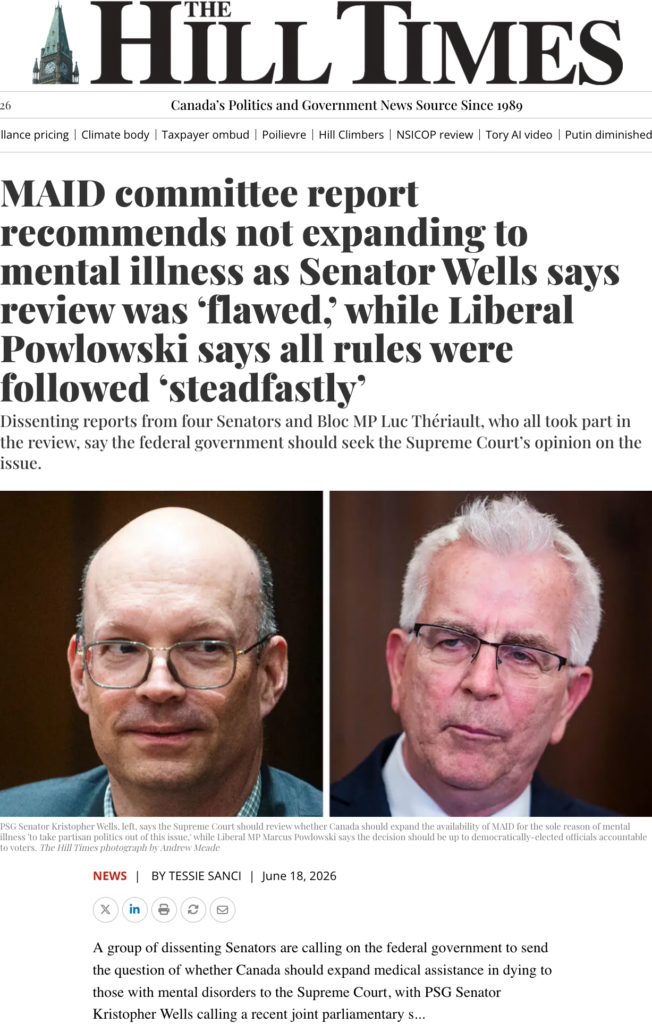
Canadian government should ‘indefinitely exclude’ people with mental illness from MAID, committee recommends, Government expected to take at least a few weeks to respond to parliamentary committee’s report by Jennifer La Grassa, CBC News, Jun 17, 2026
A special parliamentary committee is recommending that the federal government “indefinitely exclude” people whose sole underlying condition is a mental illness from applying for medical assistance in dying (MAID).
In a report tabled in the House of Commons Wednesday, the Special Joint Committee on Medical Assistance in Dying (AMAD) recommended that the government “amend the Criminal Code” to add this exclusion.
The 88-page report — which comes on the 10-year anniversary of MAID being legalized in Canada — reviews whether the country is ready from a clinical, health systems and regulatory perspective based on expert testimony.
- Why Quebec continues to shape the Canadian conversation around MAID
- Second OpinionRed flag or red herring? The numbers behind assisted dying in the Netherlands
The report says that a common theme across testimony was the “pressing need for increased and more equitable access to adequate mental health services.”
In their conclusion, the committee points to a “divergence of perspectives” on whether Canada is ready to expand eligibility to MAID to those suffering with mental illness.
It also notes that these mixed views existed previously and were partly behind their 2024 decision to delay the expansion.
WATCH | ‘We’re not giving up on them,’ says Conservative MP about MAID for mental illness:
‘We’re not giving up on them,’ says Conservative MP about MAID for mental illness
Duration 0:28Asked about those suffering with mental illness hoping for medical assistance in dying (MAID) expansion, Conservative MP Andrew Lawton One of the most cruel inhumane fuckers in gov’t said ‘I am so grateful that we “We?” So it WAS a predetermined sham of a cruelty dispensing committee have come to a conclusion that will not tell these people that we should be killing them’No one was killing anyone you miserable ugly lying fuck A special parliamentary committee released a report on Wednesday recommending the federal government pause the expansion of MAID for the sole underlying condition of mental illness.
Unless Parliament intervenes, MAID eligibility is set to expand to include people with mental disorders as of March 17, 2027. AMAD’s report will now be reviewed by the Canadian government and inform their next steps on this issue.
The committee started to assess the country’s readiness to expand MAID last February. In recent months, it heard from multiple witnesses whose testimony informed the final report.
“Conservatives support the committee’s recommendation,” said Tamara Jansen, MP for Cloverdale-Langley City in B.C., in a news conference after the report was tabled.
“This will save thousands of lives and this is the position that Conservatives have taken from the beginning.”
She said the core issues that led to this decision are that doctors cannot “reliably determine” that someone won’t recover from a mental illness and they cannot accurately distinguish a request for MAID from suicidality.
‘We don’t matter’
Toronto resident Claire Elyse Brosseau, who struggles with several mental disorders including bipolar type 1 disorder, substance use disorder and post-traumatic stress disorder, has spent years advocating for MAID to be an option for herself and others.
“Message received: we don’t matter,” Brosseau told CBC News in response to the committee’s recommendation.
“It’s just not right. I’m not sure why we don’t have equal rights or body autonomy.”

While Brosseau is seeking an exemption from the current legislation to allow her to receive MAID, she knows that’s not an option for everyone. She says she’s worried about what this latest development means for a number of people who have reached out to her and want access to MAID.
For others, the recommendation is exactly what they were hoping for.
Georgia Vrakas, a professor at the University of Quebec and clinical psychologist, says she feels “relieved.”
Vrakas has spent decades struggling with her mental health and says during some of her lowest points, she might have considered MAID had it been available. In 2021, she says she found out that she’d been misdiagnosed with depression when really, she had bipolar type 2 disorder. Now on the correct medication, she says she’s doing a lot better.
“It’s a sign for me that people understand that MAID is not a solution for mental illness,” she said.
Psychiatrists divided over issue
Canadian psychiatrists also remain divided on the issue.
Dr. Sanjeev Sockalingam, chief medical officer at the Centre for Addiction and Mental Health (CAMH), told CBC News that CAMH supports the committee’s recommendation.
He noted that without the ability to accurately predict the trajectory of an illness or distinguish suicidality from a MAID request, there isn’t enough evidence to move forward.
“We’re not disputing that people with mental illness are suffering,” he said, but added that for MAID eligibility to expand, there needs to be additional mental health resources and scientific research into diagnoses and treatment options.
WATCH | Liberal MP and committee co-chair discusses Canada’s MAID legislation:
People seeking MAID for mental illness should ‘seek psychiatric help’: Liberal MP
4 hours ago|
Duration 1:06Joint chair of the Special Joint Committee on Medical Assistance in Dying, Liberal MP Dr. Marcus Powlowski, said ‘nothing has changed’ in the end-of-life program as it still does not extend to people whose sole underlying condition is mental illness.
Meanwhile, Montreal psychiatrist Mona Gupta says not being able to fully determine the trajectory of someone’s illness is not unique to mental disorders.
And when it comes to determining suicidality, Gupta says health-care workers are making that call every day.
“What this committee is saying very clearly is that people with mental disorders are not Canadians on the same footing as other Canadians, that their rights can be dispensed with,” she said.
MAID expansion delayed twice
The government has already delayed making a decision on expanding MAID twice. MAID for mental illness was expected to begin in 2023, but that was delayed to the following year. The next year, it was delayed again until 2027.
Justice Minister Sean Fraser, who is taking the lead on the government’s response, is not expected to release an immediate decision about the expansion of MAID.
Earlier Wednesday, before the report had been tabled, Fraser said the government will review it over the next few weeks. But he will likely respond by July 11 — the deadline for feedback.
Fraser’s response may not end the debate.
WATCH | Justice Minister discusses reviewing committee’s report:
Fraser says MAID expansions have to be ‘informed by people’s personal experiences’
9 hours ago|
Duration 0:41Asked about Canada’s MAID expansion timeline, Minister of Justice Sean Fraser said ‘this isn’t easy work’ and the government is taking its time to listen to expert and personal testimonies before making a decision.
There are a number of court challenges related to MAID solely for mental illness that could eventually make their way to the Supreme Court of Canada, which would have the final say on the matter.
The federal government will have to introduce new legislation if it wants to indefinitely pause the expansion of MAID or put it on hold for another two years.
If it wants to avoid court challenges, the government could invoke the notwithstanding clause for the first time since its introduction in 1982. The clause allows governments to temporarily override other sections of the Charter of Rights and Freedoms.
On Wednesay, before the report was tabled, Fraser was asked if the government would consider using the notwithstanding clause. “My mind certainly doesn’t go to that place as a first option,” he said.
“I want to have an opportunity to actually understand the recommendation, to review some of the testimony, to engage with stakeholders across Canada to some degree on my own before we come to a conclusion on the next path forward.”
Some committee members call process ‘flawed’
While the majority of AMAD members agreed with the recommendation, others on the committee did not.
In a dissenting opinion within the report, senators Dr. Rosemary Moodie, Pamela Wallin and Kristopher Wells said the committee undertook a “highly irregular and flawed process.”
The senators said that of the 44 witnesses called to testify, more than two-thirds have been “publicly opposed” to expanding MAID for mental illness and that those with lived experience weren’t a priority.
“Simply put, a flawed and biased process cannot be relied upon and has resulted in a report that lacks rigor and credibility,” wrote the senators. “We stress this is not the way parliamentary committees are designed to operate.”
The senators recommend that the government “make a direct reference to the Supreme Court of Canada to clarify the law regarding the extension.”
When asked about criticism related to the process, AMAD co-chair Marcus Powlowski said Wednesday that there’s no way they could accurately represent that perspective by just selecting a handful of people.
He defended the committee’s work and said they “studiously followed the rules on selecting witnesses.”
Parliamentary committee recommends against MAID expansion for mental illness, MPs and majority of senators at odds, but report to produce one single recommendation by Olivia Stefanovich, Raffy Boudjikanian, CBC News, Jun 16, 2026
A special parliamentary committee will recommend that the federal government indefinitely pause the expansion of medical assistance in dying for people whose sole underlying condition is a mental illness, CBC News has confirmed.
The expansion of medical assistance in dying (MAID) is set to take effect on March 17, 2027, unless Parliament intervenes.
The Special Joint Committee on Medical Assistance in Dying (AMAD), with members from the Senate and House of Commons, started a comprehensive review of the matter last February to assess the country’s readiness to expand eligibility to MAID to those suffering with mental illness. Their report is expected to be tabled in the House of Commons on Wednesday afternoon — 10 years after MAID became legal in Canada.
Three sources with knowledge of the committee’s report who were not authorized to speak about it publicly shared details with CBC News on the condition they not be named. The National Post reported some of the details earlier.
One source said that the report contains a single recommendation: “That the Government of Canada amend the Criminal Code to indefinitely exclude persons whose sole underlying medical condition is a mental illness from eligibility for medical assistance in dying on the grounds that the evidentiary and systemic conditions necessary for safe and equitable implementation cannot presently be met.”
The same source said all Liberal and Conservative MPs on the committee agree there should be an indefinite pause, along with the joint chair Sen. Yonah Martin.
But the rest of the senators on the committee want the MAID expansion to go ahead, according to the source.
A different source said those senators have written at least one dissenting report, which could be “scathing.”
That dissenting report is expected to ask for a Supreme Court reference — an advisory legal opinion the federal government can request — on the matter.
The Bloc Québécois confirmed that their vice-chair, Luc Thériault, will also issue a dissenting opinion.
Majority of committee opposed to expansion
The majority of committee members believe the Canadian legal and health-care systems are not equipped to respond to the expansion of MAID solely for mental illness, one source said.
The same source said they were particularly persuaded to recommend an indefinite pause of the expansion after hearing about the experience of European countries that allowed MAID solely for mental illness, including the Netherlands, Belgium and Luxembourg.
- Why Quebec continues to shape the Canadian conversation around MAID
- Second OpinionRed flag or red herring? The numbers behind assisted dying in the Netherlands
The source said a pattern emerged of people requesting MAID who had experienced trauma, and were in abject poverty with no social support, which the source said governments should address.
Justice Minister Sean Fraser, who is taking the lead on responding to the committee’s report, is not expected to release an immediate decision about the expansion of MAID. But he will likely respond by July 11 — the deadline for feedback on the committee’s report.
Fraser’s response may not end the debate.
There are a number of court challenges related to MAID solely for mental illness that could eventually make their way to the Supreme Court of Canada, which would have the final say on the matter.
The federal government will have to introduce new legislation if it wants to indefinitely pause the expansion of MAID or put it on hold for another two years.
If it wants to avoid court challenges, the government could invoke the notwithstanding clause, which allows governments to temporarily override other sections of the Charter of Rights and Freedoms, for the first time in its creation since 1982.
Debate divisive in Canadian society
The House of Commons passed Bill C-14 on June 17, 2016, making it legal for doctors to help people with a terminal illness end their life. While the Senate attempted to expand the right to die beyond individuals whose deaths were considered “reasonably foreseeable,” those amendments were ultimately voted down.
More than 76,000 Canadians have used MAID since then, notes a federal report released in late 2025.
The Superior Court of Quebec deemed the federal MAID limits unconstitutional in 2019, leading to fresh legislation two years later which created separate tracks for accessing medically-assisted death.
- 10 years since MAID in Quebec, woman who fought to expand it hopes Canada catches up
- Alberta bill would limit medically assisted dying to patients facing ‘reasonably foreseeable’ death
The updated 2021 law, permitting medically-assisted deaths beyond terminal illness, temporarily excluded people whose sole underlying health issue is a mental health condition, leading to years of discussions among MPs, senators, and outside experts and advocates.
In 2023, the Liberal government extended the exclusion by one year. The next year, it was delayed yet again.
Quebec City-based psychologist and professor Georgia Vrakas, who has struggled with bipolar disorder and suicidal ideation herself — but opposes MAID’s expansion to individuals on the basis of mental illness — had testified at an earlier round of hearings in 2022.
“When people say they want to die, well, I’ve been through that,” Vrakas said.
She noted that calling a suicide prevention line helped remind her that life was worth living and allowed her to later connect with psychiatric support. She questioned if governments would continue making investments in those kinds of mental health services if MAID became an option instead.
“If we offer [MAID] to mentally ill people, the message we’re giving is that you’re disposable … and we’re not giving you the help you need.”
MAID advocates challenge religious exemptions at B.C. Supreme Court
But Dying With Dignity Canada — a pro-MAID organization — argues that excluding people with mental illness violates their Charter rights.
“It’s time that the law changed,” said Helen Long, Dying With Dignity’s CEO, who spoke to CBC News before the committee’s recommendations became known.
- Family of woman forced to transfer facilities for medical assistance in dying takes case to court
- Toronto woman who wants to die says federal MAID committee isn’t listening
She’s calling for the exemption to be lifted and says her group will continue doing all it can to ensure that “at some point people with a mental illness have the same access to [MAID] as everyone else in the country does.”
Long’s group is fighting a battle in Ontario courts over the issue.