@consbegone.bsky.social:
We never got to the bottom of how Cons across Canada and in the US backed this attempt to overthrown our government. Not a single Con showed up to the inquiry and they were just allowed to get away with that.
How I Faced Off Against the Freedom Convoy—and Won Over Its Supporters, Some even apologized and broke down in tears by Alex Silas, Jul. 13, 2026, The Walrus
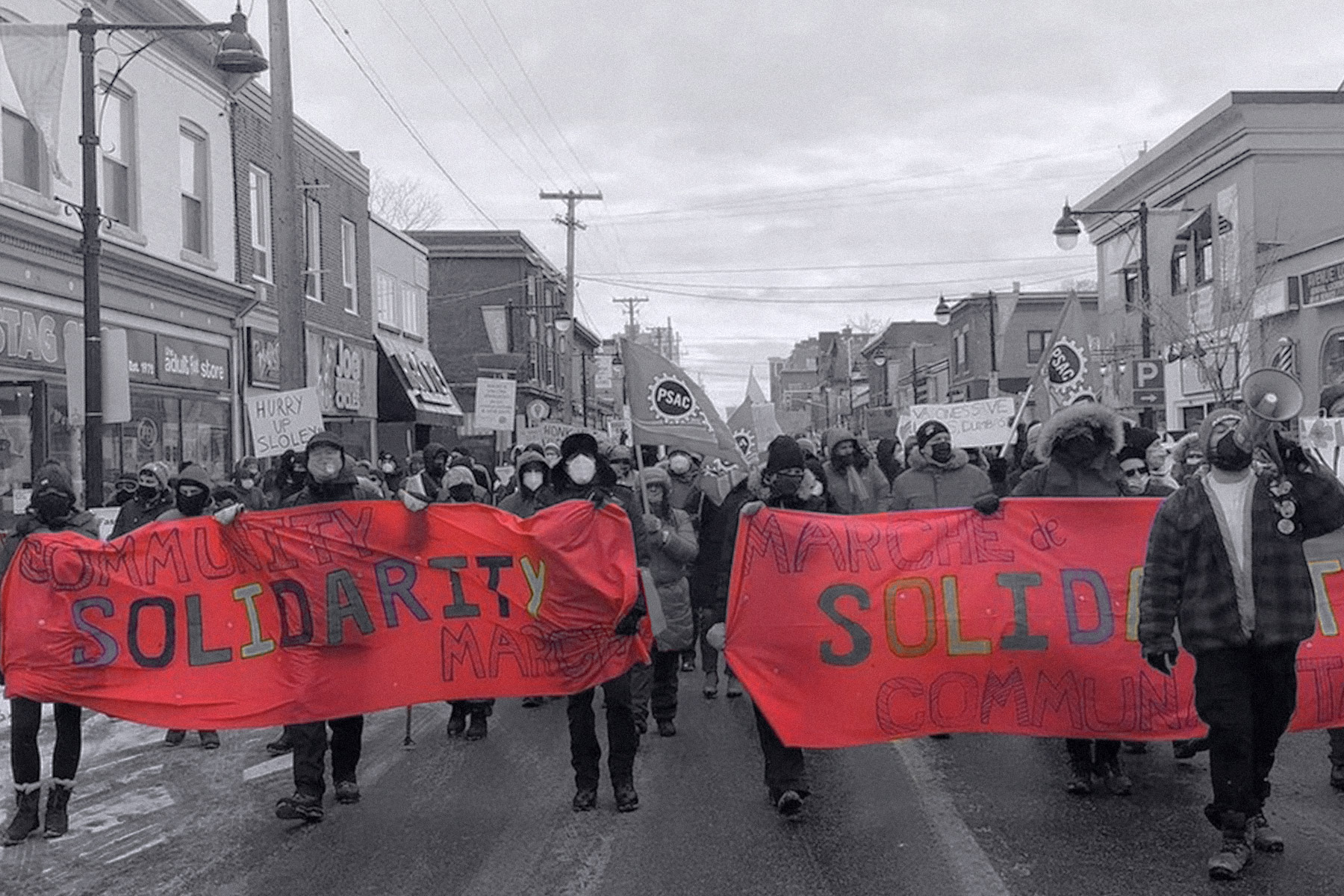
Photo courtesy of Alex Silas / University of Manitoba Press / Alana Enahoro
He reminded me of a cousin. Or an old friend back home. Early thirties, construction boots, plaid flannel jacket, scraggly beard. He reminded me of myself in a way. In a different world, we could have been friends. But at that moment, we were standing firmly on opposite sides of a line. One side could not understand why we didn’t relate to their anxieties and anger about forced COVID-19 measures, mask and vaccine mandates, and the mishandling of the pandemic. They felt that their concerns were ridiculed and shunned. Eventually, some people became radicalized by a far right that gave voice to the frustrations they were feeling. How did we not understand?
While our views may have been framed differently, on both sides of the line, we shared the same frustrations about the failures in leadership shown by different levels of government. The crisis in long-term care, the chronic  provincial, most and most nefariously (to force destruction of Canada’s Public Health Care) Alberta’sunderfunding of health care, the lack of support for low-income workers—all systemic gaps laid bare by the pandemic. While a common frustration was shared, specifically that those in charge weren’t working in our best interests, we did not find common ground. We did not find a space to foster collaboration and growth. What was missing was the capacity to build working-class solidarity, to break through the political noisenotably from selfish racist religious terrorist misogynistic Alberta separatist fuckers, previously Fucker Truckers, and GOP USA (now gone Nazi) dark money that funds/funded them that seeks to divide us and keep us down. We lacked the capacity to form a common understanding that would be resilient to the forces trying to pull us apart. Instead, divisions were fomented and fortified, and we were driven further from one another.
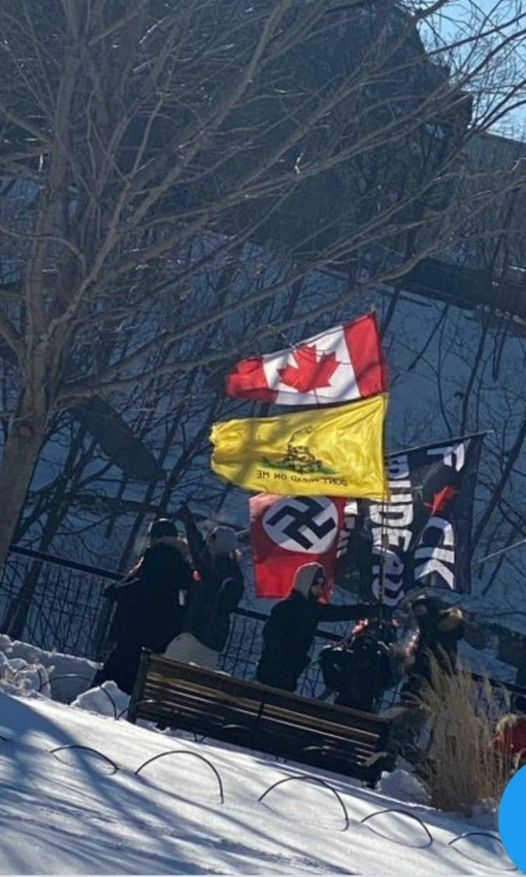
On our side of the line, we couldn’t understand either. How could they be so full of hate? Why didn’t they understand that they were terrorizing our communities? That they were making people feel unsafe? That they were part of a white supremacist and fascist movement of hate? That they had actual Nazis on their side!? How did they not understand?
The main thing we wanted them to understand was that people had had enough of being terrorized. We were done. The occupation had to end.
The so-called Freedom Convoy rolled into Ottawa on Friday, January 28, 2022. When you live in Ottawa, it’s not uncommon to have a lot of groups come through to hold actions at Parliament Hill. In fact, we had seen a precursor to the convoy in 2019 with United We Roll, a smaller convoy-type mobilization with a pro-oil populist message.financed by the oil and gas industry, FFS. These angry selfish con fuckers never pay for their own rolls into Ottawa in big rigs. Others pay. That’s why I see them as greedy-assed paid traitors, not protesters
Whether or not United We Roll was actually ever about being pro-oil,FFS! The Yellow Vester Fuckers were paid by Big Oil, and I bet by American dark moneyit morphed into something else. The Freedom Convoy certainly was not about oil, but it was not about vaccines or masks or freedom either.Of course not! It had nothing to do with COVID, it was organized and financed by USA dark money and wanna be American traitors like Tamara Lich to divide and conquer Canada to make it easier for USA to invade and or get masses of billions of our tax dollars like worse than Harper Mark Carney is now eagerly giving to the fucking kid raping Trump Nazis. Mainstream conservative politicians and the right-wing political establishment have also contributed to the rise of the far right by welcoming this new political energy and, in so doing, normalizing extremism. This has resulted in the rancour that has spilled out into our political discourse and at our family and social gatherings.It’s classic divide and conquer just like is used so very successfully by the oil and gas industry, and frac’ers.
I agree with the sentiment that there are political and corporate elites who don’t represent the working class or have our best interests at heart. Many of us across political ideologies and from different backgrounds feel that. The problem is that instead of having a place within the progressive movement where that sentiment can be nurtured to propose solutions that put people first, working-class people are being pushed further into anti-social thinking by those very same corporate and political elites that are motivated only by profit.
In February 2022, our focus was solely on navigating our way out of this crisis and keeping our communities safe. Our city was besieged by a convoy that had expressed and shown itself to be violent.I was repeatedly physically painfully assaulted by Fucker Truckers just because I was wearing a mask to protect myself and the vulnerable in my community. I know I’ll never receive any apology from sleazy Fucker Trucker/separatist lawyers (eg Keith Wilson, Jeff Rath et al)Businesses and homes flying pride flags were vandalized. Businesses owned by people of colour were targeted. Women were harassed walking down the street, and there was attempted arson and sabotage of low-income apartment buildings. To make matters worse, we also had to deal with the fact that downtown-core residents were abandoned by those in authority.Doug Ford, in my view, loved the Fucker Truckers and is another eager wanna be Repuglican traitor. He played the part well, doing nothing, while police were filmed aiding law violations by the Fucker Truckers.
When the convoy arrived in town, it seemed from all appearances that the City of Ottawa rolled out a welcome mat.They did! It was obvious. All to stupidly abusively “own the Libs.” The contrast with police behaviour at other events is pretty jarring. In 2020, a group of Black Lives Matter protesters occupied one street corner in Ottawa. That occupation lasted thirty-six hours. The Ottawa police told the protesters they would respect their right to protest—and then they proceeded to raid the small encampment and arrest everyone in the middle of the night.
Comparatively, when the convoy rolled in, the Ottawa police helped guide the protesters to Parliament Hill by directing traffic. Officers posed for selfies and spoke favourably about the convoy on livestreams. police even aided the bringing in of fleets of jerry cans filled with fuel for health harming Fucker Truckers to keep polluting and blaring their horns and bringing in and dangerously stashing many propane tanks for heaters. The City of Ottawa even went so far as to set up porta-potties for participants. I’m a labour leader and an activist. I go to a lot of picket lines. When I see the City of Ottawa or any other government entity set up porta-potties for striking workers, I will let you know, but I won’t hold my breath.
We also heard contradictory messages: the protesters were “peaceful” but also too dangerous to clear out. The mayor’s now-infamous advice for residents was to “avoid downtown,” which neglected the tens of thousands of people who live and work there. These were the people subjected to constant noise, harassment, and intimidation.
What we’ve now learned through the Emergencies Act inquiry is that the city was running public-opinion scenarios through predictive artificial intelligence software and decided that taking police action might not poll well. Rather, they ignored the interests and well-being of downtown residents.
Child care centres and libraries were shut down. Hospital workers and shelter workers reported being harassed. Restaurants and malls were shut down. Businesses and homes were vandalized. And the deafening noise from the truck horns’ blaring was incessant.
An important lesson had to be learned, a lesson we already knew but needed to acknowledge once again: we were going to have to be the ones to keep ourselves safe. We felt an urgent need for coordinated action. In short, we needed to build a coalition that could support and amplify each other’s efforts. Eventually, we came to the consensus that we should plan a march. People were frustrated, anxious, tired, and angry. They needed a solution.
We also wanted to show the community we’d be marching through that we were different than the people in the convoy. We were there in solidarity with them, not to make their lives more stressful. In our organizing, it became especially important to consult with the communities most affected and targeted by the kind of extremism and hate we were up against. We set out with a positive message calling for genuine solutions to address the gaps laid bare by the pandemic, the real anxieties people were feeling, and the frustrations at the mishandling of the pandemic response across all levels of government.
We called for fourteen paid sick days, a livable minimum wage of $20 per hour, strengthening health care and public services, ending the crisis in long-term care, and immediate support for workers impacted by the convoy. And we opposed ourselves to the far-right extremism terrorizing our community. In organizing a counter-protest, we hoped to not only be counter-convoy but to truly propose an alternative to the convoy’s narrative. A counter to the convoy. We didn’t want just to be against something. We wanted to be for something.
The day of our Community Solidarity March—Saturday, February 12—was a beautiful one. Thousands of people marched down Ottawa’s Bank Street draped in pink scarves, holding signs with positive messages, playing music, and chanting in support of our community. All centred on a message that “love is stronger than hate.” And people on the street applauded as we walked by. Neighbours opened their windows to cheer for us. I had never been part of a demonstration like this. It was an uplifting day. It’s a powerful thing: labour and community forming coalitions to fight for people and for progress. It was in the air. You could feel it. We marched through our streets. We opposed the convoy. We sent a powerful message. And we kept everyone safe.
I was at the head of the march, and my role on the surface was to keep chants going on the megaphone, to keep the energy up, and to lead the march down the street. In addition, I was also designated as one of the lead marshals, keeping lines of sight with marshals up and down the march, staying in radio communication, and maintaining an awareness for potential threats. I managed to keep my stress under the surface and got pretty good at timing call-and-response chants so that I could check in with marshals during the “response” parts. “Show me what solidarity looks like! This is what solidarity looks like!” gave me about three seconds to quickly tell marshals to keep an eye on something. I don’t think I let myself feel the positivity of the day until the march ended. I couldn’t afford to. I had to stay switched on and security minded.
Once the march ended and we knew everything had gone well, the rush of emotions hit me like a wave. The organizers exhaled a collective sigh of relief after a seventy-two-hour organizing sprint to make that day happen, and we all looked forward to finally having a day off on Sunday. Or so we thought.
- How the Freedom Convoy Broke the Emergencies Act
- Canada’s Far Right Is Getting Bolder
- Ottawa’s Response to the Trucker Protest Was Doomed from the Start
I woke up that Sunday morning of February 13, 2022, to a text saying, “Go to Bank and Riverside” in Ottawa South. That was it. When I arrived at Billings Bridge, there were about forty people there blocking roughly forty vehicles: cars and trucks. From what I understand, the plan for the blockade actually started in a neighbourhood dog-walking group chat—another inspiring example of citizen action. The atmosphere at that time was mostly festive. We still had our sound system from Saturday, so we set it up. Neighbours brought coffee, snacks, water bottles, and hand warmers. We eventually ordered pizza. There was excitement in the air and a feeling of “Look at what we did! We are holding this space, and we are blocking the convoy!”
At the same time, though, we were getting more and more reports that the convoy was sending reinforcements, so we stayed vigilant to ensure both the front and back of the line were strong. While folks arrived at Billings Bridge at different times, with different perspectives on the occupation and perhaps with different intentions as to what we hoped to achieve that day, we were able to agree on a few crucial points: we were peaceful, and there would be no violence, but under no circumstances would we back down to the convoy any longer.
We also made sure that the convoy participants in their vehicles were taken care of. A group of us volunteered to go vehicle to vehicle to offer water bottles and granola bars. We also made sure they knew we were non-violent and that we would not be threatening them or their vehicles. A lot of meaningful conversation ensued, real dialogue between counter-protesters and convoy participants. There was a glimmer of consensus building on ideas, and some empathy emerged. I got a glimpse that common ground was not only possible but might also be more in reach than we had imagined.
That being said, this wasn’t the case for every interaction. Convoy “reinforcements” showed up as agitators. Tensions flared, and many encounters remained heated. As the day went on, as frustrations grew, the numbers swelled to a point where we had about 1,000 people there with us. As the police presence also grew and day started turning to night, de-escalation became the priority in order to ensure everyone’s safety. Many of our marshals from the day before were also on the ground that day and made good use of their de-escalation training.
A lot of subsequent reports about the “Battle of Billings Bridge” have been celebratory in tone. We accomplished something significant on that day. The truth is, though, we were on razor’s edge.
Some were calling for the convoy supporters to abandon their vehicles and for the vehicles to be towed. A “Make them walk!” chant emerged, an understandable reaction but not one the Ottawa police, whose presence kept growing, was likely to oblige. Others wanted us to hold the blockade through the night. We definitely had the numbers, but did we have the capacity? Some of us had been there all day. Others had just arrived. Were there enough people ready to spend the night? And the police were looking more and more like they were about to start arresting people. We knew that any escalation would put our counter-protest in a poor light. If the day ended with violence or arrests, we would be allowing the right to smear us as the “radical left.” We needed to avoid that.
We started by agreeing that convoy participants with child care responsibilities could be let go first, earlier in the day. It was fairly easy to reach that consensus, and I think it was an important reminder of the human element with which we were dealing. I recall an interaction between a mother in a vehicle crying because she had to leave to pick up her kids from daycare and my friend explaining to her that, because of the convoy, she hadn’t been able to bring her kids to daycare in weeks.
It was important to touch on those impacts with convoy supporters. In most cases, they did not know and were shocked to learn, for example, that the convoy had resulted in little kids being scared of the Canadian flag. Kids were hiding behind their parents when they saw a truck flying one or a person carrying it.The Fucker Truckers terrified me, they were horrifically violent and cruel. I now hate the Alberta, Saskatchewan and Canada flags and rig horns.
Later on, after much consensus building on our own side, we settled on letting the vehicles leave the blockade one by one if they agreed to remove their convoy insignia and surrender their jerry cans full of gas. I spoke to every single driver and passenger from the convoy vehicles that day. I insisted on a “look me in the eye” promise from each one of them that they had understood and wouldn’t join the occupation downtown. About two-thirds of them had no idea that people felt so upset about the occupation. They had no idea they were making people feel so scared. Some even apologized and broke down in tears.
On some level, I felt that even though our views were in clear opposition, we had established some level of trust. In the midst of those conversations between counter-protesters and convoy supporters, in the heat of those negotiations around what it would take for them to leave and my attempts to reach consensus, and in the rush of on-the-fly organizing on the street while everything was happening, some common ground was found and we softened the line that divided us that day. The lesson reinforced that day was that we have to break down our silos. Step out of our bubbles. Find common ground. Engage on solutions that work for people.
Another thing I learned is that the convoy did not care about its own people. At all. The convoy “reinforcements” who showed up were about a dozen or so, and they were only there to create conflict, escalate the situation with police, and try to make a potentially dangerous situation even more dangerous for everyone. Their only intent was to cause a scene—with no regard for anyone’s safety, even that of their own supporters.
Those leading the far right are not in it for anyone’s sake but their own. Whether it is to create a cult of personality, to build one’s profile, or to profit from it either politically or financially, they are not looking out for anyone but themselves. Without any other discernible goal or objective and with complete disregard for public safety, they treated their followers like pawns. Convoy supporters were, in essence, being duped by the same elites they were rallying against. The only reason that day ended peacefully, with no harm, no violence, no damage to vehicles, and no arrests, was a bunch of union organizers and community activists who made sure everybody got home safe—including the convoy folks. Convoy supporters should know that. Their own people didn’t keep them safe. We did.
My biggest takeaway from that day, and one that is often overlooked, is how significant it is that we were able to end the day on our terms while still keeping it peaceful. When it comes to the fight against far-right extremism, we have to win that fight in the streets, but we also must win the battle of ideas.
Do I think that the events of 2022 finally put an end to the rise of the far right in Canada? Were the presence of Nazi flags, the desecration of the Tomb of the Unknown Soldier, and the attempted arson of a high-rise apartment building enough to convince the political right that there is something insidious and dangerous in the extremism they’re harbouring and encouraging?
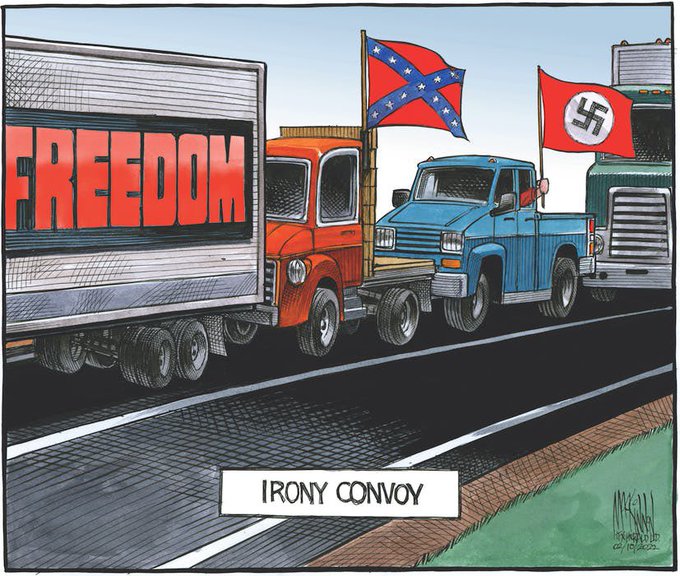
No. We have much more organizing to do. But we did show our capacity to organize our way out of a crisis—through trust, skill, dedication, empathy, focusing on positive solutions, and . . . what’s that other word I’m looking for? What’s the one thing that will always be stronger than hate? Love.
Adapted and excerpted, with permission, from the essay “Stronger than Hate: Countering the Convoy” by Alex Silas in Confronting the Resurgent Right, edited by Miriam Edelson, published by the University of Manitoba Press, 2026.