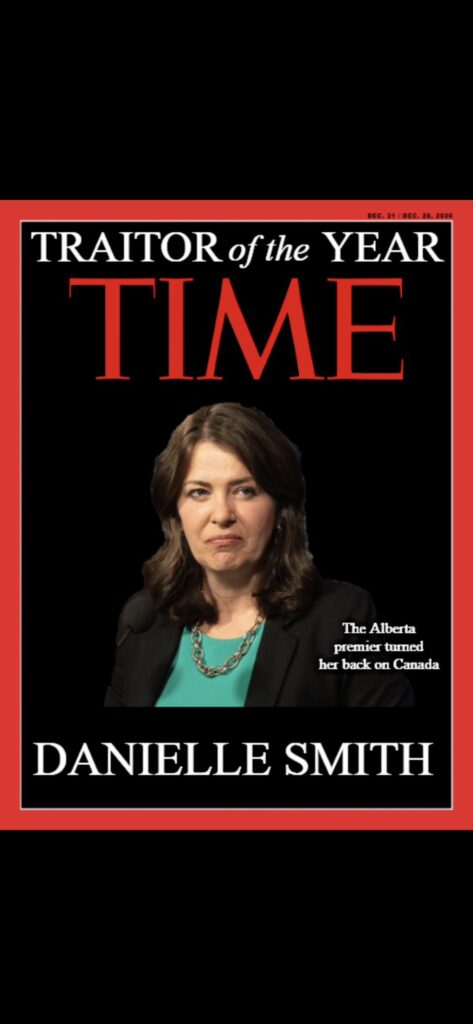
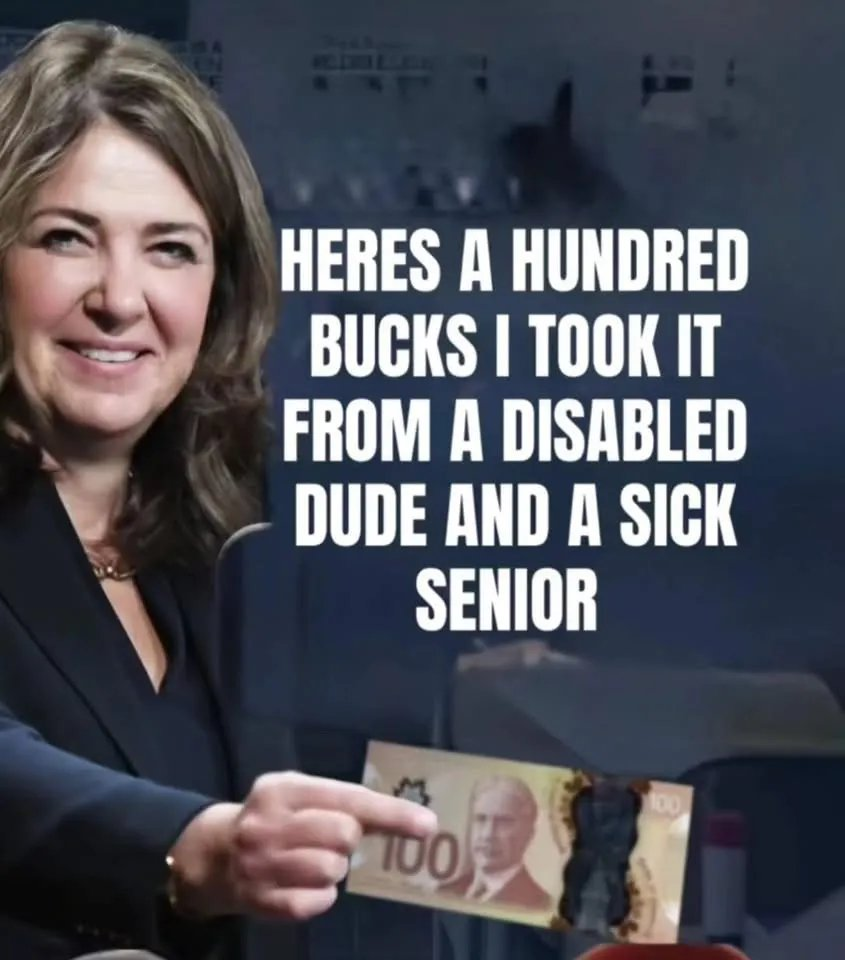
I didn’t cash Ralph Klein’s $400 bribery cheques in 2006 (equal to about $600 now), I sure as hell won’t “apply” for a $100 bribe to all who earn less than $250,000.00 from traitor to Alberta and Canada, big oil Dildo ‘n Pimp, Danielle Smith. She’s being sadistic to AISH recipients, gleefully destroying public health care and education and serves American’s most powerful pedophiles. Fucking cruel Nazi shit. And, she’s gathering data on you when you apply. Your data is worth one hell of a lot more than Dani’s Pimping Bucks.
I want protection for my privacy rights and private data Smith’s law-violating separatists stole and illegally posted online, including by Trump’s fucker Pedo Regime. And I want the fucking criminal separatists held accountable. I don’t want another fucking bribe.
To economize on Trump making his big oil pals richer via his illegal bombings of Iran, I cut my driving by 60% which saves a lot more money every month, than this greedy dribbling by Nazi Smith. She knows how greedy and stupid most Albertans are; now she wants to see how low Albertans will stoop for her traitorous shit.
And, to keep my food budget on track under the current greed plague by the rich, I eat less and do not buy beef – far too expensive. I can get better quality and more delicious and healthy protein from chick peas.
PS I still have my uncashed Ralph Bucks Bribe in my frac files. (It costs one hell of a lot more than $400 measly bucks to repair intentionally illegally frac’d drinking water aquifers). No way would I stoop so low to cash his fucking bribe, same as no way will I apply for Dani’s cruel shit.
It baffles me no end when the Alberta government MAGA mutts say that Albertans need to apply for this bribe. Of all people they should know exactly who qualifies. Just another scam in the offing? Just asking
@ctheriault.bsky.social:
A comparison.
$400 Ralph Bucks in 2006 would have been worth $615 in 2026.
$100 Dani Dollars in 2026 would have been worth $65 in 2006.
@canadianinalberta.bsky.social:
Smith announcing her Dani bucks program makes you realize just how out of touch the UCP are with regular Albertans
$100 won’t cover groceries for a week for a family of 4 It probably won’t fill a truck from empty
It’s the equivalent of allowing us to have the crumbs off her floor
@orlaghokelly.bsky.social:
To put things in perspective. As a student I bought some bad ass timberland boots with Ralph bucks. Good luck doing that with Dani bucks. And what a stupid thing anyway.
@Carolin04582966:
These people are becoming bat shit crazy.please tell me someone will be prosecuted for this data breach?
@Isuckatpicking:
I am actually shocked that the Danibucks didn’t come with a proof of Canadian citizenship requirement.
#Opinion "A hundred bucks! And Premier Danielle Smith thinks we should be grateful for this small clutch of Dani Dollars. What an insult."edmontonjournal.com/opinion/colu…
So let me get this straight…Klein at least bribed us into complacency with 400 bucks…while Dani thinks our votes are only worth 100 bucks?
@bonj.bsky.social:
The fact that it has to be applied for is appalling. Always hoops to jump through with Dani. As always, those who would benefit most will fall through the cracks. I believe no application was needed for Ralph bucks.No application, no letter requesting it, in fact I wrote and told King Polluter Ralph not to send me his bribery. His bribes were sent via cheques to all, whether they needed it or not, while slagging those unable to work. Cons are inhumane.
@wade1904.bsky.social:
The premierfromhell makes severe cuts to AISH but she can afford to give away Dani Bucks. Where is this money coming from? Aren’t we in a deficit? Make this make sense.
The premierfromhell wants to buy our votes with “dani bucks” on July 1 while she is running a $9 billion deficit, the health care system has been gutted, education is in chaos, Albertans with disabilities have been betrayed and immigrants have been kicked to the curb. She can go to h#*l
@chroniccanadian.bsky.social:
Now that she’s unpopular she thinks she’s going to bribe Alberta voters with some energy Dani bucks.
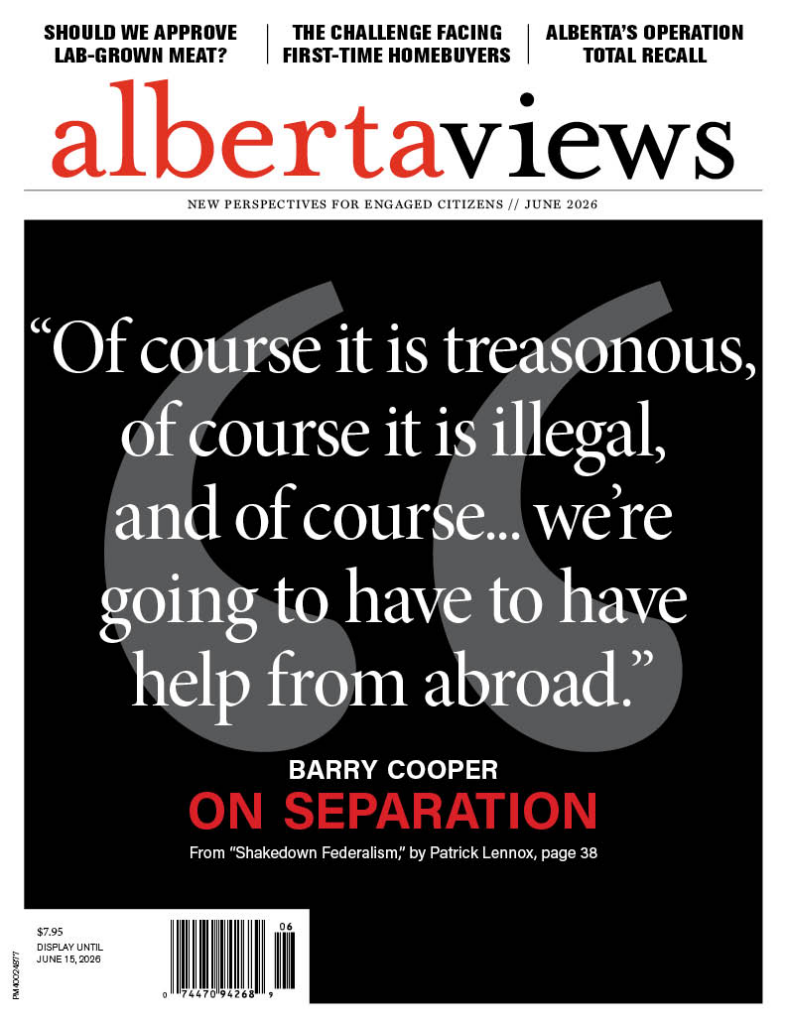
“Of course it is treasonous, of course it is illegal, and of course we’re going to have to have… help from abroad.” Here, Barry Cooper conscripts the help of the Trump administration to split Alberta from the rest of Canada.
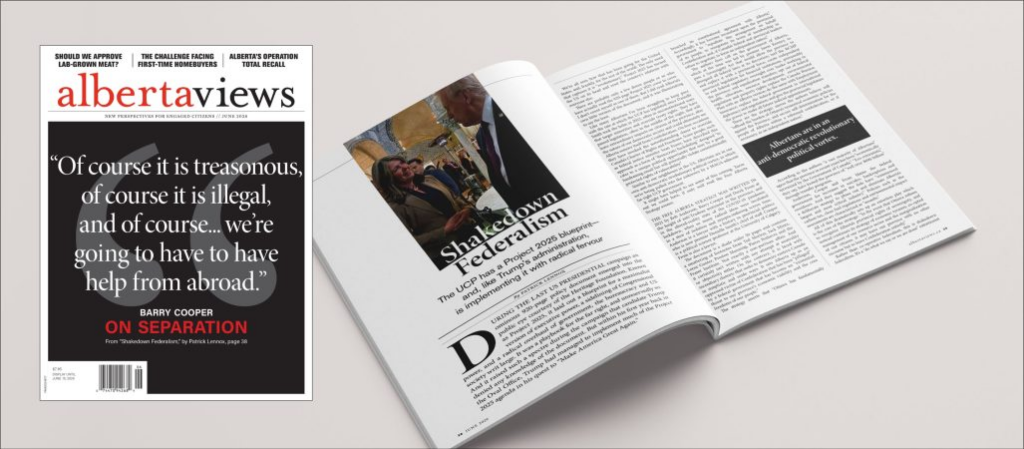
This is the best thing I've read about Alberta separatism and the close ties to the highest levels of the UCP. This is why I subscribe to @albertaviews.bsky.social
Wow, $100, that’s a lot! For all this is worth, she could have let disabled Albertans keep the extra $200, but of course, Daniel Smith is a heartless Grinch. Alberta deserves better.
@freakindelight.bsky.social:
I’m having trouble understanding this. The threshold for Dani Bucks is 220,000 per year. Every person under that and over 18 gets the pittance. It’s kind of like rewarding the traditional 2 parent household and punishing the single parents.Conning the masses into making more babies (even knowing how cruel it is to make offspring with humanity’s pollution greedily escalating and destroying earth’s livable climate) for the rich to rape and profit off of, including the kid raping catholic church, is standard gross Con practice.There’s a lot wrong with this whole scheme.
@ctheriault.bsky.social:
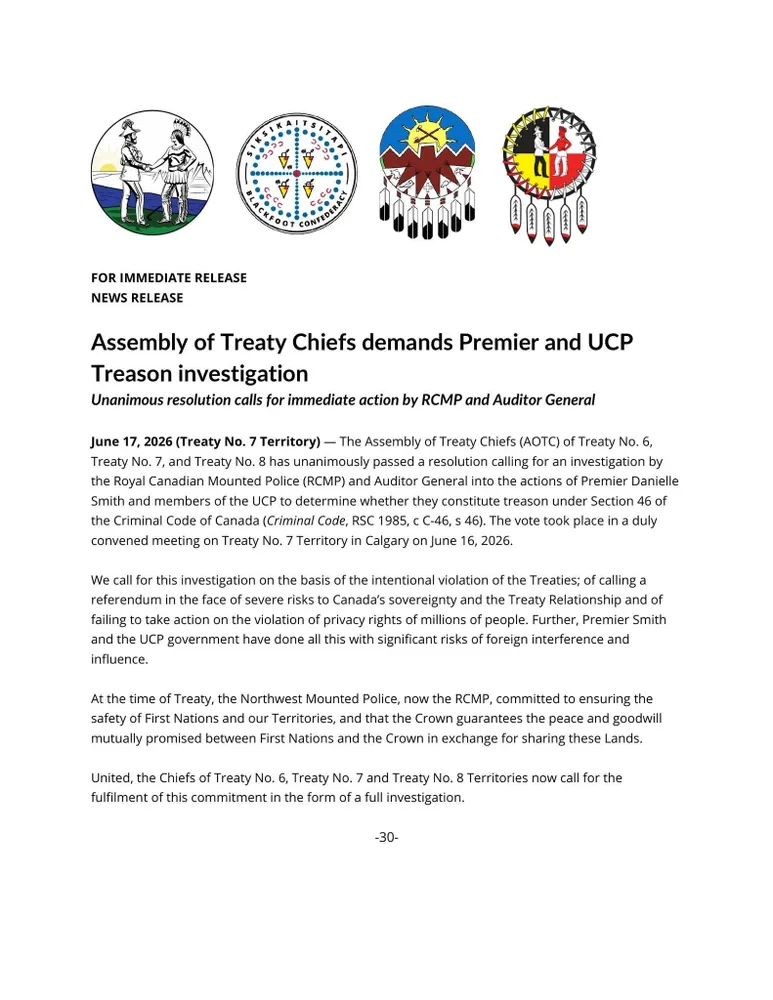
Treaty Chiefs are calling for RCMP to investigate Danielle Smith and UCP for possible treason in regards to the sovereignty referendum.Note the date of the Treaty Chiefs’ vote (June 16, 2026) and Smith’s bribery press release (June 17, 2026)
@KNugent4118 May 19, 2026:
The @RCMPAlberta need to investigate Danielle Smith, David Parker, Jeffrey Rath and the rest of the separatist movement.
And @MarkJCarney kick @petehoekstra out of Canada, asap!
@CBCNews @CTVNews
@TorontoStar
@globalnews
Stay on top of this story.
@Reil76 May 19, 2026:
So Trump’s ambassador to Canada actively promoted an app built by a Michigan MAGA group called 10xVotes. That same app is now at the centre of one of the biggest privacy scandals in Canadian history.
The Centurion Project, Alberta’s separatist group, used it to scrape personal data on nearly 3 MILLION Albertan voters. Now Elections Alberta, the Privacy Commissioner, and the RCMP are all investigating.
Hoekstra says he “wasn’t aware” of the connection. But the guy running the Centurion Project said publicly, on a podcast, that 10xVotes has been advising him behind the scenes for over a year. Hoekstra personally knows the app’s founder.
So the US ambassador to Canada promoted a voter ID tool, that tool ended up in the hands of a group trying to break up Canada, and that group illegally obtained private data on millions of Canadians.
This isn’t a conspiracy theory. It’s confirmed by PressProgress, CBC, and Elections Alberta’s own investigation.
Foreign interference in Canadian democracy!!
@paul186282 May 19, 2026:
This is the guy that shit talks Canada, the country that liberated and airdropped food to his hometown, Groningen, Netherlands in WW2 at the cost of 206 Canadians lives !
He has ZERO respect for Canada
He is a loudmouth POS and should be expelled from Canada Unfortunately Mark Carney is on Team Pedo Nazi. He’s also a traitor like Smith and her separatists and he lies like they do.
@BennySellick May 19, 2026:
Hoekstra is a demon. The Centurion Project is an evil enterprise.
And STILL Poilievre hasn’t condemned it. Hasn’t even made a comment!He’s on Team Nazi along with Harper, Smith, Trump, Parker and Carney et al.
Honestly feels like a slow-motion coup is taking place right now.
@GordoSixtytwo:
It’s time to remove the U.S. Ambassador on the grounds of election interference and promoting and aiding those who are committing treason against Canada.
@ElCarpintuerto:
Canada would be advised to expel the ambassador. He’s a traitor and brought that sedition across the border.
Smith is far too vulgar and pathetic in this clip for me to embed it here.
Beginning July 1, 2026, nearly 3.4 million Albertans will be eligible to receive $100 through the new Alberta Energy Rebate. The Energy Rebate will put tax dollars collected over recent months of elevated gas prices back in the hands of Albertans to help with the costs of fuel and other household needs. With this rebate, the government is delivering more savings with more flexibility, to meet the challenges families are facing today.
Rather than relying on fuel tax relief and hoping that savings are passed on through lower prices, this approach will ensure elevated oil revenues deliver real benefits to Albertans – benefits that don’t disappear at the pumps.
“Higher oil prices don’t just affect what people pay at the pump, they can increase the cost of groceries, utilities and other household expenses. The Alberta Energy Rebate turns higher energy revenues into direct relief for Albertans, giving families the flexibility to use it where they need it most.”
Danielle Smith, Premier
Alberta residents who are 18 or older, have filed a 2025 tax return and have a household income of $225,000 or less, will be eligible to apply for the Energy Rebate through a secure online portal starting on July 1, 2026. A household is defined as a single individual or two individuals who are married or in a common-law relationship.Why the fuck is Smith forcing Albertans to risk their private data by applying online? This reeks of data mining by the fucking kid abusing tech billionaires to me
When the federal government suspended its 10-cent fuel excise tax earlier this year, those savings were erased at the pumps within days, and before Albertans could feel any relief. The Energy Rebate gives Albertans real returns now on the higher oil prices of previous months – delivering families more than 50 per cent in additional savings, on average, than what the fuel tax relief program was projected to provide over the next three months.
“When oil prices are high, everyone feels it. Albertans deserve real relief and the freedom to use it when and where it matters most to their families. The Alberta Energy Rebate delivers exactly that with reliable support for more Albertans across the province.”Jason Nixon, President of Treasury Board and Minister of Finance
Whether the priority is groceries, bills, rent or fuel, the Energy Rebate ensures flexible support. With guaranteed support for every eligible Albertan – driver or not – eligible two-adult households will receive $200 in immediate relief that can be used for any household need. Families may also benefit from additional $100 rebates with each eligible adult family member or child aged 18 or older living in the same home.
The rebate also ensures support reaches seniors, vulnerable populations, transit users, remote workers and others who may not have benefited from fuel relief. Those receiving the Alberta Seniors Benefit and individuals enrolled in Assured Income for the Severely Handicapped (AISH), the Alberta Disability Assistance Program (ADAP) and Income Support will be automatically enrolled to receive their payment.
“We know affordability is top of mind for Albertans – we hear you, and we are taking action. This rebate builds on our existing affordability measures, delivering broader, flexible support to ensure Alberta remains the most affordable place to live, work and raise a family.”RJ Sigurdson, Minister of Affordability and Utilities
“Albertans are facing increasing financial pressures right now. The people we serve will benefit from this support as it empowers them to make decisions about what their family needs the most. This means food on the table, gas in their tanks, and some breathing room. Whether it’s to get to work, or get kids to school, fed and ready for their day – every bit of support helps.”Jeff Dyer, CEO, Trellis Society
The Alberta Energy Rebate adds to the measures and programs that make Alberta one of the most affordable places in Canada to live, work and raise a family. On top of having the second-lowest taxes on fuel in the country at 13 cents per litre, Alberta’s competitive, low-tax environment has helped keep the average fuel price at 156.3 cents per litre, well below the Canadian average of 171.2 cents per litre. Albertans also benefit from the lowest personal income taxes and no provincial sales tax. Alberta’s government also introduced an eight per cent tax bracket last year, saving Albertans about $1.2 billion in 2025.
Alberta’s government is focused on delivering direct, practical relief people can count on. Should oil prices remain elevated over future quarters, Alberta’s government will explore the best options for delivering relief and easing the pressure for Alberta families.
Quick facts
The Alberta Energy Rebate application portal opens on July 1, 2026, closes Sept. 30, 2026.
The average price of a barrel of West Texas Intermediate (WTI) over the 20-day review period from May 18, 2026, through June 15, 2026, was $92.74.
As of June 15, 2026, Alberta families pay an average of 156.3 cents per litre for fuel, which is well below the Canadian average of 171.2 cents per litre.
The average Albertan consumes 2,000 litres of fuel each year, representing fuel tax relief savings of only about $65 per person for one quarter.
For the purposes of the Alberta Energy Rebate eligibility, ‘household’ is defined as a single individual or two individuals who are married or in a common-law relationship.
Albertans 18 and over living at the same address, but who are not married or common law, would be considered separate households. This includes:
roommates
children over the age of 18
other adult family members living in the same home
Each adult will need to apply separately to receive a payment.
The Alberta Energy Rebate is not taxable and does not need to be reported to the Canada Revenue Agency.
Receiving these payments will not affect eligibility or benefit amounts under the AISH, ADAP, Income Support, Alberta Seniors Benefit or federal seniors’ programs.
During the last US presidential campaign an ominous 920-page policy document emerged into the public eye courtesy of the Heritage Foundation. Known as Project 2025, it laid out a blueprint for a maximalist version of executive power, a sidelining of Congressional power, and a radical overhaul of government, the bureaucracy and US society writ large. It was a playbook for the far right, and unreservedly so. And it raised such a spectre during the campaign that candidate Trump denied any knowledge of the document. But within his first year back in the Oval Office, Trump had managed to implement much of the Project 2025 agenda in his quest to “Make America Great Again.”
We’ve all seen how that has been going for the United States, and, frankly, for the rest of the world. The only word that captures it is “revolutionary.” Project 2025 has turned the US on its head and reset the country’s relations with everyone else.
There are probably only a few dozen people or so who have actually read the 920-page Project 2025 cover to cover. I don’t count myself as one of them. But I did read Alberta’s own little version of the document, and it was illuminating to say the least.
Like many Albertans I’ve been struggling to keep pace with the rate at which the UCP has legislated since Danielle Smith took the helm in 2022, often in unconstitutional ways that target minorities and override treaty rights. They have passed legislation, often in the middle of the night, that will leave extraordinary impacts on citizens of the province, alter the nature of our democratic society and could ultimately see Alberta remove itself from Confederation. On four occasions they have invoked the notwithstanding clause to override Canada’s Charter of Rights and Freedoms. Some people, such as federal justice minister Sean Fraser, have described this approach as a form of “democratic backsliding” designed “to cater to a unique political opportunity that may be a good fundraising email but will potentially violate constitutionally protected rights of vulnerability.”
Similar to our neighbours in the US, Albertans are in our own anti-democratic revolutionary political vortex, in which we’re being pulled into the unknown by a MAGA-adjacent far-right UCP government.
It might have helped to see some of this coming. Turns out we could have, if only we’d read the Free Alberta Strategy sooner.
The Free Alberta Strategy was written in 2021 by Rob Anderson, Barry Cooper and Derek From at the height of anti-Trudeau sentiment in the province, and in the altered-reality state of the COVID-19 pandemic lockdown, when so many radical ideas were incubated in a stew of isolation and myopia-inducing screen time. Anderson is a lawyer with a history in provincial politics who is now premier Danielle Smith’s chief of staff. Cooper is a political science professor at the University of Calgary. From is also a lawyer.
The document is a shade under 50 pages and contains a smattering of footnotes from Ted Morton, Jack Mintz, Lorne Gunter, Preston Manning, Pierre Poilievre and the Fraser Institute. Not exactly a non-partisan affair. And it certainly isn’t written with any attempt at neutrality or objectivity either. On the contrary, it is laced with incendiary rhetoric that seeks to demonize eastern Canada in simplistic and snide ways. It sets Alberta up as an oppressed victim of Confederation that has been “pillaged” by a federal government that has become an “existential threat to our province’s economic viability and the core freedoms of our people.”
The strategy asserts that “Ottawa has fundamentally breached its constitutional agreement with Alberta.” Accordingly, it has become incumbent upon the provincial government to “repudiate this arrangement on behalf of its people, to renegotiate its terms of membership in Confederation and, if Canada’s federal and provincial leaders refuse to negotiate, to form an independent nation.”
The authors then call on the government of Alberta, which at the time was led by premier Jason Kenney, to pass a Sovereignty Act that would allow the province to disregard all federal laws at its discretion; turf the RCMP and replace it with a provincial force; create independent provincial legislation for financial institutions, presumably to end federal regulatory oversight over banks working in the province; end equalization transfers; opt out of federal health, education, resource development, environmental regulation and property rights; replace the Canada Pension Plan with an Alberta version; do the same with Employment Insurance; replace the federal government in international diplomacy and negotiation; and give the provincial legislature the power to make all future judicial appointments.
These are the strategic moves the authors believe will “offload the burden of Ottawa’s tyrannical economic policies against the Province, and secure self-determination for the people of Alberta within a reformed confederation, or if necessary, as an independent nation.”
Albertans are in an anti-democratic revolutionary political vortex.
According to the authors “a vast majority of Albertans” agree that the province in recent years has been “economically terrorized by the Government of Canada.” “Eco-extremists,” they say, have looted the province of “well over $600-billion” through transfer programs.
Anderson, Cooper and From blame the federal government for increases in suicides, bankruptcies and overdoses. And they suggest the feds have “commenced a deliberate strategy to phase out and eliminate Alberta’s largest and most critical industry.” Policies such as the carbon tax, clean fuel regulations and environmental impact assessments are characterized as “assaults.”
All of this dramatically sets up an extortion play which is the core of the strategy: “In the event that Ottawa refuses to recognize Alberta’s provincial rights of sovereignty, and instead continues its strategy of economic tyranny, co-opted management of our resource sector and the marginalization of our citizens, it may leave our province with no other recourse but to leave Confederation entirely.”
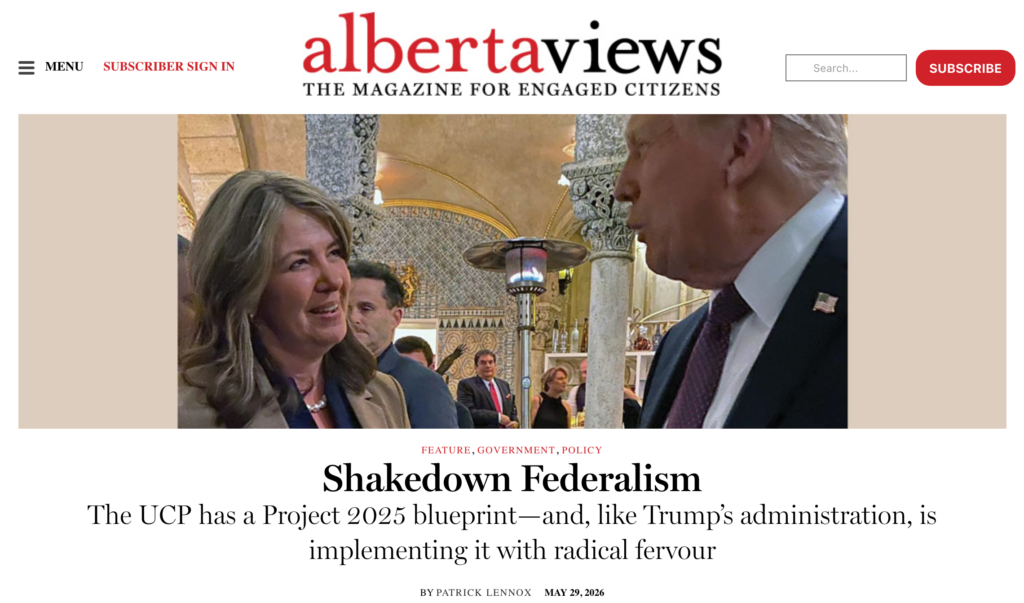
Rather than co-operative federalism, this is shakedown federalism. It’s a “do what we say or we are done” extortionist strategy that is rooted in an inflated sense of grievance that doesn’t jibe with any discernible reality.
Politicians and political scientists are careful to acknowledge the real sense of grievance that some Albertans feel vis-à-vis their relationship with the federal government. You can’t argue with people’s feelings after all, but you can take issue with how they choose to rationalize and justify them. There’s nothing on the public record that could plausibly support characterizing the federal government’s relationship with Alberta as something equivalent to economic terrorism, as the authors of the Free Alberta Strategy assert. To the contrary, since 2010 oil production in the province has more than doubled, from two million barrels a day to 4.1 million barrels a day.
The Free Alberta Strategy didn’t get much traction with Jason Kenney’s UCP, perhaps because in year one of Kenney’s reign Canada’s prime minister, Justin Trudeau, ramped up investment in the TMX pipeline, which runs from Edmonton to tidewater at Burnaby, BC. The project eventually cost the federal government $34.2-billion. Even for Kenney it would have been a stretch to describe this massive outlay of public dollars as an “assault” or a form of “terrorism” committed against his province by the evil overlords in Ottawa.
But since Kenney was given the bum’s rush by the far-right separatist wing of the party he created, the strategy has come back into vogue. In fact, Kenney’s successor, premier Smith, is hewing closely to much of the plan.
Before going further it’s important to be fair to the authors of the Free Alberta Strategy and not paint them as being fully responsible for planting the anti-democratic seeds the UCP has sown since.
The trio of Anderson, Cooper and From were careful to recommend a transparent, democratic approach to adopting their strategy and, if necessary, a democratic approach to ending Alberta’s place in Confederation. They prescribed that their strategy be adopted first as official policy, that the policy be outlined clearly to Albertans and that there should be a democratic process to give the government the mandate to pursue the strategy.
Once the democratic mandate was in hand, after a successful electoral victory with the Free Alberta Strategy as a platform, they suggested a pre-referendum blue ribbon panel on provincial secession be held and that a detailed plan be drafted by policy experts, lawyers and members of the private and public sectors that would cover the full ambit of requirements to establish an independent Alberta. They argued for a full year to be given to consultations, discussions and debates on the merits of the plan and its risks and rewards.
Danielle Smith’s UCP did not follow this recommended process. Just as Donald Trump dishonestly denied any knowledge of Project 2025 during the last presidential campaign and then proceeded to implement vast portions of its radical agenda within his first year back in the White House, Smith’s UCP did not campaign on the Free Alberta Strategy’s tenets but have embraced them wholeheartedly since forming government. Smith’s UCP don’t, therefore, have a democratic mandate to pursue these ideas, by any standard. Yet they have implemented the components of the strategy at a ferocious pace.
First, through Bill 54, which made it comprehensively easier to bring about a secession referendum by reducing the number of signatures required, and then Bill 14, which was passed in order to eliminate any bearing the Charter of Rights of Freedoms and the Treaties might have on the process, the UCP has shown it intends to construct a credible threat of separatism that it can use to extort the rest of Canada.
They have taken the Free Alberta Strategy into Trumpian territory by running on one set of issues and governing on their opposite. Believe it or not, the planks of the UCP’s winning 2023 campaign platform were tax cuts, safe streets, mental health supports, education and career training, investing in tourism, improving healthcare for women and children, and a guarantee to maintain public healthcare. None of the ideas included in the Free Alberta Strategy were campaigned on by Smith’s UCP.
However, in December 2022, just two months after Smith won the leadership of the UCP, her party introduced the Alberta Sovereignty within a United Canada Act, which achieves one of the Free Alberta Strategy’s major milestones. This really should have been a wake-up call to the electorate that under Smith’s leadership the UCP would tack hard to the right. “It’s not like Ottawa is a national government,” said Smith after the legislation passed its final reading at 1 a.m. on December 7.
UCP leadership candidates debated the Free Alberta Strategy in June 2022; most of them opposed Alberta acting as a sovereign jurisdiction. Travis Toews said it would create chaos and scare off investors. Brian Jean: “Telling Albertans… not to follow some laws is frankly irresponsible.” The winning candidate, Danielle Smith, endorsed the Free Alberta Strategy.
Provisions in the Sovereignty Act armed Smith’s government with a set of new powers to disregard federal laws at its own discretion. In effect, this kneecaps the role of the courts in this province, by setting the provincial legislature as the arbiter of the constitutionality of federal law.
In a radical revision of constitutional democracy, the act allows the provincial cabinet to decide whether it is in or out on specific aspects of federalism, including federal regulations and even enforcement of the Criminal Code by provincial entities. The dean of the University of Calgary’s law school, Ian Holloway, called the legislation an “unconstitutional gambit” and accused the premier of “engaging in a game of political chicken.”
Smith’s government furthered this line of legislation in late 2025 with the International Agreements Act, which seeks to put the province on an equal plane with the federal government when it comes to managing international relations. It asserts that no international agreement signed by the federal government is binding on the province. Something like a major climate change agreement would presumably not be binding on Alberta unless agreed to by the provincial legislature. This assertion of provincial autonomy over international relations runs counter to all norms of statecraft. But it is a tactic explicitly described in the Free Alberta Strategy, which states in its section on international relations that Alberta “can no longer afford to entrust its interests to hostile and unreliable federal governments. It must take full control of its own international and interprovincial trade and commerce.”
The UCP has also moved to establish its own police service. The Alberta Sheriffs Police Service (ASPS) was created through Bill 4, which came into force in November 2025 as the Public Safety and Emergency Services Statutes Amendment Act, 2025 (No. 2). There remains a great deal of ambiguity with respect to these sheriffs’ purpose, jurisdiction and relationship with other police services in the province.
The sheriffs were originally established to do prisoner transport but evolved to take on traffic control roles and security around the legislature grounds. The latest evolution of the service appears aimed at broadening their authority and increasing their complement to the point that they could eventually be in position to take over from the RCMP at the end of the current policing contract, which expires in 2032.
Setting up a provincial police service is no easy task and doesn’t happen overnight or without extraordinary cost, so this is a half measure less by choice than by necessity. Nevertheless, it is a move drawn from the Free Alberta Strategy, which advocates removing the RCMP—perceived as an extension of federal authority—from its policing role in the province. It is notable that this is being done against the grain of overwhelming public opinion. A survey conducted for the National Police Foundation on the prospect of an Alberta provincial police force found only 31 per cent of respondents were in favor of replacing the RCMP, while three-quarters were satisfied with the policing services received from the Mounties. Seventy-one per cent of respondents said they felt the public had not been adequately consulted on the proposal, and 81 per cent said there were more pressing issues for the province to address.
On January 23, 2026, the premier sent prime minister Mark Carney a letter threatening to withhold “the necessary funding to support any new judicial positions in the province” until the federal government agreed to make significant changes to how judges are appointed in Alberta. Following the Free Alberta Strategy’s extortion tactic to a tee, and its strategic direction to assert greater autonomy over judicial appointments, the premier has for now stopped short of the nuclear option articulated by Anderson, Cooper and From, which recommends the provincial legislature appoint all future judges serving in Alberta.
Instead, the premier is proposing a major reform of the appointments process that would see the establishment of a special advisory committee comprising “four non-partisan experts—two from Alberta and two appointed by the federal government.” The committee would make recommendations to the two ministers of justice (federal and provincial), who would then be expected to “work collaboratively to identify the successful appointee(s).”
“Of course it is treasonous, of course it is illegal… and we’re going to have to have… help from abroad.” —barry cooper
The premier also wants this committee to influence appointments to the Supreme Court of Canada and make recommendations to the prime minister about who should fill vacancies on the top bench.
Federal justice minister Sean Fraser saw the letter as a threat to judicial independence and the rule of law, and told media “it’s essential that we have a judiciary who’s able to make decisions without fear or favour amongst those who have the power to appoint or, in theory, remove a judge from the bench.” The Canadian Bar Association and its Alberta branch also expressed “grave concerns” about premier Smith’s proposal, which they saw as a threat that if carried out would ultimately “punish Albertans by limiting access to a properly functioning justice system.”
Under Smith’s leadership the UCP has also toyed with the idea of breaking with the Canadian Pension Plan and establishing a provincial plan instead. Smith floated the idea—one of the main pillars of the Free Alberta Strategy—as part of a 2023 survey she put to all residents of the province who wanted to participate. It took 21 months for her government to finally release the results of the survey, which showed that only 10 per cent of respondents supported the idea of an Alberta Pension Plan.
The other tactical moves recommended in the Free Alberta Strategy—legislating an end to equalization payments and establishing an independent banking act—have yet to be attempted by Smith’s government.
Rather than co-operative federalism, this is shakedown federalism.
The shakedown approach to federalism that is the hallmark of Smith’s government clearly has its intellectual roots in the Free Alberta Strategy. The approach derives from an understanding of Confederation as being fundamentally unfair to western Canadians, who, according to one of its authors, Barry Cooper, have been under the thumb of an imperialist power structure seated in Laurentian Canada since before Confederation. It seeks to use the ultimate threat of separation as leverage to reset the terms of the Canadian federation.
For his part, Cooper—a committed separatist—does not believe the Laurentians are capable of comprehending “what they have done.” In an interview for this article, he characterized this as a “failure of imagination” to meet “the just complaints of Alberta and Saskatchewan.”
In June 2020 Cooper joined BC political talk show host Stuart McNish on Conversations that Matter to discuss Alberta separatism. Cooper articulated his theory that western Canadians have been exploited by the Ontario/Ottawa/Quebec imperial complex and went on to expound a sense of fatalism about the future of Canadian federalism. In his view, western Canadians will eventually conclude that the relationship with Laurentian Canada will never change or evolve in meaningful enough ways to make it worth remaining in Canada.
According to Cooper: “Eventually you have to do something. Of course it is treasonous, of course it is illegal, and of course it is going to be very unpleasant, and we’re going to have to have… help from abroad. We’re going to have to rely on the Americans. It will depend on whether or not Saskatchewan and Alberta have leaders who are willing to understand the very serious implications, which means among other things getting the Americans on board.”
Here, Cooper seems to have presaged the now well-publicized efforts of the Alberta Prosperity Project to conscript the help of the Trump administration in their efforts to split Alberta from the rest of Canada. And while the Smith government hasn’t overtly and explicitly declared its separatist intentions, nor openly courted the Trump administration’s support in becoming an independent state, it has legislated in a MAGA-adjacent, far-right fashion.
With Trumpian disregard for constitutional norms, Smith’s government has used the notwithstanding clause to attack the rights of organized labour and of gender diverse people in the province. With Trumpian xenophobia it has signalled an intent to crack down on immigration and the rights of immigrants and refugees in the province. It has introduced two-tier healthcare through Bill 11, and encouraged two-tier education by subsidizing private schools at the highest rate in Canada and increasing funding to charter schools at a rate three times higher than its increase to public schools.
These moves could be construed as a method of demonstrating the UCP’s alignment with the Trump administration. This is not insignificant, particularly in light of the US’s November 2025 National Security Strategy, which states that “we will reward and encourage the region’s governments, political parties and movements broadly aligned with our principles and strategy.”
Under premier Jason Kenney, a former federal cabinet minister in the Harper government and a committed federalist, the Free Alberta Strategy barely made an impression. Under premier Smith’s UCP, the strategy is being aggressively implemented.
Cooper was forthright in stating that while he hasn’t spoken with either Rob Anderson—now the premier’s chief of staff—or premier Smith in a number of years, he is “quite supportive of what she has done.”
The Free Alberta Strategy provides a clear window into the strategic logic and tactical moves premier Smith’s UCP will make in destabilizing relations with the rest of Canada and setting Alberta on a path to separation. As Project 2025 has done in the US, the Free Alberta Strategy has begun to fundamentally alter Alberta politics and society. It’s a reckless and anti-democratic plan that seems hell-bent on destroying Canada. Canadian citizens can orient themselves amid the chaos by understanding that Smith and her government are intent on pursuing the Free Alberta Strategy to its logical conclusion. If they want a preview of where this is all headed next, they need only keep an eye on our neighbours to the south.
Patrick Lennox is the author of At Home and Abroad: The Canada–US Relationship and Canada’s Place in the World.
This website stores cookies on your computer. These cookies are used to provide a more personalized experience and to track your whereabouts around our website in compliance with the European General Data Protection Regulation. If you decide to to opt-out of any future tracking, a cookie will be setup in your browser to remember this choice for one year.

 No application, no letter requesting it, in fact I wrote and told King Polluter Ralph not to send me his bribery. His bribes were sent via cheques to all, whether they needed it or not, while slagging those unable to work. Cons are inhumane.