
Ten years of MAID, and suffering averted, is cause for celebration by André Picard
June 16, 2026, The Globe and Mail
Thanks to the legalization of medical assistance in dying, more than 100,000 Canadians have been spared unnecessary suffering at end-of-life.
As we mark the 10th anniversary of Bill C-14, Medical Assistance in Dying, on June 17, we should celebrating, not hand-wringing.
The culture of dying has changed fundamentally, for the better. About one in every 20 deaths is now medically assisted.
Life has not been cheapened by MAID. Dignity, choice, and bodily autonomy have all been bolstered.
Anti-choice activists claim there are too many MAID deaths – 16,499 in 2024, the latest year for which we have data.
But too many compared to what? How many innocents does AI murder annually? How many does USA murder annually for greed purposes, and to serve sadistic leaders like Trump? How many did it murder in Iran for Trump’s illegal war there? How many Palestinians and others in the Middle East does Israel murder annually? How many deaths does oil, gas, and bitumen cause directly and indirectly (traffic fumes) in Canada, annually? I bet many more than via MAID.
Parliamentary committee to deliver conclusions on expanding MAID to people with mental illness on June 17
More than 95 per cent of people choosing MAID have deaths that are “reasonably foreseeable,” in the words of the legislation.
If these patients – most of whom have terminal cancer, heart disease, diabetes, chronic obstructive pulmonary disease (COPD) and the like – weren’t dying from assisted deaths, how would they be spending their final days and hours?
The most common choice for the terminally ill is VSED – voluntary stopping of eating and drinking. Others opt for palliative sedation, numbed by drugs until their “natural” death mercifully arrives. Some have DNRs, “do not resuscitate” orders that mean if their heart stops, medical staff don’t shock them back to life.
Are any of these methods inherently more humane or moral than MAID? Is allowing someone to starve to death slowly a better end than a lethal injection at a time of their choosing?
But offering MAID access to those whose deaths are “reasonably foreseeable” is not sufficient. Illness and suffering come in many forms.
MAID is a modern term for an ancient desire – to have some agency at end-of-life, to minimize suffering.
Those who oppose choice seem to believe suffering is a necessary part of the human condition, an unavoidable part of life and death.I blame fucking brain and soul destroying religion
It’s fine to embrace that worldview, but you should not be allowed to impose that belief on others, especially in the legislation of a secular society.A-fucking-men!
For many Canadians, MAID has become a ritual and ceremony, like marriage, or childbirth. In most cases, it is a celebration of life.
There are tears, laughs, music and all manner of deeply personal gestures, from carefully curated final meals to deeply deliberated musical choices to mark the passage. These are the kind of rituals that can only exist when death comes at the time and place of your choosing.
When abortion was legalized, anti-choice activists issued dire warnings about fetal slaughter run amok. Never happened.
In fact, Canada hasn’t had an abortion law for almost 40 years and things function as they should, with women making deeply personal reproductive choices in concert with health care providers.
We’ve had endless warnings about the “slippery slope” of MAID as well, frightening claims that we will see the culling of the elderly, of people with disabilities, those suffering from mental illness, and those who live in poverty.
Hasn’t happened, and it won’t. Not all slopes are slippery. The cases that push the boundaries are a path to better legislation, and better care.
Let’s not forget that MAID laws have been overly conservative, and repeatedly liberalized by court rulings that remind politicians that individuals have rights, including bodily autonomy.
Tellingly, every one of the lawsuits that has resulted in expansion of MAID criteria has been championed by people with disabilities who want to be treated equitably, not in a patronizing fashion.
The changes we’ve seen, and should see, from dropping the “reasonably foreseeable” prerequisite, to allowing MAID for those whose sole underlying condition is a mental disorder, through to allowing advance requests for those with dementia, are driven by public demand and motivated by compassion.
Assisted death is on the agenda of every liberal democracy in the world, a debate driven by demographic and cultural trends and realities.
People are living much longer, but they want to live better. They also want to die better.
The public has always been way ahead of the academics and politicians on these issues. Canada has been a world leader, and we should be proud of it.
MAID is not an experiment anymore. It’s a legitimate health care choice, an integral part of end-of-life care.
Assisted death is not for everyone. But choice is.
MAID is a gift to those who want to control their exit from this world. A gift to be cherished, and nurtured, and fought for.It’s so far, the best thing that’s happened in my life.
June 17, 2026 is the 10th anniversary of legal Medical Assistance in Dying in most of Canada. (Quebec started in December 2025.)
To mark the occasion, here is a thread of stories I’ve written about MAID and the right-to-die over the past 40 years.
www.theglobeandmail.com/opinion/arti…
Catholic hospitals have no right to opt out of assisted dying. Institutions do not have a conscience. Institutions do not have rights. People do. Institutions that refuse to offer MAID should be denied public funding. (2016)
www.theglobeandmail.com/opinion/hosp…
Risk-averse assisted-death law fails Canadians who are suffering. Bill C-14 earns a failing grade. Proposed law is a muddle that shows a shocking disregard for the Supreme Court ruling of 2015. (2016) www.theglobeandmail.com/news/nationa…
Our laws, and our lawmakers, have not kept pace. The message in a new poll is clear: We should – no, we must – do everything possible, medically and legally, to facilitate the right of people to die with dignity. (2014) www.theglobeandmail.com/life/health-…
The dithering on MAID reveals the ingrained cowardice in Canadian politics. Whenever Ottawa has to make tough decisions on sensitive matters, it pushes them off to the future, and patients suffer. (2024) www.theglobeandmail.com/opinion/arti… v
Case of Montreal man sentenced for killing ailing wife highlights need to bolster assisted dying laws. People need to be able to end their suffering, but also maintain control over their decision-making. (2019) www.theglobeandmail.com/canada/artic…
There are a lot better places to die than Canada. End-of-life care in Canada “needs to be fixed from the ground up,” (2010) www.theglobeandmail.com/life/health-…
We must make it easier to both live and die with dignity, but denying MAiD to those living in poverty is not the answer. You don’t resolve one injustice by creating another (2022) www.theglobeandmail.com/opinion/arti…
The Supreme Court has ruled on assisted death in the case of Kay Carter and Gloria Taylor, but Canada is not prepared. (2015) www.theglobeandmail.com/opinion/cour…
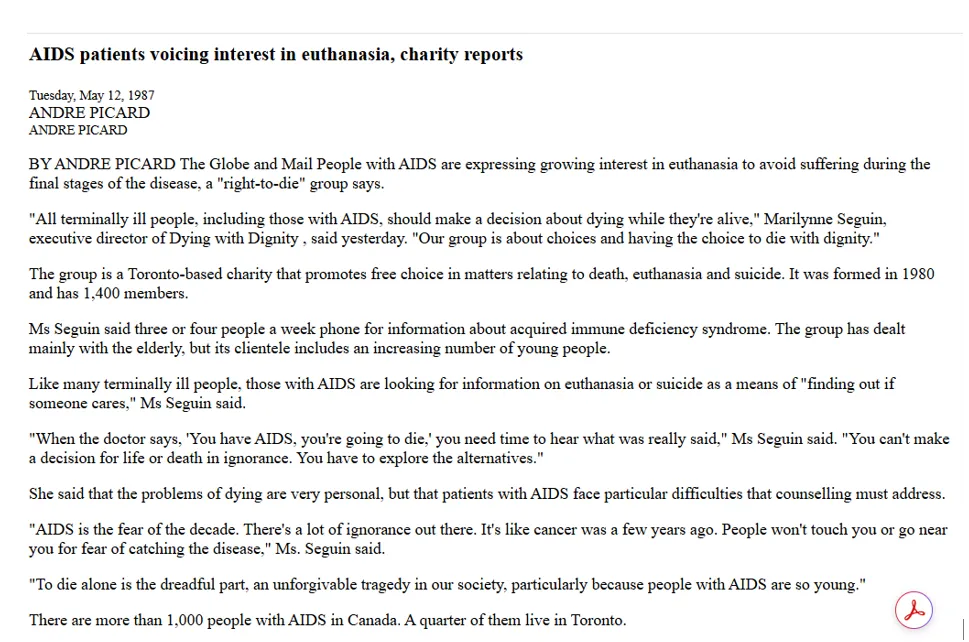
AIDS patients voicing interest in euthanasia, charity reports. “All terminally ill people, including those with AIDS, should make a decision about dying while they’re alive,” No link available, but excerpt below. (1987)
A timely reminder that the courts, and family members, and politicians, notably the cruel hideous ones like Danielle Smith, need to keep their noses out of individuals’ medical decisions. An Alberta court has rejected a Calgary father’s attempt to block his adult daughter’s MAID decision. (2024) www.theglobeandmail.com/opinion/arti…
People with irremediable mental illness should not be denied access to assisted death. We will never be fully ready for MAID in all its permutations so let’s stop dithering and get on with updating the law. (2022) www.theglobeandmail.com/opinion/arti…
Dying in Canada is costing a fortune – and worse, it’s not how we want to go. Structural issues have created costly and tragic inefficiencies in end-of-life care in Canada (2021)I heard a palliative care worker in an interview (years ago) say that keeping Canadians alive on their last day of life costs much more than all care their entire life before it. Proves to me that humans are stupid and viciously cruel. Think how many starving Alberta children that money could feed, if we let people access MAID. www.theglobeandmail.com/opinion/arti…
Bureaucracy should not stand in the way of a dignified death. As the MAiD law evolves, we should not forget its overarching purpose: To mitigate suffering (2018) www.theglobeandmail.com/opinion/arti…
What’s criminal about suicide? Withholding access to assisted death for those whose suffering is unbearable (2014) www.theglobeandmail.com/opinion/what…
The importance of picking a vocabulary for dying. Our words, loaded and nuanced, tend to reflect where we stand (2012) www.theglobeandmail.com/news/politic…
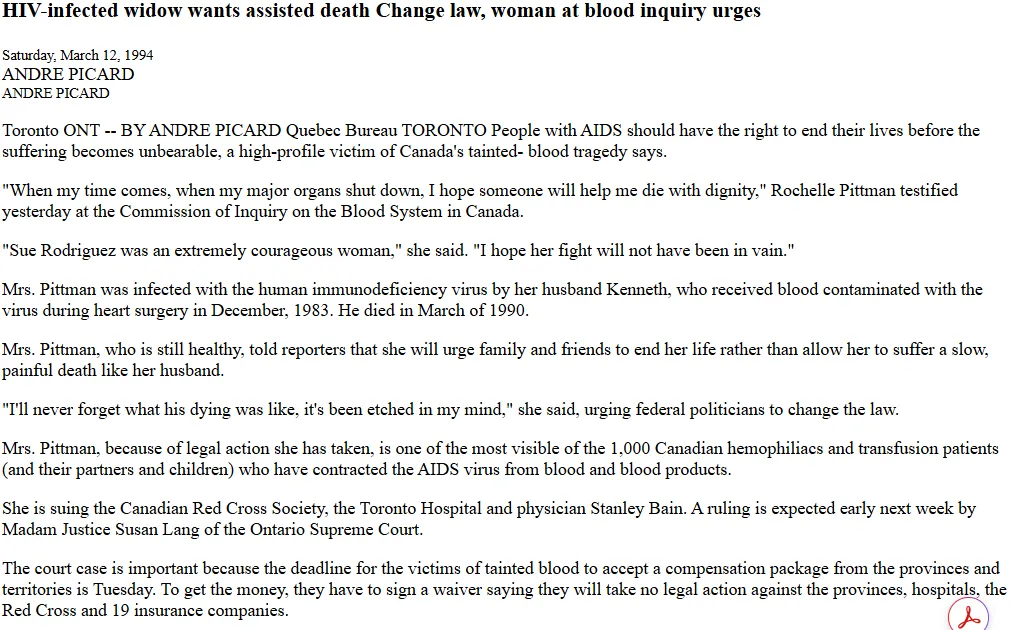
HIV-infected widow wants assisted death. Change law, woman at blood inquiry urges. No link available, but excerpt below. (1994)
The courts are the worst place to address complex MAID cases. Judicial review has no place in the doctor-patient relationship (2024) www.theglobeandmail.com/opinion/arti…especially when family members drive the interference. Our bodies belong to no one but ourselves; not parents, spouses or kids have a right to interfere
Is administering MAID in a funeral home undignified, or just practical? A debate over this question is raging in Quebec while other, more important issues are being glossed over (2023) www.theglobeandmail.com/opinion/arti…
Canadians with mental illness deserve access to medical assistance in dying too. “Cancer of the soul” can be as deadly as cancer of the body (2020)
www.theglobeandmail.com/opinion/arti…
What a Dutch teen’s death teaches us about the complicated end-of-life debate. Noa Pothoven was not granted assisted death but her case can still inform the debate, by. (2019) www.theglobeandmail.com/opinion/arti…
What a Dutch teen’s death teaches us about the complicated end-of-life debate by André Picard, June 10, 2019, The Globe and Mail
On June 3, at 2:40 a.m., Dutch teenager Noa Pothoven died in her home, surrounded by family. Her sister posted the news on Instagram.
Within hours, her death made headlines around the world because some media, led by the British tabloids, reported that the 17-year-old had died by “euthanasia.”
That wasn’t true but nonetheless triggered a polemic about the horrors of allowing teenagers, people with mental illness, or anyone for that matter, to choose an assisted death.
The media took a beating too, and deservedly so. In the rush to get a juicy story out quickly, they made some grossly wrong assumptions, neglected basic fact-checking, and engaged in some shameful click-baiting.
Still, Ms. Pothoven’s story offers up some important lessons, especially for Canada, where laws on medically-assisted death are still being shaped.
In her book Winning or Learning, Ms. Pothoven told a horrific tale of being sexually assaulted at age 11, a year later, assaulted again at a classmate’s party, and then raped by two men at age 14. The assaults led to years of increasingly debilitating post-traumatic stress disorder, depression, anorexia and mental health problems.
“To this day, my body still feels dirty,” she wrote. “My house has been broken into, my body, that can never be undone.”It absolutely can never be undone; I know the horrors well.
The teenager made several suicide attempts, both before and after she decided to go public with her story. At age 16, Ms. Pothoven approached an End of Life Clinic and asked for an assisted death.
The request was refused.inhumane fuckers
So, last month, the 17-year-old decided to take matters into her own hands. On Instagram, she wrote, “I breathe but I no longer live,” and said she would be dead within 10 days.
Ms. Pothoven decided to end all medical treatment and to stop eating and drinking.
While her parents did not fully endorse the decision, they agreed to not intervene (earlier treatment for anorexia included involuntary feeding) and physicians provided sedation to minimize her suffering.
A case like this elicits many emotions, even for the staunchest supporters of choice at end-of-life.
It also underscores how little we know about, or discuss, how we die.or how we endure rape, which in my view is worse than dying because one becomes the living dead.
In Canada, the large majority of deaths occur in hospital, in a fairly predictable manner – with cancer, cardiovascular disease and chronic obstructive pulmonary disorder making up most cases.
Many people opt for VSED – voluntary stopping of eating and drinking. Most patients, at some point, refuse further treatment, other than pain relief.
These routine end-of-life choices are sometimes referred to as “passive euthanasia.”
What Ms. Pothoven did is the norm – except she was a teenager, and her suffering was mental, not obviously physical.I beg to differ. Rape causes an unbearable abuse of the body, soul, heart and mind. I relive the physical damages done to my six and eight year and older old body, near daily. The damage to my uterus by a rapist when I was eight causes unimaginable pain. I bet Ms Pothoven’s suffering was physical, emotional, mental, and much more extremely painful than anything only physical. I believe the humans working to prevent MAID for mental health suffering are doing so because they are sadists and enjoy torturing others – in my experience, there are many such humans, Danielle Fucking Smith is one of them and her pal Donald Trump, and Mark Fucking Carney another. Life is not great at the best of times, for many humans. Life is torture for victims of pedophilic monsters like Trump, Epstein, the many catholic fucking popes, priests, bishops et al, the evangelical monsters etc. Religion is a large reason so many men rape kids and women; it’s also the reason so many people viciously stick their noses where they do not belong – one example, into our charter right to MAID – actively taking the rights of others away. Hideous.
Where it is legal – such as The Netherlands and Canada – patients can opt for assisted death – where drugs are used to hasten death. The term “active euthanasia” is sometimes used.
And more people die by suicide than by assisted death.I wish I had the courage for suicide.
There are some subtle differences between these manners of dying, and the lines can sometimes be murky.
The rules around assisted death, however, tend to be strict.
Under Dutch law, which took effect in 2002, patients requesting assisted death must have “unbearable suffering without prospect of improvement.” They can make the request as young as age 12, and after age 16, do not require parental approval.
Ms. Pothoven said the physicians who reviewed her request for euthanasia felt her recovery could not be deemed hopeless until her brain was fully developed at age 21. “They think I’m too young to die,” she told the Dutch newspaper de Gelderlander.I repeat, inhumane fuckers.
In Canada, a request for medical assistance in dying (MAiD for short) like hers would have been refused outright. Under Canadian law, only patients over 18 can request MAiD and their death must be “reasonably foreseeable.”
That controversial clause, practically speaking, rules out MAiD for people with mental illness as their principal diagnosis.
In fact, the Dutch case is quite similar to that of Canadian Adam Maier-Clayton, who took is own life at 27 after being refused assisted death. He also announced his intentions on social media in the hope it would force legal changes.
As we flirt around the edges of MAiD legislation, the lines between legal and illegal, ethical and unethical, become more blurry, and the reporting more messy.
But we must never lose sight of the ultimate purpose of assisted death – to reduce the suffering of those whose pain, physical or mental, is unbearable. That choice, that relief, must be open to all, no matter how uncomfortable it may make us.
@annakkowalkowski.bsky.social:
Yesterday I thought of Noa Pothoven. She ultimately starved herself to death and was reported in the media as approved euthanasia. That’s not entirely true, except that no one force-fed her. She was sexually assaulted and raped and never got along again.The many rapes I endured as a child, and later, destroyed life for me. I find life ghastly to endure with the nightmares and flashbacks that rerun 24/7. The only thing that got better in my life, was the SCC ruling on MAID. My death will be the only gift life gives me post rape.
@picardonhealth.bsky.social:
Medically assisted dying laws are changing, and it’s about time. The ‘reasonably foreseeable’ clause was struck down, and rightfully so. Unbearable suffering is not limited to those at end-of-life. (2019)
www.theglobeandmail.com/canada/artic…
Expert panel on MAiD has left us with many questions, but no answers. When you hire an expert to tackle a problem, should you not expect them to come up with a solution? (2018) www.theglobeandmail.com/canada/artic…
A dignified death for dementia patients: Who makes that call? Letting someone choose to die at some undetermined future date is perilous, both legally and ethically, but people want it (2016) www.theglobeandmail.com/opinion/a-di…
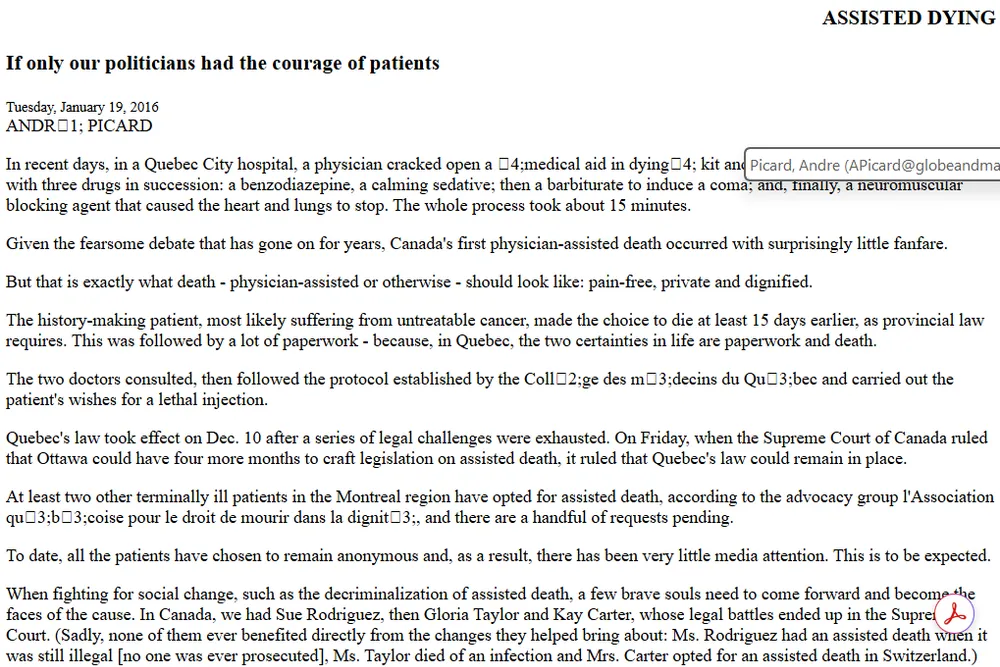
If only our politicians had the courage of patients. Given the fearsome debate that has gone on for years, Canada’s first physician-assisted death occurred with surprisingly little fanfare (2016)
Armed with the principles, on to the practicals: Next step in assisted death: Ensuring it can be done humanely. Do we need a new law with restrictions that reflects the court’s concern, or is a law needed at all? (2015) www.theglobeandmail.com/opinion/next…
Fears prevail during CMA policy debate on euthanasia, exposing the deep divisions in the medical profession about hastening death (2013) www.theglobeandmail.com/life/health-…
@jeffrey49.bsky.social:
The decision of Supreme Court Of Canada did say the government could enact legislation (i.e. C14) or could simply apply the judgment. Safeguards were in the decision. And there was no mention of natural death being reasonably foreseeable. No mention of special treatment for mental disorders.