

@alishagrauso.bsky.social:
Our entire economy is being artificially propped up by astrology for men: AI, crypto, sports betting, and prediction markets. It’s an economy shaped entirely by male insecurity and lack of impulse control, and we’ll all pay the price.
@shepherdone.bsky.social:
Translation: it’s staring to make tech oligarchs nervous because people are waking up their rapacious greed and sociopathy.

@omgsidewalks:
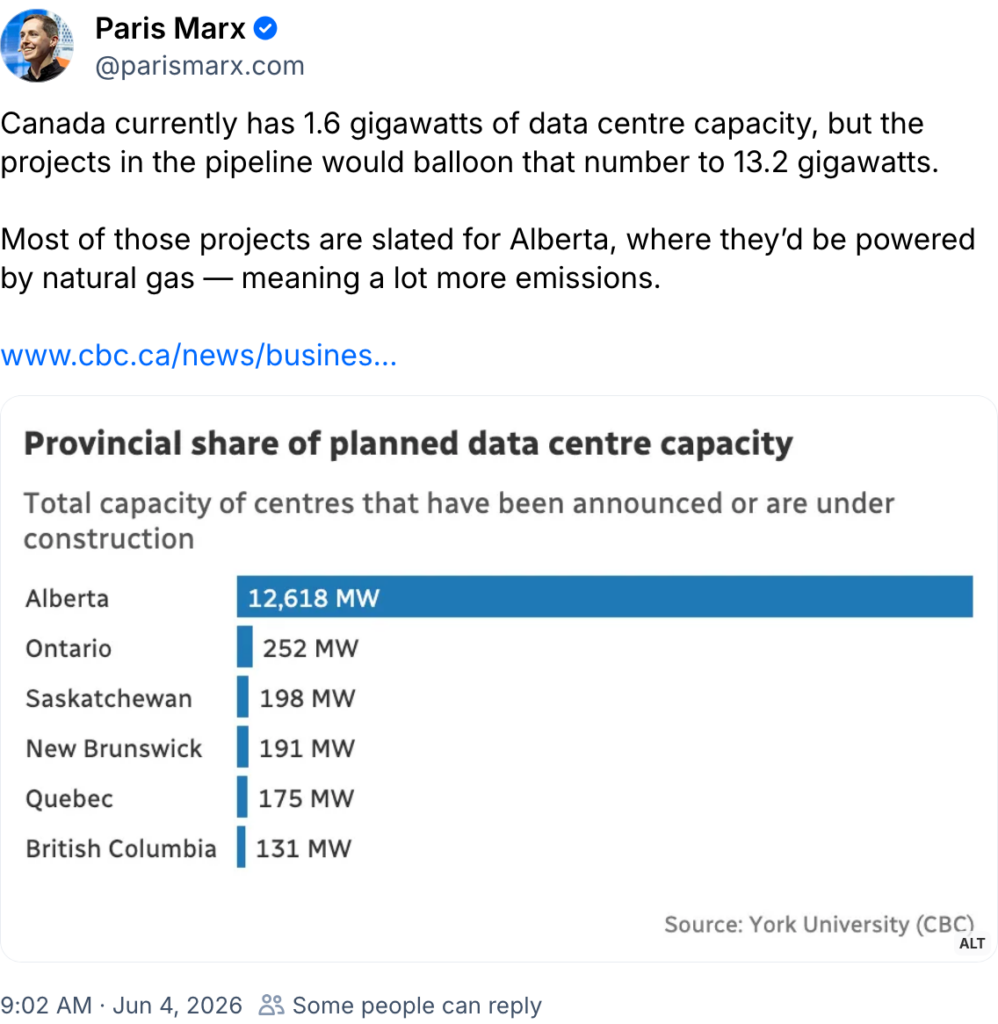
We are now in a weird era where a guy gets publicly shamed for running his sprinklers on a Tuesday, while a data center the size of a Costco quietly drains a reservoir so AI can generate a picture of your cat as a medieval knight. And the data center gets a tax incentive for it.
@itsbexy.bsky.social:
Not a word about intellectual property theft, despite the government’s own CHPC committee recommending it be addressed
Gov taking the executive-class brainrot stance that AI adoption should be encouraged and funded, with no particular use-case in mind
A document by and for starry-eyed suckers
why is it a policy objective of this government to encourage mass consumer adoption of a highly unpopular commercial product
“increase adoption from 12% to 75%”
GET REAL
@brodiedog.bsky.social:
From selling off our critical public infrastructure, to gutting the public service, to subsidizing foreign petrochemical companies and now this – a regulatory and financial gift to the most pathetic ‘innovation’ in tech – the Carney government is damaging our country in ways that may never be fixed
@marygillis.bsky.social:
Correct me if I’m wrong, but I can’t find a single word in here about protecting Canadian artists from having their work stolen by AI companies, or compensating them for that stolen work.
Why is it that people who create Canadian culture don’t deserve accountability or control?
Of course, this government AI education will be pro-AI propaganda, but I still get the feeling it has a high chance of backfiring and making the people who receive it dislike AI even more. I don’t think the government’s AI boosters will create successful propaganda. I doubt they’re capable of that.
I hope Mark Carney is known to posterity as the Slop Prime Minister, in honour of the slop he loves so much.
Mark Carney truly is a slop politician. He seems okay if you aren’t paying much attention, but when you look closely and actually judge his work, he’s just regurgitating bad ideas he got from other conservatives.
@nptwrites.bsky.social:
We knew there wouldn’t be when he decided that cabinet ministers can unilaterally allow any individual or company to break any non-Criminal Code law if it’s for “innovation, competitiveness or economic growth” purposes. It was obviously meant to allow AI companies to break copyright with impunity.
@journodale.bsky.social:
Anandasangaree wants your telecom companies to turn your phones into tracking devices on his behalf, and have you pay for the privilege.
Sweet Rhea mother of Zeus, this government got arrogant in an awful hurry under Carney.
@oaksides.bsky.social:
I get your point, but we’re paying for it if the government sends telcos money. Still coming out of the taxpayers pocket one way or another.

@itzmekatherine.bsky.social:
I’m getting close to the idea of throwing all electronics in the bin. The constant hand up our arses looking for the most basic of info is exhausting.
My life is simple and frankly boring, so it is laughable that they want the details of what I say and do. Our data is worth a lot of money to the billionaire shit tech bros, boring life or not. And, AI is for mass surveillance, SS, and all, given how Nazi the world has become, notably the rich fuckers. I thinking of ending my connection to the internet, it’s become too Nazi and abusive of kids and women.
@MarkBourrie:
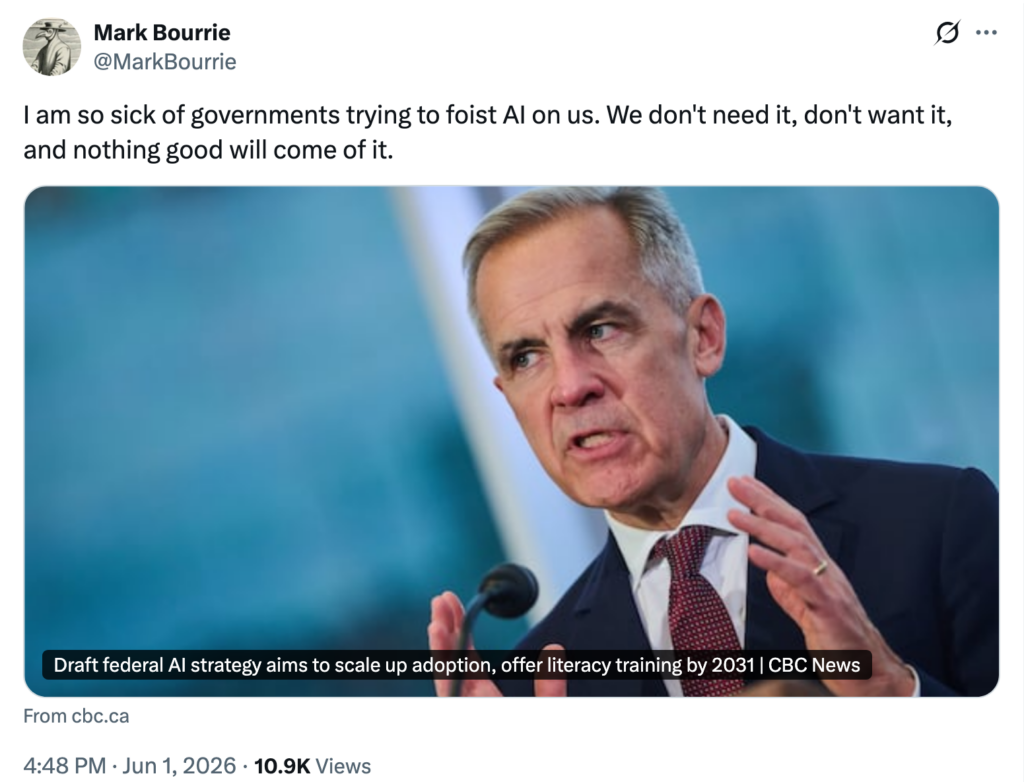
I am so sick of governments trying to foist AI on us. We don’t need it, don’t want it, and nothing good will come of it.
@bhaggart.bsky.social:
Also curious to see how often the words “surveillance” and “consent” appear in Carney’s AI strategy.
@ladymitopinion.bsky.social:
Artificial intelligence being created at the peak of an idiocracy is maybe not the best timing
Jacek Debiec, MD, PhD, DPhil @drjacekdebiec.bsky.social:
If democracy and the rule of law are obstacles to unrestrained Big Tech expansion, they are being terminated.
“AI centers are brazenly defying environmental laws, and regulators are doing little to stop it.”
We Saw What AI Data Centers Don’t Want You to See 21:41 Min by PBS Terra and Floodlight News, May 28, 2026
We investigated one of the world’s largest AI data centers, using thermal drone footage to reveal the hidden pollution powering the AI boom. As companies race to build the future of artificial intelligence, residents and experts warn that fossil fuels, secrecy, and weak regulation may be putting communities at risk.
@vickyacab.bsky.social:
Not even dystopian cyberpunk, just cyberpuke
@josephcox.bsky.social:
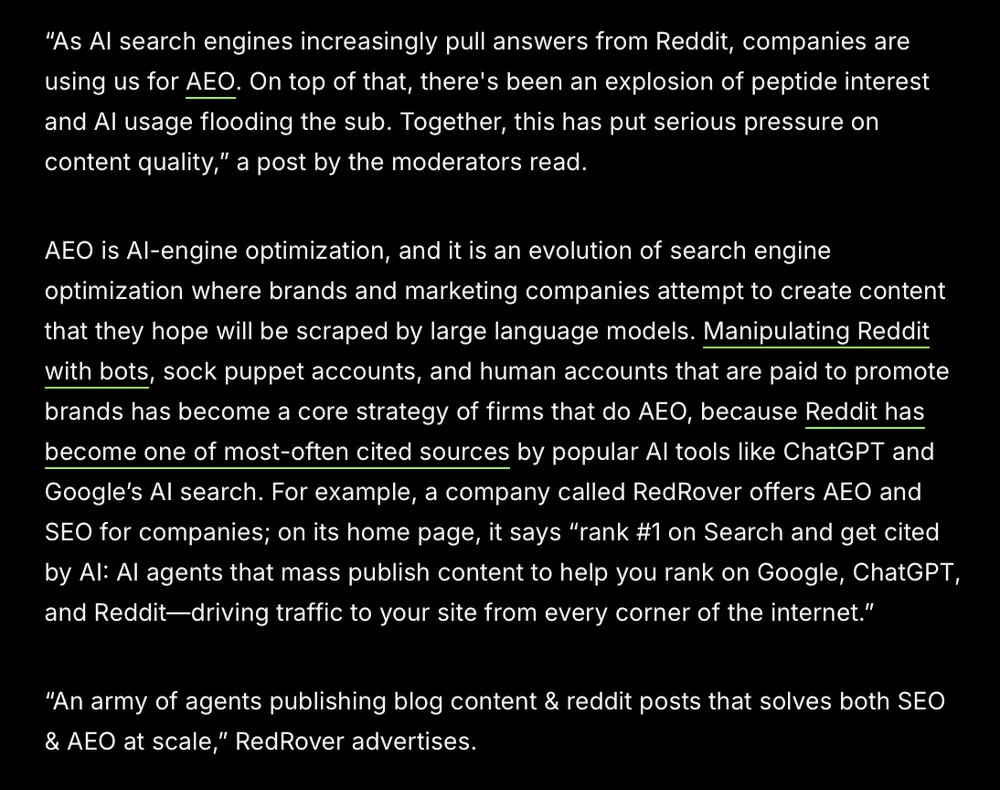
New from 404 Media: companies are using Reddit manipulate ChatGPT and Google AI Search. The strategy is to systematically manipulate answers provided by chatbots by manipulating the underlying source material those chatbots scrape—in this case, a popular subreddit
https://www.404media.co/companies-are-using-reddit-to-manipulate-chatgpt-and-google-ai-search
@gpf415.bsky.social:
This article makes sense to me from what I know of the evolution of SEO agencies. Their value has always been about getting their clients improved rankings and traffic, and that has meant gaming the system. SEO was made essential marketing by Google’s constant rule changes and algorithm tweaking.
@journodale.bsky.social:
Readout of Carney’s call with the Pope.
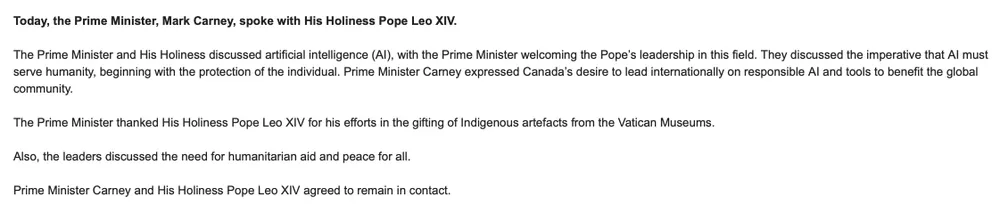
Carney claims he wants to lead on “responsible” digital asbestos tools, which isn’t what his government has been saying for months now as they have been advocating for a “light touch” because they swallowed the tech bro line that regulation stifles innovation.
@reneestephen.bsky.social:
And Solomon is just exactly the demographic who swallows AI bullshit whole too (even aside from being totally unqualified in every other way, he’s uniquely especially unqualified in that one.)
@redshan.bsky.social:
Carney will have to change what he has been doing if he is a true Catholic. This could be a good thing because his government is not being safe on the rush to scale up AI usage.
@tinkiegurl.bsky.social:
When it comes to power and money religion gets left behind.but much more often, religion is used to abuse, rape, steal, terrify, mass murder, coerce and destroy. Religion is a heinous thing, in my vew. Among the rich and powerful, it’s a weapon more harmful than nukes and Mark Carney, catholic, is a very dangerous man with his fraud (lying to Canadians that he’s a liberal) and serving murderers, Nazi USA and the rich, not Canada and Canadians.
@tinkiegurl.bsky.social:
He lied to the Pope?
@jennykwan.bsky.social:
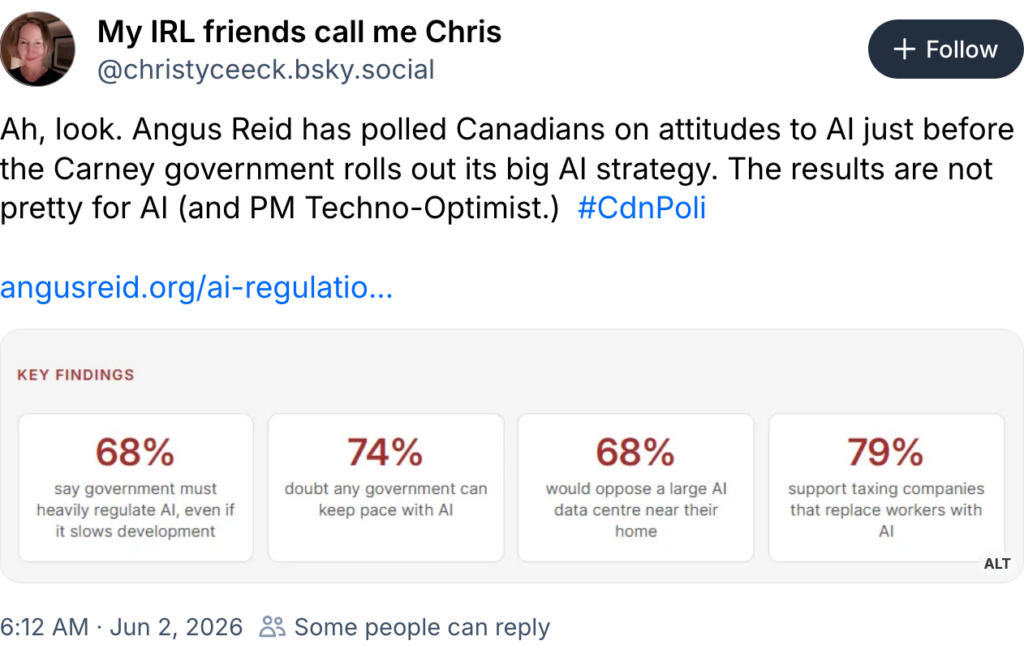
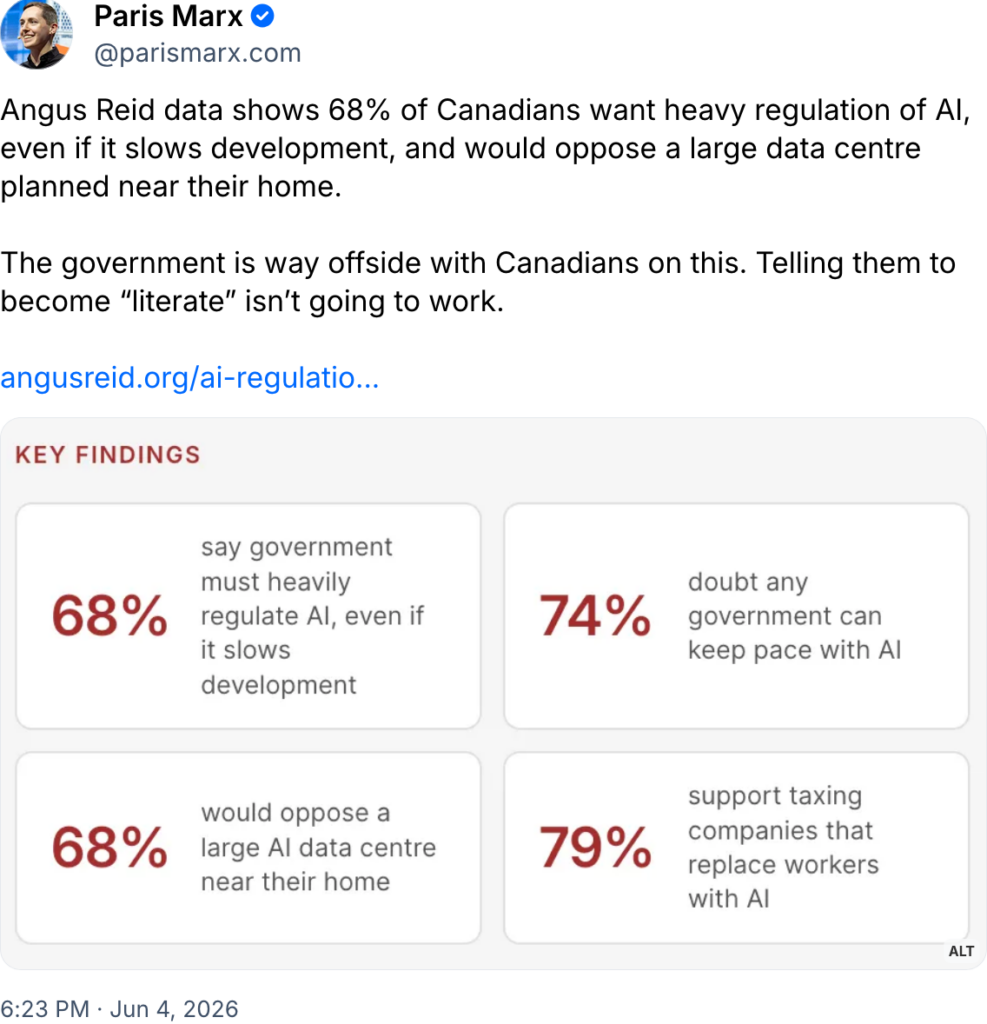
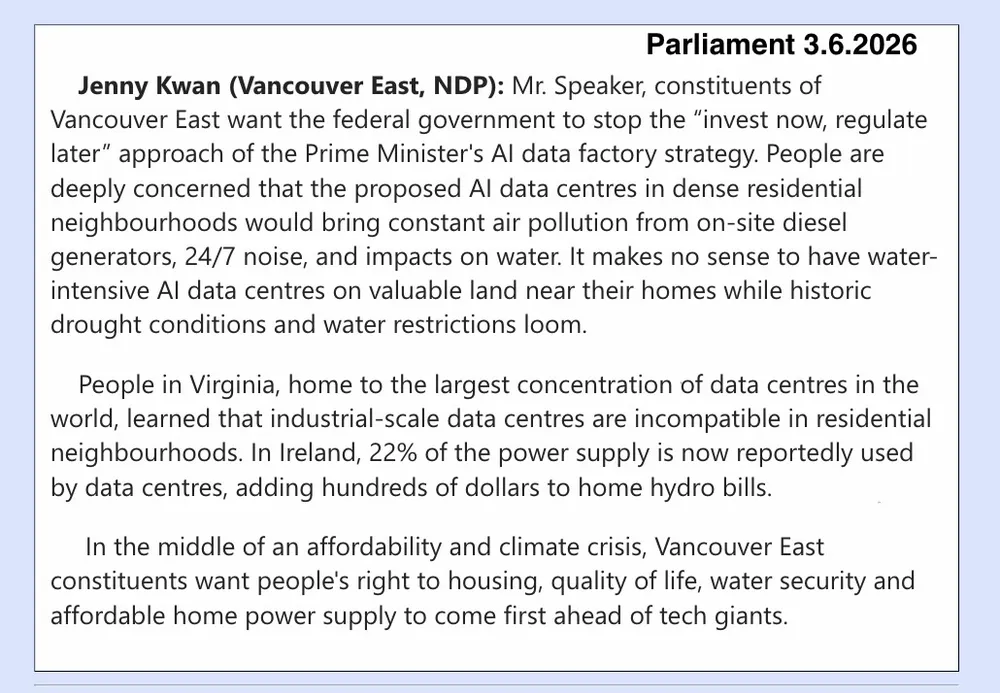
The federal government’s “invest now, regulate later” AI data factory strategy is a direct threat to residential neighbourhoods like Vancouver East. Today in the House, I stood up to demand that people be put ahead of tech giants.
@maxkennerly.bsky.social:
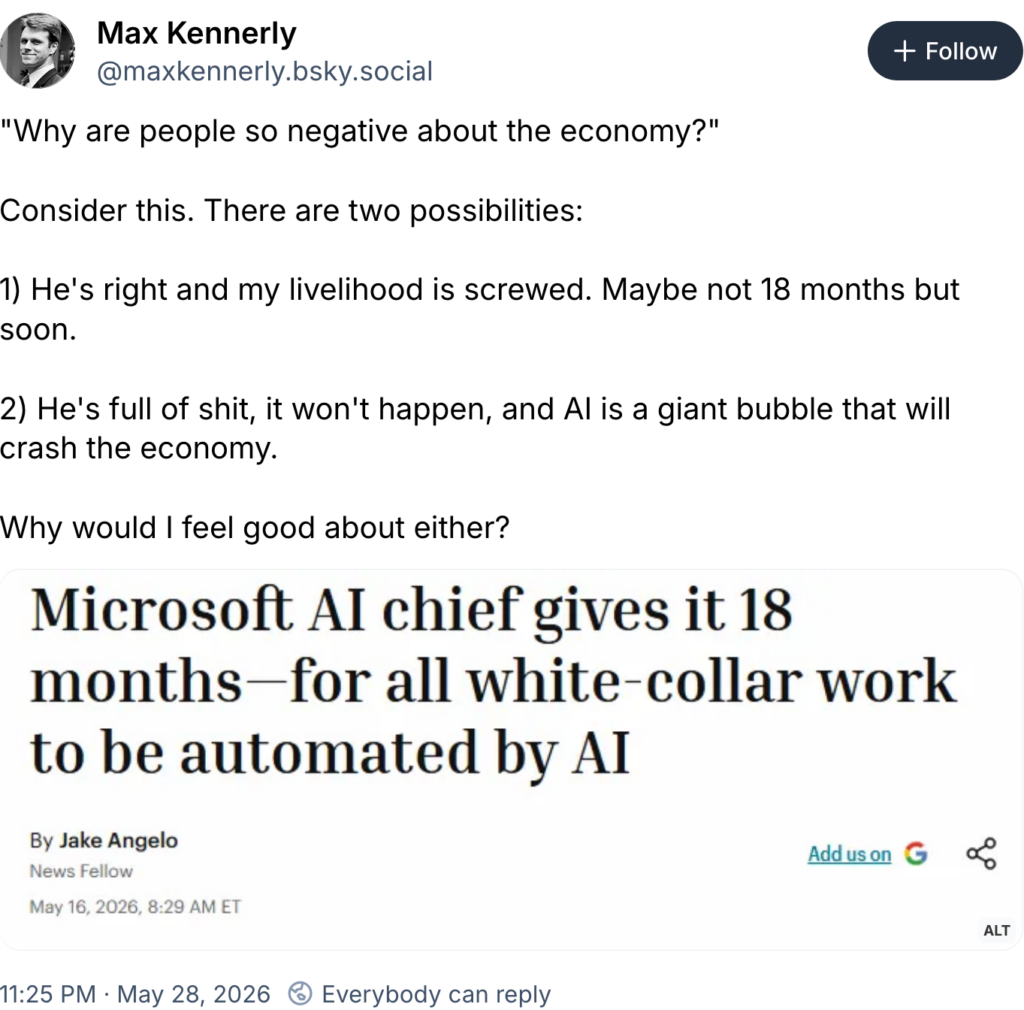
“Why are people so negative about the economy?”
Consider this. There are two possibilities:
1) He’s right and my livelihood is screwed. Maybe not 18 months but soon.
2) He’s full of shit, it won’t happen, and AI is a giant bubble that will crash the economy.
Why would I feel good about either?
@canadiancynic.bsky.social:
I’m curious … how much is Evan Solomon getting paid for being as useful as a condom machine at the Vatican?
@deonandan.bsky.social:
It’s starting to feel like the entirety of US economic growth is propped up by AI infrastructure growth. No one really wants AI or its data centres. But the economic dependency on them is real, and I don’t think anyone has a plan to extract us all from this dependence.
Genuine question. What exactly is Evan Solomon doing as “Minister of Artificial Intelligence”?
Markets, venture cap, energy, and tech valuations are all tied to (dependent on) AI expansion now. But none of the native AI companies are profitable yet. The only big winners are AI infrastructure orgs, like NVIDIA.
The shovel sellers are making more money than the gold miners.
Nervous?
‘Hidden datacentre tax’ costing Irish households millions, report says, Datacentres used 22% of country’s electricity last year, pushing up household bills, study suggests by Rory Carroll, 28 May 2026, The Guardian
Energy demand by datacentres in Ireland has added hundreds of euros to household electricity bills in a pattern that could be replicated across Europe, according to a report.
Ireland’s growing number of datacentres last year used 22% of the country’s electricity, more than all urban homes combined, according to the Central Statistics Office. The equivalent figure in the US and UK is 6%.
The centres have “drained” €715m (£620m) from the Irish economy and increased household bills by a cumulative average of €360 between 2015 and 2023, said the report commissioned by Friends of the Earth Ireland and Beyond Fossil Fuels. It argued that Irish households have been subsidising big tech via a “hidden data centre tax” on their electricity bills.
Jill McArdle, of Beyond Fossil Fuels, said: “The Irish case should be a warning for Europe: letting big tech expand datacentres unchecked will have massive ripple effects on the economy and European households. Combined with fossil gas, this creates a toxic mix – driving up energy prices for people already struggling through another energy crisis.”
Datacentre industry representatives disputed the findings and said the sector boosted the economy.What do rich fuckers do best? Lie and abuse the rest of us, and always demanding more and more and more $billions stolen from us to give to them via subsidies and political lies.
The Irish government has broadly welcomed the expansion, calling datacentres “a core enabler of our technology-rich innovation economy”, and denies they create a stealth tax on consumers.
Seán Fearon, a postdoctoral researcher at the Institute of Environmental Science and Technology at the Autonomous University of Barcelona and author of the report, said: “Our modelling shows that the high, growing and inflexible nature of datacentres’ electricity demand increases the number of hours in which gas sets the price in the Irish power system, driving up electricity costs.”
When other factors set the price – for instance strong wind that powers turbines – bills can fall.
Historical evidence suggested this effect became more pronounced during energy shocks, with the high datacentre demand and gas dependency combining to amplify price spikes, he said.
Depending on datacentre growth, the average Irish household could pay a further €295 to €644 cumulatively from 2025 to 2034, for a national total between €633m and €1.43bn, Fearon added.
McArdle said the European Commission should heed Ireland’s example and strengthen safeguards amid proliferation of datacentres – in part driven by AI – across Europe.
“Even Trump, under intense pressure from voters, has acknowledged that big tech should pay its own energy bills,” But they won’t said McArdle. “Unless datacentres are required to be powered by additional renewable energy, they could lock Europe into volatile and expensive fossil gas.”
Industry groups disputed the report, saying big energy users bought electricity in a way different from other users and were pumping money into the economy.Lie trombone
Maurice Mortell, chair of Digital Infrastructure Ireland, said datacentre investors had injected €18bn in recent years.
Tom Parlon, chair of the Irish Data Centre Supplier Alliance, said datacentres paid grid network charges and commercial electricity costs proportional to their usage and investment. Datacentres must meet 80% of energy needs from additional renewable capacity – the strictest regime in Europe – and paid the lion’s share of Ireland’s corporate tax bonanza, he said.
Parlon said: “These unprecedented tax revenues allow the Irish state to invest in critical infrastructure and housing, while also funding direct supports for Irish households and climate action programmes.”
Jeremy Scott’s magnificent speech to Kansas City Art Institute grads: Artists vs AI> It’s much easier for the Nazi bad guys, including Mark Carney, Danielle Smith, Pedo Rapist Trump and his drug addled handler Elon Musk, to control us if we all think and behave the same -which is the intent with AfuckingI:
“An artist doesn’t tell the truth, they decide what the truth feels like.”
@iheartnoise.bandcamp.com:
I’d much prefer artists reshaping the world, not billionaires…who can’t spell or think critically or create or reason and have no empathy
“And remember, when you get to the end of it, that governments aren’t regulating this technology at all.”
Evan Solomon, Carney’s corrupt art dealer pal, has already publicly stated he will not regulate AI, not even when it inspires mass murder, or mass theft, or mass rape. AI is racist, Nazi, misogynist, bigoted crap because it’s created by Nazi, misogynistic bigoted crap.

@FastCompany:
Scientists have been sounding the alarm on just how bad artificial intelligence is for the environment, and a new study offers more proof.

@unusual_whales:
Artificial intelligence is causing a net U.S. loss of 16,000 jobs per month, per Goldman Sachs.
“The most compelling reason for reforming our system is that the system is in no one’s interest. It is a suicide machine.” -Ronald Wright, A Short History of Progress
@tryangregory.bsky.social:
Carney is more Harper than Harper ever was.Yup. Carney and his partner in crime, untrustworthy non stop liar, Danielle Smith, are pushing AI data centres even in areas where there is insufficient water, e.g. MD Greenview, likely under orders from Herr IDU Harper.
Ottawa wants CPP investments in ‘sovereign’ AI, but some wonder if it’s even safe
@scalzi.com:
“I’m really angry that this scifi writer whose work was stolen to train a probability machine that depletes water tables and raises electricity prices and is accelerating the transfer of wealth and capital toward men who actively hate other humans doesn’t like ‘AI,” what a lack of vision they have”
@effinbirds.com:
I had someone go on a five day Facebook comment bender where they insisted, over and over, that I am some kind of Luddite for not using A.I. (instead of a totally sensible person who would never jeopardize his publishing contract by inserting material that could not be protected by copyright)
@scalzi.com:
Yuuuuuup. My contracts wouldn’t let me use “AI” for this reason, even if I wanted to, which I don’t.
@effinbirds.com
I repeatedly emphasized “and that’s why it is a tool only for amateurs,” which admittedly stirred the pot
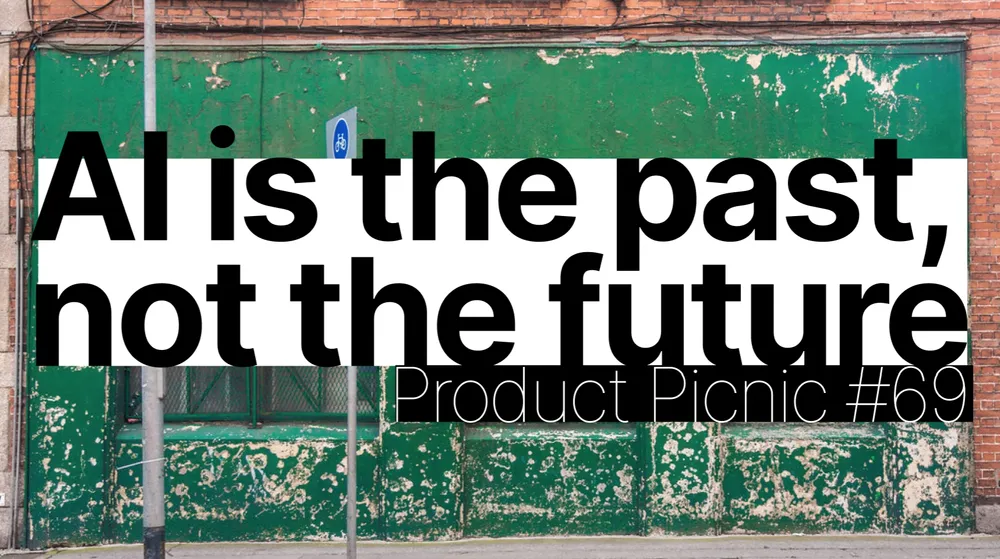
AI is not the future of software development, but the last dying gasp of the past, The industry has been building careers and business models around solving the very problems it created. But the conditions that once made this possible are breaking down. by Pavel Samsonov, May 23, 2026, The Product Picnic
At this week’s Google I/O, Google VP of Search Elizabeth Reid announced the death of a 30 year old interaction pattern: putting in a search query and getting back a page with 10 blue links. The paradigm of scrolling, reading, and clicking has been replaced by an “interactive experience.”
The Internet’s response has been unanimous: “why?“
That question has many answers, and some of them are even true. It’s a response to users’ changing preferences. It’s a cash grab to sell more ads. It is an attempt to reverse Google’s shrinking share of the search market (which is, in no small part, their own fault).
But anyone who has ever run an ideation workshop with executives will immediately recognize the real reason. “How might we transform our product into an ✨Interactive Experience✨” is inevitably the first post-it note that goes up on the board, immediately followed by a dozen nearly identical ones.
This is a real sticky note from a real workshop. The bar is not high.
The entire purpose of the following 2-3 hours of that workshop is to move past this nothingburger of an idea, towards something actually meaningful. Google’s inability to do this represents the end of a long-running conflict between, broadly speaking, two ideologies of how products create value.
Mo’ problems, mo’ money
One side of this struggle believed that products should solve problems for users, and the less effort users spend on using the product before the problem is solved, the better. While we might associate this user-centered perspective with UX design, designers have never really been able to leverage it as a source of power. But developers did. Companies needed programmers to get working software, so programmers had leverage they could use (to a certain extent) to dictate terms against an all-powerful employer:
The picturing relation is the lever practitioners have outside the firm’s interests, because it is the relation between the practitioner’s claims and a reality the firm does not constitute. The firm can dissolve teams. It can lay people off. It can replace practitioners with systems that generate fluent outputs at scale. What it cannot do is make the system have different properties than it has, and it cannot easily make the systems engineers have already built behave differently than they were built to.
Evan Garris, The picturing relation
This side fought bravely for the past 30+ years. Google I/O 2026 marks the day that it has finally lost.
But it didn’t lose against something new. Its opponent for those decades was always the same:
In organizations where the practice’s hold on picturing has already been weakened by the reshuffling cadence, by the management of engineering speech for rhetorical effect, by the celebration of fluent generation over committal claim, the AI’s outputs slot into the existing weakness. The AI is fluent in the language the management framework already speaks. It can flag risks; it does not insist on them from the position of someone who will bear the consequences of being wrong. It does not have a picturing relation to defend against rhetorical pressure. It is the engineering participant capital has been trying to produce for forty years.
Evan Garris, The picturing relation
For this winning side, value didn’t come from users putting down the product, but only from them picking it up. The more tasks users could do in that product, the better. “Problems” came from a lack of tasks to do: “we don’t have a feature that does X”.
In other words, these were artificially created problems. And creating those problems was immensely profitable:
Each year, the Annoyance Economy costs American families at least $165 billion in wasted time and lost money—an amount greater than the GDP of 14 U.S. states.
Chad Maisel and Neale Mahoney, Taking on the Annoyance Economy
Turning everything into an “interactive experience” is near and dear to an executive’s heart because it lets them manufacture many new problems for the user — assigning users new tasks that they must do — that they can then “solve” by giving the user new tools to do those tasks with.
Any problem caused by an LLM can be solved by an LLM
LLMs are the apotheosis of this line of thinking. In the eyes of interaction-maxxers, massive over-engineering of everything to do with both the models themselves and the slop code they produce is a feature, not a bug. The more unnecessary problems are created, the better.
Real problems have troublesome things like constraints, user needs, and success criteria that you might not meet. But when you invent the problem for yourself, then as long as your vibe code compiles, then the problem was solved. Every output is an outcome, because the outcome being sought is 10x-ing our PRs:
The salient difference here is whether an engineer has mostly spent their career solving problems created by other software, or solving problems people already had before there was any software at all.
Steven Wittens, The L in “LLM” Stands for Lying
LLMs are also really handy for making up problems that you want your users to have, and manufacturing legitimacy for those problems. A whole industry of products calling themselves “synthetic users” has popped up for this express purpose.
The notion of synthetic users has never been more discredited than today, with two proponent studies being retracted and literature reviews of what remains showing that artificial research is only good for lending believability to made-up conclusions. The closer authors are to studying people (as opposed to computers), the more they call foul on the outputs of research slop.
But synthetic user companies aren’t selling insights. They’re selling a permission structure to the “interactive experience” crowd: any problem you can imagine, we can legitimize for you.
And who can blame them? This era’s spotlight has been squarely on the problem-makers. Joseph “the father of AI” Weizenbaum clocked this problem over 50 years ago, and the rhetoric has not changed:
The structure of the typical essay on “The impact of computers on society” is as follows: …the glorious present and prospective achievements of the computer are applauded, while the dangers … are shown to be capable of being alleviated by sophisticated technological fixes… only computer science can guard the world against the admittedly hazardous fallout of applied computer technology.
Joseph Weizenbaum, On the Impact of the Computer on Society
Every leading company of the AI boom — the OpenAIs and Googles of this world — got to the top because they could create the biggest new problems. Those problems run the gamut from environmental costs and rising energy prices, to industry-wide layoffs, to news orgs fighting to squeeze revenue from the last remaining shreds of traffic, to a deluge of slop code and zero nines reliability across some of tech’s most critical infrastructure. We are then told that we must purchase the solution to these problems from the very people who are creating them.
Instead of delivering services and software that unlocks value for their client industries, the software industry has spent the past decade or so trying to control their customers and their client industries.
Baldur Bjarnason, The old world of tech is dying and the new cannot be born
Bjarnason’s essay dives deeply into how tech companies were able to get away with this relationship to their users for so long, and why that relationship has already started to break down. Not only are American megacorps less able to keep customers locked in to their ecosystems, but even willing clients are increasingly unable to bear the dollar cost that infinite growth targets demand from them. The risky bets that Big Tech built its business model around are looking less and less like a sure thing.
Rejecting the notion that we are in a brave new world gives us permission to look at the historical record, and draw conclusions. Those conclusions are that the era of “move fast and break things” accomplished nothing worth speaking of:
There has been zero systematic progress over the past 30 years in making startups more likely to survive… The precipitous drop in seed-funded companies raising further capital does not support the idea that venture-backed startups have become more successful over the past 15 years. If anything, they seem to fail more often.
… We have spent countless hours and billions of dollars on an intellectual framework that simply does not work.
Jerry Neumann, We Have Learned Nothing
AI is the last child of the “line go up and to the right forever” era. It does not offer the industry a lifeline to escape from this decline. It is the decline from which we must escape, or be dragged under with it.
The part of the newsletter where I give practical advice rather than just complain
If you skipped over Garris’s and Bjarnason’s essays, I strongly recommend going back to read them — even the uncomfortable parts — and sit with their conclusions for a bit. Because what they add up to is that the “golden age” of tech was not in 2014, or even in 2005. By the time Design Thinking, Agile development, DevOps, etc came on to the scene, it was already too late: practitioners had given up the picturing relation that gave them real leverage.
Finding adequate vocabulary is part of constituting the practice as something the practitioners hold rather than something the firm rents. The recognitive practice and the we-intentional structure are how picturing becomes a sustained collective achievement. The community of practitioners is what holds the practice across the dissolution of any particular firm or any particular team.
Evan Garris, The picturing relation
When we talk about the “value” we deliver, we are really talking about two different things: the value of the product to the customer who will buy it, and the value of the product to the employer for whom we are making it. Understanding both of these concepts independently of one another is key to reclaiming the vocabulary we can use to leave invented problems behind.
I quote Rob Snyder a lot on the Picnic, as one of the few Sales guys whose understanding of value aligns with UX. He recently shared his entire 3-hour lecture on how demand works — why people really buy things, rather than having things thrust upon them. If you want to move your practice up the value chain, this is definitely on the syllabus.
Another useful resource comes from the prehistoric era (2008) when Kevin Kelly clocked the problem facing the knowledge economy in the LLM era: how do you charge for something when anything can be infinitely copied for cheap or even free?
And if you want to throw off the shackles of corporate employment and throw on the shackles of consultant work, Kevin Riggle has three pieces of advice for you (and none of them are “don’t do it”).
— Pavel at the Product Picnic
Dr Sho Jacobs@shoshanahjacobs.ca:
1. Get them addicted to using it
2. Change pricing to usage-based
www.directionsonmicrosoft.com/github-copil…
@ryderr9.bsky.social:
feel like they’ve moved the timeline up simply because of how much money they’re losing and are projected to lose
***
@scalzi.com
“I’m really angry that this scifi writer whose work was stolen to train a probability machine that depletes water tables and raises electricity prices and is accelerating the transfer of wealth and capital toward men who actively hate other humans doesn’t like ‘AI,” what a lack of vision they have”
@effinbirds.com:
I had someone go on a five day Facebook comment bender where they insisted, over and over, that I am some kind of Luddite for not using A.I. (instead of a totally sensible person who would never jeopardize his publishing contract by inserting material that could not be protected by copyright)
@scalzi.com:
Yuuuuuup. My contracts wouldn’t let me use “AI” for this reason, even if I wanted to, which I don’t.
@effinbirds.com
I repeatedly emphasized “and that’s why it is a tool only for amateurs,” which admittedly stirred the pot
***
First Nation’s appeal on Wonder Valley water dismissed by Chris Zwick, May 17, 2026, Missinipi Broadcasting Corporation

Just the politicians federally like Carney, provincially like Smith, and MD Greenview council.

Photo: O’Leary Ventures says it found the perfect spot to bring the world’s largest data centre, called Wonder Valley, to northern Alberta, just south of Grande Prairie in the Greenview Industrial Gateway. An appeal of the water license brought forward by Sturgeon Lake Cree Nation was dismissed in April.
IMAGE: greenviewindustrial.ca
Sturgeon Lake Cree Nation (SLCN) is not directly affected by the water license granted to the Wonder Valley data centre project south of Grande Prairie and does not have standing to appeal.
The ruling related to the project proposed in the Greenview Industrial Gateway (GIG) came in a written April 17 decision released by the Environmental Appeals Board (EAB).That board, like CER and AER, protect rape and profits for the rich, mostly American, they don’t protect the environment or the many Albertans harmed by the raping rich.
The decision written by EAB chair Barbara Johnson recognized the First Nation’s interest in the license being issued for the Smoky River but ultimately dismissed its appeal, saying there was no evidence provided that the nation or its members would be adversely affected by the license.
“The board finds (SLCN) has a direct or personal interest in the area near the point of diversion for the (water license) and in the quality and quantity of water in the Smoky River and the Smoky River Watershed that could be adversely affected by the decision of (the province) to issue the licence.
“In contrast, (the MD of Greenview) has provided evidence that the licence is anticipated to have a negligible impact on the Smoky River and the Smoky Watershed, and fish habitat as demonstrated by (Fisheries and Oceans Canada’s) Fish Habitat Summary,” the decision went on to say.The MD is lying, their lies are based on O’Leary’s lies. There will be massive impacts to water near the insane data centre and far away. PFAS are used in data centres, and need to be regularly dumped, which AI tech billionaires do usually in violation of the law, contaminating area water, including drinking water for neighbouring families.
The appeal
The main contention was the 10-year water license granted April 2025 by the province that allows the GIG to pump six million cubic metres from the river every year. To note, Environment and Protected Areas also issued a preliminary certificate for up to 24 million cubic metres per year until 2034. This gives the GIG a spot in the line to collect from the watershed but is not an actual license to start pumping.
The other is what SLCN chief Sheldon Sunshine sees as a wilful lack of consultation — he found out about the project through a media release. He said he’s surprised by the EAB decision, considering the size of the project, but the dismissal was not all that unexpected.
“We’re disappointed, of course, but with the significance of that project, it was actually surprising,” he said. “But again, we kind of expected something of that nature. The province and these groups are adamant that they’re going to push this thing through. So, we kind of expected it.”
SLCN argued its members still use the area to hunt, fish, trap, gather and exercise their treaty rights and rely on the river for drinking water. Indigenous consultations are the government’s duty under Treaty 8.
MD of Greenview Reeve Ryan Ratzlaff said he was “a little disappointed at the appeal in the first place.”
“For the volume of water that we were applying for license on, in the grand scheme of things, it was a very small amount that is regularly approved through Alberta Environment,” he said, adding there has been little opposition to other projects on the river that used far more water.Do they illegally dump toxic chemicals, including PFAS, as a regular operation like data centres do? I betcha old rich white man O’Leary hasn’t told you or other county members about that shite aspect of AI.
The EAB ultimately agreed with the MD, and ruled in favour of the requested dismissal, saying the Nation provided no evidence their traditional uses will be affected negatively by the project.In my view, the EAB is about as rape enabling of Alberta as AER and UCP are.
The MD of Greenview and Ministry of Environment and Protected Areas’ “evidence was that the impact to the Smoky River from the diversion authorized by the licence would be temporary and negligible, representing approximately 0.0556 per cent of the yearly flow rate of the Smoky River and less than 1 per cent of the daily flow of the Smoky River,” the decision read.You fucking lying pollution enabling shits. Data centres waste phenomenal amounts of energy we cannot afford to waste, are horrifyingly toxic, noisy and insanity making, and if supplied with free frac’d gas (as Carney and Smith seem to be keen on), that gas results in massive amounts of water permanently removed from any future use because much of the water injected during frac’ing is permanently lost to the hydrogeological cycle, for fucking nothing but stolen stupid Nazi slop.
As a result of that finding “the board did not consider whether the grounds of appeal raised by the (SLCN) were within the board’s jurisdiction.”That’s fucking dirty and irresponsible, but typical of the industrial rape that goes on in Alberta every day, thanks to thugs like EAB, AER and politicians.
“The board can consider evidence of constitutional rights as evidence of a right to access or use an area or resource. However, the board is not a constitutional decision-maker … and does not have jurisdiction to consider constitutional questions including the adequacy of consultation.”
Foregone conclusion?
“We were anticipating that something like this would come along and of course we’re not happy about it, and we’re going to do everything in our means to address it,” said Sunshine, who also shared he recently met with Minister of Environment and Protected Areas Grant Hunter. He said he got the sense the project was going to happen one way or another.
“The messaging that we got is that they’re limited in their scope, based on Supreme Court of Canada, so our expectation is that there’ll be, as we’ve seen over the last several months here, with Canada, working with the province and trying to streamline their processes. We’re anticipating the worst as always,” said Sunshine.
He reiterated as he has in the past that the SLCN is not against the development but feels the duty to consult was overlooked.
“We’ve been running across that with the ACO (Aboriginal Consultation Office) process and the AR (adequacy review) processes. In recent months, we’ve been doing a lot a lot of work and finding that those things are failing our people, not only our people, but average Albertans, right when you have drought conditions throughout the province,” he said. “It really is hard to believe that a project of this magnitude doesn’t require an environmental impact assessment through the province.”
The independent news site the National Observer reported in April the province would be waiving an environmental assessment of the project because it will use standard water and power systems.
Reeve Ratzlaff sees it a different way.
“The environmental assessment, in some ways, Greenview did it when we started designing the GIG years and years and years ago. We had to get a bunch of approvals in place for heavy industrial parks, major petrochemical processing facilities,” he said.
“I think that’s part of the decision to forego that, but that doesn’t mean they don’t have to get all their environmental permits. I would like to say that it’s more of an acknowledgement of the work that’s already been done on this site.”
The Impact Assessment Agency of Canada has requested information from the developer and will consider if a federal assessment is necessary. Many more technical assessments on the impact to the air and water will also have to be completed to receive the appropriate permits.
Ratzlaff said technology is moving so quickly that the 24-million cubic metre preliminary certificate may never have to be used.
“When they first came to us, they were talking that, at full design build out, they would need the full 24 million cubic meters of water that we have the preliminary license for. As technology is changing, they’re looking at this 6 million cube water license like it will do for the life of the project,” he said.
What is it?
The Wonder Valley project, once built, will be home to the world’s largest AI data centre and is backed by celebrity billionaire Kevin O’Leary’s O’Leary Ventures, which entered a partnership with the MD of Greenview in late 2024, after expressing intent to purchase the land.
On his O’Leary Digital platform, the TV dragon hyped Wonder Valley, saying his team “has sourced what we believe is the most compelling site in all of North America to generate over 7.5 gigawatts of low-cost power to hyperscalers over the next five to 10 years.”
Data centres are the backbone of modern computing infrastructure. Essentially, entire buildings filled with processing and storage units that increase their capacity exponentially as needed. The facilities are used to provide cloud storage solutions and train artificial intelligence software to solve problems using the breadth of online human knowledge and learn from it.
The Wonder Valley campus, as it’s called in the promotional video on the same platform, is meant to be self-reliant, producing its own power thanks to an abundance of natural gas in the region. The data centre buildings will be mixed in among administrative offices and amenities to serve those who work there, giving more of a community feel than anything industrial.
“Given existing permits, proximity to stranded sources of natural gas, pipeline infrastructure, water and a fiber-optic network within just a few kilometers of the Greenview Industrial Gateway, we will be in the ground and up and running sooner than any scale project of its kind,” O’Leary said.
Ratzlaff is just as hyped to see the project progress further, as it will bring a new industry into the region and the professionals and support who will help it be successful.
“That’s the exciting part for the region; it’s the skills and the knowledge and the diversity of jobs that this is going to bring with this. It’s just going to give so much more opportunity.”
Refer also to:
More than $70B largest in world 7,000 acres AI data centre planned in MD Greenview, Alberta; Ego O’Leary’s Wonder Valley to eat worker pensions nestled under Harpie’s $170B AIMCo wing? Water guzzling from Smokey River; power from toxic frac’d gas. Cumulative impacts will be horrific so I expect evil queen Dildo Danielle will exempt the insanity from assessments.Which she did, immediately after Mark “Harper2” Carney’s massive deregulation and giving AI permission to use frac’d gas, so much for his lies of clean and green.

“And, as you head out into the world, your fresh, meaty torsos will be ripped apart and roasted to feed your new alien overlords—wait, why are you all booing?”
***Hating AI is good***, actually, LinkedIn may be awash with boosters, but shunning AI is the human choice by Marisa Kabas, May 20, 2026, The Handbasket

[Ex-Google CEO Eric Schmidt while being booed]
Jonah Peretti is very lucky. Buzzfeed—the viral media company he founded 20 years ago and was once valued at $1.6 billion—was running out of cash when billionaire Byron Allen agreed to buy 52% of its shares. At the same time this new partnership was revealed, Peretti announced he’d be stepping down as CEO of Buzzfeed to serve in a new role as President of Buzzfeed AI. So Allen will continue to bankroll the former media titan’s obsession, as he promises (without evidence) that AI will right the ship. Lucky, to be sure, but also part of the mass delusion that AI is not just worth our money, but owed our respect.
Lately I’ve felt myself rapidly radicalizing into what I can only call an anti-AI evangelist. I’ve never been quiet about my feelings on the subject—I even wrote a screed about it last month—but as more and more examples show how easily it can be used unethically, I’m not just skeptical. I’m against it.
I wouldn’t call this a particularly bold stance, given the front page of today’s Wall Street Journal declares an “AI Rebellion,” noting that public opinion on the subject is souring “at breakneck speed.” What is novel, I think, is recognizing that people who loathe AI and the way it’s being foisted upon society are an actual constituency to be taken seriously. I figure that if billionaires and brands are going to try to beat us into AI submission, it’s only fair we get to take a few swings. We’re told that if we don’t use AI then we’ll get left behind, but what if we’d like to leave the AI boosters behind instead? It’s time to give a voice to those who don’t view AI as an inevitability but a liability.
Now is our time.
The soundtrack of the past week or so has been the boos of graduating college students as out-of-touch adults try to tell them that they need to embrace AI or else. Perhaps most prominent were the boos of University of Arizona graduates as ex-Google CEO Eric Schmidt told them, “The question is not whether AI will shape the world. It will. The question is whether you will help shape artificial intelligence.”
These grads, according to Schmidt, have no agency, which was confirmed by this comment a few minutes later: “When someone offers you a seat on the rocket ship, you do not ask which seat. You just get on, Graduates, the rocket ship is here.” What Schmidt doesn’t get is that these young people have already been forced onto the ship and there aren’t enough seats.
A few days before Schmidt, record company CEO Scott Borchetta took the stage at Middle Tennessee State University’s commencement to extoll the virtues of AI. When the students, whose job prospects have shrunken significantly because of the AI bubble, booed Borchetta, he shot back: “Deal with it. Like I said, it’s a tool.”
Sage words from a man reportedly worth $450 million.
It may seem callous for a commencement speaker to respond to graduates’ existential dread with “deal with it,” but billionaires and tech companies have been feeding us this message for a while now. You may not like AI, they preach, but because of choices we are making for you, life will be increasingly unlivable without it. Yet while they try to force-feed us this bleakly inevitable future, actually existing AI keeps making the humans who use it look like idiots.
On Tuesday, the New York Times reported on a new book called “The Future of Truth: How AI Reshapes Reality,” by media executive Steven Rosenbaum. He readily copped to having “used AI tools ChatGPT and Claude during the research, writing and editing process.” But he didn’t disclose—likely because he didn’t realize it!— that his book contained misattributed or completely fabricated quotes created by those very tools. Only when reporters began to question the quotes did Rosenbaum promise to “investigate” how they’d been included.
But Rosenbaum was unrepentant. He told the Times that if this debacle “serves as a warning about the risks of AI-assisted research and verification, that is why I wrote the book.” And he went on to say: “These AI errors do not, in fact, diminish the larger questions that the book raises about truth, trust and AI and its impact on society, democracy and editorial.”
Ronsebaum’s big whoopsie is certainly a warning, but not in the way he thinks. He himself is the warning; a cautionary tale about relying so heavily on a flawed technology that it completely undermines your legitimacy. The errors may not diminish some of the book’s larger questions, but they diminish the value of the book itself. If you can’t make the effort to verify the contents of your book, then why should anyone make an effort to read it?
Two other literary AI-crises unfolded Tuesday. Coincidence? Perhaps. But also potentially a sign that AI use has reached the critical mass billionaires hoped for. Only, instead of making things better, it’s just made them stupider.
One of the crises involved the Commonwealth Short Story Prize, a prestigious annual fiction award, and the winning stories. When this year’s winners were published online by UK-based literary magazine Granta, one immediately aroused suspicion that it was partly AI-generated. Some, perhaps to sardonically prove a point, ran it through AI that claims to detect the presence of AI. Later, Granta’s publisher admitted to doing the same thing. “We showed Claude.ai the story and asked whether it was AI-generated,” the statement reads. “The response was long, concluding that it was ‘almost certainly not produced unaided by a human’.”
But the use of AI on AI only caused more confusion. “It may be that the judges have now awarded a prize to an instance of AI plagiarism – we don’t yet know, and perhaps we never will know,” the publisher wrote. For a well-respected publisher to simply throw up its hands and say “perhaps we never will know,” deeply rankled some human writers, to say the least.
The other scandal surrounded Nobel laureate Olga Tokarczuk’s admission that she used AI in her writing process, clarifying that she uses “artificial intelligence on the same principles as most people in the world – I treat it as a tool that allows faster documenting and checking of facts.” The casualness with which she mentioned it during an earlier interview indicated she wasn’t particularly tortured about using it.
“Often I just ask the machine, ‘darling, how could we develop this beautifully?’” Tokarczuk reportedly said, per a translation from Polish. “Even though I know about hallucinations and many factual errors in the algorithms in terms of economics and hard data, I have to add that in literary fiction this technology is an advantage of unbelievable proportion.”
This brings up the idea I’ve seen pushed by other writers who openly used AI and say this technology is merely like a sourdough starter, creating the conditions for something to be made where there was once nothing. The problem arises when you don’t know where the starter ends and the creative process begins. And can anything truly novel be created by a technology that feeds on what(a lot of which is crap and often outright wrong) already exists?

[Image from a 2025 Nature magazine study that was retracted in part because of this “AI-generated figure containing nonsense to demonstrate the framework.”]
To understand the crusade for, and increasingly against, AI, one must regrettably log into LinkedIn. Originally known as a social media platform for job searching and professional networking, it’s morphed primarily into a place where tech evangelists assert supremacy by loudly and frequently listing out the ways they harness technology to achieve peak performance. None of the posts read like something an actual human would say, and I would guess the people posting this shit don’t talk like that in real life. But it’s not real life. It’s LinkedIn. A haven for sycophants to gain validation for their originality all while saying the same things as everyone else. Typically I scroll through for amusement, and sometimes post to promote my 100% human-made work.
While LinkedIn may seem like an impenetrable space for AI skeptics and outright haters like me, my passive scrolling has somewhat confirmed what the WSJ labeled a “rebellion.” One trend I noticed a month or two back is that marketing professionals, TED talkers and communications gurus alike have started calling out what they see as easy tells for AI-generated writing.
At first, I took it as a hopeful sign that AI use wasn’t going completely unchecked. After all, according to a Pew study from September, “U.S. adults are generally pessimistic about AI’s effect on people’s ability to think creatively and form meaningful relationships,” with 53% saying AI will make it worse, and 16% saying it will both of those things better. But after reading enough of these posts, I came to realize people on LinkedIn weren’t mad others were using AI; they were mad people were being so sloppy about it, not even bothering to massage the machine’s language to conceal their process.
And of course with most trends, there’s a backlash to people calling out AI. One defender called the popular groundswell against AI slop “the new McCarthyism.” Some of these posts about AI policing are imbued with a sense of outright betrayal. How dare you draw attention to an unethical shortcut that we all use, even if some of us are better at using it than others. How dare you let people see your writing is actually just two LLMs in a trench coat. Again they’re not mad that people use it: they’re mad that people are catching on.
But while I took mental notes on what I was observing, I also felt a lack of representation for true, profound, and guttural loathing of AI. The people like me who have only the vaguest idea of what defines AI, but extremely specific examples of why it sucks. I’m not a hater based on vibes. I’m a hater based on facts. And those facts deserve as much respect as the billionaires who continue to dump money into losing enterprises.
Just ask Pizza Hut.
A not-insignificant part of my frustration with the AI ethos saturating LinkedIn is that it increasingly serves only one, narrow vision of success. It’s the success that comes only to the organized, the efficient and the hyper-optimized. And above all, to the deeply certain.
But as someone who’s built a business myself, the one thing I can be certain about is that there is absolutely another way. You don’t have to be part of the grindset or be a girlboss or a sociopath or use shortcuts to be successful. You don’t have to outsource thinking to a machine to demonstrate you understand the future. You will only be and do those things if what you’re actually seeking is power.
“People hate AI,” the CEO of an AI-infrastructure consulting firm said on a podcast, per the Wall Street Journal. “AI is less popular than ICE. AI is less popular than politicians.” And much like ICE, AI has sunk its claws into communities that don’t want it.
Despite the braying of the tech elite, we still have agency. We still have a choice. Players with many billions at stake have a vested interest in removing your agency, and reclaiming it hurts their bottom line. There’s no way to say for certain who will be right about AI in the end, but the current evidence points towards disaster. And it’s safe to acknowledge it.
$9-billion taxpayer transfer to a $5 trillion company for US spy agencies to go all in on AI. NYT doesn’t include a single critical word from a privacy or civil liberties expert. Just a don’t-worry-about-it assurance at the end.
Also: Anthropic is not our friend.
@richwa.bsky.social:
Talking specifically about AI use for weaponry?
AI is a general term with multiple meanings, in flux, & changing. Should AI be used for highly personalized marketing, or manipulation? Do you trust Thiel or Musk with this power?
The “race” is being used to scare us into no oversight or regulation.
@turn-left.bsky.social:
This Karp dude is an utterly insane fascist.
Lev Raphael:
This was a terrific indictment of the AI juggernaut. I am saving it to share with friends and family.
Jill Bailey:
I just subscribed! Thank you for writing about how much A.I. sucks and please continue to do so.