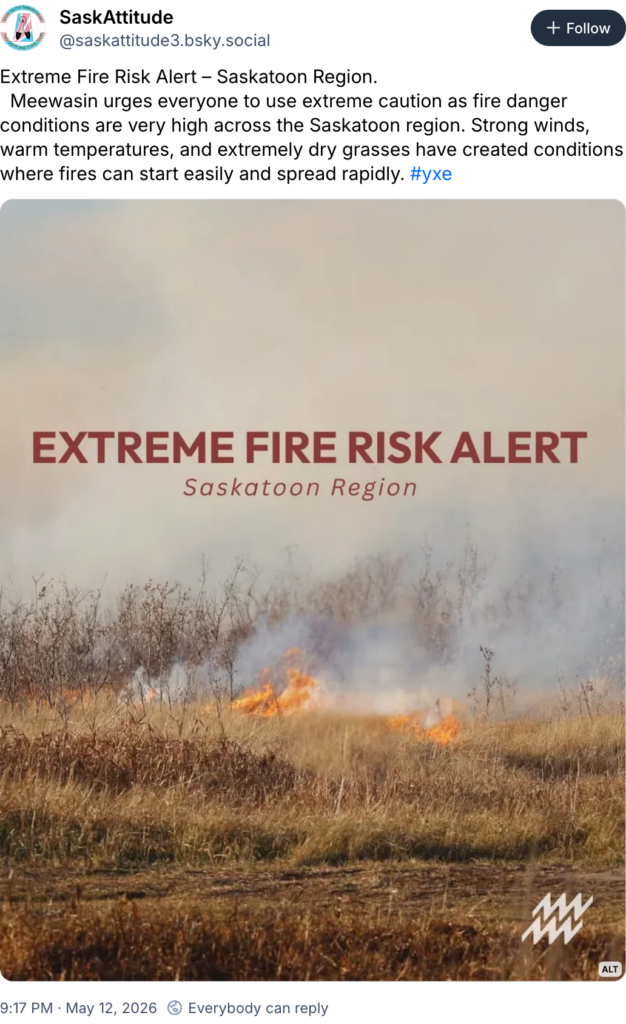
@saskattitude3.bsky.social:
Extreme Fire Risk Alert – Saskatoon Region.
Meewasin urges everyone to use extreme caution as fire danger conditions are very high across the Saskatoon region. Strong winds, warm temperatures, and extremely dry grasses have created conditions where fires can start easily and spread rapidly. #yxe
Extreme Fire Risk Alert – Saskatoon region.
Please help protect our river valley, grasslands, and surrounding communities:
- No open fires or burning
- Properly dispose of cigarettes
- Use extra caution with equipment or activities that may create sparks
- Report smoke or fire immediately to 911
Extreme Fire Risk Alert – Saskatoon Region.
Our natural areas are especially vulnerable during these high wind conditions. A single spark can quickly become a fast-moving grassfire under Tuesday and tomorrow’s weather conditions.
Worst Start to Wildfire Season Raises Alarm as El Niño Threatens by Joe Wertz, May 12, 2026, Insurance Journal
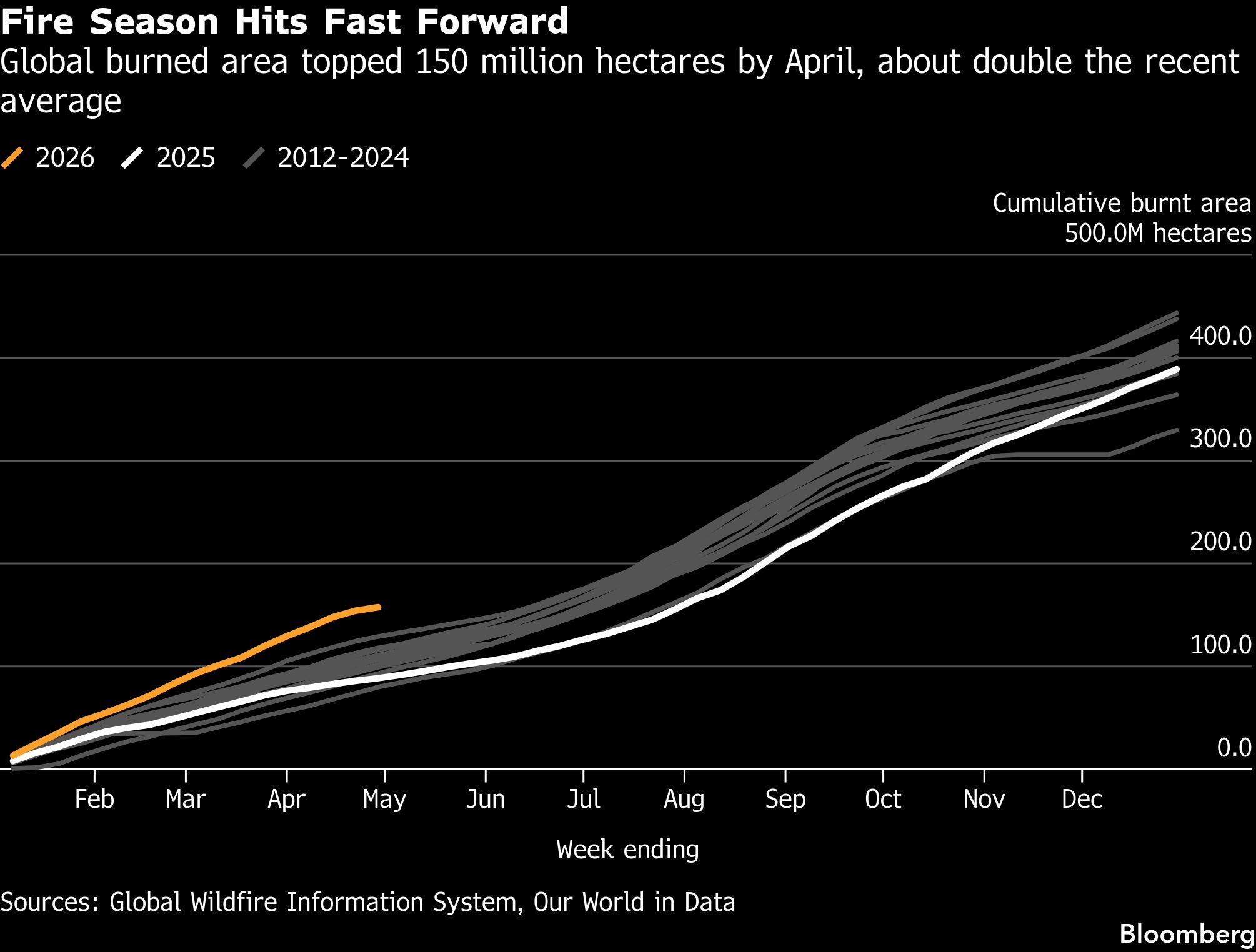
Record-breaking heat and drought have fueled the world’s worst ever start to a wildfire year, as climate change and a developing El Niño threaten to push extreme weather to new heights.
Over the first four months of this year, more than 150 million hectares (579,150 square miles) was burned, according to satellite estimates from the Global Wildfire Information System. That’s an area nearly the size of Alaska and roughly double the seasonal average for this period.
“This rapid start, in combination with the forecast El Niño means that we’re looking at a particularly severe year,” said Theodore Keeping, an extreme weather and climate researcher at Imperial College London.
This year’s early season wildfires have overwhelmed fire crews in Argentina, Chile and Japan, while fueling historic blazes in the US and Southeast Asia.
The fire surge is a symptom of a broader trend of extreme weather that’s expected to worsen this year.
Heat waves are likely to put further pressure on agricultural systems and global supply chains for food, while higher cooling demand could compound the energy shock from the Iran war, scientists say.
Sea ice in the Northern Hemisphere is the lowest recorded for this time of year, and oceans are approaching record-high temperatures, data from the University of Maine’s Climate Change Institute show. New heat records have already been set this year, from Australia and Greenland to France and the US Southwest. Spain and Brazil have witnessed historic rainfall.
The extreme weather effects are likely to be amplified even further by El Niño, a naturally recurring warming of the tropical Pacific Ocean that can raise global temperatures and worsen heat, drought, floods and fires. US forecasters say El Niño is likely to develop from June to August, and is showing signs of being exceptionally strong.
Human-driven warming alone would likely be enough to fuel weather records this year, but El Niño raises a “serious risk” of unprecedented extremes, said Friederike Otto, a climate researcher at Imperial College London and co-founder of World Weather Attribution, which organized the press briefing.
Strong global radiative effects from wildfire dark brown carbon
by
- Lulu Xu,
- Guangxing Lin,
- Chenglai Wu,
- Xi Chen,
- Hao Wang,
- Cheng Chen,
- Rajan K. Chakrabarty,
- Meng Gao,
- Ville Vakkari,
- Pieter G. van Zyl &
- Xiaohong Liu
Nature Geoscience (2026), May 12, 2026
Abstract
Wildfires emit large quantities of brown carbon, a class of light-absorbing organic aerosols whose climate effects remain poorly constrained. Brown carbon displays a broad spectrum of absorptivity, ranging from weakly absorbing chromophores in the near-ultraviolet to strongly absorbing species that extend into the visible spectrum—yet its optical properties, global distribution and radiative influence remain largely uncertain. Here we assess the global prevalence and optical characteristics of dark brown carbon through an integrated analysis of aircraft measurements, ground-based observations and satellite retrievals. We show that this strongly absorbing aerosol is widespread in wildfire plumes around the world. Measured dark brown carbon mass absorption efficiencies range from 0.5 to 1.5 m2 g-1 at 500 nm, with absorption frequently comparable to—or even exceeding—that of black carbon. When these observationally constrained optical properties are incorporated into a global aerosol–climate model, we estimate a direct radiative effect of +0.097 W m-2 (spanning +0.050 to +0.276 W m-2) attributable to wildfire-derived brown carbon, with the upper bound surpassing black carbon’s contribution and extending into mid- and high-latitude regions, including the Arctic. These results position dark brown carbon as a critical yet underrecognized contributor to wildfire radiative forcing, highlighting the need to account for its substantial warming influence in climate assessments.