@davidho.bsky.social:
Here’s the way to think about climate change that I learned from @drkatemarvel.bsky.social:
We’re creating an increasingly chaotic and dangerous world, sending our children and grandchildren there, and they’re never coming back.
@climatenews.bsky.social:
While we are also ourselves never coming back. The 2030s will already see extreme food shortages across the entire world. Especially in rich countries that exploit poor workers in poor countries for their food production. That food won’t arrive.
@wnhy.bsky.social:
I think of it as putting our kids on a bus thats failing, that’s going to break down and kill many. We could try and repair the bus and reduce the deaths but we choose not to.
 I observed that human trait before I started grade school, and is one of the reasons I chose not to have kids. Humans, notably those religious, addicted to raping kids, is another reason. In my view, the typical human response to humans knowing we need to repair our pollution and harms, is to pollute and harm more. One excellent example is frac’ing, another is AI. I find life unbearable enough, with all the harms and damages I cause to earth and other species just by being alive, eating, drinking water, and forced to pollute every day by corrupt politicians endlessly using my tax dollars to enable toxic greedy corporations, finance and arm genocidal Israel, and vicious anti-life capitalism, never mind choosing to produce more harmful toxic humans. For one human to live a week, many other beings die. Best thing that can happen for earth and all other life on it, is for humans to wipe ourselves out pronto or for the universe to punt us out of existence.
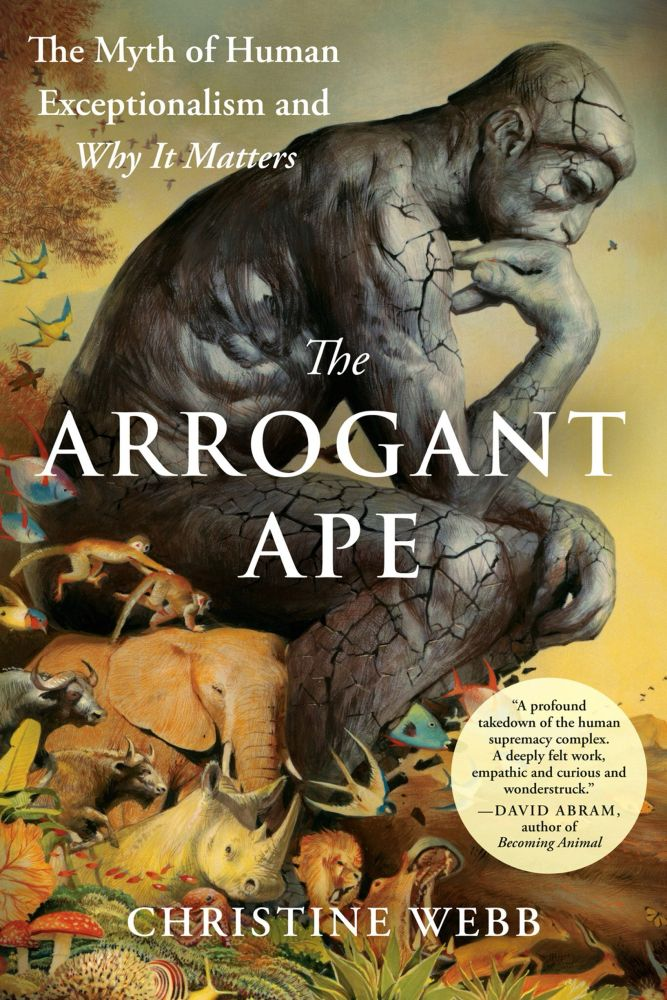
Human exceptionalism is at the root of the ecological crisis, claims evolutionary biologist by Kermit Pattison, Harvard University, edited by Lisa Lock, reviewed by Andrew Zinin, Oct 9, 2025, Harvard Gazette
In the grand story of evolution, the crowning human distinction is our big brain. But our large heads have been slow to recognize a less admirable trait of Homo sapiens—self-centeredness.
The human presumption of superiority and entitlement to exploit the natural world is deeply rooted in our religious, cultural, and scientific traditions—and now we are witnessing the consequences, said Christine Webb, a former Harvard lecturer and author of the book “The Arrogant Ape: The Myth of Human Exceptionalism and Why It Matters.”Science has been heavily influenced/controlled by religion, not surprising science is part of our arrogant problem.
“Human exceptionalism is at the root of the ecological crisis,” Webb told a Science Center audience of more than 100 people recently as part of the Harvard Science Book Talks. “This pervasive mindset gives humans a sense of dominion over the rest of nature, set apart from and entitled to commodify Earth and other species for their own exclusive use.”
The central thesis of her book is that anthropocentrism—or what Webb calls the “human superiority complex”—has pushed our planet to environmental crises such as mass extinctions, rising sea levels, forest fires, and more.
“I’ve come to think of the arrogant ape not as a species, or a culture, or even an individual, but as a tragic protagonist in a Greek drama, blinded by their own hubris,” said Webb.
“This unfortunate and dangerous way of viewing our world is a brainwashing of such major proportions that many people remain entirely unaware of it.”
Without doubt, humans are unique in many attributes (we are the only species known to send rockets into space or convene book talks). But all species, Webb wrote, have evolved specialized adaptations to their environments and are wondrous in their own rights. Still, we humans tend to see our own characteristics as more exalted—and, thanks to our technological prowess—view the rest of the natural world as a resource that we are entitled to harvest without constraint.
As Webb wrote, “Human exceptionalism suggests that what is distinctive about humans is more worthy and advanced than the distinguishing features of other forms of life.”
Now an assistant professor at New York University, Webb previously served as a lecturer in Harvard’s Department of Human Evolutionary Biology. The book grew out of her experience teaching an undergraduate seminar here also titled “The Arrogant Ape.”
“So many of the ideas that are folded into this book are students’ ideas,” she told the audience. “I was incredibly inspired by the discussions that took place.”
The book traces how the human sense of exceptionalism has deep roots in the Judeo-Christian religious tradition, Western thought, and even science.
Shakespeare’s Hamlet called humans “the paragon of animals.” In the 18th century, Carl Linnaeus, the founder of biological classification, designated the taxonomic order that includes humans, apes, and monkeys as “primates” to assign us first rank and dubbed our species “Homo sapiens” or “the wise man.” In the 1730s, poet Alexander Pope advised that, “The proper study of mankind is man.” Accordingly, the humanities celebrate the study of you-know-who.
The very notion of “progress” came to mean human command over nature. Thanks to our ever-advancing scientific and technological knowledge—and a global population that has now reached 8 billion—humans lay claim to an ever-greater share of the world’s resources. As Webb wrote, “the notion of human distinction and the exploitation of the natural world go hand in hand.”
Human exceptionalism has become an unquestioned assumption—something rarely articulated or opened to debate. As Webb told the audience, “it derives power from its invisibility.“
Science too has absorbed this bias. Two centuries ago, Charles Darwin warned of the human habit of flattering ourselves with self-affirming categorizations, but generations of evolutionists continued falling prey to the same old traps. According to Webb, a primatologist who has studied wild baboons and gorillas in Africa, comparative studies are often designed with confirmation bias or use human attributes as metrics of evolutionary advancement.
“When you measure the world with a ruler made for humans,” she said, “other species will inevitably look inferior.”
Webb drew a laugh when she showed a clip from the satirical newspaper The Onion headlined “Study: Dolphins Not So Intelligent On Land.”
Yet, Webb argued, the human presumption of superiority is a learned behavior. Many children exhibit a natural empathy for animals and humans have an innate sense of wonder for nature that Harvard biologist E.O. Wilson termed “biophilia.”
The remedy to our ecological crisis, she believes, is embracing a trait that is often undervalued: humility. In reawakening ourselves to the wondrous diversity of nature, we might become more willing to preserve it.
“Shedding this anthropocentric lens, I believe, can yield very humbling realizations,” she concluded in her talk, “and this humility might impart true wisdom—the quality our species, Homo sapiens, has assigned itself, yet one we can only ever truly realize by unlearning human exceptionalism.”
Provided by Harvard University
This story is published courtesy of the Harvard Gazette, Harvard University’s official newspaper. For additional university news, visit Harvard.edu.
@race2extinct.bsky.social:
Human exceptionalism began when we stopped seeing ourselves as part of the food web.I think it began with religion and humans worshipping money/gold/greed/raping kids, long before agriculture.
Agriculture gave us control, then the illusion of superiority.
Every species that outruns its limits believes it’s invincible—until it’s not.
@seenaswg.bsky.social:
And Abrahamic religion reinforced/enabled all of it.Yup. Religion driving propaganda is driving humans to destroy life on earth. Insane
“Man was given dominion over the earth and it’s creatures”.
@race2extinct.bsky.social:
Yup.
@gemmeri.bsky.social:
Yes, but isn’t the problem being caused by a very small group of people? I am willing to live small to be a part of the natural systems here. I think many others are as well. Isn’t it about sane management of our reality & not trying to alter this place like we are the original creators here?
@race2extinct.bsky.social:
That’s certainly a significant contribution, but there are simply too many of us.Billions too many, with more and more born every day. Not enough land, waste space, water, housing, food for billions already and the entire planet and all her inhabitants are poisoned with forever chemicals. Too much baby making – driving by religious and corporate propaganda (more babies make the rich richer), greed and ego. I cringe when I think of throw away plastic-lined diapers over flowing landfills around the world, and waste leachate poisoning groundwater everywhere.
@gemmeri.bsky.social:
True. But are we really trying to solve the problems rather than ignoring them? How does people garnering riches help this world? I believe if we knuckled down & did the right things, we could weather this while reducing our populations. Otherwise, Nature might do it for us. Regardless of their CVD.
@race2extinct.bsky.social:
There are a few people who try but they are insignificant. Our species will ignore them. One of the most difficult things a person can do is accept humans for who they are.
@gemmeri.bsky.social:
But humans can be amazing when they want to. When they finally wake up & realize that the truth is not something in the media. We were cut back once before with the last mini ice age with less than 10,000 worldwide, but that was a rather drastic event out of our control. We are capable. But will we?Of course not! Our species is too despicably arrogant and too many religions (money grubbing propaganda corporations) demand endless baby making (to keep the rich getting richer) which is fucking morbid bullshit. Humans think they know best. Pfffft.
@belungerer.bsky.social:
We will most likely be cut back again – things are getting out of hand in all sorts of areas.
Losing the Great Barrier Reef and others around the World is an undeniable tipping point & it’s closer with every record heatwave
@gemmeri.bsky.social:
The reefs really shocked me. I always thought they just kept building up. Some scientists say the atmosphere will dissipate with the mag shield collapsing. I had no idea the thing even could collapse. Sounds like a complete hard reset to me. Like the Creator is tired of this & switching things up.
@iampilgrim.bsky.social:
The remedy to our ecological crisis, she believes, is embracing a trait that is often undervalued: humility. In reawakening ourselves to the wondrous diversity of nature, we might become more willing to preserve it.
@race2extinct.bsky.social:
Humility would certainly be helpful but a tiger never changes its stripes.
@arcamedees.bsky.social:
It’s what happens when most people believe a magic man in the sky made us especially special. We’re a smart foolish species. Smart enough to engineer our own destruction. Foolish enough to not see that destruction coming.
@race2extinct.bsky.social:
That’s a good way to frame it.
We think extinction happens when a species disappears. But for most, it begins long before—when roads, fields, and fences break the world into pieces so small that life can only breed with itself. www.popsci.com/environment/…
Dr. Aaron Thierry @thierryaaron.bsky.social:
The cost of inaction.
Australia
ClimateEmergency
…
A NSW Health spokesperson reminded people to take precautions in high temperatures, given hot weather had the potential to cause severe illness requiring hospital admission, could exacerbate underlying health conditions, and even be deadly.
“Simple prevention strategies include staying indoors during the hottest times of the day, closing doors, windows, blinds and curtains early to keep hot air and sun out in the day, staying hydrated and carrying a water bottle when outside,” the spokesperson said.
“People experiencing signs of heat-related illness, like headache, dizziness, nausea and vomiting, fatigue and cramps, should cool down right away.” …