
Sudden $2 Trillion Crypto Crash Sparks ‘Death Spiral’ Fears For Bitcoin Price Feb 5, 2026, Forbes
Bitcoin has dropped sharply, plunging under the closely-watched $70,000 per bitcoin level as traders bet the bitcoin price could have much further to fall.
The bitcoin price has lost almost 10% over the last 24 hours, taking its losses since hitting an all-time high of $126,000 in October to nearly 50% as traders fear a “worst case scenario” bitcoin crash.
Now, as an “apocalypse” appears to be quietly emerging, bitcoin and crypto traders are scrambling to get ahead of what could become a full-blown bitcoin and crypto crash.
“As bitcoin continues its slide toward the psychological barrier of $70,000, it’s clear the crypto market is now in full capitulation mode. If previous cycles are anything to go by, this is no longer a short-term correction, but rather a transition from distribution to reset–and these typically take months, not weeks,” Nic Puckrin, investment analyst and co-founder of Coin Bureau, said in emailed comments.
“We’re seeing large-scale selling by bitcoin whales, and institutional outflows are mounting. At this point, expect a battle to defend the $70,000 threshold, but if bitcoin breaks below this level, it could be heading for its bear market low around $55,700-$58,200.”
02/05 update: The bitcoin price has continued to slide, heading toward $60,000 per bitcoin, following famed Big Short investor Michael Burry’s warning the bitcoin price could be entering a “death spiral.”
The bitcoin price has lost 12% over the last 24 hours, taking its weekly losses to 25% and 50% since its October all-time high. The crypto crash has wiped $2 trillion from the combined market, which has almost halved from its $4.3 trillion peak.
…
Make Canada The Blockchain Capital Of The World Press Release by Pierre Poilievre for PM
March 28, 2022
Take control of money from bankers and politicians and return it to the people
London, ON – Today, candidate for Prime Minister Pierre Poilievre issued the following statement:
The Trudeau government is ruining Canada’s money with American-style money printing that has inflated the assets of the rich and the cost of living for everyone else. This is Justinflation. After creating over $400 billion in cash out of thin air since 2020, Canada’s inflation rate has hit a 30-year high and housing inflation is hitting all-time records. Canada’s housing bubble is the second worst in the world. Since Trudeau took office, the Canadian dollar has lost half its purchasing power for buying homes, as real estate prices have doubled. Across western economies, governments have fueled inflation and created dangerous bubbles and a growing wealth gap.
Canada needs less financial control for politicians and bankers and more financial freedom for the people.
That includes the freedom to own and use crypto, tokens, smart contracts, and decentralized finance.
Government is ruining the Canadian dollar, so Canadians should have the freedom to use other money, such as Bitcoin.
The Blockchain economy is about more than new forms of cash. It’s also about decentralizing control of our economic decisions. A Poilievre government would welcome this new, decentralized, bottom-up economy and allow people to take control of their money from bankers and politicians. It would expand choice and lower the costs of financial products, and create thousands of jobs for engineers, programmers, coders, and other entrepreneurs.
To unleash this potential, a Poilievre government will simplify and streamline rules and taxes and will:
- Keep crypto legal and reject a China-style crackdown.
- Make the rules clear:
- Work with provinces to align rules and definitions across jurisdictions to make it easy for blockchain companies to operate across Canadian jurisdictions at the same time without a cobweb of contradictory rules. (Provinces control securities regulations. The goal would be to get them to voluntarily align their approaches).
- Simplify tax treatment of crypto so it is easy for buyers and sellers to comply.
- Apply the principle of treating “like-things-like”, so that laws, taxes, and regulations treat crypto assets the same as their equivalents in the traditional economy. Crypto assets that act like a commodity should have the same taxes and regulations as traditional commodities, like gold, for example. What is legal to do with Canadian dollars should be legal to do with crypto currencies and vice versa.
Choice and competition can give Canadians better money and financial products. Not only that, but it can also let Canadians opt-out of inflation with the ability to opt-in to crypto currencies. It’s time for Canadians to take back control of their money and their lives by making Canada the freest country on earth.
-30-
PaulChampLaw:
Kudos to the NB Premier. Twitter X has become a polluted stream of hate, racism, sexism, pornography, etc. It is no longer the right platform for breaking news, announcements, hot takes from experts, etc. Mr Musk has ruined the global public square.
@walkerp.bsky.social:
Every government at every level in Canada should be doing this as well. Carney and his Harper cons won’t, they’re Pedo fans and Nazi enablers
@tryangregory.bsky.social:
Feds won’t though. Not with a Minister of Digital Asbestos Integration and Carney’s Brookfield being a major investor in Musk buying X.
@marie-m.bsky.social:
Good, they allow hate, so much harassment, violence, extremism and so much misinformation. I would love to see a banned completely in Canada.
@persister.bsky.social:
And we need to get off of Starlink as well.
Bravo Ms. Holt!
@susanholt [Premier of New Brunswick, Canada]:
We’ve been carefully considering how we use social media and specifically X as a government for some time. Social media is a tool we use to keep New Brunswickers informed quickly and directly.
However, the recent concerns raised about X’s operations are deeply troubling. Protecting the safety and well-being of young people is a core responsibility of the government.
We recognize that the platform’s recent history, including reports of harmful content and inadequate safeguards, has eroded trust that it can be used in a way that aligns with our values and obligations to New Brunswickers. Given these serious concerns, our government will no longer use X for routine communications.
To stay connected, please visit my other social platforms linked below where I will continue to post as usual.
Nous réfléchissons attentivement depuis un certain temps à la façon dont le gouvernement utilise les médias sociaux, et plus particulièrement la plateforme X. Les médias sociaux sont un outil qui nous permet d’informer les Néo-Brunswickoises et les Néo-Brunswickois rapidement et directement.
Toutefois, les préoccupations récentes soulevées concernant les pratiques de la plateforme X sont profondément troublantes. Protéger la sécurité et le bien-être des jeunes est une responsabilité fondamentale du gouvernement.
Nous reconnaissons que l’historique récent de la plateforme, notamment les signalements de contenus préjudiciables et de mesures de protection inadéquates, a miné la confiance quant à sa capacité d’être utilisée d’une manière conforme à nos valeurs et à nos obligations envers la population du Nouveau-Brunswick. Compte tenu de ces préoccupations sérieuses, notre gouvernement n’utilisera plus X pour ses communications courantes.
Pour rester en contact, je vous invite à consulter mes autres plateformes de médias sociaux, dont les liens figurent ci-dessous, où je continuerai de publier comme à l’habitude.


@nicolaasstulting.bsky.social:
When tech billionaires align with the far-right extremists in the Republican Party, they really move fast to create a dystopian nightmare that only tech billionaires and insane far right extremists could love. Those donations bought those tech billionaires so much stuff, like the end to our privacy.
@GunnelsWarren:
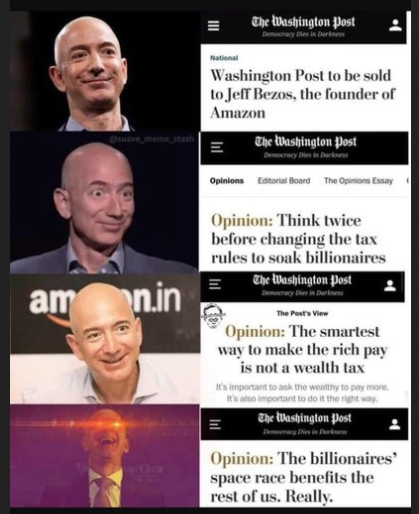
Jeff Bezos fired a third of Washington Post’s staff & will replace 600,000 Amazon workers with robots.
He became $40 billion richer since Trump was elected. His tax rate is 1.1%. Amazon got a $15.7 billion tax break from Trump last year.
@china-m.bsky.social:
Get a burner phone & leave all tech at home…Why take a phone? Go without!
@bambinamomma.bsky.social:
I flew to Europe last September and was required to allow two DHS agents dressed in black to photograph my face with a facial recognition camera before boarding my flight. It was creepy.
@anietotylkoja:
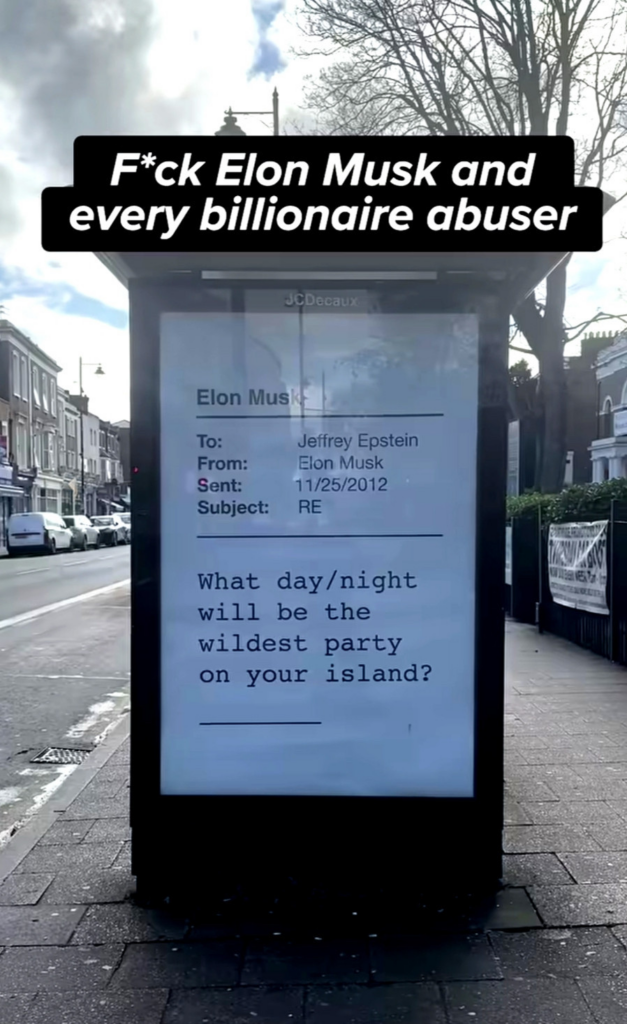
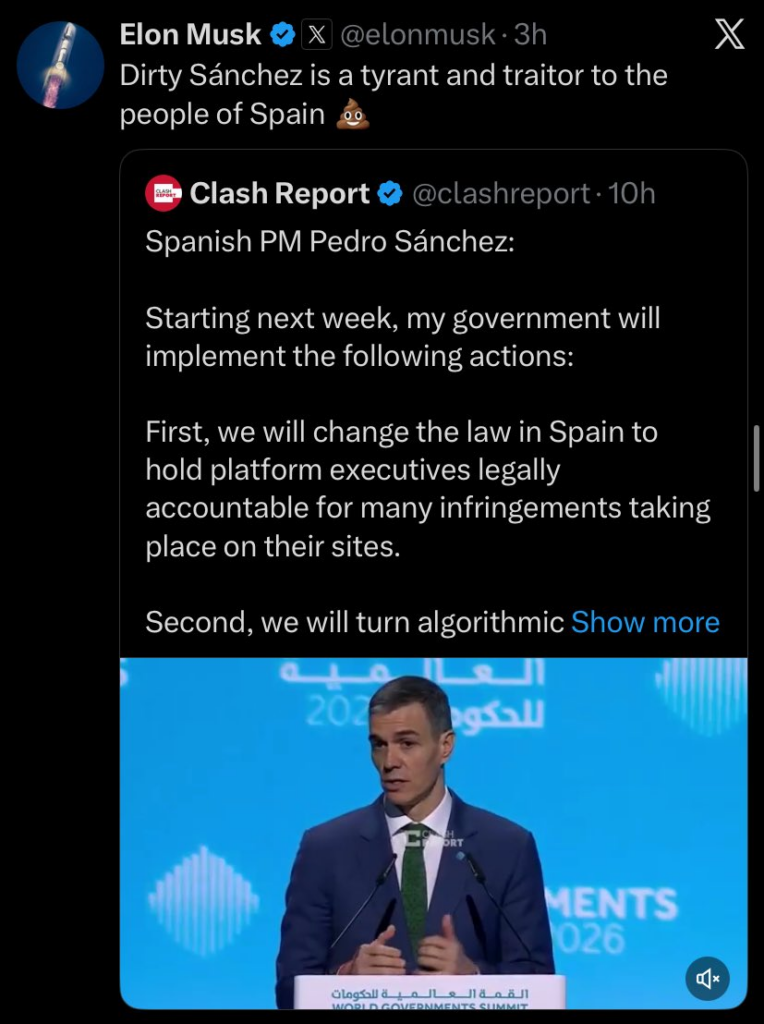
Spanish government: AI pornography will be banned
This Epstein Island lover: NOOOOO HOW DARE YOU
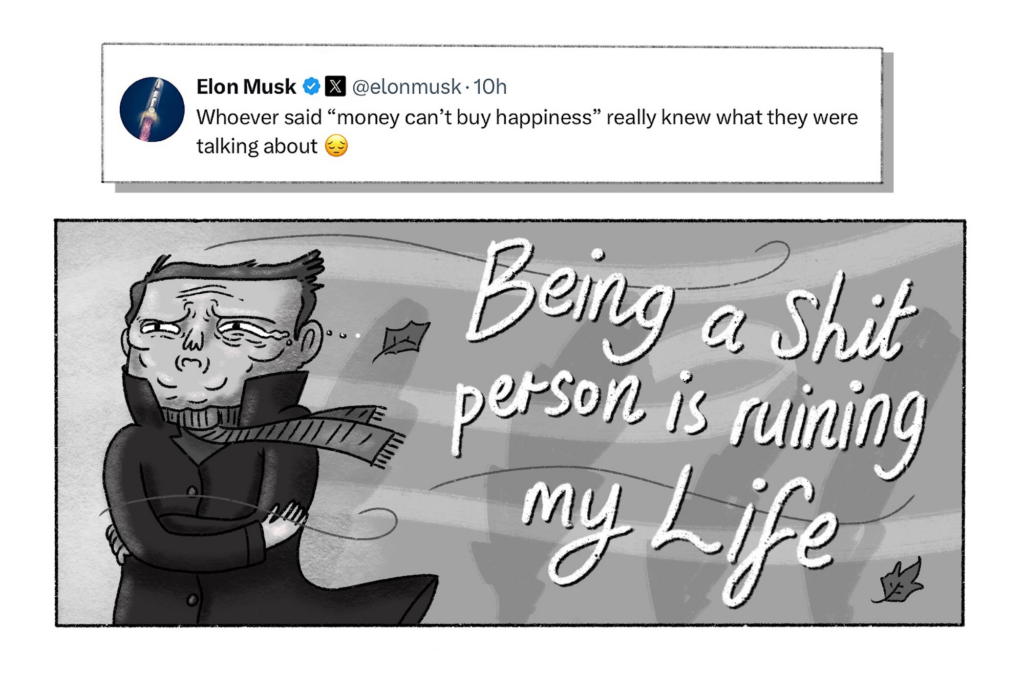
@tryangregory.bsky.social:
JFC
@theguardian.com:
‘In the end, you feel blank’: India’s female workers watching hours of abusive content to train AI
@phat-bat.bsky.social:
“Vadaliya says job listings rarely explain what the work actually involves. “People are hired under ambiguous labels, but only after contracts are signed and training begins do they realise what the actual work is.””
This is horrendous from all angles
@SenSanders:
When we talk about authoritarianism, it’s not just Donald Trump.
Musk owns X
Bezos owns Twitch
Zuckerberg owns Instagram and Facebook
Larry Ellison controls TikTok
Billionaires increasingly control what we see, hear and read.
@deonandan.bsky.social:
“some island”

Elon Musk will have to appear on April 20. For those of you, unlike Elon, who don’t celebrate it, that’s Hitler’s birthday. Never say the French don’t have a sense of humor. www.nbcnews.com/world/europe…
How can we defend ourselves from the new plague of ‘human fracking’? Big tech treats our attention like a resource to be mercilessly extracted. The fightback begins here by The Friends of Attention, 18 Jan 2026, The Guardian
In the last 15 years, a linked series of unprecedented technologies have changed the experience of personhood across most of the world. It is estimated that nearly 70% of the human population of the Earth currently possesses a smartphone, and these devices constitute about 95% of internet access-points on the planet. Globally, on average, people seem to spend close to half their waking hours looking at screens, and among young people in the rich world the number is a good deal higher than that.
History teaches that new technologies always make possible new forms of exploitation, and this basic fact has been spectacularly exemplified by the rise of society-scale digital platforms.
It has been driven by a remarkable new way of extracting money from human beings: call it “human fracking”. Just as petroleum frackers pump high-pressure, high-volume detergents into the ground to force a little monetisable black gold to the surface, human frackers pump high-pressure, high-volume detergent into our faces (in the form of endless streams of addictive slop and maximally disruptive user-generated content), to force a slurry of human attention to the surface, where they can collect it, and take it to market.
Fracking (of the Earth and of our minds) produces tectonic instability, toxicity and the despoliation of our landscapes, natural and social. We now know that the heedless exploitation of our external environment has been so relentless and irresponsible that human survival on Earth has been placed in actual jeopardy. The new “gold rush” into the inner environment of the human psyche is well on its way to effecting parallel, if even more insidious destruction.
The stakes are existential. And that is because, rightly understood, our actual human “attention” – the thing the frackers want, in the form of our eyes on their screens – is nothing less than our ability to care, our ability to think, our ability to give our minds, time and senses to ourselves, the world and each other. To commodify that is to commodify our very beings.
The problem isn’t “phones”, and it isn’t “social media”. The problem is human fracking, a world-spanning land-grab into human consciousness – which big tech is treating as a vast, unclaimed territory, ripe for sacking and empire.
That’s the bad news. The good news is that novel forms of exploitation produce novel forms of resistance. What fills the coffers of the six largest corporations on the planet is nothing other than the stuff of our humanity. Which is to say this new fight for our attention stands in a long line of clashes between those who are willing to reduce people (their labour, their eyeballs) to cash value and those who insist on a higher view of human flourishing. This history is long and complex, and often painful. But it tells us this much: we can fight back. Indeed, we must.
We must insist that human attention is ours, and we will use it to make the worlds we want to live in
So what is to be done about this new kind of human exploitation that is harming us – harming children and adults, compromising our deliberative politics and our psychological wellbeing? Regulatory efforts are piecemeal and actively thwarted by the powerful interests in play. Psychopharmacological fixes for the ever-expanding damage merely monetise the destruction in a complementary way and render us better able to submit to conditions that are palpably at odds with human flourishing. How to confront a problem that is both unspeakably intimate and unthinkably extensive?
The answer is clear: we, the actual people of this planet, must come together in decisive solidarity; we must say no to the human frackers, and do so by insisting, in new ways, that human attention is human, and it is ours, and we will use it to make the worlds in which we want to live. In other words, we need a movement.
Think that sounds quixotic? Well, keep in mind that’s how actual change actually happens. And it can happen fast. The environmental movement as we know it did not exist in 1950, but by 1970 it was a global force. In 1946 Reynolds Tobacco was using doctors to promote cigarettes. Fewer than 20 years later, the American Medical Association and the US surgeon general publicly averred that smoking caused lung cancer.
And the changes get much bigger than that. Precious few do-gooders devoted themselves to environmental politics in 1925. That’s because “environmental politics” wasn’t even a thing. It took a cultural shift (and the work of advocates such as Rachel Carson) across the mid-20th century to establish the physical environment – the unity of land, water, and air that produces shared life – as a politically tractable object around which diverse groups could organise. This is to say that the very structures of politics, not just our beliefs and hopes, are themselves emergent forms. New things come into being, and old things pass away.
Where attention is concerned, there are mounting signs that we are reaching an inflection point. People of all sorts, Maga Republicans and Mamdani progressives, hipsters in Portland and evangelicals in Arkansas– people who don’t agree about anything – all actually do agree that something is totally wrong with a world in which everyone spends nearly all their time scrolling endlessly through the algorithmic feeds of their social media, a world where military-grade technology and trillion-dollar corporations take aim at children, and feed them whatever it takes to keep them hooked.
You can only abuse people so much, and then, eventually, they turn, they rise, they insist on something else. Already politicians on the right and the left are identifying this issue as one that moves the electorate. In 30 years, we will look back, and this era – the wild west of the tech princes’ smash-and-grab into our hearts, souls and relationships – will be difficult to explain to our grandkids. “How did you all let that happen?” they will ask. And we’ll have to say: “It’s hard to explain: it happened before we noticed; it was so much fun, especially at first; it took us time to figure out what was going on … ”
But we are figuring it out. We write as representatives of a fast-growing and increasingly well-organised movement, focused on pushing back against the human frackers, and giving shape to a new politics of human attention. At the heart of our efforts? The formation of broad coalitions devoted to the politics of human attention, the practice of diverse forms of study that call forth the life-giving powers of the mind and senses, and the promotion of sanctuary spaces for the protection and cultivation of the kinds of attention that make life good. We call this work attention activism.
Our claim? That all of us already have the tools to resist the frackers, because all of us already have things we do and care about that put us beyond the reach of the algorithms. We all already know the deepest truth: that true human attention isn’t the click and swipe of screen time. True human attention is love, curiosity, daydreaming and taking care of ourselves and others.
Yes, new technologies give rise to new kinds of exploitation and resistance. But new forms of exploitation can even give rise to genuinely new forms of politics. You couldn’t brutalise an industrial proletariat before the factory system. Steam engines set the conditions of possibility for this development. They weren’t themselves a “problem”, of course; they gleamed and were precise and powerful. Who could see them operate without awe? But they also created a world in which it was possible to aggregate and extract physical labour from human beings in a revolutionary way. Along the way, they created a new kind of political subject, Homo economicus, a person who had been reduced, in the calculus of modernity, to “labuor value”. Actual revolutions followed – and a new kind of politics was born which reflected a new world of industrial labour, and new forms of labour solidarity, such as unions and workers’ parties.
The new system of human fracking is turning all of us into attentional subjects in a powerful new way. Homo attentus is the end user of every networked system – economic, political, expressive. With this new form of life comes, as we have discovered, appalling new vulnerability. But we are on the brink of understanding the new power that has come into our hands in the fracklands. We believe a new kind of politics beckons. What will it look like? It is hard to say. And there are reasons to be fearful. But if we, the people, can take up the banner of a new kind of freedom movement – a movement for the true freedom of attention itself, what we call attensity – and deploy our truly human attention in new ways, with a new understanding of the stakes, we can defy the frackers, and insist on creating, together, a human world.
D Graham Burnett is professor of history at Princeton University. Alyssa Lohis a film-maker. Peter Schmidt is a writer and organiser. The authors are members of the Friends of Attention coalition, and co-editors of ATTENSITY! A Manifesto of the Attention Liberation Movement (Particular).
Further reading
The Anxious Generation: How the Great Rewiring of Childhood Is Causing an Epidemic of Mental Illness by Jonathan Haidt (Penguin, £10.99)
How to Do Nothing: Resisting the Attention Economy by Jenny Odell (Melville House, £14.99)
The Sirens’ Call: How Attention Became the World’s Most Endangered Resource by Chris Hayes (Scribe UK, £16.99)
***
Bye bye beautiful glorious night sky. You fucking selfish thieving destroying kid and women abusing rotten nasty jerk, Elon Musk
***
Tech Corporations Engaging in “Human Fracking”, Our brains are being blasted with information so tech companies can extract our precious attention spans by Frank Landymore, Jan 19, 2026 7:00 AM EST
Social media algorithms keep us all hopelessly engaged. The data these platforms gather on us enable feeds to become fine-tuned to our exact interests, on top of turning our smartphones into glorified ad delivery devices.Simple easy super economical solution: turn data off on your phone and take a book with you if you to read on the go, or go for a walk.
All this seems to be reaching its zenith with AI chatbots, which can masquerade as a close friend, therapist, doctor, and any subject matter expert all at once — keeping many users engaged in hours-long talks as they take the AI’s responses as personal gospel.AI is stolen, stupid, racist, misogynistic, bigoted shit created by heinous monsters. It makes endless mistakes. Be smart! Never use or trust AI and never believe a word AI creators, pimps and or regulators (like not regulating it at all, in Canada’s Evan Solomon’s kid and women abusing style) say.
In sum, the advent of personal digital technologies, and our ensuing addiction to screens, means that nearly every aspect of our being can be codified, and therefore commodified.
Now, one historian is calling this new way of extracting money from human beings “human fracking” — a term that aptly conjures the image of something that is wildly destructive and which works mainly by force-feeding.
“Just as petroleum frackers pump high-pressure, high-volume detergents into the ground to force a little monetizable black gold to the surface,” writes D Graham Burnett, a professor of history at Princeton University, in an essay for The Guardian, “human frackers pump high-pressure, high-volume detergent into our faces (in the form of endless streams of addictive slop and maximally disruptive user-generated content), to force a slurry of human attention to the surface, where they can collect it, and take it to market.”
According to Burnett, who writes with filmmaker Alyssa Loh and organizer Peter Schmidt, human fracking is a “world-spanning land-grab into human consciousness — which big tech is treating as a vast, unclaimed territory, ripe for sacking and empire.” In this empire, we are all “attentional subjects.”

Troves of research has delved into the nefarious effects that this digital war for control over our attention spans has on the brain. Much criticism has been directed towards the innovation of the infinite scroll used in apps, removing a natural stopping point for our minds and preying on our brain’s desire to seek out new information. It gave birth to the phenomenon of “doomscrolling,” and was not the result of an accident, but calculated decision making: an act of human fracking, if you will. Yet more research has uncovered social media’s effects on the brains of children, with a recent study linking screen time on these apps and ADHD.
The rapid proliferation of AI-generated slop is almost certainly adding another horrific dimension to this mental health crisis that science is only beginning to sniff at.And Trump’s insane and sadistic Nazi regime appears to want to exterminate mental health sufferers (including trans, gay, sane humans refusing to have kids or refuse to worship and pray to fairy tales and the misogynistic old white man in the sky, etc.)
How do we even begin to tackle this problem? The answer may not be obvious now, but as Burnett writes, “novel forms of exploitation produce novel forms of resistance,” writes Burnett. He notes how environmental politics didn’t exist a hundred years ago, and that it took a vast cultural shift “to establish the physical environment — the unity of land, water, and air that produces shared life — as a politically tractable object around which diverse groups could organize.” If we allow ourselves to be optimistic for a moment, that shift will also come in regards to human fracking.It needs to first come for all industrial frac’ing.
More on tech: New Study Finds AI in Schools Is Undermining Kids’ Social and Intellectual Development
@technolust.bsky.social:
AI companies are all thieves and grifters. I know because I have to deal with this fucknuts every damn week.
Jensen Huang Is Begging You to Stop Being So Negative About AI, “[It’s] extremely hurtful, frankly, and I think we’ve done a lot of damage,” he said by AJ Dellinger, January 12, 2026, Gizmodo
Nvidia CEO Jensen Huang, who has seen his net worth skyrocket by nearly $100 billion since the AI boom started a couple of years ago, would really appreciate it if you would stop talking about the potential harms of the technology that’s supercharged his fortune. It’s really harshing his vibe.

In an appearance on the No Priors podcast hosted by Elad Gil and Sarah Guo, Huang took aim at people who have suggested AI may have some significant, detrimental impact, from job displacement to expanding the surveillance state. “[It’s] extremely hurtful, frankly, and I think we’ve done a lot of damage with very well-respected people who have painted a doomer narrative,” he said.
According to Huang, considering the potential existential risks of unleashing AI on society may do more harm than good. “It’s not helpful. It’s not helpful to people. It’s not helpful to the industry. It’s not helpful to society. It’s not helpful to the governments,” he said. He particularly took issue with other people in the industry going to the government and asking for regulation and mandatory safeguards. “You have to ask yourself, you know, what is the purpose of that narrative and what are their intentions,” he asked rhetorically. “Why are they talking to governments about these things to create regulations to suffocate startups?”
Huang isn’t totally off-base about some of what he’s suggesting. Regulatory capture is a real risk, especially as multi-billion-dollar companies look to lock in their lead by using their absurd wealth to sway politicians and cement favorable policy. And there’s no doubt that AI players have been getting into the lobbying business. According to the Wall Street Journal, Silicon Valley firms have already poured more than $100 million into new Super PACs to push pro-AI messaging in the lead-up to midterm elections in 2026. There is also zero doubt that industry players use societal-scale risks as a marketing tactic: it makes their product seem full of endless potential, and it suggests they need to maintain control of it to keep everyone safe rather than letting this powerful tool fall into the wrong hands or be controlled by some government regulator.
But just being optimistic doesn’t mitigate some of the very real risks that AI presents.
“When 90% of the messaging is all around the end of the world and the pessimism, and I think we’re scaring people from making the investments in AI that makes it safer, more functional, more productive, and more useful to society,” Huang said, without pointing to how more pouring more money into AI infrastructure makes us safer, other than to suggest more is better.
Huang doesn’t have a solution for the very real risk of job displacement—not necessarily because AI is so powerful that it’s replacing human labor, but because companies are so eager to chase the next big thing that they’re pulling the ladder up on would-be entry-level employees despite the fact that early AI investments have been more of a money suck than a profit generator.Which is why the douche fucking tech bros are pressuring/tricking/lying to/threatening gov’ts to make taxpayers subsidize the billionaires’ kid and woman abusing, lying, bullying, suicide urging, mistake laden, hideously water and energy wasting, useless crap that no one but billionaires, mass murdering Israel, and ICE and other thuggery agents need. Mark Carney gave fucking Nazi American AI $100M (just the start) from taxpayers, many of whom are struggling to feed their families and pay rent, especially as Herr Nazi Carney slashes tens of thousands of jobs in the public service. Jobs which Canada needs in these perilous times being threatened by Pedo Protector USA and monstrous CSAM and AI
He doesn’t have a solution for the ongoing issues of misinformation, abuse, and the ongoing mental health crisis being exacerbated by AI.
We are all simply beta testers on the path to answers.

The only apparent solution is to speed up investment and development with the belief that, at the other end, there will be a superintelligence that solves all those problems. WTF! Stupid stupid stupid statement! There will be no super intelligence rushing to save humans from our super greed-induced stupidity! AI must be criminalized, earth and living beings including human can’t take the noise, pollution, insane escalating costs and vicious hatred in and spewed by AI, and the nastier cruelty, hatred and stupidity of AI’s creators.
If the doomers have a hidden agenda of control, it’s hard to look at Huang’s position and not see an ulterior motive, too: padding his bottom line.
@brettfavaro.bsky.social:
Seconding this endorsement. No complaints at all with Sync.
Also registered a free email account with my ISP, whose servers are in Vancouver