
First Nation sues Alberta, Canada over impacts of oil sands, industrial development by Alex Antoneshyn, May 12, 2026, CTV News
Cree First Nation is suing the federal and provincial governments saying decades of industrial development have infringed on treaty rights.
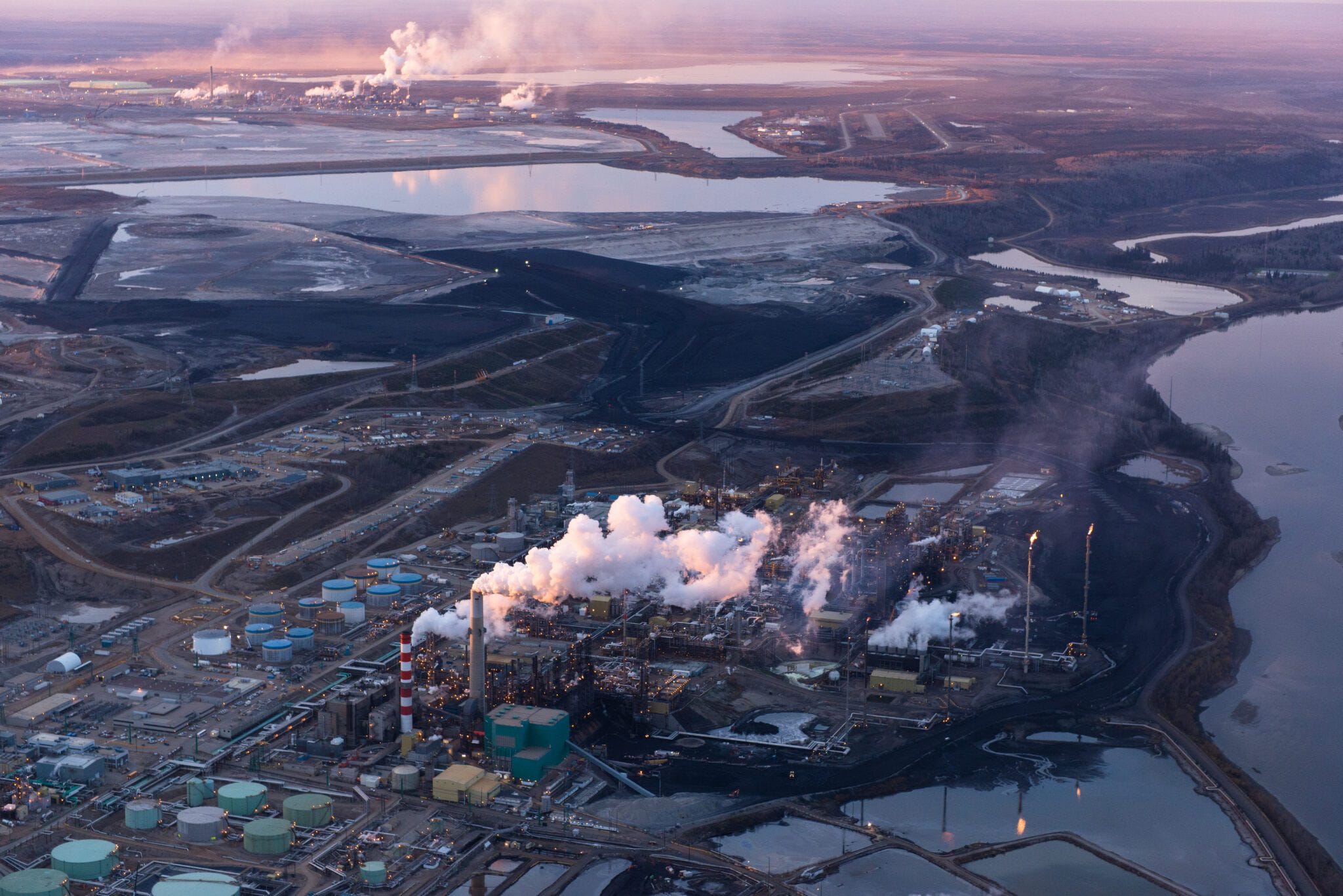
A First Nation is suing the Canadian and Alberta governments, alleging oil sands and industrial development in northeastern Alberta has infringed on its members’ treaty rights, and harmed the local environment and communities.
Mikisew Cree First Nation is located on the Peace-Athabasca Delta, one of the world’s largest inland freshwater deltas, in Treaty 8 territory.
The First Nation says its members can no longer rely on the area’s natural resources for their livelihood, cultural practices, and commercial purposes, as they have for generations, because of the degradation of water quality and depletion of wildlife.
Additionally, the nation alleges industrial pollution is sickening its members, about 1,000 of whom continue to live in the area.
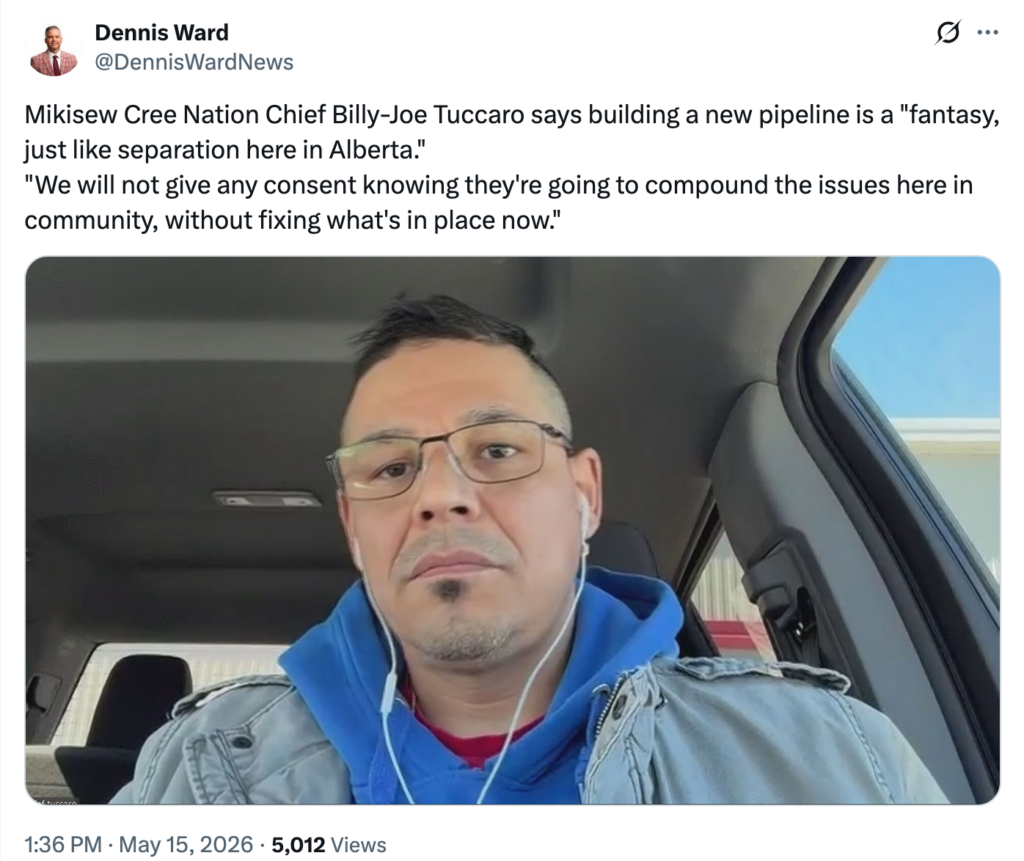
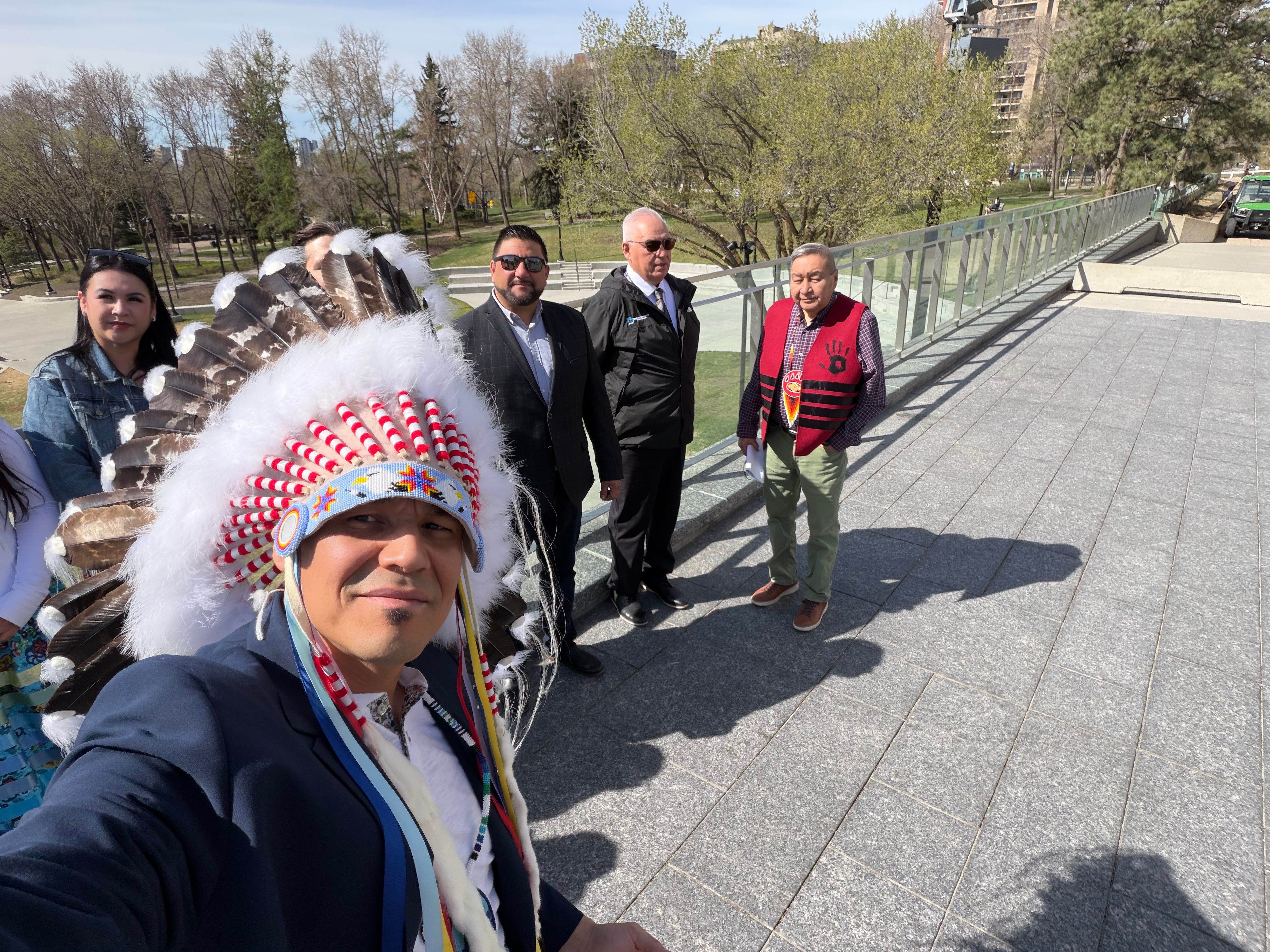
Chief Billy-Joe Tuccaro at a news conference on the Alberta legislature grounds in Edmonton on Tuesday said this equates to the failure of the federal and provincial government to honour rights set out in Treaty 8, signed in 1899, six years before Alberta was created.
“Of course we are willing to have conversations – but those conversations are not going to be the ones that we’ve been having for the last 127 years where we bring our recommendations forward and then it’s shelved,” he told reporters.
The statement of claim, filed in the Alberta Court of King’s Bench, only names Alberta and Canada as the defendants, rather than any company or project.
“The reason why we left the industry off this is because they will do whatever they’re allowed,” Tuccaro said.
Among the most serious accusations is that of carcinogenic contaminants in the region’s land, water and wildlife, as well as other substances like polycyclic aromatic hydrocarbons (PAHs), arsenic, and metals.
Tuccaro said six in 10 of the nation’s households have been affected by cancer. The number comes from a study Mikisew commissioned, but has so far not made public or provided to the government. However, the chief said it will be submitted as evidence as part of the lawsuit.
The nation wants land-healing measures including improved water quality, enforceable mechanisms and thresholds to manage the impacts of industrial development, regional and sub-regional land-use plans, and to be involved in development decisions.
“We need to be at those tables, to be heard, to be recognized. And not just the token Indian around the table,” Tuccaro said.
The Crown-Indigenous Relations and Northern Affairs Canada department declined to comment on the matter, as it was before court, but confirmed it was aware and reviewing the statement of claim.
Alberta’s minister of Indigenous relations, Rajan Sawhney, said it is “committed to meaningful consultation on projects where Treaty rights may be affected and we take these responsibilities seriously,” but that it could not comment on specifics as it is before the courts. In regards to anything by the oil and gas industry, including the tarsands, commitments by gov’ts, companies, and their lobby groups mean nothing but lots of lies, broken promises and broken commitments.
@BeanBeBaked:
So they should
They have faced decades of abuse from oilsands companies
Fort Chipewyan is Suing for Its Life, Decades of cancer, broken treaties and silence. The Mikisew Cree are taking Alberta and Canada to court. by Brandi Morin, May 12, 2026
Well, it’s come down to this.
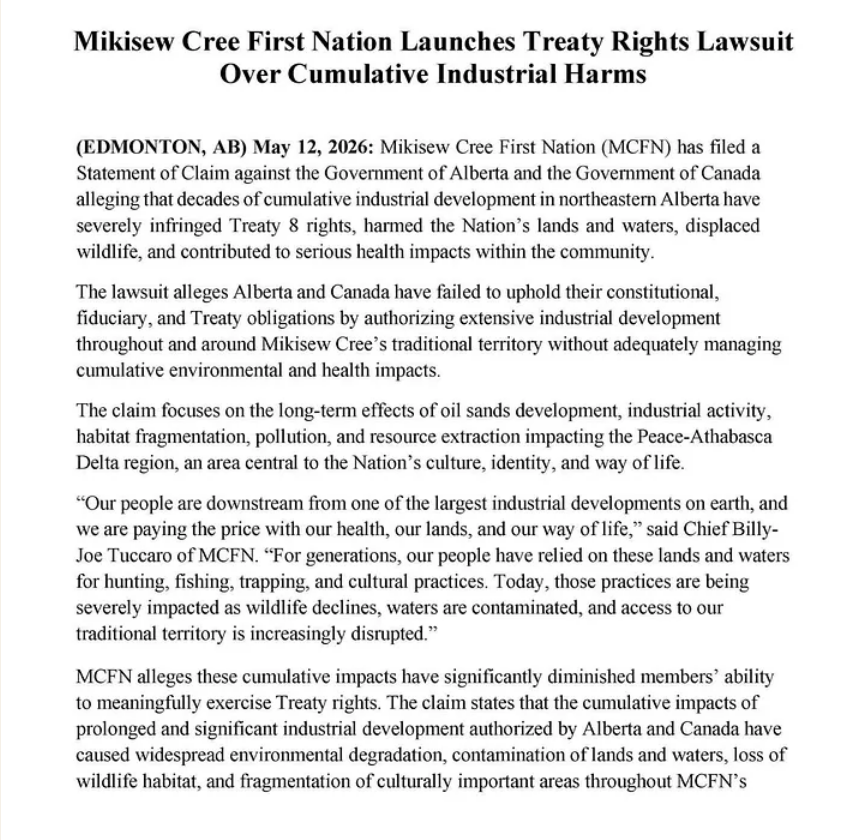
The Mikisew Cree First Nation has filed a Statement of Claim against the Governments of Alberta and Canada, alleging that decades of cumulative industrial development in northeastern Alberta have severely infringed Treaty 8 rights, harmed the Nation’s lands and waters, displaced wildlife, and contributed to serious health impacts within the community.
It always comes down to this when governments refuse to listen to and respect Indigenous sovereignty.
Here, a community has been suffering for years — with zero action or accountability from governments or industry. Here’s to praying something will be done.
Chief Billy-Joe Tuccaro put it plainly in the Nation’s press release when the Statement of Claim was filed today:
*“Our people are downstream from one of the largest industrial developments on earth, and we are paying the price with our health, our lands, and our way of life. For generations, our people have relied on these lands and waters for hunting, fishing, trapping, and cultural practices. Today, those practices are being severely impacted as wildlife declines, waters are contaminated, and access to our traditional territory is increasingly disrupted.”*
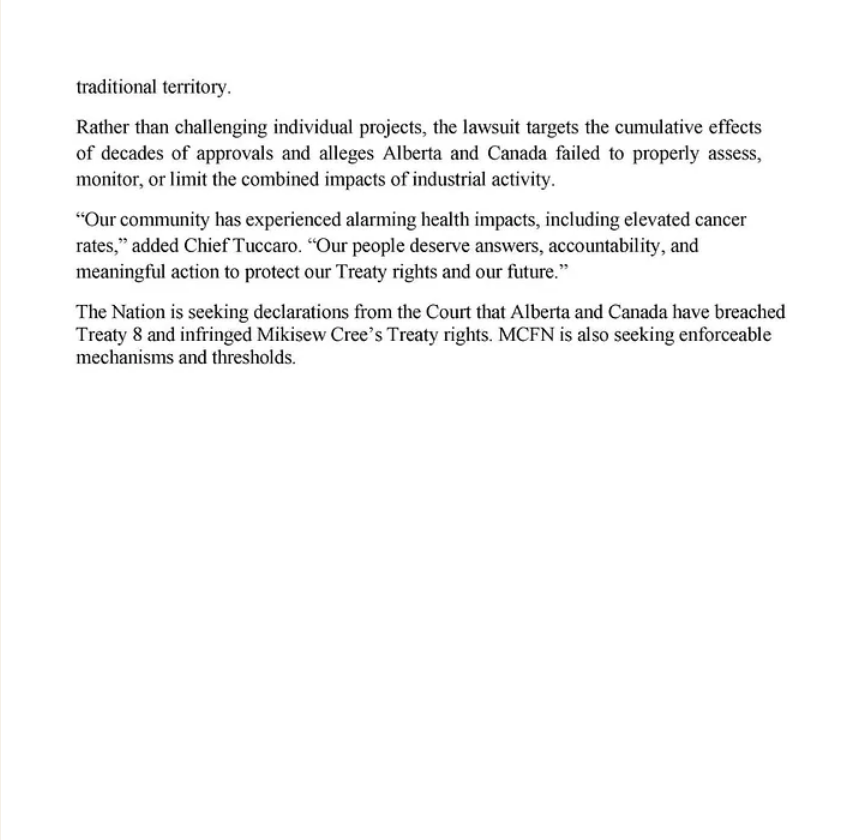
The community has experienced what he describes as *“alarming health impacts, including elevated cancer rates.”* His ask is not complicated: *“Our people deserve answers, accountability, and meaningful action to protect our Treaty rights and our future.”*
The Mikisew Cree have tried letters, lobbying, studies and rallies. Now they’re going to court. Share this story to the masses!
This isn’t a new story. I’ve been covering Fort Chipewyan for years — the contamination, the cancer, the grief, the resistance. What I have witnessed there has always stayed with me.
I watched elders describe watching their loved ones die too soon. I listened to ACFN elder Alice Rigney talk about her 49-year-old nephew Warren James Simpson, who died of a rare bile duct cancer in 2019 — a young man who chose to forgo the brutal treatment because the cure sounded like its own kind of death. He wanted to spend his last summer on the land, navigating the Athabasca and Slave Rivers one final time. He came home and died.
I heard Matthew Lepine, a 74-year-old man who worked the oil sands industry for decades, stand up in a room full of people and say words I will never forget: *“I lived there. I hunted and trapped there. Now there’s nothing left to trap, nothing. I can’t drink the water. I go to more funerals than I care to.”*
And now, as of today, the Mikisew Cree First Nation is taking both the Alberta and federal governments to court.
—–
The lawsuit alleges Alberta and Canada have failed to uphold their constitutional, fiduciary, and Treaty obligations by authorizing extensive industrial development throughout Mikisew Cree’s traditional territory without adequately managing cumulative environmental and health impacts. Rather than challenging individual projects, the claim targets the full weight of decades of approvals — and the governments’ failure to assess, monitor, or limit the combined damage.
Just last month, on April 13, I covered Chief Billy-Joe Tuccaro’s press conference on Parliament Hill in Ottawa, where he announced the findings of a health study the Mikisew Cree commissioned and funded themselves — because they couldn’t wait any longer for governments to act. The study confirmed what the community has carried in their grief for generations: cancer rates in Fort Chipewyan are at least 25 percent higher than the rest of Alberta. Since 1993, there have been 149 documented cancer cases in a community of roughly 1,000 people — and Tuccaro says that number is a gross underestimate, as people who leave for treatment are no longer counted locally. The real number, he estimates, is closer to 250 to 300.
He asked the room — the journalists, the suited aides, the ministers who sent deputies — a simple question: “Am I next?” And let it hang there.
“For too long the almighty dollar has ruled Alberta,” he said. “For too long my people have been collateral damage.”
Tuccaro hand-delivered a letter about the cancer crisis directly to Prime Minister Mark Carney at the First Nations Major Projects Summit in Gatineau last summer. Carney’s office acknowledged it. Nothing followed. The federal government issued a statement reaffirming its “commitment” to science and Indigenous rights. Alberta Health and Alberta Health Services, Tuccaro told me, will not provide the community with health data from 2022 to present. He believes the correlation to the Imperial Oil Kearl Mine spill — 5.3 million litres of toxic tailings, kept secret from the community for nine months — is exactly why. Neither Alberta Health nor Alberta Health Services responded to requests for comment. The Alberta government declined to fund or partner on the health study at all.
But here is what makes Alberta’s silence not just shameful — it is an active lie.
After Tuccaro’s Ottawa press conference, the province issued its response: cancer rates are within normal range. And then the line that stopped me cold when I reported on it last month — the province said there are *no reported cases of childhood cancer* in Fort Chipewyan.
I knew that wasn’t true. I went and found the families. I wrote about them.

Karyn Frank’s daughter Ava was seven years old when she was medevaced to Edmonton and diagnosed with Acute Lymphoblastic Leukemia. She is twelve now and cancer-free. But she doesn’t appear in Alberta’s data — because when she got sick, she had to leave Fort Chipewyan to survive. New postal code. Gone from the count. “If she didn’t get cancer, would she still be from Fort Chip?” Karyn asked me. “She didn’t matter in that number.”
Ten-year-old Athena Tourangeau was raised entirely on traditional land food — duck soup, dry meat, moose, geese — by parents who wanted to reclaim what residential schools had stolen from them. By early 2026 she had the butterfly rash of lupus, blue lips, legs that wouldn’t hold her. “We wanted our children to live off the land,” her mother Lori told me through tears. “And then our daughter is sick.” Her father Derek survived two separate cancers — both times initially dismissed by the Fort Chipewyan clinic. “The almighty dollar ruins everything,” he told me. “Everybody’s getting paid to be quiet.”
And Janelle Vermillion, who works in compassion and bereavement for the Mikisew Cree Nation, helped compile the cancer case list for the community’s health study. She almost quit. She went into counseling after. The real number of cases, she told me, is closer to 600 — not 149. When we spoke she was waiting on her own biopsy, lumps appearing on her body the same way cancer announced itself in Chief Tuccaro’s closest friend before it killed him. She is 46 with a five-year-old daughter. “I’m sitting here signing my house over to my kid,” she told me, crying, “because I might be gone in twelve days like my mom.”
The province withheld data on cancer mortality, stage at diagnosis, and survival outcomes from Mikisew Cree’s own researchers — then used the resulting silence as proof there was no crisis. The researchers who conducted the study confirmed it plainly: “Access to the withheld data would likely increase concern regarding the burden of cancer in Fort Chipewyan.”
Alberta withheld the data. Then used its absence as proof there was no crisis. That is not bureaucratic incompetence. That is strategy.
The Mikisew Cree are not the only ones fighting back.
The Athabasca Chipewyan First Nation has been in the courts as well. In March 2024, ACFN Chief Allan Adam filed a $500 million lawsuit against the Alberta Energy Regulator — the body charged with overseeing the very industry that has been poisoning his community — alleging the AER negligently failed to notify the First Nation about a catastrophic tailings leak at Imperial Oil’s Kearl Mine.
I was there the night Adam served AER CEO Laurie Pusher with the statement of claim in Fort Chipewyan’s gathering hall, in front of over 100 residents who had shown up to demand answers. The room erupted in cheers.
The lawsuit alleges negligence, nuisance, breach of the duty to consult, breach of the Honour of the Crown, breach of fiduciary duty, and unjustified Treaty infringement.
Adam told me afterward: *“This year is going to rock the world for the industry. When they cause catastrophic environmental concerns to the community, they’re going to answer for it — because we’re not going to take a back step anymore.”*
—–
Now the Mikisew Cree are stepping forward with their own action — broader, and in some ways more sweeping. Where ACFN’s suit targets the regulator’s failure on a specific spill, the Mikisew Cree are challenging the entire framework: the cumulative weight of authorized development, the failure to protect their traditional territory, the decades of broken promises.
They are seeking declarations from the Court that Alberta and Canada have breached Treaty 8 and infringed Mikisew Cree’s Treaty rights. They are also seeking enforceable mechanisms and thresholds — meaning they don’t just want an apology. They want something with teeth.
Fort Chip Métis President Kendrick Cardinal said it plainly when I interviewed him in 2024: *“The poisons have gotten bigger. Deaths have gotten larger. It’s still a continuous death pool here in our community. I’m sick and tired of my people dying, of children with rare cancers that are being caused by industry upstream. And the truth will come out after we’re done with this study — and the industry will be held accountable.”
—–
I’ve stood in Fort Chipewyan, beautiful Fort Chipewyan. I’ve listened to elders grieve. I have heard the names of the dead. I have seen the deformed fish pulled from the river. I have sat in a community meeting and watched a regulator dodge every question while the people around me refused to stop pushing.
What is happening in Fort Chipewyan is not just an environmental story. It’s a human rights story. It’s a Treaty rights story. It’s a story about what happens when governments decide that the health of an Indigenous community is an acceptable cost of doing business.
The Mikisew Cree are saying: no more.
And after everything I have witnessed in Fort Chipewyan — the graves, the sick children, the elders who have been saying this for decades while governments looked away — I know they mean every word.
Brandi Morin is a French, Cree and Iroquois award-winning journalist from Treaty 6 territory in Alberta, Canada. Her documentary ‘Killer Water,’ investigating oil sands impacts on Fort Chipewyan, won the 2024 Canadian Hillman Prize.