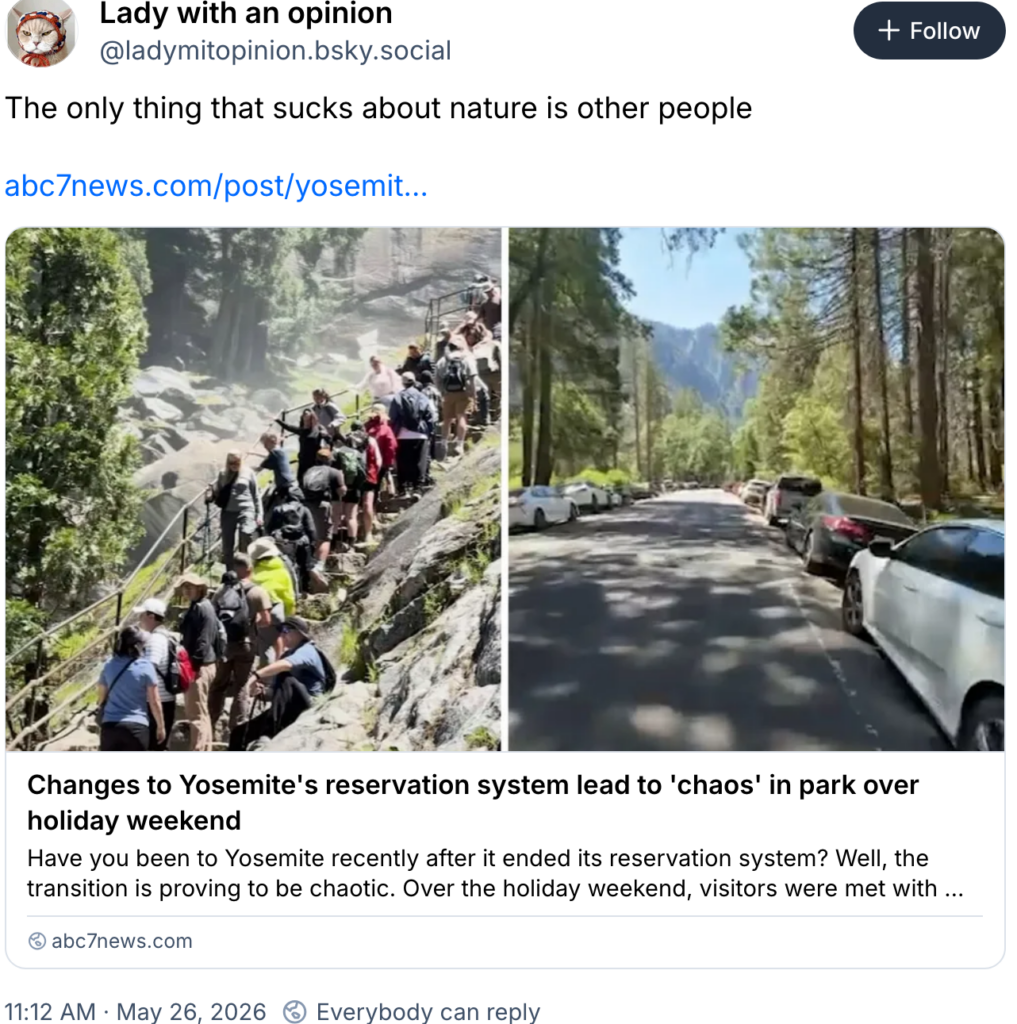
@climate-disconnect.bsky.social:
Same for climate change. People “care” but won’t actually do anything to help. or sacrifice anything, they want to keep polluting and consuming and poisoning because they think the problems can’t be caused by them.
“The older I get, the more I realize that many environmental debates are not arguments about whether people care. They are arguments about what people are willing to give up. And those are very different things.”
The Backpack Tax and the Ecology of Memory by Lyle Lewis, May 25, 2026
I recently read yet another discussion about the growing divide between “mutualists” — people who say they care about all wildlife — and hunters, who are increasingly portrayed in some academic circles as a shrinking minority interested mainly in killing animals.
I have been hearing variations of this argument for more than thirty years. And every time I hear it, I think about the backpack tax.
Most people under forty have probably never heard of it. Even many wildlife professionals barely remember it now. But for a brief moment in the 1990s, there was a serious effort to create a funding mechanism for nongame wildlife conservation by placing a small excise tax on outdoor recreation equipment — backpacks, tents, binoculars, climbing gear, kayaks, and similar products.
The idea was modeled after the Pittman-Robertson Act, the system that had funded much of American wildlife management since 1937 through taxes on firearms and ammunition. Hunters and anglers had been carrying the financial burden for wildlife conservation for generations through license fees and excise taxes. The backpack tax proposal attempted to acknowledge a changing reality: millions of people who did not hunt or fish were increasingly using public lands, participating in outdoor recreation, and claiming moral investment in wildlife conservation.
At the time, many of us working in or around wildlife conservation thought this was a pivotal moment.
We believed the broader outdoor recreation community would finally step forward materially, not just emotionally. The argument seemed straightforward: if people truly cared about wildlife, perhaps they would support a modest dedicated funding source for nongame species, habitat conservation, and biodiversity protection.
Instead, the proposal went down in flames.
What I remember most vividly was not opposition from anti-government politicians. That part was predictable.What stunned many of us was the aggressive opposition from the organized outdoor recreation industry itself. REI publicly opposed the proposal. The Outdoor Industry Association — whose membership included many of the largest and most recognizable outdoor recreation companies and retailers — formally opposed an excise tax on outdoor products and pushed hard against the idea.
The argument was familiar even then:
Taxes discourage participation.
The outdoor industry already pays enough.
Conservation should come from general revenue instead.
I remember being genuinely crushed by it.
Not irritated. Not politically frustrated. Crushed.Life among humans crushes me daily, hourly, and has done since I was a child.
At the time, I worked in imperiled wildlife conservation. Those of us focused on nongame species — species like wolverines, Townsend’s big-eared bats, harlequin ducks, and Bonneville cutthroat trout — already understood how threadbare conservation funding actually was. We understood how much of the system depended on hunters and anglers. We understood that entire categories of biodiversity — amphibians, reptiles, pollinators, songbirds, small mammals, native fish, and invertebrates — received little or no meaningful funding.In the human world, if it doesn’t make the rich richer, it has no value.
And for a brief moment, it seemed possible that the rapidly growing outdoor recreation world might help carry some of that responsibility.
Instead, the message many of us heard was:
We care about wildlife emotionally, aesthetically, recreationally, philosophically — but not enough to pay for it directly.
I remember not stepping foot into an REI store for over a decade afterward.
Not because I suddenly hated hikers or climbers or birdwatchers. I have spent much of my life among all of those communities. But because the moment revealed something uncomfortable about modern environmental culture that has only intensified since then.
Concern and sacrifice are not the same thing.
Identity and responsibility are not the same thing.
And symbolic environmentalism is often far more popular than material environmentalism.
Today, decades later, I still hear constant claims that “more people care about wildlife now.” In one narrow sense, that is undoubtedly true. Wildlife imagery saturates culture. Social media is full of emotional attachment to animals. Outdoor recreation participation has exploded. Many people genuinely love wildlife.
But the backpack tax episode exposed a harder question that remains unresolved:
What does caring actually mean when systems require material support?
Because ecosystems do not run on sentiment. Wildlife agencies do not operate on hashtags. Habitat restoration does not occur through moral positioning alone.
The uncomfortable reality — one many people still do not want to acknowledge — is that modern societies often prefer the performance of care over the cost of care.
And memory itself becomes part of the problem.
The backpack tax debate has largely vanished from public consciousness. The same culture that now celebrates broad concern for biodiversity often forgets the moment when a modest attempt to materially support nongame wildlife conservation collapsed under opposition from parts of the very outdoor industry built around professed love of nature.
That forgetting matters.
Because ecological decline is not driven only by ignorance or malice. Sometimes it is driven by a much simpler human tendency:
wanting the emotional rewards of concern without accepting the structural costs of responsibility.
The older I get, the more I realize that many environmental debates are not arguments about whether people care.
They are arguments about what people are willing to give up.
And those are very different things.