
@ketanjoshi.co:
there is going to be a day when we have to explain fossil-fuelled vehicles to kids and they are just going to burst out laughing at the entire concept
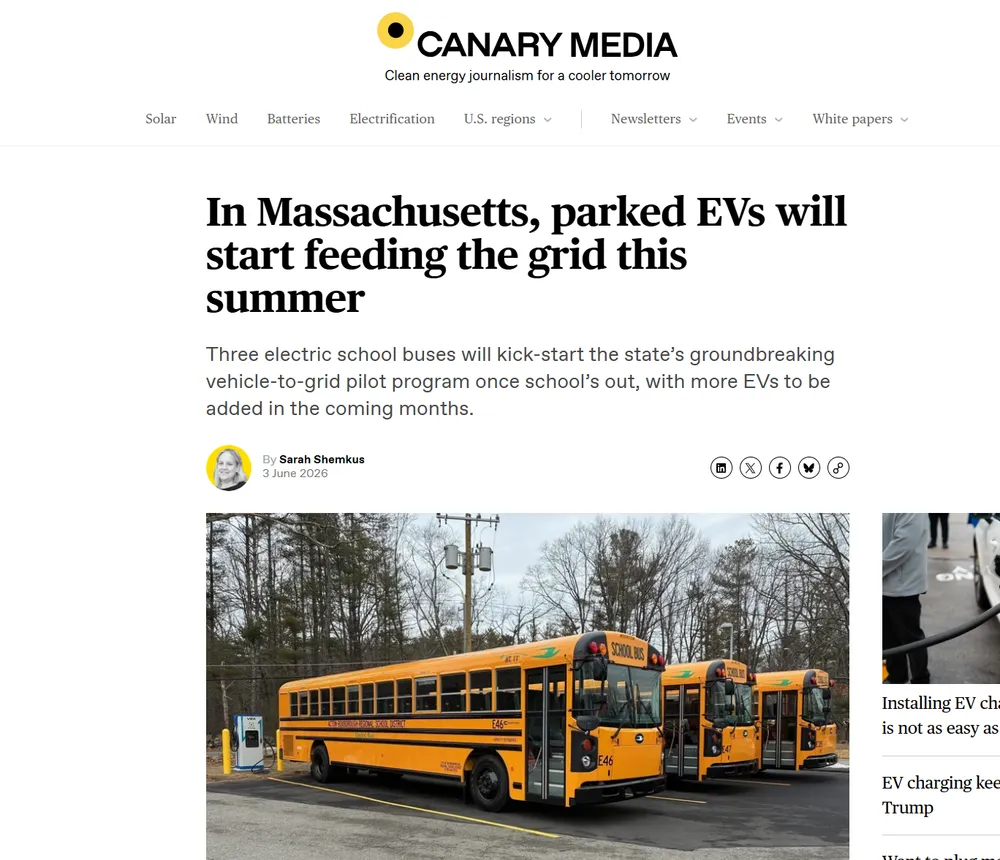
In Massachusetts, parked EVs will start feeding the grid this summer, Three electric school buses will kick-start the state’s groundbreaking vehicle-to-grid pilot program once school’s out, with more EVs to be added in the coming months by Sarah Shemkus, 3 June 2026, Canary Media
After the school year ends in the Massachusetts towns of Acton and Boxborough, the district’s electric buses will mostly stay put in a parking lot. But they won’t sit idle all summer.
The three vehicles will charge up their nearly 200-kilowatt-hour batteries overnight, when the power supply is at its cleanest and cheapest, then send energy back to the grid from 4 p.m. to 7 p.m. on days when the grid is strained. The district will earn revenue for the power it shares, perhaps even enough to cover the costs of charging up during the school year, said Kate Crosby, energy manager for the Acton-Boxborough school district. Plus, the strategy will help lower the emissions and cost of the region’s electricity supply.
“The more we plug in batteries to the grid, the less we use peaker plants,” Crosby said. “They will help to stabilize the grid, help to reduce the cost of electricity for all ratepayers, and they’ll help make the grid cleaner.” Much better plan than fucking AI data centres invading and sickening communities, and devouring their water supply and driving up energy rates for ordinary families
Acton-Boxborough’s school buses are the first vehicles to plug in to a Massachusetts program that aims to demonstrate and investigate the potential of “vehicle-to-everything” technologies, more commonly known as V2X. These systems use bidirectional chargers, which can power up a vehicle as well as send the energy stored in an EV’s battery back to a building or the grid.
Supporters say V2X technologies can yield a host of benefits. They can lower emissions by using stored energy generated at times when the grid is consuming less fossil fuel. They can help users offset their electricity bills by compensating them for power sent to the grid. They contribute to resilience when the power goes out. Plus, they can keep prices lower for everyone by sending cheaper power to the grid during times of high demand.
So far, however, widescale adoption has been elusive. Pilot programs across the U.S. and abroad have tested the possibilities, but they haven’t gained much traction in the face of high upfront costs, technical complexity, the huge variation among what equipment works with what vehicles, and the lack of established plans to compensate users for the power they pour back into the grid.
Massachusetts hopes its initiative will make some headway against these obstacles. At an event last week, the planners behind the demonstration program discussed what they’ve achieved so far, what they’ve learned along the way, and what problems remain.
The Massachusetts Clean Energy Center, an economic development agency, announced the demonstration program in early 2025, with the goal of giving away up to 100 bidirectional chargers to a variety of users. Participants were announced in February 2026: five school districts, four municipalities, and 30 residents. In order to understand how the systems function in a wide range of settings, the planners selected projects in all geographical corners of the state, and in rural, urban, and suburban areas served by 10 different utilities. The installations will include six different types of chargers plugging into eight different vehicles, from buses and pickup trucks to SUVs and compact hatchbacks.
“It’s not just about getting the right vehicle and the right chargers,” said Sally Griffith, transportation electrification program manager for energy consulting firm Resource Innovations, which is working with the state to run the program. “It’s about the whole system — how all of this needs to work together,” she said at the event.
Between 10 and 15 chargers are now installed and awaiting authorization to begin bidirectional charging. The rest are expected to be online by September.
Already, some challenges have been identified. The most pressing, speakers at the event said, have to do with finding a financial model that works.
For one, the systems are pricey: $15,000 to $40,000 for a residential setup, the Massachusetts Clean Energy Center estimates. Pilot programs can help defray costs for small numbers of users for a limited time, but a long-term, reliable compensation plan is needed to get any meaningful number of EV owners to make the leap.
But it turns out those compensation programs can be tricky to design. In Massachusetts, one major discovery so far has been the conflict between state solar incentives and the ConnectedSolutions program, which compensates battery owners for sending power onto the grid. Existing technology can’t tell the difference between electrons sent from solar panels and those coming from batteries. For a home with both solar panels and a bidirectional charger, it would be impossible to separate the solar power that should receive net-metering incentives from the EV battery power that would receive payment from ConnectedSolutions.
The Massachusetts Clean Energy Center had to immediately disqualify roughly 75% of the nearly 300 residential applicants for the V2X program because their homes had solar power, said Elijah Sinclair, the center’s senior program manager.
The state was aware there might be a conflict, but the scale took program planners by surprise, delaying the selection of participants and therefore the deployment of chargers.
One possible answer could lie in a program that compensates virtual power plants — networks of distributed energy resources like solar panels, batteries, and demand management — rather than providing different incentives for each component of the system, Steve Letendre, senior adviser at the Vehicle-Grid Integration Council, an EV charging advocacy group, told event attendees.
“We believe it’s a mechanism by which we can bring EVs onto the grid in a way that maximizes their value,” he said.
An unexpected bright spot so far has been the ease of interconnection, the process of formalizing agreements with utilities for hooking up an energy resource to the grid, Sinclair said.
“Utility interconnection was expected to be a big barrier,” he said. “But everyone has been just awesome to work with, and interconnection hasn’t slowed us down.”
The Massachusetts Clean Energy Center will collect data from participants for the rest of the year. By the end of the year, it aims to publish a comprehensive guidebook on what it’s learned about the cost, system design, and technical and regulatory barriers, with the goal of helping other agencies and states replicate the program.
In the meantime, the students and bus drivers of Acton-Boxborough will be enjoying quieter rides without any diesel fumes, said Crosby, the district energy manager.
“We are improving their quality of life immediately, and helping to create a cleaner, more stable future for them,” she said. “There’s nothing that matters more to us.”