
A town in England called off its New Year’s fireworks so Thor the Walrus could rest undisturbed before his migration.
When the Fireworks Fade, The waste, the energy, and the uncomfortable truth behind New Year’s celebrations by Peter Dynes, Jan 01, 2026, Peter’s Substack
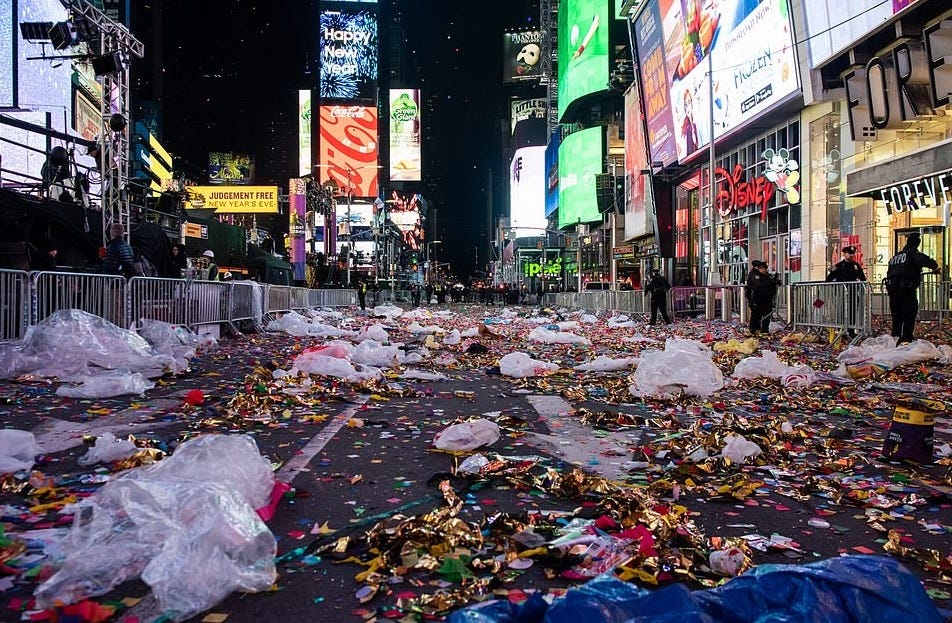
The morning after the night before is always quieter. Streets that only hours ago were packed with crowds are now strewn with debris: spent firework casings, scorched cardboard, plastic cups, discarded packaging, broken glow sticks, trampled decorations, and the faint chemical smell of smoke lingering in the cold air. Sanitation crews move through cities before most people wake, sweeping, hosing, loading trucks, restoring the illusion that nothing extraordinary happened at all. By midday, the mess is mostly gone, exported elsewhere—landfilled, incinerated, or shipped out of sight. The spectacle has vanished, but the material remains.
Every year, this ritual repeats itself on an enormous scale, leaving behind mountains of waste that must be collected, processed, and disposed of, using yet more energy, labour, and infrastructure. The celebration ends, but the clean-up bill does not. nor the stupid health harms, the annual idiotic deaths, eyes lost and hand/finger amputations, and deadly factory explosions. We are Homo stupidiens
This morning-after moment is revealing. Fireworks feel fleeting, almost harmless, because they last only minutes.
Yet they are among the most concentrated expressions of a deeply wasteful trajectory: resources extracted, processed, transported, consumed, and discarded for the sake of a brief visual thrill.
The rubbish on the pavement is only the visible fraction. Behind it lies the hidden waste of mining, refining, chemical production, global shipping, and energy use that made the display possible in the first place. When the streets are quiet again, the system that produced the spectacle keeps grinding on, preparing to do it all again next year.
It would be easy to frame this as a story about personal behaviour or public morality, but that misses the point. People will still celebrate. They will still gather, mark time, seek joy, and look for meaning together. That is not the problem. The problem is the scale and intensity of the system we have built to support these moments, and the assumption that it can continue indefinitely. What last night demonstrated was not just festivity, but how normalised excess has become—how routine it feels to burn enormous quantities of energy, generate vast amounts of waste, and clean it all up as if nothing is amiss.
The danger ahead is not a gentle, linear decline where energy use and material throughput slowly taper off in an orderly fashion. History suggests something far less comfortable. If societies do not choose to down-power deliberately—reducing waste, scaling back non-essential consumption, and redesigning how we live within limits—then decline tends to arrive abruptly. Systems built for abundance do not degrade gracefully. They overshoot, strain, fracture, and then fail in uneven and often chaotic ways. Waste accumulates faster than it can be managed. Infrastructure breaks under stress. Shortages appear suddenly rather than gradually. What feels like stability one year can give way to crisis the next.
The writer and thinker Duane Elgin has long described this moment using the metaphor of a rollercoaster. The slow climb upward represents the past few centuries of industrial expansion, accelerating energy use, and economic growth. As he puts it, “As we move toward the very top of the roller coaster, we can look out with a grand view of things, and many think this is so wonderful. This lasts only a short while as we move over the top of the ride and then begin to make a swift descent down the other side.” Standing in the aftermath of last night’s celebrations, it is hard not to feel that we are somewhere near that crest. The view has been dazzling. The momentum is immense. But gravity has not been repealed.
What makes this moment especially fragile is that waste is not just an environmental side effect; it is a signal of deeper inefficiency. A system that produces vast amounts of rubbish as a by-product of celebration is a system that has lost any meaningful feedback between cost and consequence. When disposal is easy and energy is cheap, excess feels invisible. When those conditions change, waste becomes a liability overnight—clogging cities, overwhelming services, and compounding stress during moments of disruption. Collapse, when it comes, is rarely tidy. It is messy, material, and very often smells like yesterday’s rubbish left uncollected.
None of this means a future without joy, ritual, or celebration. The quieter streets this morning also hint at another possibility: gatherings that leave little behind, celebrations measured in connection rather than consumption, moments that do not require an industrial clean-up operation to erase their traces. The question is not whether people will celebrate the new year, but whether we will choose to redesign how we do so—voluntarily, thoughtfully, and ahead of crisis—or whether we will cling to excess until the systems supporting it give way beneath us.
The debris will be gone by tonight. The memory of the fireworks will fade. But the trajectory they represent remains. The morning after is always the moment when clarity is possible—when the noise has died down and the costs are briefly visible. Whether we use that clarity to step off the rollercoaster gradually, or whether we continue upward until the drop becomes unavoidable, is still an open question.