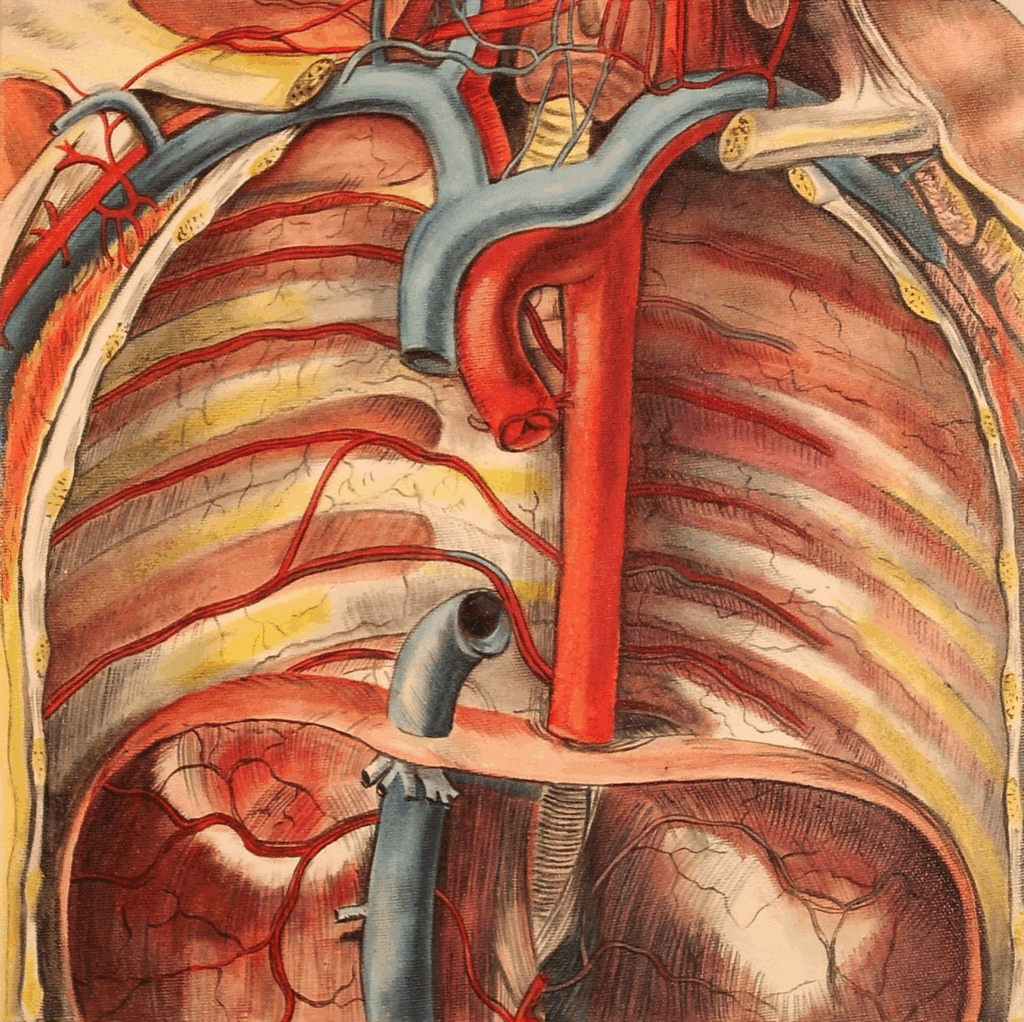
Heartless – 2006 – oil on canvas – by Marianna Gartner
Dear Mark Carney: How do you partition a heart? How do you partition a brain? by Janice Mar Wong, Nov 29, 2025
I realized I need only — always — begin with you.
Dear Mark Carney
by Janice Mar Wong
“The death of human empathy is one of the earliest and most telling signs of a culture about to fall into barbarism.”
— Hannah Arendt ¹
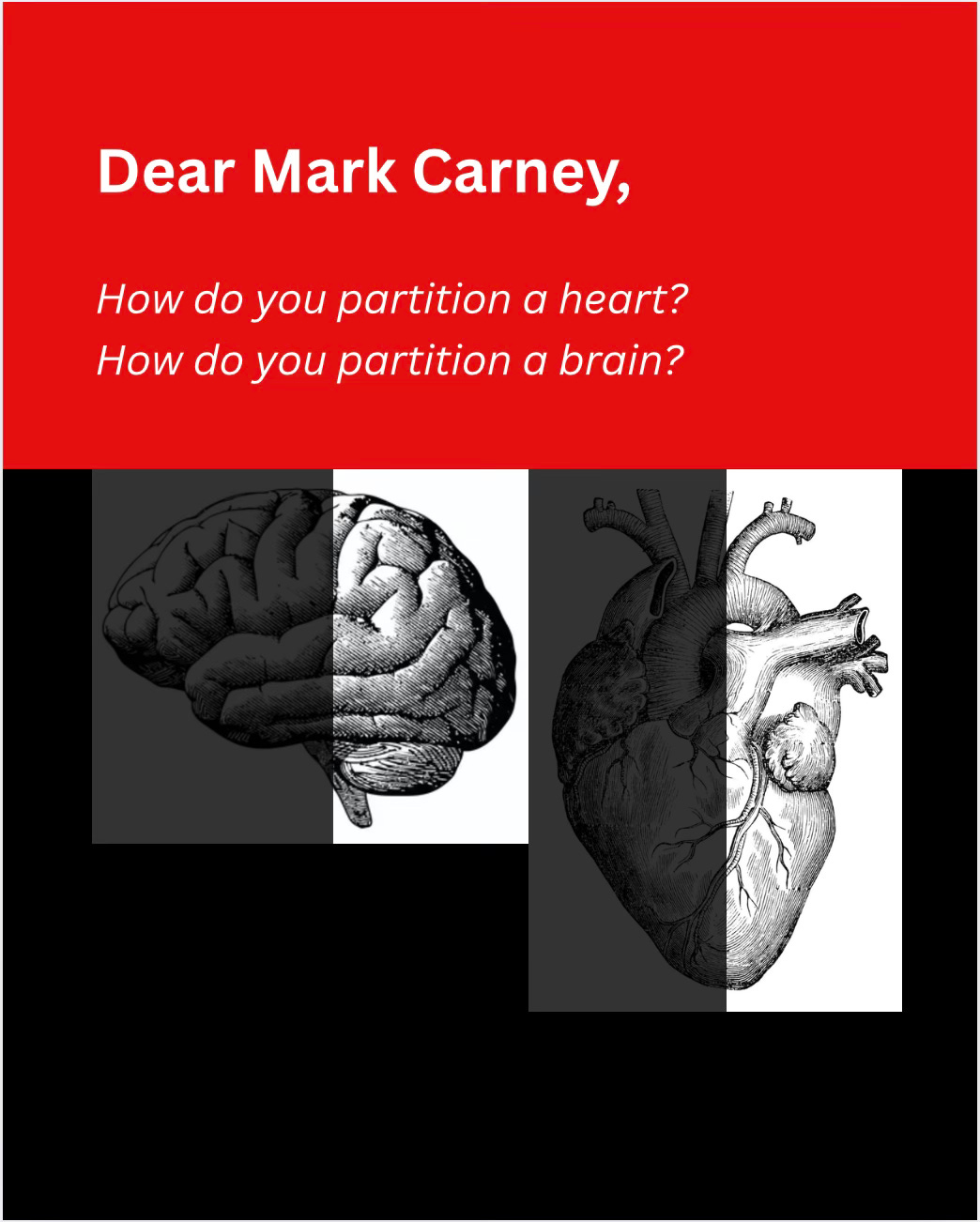
I completed this graphic quickly, but I stalled on the accompanying words. I didn’t know where to begin. Then I realized: I need only — always — begin with you.
You are consistent. Very consistent. I’ve come to know that you will always champion, grieve, and name the lives of Jewish victims — their voices, their families — both at home and abroad. And I’ve come to know that you will refuse to do the same for Palestinian victims, whether at home or abroad. I’ve come to know that you will always — only — name October 7, one set of hostages, and accuse only one side of “terror.”
I’ve come to know that where it is easy for you to name Palestinians as terrorists, when it comes to the Israeli military your vocabulary mutes to “and others, in response”² or “defence.” And we all know that you will always tell us that Canada stands “steadfast” in its support for Israel, its people, and their security.
As I’ve written before, that recurring promise of “steadfast support” now binds Canada to a state whose government directs, military enacts, and majority population endorses genocidal policies and rhetoric. A Haaretz poll from March 2025 found that 82% of Jewish Israelis supported the forced expulsion of Palestinians from Gaza, and 56% supported expelling Palestinian citizens of Israel — majority positions in a state now committing genocide. These are not outlier views; they reflect the normalization of atrocity, not its repudiation.³
As my country’s leader, you effectively speak for all Canadians. And therein lies the sticking point. Therein lies the reason for the many letters I have sent to you — and will continue to send. Because this is my grievance: you do not speak for me.
In my letter of October 24, I wrote:
“And if I consider how someone — you — can feel and express for one and not another, I have to imagine that your heart is only half-broken. Broken enough to feel for one, yet closed to the other. I speak of hearts breaking in reference to Rumi: ‘You have to keep breaking your heart until it opens.’”
Today, I speculate on your ability to live with half a heart.
I ask: how do you manage this? And why would you do this to yourself?
It is tragic, really, to know that our country’s leader is capable of this.
The outfall of half a heart will leave a questionable legacy — one that is deadly in its making.
I write “deadly” as I consider your refusal — your choice — to never speak the word genocide. Like your cohort, Mr. Starmer, you claim it is “for the courts to decide.” And you know this absolves you of the need for action. You know it buys certain powers enough time to achieve their desired agenda.
And innocents die.
And heritage dies.
It is deadly.
Back to the half a heart — the side you allow for feeling, empathy, words, action, grief:
Can you imagine what your reaction would be
if Tel Aviv looked as Gaza does today?
Can you imagine your reaction
if tens of thousands of Israeli children were hunted down — limbless, burnt, sniper-shot to head and chest — as Gaza’s children are?
Can you imagine your reaction
if the testimonies of torture of Palestinian prisoners were Israeli testimonies
(and please, do not rely on the now-debunked Israeli stories from 2023)⁴
Can you imagine your reaction
if Israelis—hundreds of them children—were held as prisoners for decades in vile conditions, indefinitely, without charge or trial or hope of release?
Israeli criminal lawyer Ben Marmarelli wrote in his report to the Israeli court that his Palestinian client was being routinely sexually violated before each of his visits — so routinely that the client begged him not to come.⁵
What would your reaction be if this were an Israeli’s story?
Can you imagine your reaction
if hundreds of Israeli hostage bodies had been returned with deep cuts, neck restraints, severe handcuff marks embedded in their skin, evidence of point-blank executions; nameless and numbered, with nationalistic emblems carved into their bodies, their features destroyed to make identification impossible?
(Yes: several Palestinian hostages were returned with the Star of David carved into their flesh — the same emblem carved into vast tracts of Gaza’s land.)⁶

Can you imagine your reaction
if Israelis were routinely shot while starving, trying to reach a food depot?⁷
If all of these victims were Israeli, would your reactions be ones of outrage, horror, grief, sympathy, anger? Would you leap into action and enact all of the laws and tools that Canada has at its disposal — Human Rights Laws against war crimes and crimes against humanity? Or would you ignore their suffering, as you have with Palestinian victims?
Would you refer to their plight as the result of a “humanitarian disaster,” and align us with the perpetrators — claiming steadfast support while Israelis starved and suffered and lost whole family lines, the last generations wiped from the public registry?
Know this: the list of “Can you imagine” is endless. It stretches on infinitely. It is inhumane; it is cruel; it is exemplary of the very worst of humankind.
And yet, you tell us this is what we stand “steadfast” in supporting.
Recently, I heard this speech by British actor Khalid Abdalla, delivered in London on November 23rd at Counterfire. The death toll he references has since risen to at least 345.
“44 days have passed since a ceasefire was called in Gaza. 44 days which I have to be honest and say, I have found immensely painful. As we all know, it is not a ceasefire in any meaningful sense. At best, we can call it a de-escalation of bombing, in which war, occupation, killing and degradation continue.
In the past 44 days, over 336 Palestinians have been killed — which to be clear, is 85 more than the number of Israeli hostages that were taken on October 7th.
If we had anything approximating parity of care over the sacredness of every human life, we might expect international outrage about what is happening week by week, but of course that is not the story of the present moment. Far from it, we are in a world in which the powers that be seem to be insisting on moving us into a further stage of genocide denial in which we are somehow supposed to forget the last two years, in favour of the “ceasefire.”
And I think it’s worth stopping for a moment to unpack why so many people feel the need to put quotation marks around the word.
On the one side of course there is the fact that, alongside the rising death toll, Israel has violated the ceasefire at least 394 times since it was called, almost every day. More than 1500 buildings have been destroyed, with entire neighbourhoods decimated, aid and medical supplies are not entering at the level required, drones haven’t stopped flying, even the yellow line that marks Israel’s total military control has moved in some areas.
But as if that wasn’t enough, the reason the word chokes in the throat is because this ceasefire is a doubling down on the scale of injustice that preceded the nightmare of this genocide.
Normally, when you have a ceasefire between two warring parties, you return to a situation in which the parties at war, previously at peace with each other, return to peace. The word peace, even the word ceasefire, tends to include the idea of sovereignty. But in the case of Palestinian, of course, this is not the case. The situation returned to is the continuation of occupation, and apartheid but now in the aftermath of a genocide that is continuing! It is in short, the next chapter of this ongoing Nakba.
And this concept of the ongoing Nakba is something that I think we need everyone in the world to understand with the same depth and humanity that the Holocaust is understood, not because they are in competition, but because at root this is about the universal struggle for the sanctity of human life that both represent.
To bear witness to the Nakba is to understand how the ethnic cleansing of Palestine, and the structures of violence necessary for the denial of Palestinian existence and sovereignty have been maintained for over 77 years, as part of the story of this genocide…
…Because amongst the most awful aspects of this genocide and what has happened to Gaza over the past two years is how it echoes what happened to Palestine in 1948, but not just in the acts, in the intergenerational experience of so many families. The phenomenon of history repeating itself is about structural conditions remaining constant in timescales that are beyond one lifetime…
…My children have spent their childhood learning what the word genocide means at a distance to the experience of thousands of Palestinian children, but with the intimacy of what it means to be an Arab in this world.
The extent of the dehumanization.
And again, I want to pause on that word, because it seems it is at the heart of the racism that is so pervasive in a political culture able to find ways to justify, or ignore, complicity in the horror of what has been done to Palestine, and indeed other Arab countries over these past decades.
This need to prove that we are equally human, and so equally grievable.
This need to prove that we are not inherently violent, but rather that the violence in our region is a product of legitimate grievances, the same way it is for every other human culture.
This need to prove that we are not anti-semitic, or that we are the good ones.
This need to prove that our testimony is just as valuable as anyone else’s.
This fundamental mistrust of Arabs, and certainly Palestinians.
This world that tells you that you are not safe, and not safe to thrive, because of where you’re from.
How do you recover from the fact that after two years of a live-streamed genocide in which you implored the culture around you to see it for what it is, now you are being told, it seems, to forget it even happened — and drop the demands for justice, and accountability in exchange for this bunny-eared ceasefire that wants to magic away the injustice with even more colonialism, headed by Trump and Tony Blair, and passed as a UN resolution while the killing continues.
When I am at my lowest, it is the space of solidarity that brings me back up. The millions around the world, and in every walk of life, who have stepped out in defiance of all the silencing and vilification with the belief that we can be different.
The good news is that our eyes are opening, collectively — not just to Palestine, but to how Palestine relates to everything else. The contortions of the law and conscience over these past two years have been bewildering, and so profoundly corrosive. Around the world they are eating away at democracies, universities, political parties, international law, the media, global institutions, causing repression and a rise of militarism and surveillance everywhere in service of what?
A genocidal Israel that Jewish people around the world are abandoning while making clear that it does not represent them, their religion, or traditions, and certainly not the memory of the Holocaust…
…To change the world you have to see it for what it is. With the intensity of struggle over these two years there is a way of seeing the last 44 days as a return to normal, and another in which we see it as the beginning of regrouping, or organizing, and getting ready for the decade ahead. Because surely we have to be the generation to bring true peace, a peace built on justice, from the river to the sea, in which every Palestinian and Israeli has equal rights, what a Free Palestine means to me…” ⁸
Half a heart.
Is it a physical trait or trick, a trained reflex — a bias that split your heart in two — or simply a political agenda?
As a visual artist, I frequently think of Henri Cartier-Bresson’s reflections on aligning eye, heart, and mind:
“To take photographs is to hold one’s breath when all faculties converge in the face of fleeing reality. It is at that moment that mastering an image becomes a great physical and intellectual joy.… It is putting one’s head, one’s eye, and one’s heart on the same axis.”⁹
I’m going to end this by saying that I wish the great Palestinian photographers we’ve seen at work these past two years — and these past seven decades — were able to align their eyes, their mind, and their heart toward “great physical and intellectual joy,” and not toward the documentation of their own deaths. I wish that they did not need to plead, over and over and over again, for politicians such as yourself to see them — with a full heart and a full mind — as fully human and deserving of enduring peace and justice.
For whatever weight your conscience allows this letter to carry.
Janice Mar Wong
Footnotes
- Hannah Arendt, On Violence, various printings.
- Mark Carney, interview with Michael Froman, Council on Foreign Relations, September 22, 2025.
- Haaretz, March 2025 polling on public support for expulsion policies.
- Multiple international reports (2023–2024) debunking specific Israeli government torture claims used as justification for military escalation.
- Ben Marmarelli, legal filing presented before an Israeli court regarding treatment of Palestinian detainees (November, 2025).
- Reports documented by Palestinian legal and medical authorities regarding the condition of returned bodies of Palestinian hostages.
- Multiple humanitarian organizations reporting lethal fire on starving civilians approaching food convoys (2024–2025).
- Khalid Abdalla, speech at Counterfire, London, November 23, 2025.
- Henri Cartier-Bresson, various interviews and writings on photographic practice.
***
THE HALL OF INFAMY: A Global Century of Environmental Supervillains by Lyle Lewis, Nov 29, 2025, Lyle’s Substack
A century of leaders who liquidated the living world–and left us the bill.

Decay feeding life. The quiet work the natural world still does, even as the forces that undermine it go unnamed.
Every era celebrates its conservation heroes.
Far fewer remember the destroyers.
But the world we inhabit was shaped far more by the people and institutions who treated land, water, species, and climate as expendable than by those who understood nature as the foundation of life itself. This piece is a record of that legacy: a Hall of Infamy for those who turned stewardship into self-interest, and the living world into capital.
Prelude: The Ancient Roots of Extraction
Long before the 20th century, the trajectory was set. Mesopotamia formalized private property and profit. Rome industrialized deforestation, mining, and overfishing. Every civilization reshaped ecosystems to sustain its growth and eventually collapsed when the foundations that supported it were exhausted.
Deep time offers an even harder truth: humans began erasing biodiversity more than two million years ago. Civilization didn’t invent destruction; it scaled it.
What changed in the last century was the speed, the technology, and the reach of decision-makers who could alter entire biomes with a single signature.
“Civilization didn’t invent destruction; it scaled it.”
I. The Early Despoilers
Franklin K. Lane, Secretary of Interior under President Woodrow Wilson, approved the Raker Act, drowning Yosemite’s Hetch Hetchy Valley under a 1913 reservoir. A wound that will never heal — proof that no landscape is sacred once ‘utility’ becomes gospel.”
Ralph H. Cameron, Arizona speculator turned senator, tried to privatize the Grand Canyon through fraudulent mining claims. The Supreme Court slowed him briefly, but he simply ignored its rulings. Only when Arizona voters removed him from office did his reign of obstruction finally end.
Albert B. Fall was the first U.S. cabinet secretary to be convicted of a felony for selling federal oil reserves for bribes in the Teapot Dome Scandal — the nation’s prototype for state-sanctioned plunder.
William Mulholland drained the Owens Valley to feed Los Angeles, leaving behind the blueprint that still defines Western water policy: move resources from places with no power to places with too much.
Together they built the myth that nature should be both monetized and managed into submission — and set the moral tone for the century.
II. The Industrial Greenwashers
By mid-century, the frontier was gone but the appetite for extraction wasn’t. The villains simply learned a new language: efficiency, patriotism, progress. This era didn’t just exploit nature; it weaponized rhetoric to make destruction sound reasonable.
Ronald Reagan and James G. Watt reframed conservation as elitism and opened millions of acres to logging, drilling, grazing, and mining. Watt insisted resources didn’t need protection because, “I do not know how many future generations we can count on before the Lord returns.” Reagan dismissed environmental concern with: “A tree is a tree — how many more do you need to look at?”
Suharto’s dictatorship in Indonesia turned the rainforests of Borneo, Sumatra, and Papua into political currency, granting vast logging and palm-oil concessions that gutted some of the planet’s richest ecosystems.
Lee Raymond, CEO of Exxon Mobil, perfected climate denial. His own scientists warned of catastrophe; he publicly cast doubt and funded disinformation networks that delayed action for decades.
In the UK, Margaret Thatcher and Tony Blair branded “market environmentalism” as innovation. Carbon trading monetized emissions without meaningfully reducing them — a template for today’s global climate shell games.
III. The Global Accelerants
The new millennium didn’t stop the damage — it globalized it.
Jair Bolsonaro declared the Amazon open for business and reversed policies that had reduced Amazon deforestation by ~80%.
Vladimir Putin weaponized fossil fuels to fund war and paralyze climate cooperation.
Saudi Arabia’s crown prince, Mohammed bin Salman draped oil expansion in futurist branding as Saudi Aramco pumped record volumes.
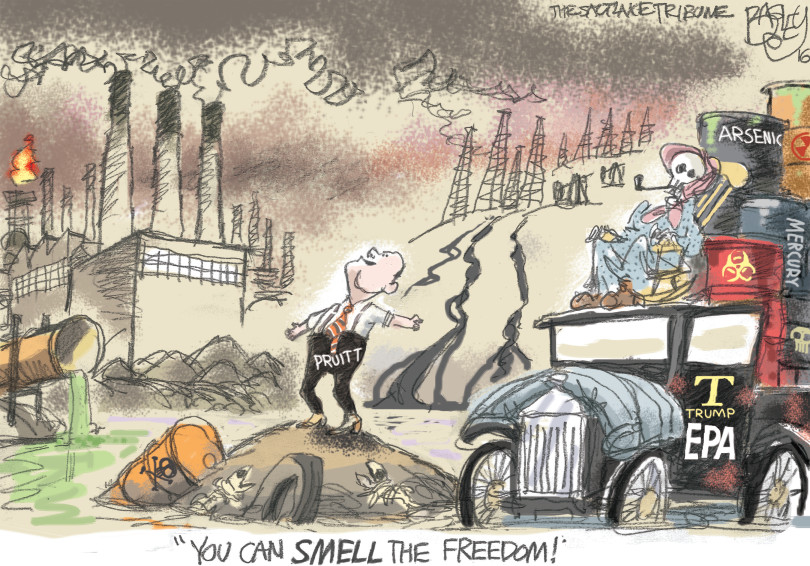
In the U.S., Scott Pruitt and Andrew Wheeler hollowed out the EPA.
Narendra Modi, prime minister of India, expanded coal while cracking down on journalists and environmental defenders.
Peter Dutton and the Adani Group pushed one of the world’s largest coal mines beside the dying Great Barrier Reef in Australia.
Each promised progress. Each accelerated collapse.
IV. The Architects of Euphemism
Some villains didn’t swing an axe. They invented the language that excuses it.
 Mark Carney, Canada’s fraudulent PM, and his evil “decarbonization” lingo to enable doubling the world’s most toxic fuel, the Alberta tarsands and massively escalate frac’ing to feed his insane LNG expansion orgasms.
Steven Meahley, a U.S. Forest Service supervisor and later director of the Idaho Department of Fish and Game, popularized and institutionalized the term “forest health,” now used globally to justify logging and mechanical “treatments” under the banner of restoration.
Allan Savory, a former Rhodesian game ranger turned self-styled grazing guru, convinced policymakers across the American West that more cattle, more fences, and more water developments would heal degraded rangelands. I specifically bought my 50 acres at Rosebud, and have worked like hell trying to keep humans off it (it constantly stuns me how many people think they have the right to invade my land whenever they demand), and painstakingly collected and spread native grasses to try to retore 100 years of rape and pillage by the farmer I bought it from. Only to get frac’d to hell by Encana/Ovintiv and now to be frac’d again by scheister fuckers Perist Oil and Gas.

His unsubstantiated claims derailed genuine efforts to reduce livestock pressure and reshaped management far beyond the science that ever supported him, and often in direct opposition to it.
Long before corporations perfected greenwashing, these men pioneered its core tactic: turn ecological harm into ecological virtue with a single, seductive phrase.
V. The Men Who Tried to Destroy Rachel Carson
Rachel Carson faced not just institutional resistance but individuals determined to silence her.
Robert White-Stevens (American Cyanamid) attacked her on television in a white lab coat, claiming her work would “return us to the Dark Ages.”
Ezra Taft Benson, U.S. Secretary of Agriculture and a senior LDS apostle, dismissed her outright because she was unmarried, as if her marital status mattered more than the science.When I went public with Encana/Ovintiv’s frac crimes in my community, men invaded my private property, trying to scare and silence me, belittling me and told me I was not allowed to talk to the media because I was not “servicing” a man! And AER named me a criminal without evidence, in writing, and years later in a court filing, named me a terorist again without any evidence, and years after that, supreme court of Canada judge Rosalie Abella lied, and changed AER’s lies to me being a vexatious litigant. Douche Fuckers, just like Decarbonizer Carney.

John T. Connor, head of the Manufacturing Chemists’ Association, orchestrated a full-scale corporate counterattack.
These tactics became the blueprint of modern science denial and the modern culture war against environmental truth.
The Carson Playbook
Industry learned it didn’t need to refute science; only scientists. Call the messenger emotional. Dismiss their warnings as alarmism.Ya, I got all that crap rammed down my throat too, by Alberta and federal politicos, and media.Reassure the public that “the experts” see no cause for concern.Enter the ultra lying corrupt Alberta Reseach Council (name changed to Alberta Innovates after I publicly pointed out their super pathetic attempts at fraud and lies to cover up contamination by frac companies.
The names change; the strategies don’t. Their ability to demean and discount those working on behalf of the living world has withstood the test of time and metastasized.
“Industry learned it didn’t need to refute science — only scientists.”
VI. The Modern Mask
Today’s supervillains don’t sign bribes in smoke-filled rooms. They speak at climate summits. Pose in front of solar farms. Break ground for carbon-capture industrial complexes. Promise “net zero” while expanding extraction.
BC resident:
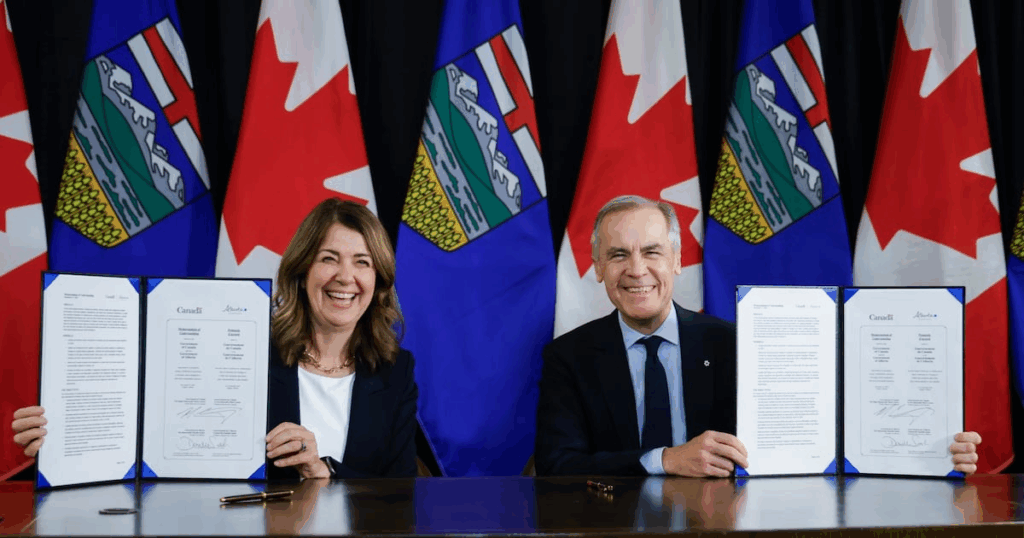
On a darker note…what really griped my ass this week was watching Carney and Smith holding up their signed agreements LIKE TRUMP ALWAYS DOES… the big flourish!!
Corporations hide behind legal personhoodA fucking American judge did that gross abuse to all life on earth. Canada copied it. Of course we know our institutions and courts were created by the rich and evil, to protect their riches while stealing from the commons and other lifeand PR departments. Governments outsource responsibility to markets. And the public, buried under metrics, forgets that ecosystems are not spreadsheets.
The modern villain doesn’t clear-cut a forest; they approve a permit. They don’t burn wetlands, they subsidize the companies that do. They don’t deny the consequences outright. They deny them by minimizing them, recasting them as overblown, or insisting technology will solve them “later.” Their destruction is insidious, quiet, polished, and devastating.
“Their destruction is insidious, quiet, polished, and devastating.”
VII. Epilogue: The Memory Problem
Every civilization imagines itself exceptional. Rome had aqueducts; we have pipelines.
The villains of this list are symptoms of something deeper — a culture that punishes those who defend biodiversity, clean water, and clean air while rewarding those who turn nature into profits and call it innovation.
But history has a long memory. And the Earth, indifferent to titles and markets, will keep its own record; not in profits or markets, but in poisoned bodies, fraying minds, collapsing systems, and the long shadow of extinction.
This is only the first chapter. The list is far longer, and I’ll be returning to it in the months ahead.
***
@race2extinct.bsky.social:
Every era celebrates its conservation heroes. Far fewer remember the destroyers.
My new piece, The Hall of Infamy, traces a century of leaders, industries, and institutions that liquidated the living world — and left us the bill.
From Hetch Hetchy to the Amazon…
@9wintercrows.bsky.social:
A real kindness to make your writing open access for everyone. Thank you.
@race2extinct.bsky.social:
You’re welcome!
@squirrellyaltruist.bsky.social:
Excellent, digestible piece. Silent Spring helped change my life at ~ 22 when I took an environmental ethics course over the summer because I heard my undergrad Theo/World Religions professor at my small private women’s college was an absolute nut case and wanted to skip that required course.
@squirrellyaltruist.bsky.social:
Interesting enuf I left the LDS church about the same time. I couldn’t imagine a culture that constantly discredited women except through the merits of their husband/kids. I never knew an LDS elder was involved in the cancel culture against Rachel Carson…as if C.C. didn’t exist until it hit men
@race2extinct.bsky.social:
I’m glad you were able to escape the chains of the LDS church. It must have been difficult. I’m not sure there is another religion in North America where there is so much indoctrination at a young age.
@squirrellyaltruist.bsky.social:
100%. Being 13 when I converted in as a foster child was also what gave me the strength to leave. The LDS culture is powerful for the alienated and orphaned, but I eschewed women dependent on men and this is what saved me. Like seriously, “Homemaking” as a college freshman is beyond for 1998/1999
@race2extinct.bsky.social:
LDS takes patriarchy to an extraordinary level……and their belief in dominion over the Earth is on a par with its patriarchy. It’s the worst of all worlds.
@raisinit.bsky.social:
This is why Terry Tempest Williams and Brooke Williams left the LDS church as well.
@squirrellyaltruist.bsky.social:
I like Terry’s discussion of the creation story. Humans that don’t need a creation story to thrive are freed up to explore life with fewer chains, especially women.
@cat-father.bsky.social:
The Modern Mask resonates here in Canada. We have a PM (a supposed proponent of CC mitigation) that’s just signed a MOU with the Premiere of Alberta to build a new pipeline to send bitumen to BC tide water. CCUS, net zero by 2050, all mentioned and total bullshit. Gains made over last decade:lost
@race2extinct.bsky.social:
Hypocrisy is rife in nearly all countries. Canada is no exception.
@jimmarciniak.bsky.social:
I’d like to nominate the fools who drained the Great Black Swamp in Ohio/Indiana and who drained northwest Indiana and turned 75 miles of the Kankakee River into a linear drainage ditch.
@race2extinct.bsky.social:
It’s impossible to argue with your nominees. The problem is there are so many, it’s difficult to parse out the “worst.” The current batch are so numerous that it really is almost impossible to pick out the “worst.”
@tgamberg.bsky.social:
Congratulations Lyle. I’m looking forward to reading this!
@clover4all.bsky.social:
Hidden evils.
@occupystephanie.bsky.social:
The “grasping wastrels of the land”. Tom McCall
race2extinct.bsky.social:
Before the fur trade, beavers…..not deer were the backbone of many predator diets. Wolves following beavers is not an anomaly; it’s a glimpse of what North America looked like before we trapped its keystone species out of existence.
queticosuperior.org/wolves-track…
Imagine what it was like historically when beaver numbers in North America hovered around 400 million.
@race2extinct.bsky.social:
“Proposals have been put forward.”
In conservation, that’s usually the last step before extinction.
By the time pudus are critically endangered, “proposal” will have become a synonym for obituary.
www.reuters.com/business/env…
Russell Means, Oglala Lakota Nation (1939-2012):
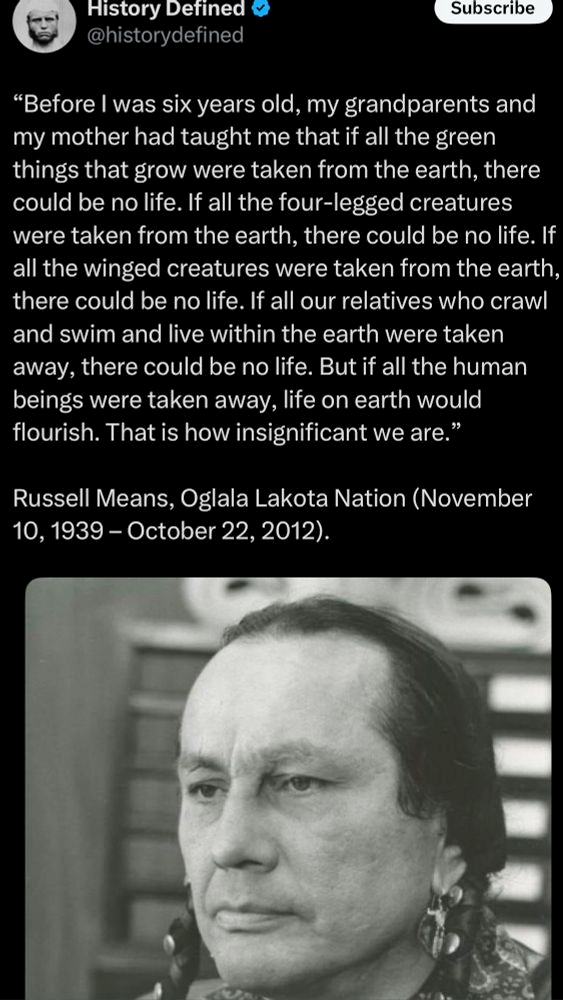
“Before I was six years old, my grandparents and my mother had taught me that if all the green things that grow were taken from the earth, there could be no life. If all the four-legged creatures were taken from the earth, there could be no life. If all the winged creatures were taken from the earth, there could be no life. If all our relatives who crawl and swim and swim and live within the earth were taken away, there could be no life. But, if all the human beings were taken away, life on earth would flourish. That’s how insignificant we are.”
***
Subject: B.C. approved logging twice sustainable rate: leaked report – Business in Vancouver ………..THIS IS OUTRAGEOUS and so hidden from the public
Date: Sun, 30 Nov 2025 13:19:23 -0800
From: Rosemary Baxter
To: email hidden; JavaScript is required, email hidden; JavaScript is required, email hidden; JavaScript is required, email hidden; JavaScript is required
CC: Adam Olsen email hidden; JavaScript is required, Elisabeth May email hidden; JavaScript is required, email hidden; JavaScript is required email hidden; JavaScript is required, email hidden; JavaScript is required, email hidden; JavaScript is required, email hidden; JavaScript is required
To: Prime Minister Carney, Premier Eby, BC Forest Minister R. Parmar, and Minister Nina Krieger, BC
CC: BC Green Party, Elizabeth May, Federal Green Party, Gord Johns, our Federal MP, Stephen Gillbault, MP, Premier D. Smith
Greetings from Courtenay…….this is not a good day. We’ve just read the article on that BC RCMP Critical Response Team and the photos of the damage they did at Cougar Creek… then earlier this week we saw the Premier of Alberta and the Prime Minister gleefully signing an MOU which if acted on would destroy almost everything on the fragile west coast we’ve been trying to protect since the 1970’s and with total disregard for the BC Indigenous people in their path, the same ones who were never consulted. To make it worse they held up their signed documents in the same way that PRESIDENT TRUMP DOES!!
We are sick and tired of the ignorance shown by the people who seem intent on destroying our environment, destroying our Old Growth and destroying our fragile oceans. ALL FOR GREED? The people with ‘power’ just don’t get it – we’re in a climate CRISIS... we have to escalate the end of fossil fuels (which by the way includes LNG) , we have to stop destroying our carbon sinks, we have to stop damaging our oceans and our salmon. Its a NO BRAINER to remove our west coast fish farms, healthy ocean, healthy salmon! It was promised..remember?
This is definitely not a good day. Maybe its back to that old slogan of POWER TO THE PEOPLE? I’m a senior.. you have no idea how sad it is to see this level of planned extinction when we’ve worked so hard for a better world and most especially for our own beautiful province.
Rosemary Baxter, Courtenay
BCC others
Leaked report claims B.C. timber harvest is vastly overestimated, An undisclosed report obtained by BIV estimates the province is likely approving twice as much logging than can be sustainably harvested by Stefan Labbé, Nov 19, 2025, Business in Vancouver

A leaked technical review prepared for a group of First Nations claims British Columbia is greatly overestimating how much timber it can sustainably harvest in a push for short-term economic gains.
The previously unreleased report charges that the methods the province uses to calculate how many trees are on the landscape—and therefore how much can be logged—is fundamentally flawed and based on “wildly extreme assumptions” that hurt the long-term health of B.C.’s forests.
The report’s authors, a forest ecologist and a registered professional forester, only agreed to speak with BIV after it independently obtained a 572-page draft of the report originally dated September 2024.
“There’s a strong likelihood that throughout the province we’re cutting almost at twice the rate of what is considered sustainable,” said co-author Dave Radies. “We’re running out of wood.”
The report focuses on the Mackenzie timber supply area (TSA), a 6.41-million-hectare swath of land spanning the Rocky Mountains and the Peace River region.
In their analysis, the authors challenge the methods B.C. uses to determine the annual allowable cut (AAC)—how much timber can be cut in the region in a given year—concluding their numbers are likely double what can be harvested without causing significant long-term damage.
The findings could have province-wide implications, as experts say the same modelling framework used in Mackenzie is applied across all TSAs in B.C.

Peter Wood, a lecturer at the University of British Columbia’s Faculty of Forestry who recently reviewed the document, said the report raises a number of “very concerning” questions around how the province calculates annual allowable cut.
“There’s nothing more important than AAC determination in terms of how forestry is going to affect a landscape in B.C.—all subsequent decisions end up being constrained by this number,” said Wood.
Without oversight, what comes out of the Ministry of Forest’s “black box of calculations” has been difficult to prove or disprove, he said. Wood added the unreleased report offers a glimpse of those “inner workings.”
“It’s pretty incredible they were able to do that,” Wood said. “My first gut feeling when I read it was ‘This is how ghost towns are made.’”
Unrealistic assumptions threaten wildlife, Indigenous rights
Under the Forest Act, every 10 years the chief forester must carry out a review of what can be annually logged across all of B.C.’s 37 timber supply areas and 34 tree farm licences.
The Mackenzie region’s latest review came in May 2023, when B.C.’s chief forester Shane Berg officially determined 2.39 million cubic metres of timber could be removed from its forests each year. The calculation used a starting “base case” of 2.97 million cubic metres.
But when Radies and his co-author, registered professional forester Martin Watts, ran their own statistical analysis, they found the province’s base case could only be justified through extreme, unrealistic assumptions that ignore reality.
Even using the ministry’s own extremely conservative methodologies, harvesting more than 1.06 million cubic metres a year was found to put environmental values—including the health of caribou, grizzly bears, fish and other furbearing animals—at high risk.
Their conclusion: the annual cut approved by the province would negatively impact First Nations’ constitutionally protected rights to hunt, gather and fish.
B.C. forest model found to use manipulated inputs
Radies said the core of the problem is that the Minister of Forests can legally direct the chief forester to manipulate up to 49 inputs used to model how much timber is actually on the land base. That allows the minister to warp data and prioritize economic interests over what’s truly sustainable, he said.
“The fact is, the minister puts restrictions on the inputs to the model to serve an economic interest. That’s what creates a lack of transparency,” Radies said. “We’re not being honest with ourselves.”
Watts, who runs the Victoria-based firm FORCOMP Forestry Consulting Ltd. and carried out much of the report’s statistical analyses, said that when he ran his own models, he found the government relies on unverified forest growth estimates and operational assumptions that do not reflect current practices. That, he said, is leading to a massive overestimation of available wood.
The provincial calculations were found to assume that future tree plantations will not fail and that there will be no drought. Government models also assume minimal damage from insects and disease, despite the region losing 37 per cent of its forests to the mountain pine beetle epidemic in recent years, according to the report.
“They’ve got unrealistic projections of how that’s going to magically grow back in the future,” said Watts.
When the chief forester made the 2023 determination, the model assumed about 310 hectares of harvestable forests would burn and be lost every year.
But in the decade leading up to 2022, the annual loss of forests to fire averaged about 1,800 hectares per year. Even more dramatically, in 2023—the same year the calculation was made—record wildfires burned at least 50,000 hectares of harvestable timber in Mackenzie. Those losses are 160 times higher than what the province assumes will occur for the coming decades.

A study published that same year in the journal Nature found rising temperatures due to climate change have dried out B.C.’s forests, leading to a historic spike in wildfire activity over the past two decades.
The research is among multiple peer-reviewed investigations that indicate the province will become a global hot spot for increasingly powerful mega-fires.
Another study published in 2024 found exposure to increased levels of carbon dioxide in the atmosphere is accelerating the reproductive cycle of mountain pine beetles. The authors concluded that the pests are adapting to human-caused climate change and that B.C. should expect more outbreaks over the coming decades.
Radies said the gap between what the Ministry of Forests is modelling and what independent science is telling us about the impacts of climate change on forests is startling.
“It’s totally insane,” he said.

Collaboration ends abruptly
The report was produced as part of a three-year pilot project involving five First Nations: Tsay Keh Dene Nation, Takla Nation, Kwadacha Nation, Nak’azdli First Nation, and the McLeod Lake Indian Band (members of the Gitxsan Nation were involved to a lesser extent).
The project was meant to serve as a new way to implement B.C.’s Declaration on the Rights of Indigenous Peoples Act, and allow the nations to work closely with the Ministry of Forests to re-assess Mackenzie’s timber supply.
For three years, the First Nations working group gained unprecedented access to the government’s data and methods. The result, according to Radies, was the “most comprehensive independent review of a B.C. timber supply process ever conducted.”
The authors say their work was later validated: after reviewing the report’s methodology, the Ministry of Forests chief statistician acknowledged that the ministry’s own calculation was not appropriate and supported the statistical approach taken by Watts.
Despite the internal support, Radies said the ministry refused requests from the working group to look deeper into provincial modelling and sensitivity analyses.
When their independent conclusions began to challenge the province’s official numbers, the collaboration abruptly ended, according to the authors.
“They just shut the door on us,” Radies said. “They stopped communicating with us all together.”

Mike Morris, a former MLA who represented the Prince George-Mackenzie riding until 2024, said he was surprised that the science could be buried for more than a year.
“I read through the whole thing, and I was shocked at what I saw,” Morris said. “It shows the fatal flaw that’s been used for decades now.”
The former MLA said the damning findings are particularly explosive because they emerged from a process intended to be a model of transparency and collaboration.
He said First Nations in the Mackenzie TSA have raised concerns to him that releasing the report would directly challenge the chief forester’s credibility. That, in turn, could destroy their future economic opportunities with the province.
“Everybody is afraid to touch it,” Morris said. “It’s not a balanced playing field, and there’s a lot of pressure put on these First Nations because most of them are broke. They’re looking at any kind of economic advantage that they can get.”
With the report buried, access to timber in Mackenzie began changing hands. In September 2024, the timber giant Canfor Corp. (TSX:CFP) sold its tenure in the region to the McLeod Lake Indian Band and the Tsay Keh Dene Nation in a $69-million deal that gave each annual access to more than 430,000 cubic metres of wood.
At the time, McLeod Lake Indian Band Chief Harley Chingee said the deal would create “lasting economic benefits” and foster a “sustainable future for our people.”
BIV contacted all of the First Nations involved. Only one responded.
In a statement, Tsay Keh Dene Chief Johnny Pierre said his nation did not fund, endorse or technically review the report but that its findings are not surprising. He raised concerns that the harvesting approved in 2023 has focused logging operations in the TSA’s already over-harvested southwest area.
“This pattern is deeply concerning,” he said.
The Ministry of Forests defended the chief forester’s 2023 annual allowable cut determination for the Mackenzie TSA. In an unattributed statement, the ministry said the annual cut was lowered 20 per cent to address Indigenous rights, the environment, resource sustainability, and the needs of local communities.
Concerns raised in the report on data and methods “should be considered” in light of hundreds of hours of “unprecedented engagement and collaboration with First Nations” — a process that marks a “major step toward shared decision-making,” it added.
The ministry did not contest the report’s findings. It said all of the working group’s proposals could not be fully explored due to “limited resources” and that the ministry needs to improve how it works with First Nations.

A history of ‘voodoo science’ and ‘greed’
The systematic flaws identified in the Mackenzie TSA report are, according to the authors and other experts, a long-simmering crisis born from decades of political and industry pressure.
B.C. began its timber supply review program in 1992. The goal was to replace outdated data with a scientifically sound, transparent method that would include non-timber values—such as wildlife, water and biodiversity—and assure the public that the province was managing its forests sustainably.
Several experts BIV spoke to said that process was quickly compromised. Since the 1990s, Radies said forest industry lobbyists have pressured chief foresters to approve harvest levels based on what licences allowed and mills needed, rather than the true sustainable capacity of the forest.
“This is just the classic story of greed,” Radies said. “They loaded it up so much that there was no room for error.”
Independent forest ecologist and former government advisor Rachel Holt said she and other experts have been warning the province for decades over its plan to transition its forests into an agricultural model dominated by tree plantations.
The main risk has always been that second-growth replacement forests could not mature fast enough to keep up with government approvals to cut large swathes of primary forests, said Holt.
The gap in tree size has resulted in a massive reduction in available timber—a phenomenon anticipated as early as 1976 when a Royal Commission report warned the province’s depleted forest face the prospect of a great “fall down.”
“Yes—the timber supply crisis is not a crisis—it has literally been decades in the making,” said Holt.

When the mountain pine beetle epidemic hit in 1999, the whole forestry model saw its collapse accelerate even faster. The province reacted to the outbreak by boosting B.C.’s annual allowable cut to more than 85 million cubic metres by 2008.
Over the coming years, the amount of timber allowed to be cut in B.C. was sharply reduced, dropping to about 45 million cubic metres this year.
What actually gets cut every year is much lower, a consistent gap Radies said shows the province regularly approves more logging than the land can support.
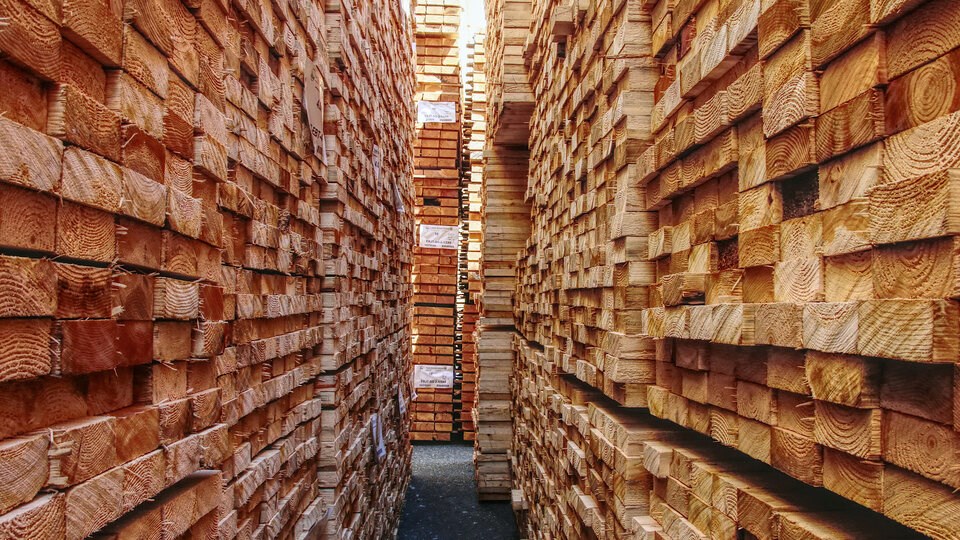
“Most people define sustainability on fibre supply. I’m not even talking about environmental stuff,” he said. “I’m just talking about producing the same amount of two-by-fours because you’re still getting the same amount of trees out there.”

Nearly 50 sawmills have closed in B.C. over the past two decades. And since 2020, another half-dozen major pulp and paper mills have curtailed operations, indefinitely closed, or shut permanently in places like Powell River, Prince George and Crofton.
Paper Excellence permanently closed the Mackenzie pulp and paper mill in 2021. And in B.C.’s latest mill closure, West Fraser Timber Co. Ltd. (TSX:WFG) announced earlier this month it would permanently shutter and lay off 165 workers at its 100 Mile House operations.
The common denominator in both closures: mills could no longer access economically viable timber.
Some experts and former officials who spoke to BIV agree the report raises questions over the root cause of those closures.
One expert with the Ministry of Forests who spoke on condition of anonymity said the way timber supply reviews are conducted in B.C. amounts to “voodoo science” and grossly overestimates harvestable wood.
“It’s a dirty secret. But if you lower that number, it’s seen as some kind of loss,” said the government expert. “We just don’t want to look ourselves in the face.”

According to Wood, the flawed assumptions and glaring omissions raised in the report show how B.C.’s complex forestry policy hides the truth from the public.
“At the very minimum, the onus now is for the ministry to respond to legitimate concerns that the cut has been set too high,” he said.
For Morris, the report shows that what is happening in Mackenzie can be applied to timber supply areas across the province, from 100 Mile House to Prince George, the Okanagan and Vancouver Island.
“When you lump everything together that’s taken place over the last number of decades now, they are merely exposing what’s been taking place, only in a scientific way,” Morris said.
“I really do believe that we need to hold a public inquiry into forestry and get to the bottom of it.”
@race2extinct.bsky.social:
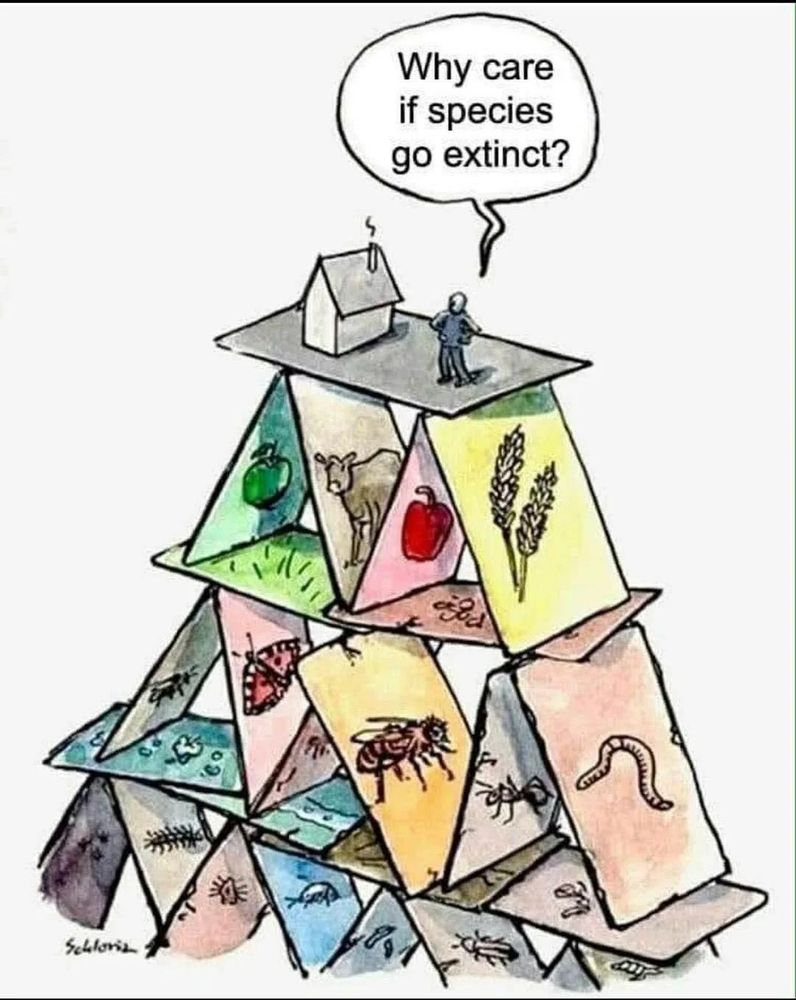
The architects of the sixth mass extinction are woefully short on honesty.
We call ourselves “rational actors” as ecosystems collapse around us.
Self-deception may be the only thing we’ve mastered at scale.