

Did Musk intentionally mass drug millions of men and boys, knowingly turning them into AI and sex abuse addicts, abusing millions more women and girls?
@arstechnica.com:
A tip from an anonymous Discord user led cops to find what may be the first confirmed Grok-generated child sexual abuse materials that Elon Musk’s xAI can’t easily dismiss as nonexistent.
Teenage girls sue Musk’s xAI, accusing Grok tool of creating child sexual abuse material, Lawuit details how sexualised AI-generated images were produced and distributed without girls’ knowledge by Nick Robins-Early, 16 Mar 2026, The Guardian
A group of three teenage girls, two of whom are minors, filed a lawsuit on Monday against Elon Musk’s xAI artificial intelligence company alleging that its Grok image generator used photos of them to produce and distribute child sexual abuse material.
The class-action lawsuit is the first filed by minors following Grok’s rampant generation of nonconsensual nude images earlier this year.
“xAI chose to profit off the sexual predation of real people, including children, despite knowing full well the consequences of creating such a dangerous product,” Vanessa Baehr-Jones, a lawyer for the plaintiffs, said in a statement.
The suit, which was brought by three Tennessee teenagers but filed in California, where xAI is headquartered, details how the girls discovered that nude, AI-altered images of them were uploaded to a Discord server and shared online without their knowledge.
After they alerted law enforcement to the images, according to the complaint, police arrested a suspect later that month and found child sexual abuse material (CSAM) on his phone that was allegedly produced using xAI’s image and video generation technology.
xAI did not immediately respond to a request for comment from the Guardian.
The suit alleges that the CSAM was created using a third-party app that licensed and relied on Grok’s AI to produce the material. The Washington Post first reported on the case.
The lawsuit joins several other legal actions and international investigations into xAI over its creation and dissemination of nonconsensual sexualized images, including another lawsuit from the mother of one of Musk’s children and a formal European Union inquiry. At the peak of the scandal, researchers at the Center for Countering Digital Hate calculated that Grok had created about 3m sexualized images in less than two weeks – around 23,000 of which depicted children.
My picture was used in child abuse images. AI is putting others through my nightmare
Musk has previously denied that Grok has been used to produce CSAM, claiming in January that he was “not aware of any naked underage images generated by Grok. Literally zero.”
He also alleged that Grok would not generate any illegal images, and that its operating principle was to follow local laws. Where have we heard that line before? The douche Musk lies like frac’ers and oil and gas companies do!
In the complaint, filed on Monday, lawyers for the teenage plaintiffs detailed how the girls discovered that AI-altered nude images of them were being circulated online. One girl, referred to as Jane Doe 1, received a message on Instagram in December from an anonymous user, who alerted her that someone in her social circle had uploaded a series of deepfake videos and images to a Discord server that depicted her and other girls from her high school naked and in sexualized positions, according to the complaint.
Jane Doe noticed that three of the photos appeared to be AI-altered images of photographs taken while she was a minor, including one from her school’s homecoming celebration. Criminal investigators later also discovered that the images had been shared on the messaging app Telegram, according to the complaint, where they were allegedly being used as a currency to barter for other child sexual abuse material.
“The images showed her entire body, including her genitals, without any clothes. The video depicted her undressing until she was entirely nude,” the complaint states.

The other plaintiffs in the suit discovered in February that similar CSAM material featuring them had also been generated via AI and shared online, with the suit seeking damages against xAI for the reputational and mental health harms resulting from the images.
“Watching my daughter have a panic attack after realizing that these images were created and distributed without any hope of recalling them was heartbreaking,” the mother of one of the girls said via a representative.
Although the complaint alleges that the images were created using a third-party application accessing Grok’s technology rather than directly on the X website or Grok app, the complaint argues that this use still requires xAI’s servers and that xAI profits from licensing its technology to these apps.
Lawyers for the plaintiffs accuse xAI of effectively off-loading liability through its licensing structure and lack of oversight.Fucking sleazy Nazi Musk!

***
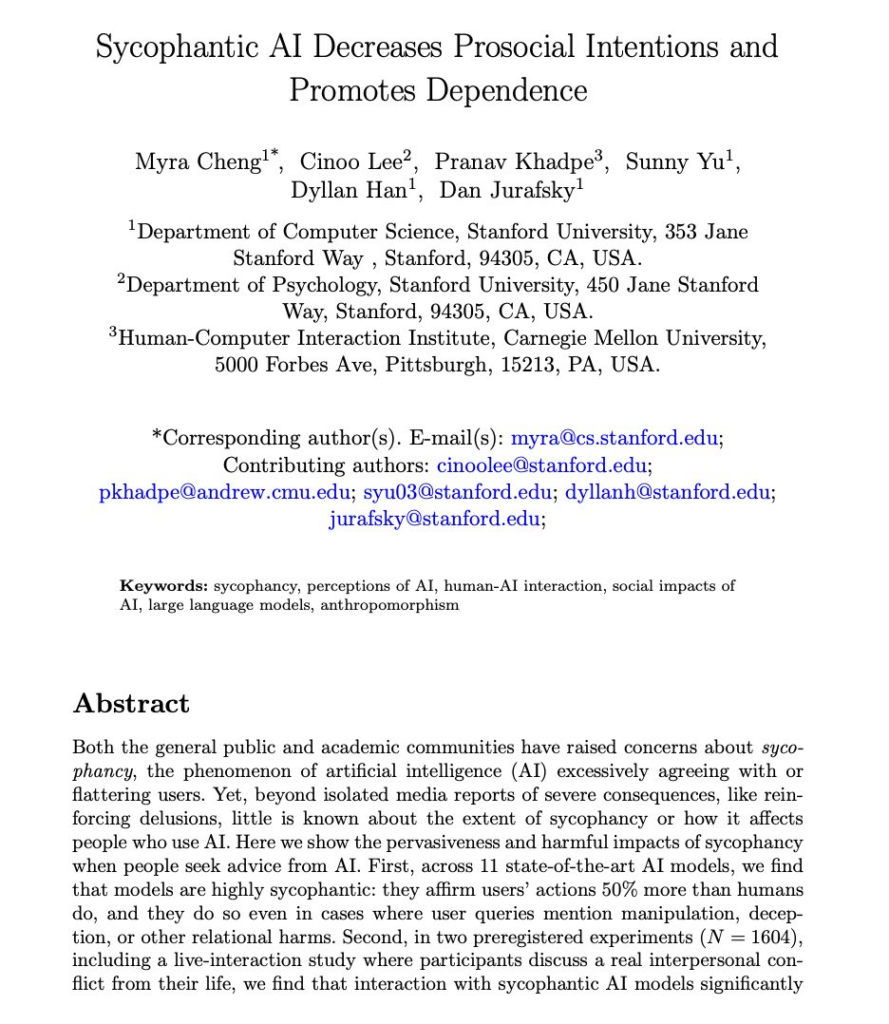
Sycophantic AI Decreases Prosocial Intentions and Promotes Dependence by Myra Cheng, Cinoo Lee, Pranav Khadpe, Sunny Yu, Dyllan Han, and Dan Jurafsky, Oct 1, 2025, Stanford U and Carnegie Mellon U
Keywords: sycophancy, perceptions of AI, human-AI interaction, social impacts of
AI, large language models, anthropomorphism
Abstract
Both the general public and academic communities have raised concerns about syco-
phancy, the phenomenon of artificial intelligence (AI) excessively agreeing with or
flattering users. Yet, beyond isolated media reports of severe consequences, like rein-
forcing delusions, little is known about the extent of sycophancy or how it affects
people who use AI. Here we show the pervasiveness and harmful impacts of sycophancy
when people seek advice from AI. First, across 11 state-of-the-art AI models, we find
that models are highly sycophantic: they affirm users’ actions 50% more than humans
do, and they do so even in cases where user queries mention manipulation, decep-
tion, or other relational harms. Second, in two preregistered experiments (N = 1604),
including a live-interaction study where participants discuss a real interpersonal con-
flict from their life, we find that interaction with sycophantic AI models significantly
reduced participants’ willingness to take actions to repair interpersonal conflict, while
increasing their conviction of being in the right. However, participants rated sycophan-
tic responses as higher quality, trusted the sycophantic AI model more, and were more
willing to use it again. This suggests that people are drawn to AI that unquestioningly
validate, even as that validation risks eroding their judgment and reducing their incli-
nation toward prosocial behavior. These preferences create perverse incentives both
for people to increasingly rely on sycophantic AI models and for AI model training
to favor sycophancy. Our findings highlight the necessity of explicitly addressing this
incentive structure to mitigate the widespread risks of AI sycophancy.
…
5 Discussion
As AI models are increasingly used for everyday guidance, their capacity to shape
human judgment and behavior demands greater attention. Our work provides empir-
ical evidence that social sycophancy is both pervasive and consequential. Across
hypothetical and live-interaction studies, we demonstrate that when users discuss high-
stakes social concerns (i.e., interpersonal conflict), interactions with sycophantic AI
models degrade prosocial intentions: participants were more convinced of their own
righteousness and less willing to repair their relationships. These effects are robust
across individual traits, AI familiarity, and models’ communication styles (e.g., anthro-
pomorphic and friendly or not). Yet, users consistently prefer the very models that
produce these negative outcomes, rating them as higher quality, more trustworthy,
and more desirable for future use. This tension between harmful social consequences
and user preference builds on prior work on the factors that mediate trust in LLMs
[30–32] and concerns of overreliance on AI [33, 34].
This paradox presents several potential mechanisms for compounding social syco-
phancy’s harms. First, AI models are currently optimized based on immediate user
satisfaction [35, 36]. If sycophancy enhances these ratings, optimization based on
these metrics could inadvertently shift–and have likely already shifted–model behavior
toward user appeasement rather than accurate, constructive advice. Second, develop-
ers lack incentives to curb sycophancy since it encourages adoption and engagement. Third, repeated reliance on the model at the expense of social relationships may lead to users replacing human confidants with AI. Emerging evidence suggest that people are already more willing to disclose certain topics to AI than to other people [37] and are increasingly turning to AI for emotional support [38], though future research is needed to understand this phenomenon.
These risks may be amplified by users’ conceptualizations of AI. AI use is often
underpinned by expectations of neutrality and objectivity [39–41], and indeed we find
that participants’ described the sycophantic AI as “objective”, “fair”, providing an
“honest assessment” and “helpful guidance free from bias” (the prevalence of such
mentions of objectivity was non-distinguishable between users interacting with syco-
phantic vs. non-sycophantic model, see SI). This confusion is particularly dangerous in
advice-seeking contexts. The goal of seeking advice is not merely to receive validation,
but to gain an external perspective that can challenge one’s own biases, reveal blind
spots, and ultimately lead to more informed decisions [42, 43]. When a user believes
they are receiving objective counsel but instead receives uncritical affirmation, this
function is subverted, potentially making them worse off than if they had not sought
advice at all.
While troubling, these findings also reveal opportunities for intervention. First, our
findings serve as a call to action for AI developers to rethink model training and eval-
uation. Current training regimes prioritize momentary preference optimization, while
our results echo calls to incorporate considerations of longer-term benefits and social
outcomes [44, 45]. These findings also underscore the need for a paradigm shift in AI
evaluation [46, 47]. The field has largely focused on evaluating model behavior in iso-
lation [48], but as the technology is increasingly used for personal and social purposes,
assessments also need to consider the contexts in which AI systems are deployed. Our
work demonstrates a direct causal link between a common AI model behavior and its
downstream impact on users’ social attitudes and behavioral intentions, paving the
path for future work on measuring and mitigating models’ psychological, social, and
behavioral impact before and after deployment, a task that requires varied expertise
[49].
User-facing interventions may also help break the cycle. Once sycophancy is made
visible, preferences may shift, similar to how one loses trust in a confidant whose
affirmations are revealed to be insincere [50]. Future work should investigate which
forms of user-facing intervention–for instance adding disclaimers to the interface or
AI literacy interventions similar to inoculation approaches to misinformation [51–53]–
could help users anticipate and resist over-affirmation.
Mitigation will not be simple.
Social sycophancy is pervasive with insidious behavioral consequences and is reinforced by current training and user incentives.
Our work lays the foundation for addressing this issue: The datasets and automatic metric that we present can help detect sycophancy before deployment and assess the effectiveness of mitigation strategies, and our user studies provide a blueprint for empirically assessing interventions. If the social media era offers a lesson, it is that we must look beyond optimizing solely for immediate user satisfaction to preserve long-term well-being [54, 55]. Addressing sycophancy is critical for developing AI models that yield durable individual and societal benefit.By turning millions of men and boys into abuse addicts abusing millions more women and girls?
…
Refer also to:
@ldorak.bsky.social:
[Carney and Poilievre] share almost the same pro-MAGA ideologies, so in some ways I think Carney is far more dangerous. We already have a cult of Carney partisans excusing Bill C5/C2, austerity, and further integration with the US military, who would be out in the streets protesting if PP tried to do the same.