@emmettmacfarlane.com:
Just because Mark Carney’s not Pierre Poilievre doesn’t mean he’s not LIKE Pierre Poilievre.
@bdmclarnon.bsky.social:
In some respects, Carney is worse, because he has a far more impressive CV, carries the ‘liberal’ brand, and is more likeable, making him much more influential and powerful.
@tinkiegurl.bsky.social:
A lot of people were duped.
@antifafrontenac.bsky.social:
I’ve barely heard a word about/from PP because he’s got nothing to say … Carney is doing everything he would have done.
@mehlerpaperny.bsky.social:
More than a decade after pledging to end long-term drinking water advisories, the feds are presiding over a ramping-up of legal acrimony in First Nations’ fight for water. And First Nations are fighting back. “It’s litigate or go home,” one lawyer told me.
How much is Canada spending to fight First Nations in court, you ask? We ATIPd the legal costs for four drinking water cases – and were told this information was secret.
@ridlr2.bsky.social:
This just sucks
Liberals are playing legal hardball with First Nations over drinking water by Anna Mehler Paperny, May 19, 2026, University of Toronto

Prime Minister Mark Carney’s Liberal government is playing legal hardball with First Nations fighting for clean drinking water — and First Nations are fighting back.
Interviews and hundreds of pages of court documents reviewed by the IJB reveal this marked shift primarily on three fronts.
In Alberta, Canada pulled the plug on settlement talks involving four nations. In Ontario, it is using a legal tactic against another that appears to contradict its own guidelines for government lawyers. And nationally, it is appealing a summary judgment that handed First Nations a victory late last year, arguing the federal court judge erred in finding Canada owes First Nations a duty of care on drinking water.
Meanwhile, some First Nations are taking the government back to court, alleging it is breaching its obligations under a separate drinking-water settlement agreement hammered out in 2021.
Another nation plans to ask a court to declare a right to clean drinking water for First Nations — something Canada has fought in court despite ministers’ declarations backing such a right.
Meanwhile, Canada is keeping the costs of these court battles a secret.
The ramped-up legal tussles come more than a decade after former prime minister Justin Trudeau pledged to end long-term drinking water advisories and as Carney tells First Nations Canada wants “stronger nation-to-nation relationships” and to build infrastructure, “including housing and water.”
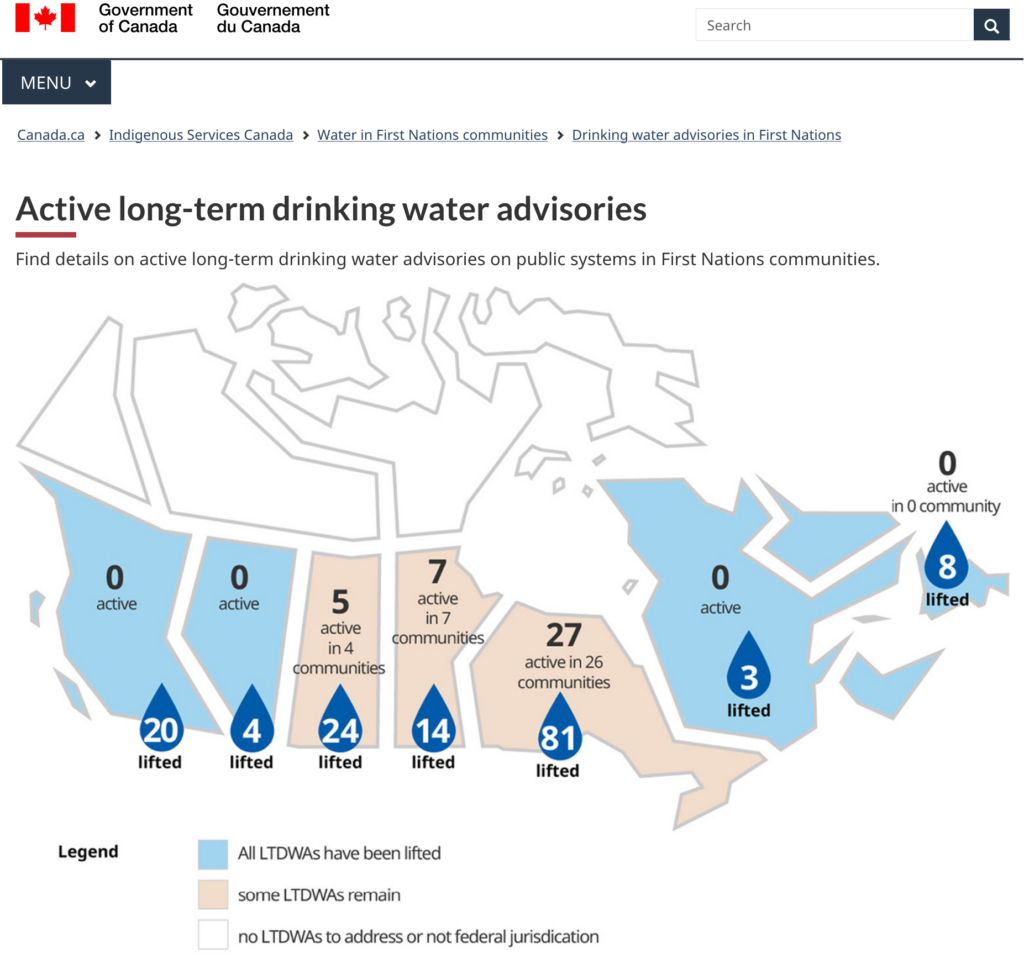
According to the federal government there were 39 long-term drinking water advisories in 37 First Nations communities as of May 6, with 154 lifted since 2015. But both last year and the year before, for the first time in a decade, more have been added than lifted — and these tallies ignore the dozens of drinking water advisories in British Columbia and Alberta.
As Canada pushes forward high-profile “nation-building” infrastructure projects, many of them on Indigenous land, some First Nations leaders have called for their own infrastructure needs to get sped-up nation-building treatment.
Legal representatives for First Nations said they are frustrated to find a government that once emphasized reconciliation abandoning attempts to reconcile. First Nations leaders who spoke with the Investigative Journalism Bureau said they are worn out by years — in some cases, generations — without water to drink, without water for firefighting, in some cases without running water at all.
Indigenous Services Minister Mandy Gull-Masty was not available for an interview. Indigenous Services Canada spokesperson Pascal Laplante would not comment on specific legal cases but said in an emailed statement: “Everyone in Canada should  MUST is the required word have access to clean drinking water. The Government of Canada respects the decision of First Nations to seek the Court’s assistance on these important issues and remains committed to working with all First Nations to advance solutions with communities to support reliable access to safe drinking water, now and over the long term.”
The nations fighting Canada in court see things differently.
‘Litigate or go home’
Carol Wildcat remembers when the water was sweet.
That was 30 years ago. Now the Ermineskin Cree Nation member and director of industrial relations, whose community is south of Edmonton, drinks bottled water and fears what bathing her great-grandchild could do to the three-year-old’s skin. What comes out of their tap smells of rotten eggs, is yellowed and cloudy and will give you stomach problems or worse.Smells like it’s contaminated with sour gas, likely from a leaking hydrocarbon well. If it’s H2S, it damages the brain even in small concentrations, which would be the gas
“You could start smelling it. You could start seeing a difference. It cooked differently,” she said. “If I’m a human, I have human rights. But we’re not sure if water is a human right.”It is in many parts of the world, but Steve Harper refused to include Canadians having water as a human right. And Mark Carney is much more to the inhumane right than Harper and much more pro polluter, pro American – American firms are the most serious polluters operating in Canada.

Indigenous Services Canada says it provided Ermineskin with $12.9 million in capital investments for water and $12.1 million in operational and maintenance funding between 2004 and 2025. Lawyer Clayton Leonard, who represents western First Nations including Ermineskin, said the operations and maintenance funding goes toward a treatment plant that serves, in often inadequate amounts, about 30 per cent of the community.
Leonard thought some of his clients were close to a deal with the federal government. They had been negotiating for the better part of nine years, seeking an out-of-court settlement to a lawsuit over four Alberta nations’ lack of clean drinking water.
Then came an August 27, 2025, letter from the government.With pro genocide racist Zionist Mark Carney in power.
“Canada does not currently have a financial mandate to negotiate settlement of this matter,” it read in part. “We have also been advised that we do not have instructions to continue with any exploratory discussions at this time. It remains uncertain when, or if, such instructions will be forthcoming.”

The news and the effective end to settlement talks was a blow to Leonard’s clients. And to his faith in the government.It is to me too.
“I can tell you, for the first time in 21 years as a lawyer, it’s gone. I have no confidence at all any more that any political party or prime minister will actually do what’s required, here.
“It’s litigate or go home. I think that’s the only thing that will force the government of Canada to ensure First Nations have access to clean drinking water.”
Laplante would not comment on individual cases.
Canada’s move hardened Leonard’s clients’ resolve, he said. He has received instruction to fight more aggressively on their behalf. While the case itself may take years, Ermineskin Cree Nation plans to request a summary judgment finding First Nations have a right to clean drinking water.
‘One of the sickest communities in Canada’
Family doctor Beverley Preater has practiced medicine from Labrador to Lebanon. She has worked on rotation in about 40 First Nations communities across Ontario and visits Pikangikum, in the province’s northwest, at least four times a year.
She is accustomed to adverse conditions that make practising medicine hard and staying healthy harder. Nowhere she has worked in Canada, she told the IJB, is as bad as Pikangikum.
“I believe that Pikangikum may be one of the sickest communities in Canada,” she wrote in a January 2025 affidavit, filed as part of Pikangikum’s legal memorandum in its lawsuit against Canada, which seeks $2 billion in damages and a declaration by the court that Canada breached its obligations owed to Pikangikum, among other things.

Pikangikum’s problems have persisted so long, the federal government argues, that Canada cannot be held responsible for them.

Pikangikum’s situation, Preater says, is getting worse. The population is growing — it’s a little over 4,100, and projected to double within 20 years — but its infrastructure is deteriorating as it ages and becomes less able to meet growing demand.
Of the community’s 521 homes, the First Nation’s lawyer Yana Sobiski said, about 320 have no water whatsoever, while about 172 have water trucked to cisterns. Those without running water haul it in buckets from a distribution point.
The federal government pays to operate and maintain a water treatment plant that provides piped water to 29 homes and trucked water to 172, although the community says the latter is unreliable and has never been enough to meet the population’s need. Indigenous Services Canada says it approved $17 million in January for short-term water and wastewater system upgrades. “We are working closely with the First Nation to address their water infrastructure needs.”Ya, right, going nowhere but insulting and abusing them.
That lack of usable, drinkable, running water means parents without flushing toilets delay toilet-training children because the trek to the outhouse with a toddler in minus-40-degree-Celsius weather is too much to bear. The inability to wash easily makes medical evacuations increasingly likely because wounds fester, infections worsen.
In any other community, a child with lice would be an unpleasant but routine ordeal, addressed with special shampoo. In Pikangikum, Preater said, it can become a pernicious infection necessitating medical evacuation.
Canada’s response appears to go against advice it has given its lawyers.
Assertions in Pikangikum’s claim “rest on events that took place many years ago,” the government argued in its May 29, 2025, statement of defence. As a result, they argued, potential damages for alleged government failures have effectively timed out.OMFG! Carney you are a fucking douche! You call yourself “christian?”
This contention appears to fly in the face of the government’s own guidance for its lawyers: A 2021 memo from then-attorney-general Jody Wilson-Raybould said that in cases that have been delayed the government should avoid using statute-of-limitations arguments to throw them out.
Former Pikangikum lawyer Jonathan Schachter’s response to the government’s legal argument was “complete frustration,” he said. (Since he spoke with the IJB, Schachter left the firm for reasons unrelated to Pikangikum’s case.)
“The wrong keeps going: The limitation period has not elapsed…You can’t bar a claim if the situation is worse than ever.”
Laplante said the 2021 directive “recognizes that litigation may be necessary in certain circumstances and sets out how it should be conducted in a manner that supports reconciliation and respects Indigenous perspectives.” Laplante did not comment on the government’s statute-of-limitations argument.
Schachter said he does not know why Canada is taking this tack but contends the decision would have been made by someone higher up. “This isn’t a mistake by a junior lawyer. Someone with decision-making power said, ‘Yes, let’s do that.’”Carney runs a one man ship, nastily, it is reported. I expect this came from him. Fitting, as he refuses to sanction genocidal Israel, and lies about Canada supplied the killers with weapons.
‘A real shift’ in Canada’s litigation posture
In addition to the Alberta and Ontario cases, Canada is appealing a courtroom victory for at least 60 First Nations fighting a class-action suit over clean drinking water.JFC!!!
In December a federal court judge found Canada owes a fiduciary duty to First Nations on this matter.
Federal spokesperson Laplante referred reporters to the government’s court filings. In January, the federal government filed documents announcing its intent to appeal that ruling, arguing the judge “erred in finding a common law duty of care,” among other objections.Carney hoping some Harper judges will serve evil?
It came as a surprise to Michael Rosenberg, a lawyer for some of the First Nations in the case.
“It’s a very disappointing message,” he said. “I think we’ve seen a real shift in the litigation posture” of the federal government on this file, he added.
Meanwhile, some First Nations are going on the offensive in the face of what they see as government stalling.
Tataskweyak Cree Nation, Curve Lake First Nation and Neskantaga First Nation are taking Canada to court alleging it has breached its obligations in relation to a previous drinking-water settlement. That settlement required the introduction of drinking-water legislation, which died when Parliament was put on hold when Trudeau stepped down in early 2025.
Canada’s failure to introduce a replacement law “is not reasonable” and the government has not fulfilled its obligations, the motion read.
Laplante said, “Canada has signalled its intention to introduce drinking water legislation this spring.”Signalling is not doing, and so far, Carney’s signally has been shit for Canadians, wonderful abundance for American corporations, many of which pollute drinking water with abandon.
Rosenberg said his clients have not seen a draft of the bill.
The IJB filed an access-to-information request for the legal costs related to four court cases on First Nations drinking water. The response came with all the costs redacted on the grounds they are subject to solicitor-client privilege.Such a bullshit excuse, which seems to give lawyers the right to abuse their clients, if they so choose.
Deborah McGregor, an associate law professor and Canada Research Chair in Indigenous Environmental Justice at York University, sees a government proclivity to litigate that brings financial and logistical burdens.
“It’s expensive and it takes a long time and so much resources go into it, including government resources, that could be going to the community to help solve the problem.”Ya, but in my view, Carney’s favourite game is genocide, so not putting any of that energy and legal costs into the community is intentional, and fucking unforgivable abusive shit.
This story was also published by the National Post