From: “Anthony R. Ingraffea” email hidden; JavaScript is required
Date: August 31, 2025 at 10:40:04 AM EDT
To: “Vitali, Greg” email hidden; JavaScript is required, “(null) yoko” email hidden; JavaScript is required, “O’Donnell, Michael” email hidden; JavaScript is required, “Comitta, Senator Carolyn” email hidden; JavaScript is required, Rebecca Franz email hidden; JavaScript is required, Anthony Martinelli email hidden; JavaScript is required, Senator Katie Muth email hidden; JavaScript is required, Don A Kessler email hidden; JavaScript is required, tpickett email hidden; JavaScript is required, gyaw email hidden; JavaScript is required
Subject:PA Environment Digest Blog: Freeport Township Declares Disaster Emergency After Residents Impacted By A Gas Related Water Contamination Event Have Been Without Permanent Water Supplies For 3 Years– We’re Not Blaming Anybody, We Just Want Good, Clean
Hi Greg
Thank you for responding as I knew you would. First, I will answer your questions directly. Then I will elaborate.
“Is the occasional contamination of a community’s water supply an inevitable consequence of fracking?” YES, BUT NOT EXACTLY
“Is there legislation/regulation that could improve the situation? ” YES
“Do Oil and Gas Program staffing shortages figure into this at all?” PROBABLY YES
“Should the DEP be more aggressive in enforcing existing laws/ regulations?” YES
Elaboration:
“Is the occasional contamination of a community’s water supply an inevitable consequence of fracking? “
Yes, but “fracking” is not usually the issue. It is inevitable that a significant percentage of gas wells drilled towards the Marcellus and Utica formations in Pennsylvania will leak because of problems with cementing, not fracking. By “leak” I mean that fluids (methane and accompanying gases and liquids) can migrate through/around/along the cement job(s) and into an USDW. Let me make that clear: it is an initial well construction problem, not fracking that causes this kind of leaking. There is a fundamental, chronic, as yet unsolvable problem with using “cement” to provide a seal against leaking in ANY WELL, gas/oil, anywhere. I was consulting on this problem in the mid ’80’s. The industry has spent hundreds of millions trying to fix the problem over the last 50 years. The problem will always exist when cement as used as a sealant.
I’ll try to make this understandable to everyone. Cement is injected as a liquid into the annuli (the spaces between the casings and the rock wall) of a well under construction. To provide the intended seal, it must chemically transition into a solid. That transition takes an hour or so. During the transition, if there are fluids present around the wellbore at pressures higher than the pressure of the column of liquid cement, those fluids can invade the not-yet-hardened cement and do their dirty work, essentially destroying the cement job. Unfortunately, there are sources of such high pressure fluids in formations above the Marcellus in PA. There are PADEP regulations requiring operators to be diligent about that transition: use specially formulated cement that inhibits (but CANNOT PROHIBIT) fluid invasion. Such cements can cost much more than “regular” cement, and different suppliers offer competing formulations that sometimes work better than others in specific instances, sometimes they do not. Bottom line, as I mentioned in a previous email: it’s a crap shoot.
Hence, the “occasional” contamination.
But, “occasional” is too dismissive a word. As Vicki noted: who’s counting? Since 2008, the PADEP has issued 444 (as of 7/25. https://files.dep.state.pa.us/oilgas/bogm/bogmportalfiles/oilgasreports/determination_letters/regional_determination_letters.pdf) water supply determination letters to landowners confirming that a contamination incident has occurred as a result of gas development. It is not possible to discern from the letters (but the PADEP knows) the exact nature of each incident. An unknown number of these is because of a leaky well as described here. Others are because of surface spills, others because of “frac hits” like that involved in the Freeport Township Disaster ( a situation where “fracking” itself was a cause), others are caused by temporary disturbance of the aquifer. Again, as Vicki noted, whose counting with so much secrecy? How many is too many when there WILL BE MANY MORE during the next decades as the Marcellus and Utica are played out? How many cases are unknown because of NDA’s?
Folks are being sickened, home life destroyed, home values ruined and nobody in power has ever really done anything to ameliorate these harms in any significant way. And, it’s much worse in Alberta
| Water Supply Determination Letters – files.dep.state.pa.usWater Supply Determination Letters The following list identifies cases where DEP determined that a private water supply was impacted by oil and gas activities. The oil and gas activities referenced in the list below include operations associated with both conventional and unconventional drilling activities that either resulted in a water diminution event or an increase in constituents above …files.dep.state.pa.us |
“Is there legislation/regulation that could improve the situation?”
Improving the situation cannot involve the rules of physics and chemistry. The Commonwealth permits drilling and fracking so what happens happens as it has for the last 50 years according to natural laws: cement jobs will fail, wells will leak. Improving the situation MUST involve human laws/regulations. Ask an affected landowner what improvement might mean. You will likely hear this: “I signed a lease. I’ve made money on it. I am not against gas development. I just want my clean water back. ” Or, “I never signed a lease. I’ve had nothing but losses. I just want my clean water back.” But in many cases (how many??????) it is never coming back to the way it was because of natural laws of hydraulics and chemistry. It will never come back in Dimock, Acre Lake, Lenox, Springville, Hunter Road, Freeport Township and many others (how many?????). And forever buffalos do NOT COUNT as getting water back. So, in my opinion:
— there should be a law that requires complete, public, information about every contamination incident, no matter the cause. Start counting, establish a scientific database. Let in the sunshine.
— there should be unquestioned enforcement of the presumption clause in the existing regs. It should never be incumbent on a landowner to have to hire a lawyer, pay legal costs, and wait seemingly forever to fight the operator for what the law already affords the landowner. Operators spend MILLIONS in legal fees to deflect blame, run out the clock, prolong the myth that “our wells never leak”, and TORTURE the landowners. YES, THAT HAPPENS and it is happening now in Dimock. There is a better, fairer, more humane use of thoise millions.
— there should be an automatic process within which aggrieved landowners, as confirmed by PADEP studies, are offered a multiple (3x, 4x, 5x?) of the value of there contaminated property to be paid by the operator within 1 month of receipt of a letter of determination. That is fair improvement on the situation.
“Do Oil and Gas Program staffing shortages figure into this at all?”
I think yes because the number of wells keeps rising, the problems keep accumulating, operators are under cost pressures and are drilling ever longer wells, and the PADEP staffing budget has not kept pace. Example with which I am very familiar is the PADEP’s well Mechanical Integrity Program. My study of that program found that only about 47% of all the wells in PA that were required to report yearly integrity assessments actually did so. And there was insufficient oversight of the program because of staff shortages. (Reported Methane Emissions from Active Oil and Gas Wells in Pennsylvania, 2014−2018
Anthony R. Ingraffea,* Paul A. Wawrzynek, Renee Santoro, and Martin Wells, https://dx.doi.org/10.1021/acs.est.0c00863
Reported Methane Emissions from Active Oil and Gas Wells in Pennsylvania, 2014–2018
Oil/gas well integrity failures are a common but poorly constrained source of methane emissions to the atmosphere. As of 2014, Pennsylvania requires gas and oil well operators to report gas losses, both fugitive and process, from all active and unplugged abandoned gas and oil wells. We analyze 589,175 operator reports and find that lower-bound reported annual methane emissions averaged 22.1 Gg (−16.9, +19.5) between 2014 and 2018 from 62,483 wells, an average of only 47% of the statewide well inventory for those years. Extrapolating to the 2019 oil and gas well inventory yields well average emissions of 55.6 Gg CH4. These emissions are not currently included in the state’s oil and gas emission inventory. We also assess compliance in reporting among operators and note anomalies in reporting and apparent workarounds to reduce reported emissions. Suggestions for improving the accuracy and reliability in reporting and reducing emissions are offered. dx.doi.org
Better to let Michael O’Donnell on this stream tell us his insights into this issue.
“Should the DEP be more aggressive in enforcing existing laws/ regulations?”
What was one of the purposes of the grand jury investigation initiated by then AG Shapiro over 5 years ago? It was to determine whether the PADEP was doing the job that citizens expect without mollycoddling to the industry (https://www.attorneygeneral.gov/wp-content/uploads/2020/06/FINAL-fracking-report-w.responses-with-page-number-V2.pdf)
| Report 1 of the Forty-Third Statewide Investigating Grand Jury Response of Michael Krancer ………………………………………………………………..224 Response of Scott Perry …www.attorneygeneral.gov |
The grand jury issued a comprehensive report on its findings. Pages 48–67 say what still needs saying. The grand jury found instances of:
Failure to regulate. page 49
Failure to train, page 53
Failure to communicate, page 54
Failure to test, page 55
Failure to inspect, page 58
Revolving door, page 59
Failure to notify, page 60
Failure to issue violations, page 62
Failure to refer. page 64
Failure to listen, page 65
What actions have been taken to date to address these failures? Does anybody know, care?
In summary, everyone –operators, PADEP, the politicians–must just acknowledge the reality of the consequences of large scale gas development in PA, and enforce new laws/regs that treat openly and fairly those citizens who suffer unfixable harm to their property and health.
I hope these comments are responsive to your questions, Greg. I hope you and others of like mind can cause long-overdue actions in defense and support of its citizens to be taken by the Commonwealth.
Best regards,
Tony
A. R. Ingraffea, Ph.D., P.E., Dist. Member ASCE
Dwight C. Baum Professor of Engineering Emeritus and Weiss Presidential Teaching Fellow at Cornell University
607-351-0043
As a concerned scientist/engineer, I engage beyond the academy to further inform and educate the public on critical scientific issues that involve public health and safety, and am also Founding and Past President and now Senior Fellow at:
PSE Healthy Energy, Inc.
From: Vitali, Greg <email hidden; JavaScript is required>
Sent: Friday, August 29, 2025 8:36 AM
To: (null) yoko <email hidden; JavaScript is required>; O’Donnell, Michael <email hidden; JavaScript is required>; Comitta, Senator Carolyn <email hidden; JavaScript is required>; Rebecca Franz <email hidden; JavaScript is required>; Anthony Martinelli <email hidden; JavaScript is required>; Senator Katie Muth <email hidden; JavaScript is required>; Anthony R. Ingraffea <email hidden; JavaScript is required>; Don A Kessler <email hidden; JavaScript is required>; tpickett <email hidden; JavaScript is required>; gyaw <email hidden; JavaScript is required>
Subject: RE: PA Environment Digest Blog: Freeport Township Declares Disaster Emergency After Residents Impacted By A Gas Related Water Contamination Event Have Been Without Permanent Water Supplies For 3 Years– We’re Not Blaming Anybody, We Just Want Good, Clean
Ok. So, what’s the answer here?
Is the occasional contamination of a community’s water supply an inevitable consequence of fracking?
Is there legislation/regulation that could improve the situation?
Do Oil and Gas Program staffing shortages figure into this at all?
Should the DEP be more aggressive in enforcing existing laws/ regulations?
Greg
—–Original Message—–
From: (null) yoko <email hidden; JavaScript is required>
Sent: Thursday, August 28, 2025 11:18 PM
To: O’Donnell, Michael <email hidden; JavaScript is required>; Vitali, Greg <email hidden; JavaScript is required>; Comitta, Senator Carolyn <email hidden; JavaScript is required>; Rebecca Franz <email hidden; JavaScript is required>; Anthony Martinelli <email hidden; JavaScript is required>; Senator Katie Muth <email hidden; JavaScript is required>; Anthony R. Ingraffea <email hidden; JavaScript is required>; Don A Kessler <email hidden; JavaScript is required>; tpickett <email hidden; JavaScript is required>; gyaw <email hidden; JavaScript is required>
Subject: PA Environment Digest Blog: Freeport Township Declares Disaster Emergency After Residents Impacted By A Gas Related Water Contamination Event Have Been Without Permanent Water Supplies For 3 Years– We’re Not Blaming Anybody, We Just Want Good, Clean D…
http://paenvironmentdaily.blogspot.com/2025/08/freeport-township-declares-disaster.html__;!!DXfqi9lE!Pe-xGdfAMZuBVt3XmLW8M9KURMoIAamRJxD-qlI6_Yz-TSfua0QuiREDAu6orAyr3HbfS0JH6YjV$
Is there a number? Dimock, Lenox, Acre Lake, and many more. Anyone counting???
Refer also to:
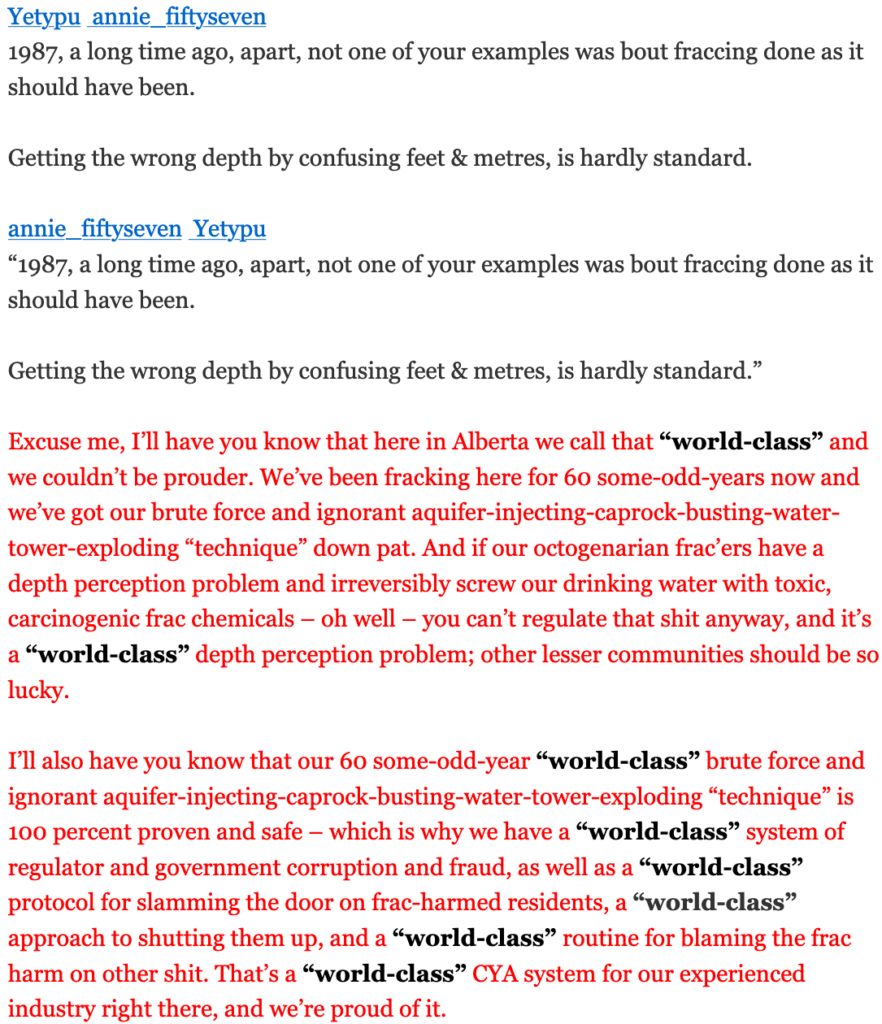
Snap from the comments section of Aug 8, 2019 Nikiforuk article in The Tyee.
annie_fiftyseven brilliantly sums up how the oil patch is regulated in Alberta