
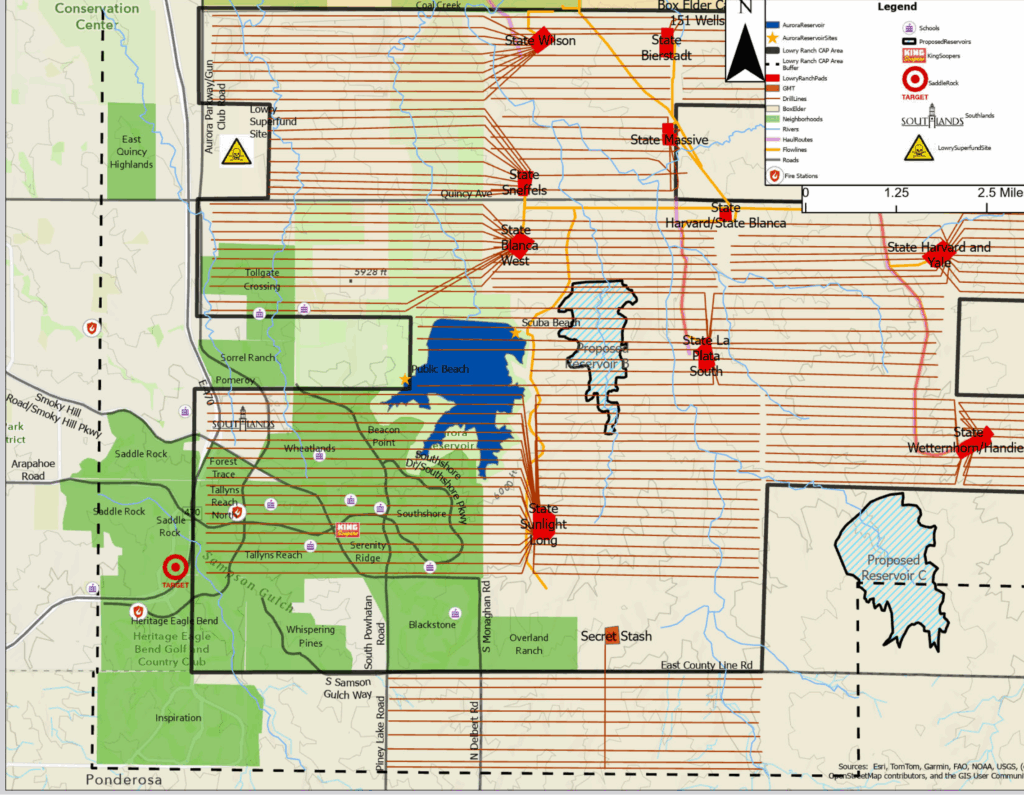
Satanic stupidity: The red lines are horizontal drill lines, the large dark blue is the Aurora Reservoir, the green is residential
Community members gear up to oppose fracking near Aurora Reservoir at upcoming public meeting by Michael Abeyta, CBS News, Sep 7, 2025
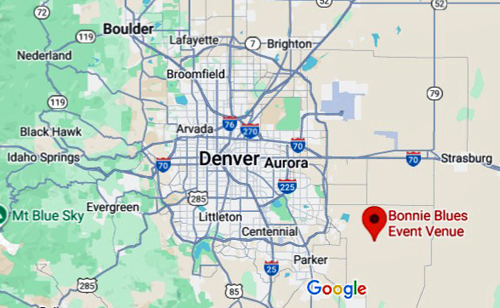
The hearing will be on Thursday, Sept. 11, at 5 p.m. inside the Bonnie Blues Event Venue in Elizabeth, Colorado.
A public meeting will be held this week to get public input about a controversial fracking well that oil and gas company Civitas wants to build near the Aurora Reservoir, and neighbors are once again getting the chance to say their piece. “This is the biggie,” said Randy Willard, with Save The Aurora Reservoir, a community group opposed to the project.
“Protect the Aurora Reservoir and its surrounding communities from the current proposal to drill 160+ wells on land shared by the reservoir and the Lowry Landfill Superfund Site.”
Red lines are drill lines
Large Dark Blue = Aurora Reservoir
It’s the public hearing for the Sunlight-Long fracking well, set to be built near the reservoir and the homes surrounding it. “This is a 35-acre well pad with 32 wells. We believe it’s the largest in the state. It’s certainly the largest in the state that would be considered to be residential fracking,” Willard said.
Willard and Save the Aurora Reservoir are skeptical. “It’s 3,200 feet from homes, 3,000 feet from the Aurora Reservoir, which is drinking water for 400,000 people,” he said.
“If we have an incident like happened earlier this year in Galeton, where a well sprayed for four days, 80,000 gallons of benzene and other crap as much as eight miles away– if anything like that happens, we have a physician in the group that calculated that if five gallons of benzene hits the reservoir, all the water is gone: 13 billion gallons, poof!” I think it would take much less benzene to destroy that water.
Weld County oil well blowout exposed people miles away to high levels of benzene, researchers say, The chemical plume from Chevron’s Bishop pad in tiny Galeton flowed for almost five days in April before the well was secured and sealed by Mark Jaffe, May 12, 2025, The Colorado Sun

The oil well blowout last month in rural Galeton, which sparked the evacuation of nearby homes, spewed dangerous levels of toxic chemicals as far as 2 miles away, according to preliminary tests by a Colorado State University team.
Benzene, a known carcinogen and respiratory irritant, was found in concentrations 10 times above federal standard for chronic exposure, and was among dozens of chemicals detected.
“People were potentially exposed to a chemical soup,” said Emily Fischer, a CSU professor of atmospheric science.
The uncontrolled blowout of the Chevron Bishop well in Galeton, a community of 256 about 7 miles northeast of Greeley, began the evening of April 6, sending a white geyser of water, crude oil and gas high into the air.
It was almost five days before the well was secured and sealed. The failure of wellhead equipment caused the blowout and it was not related to either drilling or fracking the well, Chevron said in its preliminary assessment.It’s all the same fucking toxic abusive circus. No drilling, then no frac’ing, then no blowout.
“We know the when,” said Kristen Kemp, a spokesperson for the Colorado Energy and Carbon Management Commission, which oversees oil and gas drilling. “And we know the what: an uncontrolled release of wellbore fluid due to a failed barrier. … We are still investigating the why.”I bet the why is good old greed and stupidity
Chevron, CDPHE report lower emissions levels
The ECMC is overseeing the investigation and the remediation of the site, but deferred to state air regulators on emissions.
Both Chevron and the Colorado Department of Public Health and Environment have been conducting air quality tests and have not detected levels as high as those measured by the CSU team.Of course not! I bet they only sample when the wind is blowing the right way to dilute the poisons being sampled. Companies and the dirty enabling regulators do same in Canada
CSU reported its initial findings to CDPHE, but the department said its Air Pollution Control Division had not yet received or reviewed the university’s full air monitoring data.
The difference in readings comes from a difference in the way researchers did their sampling.
CSU’s data show higher levels because researchers followed the pollution plume streaming from the well.
Emissions from a point source — like a smokestack — move on the wind, forming a band that becomes more diluted as it travels farther from the source and is less dense at its edges than in its center.
2024: Consultants hired by Chevron, other large producers falsified oil and gas data, Colorado regulators say
Using a mobile air lab in a Chevy Tahoe, CSU graduate student Lena Low and Matthew Davis, a postdoctoral researcher, tracked the plume while the geyser from the well was at full force.
On the evening of April 8, Low tracked the plume taking samples at about 1 mile downwind from the well, with the highest reading 35.5 parts per billion of benzene at the plume’s edge — that yielded a calculation of about 100 ppb at the center.
Low used a canister to grab a sample of the air for laboratory analysis.
There was no question of heading into the plume. Even at the edge, “it smelled horrible and felt hot,” Low said. “It was very unpleasant.”
At 2 miles, just using the instruments in the Tahoe, the methane level was about 20 ppm.
The federal Agency of Toxic Substances and Disease Registry sets the long-term exposure level at no more than 9 ppb. Colorado’s health guideline value is the same.
Davis sampled the area midday April 8 and recorded levels of 22 ppb of benzene a mile away and 5.4 ppb 2 miles away.
Fourteen families within a half-mile of the wells voluntarily evacuated with Chevron providing help with living and housing expenses.
Most of the houses are now wrapped in plastic and being decontaminated. “The whole area looks like Chernobyl,” Carol Hawkins, a Weld County activist opposing drilling, said after driving through the area from her home in Ault.
Monitoring at Galeton Elementary will continue “for the next few years”
The emissions readings are dependent on meteorological and atmospheric conditions, CSU’s Fischer said. For example, multiple measurements were taken at the Galeton Elementary School, which is next to the well site, but was upwind and all those readings were comparable to the ambient background level of 2 ppb. The school had been closed from April 11 to April 22.
But during the early morning, when the air cools and becomes more dense, the benzene likely became more concentrated leading to even high emission levels.CDPHE sent its Mobile Optical Oil and Gas Sensor of Emissions air monitoring van, known as MOOSE, to the area after the incident soon after the well failure and stayed through April 11. The MOOSE recorded maximum levels of 9 ppb to 10 ppb of benzene about 2 miles downwind of the incident location on two different deployments.
On April 11, CDPHE also placed a stationary monitor at the school and said it will continue monitoring until the school year ends May 23. CDPHE said it has not observed any measurement above the state’s health guideline value for benzene since beginning measurements at the school.
“Chevron has multiple air monitors in and around our locations. The night of the Bishop well incident, our on-going air monitoring was in place,” the company said in a statement.
Chevron conducted air monitoring and collected approximately 3,000 measurements that were analyzed by independent laboratories.
“Air monitoring continues in and around the area surrounding the site and the community, and all measurements that we have received from the laboratories have been below levels of concern,” the company said.

Monitoring at the school will continue for the “next few years” according to a note to parents from Kim Hielscher, the school’s principal, and Jay Tapia, the district superintendent.
Measurements of exposure to emissions can be elusive, said Andrew Klooster, who as the Colorado field advocate for the environmental group Earthworks uses an infrared camera to document emissions violations.
“Chevron probably had air monitors at the edge of its site but this pollution plume flew right over them,” Klooster said. “What happened in Galeton is rare. This isn’t something we routinely encounter.”
“It is a cautionary tale for even with Chevron having all these best management practices in place it happened,” he said.

“Galeton is rural. What if it happens in proximity of homes and growing communities as we see on the Front Range?”
Refer also to:
2013: FrackingCanada The Science is Deafening: Industry’s Gas Migration