
Prof. Stefan Rahmstorf @rahmstorf Aug 28, 2025:
The Guardian on our study published today:

On 19 August protesters in London demanded that politicians and media take the AMOC risk seriously and finally take action, calling it a ticking time bomb.
In 10 or 20 years it may well be too late – questions will be asked of those who ignore it today.
@TTTMediaXR:
Most crops in the British Isles? Gone.
A colder, drier climate devastating our food system.
UK arable land set to crash from 32% to just 7%.
Haven’t heard much about this? That’s why these people turned up in London today with their AMOC bomb.

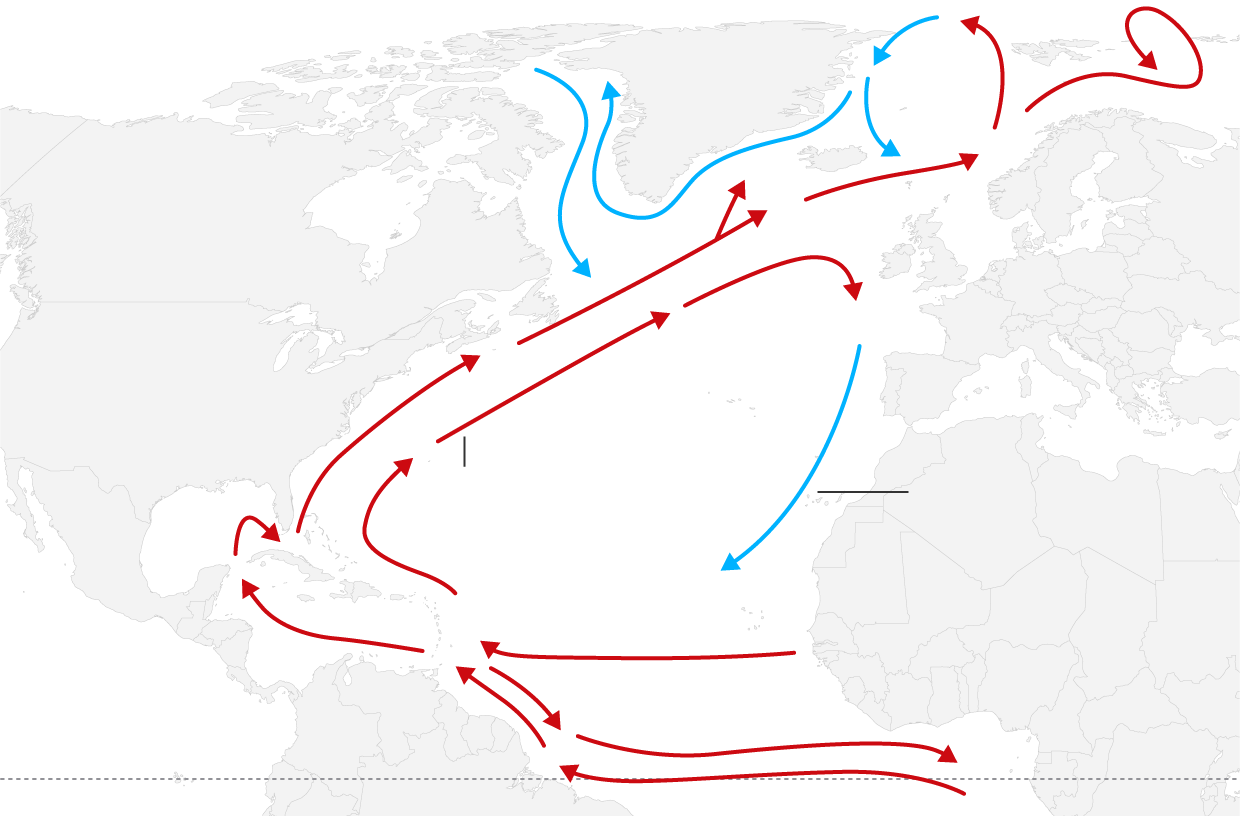
AMOC = Atlantic Meridional Overturning Circulation. A system of ocean currents that acts like a giant conveyor belt, moving warm water from the tropics to the North Atlantic. It’s slowing down and could collapse, with dire implications for the UK….
@MarkRid31548165:
Thats a real bucket of freezing water in the face wakeup call…….for the civilized world.
Current admin Russia & the USA wont give a rats arse. And many citizens won’t give a shit either, many just care about their next meal, sex and more sex, bigger and more trucks, toys and houses, more holidays overseas, and more and more and more money. And the many humans starving do not have the energy or ability to do anything, but they are not big polluters.
@race2extinct.bsky.social:
Scientists shocked. Humans shrug. Collapse ahead.
Collapse of critical Atlantic current is no longer low-likelihood, study finds, Scientists say ‘shocking’ discovery shows rapid cuts in carbon emissions are needed to avoid catastrophic fallout by Damian Carrington, 28 Aug 2025, The Guardian
The collapse of a critical Atlantic current can no longer be considered a low-likelihood event, a study has concluded, making deep cuts to fossil fuel emissions even more urgent to avoid the catastrophic impact.
The Atlantic meridional overturning circulation (Amoc) is a major part of the global climate system. It brings sun-warmed tropical water to Europe and the Arctic, where it cools and sinks to form a deep return current.
The Amoc was already known to be at its weakest in 1,600 years as a result of the climate crisis.
Climate models recently indicated that a collapse before 2100 was unlikely but the new analysis examined models that were run for longer, to 2300 and 2500. These show the tipping point that makes an Amoc shutdown inevitable is likely to be passed within a few decades, but that the collapse itself may not happen until 50 to 100 years later.
The research found that if carbon emissions continued to rise, 70% of the model runs led to collapse, while an intermediate level of emissions resulted in collapse in 37% of the models. Even in the case of low future emissions, an Amoc shutdown happened in 25% of the models.
Scientists have warned previously that Amoc collapse must be avoided “at all costs”.
It would shift the tropical rainfall belt on which many millions of people rely to grow their food, plunge western Europe into extreme cold winters and summer droughts, and add 50cm to already rising sea levels.
The new results are “quite shocking, because I used to say that the chance of Amoc collapsing as a result of global warming was less than 10%”, said Prof Stefan Rahmstorf, at the Potsdam Institute for Climate Impact Research in Germany, who was part of the study team. “Now even in a low-emission scenario, sticking to the Paris agreement, it looks like it may be more like 25%.
“These numbers are not very certain, but we are talking about a matter of risk assessment where even a 10% chance of an Amoc collapse would be far too high. We found that the tipping point where the shutdown becomes inevitable is probably in the next 10 to 20 years or so. That is quite a shocking finding as well and why we have to act really fast in cutting down emissions.”
Scientists spotted warning signs of a tipping point in 2021 and know that the Amoc has collapsed in the Earth’s past. “Observations in the deep [far North Atlantic] already show a downward trend over the past five to 10 years, consistent with the models’ projections,” said Prof Sybren Drijfhout, at the Royal Netherlands Meteorological Institute, who was also part of the team.
“Even in some intermediate and low-emission scenarios, the Amoc slows drastically by 2100 and completely shuts off thereafter. That shows the shutdown risk is more serious than many people realise.”
The study, published in the journal Environmental Research Letters, analysed the standard models used by the Intergovernmental Panel on Climate Change (IPCC). The scientists were particularly concerned to find that in many models the tipping point is reached in the next decade or two, after which the shutdown of the Amoc becomes inevitable owing to a self-amplifying feedback.
Air temperatures are rising rapidly in the Arctic because of the climate crisis, meaning the ocean cools more slowly there. Warmer water is less dense and therefore sinks into the depths more slowly. This slowing allows more rainfall to accumulate in the salty surface waters, also making it less dense, and further slowing the sinking, forming the feedback loop. Another new study, using a different approach, also found the tipping point is probably going to be reached around the middle of this century.
Only some of the IPCC models have been run beyond 2100, so the researchers also looked to see which of those running to the end of this century showed Amoc was already in terminal decline. This produced the 70%, 37% and 25% figures. The scientists concluded: “Such numbers no longer comply with the low-likelihood-high-impact event that is used to discuss an abrupt Amoc collapse in [the IPCC’s last report].”
Rahmstorf said the true figures could be even worse, because the models did not include the torrent of meltwater from the Greenland ice cap that is also freshening the ocean waters.
Dr Aixue Hu at the Global Climate Dynamics Laboratory in Colorado, US, who was not part of the study team, said the results were important. “But it is still very uncertain when Amoc collapse will happen or when the Amoc tipping point is going to crossed because of the lack of direct observations [of the ocean] and the varying results from the models.”
The study that found that a total collapse of the Amoc was unlikely this century was led by Dr Jonathan Baker at the Met Office Hadley Centre in the UK. “This new study highlights that the risk rises after 2100,” he said. “[But] these percentages should be treated with caution – the sample size is small, so more simulations [beyond 2100] are needed to better quantify the risk.”
Nonetheless, Baker said, “the ocean is already changing, and projected shifts in North Atlantic convection are a real concern. Even if a collapse is unlikely, a major weakening is expected, and that alone could have serious impacts on Europe’s climate in the decades to come. But the future of the Atlantic circulation is still in our hands.”
Shutdown of northern Atlantic overturning after 2100 following deep mixing collapse in CMIP6 projections by Sybren Drijfhout*, Joran R Angevaare, Jennifer Mecking, René M van Westen and Stefan Rahmstorf, 28 August 2025, IOP Publishing Ltd
Environmental Research Letters, Volume 20, Number 9
Citation Sybren Drijfhout et al 2025 Environ. Res. Lett. 20 094062DOI 10.1088/1748-9326/adfa3b
4628 Total downloads
Abstract
Several, more recent global warming projections in the coupled model intercomparison project 6 contain extensions beyond year 2100–2300/2500. The Atlantic meridional overturning circulation (AMOC) in these projections shows transitions to extremely weak overturning below the surface mixed layer (<6 Sv; 1 Sv = 106 m3 s−1) in all models forced by a high-emission (SSP585) scenario and sometimes also forced by an intermediate- (SSP245) and low-emission (SSP126) scenario. These extremely weak overturning states are characterised by a shallow maximum overturning at depths less than 200 m and a shutdown of the circulation associated with North Atlantic deep water formation. Northward Atlantic heat transport at 26°N decreases to 20%–40% of the current observed value. Heat release to the atmosphere north of 45°N weakens to less than 20% of its present-day value and in some models completely vanishes, leading to strong cooling in the subpolar North Atlantic and Northwest Europe. In all cases, these transitions to a weak and shallow AMOC are preceded by a mid-21st century collapse of maximum mixed-layer depth in Labrador, Irminger and Nordic Seas. The convection collapse is mainly caused by surface freshening from a decrease in northward salt advection due to the weakening AMOC but is likely initiated by surface warming. Maximum mixed-layer depths in the observations are still dominated by internal variability but notably feature downward trends over the last 5–10 years in all deep mixing regions for all data products analysed. This could be merely variability but is also consistent with the model-predicted decline of deep mixing.
…
4. Discussion and conclusions
Of particular concern is our finding that deep convection in many models stops in the next decade or two, and that this is a tipping point which pushes the northern AMOC into a terminal decline from which it will take centuries to recover, if at all. As a result, CMIP6 models point to a significantly higher risk than previously assumed for the AMOC to evolve to a state in which the northern AMOC has vanished [1, 48]. Although the whole AMOC does not completely shut down to 0 Sv, consistent with the evolution of CMIP6 models forced under extreme climate change [49], the heat transport in these states is greatly reduced and the ocean’s net heat release north of 45°N (green curves) essentially disappears (figure 9). This can cause major surface cooling, unless it is more than compensated by greenhouse-gas induced global warming under high emissions.
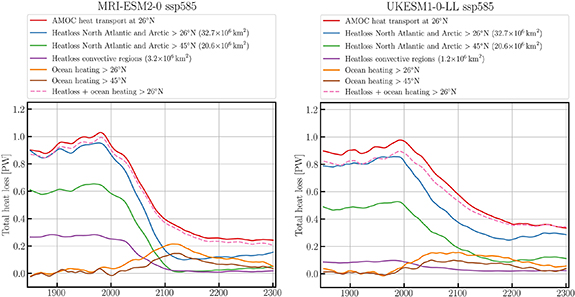
Figure 9. Atlantic Ocean heat transport at 26°N (red curve) with net ocean heat loss (sum of up minus downwelling long- and shortwave radiation and sensible and latent heat fluxes) to the atmosphere north of 26°N (blue curve) and ocean heat storage north of 26°N (orange curve). The sum of those two is given by the stippled red curve and the difference between the straight and stippled red curves is due to Bering Strait heat transport, horizontal diffusion across 26°N, possible eddy-induced heat transport across 26°N and sea-ice melt north of 26°N. The green curve shows net ocean heat loss to the atmosphere north of 45°N where Europe is warmed by the AMOC; the brown curve shows ocean heat storage north of 45°N and the purple curve net ocean heat loss to the atmosphere from the convective areas in the model. Left panel for MRI and right panel for UKESM, both for the SSP585 simulations.
Download figure: Standard image High-resolution image
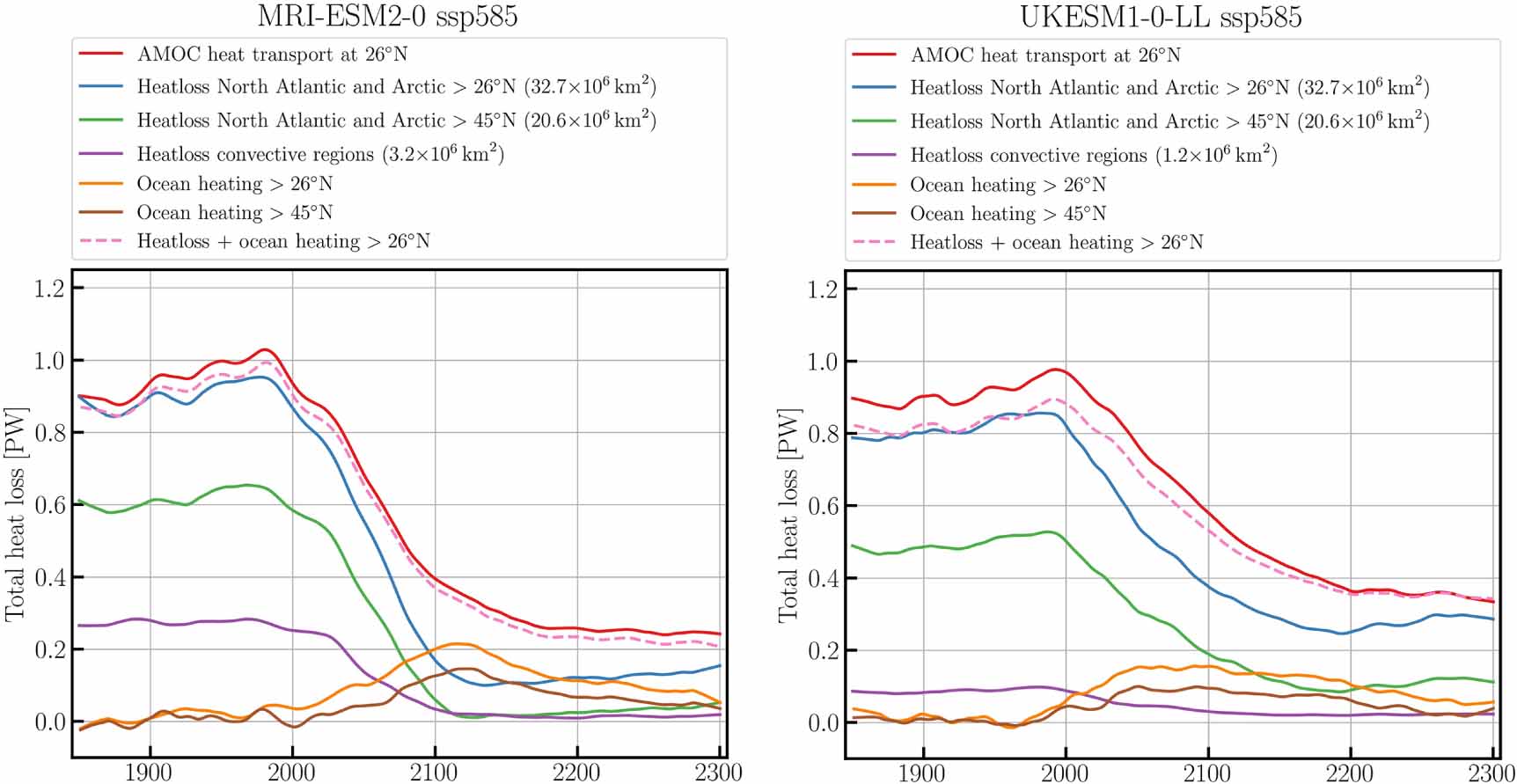
Previously, a threshold of 5 Sv for the AMOC at 45°N after applying freshwater hosing [24] was suggested to characterise an AMOC that remains in a weak state and does not recover. Our thresholds of 6 Sv at the depth of its 20th century maximum at 26°N, together with a 2.5 Sv threshold for net northward transport below the mixed-layer are consistent with aforementioned threshold. Below these thresholds the shallow residual AMOC no longer possesses adiabatic pathways between the SPG and the Southern Ocean and becomes strongly diffusive [50, 51], largely determined by the patterns of wind forcing. This is further corroborated by figure 9 showing the lack of oceanic heat release to the atmosphere north of 45°N after a northern AMOC shutdown.
All AMOC projections shown in figure 1 evolve to a state without NADW cell using the 6 Sv and 2.5 Sv thresholds. But when the forcing increases slowly, the northern AMOC shutdown evolves over 50–100 years [2, 11, 45, 52]. This 50–100 year timescale for a northern AMOC shutdown has important consequences. First, when projections ending in year 2100 do not show such northern AMOC shutdown this does not imply that the northern AMOC is not in the process of vanishing in those simulations, but simply that the length of the simulation was too short to show whether models are en route to a northern AMOC shutdown or not. This is also the reason why only when analysing extended simulations, the northern AMOC shutdown becomes apparent. Second, this also means that the term ‘abrupt’ is not applicable to a northern AMOC shutdown triggered by realistic forcing scenarios of global warming and/or Greenland meltwater added. An abrupt collapse only occurs after massive amounts of freshwater hosing applied in idealised studies, e.g [2, 3].
It should be noted that the models still contain several limitations, including the neglect of increasing meltwater from Greenland, the effect of which was recently underscored [14]. Its effect was also studied in a special AMOCMIP [52] model intercomparison. Under a strong emission scenario half of the models transitioned to a northern AMOC shutdown after 2100. Under a medium emission scenario none of the models showed such transition. By comparing runs with and without Greenland meltwater forcing it was concluded that meltwater forcing did enhance the weakening of the AMOC but was of secondary importance compared to other effects of global warming. These results reinforce the increased likelihood of a northern AMOC shutdown that we found, where such states without an NADW cell are now also found in models forced by intermediate- and low-emission scenarios.
In addition, climate models also contain various biases affecting AMOC stability and AMOC evolution in their projections. Mixed layers are often too deep [20], compare e.g. figures 5 and 6, but the convection collapse in the projections seems not related to the simulated mixed layer depths in historical runs. Overflow waters mix too much with overlying light water and contain incorrect water mass characteristics [53]. Much of the water mass transformation feeding into the AMOC occurs within or near boundary currents that are not well resolved [54, 55]. Also, eddies are important for exchanging water between the convective interior and boundary currents. However, because eddies re-stratify the water column [56], for the current non-ocean-eddy-resolving climate models this implies the absence of a positive feedback on a freshwater-forced convection collapse. The same models also underestimate shorter term AMOC-variability compared to observations [57] and this extends to ocean-atmosphere coupling and the North Atlantic Oscillation [58, 59], and the simulation of the cold SSTs in the North Atlantic SPG [60]. Furthermore, many models possess a salinity bias leading to a too stable AMOC [12]. Recent eddy-resolving model experiments suggest a larger impact of Greenland meltwater when eddies are present [61, 62] and an eddy-permitting model was able to maintain a stable northern AMOC shutdown for 450 years [63], and recently a northern AMOC shutdown was also found in a strongly eddying global ocean-only model [5]. On the other hand, the models appear too sensitive to aerosol forcing [64] and this could lead to the modelled AMOC being too sensitive to future emission scenarios that contain large aerosol removal. This may also explain part of the discrepancy between modelled AMOC evolution over the historical period and reconstructions [1]. By and large, we cannot be certain whether CMIP6 model biases would under- or overestimate the risk of a northern AMOC shutdown.
As far as current models suggest, we conclude that the risk of a northern AMOC shutdown is greater than previously thought [1, 48], at least when concerning the recent CMIP6 model ensemble. A larger sensitivity of CMIP6 than CMIP5 models concerning the AMOC response to global warming was also inferred from a previous heat transport analysis, even when corrected for the larger climate sensitivity in CMIP6 [18]. In the CMIP6 ensemble a northern AMOC shutdown by 2300 occurs in 67% of all model-runs in an SSP585 scenario; 30% of all model-runs in an SSP245 and 21%, in an SSP126 scenario. Such numbers do no longer comply with the low-likelihood-high-impact event that is used to discuss an abrupt AMOC collapse in AR6 [1] and this assessment needs to be revised in AR7.
***
Prof. Stefan Rahmstorf @rahmstorf Aug 29, 2025:
Here is a reminder that already last year 44 experts directed a powerful warning to policy makers about the risk of #AMOC shutdown. What more can we do to get heard?
It’s like the saying that every disaster movie starts with scientists warning and being ignored.
Prof. Stefan Rahmstorf @rahmstorf Oct 20, 2024:
44 experts from 15 countries issued a stark warning about the dangers of crossing an ocean circulation tipping point, in an open letter to the Nordic Council of Ministers. I had the honor to present it to the Icelandic climate minister Guðlaugur Þór Þórðarson yesterday. #AMOC
Full letter with signatories: https://en.vedur.is/media/ads_in_header/AMOC-letter_Final.pdf
Is the AMOC Shutting Down? 15:13 Min. Earth System Analysis by Potsdam Institute, Oct 25, 2024
Refer also to: