A weakened diurnal weather constraint leads to longer burning hours in North America by Kaiwei Luo, Xianli Wang, Dante Castellanos-Acuna, and Mike Flannigan, April 17, 2026, Science Advances Vol 12, Issue 16
- Abstract
- INTRODUCTION
- RESULTS
- DISCUSSION
- MATERIALS AND METHODS
- Acknowledgments
- Supplementary Materials
- REFERENCES
- eLetters (0)
Abstract
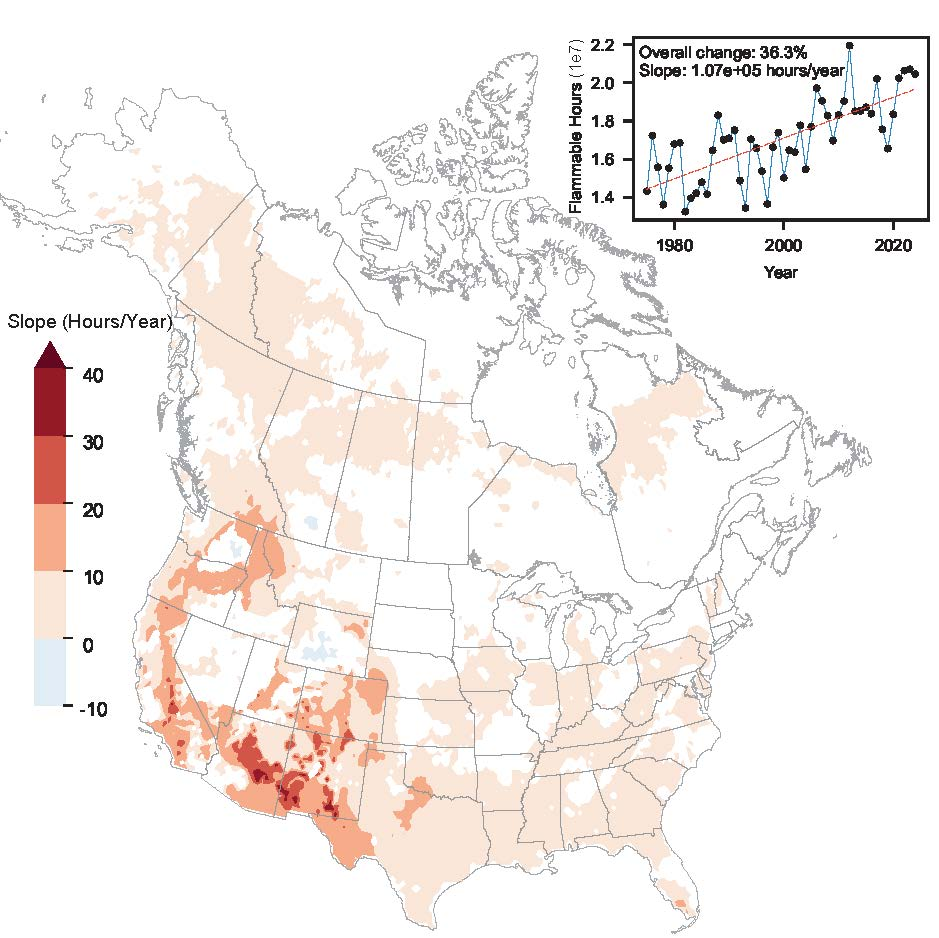
Contemporary North American wildfires exhibit increasingly erratic intraday burning, posing immediate operational and socioeconomic challenges. Here, we show that climate-driven weakening of day-night (diurnal) weather constraints extends and intensifies burning hours, a key mechanism behind broader fire regime transformations. Analyzing hourly geostationary satellite observations for ~9000 fires (>200 hectares; 2017–2023), we found western mountains and boreal forests experienced the longest active burning hours, with approximately one-third of active days exceeding 12 hours. About 60% of fires reached peak intensity within 24 hours of detection, while 14% of active days peaked at night. On the basis of fire weather, annual potential burning hours were estimated to rise 36% over 1975–2024, with pronounced increases in western regions and spring/fall (48 to 57%). Regions with significant changes gained 26 more potential active days annually and 1.2 additional potential burning hours daily, while extreme days (≥12 or 24 potential burning hours) rose 81 to 233% in fire-prone biomes. Future management requires adaptation to wildfires that increasingly defy diurnal norms.
***