
2016 12 08 snap from Canadian gov’ts website on oil and gas industry exemptions for chemical disclosure, effectively allowing billion dollar profit-raping companies to legally poison us, our families, communities, drinking water and country in secret.
Ottawa releases new list of chemicals it will prioritize for risk assessments, Ottawa proposes to study the health impacts of chemicals found in cosmetics, flame retardants by David Thurton, CBC News, Oct 04, 2024
The federal government has released a proposed list of more than 30 chemicals and groups of substances Canadians encounter daily that it wants to prioritize for risk assessments.
The announcement is part of a batch of measures Health Canada and Environment Canada are introducing as they revamp the country’s cornerstone environmental legislation.
In 2023, Parliament passed updates to the decades-old Canadian Environmental Protection Act (CEPA). The act is one of the country’s key environmental laws. It gives the federal government a wide range of powers to address pollution contaminating air, water and land. Ya, but, the feds rarely implement these powers, if ever when it’s related to significant polluting harms by the frac, oil, gas and bitumen industry. I went to present to a parliamentary committee in 2007, beseeching the gov’t to implement CEPA and disclose all frac chemicals, notably those injected directly into community drinking water aquifers as Encana/Ovintiv illegally did in Rosebud, Alberta. But Steve Harper was PM then, sleazy fucker buddy of Gwyn Morgan, CEO of the company, so CEPA was not used to make Encana disclose the chemicals it was injecting during, drilling, frac’ing, cementing, and recementing in our drinking water supply. Alberta Rules of Court do not allow trade secrets in cases like mine, still, Encana refused to disclose the chemicals they injected on hundreds of gas wells frac’d into the fresh water zones in and around my community. Rule of Law in Canada when it comes to the rich, and the worst law violating polluters like Encana/Ovintiv, is a Caveman’s unwashed ass.
On Friday, the government released a proposed framework indicating which chemicals it will prioritize for assessment.
Ahead of the public release of the list, federal Environment Minister Steven Guilbeault said Wednesday that when CEPA was first introduced in 1999, just 23,000 chemical substances in use in Canada fell under its regulatory regime.
“Today, up to 10 million new chemical compounds are produced every year. Our science must keep pace with global chemical markets,” he said.
Among the chemicals and substances on the federal government’s priority list are styrene (used to make various plastic products) and octocrylene, which is found in sunscreen.
- The C-word: firefighters push for better cancer protection
- Forever chemicals are everywhere. These burnt wood chips could help change that
- ‘Forever chemicals’ found in Canadians’ blood samples: report
- Industry knew about risks of PFAS ‘forever chemicals’ for decades before push to restrict them, study says
The changes to CEPA also mean the federal government now recognizes it needs to pay particular attention to communities or jobs that are disproportionately affected by pollution.Really? So why is the oil and gas industry largely exempt?
The proposed priorities list targets chemicals used by some of those groups. Organic flame retardant, which firefighters often use, is on the list.
“Scientists are also going to be digging into certain chemicals used in flame retardants, which may elevate human risk impacts,” Guilbeault said. “This is something that firefighters are asking for.”What about oil and gas workers and the thousands of families across Canada poisoned nearly daily by the oil, gas, frac and bitumen industry?
Also on the list is a compound linked to oilsands operations: naphthenic acids.
Naphthenic acids are found in oilsands tailings ponds used by mining operations in places like northeastern Alberta. These massive ponds collect by-products from oilsands mining operations — a mixture of water, sand, residual bitumen and other hydrocarbons that the industry calls “processed” water.
Listing substances on a priority list does not mean they’re harmful to Canadians — but it does mean federal officials will prioritize determining whether those substances are toxic. If that happens, the government can take steps under CEPA to address their use — or even ban them.But knowing how cowardly Caveman Canada is, they won’t, as usual.
Environmental groups are urging the government to move from proposals to actual regulations that protect Canadians.Industry and the rich will never let that happen and our politicos/regulators/judges are sappy washboards with limited courage/integrity.
…
Federal Administrative Monetary Penalty Scheme Arrives by Paula Boutis, April 21, 2016, Siskinds LLP, Ontario’s Environmental Firm
On April 9, 2016, almost six years after passing legislation to allow for “administrative monetary penalty orders” (“AMP orders”) as environmental enforcement tools, the federal government has released draft regulations for comment. The commenting period is open for 60 days.
AMPs, as we have described before, are “a halfway house between tickets (such as traffic tickets) and full-scale prosecution.” In a prosecution, the Crown must prove beyond a reasonable doubt that the “act” of an offence occurred. The defendant can be acquitted if the defense proves, on a balance of probabilities, that the defendant was duly diligent, i.e. did all it reasonably could do to avoid committing the offence. AMPs require only proof on a “balance of probabilities” that an offence occurred, and no defense is possible. The fine is due and payable, subject only to rights of review granted under the scheme. Unlike prosecutions, jail time is not possible for AMPs.
Not all offences which currently can be prosecuted will also be subject to an AMP regime. The proposed AMPs Regulations would designate provisions of the following six federal acts and their associated regulations that could be enforced by means of an AMP:
- Antarctic Environmental Protection Act
- Canada Wildlife Act;
- Canadian Environmental Protection Act, 1999, Parts 7 and 9 only REFER BELOW FOR COMPLETE COPIES OF THESE PARTS;
- International River Improvements Act;
- Migratory Birds Convention Act, 1994; and
- Wild Animal and Plant Protection and Regulation of International and Interprovincial Trade Act.
One of the fundamental differences between the federally proposed AMP scheme and Ontario’s scheme, passed in June 2005, is that if an offender is subject to an AMP, it cannot also be subject to a prosecution for the same alleged offence. The federal government, at the same time as releasing the draft regulations, released a policy framework in which it is carefully explained when a prosecution and AMP may overlap, for example, for continuing violations. On Day 1 of the offence, an officer may issue an AMP, but for Day 5, the decision may be to proceed with a prosecution, instead.
Ontario’s Compliance Policy, by contrast, states the following:
A person can be given an EP Order and prosecuted for the same violation. The payment of a penalty or entering into a settlement agreement is not, for the purposes of any prosecution for the same violation, an admission of guilt. Prosecution remains available to deter serious pollution incidents and repeat offenders and will be considered in accordance with direction provided … [in this] Policy. However, if a regulated person is convicted for the same violation where an EP Order has already been issued, the court may consider the payment of a penalty as a mitigating factor when imposing sentence.
AMPs in Ontario apply to a small subset of operations. The 2014 report for AMPs reported a total of $189,713.83 in penalties. By contrast, just one prosecution, such as the prosecution of concrete batching company ML Ready Mix Concrete Inc. and its Director, can result in fines as high as $160,000 (plus the 25% Victim Fine Surcharge). These fines were for six offences under the Environmental Protection Act, related to dust and noise emissions. Of course, the state resources expended for prosecutions are also significantly higher than for AMPs.
Ultimately, AMPs are intended to allow for a more efficient means of deterring bad environmental actors and adds one more option to the enforcement tool kit. It remains to be seen how the federal government will take advantage of this new tool. [Emphasis added]
Canada proposes new regulations for environmental administrative monetary penalties by Mark Youden, April 15, 206, Gowling WLG
The federal government recently released proposed regulations that provide federal environmental enforcement officers an administrative alternative to existing enforcement measures. The proposed Environmental Violations Administrative Monetary Penalties Regulations (the “proposed Regulations”) were published in the Canada Gazette on April 9, 2016, and provide key details necessary for the implementation of the administrative monetary penalties (“AMP”) regime authorized by the Environmental Violations Administrative Monetary Penalties Act (“EVAMPA”).
AMPs as an Alternative
AMPs are regulatory in nature, rather than criminal, and are intended to encourage compliance with a regulatory scheme. Both the federal and provincial governments have introduced various AMP schemes on a sector-by-sector basis, but to date, AMPs have not been available to federal environmental enforcement officers as a response to environmental violations.
As it stands, federal environmental officers have a range of enforcement options available to respond to environmental violations. Environmental officers may issue a written warning, a ticket, an Environmental Protection Compliance Order (“EPCO”), or proceed with prosecution. These options are, however, inappropriate in some circumstances. For example, prosecution is time-consuming and expensive and generally reserved for the most serious of offences. [Like repeatedly illegally, intentionally fracturing a community’s drinking water aquifers?]
Conversely, written warnings may not sufficiently deter violators from reoffending. EPCOs, similar to “stop” or “cease and desist” orders from other legislative regimes, are limited in their application, and like tickets (issued under the Contraventions Act) are only available in response to specific violations under certain environmental statutes. The new AMP regime was developed to fill this gap in enforcement options.
Background and Application
The EVAMPA was enacted under the Environmental Enforcement Act (“EEA”) and came into force in 2010. One of the objectives of the EEA was to strengthen and harmonize the enforcement regimes of nine federal environmental Acts by introducing different categories of offenders and introducing new minimum fines and increased maximum fines. Through the enactment of the EVAMPA, the EEA also established a new enforcement tool, namely AMPs. The AMP regime was implemented in a staged approach set to conclude with the registration of the proposed Regulations.
Beginning in 2011, the proposed AMP regime was subject to an online consultation process. The consultation process solicited suggestions regarding the appropriate violations for the AMP regime, as well as the design, scope and methodology for determining the amounts payable under AMPs.
As drafted, the proposed Regulations will apply to designated violations of six environmental Acts administered by Environment and Climate Change Canada.1 The designated violations include contraventions of specified provisions of the applicable legislation, contraventions of specified directions and orders, and acts of non-compliance with specified conditions of a permit, licence or other authorization.
Proposed Method to Quantify AMPs
Under the proposed Regulations, an AMP may be issued, in the form of a notice of violation, to “a person, ship or vessel” [Are drilling, perforating, cementing, fracing, servicing rigs vessels?] if an enforcement officer believes on reasonable grounds, that the “person, ship or vessel” has committed a contravention of a specified provision under any of the six above-mentioned environmental statutes. As proposed, the amount of baseline penalty applicable to a violation will vary depending on the seriousness of the violation (classified as either Type A, B or C) and the identity of the violator (classified as either an “individual” or “other person, ship or vessel”, which notably includes corporations, government departments, indigenous governments and Bands and Band Councils). For example, under the proposed Regulations:
- Type A violations will represent less serious violations, such as a failure to meet record keeping requirements under an environmental permit.
- Type B violations will cover more serious violations that may or may not cause harm to the environment or constitute an obstruction of authority. For example, when a person is found transporting hazardous waste without being named on a valid transit permit (and thus in violation of the Export and Import of Hazardous Waste and Hazardous Recyclable Material Regulations).
- Type C violations will represent the most serious violations, such as an act known to cause the degradation or alteration of the environment. For example, where a violator deposits an inherently harmful substance into the environment. [And, for example, when a company intentionally, repeatedly, illegally frac’s drinking water aquifers, then, with provincial regulators and research council experts helping, engages in fraud to cover-up the law violations and harms, and keep them secret from the families now living in risk of explosion and being poisoned in their own homes breathing the frac’d gases venting from drinking water taps?]
The proposed Regulations also set out aggravating factors that can increase a baseline penalty – namely: the history of non-compliance, environmental harm, and economic gain.
For example, a Type C violation issued to an “other person, ship or vessel” could increase from a baseline penalty of $5,000 to a maximum penalty of $25,000 if the violator had a history of non-compliance or achieved an economic gain.
What multinational corporation will be deterred by such incredibly puny fines? Was this a Harper-Encana production, then enabled by Trudeau-McKenna to enable the unconventional oil and gas industry devastation without accountability by synergizing Pembina Institute’s Marlo Reynolds? More details on the Pembina Institute’s synergizing, enabling the oil and gas industry.
Because the baseline AMP amount for a Type C violation already reflects environmental harm, the aggravating factor of “environmental harm” is not applicable.
Defences and the Review Process
AMPs will not be applicable to offences that require proof that an alleged offender possessed a certain mental state, such as those offences that require an act to be committed “knowingly” or “wilfully”. Offences that require a full assessment of the mental state of the alleged offender are excluded from the proposed AMP regime as they are better dealt with by other measures (such as prosecution).
Under the existing EVAMPA, defences are limited. For example, an alleged violator named in a notice of violation does not have a defence by reason that the violator “exercised due diligence to prevent the violation” or “reasonably and honestly believed in the existence of facts, if true, would exonerate” the violator.
An alleged violator served with an AMP may, within 30 days after the day on which the AMP is served (or within any longer period that the Chief Review Officer allows), make a request to the Chief Review Officer for a review of the penalty, the facts of the alleged violation, or both. [And escape the super puny fines?]The Chief Review Officer is an adjudicator, independent from Environment and Climate Change Canada, who conducts reviews requested by an applicant. The review officer or panel must provide its determination in writing within 30 days after the day on which the review is completed. If the review officer or panel determines that the alleged violator has committed a violation, the violator is liable for the amount of the penalty as set out in the decision.
A determination made by the review officer or panel under the EVAMPA is final and binding and is not subject to appeal or to review by any court, except for judicial review under the Federal Courts Act. [That’s a mighty big escape hatch. It appears corporations causing harms have many ways out, especially with their “bank accounts full of case” and endless teams of lawyers, as the AER’s outside counsel Glenn Solomon so aptly advised]
AMPs Policy Framework and Comment Period
In addition to the proposed Regulations, the federal government recently released the “Policy Framework of the Administrative Monetary Penalty System at Environment and Climate Change Canada to Implement the Environmental Violations Administrative Monetary Penalties Act”. [What a mouthful! Escape hatch mouthful?] This Policy Framework Document outlines operational features of the proposed AMP regime, such as: the compliance and enforcement of AMPs (including how AMPs will be issued in conjunction with other enforcement actions), the determination of the amount of penalty under the AMP regime, and the oversight and review process for the AMP regime. The Policy Framework Document also provides responses to questions from the 2011 online consultation process.
The proposed Regulations are now subject to a 60 day comment period (which started on April 9, 2016) and are set to come into force on the day on which they are registered. If registered, the choice of enforcement action, AMPs or otherwise, will rest with enforcement officers according to the principles and factors set out in Environment and Climate Change Canada’s existing Compliance and Enforcement Policy. If implemented, it will be interesting to see how environmental officers use AMPs either alone or in conjunction with other enforcement measures, to help achieve higher levels of environmental compliance in Canada. [There’s corporate environmental compliance now in Canada? Where?]
1 The Antarctic Environmental Protection Act; the Canada Wildlife Act; the Canadian Environmental Protection Act, 1999 (Parts 7 and 9); the International River Improvements Act; the Migratory Birds Convention Act, 1994; and the Wild Animal and Plant Protectionand Regulation of International and Interprovincial Trade Act.
Making Waves: Message to MPs: We need meaningful action on fracking by Emma Lui, May 14, 2015, Rabble.ca
Tuesday morning Indigenous lawyer Caleb Behn, pediatrician Dr. Kathleen Nolan and I presented to members of Parliament and senators urging meaningful action from the federal government on fracking.
At the breakfast briefing, I gave an overview on fracking across Canadian and Indigenous communities. Officials in attendance included NDP member of Parliament François Choquette, Liberal environment critic John Mackay, Green Party leader Elizabeth May, Senator Richard Neufeld, Senator Kelvin Ogilvie, Liberal water critic Francis Scarpaleggia and Senator Judith Seidman. Representations from the Assembly of First Nations also attended including Will David (Special Advisor – Implementing Rights), Irving LeBlanc (Special Advisor – Housing, Infrastructure and Emergency Issues Management Safe, Secure and Sustainable Communities) and Judy Whiteduck (Director of Economic Development).
Where are there moratoriums on fracking?
Communities have been raising a number of serious concerns about fracking including the risk of drinking water contamination. A recent study published shows that drinking water in Pennsylvania was contaminated by fracking. There are also risks to climate change, public health, ecosystems and wildlife. The potential for earthquakes and the lack of safe methods to dispose of fracking wastewater are other key threats associated with fracking.
There has been a wave of moratoria in Eastern Canada including in Quebec, New Brunswick, Nova Scotia and Newfoundland and Labrador. It has been heartening to see a number of provincial governments listening to communities and putting a stop to fracking because of the risks.
Despite the moratorium in both Nova Scotia and New Brunswick, there are proposals to have municipalities in these provinces treat existing fracking wastewater in their municipal wastewater facilities. The wastewater would then be discharged into the local river and all of which connect to the Bay of Fundy. Colchester County recently rejected a proposal for their town. Newfoundland and Labrador is currently going through an independent review panel process.
There has been a NAFTA lawsuit launched against the Canadian government by the company Lone Pine Resources for Quebec’s fracking moratorium. Trade agreements like NAFTA and CETA raise concerns because investor-state dispute settlement clauses can inhibit governments from implementing safety or environmental regulations.
While there is currently no horizontal, multi-stage fracking happening in Ontario, there are concerns industry wants to move forward with fracking which would put the Great Lakes at grave risk.
In Alberta, landowners have raised concerns about water contamination as well as health impacts on themselves and their livestock. Jessica Ernst is one example and the Supreme Court recently agreed to hear her case.
In British Columbia, there are up to 18 proposals to build Liquefied Natural Gas terminals along the Pacific Coast. Communities and First Nations are highlighting concerns about tanker safety and impacts on rivers and salmon.
Fracking recently started in the Northwest Territories. And now the Yukon government is opening its doors to fracking despite widespread opposition from Yukoners and First Nations. Maude Barlow, members of the Liard First Nation and I were recently in Whitehorse, Yukon to express opposition to fracking in the territory.
Fracking in northeastern B.C. and federal responsibility
Caleb Behn, a young lawyer from northeastern British Columbia, explained to members of Parliament and senators the scale of development in the northeast including the development of dams, pipelines, oil and gas and fracking projects.
Behn, who is also Eh Cho Dene and Dunne-Za from Treaty 8 Territory, talked about the impacts fracking has had on the land, water and wildlife. He showed shocking photos of lesions found in animals he has hunted not seen by past generations.
Photo by Caleb Behn [Not published by Rabble]
Behn emphasized the need for the federal government to step in and take responsibility under the national interest doctrine.
To learn more about Behn and his territory’s experience with fracking, see the recently released documentary called Fractured Land.
Health impacts on fracking and New York’s ban
Dr. Kathleen Nolan, a pediatrician with training in epidemiology, talked about the exponential increase in peer-reviewed research on the air quality, seismicity and health consequences.
Nolan, Senior Research Director for Catskill Mountainkeeper and co-founder of the Concerned Health Professionals of New York, described the children she has treated that have had seizures, chemical burns and other illnesses related to fracking. She talked about the clear link between these health impacts and fracking. Respiratory illnesses disappeared when they left their homes close to well sites and came back when they returned. The respiratory illnesses were manageable when they put in air filters in their homes.
She talked about the need for science to catch up with people’s stories. Nolan made recommendations in how to address the current impacts on fracking including the use of tracers and the need to legally require companies to disclose the names of fracking chemicals (without the concentrations).
Behn and Nolan speak at the press conference
CBC reported, “Indigenous lawyer Caleb Behn, pediatrician Dr. Kathleen Nolan and Council of Canadians national water campaigner Emma Lui hit the stage at the Centre Block press theatre to call on the government to “act now … to protect public health, our drinking water, and ecosystems from the impact of fracking” by imposing “adequate regulations” and ensuring federal oversight of the industry.”
In the press conference, Behn explained, “I am from northeastern B.C. We have some of the world’s biggest hydraulic fracturing operations in terms of volume of water used. Our people have been reporting anecdotally for quite a while about the issues associated with this development. It has become clear over time as the science catches up to people’s experience on the land adjacent to these developments that more has to be done.”
He warned, “We can’t race to the bottom line on energy and energy developments in this country without seriously considering the long term implications of these developments. There’s no technology on this planet that can reclaim a contaminated aquifer.”
DeSmog quoted Dr. Nolan, “People are getting sick…With water contamination there’s a lag time between the time the contaminants enter the water and then enters the person and then the person gets ill….it could take years or decades before the contaminants reach people.”
Watch the press conference and Q & A period.
The federal government and fracking
The Council of Canadian Academies’ report, commissioned by Environment Canada, looked into the state of knowledge on the potential environmental impacts of fracking and mitigation options.
The report found there were critical gaps in information including on well deterioration and leaks, chemical migration or contamination, cumulative impacts, hydrogeology, wastewater injection and the safety of fracking chemicals. The report showed that decision makers do know enough about fracking to declare it safe.
The Council of Canadians conducted a poll last fall that found 70 per cent of Canadians want a national moratorium on fracking until it is scientifically proven to be safe. However, while fracking still occurs communities need federal leadership in the areas of public health, climate, fisheries, drinking water and toxic chemicals.
It has been roughly five years since the then environment minister Jim Prentice said environmental regulations are still a work in progress for Canada’s booming shale gas industry and that environmental policies were being drawn up but impacted communities have not seen any concrete regulations that adequately address horizontal, multi-stage fracking.
What members of Parliament need to do
There are a number of areas where the federal government has responsibility to regulate fracking. Ministers, opposition critics and members of Parliament in impacted regions need to take concrete action in the following areas:
Fisheries Act: While the Fisheries Act has been gutted so that it now only prevents the depositing of deleterious substances that kills more than 50 per cent of fish at 100 per cent concentration over a 96 hour period, the Fisheries and Oceans Minister must still intervene in fracking wastewater disposal projects that impact waters frequented by fish. As mentioned, there are proposals in the Atlantic to treat fracking wastewater in municipal wasterwater systems.
Management of toxic chemicals: A memo to the Environment Minister in 2011 notes that under the Chemicals Management Plan (CMP), Environment Canada reviewed 265 chemicals used in the fracking process in both Quebec and the U.S. Only 13 of the 265 chemicals have been assessed under the Canadian Environmental Protection Act and only a quarter will be addressed under the CMP. Roughly half of the fracking chemicals did not meet the CMP criteria for further investigation, meaning these chemicals have not been assessed for potential risks to the public. Environment Minister Leona Aglukkaq and Health Minister Rona Ambrose must ensure that all chemicals commonly used in the fracking process must be assessed for public safety under the Chemicals Management Plan.
The UN Declaration on the Rights of Indigenous Peoples: The Council of Canadian Academies report noted that the majority of shale gas reserves are on Indigenous lands. The Canadian government has endorsed the UNDRIP and therefore must obtain free, prior and informed consent on fracking and related projects.
Human right to water: Canada has also endorsed the UN resolutions recognizing the human right to water and sanitation and therefore is required to come up with a national plan of action. There were 1,838 drinking water advisories at the end of January. The federal government, including all members of Parliament must commit to developing a national water policy that addresses current threats to water such as fracking.
As Behn said, “We can’t race to the bottom line on energy and energy developments in this country without seriously considering the long term implications of these developments. There’s no technology on this planet that can reclaim a contaminated aquifer.”
With the upcoming federal election, members of Parliament need to show real federal leadership and, along with federal election candidates, make genuine commitments to protect communities, public health, our climate and our water sources caused by fracking.
The Council of Canadians thanks Elizabeth May’s office for helping to organize the briefing on fracking for members of Parliament and senators as well as the press conference.
TAGS: INDIGENOUS RIGHTSWATER QUALITYWASTEWATERHEALTH AND SAFETYENVIRONMENTAL DESTRUCTIONFRACKINGDRINKING WATERANTI-FRACKING FRACKING BAN Where did the demand for frac ban go? Synergy? Donations? Jobs? Ego-fodder?
One comment was posted:
“The report showed that decision makers do know enough about fracking to declare it safe.”
Apparently our “decision makers,” and some of our scientists, haven’t looked hard enough, are choosing to ignore the information, or maybe just busy working on their frac patents. Absolutely ridiculous, the information is there, it’s clear, and it’s growing:
“A growing body of peer-reviewed studies, accident reports, and investigative articles is now detailing specific, quantifiable evidence of harm and has revealed fundamental problems with the entire life cycle of operations associated with unconventional drilling and fracking. Industry studies as well as independent analyses indicate inherent engineering problems including uncontrolled and unpredictable fracturing, induced seismicity, and well casing and cement impairments that cannot be prevented.
Earlier scientific predictions and anecdotal evidence are now bolstered by empirical data, confirming that the public health risks from unconventional gas and oil extraction are real, the range of adverse impacts significant, and the negative economic consequences considerable. Our examination of the peer-reviewed medical and public health literature uncovered no evidence that fracking can be practiced in a manner that does not threaten human health.’”
http://concernedhealthny.org/compendium/
So I think that sentence really should read:
“The report showed that decision makers do know more than enough about fracking to declare it UNsafe.”
But in Canada it seems, they’d prefer to study communities like lab rats, while the industry fracs us to dust over “decades-long development periods.”
From the Council of Canadian Academies’ report: “Most research projects conducted in Canada are planned for the relatively short term — five to ten years or less. To address some of the most important questions about shale gas, longer-term research will be needed over the anticipated decades-long development periods and over sufficient time scales following well closure.”
———————
“It has been roughly five years since the then environment minister Jim Prentice said environmental regulations are still a work in progress for Canada’s booming shale gas industry and that environmental policies were being drawn up but impacted communities have not seen any concrete regulations that adequately address horizontal, multi-stage fracking.”
Of course not, they can’t regulate “brute force and ignorance,” so they deregulate to accommodate. Harper gutted environmental regs for a reason.
“Growing evidence shows that regulations are simply not capable of preventing harm. That is both because the number of wells and their attendant infrastructure keeps increasing and, more importantly, because some of fracking’s many component parts, which include the subterranean geological landscape itself, are simply not controllable.”
http://concernedhealthny.org/wp-content/uploads/2014/07/CHPNY-Fracking-Compendium.pdf
“’I don’t think that the actual optimum technology set for producing shale gas has yet been defined — at the moment, we are doing it by brute force and ignorance.’”
Andrew Gould – CEO Schlumberger
And now provincial governments are seeing to the rest of the deregulation:
June 13, 2014 – “A government document obtained by the NDP shows Alberta’s Energy Regulator is scheduled to meet next week with industry officials to discuss a pilot project that will reduce regulations and streamline the application process for fracking and other forms of unconventional oil and gas development.
The information session on June 17 is meant to brief industry representatives on regulations that will be tested in the Fox Creek area beginning in September. Representatives from Alberta’s Environment and Energy departments will also attend the meeting, the document shows.
‘At the same time government is selling itself as being a steward of the environment, it is working behind closed doors to undermine the integrity of our environmental regime,’ NDP critic Rachel Notley said Thursday. ‘It is the type of game-playing you expect from a tired, 40-year-old government that is not going to change.
‘Making major changes to regulations that govern fracking shouldn’t be done behind closed doors with a bunch of industry insiders, it should happen in public. Albertans deserve better than this.'”
Play based deregulation with blanket approvals and self-reporting. Fox Creek (home of Canada’s largest frac quakes, one was a 4.4M) is the unlucky recipient for now, but I expect unless Harper is voted out, the rest of the country won’t be far behind.
***
CEPA
Canadian Environmental Protection Act, 1999
S.C. 1999, c. 33
Assented to 1999-09-14
PART 7
Controlling Pollution and Managing Wastes
DIVISION 1
Nutrients
Marginal note:Definitions
116 The definitions in this section apply in this Division and in Part 10.
cleaning product means a phosphate compound or other substance that is intended to be used for cleaning purposes, and includes laundry detergents, dish-washing compounds, metal cleaners, de-greasing compounds and household, commercial and industrial cleaners. (produit de nettoyage)
nutrient means a substance or combination of substances that, if released in any waters, provides nourishment that promotes the growth of aquatic vegetation. (substance nutritive)
water conditioner means a substance that is intended to be used to treat water, and includes water-softening chemicals, anti-scale chemicals and corrosion inhibiters. (conditionneur d’eau)
Marginal note:Prohibition
117 No person shall manufacture for use or sale in Canada or import a cleaning product or water conditioner that contains a prescribed nutrient in a concentration greater than the permissible concentration prescribed for that product.
Marginal note:Regulations
118 (1) The Governor in Council may, on the recommendation of the Minister, make regulations for the purpose of preventing or reducing the growth of aquatic vegetation that is caused by the release of nutrients in waters and that can interfere with the functioning of an ecosystem or degrade or alter, or form part of a process of degrading or altering, an ecosystem to an extent that is detrimental to its use by humans, animals or plants, including regulations
(a) prescribing nutrients;
(b) prescribing the permissible concentration of a prescribed nutrient in a cleaning product or water conditioner;
(c) respecting the conditions, test procedures and laboratory practices to be followed for analysing, testing, measuring or monitoring a nutrient, cleaning product or water conditioner; and
(d) requiring persons who manufacture for use or sale in Canada or import a cleaning product or water conditioner
(i) to maintain books and records for the proper administration of this Division and the regulations,
(ii) to submit samples of the cleaning product or water conditioner to the Minister, and
(iii) to submit to either Minister information regarding cleaning products, water conditioners and their ingredients.
Marginal note:Nutrients regulated under other Acts of Parliament
(2) The Governor in Council shall not make a regulation under subsection (1) in respect of a nutrient to the extent that the nutrient, or a product in which the nutrient is contained, is, in the opinion of the Governor in Council, regulated by or under any other Act of Parliament in a manner that provides, in the opinion of the Governor in Council, sufficient protection to the environment.
Marginal note:Remedial measures
119 (1) Where there is a contravention of section 117 or the regulations, the Minister may, in writing, direct a manufacturer or importer of a nutrient, cleaning product or water conditioner to take any or all of the following measures in the manner and within the period directed by the Minister:
(a) give public notice of the contravention and of any danger to the environment or to human life or health posed by the nutrient, cleaning product or water conditioner;
(b) mail a notice as described in paragraph (a) to manufacturers, processors, distributors or retailers of the nutrient, cleaning product or water conditioner;
(c) mail a notice as described in paragraph (a) to persons to whom the nutrient, cleaning product or water conditioner is known to have been delivered or sold;
(d) replace the nutrient, cleaning product or water conditioner with one that meets the applicable requirements;
(e) accept the return of the nutrient, cleaning product or water conditioner from the purchaser and refund the purchase price;
(f) take other measures for the protection of the environment or human life or health; and
(g) report to the Minister on the steps taken in satisfaction of any direction under paragraphs (a) to (f).
Marginal note:Intervention of Minister
(2) If a person fails to take any measures required under paragraph (1)(a), (b), (c) or (f), the Minister may take those measures or cause them to be taken.
Marginal note:Recovery of costs
(3) Her Majesty in right of Canada may recover the costs and expenses of and incidental to taking any measures under subsection (2) from the person referred to in that subsection.
DIVISION 2
Protection of the Marine Environment from Land-based Sources of Pollution
Marginal note:Definitions
120 The definitions in this section apply in this Division.
land-based sources means point and diffuse sources on land from which substances or energy reach the sea by water, through the air or directly from the coast. It includes any sources under the sea bed made accessible from land by tunnel, pipeline or other means. (sources telluriques)
marine pollution means the introduction by humans, directly or indirectly, of substances or energy into the sea that results, or is likely to result, in
(a) hazards to human health;
(b) harm to living resources or marine ecosystems;
(c) damage to amenities; or
(d) interference with other legitimate uses of the sea. (pollution des mers)
Marginal note:Objectives, guidelines and codes of practice
121 (1) The Minister may, after consultation with any other affected minister, issue environmental objectives, release guidelines and codes of practice to prevent and reduce marine pollution from land-based sources.
Marginal note:Consultation and conferences
(2) To carry out the functions set out in subsection (1), the Minister
(a) shall offer to consult with the government of a province and the members of the Committee who are representatives of aboriginal governments and may consult with any government department or agency or any person interested in the protection of the sea;
(b) may organize conferences relating to the prevention or reduction of marine pollution from land-based sources; and
(c) may meet with the representatives of international organizations and agencies and other countries to examine the rules, standards, practices and procedures recommended under the United Nations Convention on the Law of the Sea, signed by Canada on October 7, 1982.
Marginal note:Minister may act
(3) At any time after the 60th day following the day on which the Minister offers to consult in accordance with paragraph (2)(a), the Minister may act under subsection (1) if the offer to consult is not accepted by the government of a province or members of the Committee who are representatives of aboriginal governments.
DIVISION 3
Disposal at Sea
Interpretation
Marginal note:Definitions
122 (1) The definitions in this subsection apply in this Division and in Part 10.
aircraft means a machine that is used or designed for navigation in the air, but does not include an air cushion vehicle. (aéronef)
Canadian aircraft means an aircraft that is registered under an Act of Parliament. (aéronef canadien)
Canadian permit means a permit that is issued under subsection 127(1) or 128(2). (permis canadien)
Canadian ship means a ship that is registered under an Act of Parliament. (navire canadien)
Version anglaise seulement
condition means, in respect of a permit, any term or condition of the permit. (Version anglaise seulement)
contracting party means a state that is a contracting party to the Convention or the Protocol. (partie contractante)
Convention means the Convention on the Prevention of Marine Pollution by Dumping of Wastes and Other Matter signed by Canada on December 29, 1972, as amended from time to time. (Convention)
disposal means
(a) the disposal of a substance at sea from a ship, an aircraft, a platform or another structure,
(b) the disposal of dredged material into the sea from any source not mentioned in paragraph (a),
(c) the storage on the seabed, in the subsoil of the seabed or on the ice in any area of the sea of a substance that comes from a ship, an aircraft, a platform or another structure,
(d) the deposit of a substance on the ice in an area of the sea,
(e) the disposal at sea of a ship or aircraft,
(f) the disposal or abandonment at sea of a platform or another structure, and
(g) any other act or omission that constitutes a disposal under regulations made under paragraph 135(3)(c),
but does not include
(h) a disposal of a substance that is incidental to or derived from the normal operations of a ship, an aircraft, a platform or another structure or of any equipment on a ship, an aircraft, a platform or another structure, other than the disposal of substances from a ship, an aircraft, a platform or another structure operated for the purpose of disposing of such substances at sea,
(i) the placement of a substance for a purpose other than its mere disposal if the placement is not contrary to the purposes of this Division and the aims of the Convention or the Protocol,
(j) the abandonment of any matter, such as a cable, pipeline or research device, placed on the seabed or in the subsoil of the seabed for a purpose other than its mere disposal, or
(k) a discharge or storage directly arising from, or directly related to, the exploration for, exploitation of and associated off-shore processing of seabed mineral resources. (immersion)
incineration means the combustion of a substance on board a ship, a platform or another structure at sea for the purpose of its thermal destruction. (incinération)
master means the person in command or charge of a ship, but does not include a licensed pilot, within the meaning of section 1.1 of the Pilotage Act. (capitaine)
owner, in relation to any ship, aircraft, platform or other structure, includes the person who has the possession or use, by law or contract, of the ship, aircraft, platform or other structure. (propriétaire)
Protocol means the 1996 Protocol to the Convention on the Prevention of Marine Pollution by Dumping of Wastes and Other Matter, 1972, as amended from time to time. (Protocole)
ship includes a vessel, boat or craft designed, used or capable of being used solely or partly for marine navigation, without regard to its method or lack of propulsion, and includes an air cushion vehicle. (navire)
Version anglaise seulement
structure means a structure that is made by a person. (Version anglaise seulement)
waste or other matter means waste or other matter listed in Schedule 5. (déchets ou autres matières)
(2) In this Division and in Part 10, sea means
(a) the territorial sea of Canada;
(b) the internal waters of Canada, excluding all the rivers, lakes and other fresh waters in Canada and the St. Lawrence River as far seaward as the straight lines drawn
(i) from Cap-des-Rosiers to the western-most point of Anticosti Island, and
(ii) from Anticosti Island to the north shore of the St. Lawrence River along the meridian of longitude sixty-three degrees west;
(c) any exclusive economic zone that may be created by Canada;
(d) the arctic waters within the meaning of section 2 of the Arctic Waters Pollution Prevention Act;
(e) an area of the sea adjacent to the areas referred to in paragraphs (a) to (d) that is specified under paragraph 135(1)(g);
(f) an area of the sea under the jurisdiction of a foreign state, other than its internal waters; and
(g) an area of the sea, other than the internal waters of a foreign state, not included in the areas of the sea referred to in paragraphs (a) to (f).
1999, c. 33, s. 122; 2005, c. 23, ss. 18, 49.
Previous Version
Purpose
Marginal note:Purpose
122.1 The purpose of this Division is to protect the marine environment, particularly by implementing the Convention and the Protocol.
2005, c. 23, s. 19.
Prohibitions
Marginal note: Imports for disposal in waters under Canadian jurisdiction
123 (1) No person or ship shall import a substance for disposal in an area of the sea referred to in any of paragraphs 122(2)(a) to (e).
Marginal note:Export for disposal in waters under foreign jurisdiction
(2) No person or ship shall export a substance for disposal in an area of the sea under the jurisdiction of a foreign state or in its internal waters.
1999, c. 33, s. 123; 2005, c. 23, s. 20.
Previous Version
Marginal note:Loading in Canada for disposal at sea
124 (1) No person shall, in Canada, load a substance onto any ship, aircraft, platform or other structure for the purpose of disposal in an area of the sea referred to in any of paragraphs 122(2)(a) to (e) and (g) unless
(a) the substance is waste or other matter; and
(b) the loading is done in accordance with a Canadian permit.
Marginal note:Loading in Canada for disposal at sea
(1.1) No ship shall, in Canada, load a substance onto itself for the purpose of disposal in an area of the sea referred to in any of paragraphs 122(2)(a) to (e) and (g) unless
(a) the substance is waste or other matter; and
(b) the loading is done in accordance with a Canadian permit.
Marginal note:Responsibility of master and pilot in Canada
(2) The master of a ship or pilot in command of an aircraft shall not permit a substance to be loaded onto their ship or aircraft in Canada for the purpose of disposal in an area of the sea referred to in any of paragraphs 122(2)(a) to (e) and (g) unless
(a) the substance is waste or other matter; and
(b) the loading is done in accordance with a Canadian permit.
Marginal note:Responsibility of master and pilot outside Canada
(3) The master of a Canadian ship or pilot in command of a Canadian aircraft shall not permit a substance to be loaded onto their ship or aircraft outside Canada for the purpose of disposal at sea.
Marginal note:Exception
(4) Subsection (3) does not apply where
(a) the substance is waste or other matter;
(b) the disposal occurs in an area of the sea referred to in paragraph 122(2)(g) or in an area of the sea that is under the jurisdiction of the foreign state where the substance is loaded;
(c) if the disposal occurs in an area of the sea referred to in paragraph 122(2)(g) and the loading occurs in the territory of a foreign state that is a contracting party, the loading and disposal are done in accordance with a permit issued under the Convention or the Protocol by that state;
(d) if the disposal occurs in an area of the sea referred to in paragraph 122(2)(g) and the loading occurs in the territory of a foreign state that is not a contracting party, the loading and disposal are done in accordance with a Canadian permit;
(e) if the disposal occurs in an area of the sea under the jurisdiction of a foreign state that is a contracting party, the loading and disposal are done in accordance with a permit issued under the Convention or the Protocol by that state; and
(f) if the disposal occurs in an area of the sea under the jurisdiction of a foreign state that is not a contracting party, the loading is done in accordance with a Canadian permit and the disposal is authorized by that state.
1999, c. 33, s. 124; 2005, c. 23, s. 21.
Previous Version
Marginal note:Disposal in waters under Canadian jurisdiction
125 (1) No person or ship shall dispose of a substance in an area of the sea referred to in any of paragraphs 122(2)(a) to (e) unless
(a) the substance is waste or other matter; and
(b) the disposal is done in accordance with a Canadian permit.
Marginal note:Disposal from Canadian ship, etc., in waters that are not under the jurisdiction of any state
(2) No person shall dispose of a substance from a Canadian ship, a Canadian aircraft or a Canadian platform or other structure in an area of the sea referred to in paragraph 122(2)(g) unless
(a) the substance is waste or other matter; and
(b) the disposal is done in accordance with a Canadian permit or, if the substance was loaded in the territory of a state that is a contracting party, a permit issued under the Convention or the Protocol by that state.
Marginal note:Disposal by Canadian ship in waters that are not under the jurisdiction of any state
(2.1) No Canadian ship shall dispose of a substance in an area of the sea referred to in paragraph 122(2)(g) unless
(a) the substance is waste or other matter; and
(b) the disposal is done in accordance with a Canadian permit or, if the substance was loaded in the territory of a state that is a contracting party, a permit issued under the Convention or the Protocol by that state.
Marginal note:Disposal from Canadian ship, etc., in waters under foreign jurisdiction
(3) No person shall dispose of a substance from a Canadian ship, a Canadian aircraft or a Canadian platform or other structure in an area of the sea referred to in paragraph 122(2)(f) unless
(a) the substance is waste or other matter;
(b) the substance was loaded in the foreign state that has jurisdiction over that area;
(c) if the foreign state is a contracting party, the disposal is done in accordance with a permit issued under the Convention or the Protocol by that contracting party; and
(d) if the foreign state is not a contracting party, that state has authorized the disposal and it is done in accordance with a Canadian permit.
Marginal note:Disposal by Canadian ship in waters under foreign jurisdiction
(3.1) No Canadian ship shall dispose of a substance in an area of the sea referred to in paragraph 122(2)(f) unless
(a) the substance is waste or other matter;
(b) the substance was loaded in the foreign state that has jurisdiction over that area;
(c) if the foreign state is a contracting party, the disposal is done in accordance with a permit issued under the Convention or the Protocol by that contracting party; and
(d) if the foreign state is not a contracting party, that state has authorized the disposal and it is done in accordance with a Canadian permit.
Marginal note:Disposal of Canadian ship, etc., in waters that are not under the jurisdiction of any state
(4) No person shall dispose of a Canadian ship, a Canadian aircraft or a Canadian platform or other structure in an area of the sea referred to in paragraph 122(2)(g) unless the disposal is done in accordance with a Canadian permit.
Marginal note:Disposal of Canadian ship etc., in waters under foreign jurisdiction
(5) No person shall dispose of a Canadian ship, a Canadian aircraft or a Canadian platform or other structure in an area of the sea referred to in paragraph 122(2)(f) unless
(a) if the foreign state that has jurisdiction over that area is a contracting party, the disposal is done in accordance with a permit issued under the Convention or the Protocol by that contracting party; and
(b) if the foreign state that has jurisdiction over that area is not a contracting party, that state has authorized the disposal and it is done in accordance with a Canadian permit.
Marginal note:Exception
(6) This section does not apply in respect of any disposal that is authorized under the Canada Shipping Act, 2001.
1999, c. 33, s. 125; 2005, c. 23, ss. 22, 50.
Previous Version
Marginal note:Incineration
126 (1) No person shall incinerate a substance on board a ship, a platform or another structure in an area of the sea referred to in any of paragraphs 122(2)(a) to (e) unless
(a) the substance is waste generated on board the ship, platform or other structure during normal operations; or
(b) the incineration is done in accordance with a permit issued under subsection 128(2).
Marginal note:Incineration by ship
(1.1) No ship shall incinerate a substance on board the ship in an area of the sea referred to in any of paragraphs 122(2)(a) to (e) unless
(a) the substance is waste generated on board the ship during normal operations; or
(b) the incineration is done in accordance with a permit issued under subsection 128(2).
Marginal note:Incineration in waters under foreign jurisdiction, etc.
(2) No person shall incinerate a substance on board a Canadian ship or a Canadian platform or other structure in an area of the sea referred to in paragraph 122(2)(f) or (g) unless
(a) the substance is waste generated on board the Canadian ship or the Canadian platform or other structure during normal operations; or
(b) the incineration is done in accordance with a permit issued under subsection 128(2).
Marginal note:Incineration by Canadian ship in waters under foreign jurisdiction
(3) No Canadian ship shall, in an area of the sea referred to in paragraph 122(2)(f) or (g), incinerate a substance on board the ship unless
(a) the substance is waste generated on board the ship during normal operations; or
(b) the incineration is done in accordance with a permit issued under subsection 128(2).
1999, c. 33, s. 126; 2005, c. 23, s. 23.
Previous Version
Permits
Marginal note:Permit
127 (1) The Minister may, on application, issue a permit authorizing the loading for disposal and disposal of waste or other matter and, subject to the regulations, renew it no more than four times.
Marginal note:Application
(2) The application must
(a) be in the prescribed form;
(b) contain the information that may be prescribed or that may be required by the Minister for the purpose of complying with Schedule 6;
(c) be accompanied by the prescribed fees; and
(d) be accompanied by evidence that notice of the application was published in a newspaper circulating in the vicinity of the loading or disposal described in the application or in any other publication specified by the Minister.
Marginal note:Factors for consideration
(3) Before issuing a permit under subsection (1) or renewing it, the Minister shall comply with Schedule 6 and shall take into account any factors that the Minister considers necessary.
1999, c. 33, s. 127; 2012, c. 19, s. 157.
Previous Version
Marginal note:Exception
128 (1) Paragraphs 125(1)(a), (2)(a), (2.1)(a), (3)(a) and (3.1)(a) do not apply if a permit is issued under this section.
Marginal note:Permits for emergency disposal
(2) The Minister may, on application, issue a permit to dispose of or incinerate a substance if the Minister is of the opinion that
(a) the disposal or incineration of a certain quantity of the substance is necessary to avert an emergency that poses an unacceptable risk relating to the environment or to human health; and
(b) there is no other feasible solution.
Marginal note:Application
(3) An application for a permit must
(a) be in the prescribed form;
(b) contain the information that may be prescribed or that may be required by the Minister for the purpose of complying with Schedule 6;
(c) be accompanied by the prescribed fees; and
(d) subject to subsection (4), be accompanied by evidence that notice of the application was published in a newspaper circulating in the vicinity of the loading, disposal or incineration described in the application or in any other publication specified by the Minister.
Marginal note:Publication
(4) The Minister may permit the publication referred to in paragraph (3)(d) to be made at any time after the application is made.
Marginal note:Consultation
(5) The Minister shall
(a) offer to consult with any foreign state that is likely to be affected by the disposal or incineration and with the International Maritime Organization; and
(b) endeavour to follow any recommendations that are received from the International Maritime Organization.
Marginal note:Notice
(6) The Minister shall inform the International Maritime Organization of any action taken under this section.
1999, c. 33, s. 128; 2005, c. 23, s. 24.
Previous Version
Marginal note:Conditions of permit
129 (1) A Canadian permit shall contain any conditions that the Minister considers necessary for the protection of marine life, any legitimate uses of the sea or human life, including conditions relating to the following:
(a) the nature and quantity of the substance for loading, disposal or incineration;
(b) the method and frequency of the disposal or incineration authorized including, if necessary, the date or dates on which disposal or incineration is authorized;
(c) the manner of loading and stowing the substance authorized for disposal or incineration;
(d) the site at which disposal or incineration may take place;
(e) the route to be followed by the ship or aircraft transporting the substance to the disposal or incineration site;
(f) any special precautions to be taken respecting the loading, transporting, disposal or incineration of the substance; and
(g) the monitoring of the disposal, the incineration and the disposal site to determine the effects of the disposal on the environment and human life.
Marginal note:Duration of permit
(2) A Canadian permit shall specify that it is valid for a particular date or dates or for a particular period that shall not exceed one year. For greater certainty, this subsection applies to each renewal of a permit issued under subsection 127(1).
Marginal note:Powers to suspend, revoke or vary permit
(3) The Minister may suspend or revoke a Canadian permit or vary its conditions where, having regard to Schedule 6 or the establishment of, or any report of, a board of review under section 333, the Minister considers it advisable to do so.
1999, c. 33, s. 129; 2012, c. 19, s. 158.
Previous Version
Exception for Safety Reasons
Marginal note:Exception
130 (1) Despite the other provisions of this Division, a person may dispose of a substance if
(a) it is necessary to avert a danger to human life or to a ship, an aircraft, a platform or another structure at sea in situations caused by stress of weather or in any other case that constitutes a danger to human life or a threat to a ship, an aircraft, a platform or another structure at sea;
(b) the disposal appears to be the only way of averting the danger or threat; and
(c) it is probable that the damage caused by the disposal would be less than would otherwise occur.
Marginal note:Danger to be minimized
(2) Any disposal under subsection (1) shall be carried out in a manner that minimizes, as far as possible, danger to human life and damage to the marine environment.
Marginal note:Negligence not a defence
(3) Subsection (1) does not apply if the danger was caused or contributed to by the person’s negligent act or omission.
Marginal note:Duty to report
(4) If disposal takes place under subsection (1), the master of the ship, the pilot in command of the aircraft or the person in charge of the platform or other structure shall report the disposal without delay to an enforcement officer or any other person whom the Governor in Council may, by order, designate, at the location and in the manner that may be prescribed, and the report shall contain any information that may be prescribed.
1999, c. 33, s. 130; 2005, c. 23, s. 25(E).
Previous Version
Marginal note:Fisheries Act not applicable
131 If a person disposes of a substance in accordance with the conditions of a Canadian permit or section 130, subsection 36(3) of the Fisheries Act is not applicable.
Site Monitoring
Marginal note:Monitoring of sites
132 The Minister shall monitor sites selected by the Minister that are used for disposal or incineration at sea.
Publication
Marginal note:Publication
133 (1) When issuing a Canadian permit or varying any of its conditions or renewing a permit issued under subsection 127(1), the Minister shall publish the text of the permit, the varied condition or the renewed permit, as the case may be, in the Environmental Registry.
Marginal note:Publication before disposal or loading
(2) Publication under subsection (1) shall be made
(a) in the case of a permit issued under subsection 128(2), as soon as possible after the permit is issued; and
(b) in every other case, at least seven days before the effective date of the permit, the variation of its conditions or its renewal.
1999, c. 33, s. 133; 2012, c. 19, s. 159.
Previous Version
Notice of Objection
Marginal note:Notice of objection
134 (1) Any person may file with the Minister a notice of objection requesting that a board of review be established under section 333 and stating the reasons for the objection, if the Minister
(a) issues or refuses a Canadian permit;
(a.1) renews or refuses to renew a permit issued under subsection 127(1); or
(b) suspends or revokes a Canadian permit or varies its conditions, otherwise than in accordance with the recommendations of a report of a board of review established under section 333 in respect of the permit.
Marginal note:Time for filing notice of objection
(2) The notice of objection shall be filed within seven days after
(a) the date the text of the Canadian permit or the permit renewed under subsection 127(1), as the case may be, is published in the Environmental Registry; or
(b) the date the person receives a notice from the Minister that the Canadian permit has been refused, suspended or revoked, that its conditions have been varied or that the renewal of a permit issued under subsection 127(1) has been refused.
1999, c. 33, s. 134; 2012, c. 19, s. 160.
Previous Version
Regulations
Marginal note:Regulations
135 (1) The Governor in Council may, on the recommendation of the Minister, make regulations for carrying out the purposes and provisions of this Division and Schedule 6, including regulations
(a) for carrying out and giving effect to the provisions of the Convention or the Protocol;
(b) defining the expression Canadian platform or other structure;
(b.1) respecting time limits for issuing permits under subsection 127(1) or for refusing to issue them, specifying the circumstances under which any of those time limits do not apply and authorizing the Minister to extend any of those time limits or to decide that a time limit does not apply when the Minister considers that it is appropriate to do so;
(b.2) respecting the renewal of permits under subsection 127(1), including regulations respecting time limits for renewing them or for refusing to renew them, specifying the circumstances under which any of those time limits do not apply and authorizing the Minister to extend any of those time limits or to decide that a time limit does not apply when the Minister considers that it is appropriate to do so;
(c) respecting the report referred to in subsection 130(4);
(d) respecting the conduct of sampling, analyses, tests, measurements or monitoring;
(e) respecting the conditions, test procedures and laboratory practices to be followed for sampling, analysing, testing, measuring or monitoring;
(f) respecting the monitoring of disposal sites;
(g) specifying, for the purpose of paragraph 122(2)(e), areas of the sea adjacent to areas referred to in any of paragraphs 122(2)(a) to (d);
(h) limiting the quantity or concentration of a substance contained in waste or other matter for disposal; and
(i) prescribing any other thing that by this Division is to be prescribed.
Marginal note:Amendments to Schedules 5 and 6
(2) The Governor in Council may, on the recommendation of the Minister, by order, amend Schedules 5 and 6.
Marginal note:Regulations
(3) The Minister may make regulations
(a) prescribing the form of an application for a Canadian permit or for the renewal of a permit issued under subsection 127(1);
(b) specifying the information required to be contained in or to accompany an application referred to in paragraph (a);
(c) specifying acts or omissions that constitute a disposal for the purposes of paragraph (g) of the definition disposal in subsection 122(1);
(d) specifying, for the purposes of paragraph (h) of the definition disposal in subsection 122(1), the operations that are deemed to be, or deemed not to be, the normal operations of a ship, an aircraft, a platform or another structure or of any equipment on a ship, an aircraft, a platform or another structure;
(e) specifying, for the purposes of subsections 125(1) to (3.1), disposals that are deemed to be, or deemed not to be, disposals of substances referred to in paragraph (h) of the definition disposal in subsection 122(1), which specifications may refer, among other things, to any quantity or concentration of any substance or to any place or area; and
(f) specifying, for the purposes of section 126, the operations that are deemed to be, or deemed not to be, normal operations of ships, including Canadian ships.
1999, c. 33, s. 135; 2005, c. 23, s. 26; 2012, c. 19, s. 161.
Previous Version
Costs and Expenses of the Crown
Marginal note:Costs and expenses recoverable
136 If the Minister directs an action to be taken by or on behalf of Her Majesty in right of Canada to remedy a condition or mitigate damage resulting from an offence under this Act that arises out of this Division, the costs and expenses of and incidental to taking that action, to the extent that they can be established to have been reasonably incurred in the circumstances, are recoverable by Her Majesty in right of Canada from the person or ship that committed the offence with costs in proceedings brought or taken therefor in the name of Her Majesty in any court of competent jurisdiction.
1999, c. 33, s. 136; 2005, c. 23, s. 27(E).
Previous Version
Service of Documents
Marginal note:Manner of service
137 Except where otherwise provided by any rules of the Federal Court that are applicable to proceedings arising out of this Division, any document that, for the purposes of any such proceedings, is to be served on a person may be served
(a) in any case, by delivering a copy of the document personally to the person to be served or, if the person cannot be found, by leaving a copy at their latest known address;
(b) if the document is to be served on the master of a ship or on any other person employed on a ship and service cannot reasonably be effected in the manner provided in paragraph (a), by leaving a copy of the document for the master or other person on board the ship with the person who is, or appears to be, in command or charge of the ship;
(c) if the document is to be served on the pilot in command of an aircraft and service cannot reasonably be effected in the manner provided in paragraph (a), by leaving a copy of the document with the person who is, or appears to be, in charge of the aircraft; and
(d) if the document is to be served on a person in their capacity as owner or master of a ship or owner or pilot in command of an aircraft and service cannot reasonably be effected in the manner provided in paragraph (a) and the ship or aircraft is within an area of the sea referred to in any of paragraphs 122(2)(a) to (e) or in Canada, by leaving a copy of the document with any agent of the owner residing in Canada or, where no such agent is known or can be found, by affixing a copy of it to a prominent part of the ship or aircraft.
DIVISION 4
Fuels
Interpretation
Marginal note:Definitions
138 The definitions in this section apply in this Division.
engine means a device that transforms one form of energy into another. (moteur)
national fuels mark means a mark established by regulation for use in respect of fuels. (marque nationale)
General Requirements for Fuels
Marginal note:Prohibition
139 (1) No person shall produce, import or sell a fuel that does not meet the prescribed requirements.
Marginal note:Exceptions
(2) A person does not contravene subsection (1) if
(a) the fuel is in transit through Canada, from a place outside Canada to another place outside Canada, and there is written evidence establishing that the fuel is in transit;
(b) subject to the regulations, the fuel is produced or sold for export and there is written evidence establishing that the fuel will be exported;
(c) subject to the regulations, the fuel is being produced or imported and there is written evidence establishing that the fuel will meet the requirements of subsection (1) before the fuel is used or sold;
(d) subject to the regulations, the fuel is being imported in a fuel tank that supplies the engine of a conveyance that is used for transportation by water, land or air; or
(e) that person is exempted from the application of that subsection by a regulation made under subsection 140(3).
1999, c. 33, s. 139; 2008, c. 31, s. 1.
Previous Version
Marginal note:Regulations
140 (1) The Governor in Council may, on the recommendation of the Minister, make regulations for carrying out the purposes of section 139 and may make regulations respecting
(a) the concentrations or quantities of an element, component or additive in a fuel;
(b) the physical or chemical properties of a fuel;
(c) the characteristics of a fuel, based on a formula related to the fuel’s properties or conditions of use;
(c.1) the blending of fuels;
(d) the transfer and handling of a fuel;
(e) the keeping of books and records by persons who produce, sell or import fuel or blend fuels;
(f) the auditing of the books and records and the submission of audit reports and copies of the books and records;
(g) the submission by persons who produce, sell or import fuel or blend fuels of information regarding
(i) the fuel and any element, component or additive contained in the fuel,
(ii) any physical or chemical property of the fuel or any substance intended for use as an additive to the fuel,
(iii) the adverse effects from the use of the fuel, or any additive contained in the fuel, on the environment, on human life or health, on combustion technology and on emission control equipment, and
(iv) the techniques that may be used to detect and measure elements, components, additives and physical and chemical properties;
(h) the conduct of sampling, analyses, tests, measurements or monitoring of fuels and additives and the submission of the results;
(i) the submission of samples of fuels and additives;
(j) the conditions, test procedures and laboratory practices to be followed for conducting sampling, analyses, tests, measurements or monitoring; and
(k) the submission of reports on the quantity of fuel produced, imported or sold for export.
Marginal note:Significant contribution
(2) The Governor in Council may make a regulation under any of paragraphs (1)(a) to (d) if the Governor in Council is of the opinion that the regulation could make a significant contribution to the prevention of, or reduction in, air pollution resulting from
(a) directly or indirectly, the fuel or any of its components; or
(b) the fuel’s effect on the operation, performance or introduction of combustion or other engine technology or emission control equipment.
Marginal note:Exemption
(3) The Governor in Council may, on the recommendation of the Minister, make regulations exempting from the application of subsection 139(1) any producer or importer in respect of any fuel that they produce or import in quantities of less than 400 m3 per year.
Marginal note:Consultation
(4) Before recommending a regulation to the Governor in Council under subsection (1), the Minister shall offer to consult with the government of a province and the members of the Committee who are representatives of aboriginal governments and may consult with a government department or agency, aboriginal people, representatives of industry and labour and municipal authorities or with persons interested in the quality of the environment.
Marginal note:Minister may act
(5) At any time after the 60th day following the day on which the Minister offers to consult in accordance with subsection (4), the Minister may recommend a regulation to the Governor in Council under subsection (1) if the offer to consult is not accepted by the government of a province or members of the Committee who are representatives of aboriginal governments.
Marginal note:Review
(6) Within one year after this subsection comes into force and every two years thereafter, a comprehensive review of the environmental and economic aspects of biofuel production in Canada should be undertaken by such committee of the Senate, of the House of Commons or of both Houses of Parliament as may be designated or established by the Senate or the House of Commons, or by both Houses of Parliament, as the case may be, for that purpose.
Marginal note:Report
(7) The committee referred to in subsection (6) should, within one year after a review is undertaken pursuant to that subsection, submit a report on the review to Parliament, including a statement of any recommendations that the committee makes in respect of biofuel production in Canada.
1999, c. 33, s. 140; 2008, c. 31, s. 2.
Previous Version
National Fuels Marks
Marginal note:Nature of mark
141 (1) The national fuels marks are national trade-marks.
Marginal note:Property rights
(2) The exclusive property in and, except as otherwise provided in this Division, the right to the use of the national fuels marks are hereby vested in Her Majesty in right of Canada.
Marginal note:Prohibition
142 (1) No person shall use a national fuels mark except in accordance with this Division and the regulations.
Marginal note:Confusing marks
(2) No person shall use any other mark in such a manner that it is likely to be mistaken for a national fuels mark.
Marginal note:Requirements for use
143 A person may use a national fuels mark in respect of a prescribed fuel if
(a) the use is authorized by the Minister;
(b) the fuel conforms to the requirements for that fuel provided for by regulations made under section 145 and any requirements that are applicable to that fuel and that may be provided for by regulations made under subsection 93(1) or 140(1);
(c) evidence of such conformity has been obtained and produced in accordance with the regulations; and
(d) prescribed information relating to the fuel has been submitted to the Minister in the prescribed manner.
Marginal note:Cross-boundary shipments
144 (1) No person shall import, or transport within Canada, a prescribed fuel if the requirements set out in paragraphs 143(b) to (d) are not met.
Marginal note:Exceptions
(2) Except as otherwise provided by the regulations, subsection (1) does not apply if
(a) the requirements are met before the fuel is used or sold; or
(b) the fuel is being used in a fuel tank that supplies the engine of a conveyance that is used for transportation by water, land or air.
Marginal note:Regulations
145 (1) The Governor in Council may, on the recommendation of the Minister, make regulations for carrying out the purposes and provisions of sections 141 to 144 and 147, including regulations
(a) establishing the national fuels marks;
(b) determining the fuels for which a national fuels mark may be used;
(c) respecting any condition or requirement that must be met for a national fuels mark to be used if, in the opinion of the Governor in Council, regulations respecting that condition or requirement may not be made under section 140;
(d) respecting the conditions and procedures for obtaining authorization to use a national fuels mark;
(e) respecting the information or other evidence necessary under sections 143 and 144; and
(f) prescribing or providing for anything that by sections 141 to 144 and 147 is to be prescribed or provided for by the regulations.
Marginal note:Consultation
(2) Before recommending a regulation to the Governor in Council under subsection (1), the Minister shall offer to consult with the government of a province and the members of the Committee who are representatives of aboriginal governments and may consult with a government department or agency, aboriginal people, representatives of industry and labour and municipal authorities or with persons interested in the quality of the environment.
Marginal note:Minister may act
(3) At any time after the 60th day following the day on which the Minister offers to consult in accordance with subsection (2), the Minister may recommend a regulation to the Governor in Council under subsection (1) if the offer to consult is not accepted by the government of a province or members of the Committee who are representatives of aboriginal governments.
146 [Repealed, 2008, c. 31, s. 3]
Previous Version
Temporary Waivers
Marginal note:Temporary waiver
147 The Minister may, in prescribed circumstances, grant a temporary waiver from any of the requirements of a regulation made under section 140 or 145 on any conditions and for any period that may be determined by the Minister.
Remedial Measures
Marginal note:Remedial measures
148 (1) If, in respect of a fuel, there is a contravention of this Division or a regulation made under this Division, the Minister may, in writing, direct a producer, processor, importer, retailer or distributor of the fuel to take any or all of the following measures in a manner and within the period directed by the Minister:
(a) give public notice of the relevant characteristics of the fuel and of any danger to the environment or to human life or health that might be posed by the fuel;
(b) mail a notice as described in paragraph (a) to producers, processors, importers, retailers or distributors of the fuel;
(c) mail a notice as described in paragraph (a) to persons to whom the fuel is known to have been delivered or sold;
(d) replace the fuel with fuel that meets the applicable requirements;
(e) accept the return of the fuel from the purchaser and refund the purchase price;
(f) take other measures to mitigate the effect of the contravention on the environment or on human life or health; and
(g) report to the Minister on the steps taken in satisfaction of any direction under paragraphs (a) to (f).
Marginal note:Intervention of Minister
(2) If a person fails to take any measures required under paragraph (1)(a), (b), (c) or (f), the Minister may take those measures or cause them to be taken.
Marginal note:Recovery of costs
(3) Her Majesty in right of Canada may recover the costs and expenses of and incidental to taking any measures under subsection (2) from the person referred to in that subsection.
DIVISION 5
Vehicle, Engine and Equipment Emissions
Interpretation
Marginal note:Definitions
149 The definitions in this section apply in this Division and in Part 10 as it relates to the enforcement of this Division.
company means a person who
(a) is engaged in the business of manufacturing vehicles, engines or equipment in Canada;
(b) is engaged in the business of selling to other persons, for the purpose of resale by those persons, vehicles, engines or equipment obtained directly from a person described in paragraph (a) or the agent of such a person; or
(c) imports any vehicle, engine or equipment into Canada for the purpose of sale. (entreprise)
engine means any prescribed internal combustion engine, but does not include
(a) an engine designed to propel an aircraft as defined in subsection 3(1) of the Aeronautics Act;
(b) an engine designed to propel rolling stock as defined in section 6 of the Canada Transportation Act; or
(c) a marine compression-ignition engine that is rated at 37 kW or more and is designed to propel a vessel. (moteur)
equipment means any prescribed equipment that is designed for use in or on a vehicle or engine. (équipement)
manufacture includes any process of assembling or altering any vehicle, engine or equipment before its sale to the first retail purchaser. (fabrication ou construction)
national emissions mark means a mark established by regulation for use in respect of emissions from vehicles, engines or equipment. (marque nationale)
standard means a standard that governs the design, construction, functioning or marking of vehicles, engines or equipment for the purpose of controlling or monitoring their emissions. (norme)
vehicle means any prescribed self-propelled vehicle, but does not include
(a) an aircraft as defined in subsection 3(1) of the Aeronautics Act;
(b) rolling stock as defined in section 6 of the Canada Transportation Act; or
(c) a vessel that is fitted, for the purpose of propulsion, with a marine compression-ignition engine that is rated at 37 kW or more. (véhicule)
vessel means a boat, ship or craft designed, used or capable of being used solely or partly for navigation in, on, through or immediately above water. (bâtiment)
1999, c. 33, s. 149; 2001, c. 26, s. 331.
National Emissions Marks
Marginal note:Nature of marks
150 (1) The national emissions marks are national trade-marks.
Marginal note:Property rights
(2) The exclusive property in and, except as otherwise provided in this Division, the right to use a national emissions mark are hereby vested in Her Majesty in right of Canada.
Marginal note:Prohibition
(3) No person shall use a national emissions mark except in accordance with this Division and the regulations.
Marginal note:Confusing marks
(4) No person shall use any other mark in such a manner that it is likely to be mistaken for a national emissions mark.
Marginal note:Use of marks
151 A company authorized by the Minister may, subject to this Division and the regulations, apply a national emissions mark to vehicles, engines or equipment.
Marginal note:Transportation within Canada
152 No company shall transport within Canada a prescribed vehicle, engine or equipment that does not have a national emissions mark applied to it.
Vehicle, Engine and Equipment Standards
Marginal note:Compliance by companies
153 (1) No company shall apply a national emissions mark to any vehicle, engine or equipment, sell any vehicle, engine or equipment to which a national emissions mark has been applied or import any vehicle, engine or equipment unless
(a) the vehicle, engine or equipment conforms to the standards prescribed for vehicles, engines or equipment of its class at the time its main assembly or manufacture was completed;
(b) evidence of such conformity has been obtained and produced in the prescribed form and manner or, if the regulations so provide, in a form and manner satisfactory to the Minister;
(c) prescribed information relating to standards for emissions from the vehicle, engine or equipment has been submitted to the Minister in the prescribed manner;
(d) information is marked on the vehicle, engine or equipment in accordance with the regulations;
(e) if required by the regulations, prescribed documentation or accessories accompany the vehicle, engine or equipment;
(f) prescribed information relating to the operation or use of the vehicle, engine or equipment is disseminated in the prescribed form and manner;
(g) records are maintained and furnished in the prescribed form and manner in relation to the design, manufacture, testing and field performance of the vehicle, engine or equipment, for the purpose of
(i) enabling an enforcement officer to determine whether the vehicle, engine or equipment conforms to all prescribed standards applicable to it, and
(ii) facilitating the identification and analysis of defects referred to in subsection 157(1); and
(h) in the case of engines and equipment, the company maintains a registration system in the prescribed form and manner.
Marginal note:Exception
(2) Except as otherwise provided by the regulations, subsection (1) does not apply with respect to the application of a national emissions mark or an importation referred to in that subsection if the requirements under that subsection are met before the vehicle, engine or equipment leaves the possession or control of the company and, in the case of a vehicle, before the vehicle is presented for registration under the laws of a province or an aboriginal government.
Marginal note:Certification by foreign agency
(3) Any vehicle, engine or equipment is deemed to conform to a prescribed standard if
(a) the regulations provide that an enactment of a foreign government corresponds to that standard; and
(b) a prescribed agency of that government has certified that the vehicle, engine or equipment conforms to the enactment as applied by the agency, unless the Minister determines otherwise.
Marginal note:Compliance on importation
154 No person shall import any vehicle, engine or equipment of a prescribed class unless the requirements of paragraphs 153(1)(a), (b), (d) and (e) are met in respect of the vehicle, engine or equipment.
Marginal note:Exceptions for certain importations
155 (1) Sections 153 and 154 do not apply in respect of the importation of any vehicle, engine or equipment if
(a) the person importing the vehicle, engine or equipment makes a declaration in the prescribed form and manner that the vehicle, engine or equipment will be used in Canada solely for purposes of exhibition, demonstration, evaluation or testing and will remain in Canada for not longer than one year or any other period that the Minister specifies;
(b) the vehicle, engine or equipment is in transit through Canada, from a place outside Canada, to another place outside Canada and is accompanied by written evidence establishing that the vehicle, engine or equipment will not be sold or used in Canada; or
(c) the vehicle, engine or equipment is being imported exclusively for use by a visitor to Canada or by a person passing through Canada to another country.
Marginal note:Vehicle from United States or Mexico
(2) Sections 153 and 154 do not apply in respect of the importation of a vehicle that has been sold at the retail level in the United States, or that is a prescribed vehicle from Mexico, if the vehicle satisfies the conditions specified in the regulations, if any, and if the person importing it makes a declaration in the prescribed form and manner that,
(a) within the prescribed period, the applicable requirements of those sections will be met and, if required by the regulations, the vehicle will be inspected in accordance with them; and
(b) before the vehicle is presented for licensing under the laws of a province or an aboriginal government, the vehicle will be certified, in accordance with the regulations, as conforming to the applicable requirements of those sections.
Marginal note:Change in standard since manufacture
(3) Sections 153 and 154 do not apply in respect of the importation of any vehicle, engine or equipment that does not conform to a standard prescribed for its class at the time of its main assembly or manufacture if, at the time of its importation, that standard is no longer in effect and
(a) the vehicle, engine or equipment conforms to the corresponding standard prescribed for its class at that time; or
(b) there is no corresponding standard at that time.
Marginal note:Imported vehicle or engine
(4) A vehicle or engine that is imported and for which there is no prescribed standard must conform to the standard prescribed for the class of equivalent vehicles or engines before presentation for registration under the laws of a province or an aboriginal government.
Marginal note:Declarations binding
(5) No person who makes a declaration referred to in paragraph (1)(a) or subsection (2), or provides evidence referred to in paragraph (1)(b), in respect of any vehicle, engine or equipment shall use or dispose of the vehicle, engine or equipment in a manner contrary to the terms of that declaration or evidence.
Marginal note:Record keeping
(6) Every person who makes a declaration referred to in paragraph (1)(a) or subsection (2), or provides evidence referred to in paragraph (1)(b), in respect of any vehicle, engine or equipment shall keep a record of the use or disposition of the vehicle, engine or equipment in accordance with the regulations.
1999, c. 33, s. 155; 2011, c. 1, s. 4.
Previous Version
Vehicle or Engine Exemptions
Marginal note:Exemption from standards
156 (1) On application by a company in the prescribed form, supported by prescribed technical and financial information, the Governor in Council may, by order, grant an exemption for a specified period, subject to any conditions specified in the order, for any model of vehicle or engine manufactured or imported by the company from conformity with any prescribed standard applicable to that model if conformity with that standard would, in the opinion of the Governor in Council,
(a) create substantial financial hardship for the company;
(b) impede the development of new features for safety, emission monitoring or emission control that are equivalent to or superior to those that conform to prescribed standards; or
(c) impede the development of new kinds of vehicles, engines or vehicle or engine systems or components.
Marginal note:Period and extent of exemption
(2) An exemption for a model may be granted for a period not exceeding
(a) three years, if paragraph (1)(a) applies; or
(b) two years, in respect of a stated number of units of that model not exceeding 1,000 units, if paragraph (1)(b) or (c) applies.
Marginal note:Conditions for granting exemption
(3) An exemption may not be granted for a model if the exemption would substantially diminish the control of emissions from it or if the company applying for the exemption has not provided evidence that satisfies the Governor in Council that it has attempted in good faith to bring the model into conformity with all applicable prescribed standards.
Marginal note:Further conditions
(4) An exemption for substantial financial hardship may not be granted under paragraph (1)(a) if
(a) the world production of vehicles or engines manufactured by the company, or by the manufacturer of the model that is the subject of the application, exceeded 10,000 vehicles or engines in the 12-month period beginning two years before the beginning of the exemption period; or
(b) the total number of vehicles or engines manufactured for, or imported into, the Canadian market by the company exceeded 1,000 vehicles or engines in that 12-month period.
Marginal note:Renewal of exemption
(5) On the expiry of the exemption period, a new exemption may be granted in accordance with this section.
Notice of Defects
Marginal note:Obligation to give notice
157 (1) A company that manufactures, sells or imports any vehicle, engine or equipment of a class for which standards are prescribed shall, on becoming aware of a defect in the design, construction or functioning of the vehicle, engine or equipment that affects or is likely to affect its compliance with a prescribed standard, cause notice of the defect to be given in the prescribed manner to
(a) the Minister;
(b) each person who has obtained such a vehicle, engine or equipment from the company; and
(c) each current owner of such a vehicle, engine or equipment.
Marginal note:Determining owners
(2) Current owners are to be determined for the purpose of subsection (1)
(a) from a warranty issued by the company with respect to the functioning of the vehicle, engine or equipment that has, to its knowledge, been given, sold or transferred to the current owner;
(b) in the case of a vehicle, from registration records of a government; or
(c) in the case of an engine or equipment, from a registration system referred to in paragraph 153(1)(h).
Marginal note:If notice previously given
(3) A company is not required to cause notice to be given of a defect of which notice has already been given under this section or under section 10 of the Motor Vehicle Safety Act.
Marginal note:Publication of notice
(4) If the Minister is satisfied that the name of the current owner of the vehicle, engine or equipment cannot reasonably be determined by a company in accordance with subsection (2), the Minister may
(a) order the company to give notice of the defect by publication in the prescribed form for a period of five consecutive days in two major daily newspapers in each of the following six regions, namely, the Atlantic provinces, Quebec, Ontario, the Prairie provinces, British Columbia and the Territories, or by dissemination in an alternative medium for any period that the Minister determines; or
(b) order that the current owner need not be notified.
Marginal note:Contents of notice
(5) A notice required to be given under subsections (1) and (4) shall contain, in the form and to the extent prescribed, a description of the defect, an evaluation of the pollution risk arising from it and directions for correcting it.
Marginal note:Particulars to responsible authorities
(6) On receiving a notice under subsection (1), the Minister shall forward full particulars of the notice to the person responsible for vehicle or engine administration in each government.
Marginal note:Follow-up reports
(7) Every company that causes notice to be given under subsection (1) shall submit an initial report and subsequent regular reports respecting the defect and its correction in accordance with the regulations.
Marginal note:Frequency of reports
(8) Unless the Minister directs otherwise, the reports referred to in subsection (7) shall be submitted for a period of two years after the day on which notice was given under subsection (1).
Research and Testing
Marginal note:Powers of Minister
158 The Minister may
(a) conduct any research, studies and evaluations that the Minister considers necessary for the administration and enforcement of this Division;
(b) undertake research and development programs for the study of the effect of vehicles, engines or equipment or emissions on air pollution, energy conservation and the environment and for the promotion of measures to control that effect;
(c) establish and operate facilities for the testing of vehicles, engines or equipment and components, and acquire test equipment for that purpose;
(d) make the facilities referred to in paragraph (c) and all related material, parts and services available to any person; and
(e) publish or otherwise disseminate information relating to the activities of the Minister under this section.
Marginal note:Emission control tests
159 (1) At the request of the Minister and subject to payment by the Minister of the cost of transportation and of rental at a prescribed rate based on capital value, a company shall make available for testing any vehicle, engine, equipment or component that
(a) was used in tests conducted by or for the company in order to establish information submitted to the Minister under paragraph 153(1)(c); or
(b) for the purpose of that testing, is equivalent to a vehicle, an engine, equipment or a component referred to in paragraph (a).
Marginal note:Testing by Minister
(2) The Minister may examine and dismantle any vehicle, engine, equipment or component made available under subsection (1) and conduct all necessary tests to verify the accuracy of tests referred to in paragraph (1)(a).
Marginal note:Detention of vehicles or engines
(3) The Minister may not detain any vehicle, engine, equipment or component for more than 90 days after completion of the tests conducted under subsection (2) unless, before that time, proceedings have been instituted in respect of an offence related to the vehicle, engine, equipment or component, in which case it may be detained until the proceedings are concluded.
1999, c. 33, s. 159; 2009, c. 14, s. 52.
Previous Version
Regulations
Marginal note:Regulations
160 (1) The Governor in Council may, on the recommendation of the Minister, make regulations for carrying out the purposes and provisions of this Division, including regulations
(a) respecting emissions and prescribing standards in relation to emissions;
(b) establishing the national emissions marks;
(c) respecting the conditions that must be met for a national emissions mark to be used in relation to vehicles, engines or equipment or a class of vehicles, engines or equipment;
(d) respecting the manner of applying national emissions marks;
(e) prescribing the period for which records referred to in paragraph 153(1)(g) or a registration system referred to in paragraph 153(1)(h) shall be retained;
(f) respecting exemptions from sections 153 and 154;
(g) respecting the information to be submitted under section 153;
(g.1) respecting inspection and certification referred to in subsection 155(2) and, in particular, designating any person who is authorized to inspect or certify vehicles; and
(h) prescribing or providing for anything that by this Division is to be prescribed or provided for by the regulations.
Marginal note:Progressive application
(2) Regulations prescribing a standard may be made applicable in respect of a specified proportion of vehicles, engines or equipment of a class before they are made applicable in respect of all vehicles, engines or equipment of that class.
1999, c. 33, s. 160; 2011, c. 1, s. 5.
Previous Version
161 (1) In this section, technical standards document means a document, published in the prescribed manner by authority of the Minister, that reproduces in the official languages of Canada an enactment of a foreign government with any adaptations of form and reference that will facilitate the incorporation of the enactment under this section.
Marginal note:Incorporation of document
(2) For greater certainty, regulations made under this Division may incorporate by reference a technical standards document as it reads on a prescribed day or as it is amended from time to time following the incorporation by reference, and may extend, qualify or exclude the application of any provision of the document so incorporated.
Marginal note:Publication
(3) No person is required to comply with a provision of a technical standards document incorporated by the regulations until six months after the publication of the provision in the prescribed manner, if the person continues to comply with the provision for which that provision is substituted.
Marginal note:Document not a regulation
(4) A technical standards document is not a regulation for the purposes of the Statutory Instruments Act.
Marginal note:Emission credits
162 (1) Regulations that prescribe standards in relation to emissions may provide for a system of credits based on the following principles:
(a) a company may establish that vehicles, engines or equipment conform to those standards by applying credits against emissions of the vehicles, engines or equipment in the prescribed manner and within prescribed limits;
(b) credits may be obtained by a company in the prescribed manner
(i) by reference to emissions of the vehicles, engines or equipment that more than meet the requirements of those standards, or
(ii) by the payment of an amount to the Receiver General determined at a prescribed rate in relation to emissions of the vehicle, engine or equipment; and
(c) credits obtained by reference to emissions may be transferred to or from a company in the prescribed manner.
Marginal note:Deemed conformity to standard
(2) Regulations referred to in subsection (1) may provide that any vehicle, engine or equipment is deemed to conform to a standard if the application of those regulations to all vehicles, engines or equipment of its class sold in Canada and the United States would result in that vehicle, engine or equipment so conforming.
Marginal note:Emission report
(3) Every company shall submit to the Minister, in the prescribed form and manner and at the prescribed time, a report setting out, with respect to a prescribed period, an account of any emission credits obtained or applied by the company and a description of each of the following vehicles, engines or pieces of equipment for which credits were obtained or applied:
(a) vehicles, engines and equipment to which the company applied a national emissions mark during that period, other than those that were exported;
(b) vehicles, engines and equipment bearing a national emissions mark that were sold by the company in Canada during that period; and
(c) vehicles, engines and equipment that were imported by the company during that period for the purpose of sale in Canada.
Marginal note:Contents of report
(4) If credits applied under this section were obtained on the basis of emissions from vehicles, engines or equipment not referred to in paragraph (3)(a), (b) or (c), the report submitted in respect of the application of those credits shall include a description of those vehicles, engines or equipment.
Marginal note:Interim order
163 (1) If an enactment of a foreign government corresponds to the regulations made under this Division and that enactment is amended by that government or its operation is affected by a decision of a foreign court, the Minister may issue an interim order suspending or modifying the operation of the regulations to the extent that they are inconsistent with the enactment as amended or given effect.
Marginal note:Effective date of order
(2) An interim order has effect from the time it is made.
Marginal note:Approval of Governor in Council
(3) An interim order ceases to have effect 14 days after it is made unless it is approved by the Governor in Council within that period.
Marginal note:Contravention of regulation modified by an unpublished order
(4) No person shall be convicted of an offence consisting of a contravention of a regulation to the extent that it is modified or suspended by an interim order that, at the time of the alleged contravention, had not been published in the Canada Gazette unless it is proved that, at the time of the alleged contravention, the person had been notified of the interim order.
Marginal note:Cessation of effect
(5) Subject to subsection (3), an interim order ceases to have effect on the earliest of
(a) the day it is repealed,
(b) the day the regulation is amended or repealed to give effect to the order, and
(c) one year after the order is made.
Evidence
Marginal note:Evidence
164 In a prosecution under this Act, evidence that any vehicle, engine or equipment bore a name or mark purporting to be the name or mark of a company engaged in the business of manufacturing, importing or selling vehicles, engines or equipment is, in the absence of evidence to the contrary, proof that the vehicle, engine or equipment was manufactured, imported or sold, as the case may be, by the company.
Marginal note:Evidence
165 In a prosecution under this Act, evidence that any vehicle, engine or equipment bearing a national emissions mark was manufactured by a company is, in the absence of evidence to the contrary, proof that the national emissions mark was applied by the company.
DIVISION 6
International Air Pollution
Marginal note:Determination of international air pollution
166 (1) Subject to subsection (4), the Minister shall act under subsections (2) and (3) only if the Ministers have reason to believe that a substance released from a source in Canada into the air creates, or may reasonably be anticipated to contribute to
(a) air pollution in a country other than Canada; or
(b) air pollution that violates, or is likely to violate, an international agreement binding on Canada in relation to the prevention, control or correction of pollution.
Marginal note:Consultation with other governments
(2) If the source referred to in subsection (1) is not a federal source, the Minister shall
(a) consult with the government responsible for the area in which the source is situated to determine whether that government can prevent, control or correct the air pollution under its laws; and
(b) if the government referred to in paragraph (a) can prevent, control or correct the air pollution, offer it an opportunity to do so.
Marginal note:Ministerial action
(3) If the source referred to in subsection (1) is a federal source or if the government referred to in paragraph (2)(a) cannot prevent, control or correct the air pollution under its laws or does not do so, the Minister shall take at least one of the following courses of action:
(a) on approval by the Governor in Council, publish a notice under subsection 56(1); or
(b) recommend regulations to the Governor in Council for the purpose of preventing, controlling or correcting the air pollution.
Marginal note:Reciprocity with other country
(4) If the air pollution referred to in paragraph (1)(a) is in a country where Canada does not have substantially the same rights with respect to the prevention, control or correction of air pollution as that country has under this Division, the Minister shall decide whether to act under subsections (2) and (3) or to take no action at all.
Marginal note:Other factors
(5) When recommending regulations under paragraph (3)(b), the Minister shall take into account comments made under subsection 168(2), notices of objection filed under subsection 332(2) and any report of a board of review submitted under subsection 340(1).
Marginal note:Regulations
167 The Governor in Council may, on the recommendation of the Minister, make regulations with respect to a substance released from a source in Canada into the air that creates, or may reasonably be anticipated to contribute to air pollution referred to in subsection 166(1) for the purpose of preventing, controlling or correcting the air pollution, including regulations respecting
(a) the quantity or concentration of the substance that may be released into the air;
(b) the manner in which and conditions under which the substance may be released into the air, either alone or in combination with any other substance;
(c) the maintenance of books and records for the administration of any regulation made under this section;
(d) the conduct of sampling, analyses, tests, measurements or monitoring of the substance and the submission of the results to the Minister; and
(e) the conditions, test procedures and laboratory practices to be followed for conducting sampling, analyses, tests, measurements or monitoring of the substance.
Marginal note:Notice to other country
168 (1) The Minister shall advise the government of any country that would be affected by or benefit from the regulation before it is published under subsection 332(1).
Marginal note:Comments
(2) Within 60 days after the publication of a proposed regulation under subsection 332(1), any person, including a representative of the government of any country that would be affected by or benefit from it, may file with the Minister written comments on the proposed regulation.
Marginal note:Notice to other governments
(3) At the end of the period of 60 days referred to in subsection (2), the Minister
(a) shall advise each government referred to in paragraph 166(2)(a) of any notice of objection filed under subsection 332(2); and
(b) shall publish in the Canada Gazette, and may publish in any other manner that the Minister considers appropriate, a report or a notice of the availability of a report that summarizes how any written comments filed under subsection (2) or a notice of objection filed under subsection 332(2) were dealt with.
Marginal note:Report and remedial measures
169 (1) Where there occurs or there is a likelihood of a release into the air of a substance in contravention of a regulation made under section 167, any person described in subsection (2) shall, as soon as possible in the circumstances,
(a) subject to subsection (4) and the regulations, notify an enforcement officer or any other person designated pursuant to the regulations and provide a written report on the matter to the enforcement officer or other person;
(b) take all reasonable measures consistent with the protection of the environment and public safety to prevent the release or, if it cannot be prevented, to remedy any dangerous condition or reduce or mitigate any danger to the environment or to human life or health that results from the release of the substance or may reasonably be expected to result if the substance is released; and
(c) make a reasonable effort to notify any member of the public who may be adversely affected by the release or likely release.
Marginal note:Application
(2) Subsection (1) applies to any person who
(a) owns or has charge of a substance immediately before its release or its likely release into the air; or
(b) causes or contributes to the release or increases the likelihood of the release.
Marginal note:Report by property owner
(3) Where there occurs a release of a substance as described in subsection (1), any person, other than a person described in subsection (2), whose property is affected by the release shall, as soon as possible in the circumstances and subject to subsection (4), report the matter to an enforcement officer or to any person that is designated by regulation.
Marginal note:Report to official
(4) Where there are in force, by or under the laws of a province or an aboriginal government, provisions that the Governor in Council, by regulation, declares to be adequate for dealing with a release described in subsection (1), a report required by paragraph (1)(a) or subsection (3) shall be made to a person designated by those provisions.
Marginal note:Intervention by enforcement officer
(5) Where a person fails to take any measures required under subsection (1), an enforcement officer may take those measures, cause them to be taken or direct any person referred to in subsection (2) to take them.
Marginal note:Limitation on power of direction
(6) Any direction of an enforcement officer under subsection (5) that is inconsistent with a requirement imposed by or under any other Act of Parliament is void to the extent of the inconsistency.
Marginal note:Access to property
(7) Any enforcement officer or other person authorized or required to take any measures under subsection (1) or (5) may enter and have access to any place or property and may do any reasonable things that may be necessary in the circumstances.
Marginal note:Immunity
(8) Any person, other than a person described in subsection (2), who provides assistance or advice in taking the measures required by subsection (1) or who takes any measures authorized under subsection (5) is not personally liable either civilly or criminally in respect of any act or omission in the course of providing assistance or advice or taking any measures under those subsections unless it is established that the person acted in bad faith.
Marginal note:Recovery of reasonable costs and expenses by Her Majesty
170 (1) Her Majesty in right of Canada may recover the costs and expenses of and incidental to taking any measures under subsection 169(5) from
(a) any person referred to in paragraph 169(2)(a); and
(b) any person referred to in paragraph 169(2)(b) to the extent of the person’s negligence in causing or contributing to the release.
Marginal note:Only if reasonably incurred
(2) The costs and expenses referred to in subsection (1) shall only be recovered to the extent that they can be established to have been reasonably incurred in the circumstances.
Marginal note:Liability
(3) Subject to subsection (4), the persons referred to in subsection (1) are jointly and severally liable or solidarily liable for the costs and expenses referred to in that subsection.
Marginal note:Limitation
(4) A person referred to in paragraph 169(2)(b) shall not be held liable under subsection (3) to an extent greater than the extent of the person’s negligence in causing or contributing to the release.
Marginal note:Procedure
(5) A claim under this section may be sued for and recovered by Her Majesty in right of Canada with costs in proceedings brought or taken therefor in the name of Her Majesty in right of Canada in any court of competent jurisdiction.
Marginal note:Recourse or indemnity
(6) This section does not limit or restrict any right of recourse or indemnity that a person may have against any other person.
Marginal note:Limitation period
(7) Where events giving rise to a claim under this section occur, no proceedings in respect of the claim may be instituted after five years from the date on which the events occur or become evident to the Minister, whichever is later.
Marginal note:Minister’s certificate
(8) A document purporting to have been issued by the Minister certifying the day on which the events giving rise to a claim under this section came to the knowledge of the Minister shall be received in evidence and, in the absence of any evidence to the contrary, the document shall be considered as proof of that fact without proof of the signature or of the official character of the person appearing to have signed the document and without further proof.
Marginal note:Prohibition
171 No person shall carry on a work, undertaking or activity that results in the release of a substance in contravention of a regulation made under section 167.
Marginal note:Plans and specifications
172 (1) If a person carries on or proposes to carry on a work, undertaking or activity that results or may result in the release of a substance that creates, or may reasonably be anticipated to create, air pollution, the person shall, at the request of the Minister for the purposes of this Division and within the time that the Minister may specify, provide the Minister with plans, specifications, studies, procedures, schedules, analyses, samples or other information relating to the work, undertaking or activity and with analyses, samples, evaluations, studies, mitigation methodologies or other information relating to the substance.
Marginal note:Obtaining information from government
(2) Before making a request to a person under subsection (1), the Minister shall try to obtain, within a reasonable time, the samples or information from the government responsible for the area in which the person is situated.
Marginal note:Interim order
173 (1) The Minister may make an interim order that contains any provision that may be contained in a regulation under section 167 if the Minister believes
(a) that the substance or source referred to in subsection 166(1) is not adequately regulated; and
(b) that immediate action is required to deal with a significant danger to the environment or to human life or health.
Marginal note:Effective date of order
(2) An interim order has effect from the time it is made.
Marginal note:Approval of Governor in Council
(3) An interim order ceases to have effect 14 days after it is made unless it is approved by the Governor in Council within that period.
Marginal note:Consultation
(4) The Governor in Council shall not approve an interim order unless the Minister has
(a) within 24 hours after making the order, offered to consult with all affected governments to determine whether they are prepared to take sufficient action to deal with the significant danger; and
(b) consulted with other ministers of the Crown in right of Canada to determine whether any action can be taken under any other Act of Parliament to deal with the significant danger.
Marginal note:Ministerial action
(5) Where the Governor in Council approves an interim order, the Minister shall, within 90 days after the approval, take measures to comply with section 166 in order to address the significant danger that gave rise to the interim order.
Marginal note:Contravention of unpublished order
(6) No person shall be convicted of an offence consisting of a contravention of an interim order that, at the time of the alleged contravention, had not been published in the Canada Gazette unless it is proved that, at the time of the alleged contravention, the person had been notified of the interim order.
Marginal note:Cessation of effect
(7) Subject to subsection (3), an interim order ceases to have effect on the earliest of
(a) the day it is repealed,
(b) the day a regulation is made in accordance with subsection (5), and
(c) two years after the order is made.
Marginal note:Repeal of interim order
(8) No action is required to be taken under subsection (5) if the interim order is repealed.
Marginal note:Report to Parliament
174 The Minister shall include in the annual report required by section 342 a report on the administration of this Division.
DIVISION 7
International Water Pollution
175 In this Division, water pollution means a condition of water, arising wholly or partly from the presence in water of any substance, that directly or indirectly
(a) endangers the health, safety or welfare of humans;
(b) interferes with the normal enjoyment of life or property;
(c) endangers the health of animal life;
(d) causes damage to plant life or to property; or
(e) degrades or alters, or forms part of a process of degrading or alterating, an ecosystem to an extent that is detrimental to its use by humans, animals or plants.
Marginal note:Determination of international water pollution
176 (1) Subject to subsection (4), the Minister shall act under subsections (2) and (3) only if the Ministers have reason to believe that a substance released from a source in Canada into water creates, or may reasonably be anticipated to create,
(a) water pollution in a country other than Canada; or
(b) water pollution that violates, or is likely to violate, an international agreement binding on Canada in relation to the prevention, control or correction of pollution.
Marginal note:Consultation with other governments
(2) If the source referred to in subsection (1) is a not a federal source, the Minister shall
(a) consult with the government responsible for the area in which the source is situated to determine whether that government can prevent, control or correct the water pollution under its laws; and
(b) if the government referred to in paragraph (a) can prevent, control or correct the water pollution, offer it an opportunity to do so.
Marginal note:Ministerial action
(3) If the source referred to in subsection (1) is a federal source, or if the government referred to in paragraph (2)(a) cannot prevent, control or correct the water pollution under its laws or does not do so, the Minister shall take at least one of the following courses of action:
(a) on approval by the Governor in Council, publish a notice under subsection 56(1); or
(b) recommend regulations to the Governor in Council for the purpose of preventing, controlling or correcting the water pollution.
Marginal note:Reciprocity with other country
(4) If the water pollution referred to in paragraph (1)(a) is in a country where Canada does not have substantially the same rights with respect to the prevention, control or correction of water pollution as that country has under this Division, the Minister shall decide whether to act under subsections (2) and (3).
Marginal note:Other factors
(5) When recommending regulations under paragraph (3)(b), the Minister shall take into account comments made under subsection 178(2), notices of objection filed under subsection 332(2) and any report of a board of review submitted under subsection 340(1).
Marginal note:Regulations
177 The Governor in Council may, on the recommendation of the Minister, make regulations with respect to a substance released from a source in Canada into water that creates, or may reasonably be anticipated to create, water pollution referred to in subsection 176(1) for the purpose of preventing, controlling or correcting the water pollution, including regulations respecting
(a) the quantity or concentration of the substance that may be released into water;
(b) the manner in which and conditions under which the substance may be released into water, either alone or in combination with any other substance;
(c) the maintenance of books and records for the administration of any regulation made under this section;
(d) the conduct of sampling, analyses, tests, measurements or monitoring of the substance and the submission of the results to the Minister; and
(e) the conditions, test procedures and laboratory practices to be followed for conducting sampling, analyses, tests, measurements or monitoring of the substance.
Marginal note:Notice to other country
178 (1) The Minister shall advise the government of any country that would be affected by or benefit from the regulation before it is published under subsection 332(1).
Marginal note:Comments
(2) Within 60 days after the publication of a proposed regulation under subsection 332(1), any person, including a representative of the government of any country that would be affected by or benefit from it, may file with the Minister written comments on the proposed regulation.
Marginal note:Notice to other governments
(3) At the end of the period of 60 days referred to in subsection (2), the Minister
(a) shall advise each government referred to in paragraph 176(2)(a) of any notice of objection filed under subsection 332(2); and
(b) shall publish in the Canada Gazette, and may publish in any other manner that the Minister considers appropriate, a report or a notice of the availability of a report that summarizes how any written comments filed under subsection (2) or a notice of objection filed under subsection 332(2) were dealt with.
Marginal note:Report and remedial measures
179 (1) Where there occurs or there is a likelihood of a release into waters of a substance in contravention of a regulation made under section 177, any person described in subsection (2) shall, as soon as possible in the circumstances,
(a) subject to subsection (4) and the regulations, notify an enforcement officer or any other person designated pursuant to the regulations and provide a written report on the matter to the enforcement officer or other person;
(b) take all reasonable measures consistent with the protection of the environment and public safety to prevent the release or, if it cannot be prevented, to remedy any dangerous condition or reduce or mitigate any danger to the environment or to human life or health that results from the release of the substance or may reasonably be expected to result if the substance is released; and
(c) make a reasonable effort to notify any member of the public who may be adversely affected by the release or likely release.
Marginal note:Application
(2) Subsection (1) applies to any person who
(a) owns or has charge of a substance immediately before its release or its likely release into water; or
(b) causes or contributes to the release or increases the likelihood of the release.
Marginal note:Report by property owner
(3) Where there occurs a release of a substance as described in subsection (1), any person, other than a person described in subsection (2), whose property is affected by the release shall, as soon as possible in the circumstances and subject to subsection (4), report the matter to an enforcement officer or to any person that is designated by regulation.
Marginal note:Report to official
(4) Where there are in force, by or under the laws of a province or an aboriginal government, provisions that the Governor in Council, by regulation, declares to be adequate for dealing with a release described in subsection (1), a report required by paragraph (1)(a) or subsection (3) shall be made to a person designated by those provisions.
Marginal note:Intervention by enforcement officer
(5) Where any person fails to take any measures required under subsection (1), an enforcement officer may take those measures, cause them to be taken or direct any person referred to in subsection (2) to take them.
Marginal note:Limitation on power of direction
(6) Any direction of an enforcement officer under subsection (5) that is inconsistent with a requirement imposed by or under any other Act of Parliament is void to the extent of the inconsistency.
Marginal note:Access to property
(7) Any enforcement officer or other person authorized or required to take any measures under subsection (1) or (5) may enter and have access to any place or property and may do any reasonable things that may be necessary in the circumstances.
Marginal note:Immunity
(8) Any person, other than a person described in subsection (2), who provides assistance or advice in taking the measures required by subsection (1) or who takes any measures authorized under subsection (5) is not personally liable either civilly or criminally in respect of any act or omission in the course of providing assistance or advice or taking any measures under those subsections unless it is established that the person acted in bad faith.
Marginal note:Recovery of reasonable costs and expenses by Her Majesty
180 (1) Her Majesty in right of Canada may recover the costs and expenses of and incidental to taking any measures under subsection 179(5) from
(a) any person referred to in paragraph 179(2)(a); and
(b) any person referred to in paragraph 179(2)(b) to the extent of the person’s negligence in causing or contributing to the release.
Marginal note:Only if reasonably incurred
(2) The costs and expenses referred to in subsection (1) shall only be recovered to the extent that they can be established to have been reasonably incurred in the circumstances.
Marginal note:Liability
(3) Subject to subsection (4), the persons referred to in subsection (1) are jointly and severally liable or solidarily liable for the costs and expenses referred to in that subsection.
Marginal note:Limitation
(4) A person referred to in paragraph 179(2)(b) shall not be held liable under subsection (3) to an extent greater than the extent of the person’s negligence in causing or contributing to the release.
Marginal note:Procedure
(5) A claim under this section may be sued for and recovered by Her Majesty in right of Canada with costs in proceedings brought or taken therefor in the name of Her Majesty in right of Canada in any court of competent jurisdiction.
Marginal note:Recourse or indemnity
(6) This section does not limit or restrict any right of recourse or indemnity that a person may have against any other person.
Marginal note:Limitation period
(7) Where events giving rise to a claim under this section occur, no proceedings in respect of the claim may be instituted after five years from the date on which the events occur or become evident to the Minister, whichever is later.
Marginal note:Minister’s certificate
(8) A document purporting to have been issued by the Minister certifying the day on which the events giving rise to a claim under this section came to the knowledge of the Minister shall be received in evidence and, in the absence of any evidence to the contrary, the document shall be considered as proof of that fact without proof of the signature or of the official character of the person appearing to have signed the document and without further proof.
Marginal note:Prohibition
181 No person shall carry on a work, undertaking or activity that results in the release of a substance in contravention of a regulation made under section 177.
Marginal note:Plans and specifications
182 (1) If a person carries on or proposes to carry on a work, undertaking or activity that results or may result in the release of a substance that creates, or may reasonably be anticipated to create, water pollution, the person shall, at the request of the Minister for the purposes of this Division and within the time that the Minister may specify, provide the Minister with plans, specifications, studies, procedures, schedules, analyses, samples or other information relating to the work, undertaking or activity and with analyses, samples, evaluations, studies, mitigation methodologies or other information relating to the substance.
Marginal note:Obtaining information from government
(2) Before making a request to a person under subsection (1), the Minister shall try to obtain, within a reasonable time, the samples or information from the government responsible for the area in which the person is situated.
Marginal note:Interim order
183 (1) The Minister may make an interim order that contains any provision that may be contained in a regulation under section 177 if the Minister believes
(a) that the substance or source referred to in subsection 176(1) is not adequately regulated; and
(b) that immediate action is required to deal with a significant danger to the environment or to human life or health.
Marginal note:Effective date of order
(2) An interim order has effect from the time it is made.
Marginal note:Approval of Governor in Council
(3) An interim order ceases to have effect 14 days after it is made unless it is approved by the Governor in Council within that period.
Marginal note:Consultation
(4) The Governor in Council shall not approve an interim order unless the Minister has
(a) within 24 hours after making the order, offered to consult with all affected governments to determine whether they are prepared to take sufficient action to deal with the significant danger; and
(b) consulted with other ministers of the Crown in right of Canada to determine whether any action can be taken under any other Act of Parliament to deal with the significant danger.
Marginal note:Ministerial action
(5) Where the Governor in Council approves an interim order, the Minister shall, within 90 days after the approval, take measures to comply with section 176 in order to address the significant danger that gave rise to the interim order.
Marginal note:Contravention of unpublished order
(6) No person shall be convicted of an offence consisting of a contravention of an interim order that, at the time of the alleged contravention, had not been published in the Canada Gazette unless it is proved that, at the time of the alleged contravention, the person had been notified of the interim order.
Marginal note:Cessation of effect
(7) Subject to subsection (3), an interim order ceases to have effect on the earliest of
(a) the day it is repealed,
(b) the day a regulation is made in accordance with subsection (5), and
(c) two years after the order is made.
Marginal note:Revocation of interim order
(8) No action is required to be taken under subsection (5) if the interim order is repealed.
Marginal note:Report to Parliament
184 The Minister shall include in the annual report required by section 342 a report on the administration of this Division.
DIVISION 8
Control of Movement of Hazardous Waste and Hazardous Recyclable Material and of Prescribed Non-hazardous Waste for Final Disposal
Marginal note:Import, export and transit
185 (1) No person shall import, export or convey in transit a hazardous waste or hazardous recyclable material, or prescribed non-hazardous waste for final disposal, except
(a) after notifying the Minister and paying the prescribed fee;
(b) after receiving from the Minister whichever one of the following permits is applicable:
(i) an import permit or export permit that, except in the case of a permit issued under subsection (4), states that the authorities of the country of destination and, if applicable, of the country of transit have authorized the movement, and that the authorities of the jurisdiction of destination have authorized the final disposal or recycling of the waste or material, or
(ii) a transit permit that states that the Minister has authorized the movement; and
(c) in accordance with the prescribed conditions.
Marginal note:Refusal to issue permit
(2) If the Minister is of the opinion that the waste or material will not be managed in a manner that will protect the environment and human health against the adverse effects that may result from that waste or material, the Minister may refuse, in accordance with the criteria set out in the regulations, to issue a permit even if the relevant authorities have given their authorization.
Marginal note:Consultation with governments
(3) Before refusing under subsection (2) to issue a permit to import, the Minister shall consult with the government of the jurisdiction of destination.
Marginal note:Special circumstances to issue permits
(4) Where the Minister is of the opinion that the waste or material will be managed in a manner that will protect the environment and human health against the adverse effects that may result from that waste or material, the Minister may issue a permit if the relevant authorities inform the Minister that they lack the legal authority to authorize the movement, final disposal or recycling but are not opposed to it.
Marginal note:Prohibitions — import, export and transit
186 (1) For the purpose of implementing international agreements respecting the environment, the Minister may, with the approval of the Governor in Council and taking into account Canada’s international obligations, prohibit, completely or partially and under any conditions that may be prescribed, the import, export or transit of waste or material referred to in subsection 185(1).
Marginal note:Prohibition of abandonment
(2) No person shall abandon any waste or material referred to in subsection 185(1) in the course of import, export or transit.
Marginal note:Publication
187 After the Minister receives a notification of the proposed import, export or transit of a waste or material referred to in paragraph 185(1)(a), the Minister shall publish in the Canada Gazette, or in any other manner that the Minister considers appropriate, the name or specifications of the waste or material and
(a) in the case of a proposed import, the name of the jurisdiction of origin and the name of the importer;
(b) in the case of a proposed export, the name of the jurisdiction of destination and the name of the exporter; and
(c) in the case of a proposed transit, the names of the jurisdictions of origin and of destination and the name of the conveyor.
Marginal note:Reduction of export for final disposal
188 (1) For the purpose of reducing or phasing out the export of hazardous waste or prescribed non-hazardous waste for final disposal, the Minister may require an exporter, or a class of exporters, of hazardous waste to
(a) submit to the Minister, at the same time as the notification referred to in paragraph 185(1)(a) and at any other prescribed time, a plan in accordance with the regulations; and
(b) implement that plan.
Marginal note:Declaration of implementation
(2) Every person who is required to implement a plan under paragraph (1)(b) shall file with the Minister, within 30 days after the completion of each stage of the plan, a written declaration that the implementation has been completed.
Marginal note:Sanction
(3) The Minister may refuse to issue a permit to an exporter who does not comply with subsection (1) or (2).
Marginal note:Movement within Canada
189 (1) No person shall undertake movement within Canada of hazardous waste or hazardous recyclable material otherwise than in accordance with this Division and the regulations and unless the person pays the prescribed fee.
Marginal note:Publication
(2) The Minister shall publish in the Canada Gazette, or in any other manner that the Minister considers appropriate, information derived from documents received under regulations made for the purpose of this section.
Marginal note:Permits based on equivalent environmental safety level
190 (1) The Minister may issue a permit authorizing, subject to conditions fixed by the Minister, any activity to be conducted in a manner that does not comply with this Division if the Minister is satisfied that
(a) the manner in which the activity will be conducted provides a level of environmental safety at least equivalent to that provided by compliance with this Division; and
(b) in the case of the importation, exportation or transit of a waste or material referred to in subsection 185(1), the activity is consistent with international environmental agreements binding on Canada.
Marginal note:Scope of permit
(2) The permit may authorize the activity in terms of the persons who may conduct the activity and in terms of the waste and material that it may involve.
Marginal note:Revocation of permit
(3) The Minister may revoke the permit if
(a) the Minister is of the opinion that paragraph (1)(a) or (b) no longer applies;
(b) the regulations have been amended and address the activity authorized by the permit; or
(c) the permit holder does not comply with the conditions of the permit.
Marginal note:Publication
(4) The Minister shall publish in the Canada Gazette, or in any other manner that the Minister considers appropriate, a copy of each permit issued under this section.
Marginal note:Regulations
191 The Governor in Council may, on the recommendation of the Minister, make regulations generally for carrying out the purposes and provisions of this Division, including regulations
(a) defining, for the purposes of this Division and Part 10, words and expressions used in this Division, and providing criteria, testing protocols and standards in relation to those definitions;
(b) respecting the notification referred to in paragraph 185(1)(a) and the procedure for applying for a permit under this Division;
(c) establishing criteria for the purpose of subsection 185(2) that take into account obligations arising from international agreements to which Canada is a party;
(d) for establishing a classification system for waste and material;
(e) respecting information and documents to be provided to the Minister;
(f) respecting conditions governing the import, export, transit and movement within Canada of waste and material;
(g) respecting plans referred to in subsection 188(1), taking into account
(i) the benefit of using the nearest appropriate disposal facility, and
(ii) changes in the quantity of goods the production of which generates hazardous waste to be disposed of by an exporter or class of exporters; and
(h) prescribing anything that by this Division is to be prescribed.
Marginal note:Forms
192 The Minister may establish forms for the purposes of this Division.
…
PART 9
Government Operations and Federal and Aboriginal Land
Interpretation
206 In this Part, regulations means regulations made under this Part.
Application
Marginal note:Application to Government, etc.
207 (1) This Part applies to
(a) departments, boards and agencies of the Government of Canada;
(b) federal works and undertakings;
(c) aboriginal land, federal land, persons on that land and other persons in so far as their activities involve that land; and
(d) Crown corporations, as defined in subsection 83(1) of the Financial Administration Act.
Marginal note:Yukon
(1.1) This Part does not apply to public real property under the administration and control of the Commissioner of Yukon pursuant to the Yukon Act.
Marginal note:Limitation
(2) This Part does not restrict any of the following powers in so far as they may be exercised in relation to air and all layers of the atmosphere above federal land or aboriginal land:
(a) powers under the Aeronautics Act or a provision of any other Act of Parliament relating to aeronautics or air transportation; or
(b) powers under the National Defence Act or a provision of any other Act of Parliament relating to national defence and security.
1999, c. 33, s. 207; 2002, c. 7, s. 125.
Previous Version
Objectives, Guidelines and Codes of Practice
Marginal note:Minister shall establish
208 (1) The Minister shall establish objectives, guidelines and codes of practice for the purpose of carrying out the Minister’s duties and functions under this Part related to the quality of the environment.
Marginal note:Consultation
(2) In establishing an objective, a guideline or a code of practice under subsection (1), the Minister
(a) shall offer to consult with the government of a territory if the objective, guideline or code of practice applies to that territory, and with the members of the Committee who are representatives of aboriginal governments if it applies to aboriginal land over which an aboriginal government has jurisdiction; and
(b) may consult with a department, board or agency of the Government of Canada, or a Crown corporation as defined in subsection 83(1) of the Financial Administration Act.
Marginal note:Minister may act
(3) At any time after the 60th day following the day on which the Minister offers to consult in accordance with paragraph (2)(a), the Minister may act under subsection (1) if the offer to consult is not accepted by the government of a territory or members of the Committee who are representatives of aboriginal governments.
Regulations
Marginal note:Regulations for the protection of the environment
209 (1) The Governor in Council may, on the recommendation of the Minister, make regulations for the protection of the environment, including, but not limited to, regulations respecting
(a) the establishment of environmental management systems;
(b) pollution prevention and pollution prevention plans;
(c) environmental emergencies, releases of substances and likely releases, including their prevention, preparedness for them, reporting them, both as soon as possible in the circumstances and in detail at a later stage, and the measures to be taken to respond to them and to correct damage to the environment;
(d) the designation of persons for the purposes of paragraph 212(1)(a) and subsections 212(3) and 213(1) and prescribing the form of the report to be made under those provisions and the information to be contained in it;
(e) the circumstances in which a report is not required under paragraph 212(1)(a);
(f) any substance; and
(g) any other matter necessary to carry out the purposes of this Part.
Marginal note:Content of the regulations
(2) Regulations with respect to any substance may provide for, or impose requirements respecting,
(a) the quantity or concentration of any substance that may be released into the environment either alone or in combination with any other substance from any source or type of source;
(b) the places or areas where the substance may be released;
(c) the commercial, manufacturing, processing or other activity in the course of which the substance may be released;
(d) the manner in which and the conditions under which the substance may be released into the environment, either alone or in combination with any other substance;
(e) the quantity of the substance that may be manufactured, processed, used, offered for sale or sold in Canada;
(f) the purposes for which the substance or a product containing it may be imported, manufactured, processed, used, offered for sale or sold;
(g) the manner in which and the conditions under which the substance or a product containing it may be imported, manufactured, processed or used;
(h) the quantities or concentrations in which the substance may be used;
(i) the quantities or concentrations of the substance that may be imported;
(j) the countries from or to which the substance may be imported or exported;
(k) the conditions under which, the manner in which and the purposes for which the substance may be imported or exported;
(l) the total, partial or conditional prohibition of the manufacture, use, processing, sale, offering for sale, import or export of the substance or a product containing the substance and the total, partial or conditional prohibition of the import or export of a product that is intended to contain the substance;
(m) the quantity or concentration of the substance that may be contained in any product manufactured, imported, exported, sold or offered for sale in Canada;
(n) the manner in which, the conditions under which and the purposes for which the substance or a product containing it may be advertised or offered for sale;
(o) the manner in which and the conditions under which the substance or a product containing it may be stored, displayed, handled, transported or offered for transport;
(p) the packaging and labelling of the substance or a product containing it;
(q) the manner, conditions, places and method of disposal or recycling of the substance or a product containing it, including standards for the construction, maintenance and inspection of disposal or recycling sites;
(r) the submission to the Minister, on request or at any times that are prescribed, of information relating to the substance;
(s) the maintenance of books and records for the administration of any regulation made under this section;
(t) the conduct of sampling, analyses, tests, measurements or monitoring of the substance and the submission of the results to the Minister;
(u) the submission of samples of the substance to the Minister;
(v) the conditions, test procedures and laboratory practices to be followed for conducting sampling, analyses, tests, measurements or monitoring of the substance;
(w) the circumstances or conditions under which the Minister may, for the proper administration of this Act, modify
(i) any requirement for sampling, analyses, tests, measurements or monitoring, or
(ii) conditions, test procedures and laboratory practices for conducting any required sampling, analyses, tests, measurements or monitoring; and
(x) the decommissioning and decontamination of storage, handling, transportation, disposal and recycling sites for the substance.
Marginal note:Consultation
(3) Before recommending to the Governor in Council a regulation under this section, the Minister
(a) shall offer to consult with the government of a territory if the regulation applies to that territory, and with the members of the Committee who are representatives of aboriginal governments if it applies to aboriginal land over which an aboriginal government has jurisdiction; and
(b) may consult with a department, board or agency of the Government of Canada, or a Crown corporation as defined in subsection 83(1) of the Financial Administration Act.
Marginal note:Minister may act
(4) At any time after the 60th day following the day on which the Minister offers to consult in accordance with paragraph (3)(a), the Minister may recommend a regulation to the Governor in Council under this section if the offer to consult is not accepted by the government of a territory or members of the Committee who are representatives of aboriginal governments.
Marginal note:Non-application of regulations
210 Where the Governor in Council is of the opinion that provisions of any other Part of this Act or any other Act of Parliament, or regulations made under them,
(a) are in force in respect of an aspect of the protection of the environment,
(b) apply to a federal work or undertaking, federal land or aboriginal land, and
(c) provide sufficient protection to the environment and human health,
the Governor in Council may make an order stating that opinion and, if such an order is made, regulations made under this Part relating to the same aspect do not apply to the federal work or undertaking, the federal land or the aboriginal land.
Information about Works and Activities
Marginal note:Minister may require information
211 (1) For the purpose of making regulations, the Minister may require information from any person who carries on, or proposes to carry on, a federal work or undertaking or an activity on federal land or aboriginal land.
Marginal note:Kind of information
(2) The required information shall be information that will enable the Minister to determine any environmental effects that the work, undertaking or activity may have, and it may include
(a) plans, specifications, studies, procedures, schedules, analyses, samples or other information relating to the work, undertaking or activity; and
(b) analyses, samples, evaluations, studies or other information relating to the environment that is or is likely to be affected by the work, undertaking or activity.
Release of Substances
Marginal note:Report and remedial measures
212 (1) If a substance is released into the environment in contravention of a regulation, or if there is a likelihood of such a release, a person described in subsection (2) shall, as soon as possible in the circumstances,
(a) subject to the regulations, notify an enforcement officer or any other person designated pursuant to the regulations and provide a written report on the matter to the enforcement officer or other person;
(b) take all reasonable measures consistent with the protection of the environment and public safety to prevent or eliminate any dangerous condition or minimize any danger to the environment or to human life or health that results from the release or may reasonably be expected to result if the substance is released; and
(c) make a reasonable effort to notify any members of the public who may be adversely affected by the release or likely release.
Marginal note:Application of subsection (1)
(2) Subsection (1) applies to any person who
(a) owns or has the charge, management or control of the substance immediately before its release or its likely release into the environment; or
(b) causes or contributes to the release or increases the likelihood of the release.
Marginal note:Report by other persons
(3) A person, other than a person described in subsection (2), shall, as soon as possible in the circumstances, report a release of a substance to an enforcement officer or to a person designated by the regulations if their property is affected by the release and they know that the substance has been released in contravention of a regulation.
Marginal note:Intervention by enforcement officer
(4) Where measures required by subsection (1) are not taken, an enforcement officer may take them, have them taken or direct a person described in subsection (2) to take them.
Marginal note:Limitation on direction
(5) If the direction to the person described in subsection (2) is inconsistent with a requirement imposed by or under any other Act of Parliament, it is void to the extent of the inconsistency.
Marginal note:Access to property
(6) An enforcement officer or other person authorized or required to take measures under subsection (1) or (4) may, for the purpose of taking those measures, enter and have access to any place or property and may do anything reasonable that may be necessary in the circumstances.
Marginal note:Personal liability
(7) A person who provides assistance or advice in taking the measures required by subsection (1), or who takes any measures authorized under subsection (4), is not personally liable either civilly or criminally for any act or omission in the course of providing assistance or advice or taking any measures under those subsections, unless it is established that the person acted in bad faith.
Marginal note:Voluntary report
213 (1) If a person knows about a release or likely release of a substance into the environment in contravention of a regulation but the person is not required to report the matter under this Act, the person may report any information about the release or likely release to an enforcement officer or to a person designated by the regulations.
Marginal note:Request for confidentiality
(2) The person making the report may request that their identity and any information that could reasonably reveal their identity not be released.
Marginal note:Requirement of confidentiality
(3) No person shall disclose, or have disclosed, the identity of the person making the request or any information that could reasonably be expected to reveal their identity unless the person making the request authorizes the disclosure in writing.
Marginal note:Employee protection
(4) Despite any other Act of Parliament, no employer shall dismiss, suspend, demote, discipline, harass or otherwise disadvantage an employee, or deny an employee a benefit of employment, by reason that
(a) the employee has made a report under subsection (1);
(b) the employee, acting in good faith and on the basis of reasonable belief, has refused or stated an intention of refusing to do anything that is an offence under this Act; or
(c) the employee, acting in good faith and on the basis of reasonable belief, has done or stated an intention of doing anything that is required to be done by or under this Act.
Marginal note:Recovery of costs and expenses
214 (1) The costs and expenses related to taking any measures under subsection 212(4) may be recovered by Her Majesty in right of Canada from
(a) any person referred to in paragraph 212(2)(a); and
(b) any person referred to in paragraph 212(2)(b) to the extent of their negligence or wilful conduct in causing or contributing to the release.
Marginal note:Reasonably incurred
(2) The costs and expenses may only be recovered to the extent that they have been reasonably incurred in the circumstances.
Marginal note:Liability
(3) Persons from whom the costs and expenses may be recovered are jointly and severally liable or solidarily liable for them. However, a person mentioned in paragraph 212(2)(b) is not liable to an extent greater than the extent of their negligence or wilful conduct in causing or contributing to the release.
Marginal note:Recourse or indemnity
(4) This section does not limit or restrict any right of recourse or indemnity that a person may have against any other person.
Marginal note:Court and costs
215 (1) A claim under section 214 may be recovered with costs in any court of competent jurisdiction.
Marginal note:Limitation period
(2) Where events giving rise to the claim occur, no proceedings in respect of the claim may be instituted more than five years after the date on which the events occur or the Minister becomes aware of them, whichever is later.
Marginal note:Minister’s certificate
(3) A document purporting to have been issued by the Minister certifying the day on which the events giving rise to a claim under section 214 came to the knowledge of the Minister shall be received in evidence and, in the absence of any evidence to the contrary, the document shall be considered as proof of that fact without proof of the signature or of the official character of the person appearing to have signed the document and without further proof.
Refer also to:

I begged the feds to implement CEPA(1999) to no avail. After my presentation, a few MPs came up to talk with me privately. They congratulated me on my excellent information presentation, and then smirked and told me “But, Ms. Ernst, companies always break the law and pollute, and are allowed to in Canada. This will never change, industry won’t allow it.”
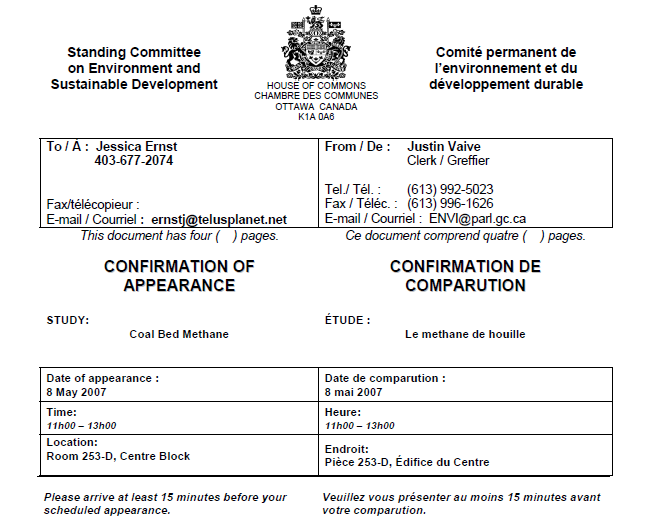
Ms. Jessica Ernst (Environmental Specialist, Ernst Environmental Services) Testimony, May 8, 2007:
Good morning. Bonjour.
I grew up in Montreal. I now live in Alberta. I’m very sorry, but I have forgotten all my French. I live near Rosebud, Alberta. It’s a small, little-theatre cultural town with a lot of beautiful historic resource.
I have worked in the oil patch for 25 years. I have also been banished by the regulator that Mr. David Pryce was so proudly discussing earlier in his presentation. I believe I was banished—this was in writing—by the energy regulator because they were trying to intimidate me.
I have evidence of EnCana Corporation not complying with the noise regulations, and the EUB actually covering up for the non-compliance in writing. I believe that the EUB, the regulator, did this to try to silence me. They copied the RCMP. So I’m very surprised that you, honourable members, here have allowed me to speak, because I do believe this was the first time this had happened in Alberta. I have been informed that the banishment was a violation of the Canadian Charter of Rights.
I grew up proud to be a Canadian. I grew up proud of our water, of our leadership on peace and mediation, and environmental issues globally. I have worked in other parts of the world. I have to admit, I’m ashamed to be Canadian now, and I plead to you all as this committee to listen carefully and review the documents, and carefully consider whether the federal government needs to get involved.
I have never seen such atrocities in my 25-year career of working in the oil patch as I have now seen in the boom: human rights violations, environmental degradation, and disrespect of the legislation and the regulations.
In regard to noise, the other day when I was leaving from the airport, the night before I left, the compressor noise—we’re surrounded by 13 EnCana compressors—drove me to distraction. Occasionally the noise is mitigated, but not always. There’s a straw-bale wall surrounding these compressors.
I have direct experience with the water. This is my water, on fire, from my tap, poured into a pop bottle, a water bottle. There is no sugar in there. A few minutes later I set it on fire. I’ve lived in my place since 1998, 50 acres. CBM came and my water dramatically changed–a chemical burst on my skin and eyes. My dogs not only refused to drink the water, but they would back up. White smoke was coming off the water.
There were whistling taps. I didn’t know what it was. I was really busy. I thought it was my plumbing. I thought, “Oh my goodness, I have to replace the taps.” Little did I know that I was living in an explosive time bomb. It was methane and other hydrocarbons coming out of my taps. Sometimes I couldn’t even close my taps there was so much gas. I couldn’t get suds out of my soap or shampoo anymore; the water changed.
Also, living rurally, you know you get stains on your plumbing and toilets—sorry to speak so intimately. All of a sudden my toilets went pristine, brand new. Something got rid of the stains, I think probably what was burning my skin.
Mr. Pryce mentioned the good regulations. This happened in 2004. These are the two aquifers in my community. This is an EnCana well. It fractured into—into—our aquifers. So the protection and the separation that was discussed is not possible. Perforations, which explode through the casing, and then the fracs, and who knows what solvents went into our aquifers?
In the States, EnCana was found to contaminate groundwater and did not protect health and safety.
This again is another picture of my water, a different picture. I don’t do this in the house anymore because the flame exploded so high it shot up to the ceiling. I’m a blur in the picture—this is me here—because I had to jump; it scared me.
We have one out of 20 resource wells leaking. The landowner in an investigation is usually blamed, instead of comprehensive testing of the resource wells. There are ways to find out which gas wells are leaking. They can be fixed. In this case, EnCana has stated publicly that they do not need to cooperate with this investigation because they don’t believe in the science that can lead to finding out which wells are leaking.
The regulators misinform the public. We have thousands of resource wells leaking.
The new testing that came up only began when a number of concerned citizens went to the legislature and went to the public. The MAC committee was still in deliberation. I believe the testing requirements wouldn’t have happened.
(1140)
We have now had, finally, a number of years of CBM, but our knowledge on groundwater is behind. The precautionary principle: where is it?
In 2005, industry advised the Alberta Energy and Utilities Board that some of their shallow fracs were damaging oil and gas wells. So they brought in some new rules. These rules should have been brought in before they began the experiments, especially for our drinking water.
This is a water well that exploded last spring. The farmer had dealt for three years with the regulator–the so-called best regulator. What’s wrong with this picture? Three men were seriously injured on sampling day. After contamination, some companies refused to cough up the data that was needed to investigate and remediate.
This is a diagram that the AEUB, the energy board, and Alberta Environment go to the public with. They say it never happens. Oh, no, there is no leaking.
By the way, methane is a much worse greenhouse gas than CO2, and we have thousands of these leaking methane directly into the atmosphere. There is surface casing vent flow, and gas migration through soils. The interesting thing is that the AEUB, in 2007, is even warning that the gas leakage and the gas migration potential is worse in the shallow zones. This is where we’re going to be doing our CBM and where our water is.
In Rosebud water we have 30 milligrams to 66 milligrams of dissolved methane, as well as free gas. CAPP, which is here today on the video, has a report that one milligram puts you at risk of explosion if the water passes through an unventilated place. A light switch, static in my hair, could have blown up my house.
The regulator is still in denial. They have done tests on our water. You have a table. We have benzene, toluene, ethylbenzene, and xylenes in our water. We have ethane, propane, methane, butane, and octanes, and we have kerosene in the community drinking water. In most cases, the landowner is blamed for the contamination by way of bacteria. On the table, you can look at the process we have to go through.
I read your report that came out recently on the chemicals and your Canadian Environmental Protection Act, and I plead with you to please implement this act in Alberta.
We are told that only nitrogen is used, so our water is safe because nitrogen comes from the air. I would like to show you a list. This came from Oilweek. These are a variety of products, hundreds of them, used in different stages of drilling, [f]racking, and servicing. Some of them contain diesel and mineral oil. In Alberta, the regulator does not require industry to disclose any of the chemicals used, not even if they’re toxic, not even if it’s benzene, a known carcinogen, or toluene, which damages the brain, notably in children. Toluene was found in our water.
We need to know what the chemicals are, especially so shallow, and I believe that the federal act is perfect. I noticed in your report this is seldom used and seldom implemented. I would like to ask that you use this and implement it in Alberta and ask the regulators to control the chemicals being used.
I have seen many pallets of chemicals that aren’t even on this list, bags of chemicals that say, “Danger, Unregulated”. Nobody knows what’s inside, driving through playground zones. We don’t know now how to analyze our water. These chemicals could have gone into our water, but we don’t know what to test for.
I also brought with me a pledge to protect our groundwater. You had this translated. I would like to ask every member of Parliament, not just the committee members, to sign this pledge and fax it to Honourable Minister Baird and our Honourable Premier Stelmach.
There are a few things we would like done to protect our groundwater.
CBM can be a fantastic new resource. We can all share in the prosperity. Canada is a fantastic country. I would like to see the Canada I knew as a child come back from corporate rule. I would like to see the people in charge. I would like to see public health and safety protected. There are still people in my community bathing in and drinking water with benzene and toluene. We do not need to harm people to have prosperity.
Coal-bed methane will spread far. The shales are coming. They will spread far. These impacts, violations of the Canadian Charter of Rights and Freedoms, will spread through the country if we continue to allow industry to rule.
(1145)
The precautionary principle: why are we allowing perforations and fractures into these shallow zones above the base of groundwater protection? Industry still doesn’t know what these shallow perfs and fracs do. They have stated this in writing to the EUB. Why don’t we learn first? We can do an economical mitigation here, slow down, think first, collect some data first. Let’s find out what we’re doing to our groundwater. This is Canada’s water. We all have water on the table here. This water will affect all of us.
The story has been much in the news. I bring one gift for my French friends here today. Quebec journalists are writing three stories on the water situation. In September, I believe, the Rosebud water situation will be published, but they are also writing about climate change. I find it interesting that Quebec is so concerned about what is happening to our water in Alberta that they’re sending journalists out. There is an Alberta Views article. I have copies here for you. They’ve been handed in. Even Canadian Business magazine has published the story about the water. There I am with my water. I can’t live with this water anymore. It’s too dangerous. I have trucked-in water that the Alberta government is supplying and paying for. I’ve lost my independence. I live rurally. I have to rely on trucked-in deliveries. I want my water back. I want to protect water for others.
In conclusion, in my experience, the regulations are not working. The regulators are not working. Instead of dealing with the industry’s non-compliance, they banished an ordinary citizen, considered me a threat to safety and the public. I had just found out when I got this letter from my regulator in Canada, a country that I thought was a democracy, that I was living in danger of explosion from my water. Yes, methane can be natural, but it is normally at very low levels. Nothing like the levels we have after this company, EnCana, fractured directly into our potable water supplies. They have cemented this well off, but we do not know what damage has been done to our aquifers. This is very serious.
Thank you.