@unraveledlissa.bsky.social:
I despise him to my very core. Me too.
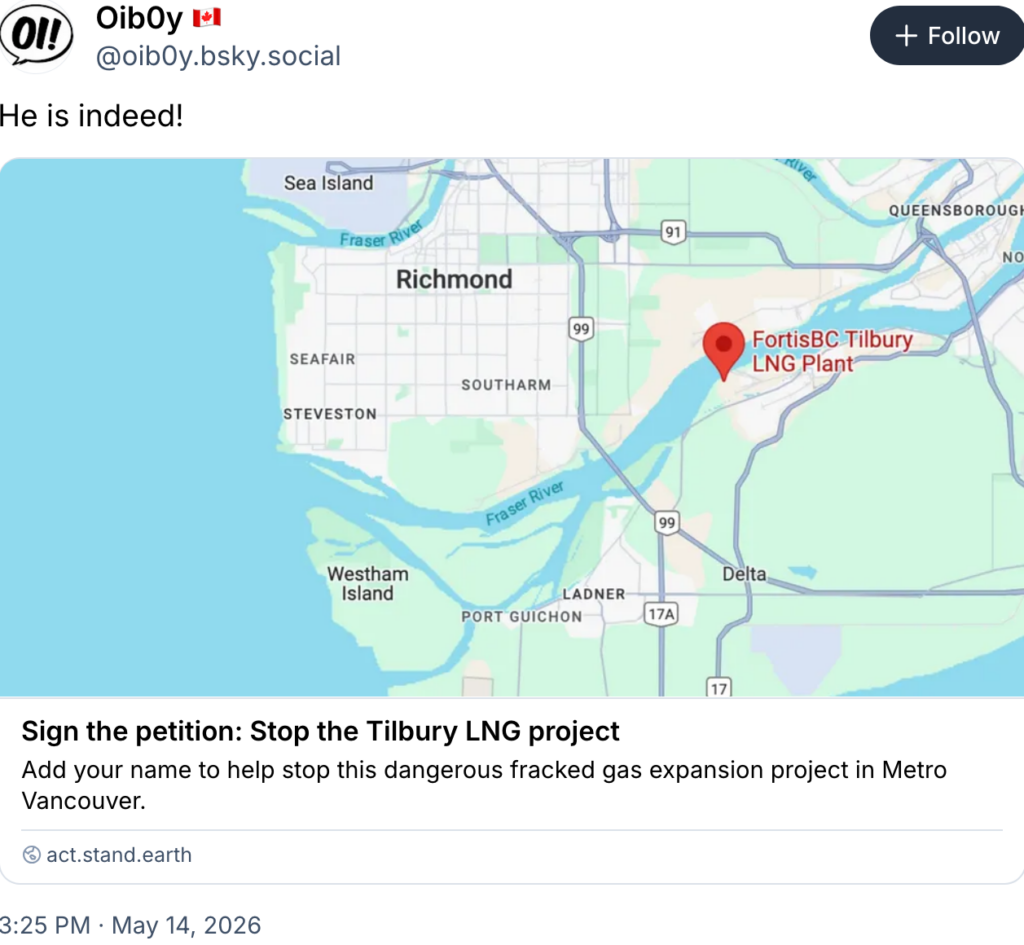
https://act.stand.earth/page/78758/petition/1
Carney government proposal targets extinction protections for endangered killer whales off B.C. coast, The orcas’ habitat has been affected by shipping traffic causing physical and acoustic disturbances, pollutants in the ocean, and declining food stock. By Althia Raj, May 14, 2026, Toronto Star
The federal government’s proposal to legally allow projects to go ahead even if they result in an entire species going extinct is directed at projects, such as ports and pipelines, that jeopardize the existence of the endangered southern resident killer whale population, several sources told the Star Wednesday.
There are only 73 to 75 of these iconic coastal species left in the Salish Sea. The orcas have been listed as endangered in Canada since 2001, and in the U.S. since 2005. But in the past ten years, their habitat has been so significantly impacted by shipping traffic causing physical and acoustic disturbances, pollutants in the ocean, and declining food stock, that their population has declined to the point that their continued existence is in jeopardy.
“There’s increasinglsy well-documented, scientifically documented evidence now that the conditions are getting worse. We’re losing reproductive females, we are not able to lower mortality or improve the fecundity — the birth rates of these whales — and they’re not recovering,” Misty MacDuffee, a biologist at Raincoast Conservation Foundation, told the Star.
Two years ago, Parks Canada and the department of Fisheries and Oceans concluded through a risk assessment that the southern resident killer whale population faced “imminent” threats to its survival. Efforts to “mitigate threats must continue,” the agencies said, as they noted that the government was “committed to assess and monitor measures to avoid or lessen the impacts of major projects (such Trans Mountain Expansion, Roberts Bank Terminal 2 and Tilbury Marine Jetty) and adaptively manage these measures in a manner consistent with the recovery strategy and action plan.”

Carney’s plan to ram big projects through is not progress. It’s recklessness
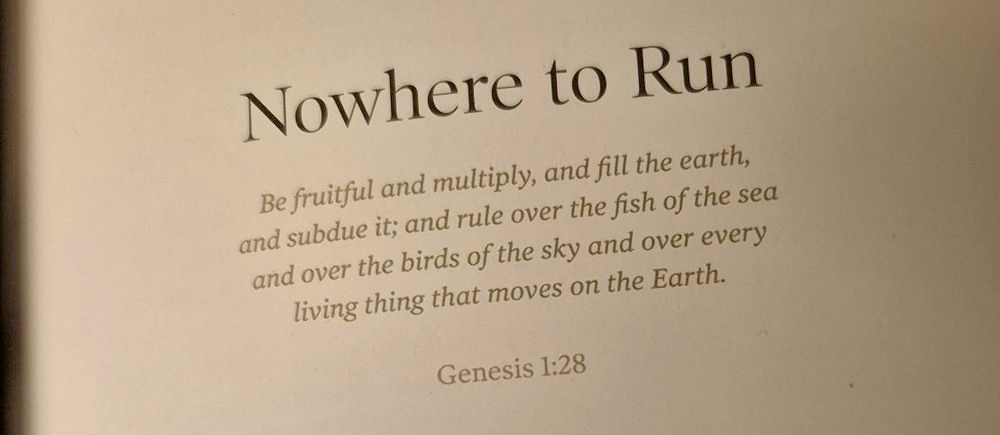
But fast forward to last week, when Prime Minister Mark Carney released a pre-legislation discussion paper that focused not on avoiding or lessening the impacts of major projects but of removing obstacles that lay in front of them.Monstrous fucker, Carney is, religious monstrous fucker
The government’s proposal, which is open for public comments until June 7, was lambasted by environmentalists for removing impact assessments on interprovincial pipelines, for allowing project construction to begin before impact decisions are made, for making it easier to destroy fish habitat, and for granting cabinet the ability to “exempt specific projects from the application of the jeopardy test for species at risk, but only if it’s in the public interest and if the proponent (of the project) has made all reasonable efforts to avoid or reduce impacts on at-risk species.”
The ‘jeopardy test’ is the prohibition on driving a species to extinction. “Not just kills the individuals, but wipes the species forever off the planet,” explained Environmental Defence’s Counsel and Ontario Environment Program Manager Phil Pothen.
“Currently, the Species at Risk (Act, also known as SARA) says that the minister may not authorize harm to a species or its critical habitat if it will jeopardize the survival of that species,” he added. “So, if it is likely to cause the extinction of that species in Canada, the extirpation of that species, then there is no authority for the minister to issue the permit,” he said.
Building a pipeline to Burnaby or Tsawwassen, or expanding the Port of Vancouver through Roberts Bank Terminal 2, for example, would require a species at risk permit because it impacts the critical habitat of the wouthern resident killer whale. Increased shipping traffic would create more underwater noise for the endangered orcas and make it more difficult for them to hunt their prey. Since SARA prohibits the destruction of any part of critical habitat, and these activities would “jeopardize the survival or recovery of the species,” under the law, the minister could not approve a permit.
“So what (the government has) done — what they are trying to do — they are kind of bypassing any legal challenges on these whales by passing these provisions that say that they can fast-track these projects without having to adhere to the Species at Risk Act,” said MacDuffee. “So yes, this is what they’re doing. They are trying to do an end run around the Specie at Risk Act and at the same time, they’re trying to tell the public how much they’re investing in Canada’s nature.”

Althia Raj: Mark Carney runs roughshod over the environment: ‘It’s worse than what Harper did’
Two sources within the government, who spoke on condition of anonymity, confirmed the last measure in the discussion paper is intended to create a carve-out for the southern resident killer whales.
Last month, the government’s spring economic update announced $160.8 million over five years to protect the habitat of whales on Canada’s coasts. The government also set aside $91.3 million over five years to address what it called “the potential for increased marine traffic on the West Coast as Canada embarks on its Trade Diversification Strategy.” The money is to implement a regional noise monitoring and management program and to address other threats to the southern resident killer whale population. In addition, the government said it would amend the Marine Mammal Regulations to increase the vessel approach distance from 200 metres to 1,000 metres for the southern resident killer whale to mitigate the threats posed by physical and acoustic disturbance from vessel traffic.
“(The whales) are not functionally extinct yet, but we’re heading there if we can’t turn this around — and not only are we not turning it around, we are making the conditions in which they must recover worse,” said MacDuffee.
@andrewbear.bsky.social:
The idea that natural gas “has one of the lowest emissions intensities in the world,” is a lie.
Never mind the endless leaks, frac’ing fracs the fucking subsurface, resulting in letting gases rise to surface everywhere, not just at the wellbore. Powering up the grid with frac’d natural gas is fucking demonic. And, most of the water injected to frac is lost permanently to the hydrogeological cycle FFS which has has been known since 2012.
Carney announces environment to be eliminated as cost-cutting measure by Ian MacIntyre, May 14, 2026, The Beaverton

EDMONTON – In addition to his announcement lowering industrial carbon pricing specifically just for Alberta, Prime Minister Mark Carney has unveiled a plan to eliminate all of Canada’s environment in order to balance the nation’s finances.
At a press conference with Alberta Premier Danielle Smith, Prime Minister Carney outlined his plan to remove all of Canada’s trees, waterways, and all but the bare minimum of its breathable air from the nation’s balance sheets.
“Coming at the from a purely financial standpoint, or as I call it, the only standpoint, selling off Canada’s entire environment just makes good fiscal sense,” explained Carney as he motioned to a series of Excel sheets.
Arguing that it was necessary to “unlock the economic potential of outside”, Carney explained that Canada’s lakes, forests, dirt, and beavers will be sold off to private enterprise. “This one-time revenue infusion will boost Canada’s GDP in myriad ways, that shall only benefit our largest corporations and asset holding class.”
Premier Smith took to the podium, explaining how Carney’s budgetary move represented a massive victory in Alberta’s long-standing war against the environment. “For too long, nature has been a key impediment in extracting the wealth of Albertans in order to hand that wealth over to multi-national oil conglomerates,” Smith added, beaming at her good fortune. “Now, not only can we build as many pipelines as we want without having to worry about environmental assessments, but Suncor will have enough money to buy up all our forests as well. It’s win-win, for Suncor!”
Asked whether his plan to privatize all of Canada’s environment would impact everyday Canadians, Carney answered, “Yes”. When asked to elaborate, he directed Canadians to contact Scotiabank Financial holdings, who are currently making an offer to acquire 50% of Canada’s environment in a joint bid along with the Brookfield Financial Corporation.
At press time, plans have been unveiled to train all Canada geese to say “You’re richer than you think!”
@heisenberg77.bsky.social:
The biggest political coup in Canadian history. The complete co-opting of the #ElbowsUp movement.