@ryankatzrosene:
Well that’s the coolest thing I’ve learned today
Corona Discharges Glow on Trees Under Thunderstorms by P. J. McFarland, W. H. Brune, D. O. Miller, and J. M. Jenkins, 2026, RESEARCH LETTER 10.1029/2025GL119591, Advancing Earth and Space Sciences
Key Points:
- A new ultraviolet‐sensitive instrument has enabled the first direct observations
of corona discharges on trees under thunderstorms - Corona discharges are transient in nature, often jumping from leaf to leaf and branch to branch but occur all across treetops
- Ultraviolet emissions from corona discharges are directly proportional to currents flowing through trees under high voltage
Abstract
Coronae, which are weak electrical discharges, have long been hypothesized to form on trees under thunderstorms, though never directly observed, characterized, or quantified. Using a newly developed instrument that measures ultraviolet emissions from coronae, the first direct observations and quantifications of coronae are presented for two trees under a thunderstorm in North Carolina. Coronae moved sporadically among leaves on every tree branch in a narrow field of view while the thunderstorm was directly overhead. Coronae emitted ∼1011 photons at 260 nm, corresponding to electrical currents of ∼1 μA, derived from unique measurements relating corona intensity to tree electrical current. Similar results across four additional storm intercepts from Florida to Pennsylvania give rise to a vision of swaths of scintillating corona glow as thunderstorms pass over forests. Such widespread coronae have implications for the removal of hydrocarbons emitted by trees, subtle tree leaf damage, and limited thunderstorm electrification.
Plain Language Summary
Most people know about lightning and the havoc it wreaks on forests. They do not know about the weak electrical glow, called a corona, that is thought to form on tree leaves under
thunderstorms. Coronae may have been seen in total darkness, but their amount and behavior have never been documented. Here, we present the first observations of the ultraviolet glow from coronae on trees under thunderstorms. Coronae glowed on a sweetgum tree and a pine tree during a thunderstorm in North Carolina. It hopped among leaves and sometimes followed a branch as it swayed in the wind. Similar observations were made on other trees under four other thunderstorms from Florida to Pennsylvania. Our observations indicate that corona shimmer on the swath of trees beneath a thunderstorm. These coronae can alter air quality in forests, subtly damage leaves, and possibly give charge to overhead thunderstorms.
In a first, researchers film treetops glowing during thunderstorms, Glimmer sparked by electrical fields detected in nature for the first time by Hannah Richter, 26 Feb 2026, Science
 Most beautiful thing I’ve ever seen.

In James Cameron’s movie Avatar, trees glow with a mesmerizing bluish hue. For half a century, researchers suspected treetops on Earth might also glow—albeit because of thunderstorms, not Pandoran bioluminescence. But the phenomenon, an electric outburst called a corona, had only ever been spotted in the lab.
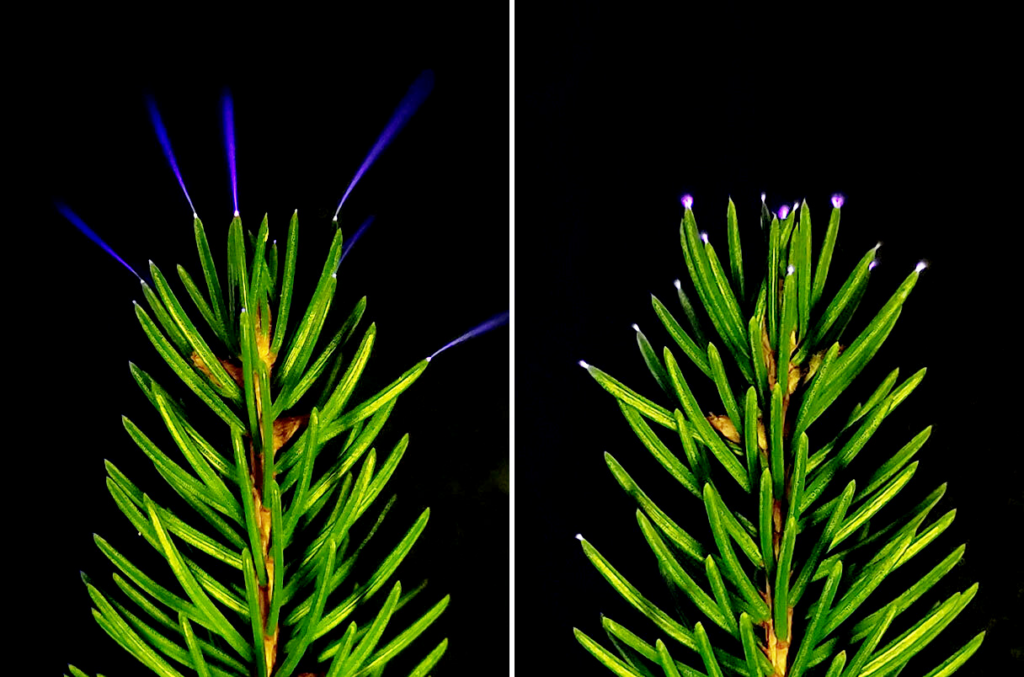
Now, a team of meteorologists has captured the first observations of faintly glowing trees in nature, they reported earlier this month in Geophysical Research Letters. The researchers caught a twinkling surrounding the tips of leaves at ultraviolet (UV) wavelengths. They hope the work will shed light on how thunderstorms electrify the landscape and produce lightning. These “are some of the biggest problems in the atmospheric sciences,” says Joseph Dwyer, a physicist at the University of New Hampshire who was not involved in the study. “This was not an easy measurement to make.”
During thunderstorms, storm clouds are highly negatively charged, which induces an opposite, positive charge in the ground below. Because opposite charges attract, the ground’s charge seeks to close the gap with the cloud–which, in forested areas, means the charges climb to leaf tips via trees’ electrically conductive trunks and branches. There, researchers believe, the charges concentrate, creating a strong, localized electric field. The field excites and ionizes nearby air molecules, creating a plasma. When the molecules relax or recombine, they emit light: a brief, shimmering corona.
Background ambient light has prevented cameras and the human eye from documenting the phenomenon at visible wavelengths. So Patrick McFarland, a postdoctoral researcher at Pennsylvania State University, and his adviser, William Brune, decided to search in the UV, and built an instrument from scratch. They combined a telescope, a periscope, and a high-speed UV camera and mounted the device on a 2013 Toyota Sienna. Then they spent the summer of 2024 chasing storms from Florida to Pennsylvania.
In North Carolina, the duo got lucky: Although most thunderstorms are short, they experienced one lasting 90 minutes, during which they observed two trees, a sweetgum and a pine. They compared videos of swaying branches on a regular camera with what was seen on the UV camera and found that twinkling UV dots matched up with the tips of branches. The observations confirmed not only that coronae exist, but also that they can occur in multiple locations on different kinds of trees. The coronae also seemed to jump quickly between the tips of leaves on different branches. It suggests that “hopping” is a fundamental characteristic of coronae, potentially because of shifting electric fields or electrical charges taking different paths up a tree. Roughly five more observations throughout the summer confirmed the North Carolina findings.
“If you can imagine being able to see these coronae under a thunderstorm, you would probably see a really, really cool light show with all these flickers or shimmers popping up,” McFarland says. “It’s fantastic to have concrete proof.”
The authors already have ideas about the potential effects of coronae. They should produce hydroxyl radicals, molecules that are sometimes called the atmosphere’s detergent, because they destroy methane and carbon monoxide. But they can also gunk it up by producing hazes and smog from interactions with volatile organic compounds emitted by trees. Although the amount of hydroxyl produced during a thunderstorm would be too small to affect the global climate, it could influence air quality in the immediate region surrounding a forest canopy, McFarland says.
The corona observations should also help researchers understand streamers, the next phase of a thunderstorm’s electric discharge that leads to full-blown lightning, says Richard Sonnenfeld, a physicist and director of the Langmuir Laboratory for Atmospheric Research at the New Mexico Institute of Mining and Technology. Although it’s unlikely that the coronae on trees last long enough to turn into streamers, they do seem to precede streamer formation in thunderclouds, which are difficult to study. “We’re putting all the pieces together, and it’s simply beautiful every time you drop a new piece in,” Sonnenfeld says.
It’s unclear whether all this crackling electricity damages trees at all. Previous work in a lab has shown that leaf tips get visibly burnt after only a few seconds of coronaelike voltages. But “trees are incredibly resilient,” Ya, but not to human over population, greed, selfishness, pollution, and global warmingsays Evan Gora, a forest ecologist at the Cary Institute of Ecosystem Studies. “I would assume, if [coronae] can damage trees, then trees also likely have some adaptations to them.”
For now, the researchers are keeping their storm-chasing van parked as they work to increase the sensitivity of their instrument, which could only perceive the strongest glows, McFarland says. “It’s possible, and maybe even likely, that these coronae are much more widespread than even what we report.”
doi: 10.1126/science.zgdl9r1