

Starlink Satellites Fall Back To Earth Every Single Day – Here’s What Happens To Them by Trevor Mogg Nov. 8, 2026 BGR
SpaceX deployed its first batch of Starlink internet satellites in 2019, and since then has put more than 10,000 into low-Earth orbit. The satellites are part of a growing constellation that provides broadband internet to more than a million customers around the world. But eventually, each and every one of these satellites will fall back to Earth.
Orbital Radar recorded 445 Starlink reentries in 2026 between January 1 and October 22, while Spaceweather’s tracking data counted 435 up until October 27, with the figures averaging around one or two reentries per day. Satellites are often deorbited by the operator when they reach the end of their operational lives, though they can also descend due to a malfunction or loss of power. During the high-speed reentry, the generated heat causes the spacecraft to break apart. Most of the material then burns up or vaporizes, with some particles and gases dispersing into the atmosphere. The satellite fragments don’t always completely disintegrate, however, as some can survive the descent and reach Earth’s surface.
The most frequently deployed Starlink model, the V2 Mini, has a main body measuring about 13.5 feet x 8.9 feet (4.1 meters × 2.7 meters), with its solar array spanning around 100 feet (30 meters) tip to tip when deployed. The Starlink satellites operate in low-Earth orbit at an altitude of between 280 miles and 304 miles (450 km and 490 km ) — slightly above the International Space Station. They’re designed for a service life of around five years, after which SpaceX aims to deorbit them using onboard propulsion. Atmospheric drag also gradually slows satellites, so failed satellites that can no longer be re-positioned eventually descend into Earth’s atmosphere. Disposing of them in this way prevents them from becoming hazardous space junk, though destroying them in Earth’s atmosphere comes with risks.
When reentry goes wrong
Although most Starlink satellites burn up during reentry, there’s a small chance that a fragment could survive and hit land or water. In fact, it happened in Canada in 2024. Saskatchewan farmer Dan Kennedy found a panel about the size of a laptop computer on his land 310 miles (about 500 km) east of Calgary. SpaceX later identified the 5.5-pound (2.5 kg) aluminum component as being part of a Starlink satellite. The satellite had reentered Earth’s atmosphere along with 19 others after an erroneous deployment from the upper stage of a SpaceX Falcon 9 rocket left them in an unusually low orbit.
 Reality Check:
Minimizing Musk space junk sizes and risk, these photos below are from articles I read about another Musk space garbage incident in the same year in the same province:
These pieces of Elon Musk space junk landing on you or a loved one would most assuredly kill, likely flatten you to nothing.
Trunk fragments were even found from Elon Musk’s first operational crewed Dragon mission, with those pieces strewn over fields in New South Wales, Australia. It is becoming evident that deadly debris falls to the ground every time a Crew Dragon trunk re-enters, with pieces being found whenever this occurs over an accessible area.
These are not small pieces, with some approaching the size of ping-pong tables and weighing 100 pounds. They could easily cause a fatality or substantial damage.
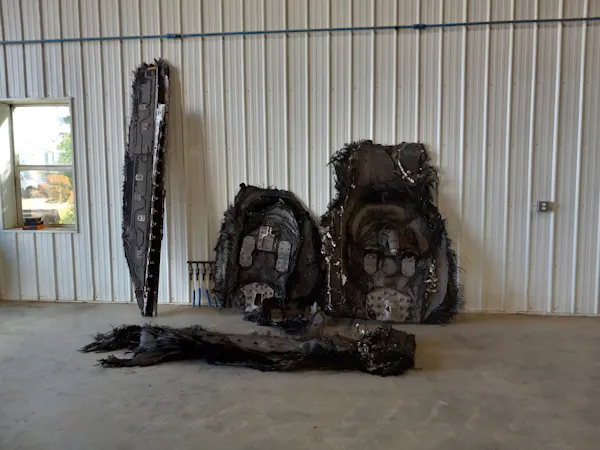
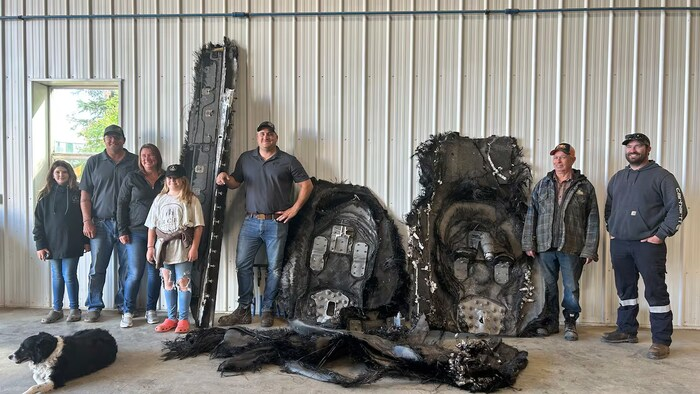
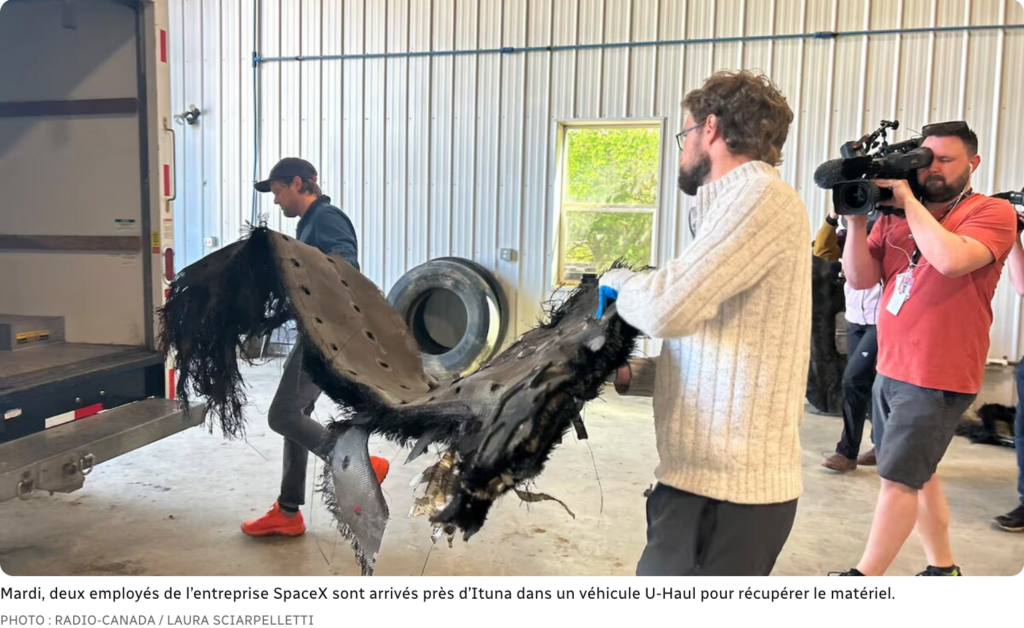
SpaceX retrieves space junk from Sask. farmer 2:36 Min by CBC News Saskatchewan June 11, 2024
Expert statement, Samantha Lawler, in the clip:
The fallen space junk will not be an isolated incident.
“It’s going to happen over Canada more often uh because of the orbits that SpaceX has chosen to use right SpaceX dominates the use of orbit right now. They have uh something like 62% of all satellites are SpaceX uh so it’s really important for um Canadians to know like the highest density of those those Starling satellites is right above our heads right here in southern Saskatchewan.”
Lawler says SpaceX needs to be transparent about how their operations are affecting the atmosphere and how they deal with situations like this one.
“There’s no public admission of this. There’s no apology. There’s no right like they could have killed people. They could have killed people in Saskatchewan. Those pieces are huge. What if it had fallen on Regina? What if it had fallen on Barry Sawchuk’s house? Like it absolutely would have killed people.”
“We’re sorry, we’re not permitted to speak to journalists” about our deadly space garbage which can kill you as we pollute a public U-haul truck that will be rented out by many ordinary families after this and will not know.
End Reality Check.
SpaceX discovered that the fragment was part of a lid on a Starship satellite’s antenna. Starlink said in a report that the satellites’ solar arrays kept them in a stable orientation during descent, preventing them from tumbling, as intended, prior to reentry. Tumbling helps satellites break up during the high-speed descent through the atmosphere. But without it on this occasion, the satellites broke apart lower in the atmosphere than predicted, altering the level of heat experienced by individual components, and causing a part of at least one ??? One ??? of them to end up in a Saskatchewan field.
In its subsequent analysis, SpaceX identified shortcomings in its reentry risk assessments and updated its calculations to better account for component heating. They also incorporated lessons from the incident into the design of their V2 Mini Optimized satellites. With Amazon Leo and various Chinese operators now building their own vast constellations of internet satellites, does it mean more incidents like this are inevitable?
Will there be more internet satellite debris hitting Earth?
SpaceX may have pioneered the large-scale deployment of internet satellites, but other projects are following in its footsteps, among them Amazon Leo — formerly Project Kuiper — and China’s Spacesail and Honghu-3 projects. Once completed, these and other planned constellations will add tens of thousands of extra satellites to low-Earth orbit, leading to a steady stream of reentries as each one reaches the end of its operational life. Maintaining a constellation with satellites that have a typical operational life of around five years means having to continually launch replacements while at the same time de-orbiting aging spacecraft. A study in 2025 estimated that, for a constellation of tens of thousands of satellites, around 20% of the fleet would need replacing each year. Across the major planned networks it examined, that could mean thousands of reentries every year.
It’s important to keep in mind, though, that more de-orbits doesn’t necessarily mean more debris reaching the ground. Remember, the Saskatchewan incident resulted from an erroneous deployment rather than a routine end-of-life de-orbit, and most of those appear to have followed the expected course, with the entirety of each satellite burning up during descent. But as the number of reentries grows, so will the opportunity for something to go wrong, increasing the potential risk to people and property on the ground.
There’s also the matter of pollution. While we certainly want satellites to burn up during reentry, the process releases particles into the upper atmosphere. Aluminum oxide, in particular, may persist for years or decades and even deplete Earth’s ozone layer, which protects us from harmful solar radiation. The precise effects remain uncertain, however, and thus more work is needed to fully understand the potential consequences.