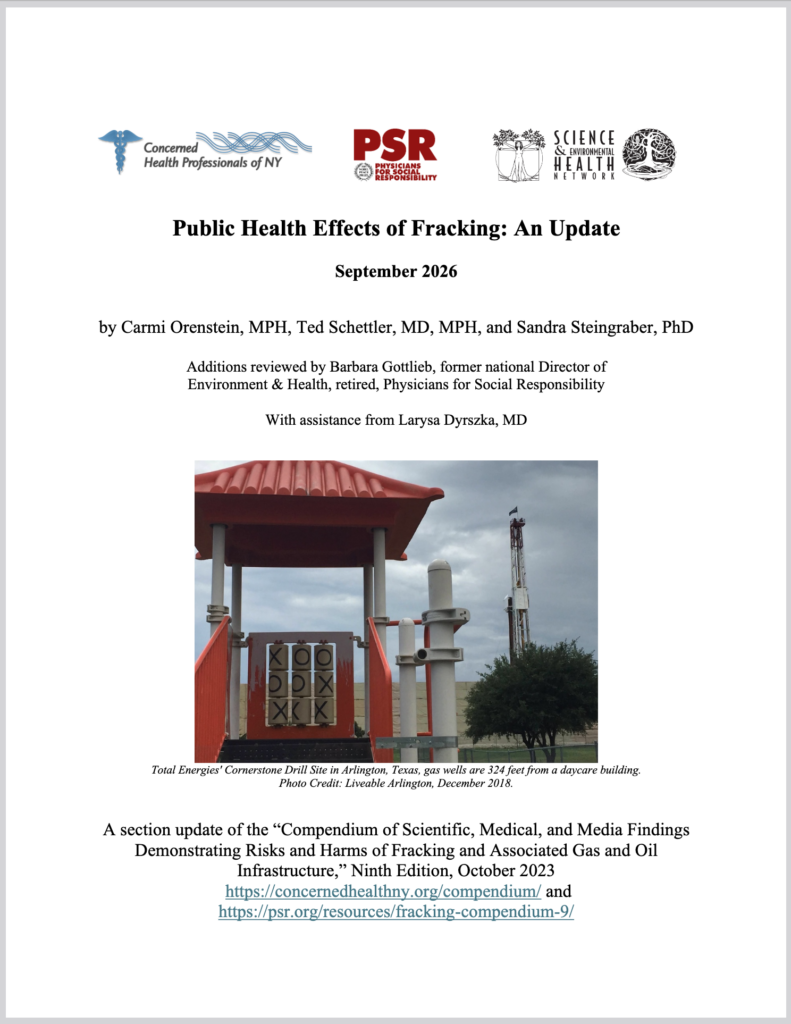
Public Health Effects of Fracking: a 2026 Compendium section update by by Carmi Orenstein, MPH, Ted Schettler, MD, MPH, and Sandra Steingraber, PhD. Additions reviewed by Barbara Gottlieb, former national Director of Environment & Health, retired, Physicians for Social Responsibility. With assistance from Larysa Dyrszka, MD, Sept 2026
…
Introduction
In the ninth edition fracking science Compendium (October 2023) we identified the following
trend in our review of the body of research: Public health problems associated with fracking
include prenatal harm, respiratory impacts, cancer, heart disease, mental health problems,
and premature death. Subsequent original studies, reviews, and analyses have added evidence
to previous findings in the majority of these areas, especially with regard to adverse birth impacts and childhood cancer.
Fracking processes and emissions include known carcinogens and endocrine disruptors, indicating plausible biological mechanisms for these impacts. With at least 17.6 million Americans living within one mile of an active oil or gas well, and inactive wells also releasing pollutants, the research points to a vast public health crisis.
The newer findings summarized in the present Update include results from studies published
from May 2023 through February 18, 2026 (since the ninth edition and through this project’s
cutoff date), plus several studies that were previously missed. They reflect increasingly
sophisticated epidemiological study designs that incorporate increasingly refined measures.
Many studies are firsts that focus on a particular impact in a specific geographic area, with others building on well-studied locations, such as Pennsylvania, Colorado, and California’s San Joaquin Valley. Several of the new studies utilize complex analyses of factors including exposure to the various phases of drilling and fracking for oil and gas and analysis of those exposures at varying distances. Six new reviews, with varying areas of focus and with various designs, incorporate and analyze data from hundreds of studies.
The new studies and analyses described in this Update show serious health impacts of urgent concern. Many document dose-response relationships: the closer people reside to oil and gas sites, the greater the exposures and the greater the harm they experience.
Reinforcing these findings, a recent interdisciplinary analysis including animal and laboratory research found moderate evidence that fracking plays a role in disrupting reproductive health. Further, a review of toxicological studies addressing exposure to fracking chemicals and water samples linked to fracking found deleterious effects—including endocrine disruption, carcinogenicity, behavioral changes, impaired metabolism, immune dysregulation, and impacts on mammary gland development—that align with the epidemiological literature.
The evidence also overwhelmingly points to the benefits of increased setbacks. That is, from a
public health point of view, the distance between fracking sites and communities where people
live and work should be as great as possible, as many researchers recommend.

Authors of studies that document early-life exposures linked to harmful outcomes, including birth defects and childhood cancers, note the possible effects on a child’s entire life course and even survival. A three-university research team said that the consistent findings on childhood cancer are “directly actionable and can inform siting decisions, setback distances, and land-use policies,” and called for strengthening children’s health protections. This and other policy-relevant statements are included in the summaries below.
Our most recent full edition of the Compendium, which contains sixteen additional sections—
including topics such as air pollution, water contamination, and occupational health and safety
hazards—concludes: Our examination uncovered no evidence that fracking can be practiced in a manner that does not threaten human health directly or without imperiling climate stability upon which human health depends. As shown by this section Update, the second in a series, the research continues to affirm our conclusion.
The research summaries below include: all those in the ninth edition fracking science
Compendium, either in the section entitled “Public health effects, measured directly” (pages 263-301) or covered as late-breaking studies in that report’s introduction; new studies appearing after May 8, 2023 and through February 18, 2026; and several studies that were missed in the ninth edition. The italicized research summary is updated from the ninth edition
Public Health Effects: A Ninth Edition Compendium Section Update
Scientific evidence for a broad range of public health impacts linked to fracking continues to
emerge across the United States and Canada.
Notably, in multiple states and nationally, studies of pregnant women in regions of intensive oil and gas extraction point to reproductive and developmental risks, including low birth weight, preterm births, and birth defects. A study that surveyed U.S. birth certificate data from 1990 to 2020 showed that exposure to oil and gas drilling activity significantly reduces birthweight by an average of 10 grams. A review of 24 studies showed maternal exposure to oil and gas extraction was significantly linked to preterm birth, miscarriage, small for gestational age, and reduced birth weight, and a scoping review including 52 epidemiological studies concluded that injurious effects on birth outcomes linked to proximity to fracking included reduced fetal growth, an increase in preterm birth, and various birth defects. In a recent study, there were elevated risks of birth defects in four core fracking counties of the Barnett Shale region compared to overall statewide risk of these conditions in Texas. Studies conducted in previous years in states including Oklahoma, Texas, Colorado, and Ohio, found birth defects elevated among infants whose mothers lived near drilling and fracking sites while pregnant. In California’s San Joaquin Valley, women who lived with the highest exposure to oil and gas wells during early pregnancies were eight to 14 percent more likely to experience preterm births. Two related studies in British Columbia found that pregnant indigenous women living near fracking sites had elevated levels of developmental toxicants, including barium and strontium, in their hair and urine.
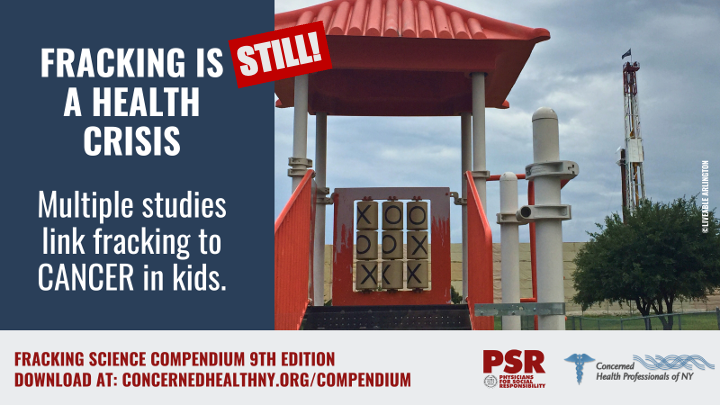
Residential proximity to oil and gas development is strongly linked to childhood cancer, most
consistently for leukemia, according to a 2025 systematic review. Fracking has been linked to
various cancers in several states. Researchers identified a higher risk of acute lymphoblastic
leukemia in Colorado children within 13 kilometers (8 miles) of an active oil and/or gas well site; they also noted the presence in this environment of “leukemogens,” specific carcinogens known to increase the risk of leukemia. Children living within a half mile of a fracking site in southwestern Pennsylvania were almost four times more likely to develop one of four cancers studied compared to children who lived farther away, and the risk of lymphoma specifically was elevated even at greater distances. Previous studies in these two states had also found elevated childhood cancer rates among those living near oil and natural gas development operations.
As shown by multiple studies in Pennsylvania, as the number of gas wells increases in a community, so do rates of hospitalization. Replicating previous study results, medical records of over 46,000 asthma patients in Southwestern Pennsylvania showed strong evidence for an increased risk of exacerbation of asthma symptoms, emergency room visits, and hospitalizations for those living within 1 to 10 miles of fracking sites. Hospitalizations for pneumonia among the elderly were likewise found to be elevated in areas of fracking activity. Pennsylvanians living in proximity to gas wells also experience sleep disturbance, headache, throat irritation, stress/anxiety, cough, shortness of breath, sinus problems, fatigue, wheezing, and nausea.
Researchers are documenting increased rates of other serious health impacts associated with
proximity oil and gas wells. An emerging body of evidence from multiple states links fracking to increased risk of death and increased rates of heart attack, ischemic heart disease, and heart
failure among older residents living nearby. Drilling and fracking operations in multiple states are variously correlated with increased rates of asthma; increased hospitalizations for pneumonia and kidney, bladder, and skin problems; high blood pressure; elevated motor vehicle fatalities; symptoms of depression and anxiety; ambulance runs and emergency room visits; and incidence of sexually transmitted diseases. In Colorado, acute health risks remained despite “best management practices” to reduce air emissions from fracking operations, according to a new cumulative human health risk assessment. Increased risk of Coccidioidomycosis (Valley Fever) was identified in those Kern County, California residents living within 5 kilometers of new oil and gas wells. A recent analysis of ten years of Medicaid claims and U.S. county-level oil and gas production data showed a small increase in inpatient psychiatric hospitalization rates during bust periods. A new study found an increase in premature deaths among adults aged 25–64 years old in oil and gas boom-and-bust U.S. counties, especially during bust periods, and with “extreme production busts” reaching up to over 19 additional deaths per county. (See the full Compendium for data on fatality rates for oil and gas workers specifically.)
Chemical exposures associated with oil and gas operations pose specific risks. Benzene levels in ambient air surrounding drilling and fracking are sufficient to elevate risks for future cancers in both workers and nearby residents, according to studies. Animal studies show numerous threats to fertility and reproductive success from exposure to various concentrations of oil and gas chemicals at levels representative of those found in drinking water near some oil and gas operations. At least 43 chemicals used in drilling and fracking operations are classified as known or presumed human reproductive toxicants, while 31 others are suspected human reproductive toxicants. Two dozen chemicals commonly used in fracking operations are known endocrine disruptors that can variously disrupt organ systems, lower sperm counts, and cause reproductive harm. Endocrine-disrupting chemicals have also been identified in fracking wastewater. Tissue culture and animal studies show endocrine-disrupting effects in response to exposures to mixtures of fracking chemicals that reflect concentrations found in fracking wastewater. The most recent reviews analyzing the pool of non-human studies corroborate these earlier findings.
…
Refer also to: