It’s National Indigenous History Month in Alberta. First Nations Are Being Warned to Fear for Their Safety. The Blackfoot Confederacy has issued a safety warning to its members amid rising threats linked to Alberta’s separatist movement. by Brandi Morin, Jun 04, 2026, Indigenous Insider
Tansi — You showed up.
6,600 readers. 330 paying. That gap is the weight I carry every single day.
I leave my girl behind and hit the road. I’ve stood my ground in front of armed guards. Reported through fever, through grief, through terrain that doesn’t forgive. I’ve put my body on the line — because no one else is coming.
These stories exist because I refuse to let them disappear.
That’s what reconciliation looks like from where I’m standing.
I need you in this with me. Step into the fire with me.
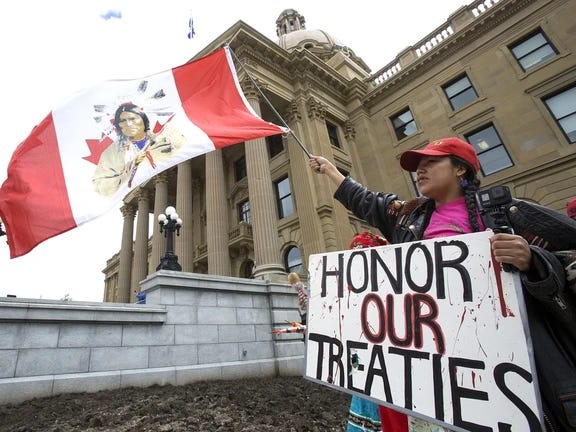
So yeah…It’s National Indigenous History Month. A time to celebrate. A time to honour. A time to acknowledge the resilience and brilliance of Indigenous peoples across this land.
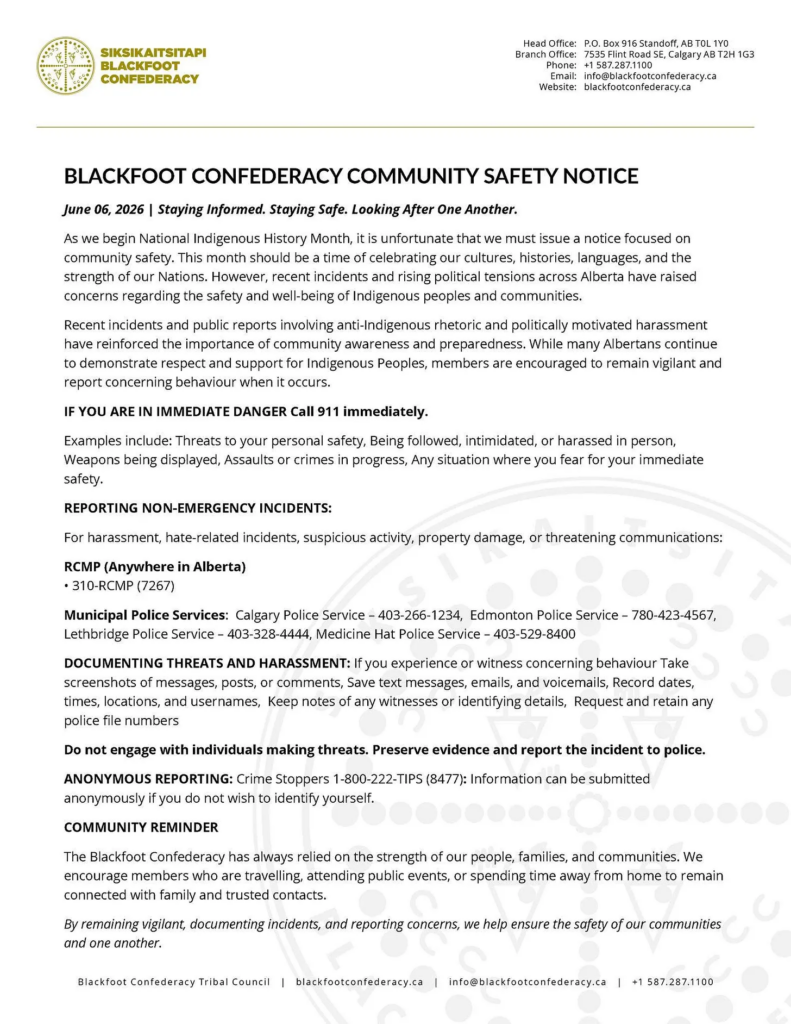
And yet — the Blackfoot Confederacy just had to issue a community safety notice warning their members about harassment and potential violence.
The notice, released this week, asks Blackfoot members — whether they’re living on reserve, studying in the city, travelling, or just going about their daily lives — to stay aware of their surroundings. To document threats. To not engage with people trying to provoke them. It lists emergency numbers. It tells people to share their travel plans with loved ones.
This is what it has come to in Alberta in 2026.
The Confederacy’s notice doesn’t mince words about “rising political tensions” and “anti-Indigenous rhetoric and politically motivated harassment.” We know exactly what that means. The racist underbelly of this province has found a new political home, emboldened by the MAGA playbook bleeding across the border. The Wild West energy is back — and Indigenous peoples are, once again, in the crosshairs.
@nigelb.bsky.social June 7, 2026:
Janice Mackinnon’s op-ed for the Calgary Herald is full of illogical statements and innuendo designed to support Premier Smith’s goal of revisiting the constitutional protections accorded to existing Indigenous and treaty rights in Canada in 1982. Here are some examples.
First, Mackinnon claims that the ACFN case “resulted” in a wordy & confusing referendum question. It did no such thing. We have the wordy and confusing secession question framed as it is because Premier Smith decided to pose that question. The ACFN decision did not compel that result in any way.
Second, the ACFN decision did not turn on the duty to consult. The principal ground that the Court gave for quashing the Sylvestre petition was that the petition was already dead and buried by an earlier KB decision and the UCP’s efforts to resurrect it were inept and legally ineffective.
Third, reliance on Prof Newman is misplaced. His suggestion that the ACFN decision is flawed because the Court failed to take into a/c the value of democratic participation when interpreting constitutional rules designed to protect minority right, is, to say the least, novel if not simply wrong.
Fourth, Ms Mackinnon blames the protection of Indigenous rights in Canada as the principal source of investment uncertainty in AB. Really? Most folks who aren’t trying to shore up Premier Smith might list Smith’s secession referendum question as the principal source of investment uncertainty.
Fifth, Mackinnon believes that most of her invented problems will be resolved if the feds simply repeal their UNDRIP implementation legislation. That’s nonsense. The ACFN case never mentioned UNDRIP. Repealing the federal statute doesn’t change the legal status of the Declaration in Alberta.
But it’s what’s missing that is most troubling. One thing entirely missing is any reference to reconciliation & the Crown’s duty of honourable dealing with Indigenous nations.
Unilateral repeal is not honourable or consistent with reconciliation or ultimately with investor certainty. Fin.
@mgrasdal.bsky.social:
Whatever happened to Ms. MacKinnon? She was a good finance minister for Roy Romanow’s NDP government. Then she chaired the problematic Blue Ribbon Panel on Alberta’s finances. She later proposed eliminating the U of A’s EDI office. Now this. Quite the trajectory.
@nigelb.bsky.social:
My only observation is that when SK went right and forgot its social democratic roots so too did Ms Mackinnon (and perhaps Mr Peter Mackinnon too).
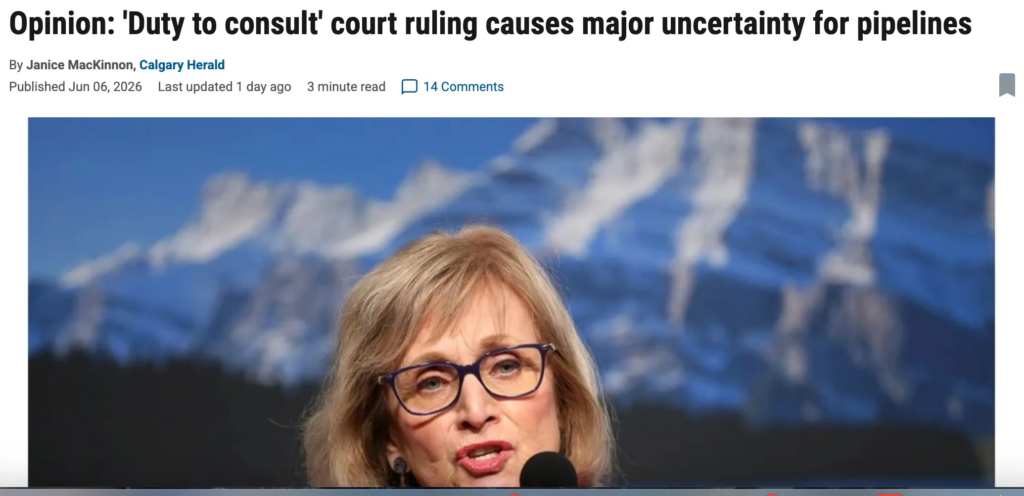
Opinion: ‘Duty to consult’ court ruling causes major uncertainty for pipelines by Janice MacKinnon, Calgary Herald, Jun 06, 2026
An Alberta King’s bench judge’s decision that a proposed referendum question supporting separation is unconstitutional because the province had a duty to consult First Nations has implications for the referendum question and for the Alberta-Canada MOU proposing a pipeline to the Pacific Coast.
On the referendum, the result is a wordy and confusing question that asks Albertans if they want to remain in Canada or “commence the legal process” to hold a “binding referendum on whether or not Alberta should separate from Canada.” Regarding the MOU, the flaws in the judge’s interpretation of the duty to consult add to the uncertainty and risks of building a pipeline to the West Coast.
Dwight Newman, a University of Saskatchewan law professor and expert in constitutional and Indigenous rights law, criticized the judge who “mechanically applied the duty to consult test” rather than taking a broader view of the importance of participation in referendums as a “vital act of democratic participation.” The shortcomings of this decision were described by Newman as part of a pattern in which “simplistic understandings of rights and desires to apply simple little legal tests have overtaken judgment,” citing the example of the British Columbia Cowichan decision, which called into question private property rights and caused “chaos.”
Judicial decisions that misinterpret the duty to consult can be appealed and overturned by the Supreme Court. But the risk for pipeline companies is that a problematic trial court decision causes lengthy and costly delays as appeals wind their way to the Supreme Court.
The uncertainty and risks associated with judicial interpretations of the duty to consult are compounded by the federal government’s adoption of the United Nations Declaration on the Rights of Indigenous Peoples (UNDRIP). Newman warns that UNDRIP could frame court decisions and raise the standard for Indigenous participation in infrastructure projects from duty to consult to the requirement of Indigenous consent, effectively giving First Nations a veto and risking “additional legal challenges for national infrastructure projects being pursued by the federal government.”
The risks and uncertainties over shifting policy and court decisions regarding Indigenous participation in projects compromise Canada’s competitiveness. Canada can diversify its trading relations beyond North America; however, it must compete with the United States for investment. The government has made important policy changes to facilitate the building of a pipeline to the West Coast, which would enhance energy security, trade diversification, employment and government revenue.
However, to date, there is no proponent for such a pipeline. Instead, Alberta’s two biggest companies have announced plans to pursue building oil pipelines to the U.S., even though that oil sells at a discount. One advantage of building pipelines south rather than west is avoiding the uncertainties associated with Indigenous participation in major projects. Also, there is support for pipelines in the states south of the border; Wyoming’s governor welcomed the prospect of a Canadian oil pipeline through his state and called it a sign of cross-border co-operation.
Enhancing Canadian competitiveness requires federal government changes with respect to Indigenous participation in major projects.
The Canadian government should repeal UNDRIP, clarify its support for the duty to consult and commit to fast-tracking appeals of lower court decisions on major projects to the Supreme Court to avoid costly delays.
Canadians can hope that pipeline companies will build an oil pipeline to the Pacific coast. But they should expect that these companies will build pipelines to the United States, since they are in the business of building pipelines and the United States is where they can do business.
Janice MacKinnon is an executive fellow at the University of Calgary School of Public Policy. She chaired the Blue Ribbon Panel on Alberta’s finances.