@climatecasino.net June 7, 2026:
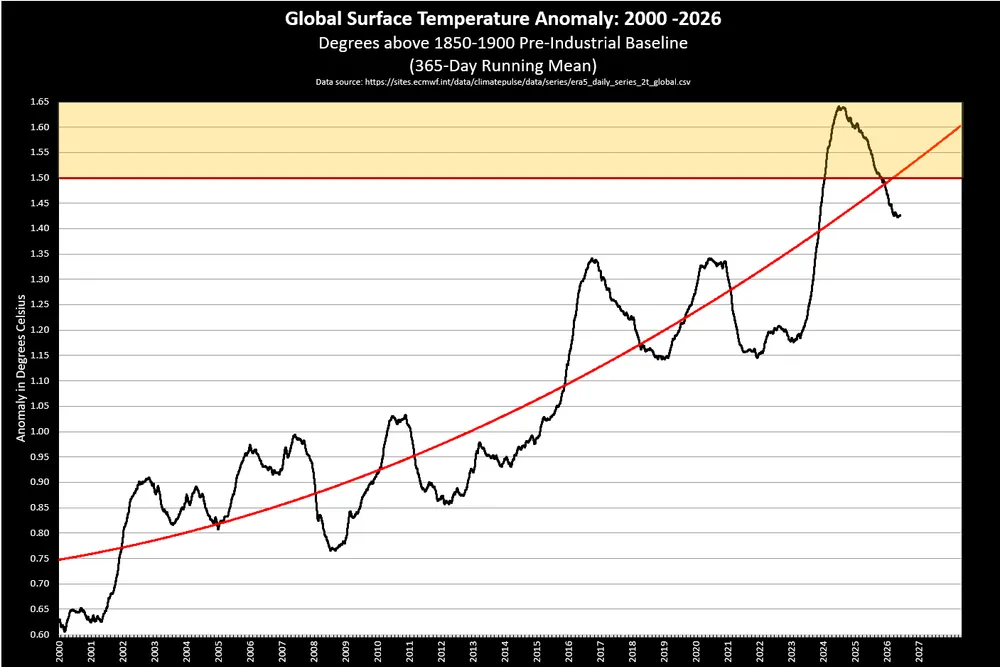
We’ve crossed 1.5°C.
@davidacollier.bsky.social:
Oh shit
***
Mysterious ‘cold blob’ in the Atlantic suggests the AMOC is weakening, A patch of ocean south-east of Greenland is the only place on Earth that is cooling, and it could be a sign that the warm water “conveyor belt” in the Atlantic is slowing down by Alec Luhn, 4 June 2026, New Scientist

Over the past 150 years, Earth’s entire surface has been warming, except for one patch of the north Atlantic. Located south-east of Greenland, this area has cooled by as much as 1°C and is known as the “warming hole” or the “cold blob”.
Scientists have been split over why this cold blob exists, but the latest evidence backs up the idea that it is caused by a weakening of the Atlantic Meridional Overturning Circulation (AMOC), the system of currents that transports warmth from the tropics to Europe.
The AMOC carries warm, salty water from the Gulf of Mexico towards the north Atlantic, where it cools and sinks, flowing back south along the ocean floor. Scientists are concerned that the surge of freshwater from Greenland’s melting ice is making this salty water less dense, so it sinks more slowly, weakening the circulation.
Some research suggests the AMOC could cross a tipping point within decades, locking in a future collapse that would freeze Europe and disrupt monsoon rains crucial for agriculture in Africa and Asia. But we only have 22 years of direct observation of AMOC strength, not enough to tease out a clear trend.
Climate modelling has suggested that a slowing AMOC is carrying less warm water to the north Atlantic, resulting in the cold blob. However, other modelling has placed most of the blame on the atmosphere.
In a 2022 study, Chengfei He at Northeastern University in Boston and his colleagues found that rapid warming of the Arctic has reduced the temperature difference between the pole and the tropics, shifting the jet stream northwards into the cold blob region. The arrival of these strong westerly winds has forced more evaporation and churned up the water, drawing heat out of the ocean.
Greater evaporation has also led to more clouds, shading the cold blob from the sun’s warmth, another study suggested.
Stefan Rahmstorf at the Potsdam Institute for Climate Impact Research in Germany and his colleagues have now investigated the cold blob with climate reanalyses, which are based on direct weather observations from satellites, buoys and ships, rather than climate modelling.
They found that heat loss from the ocean surface has decreased in the cold blob since 1955. In addition, the ocean has been cooling not just near the surface, but also 1000 metres down. That means that the AMOC is transporting less heat, not that winds are taking more heat away, they argue.
Winds and clouds “only explain a modest fraction of the warming hole”, says Rahmstorf. “Even if, in some modelling approaches, it seems possible that the cold blob is caused by the atmosphere, in fact, the data show it is caused by the ocean.”
The finding reveals that Atlantic Ocean circulation has already been changing for decades, he adds, raising concerns about a collapse not only of the AMOC, but also of the subpolar gyre, a massive swirl of currents around the cold blob. The subpolar gyre helps bring in salty surface water to feed the sinking of cold, dense water that drives the AMOC. If it shuts down, it could reduce temperatures in the UK and nearby countries more rapidly than a full AMOC collapse.
“The subpolar gyre passing this tipping point could already lead to serious climate impacts in western Europe as early as in the 2040s,” says Rahmstorf.
But the ocean surface heat flux hasn’t been directly measured, so the study could only infer it through modelling. A 2021 study based on some of the same reanalyses as the Rahmstorf one found that stronger winds accounted for most of the cold blob.
“It’s challenging to try to use reanalysis to infer the energy budget in the cold blob,” says He.
The new study is useful, “but it won’t be the final word” on what is causing the cold blob, says David Thornalley at University College London.
Because data is limited, alternative explanations for the cold blob still can’t entirely be ruled out, according to Neil Fraser at the Scottish Association for Marine Science. For example, a branch of the AMOC known as the Norwegian current may be strengthening, transporting more heat out of the cold blob area, he says.
“The cold blob is consistent with a weakening AMOC,” he says. “But it is not conclusive evidence.”
Journal reference
Geophysical Research Letters DOI: 10.1029/2025GL118383
Refer also to:
***
“If we’ve crossed this tipping point in London, it’s -20°C in three frozen months of the year, and in Edinburgh it’s -30°C in five and a half frozen months of the year.”
Professor Tim Lenton OBE
Key points from the briefing:
- Tipping points are thresholds beyond which change becomes unstoppable. Once crossed, the climate can shift abruptly into a new stable state that is extremely hard to reverse.
- The risk rises with every fraction of a degree. As global warming moves beyond 1.5°C, the likelihood of triggering multiple, interacting tipping points increases sharply – with cascading effects.
- Some tipping points are already being crossed. Coral reef systems have effectively tipped, threatening the livelihoods of about 500 million people and removing vital coastal protection worldwide from storm surges made worse by rising sea levels.
- The biggest risk for the UK is the failure of the Atlantic Meridional Overturning Circulation (AMOC). This great ocean current keeps the UK’s climate mild. It is already weakening and could tip at around 2°C of warming.
- An AMOC tipping point would transform the UK into an unrecognisable place. There would be winters of -20°C in London and –30°C in Edinburgh, with Arctic sea ice likely to reach down as far as East Anglia. But there would also be hotter summers, combined with severe water shortages due to significantly lower rainfall. This would end large-scale agriculture in the UK.
- Near 2°C, the odds of crossing this tipping point are worse than Russian roulette. By around 3°C, it becomes more likely than not.
- There is only one credible way to reduce this risk: accelerate to zero emissions fast. The longer we linger above 1.5°C, the higher the danger.
- The good news is that positive tipping points exist. Clean technologies and social change can also become self-reinforcing, driving rapid transformation – as the UK already proved by tipping coal out of power generation.
- Strong policy triggers tipping points. We need clear ambitious phase-out dates for fossil fuels in cars, boilers, power and freight. We also need to activate market feedbacks that make clean options cheaper, faster and inevitable.
- This is a race between two futures. Either we trigger positive societal tipping points toward a clean, prosperous system, or we gamble on dangerous climate tipping points we cannot control.
Tipping Points – Professor Tim Lenton OBE 13:07 Min. by The National Emergency Briefing Dec 9, 2025
On Thursday 27th November 2025 a National Emergency Briefing on Climate & Nature was held in Westminster Central Hall, London, UK. Nine experts presented an up-to-date summary of their specialist areas in front of an audience of MPs, peers and other influential figures in public life. Professor Lenton addressed the audience on climate and societal tipping points.
Speaker: Professor Tim Lenton, Chair in Climate Change and Earth System Science at the University of Exeter & Director of the Global Systems Institute
@charlieangus104.bsky.social:
Explaining the petro politics of Canada and how we have deep-sixed our international commitments signed at Paris.At the time, the UN stated the world had at most a dozen years to dramatically lower emissions.
Canada has gone in for massive increases.