B.C. landowner loses bid to reopen landmark Cowichan Aboriginal title case by The Canadian Press, Jun 30, 2026, APTN News
A B.C. judge won’t allow the landmark Cowichan aboriginal title case to be re-opened. Photo: APTN file.
An attempt by a Richmond, B.C., company to reopen a landmark Aboriginal title case after the original trial lasted more than 500 days e Court judge ruled this week.
The court ruled in August that the Cowichan Tribes have Aboriginal title over a portion of Crown, city and private land in Richmond, saying the Crown’s granting of private titles on the land “unjustifiably” infringed on the Cowichan title.
Montrose Properties, the area’s largest landowner, tried to have the case reopened, arguing it was unfairly omitted from the original trial and that its fee simple land interests are directly affected by a declaration of Aboriginal title.
While the Cowichan Tribes did not seek to have private titles invalidated, and are not laying claim to those lands, the case has led to concerns that it puts private property at risk.
All parties are appealing the ruling.
Justice Barbara Young said that while Montrose wasn’t given formal notice of the case, it knew what was happening and chose not to apply to be added as a party until long after the conclusion of the trial.
“I agree with the plaintiffs that allowing this application could open the floodgates for numerous other private landowners and persons with commercial or other interests in the Cowichan Title Lands to seek to join the litigation,” she said.
Young ruled that type of process would be “inefficient, disruptive to the parties, and would not enhance the integrity of the administration of justice.”
“Allowing this application could incentivize third parties to take a wait-and-see approach to joining litigation until after reasons for judgment are released,” she said.
“That would mean if reasons for judgment are met with disapproval, a person might apply to be added as a party after they are issued and seek to have the matter reopened, rather than applying … in a timely way and assuming the cost and efforts associated with participating in litigation.”
Montrose CEO Ken Low said in a statement issued Tuesday that the company is reviewing the decision and that there are “a few legal options to consider.”
“But we are not done, and private property rights must be protected,” he said.
Young said in her ruling that the Montrose claims were addressed in her initial ruling over the course of a lengthy trial by well-resourced parties.
Read more:
APTN Investigates: Lost Village, Landmark Victory
The case has led to plenty of sparring in the province’s legislature with the Conservative opposition accusing the governing New Democrats of not doing enough.
In a statement Tuesday, the Conservatives said the case “called a question of who controls British Columbia” and its members called on the government to bring forward legislation to protect property rights and lobby Ottawa for “constitutional guardrails.”
“And, they need to immediately disclose every Aboriginal title claim currently before the courts or in negotiation, so people can come forward and get into litigation at the earliest possible stage, not when it’s too late,” Indigenous relations critic Scott McInnis said in the statement.
Finally, a thoughtful news story about the Cowichan decision, which isn’t radical so much as the result of 150 year old chickens coming home to roost.
The road to Cowichan, Aboriginal title has come a long way in Canadian courts. Now, a B.C. First Nation finds itself at a vital juncture in the journey by Justine Hunter, Victoria, July 2, 2026, The Globe and Mail
In 1878, an agent for the province of British Columbia predicted the legal battle that surrounds the declaration of Aboriginal title for the Cowichan Nation today.
Gilbert Sproat, a commissioner in charge of establishing reservations for Indigenous communities, sent a letter to his superiors urging them not to rush the business of handing out land grants to the province’s new settlers, who were eager to snatch up the best lands the province offered.
“It is extremely inconvenient to the province to have lands locked up from preemption or sale in fine districts, owing to the non-settlement of the Indian claims, but this is a necessity,” Mr. Sproat wrote in a letter that became a key part of evidence in the B.C. Supreme Court record in the Cowichan case.
The government had made that mistake with the Cowichan Nation, Mr. Sproat pointed out, by selling the land of their ancient fishing village on the lower Fraser River to white settlers without first settling the Cowichans’ claims.
That village is now buried beneath a portion of the City of Richmond, covered with homes, highways and industrial development.
Last August, after a lengthy trial, the B.C. Supreme Court confirmed the province’s land sales were illegitimate and that the Cowichan have Aboriginal title to their village, including land that is now privately owned.
On Monday, B.C. Supreme Court Justice Barbara Young rejected an effort by the largest landowner in the area to have the case reopened. Montrose Property Holdings Ltd. argued they were never warned their property rights may be in question in the case and were not given a chance to represent themselves.
But Justice Young concluded the issues Montrose wanted considered were already addressed during the five-year case and that anything they wanted to challenge could be done through an appeal.
The uncertainty that Mr. Sproat flagged 148 years ago remains for the current landowners, both public and private, who are waiting for clarity of how Aboriginal title will co-exist with their fee simple titles. In Canadian law, fee simple lands have long been considered the highest form of private land ownership, but the Cowichan ruling’s declaration that Aboriginal title is now a senior interest has sparked a national debate that has eroded public support for reconciliation with Indigenous peoples. It has not eroded my support. I think more what has eroded that support for many Canadians are lies by Canada’s racist separatists, including BC, UCP and CPC Cons, and endless propaganda and lies by our racist media, notably National Post and its American owned-controlled Post Media ilk.
Justice Young’s Cowichan decision is built upon a series of landmark court decisions by the Supreme Court of Canada over the past 50 years that define what Aboriginal title is and how it is proven. Her ruling is widely expected to end up before the Supreme Court of Canada.And, thankfully, we have newly appointed (appears not to be a racist) J Joyal on that court.
For Shana Thomas, a Cowichan hereditary chief, the legal contest over private lands was inevitable. “This is the unfinished business of Confederation,” she said. “The need to negotiate with First Nations prior to settlement was a requirement, and folks just continue to ignore it and pass it from one generation to the next.”
Here are the landmark rulings that laid the path for how we got here.


Calder et al. v. Attorney-General of British Columbia, 1973
This case ushered in the modern era of Aboriginal land law in Canada. For the first time, Aboriginal title was determined to be a legal question that the courts can adjudicate.
“Calder recognized the long-standing, common-law right of what was called Indian title,” said Robert Hamilton, a law professor at the University of Calgary and widely published scholar in Aboriginal title law.
He emphasized that the courts did not create Aboriginal title – these rights were already recognized in historic treaties.
The Nisga’a Nation of the Nass Valley in northwest B.C. sought a declaration that their Aboriginal title had never been lawfully extinguished.
Like most First Nations in British Columbia, they had signed no treaty and although their traditional territories are large, they were pushed onto small reserves, disconnected from the land and natural resources around them.
Until 1951, First Nations in Canada were prevented from hiring lawyers or raising funds to pursue land claims. After that barrier was removed, the Nisga’a launched their court challenge, at no small cost.

They lost their case in both the B.C. Supreme Court and the Court of Appeal, and the Supreme Court of Canada was divided – three judges found the Nisga’a had an enforceable claim to about 12,400 square kilometres of the Nass Valley, based on the Royal Proclamation of 1763 that recognized the rights of Indigenous peoples to unceded lands in their possession, which could only be ceded to the Crown.
Three judges dissented, and the seventh justice cast the deciding vote by tossing the claim out on a technicality.Same 3-1-3 ruling, Zionist Rosalie Abella the was the swing judge, happened in my frac case
Still, the majority agreed that Aboriginal title exists unless validly extinguished by the Crown. That is, Indigenous peoples owned and governed land before Canada existed, and those rights could only be stripped away if the Crown explicitly and lawfully ended their ownership, for example through treaties.
The ruling prompted prime minister Pierre Trudeau, who had refused to hear Aboriginal title claims, to change his mind. The matter was no longer a legal question, he said, but a political task to settle the issue of Aboriginal title over the unceded tracts of land in Canada.
Mr. Trudeau launched the comprehensive land claims process, but the ruling also came at a crucial moment in Canada’s history, as the prime minister embarked on the long process to draft a new constitution.
The finished product, in 1982, includes Section 35, which recognizes and affirms existing Aboriginal and treaty rights of the Indigenous peoples of Canada. Calder helped set the table.


Look at that! All old white men, mostly likely racist old white men.
Guerin v. The Queen, 1984
This ruling determined that Aboriginal title is a unique legal interest, grounded in an Indigenous peoples’ historic use and occupation of their lands prior to European arrival.
Guerin revolved around Vancouver’s prestigious Shaughnessy Heights Golf Club. The Musqueam Nation surrendered the most valuable part of its reserve land to the federal Crown in the 1950s so it could be leased to the golf club, and they were promised lease terms including revenue tied to fair market value. But the federal government secretly negotiated less favourable terms and failed to disclose these to the Musqueam for more than a decade.
In Guerin, the court also established that the Crown has a legally binding obligation to act with the best interests of Indigenous peoples in mind – a duty it breached in this case.
“Before Guerin, Aboriginal interest in the land was very vulnerable, something the Crown could either give or take away entirely at its pleasure, without any compensation,” said Jim Reynolds, one of the lawyers who represented the Musqueam in this case.
“Guerin recognized that Aboriginal title was something that was protected by the Canadian legal system, and First Nations could go to court to have their rights recognized and enforced. It’s an important stepping stone.”
The Cowichan trial rested on ample evidence of the use of their summer village site prior to Confederation, confirmed by Mr. Sproat’s records among others. That is the basis of their legal interest – notwithstanding the current occupants, they had a pre-existing legal right to that land.
Justice Young expanded on Guerin in one of her most controversial and precedent-setting conclusions, that the Cowichan’s legal right is senior to that of today’s title holders. “I find that the Cowichan’s Aboriginal title, which is grounded in the prior occupation of the Cowichan’s ancestors, and a constitutionally protected interest in land, is a senior interest in land vis-a-vis the fee simple titles which derive from the Crown grants.”

R. v. Sparrow, 1990
This case determined that the courts can supervise government actions to ensure they are not arbitrarily impacting or undermining Aboriginal rights. Sparrow established that the province’s misconduct in handling the Cowichan lands 150 years ago did not extinguish Cowichan’s title.
In 1984, Musqueam band member Ronald Sparrow was arrested for fishing with a net that was longer than permitted. The Musqueam went to court to argue that they retained the right to fish in their traditional territories, and that their rights to the land and its resources had never been extinguished by treaty. They argued, too, that any infringement on their fishing rights was invalid under Section 35 of the Constitution, unless justified as being a necessary measure of conservation.
This was the first major Aboriginal title case to come forward after the Constitution came into effect. The Constitution recognizes and affirms Aboriginal rights without defining them. In Sparrow, the Supreme Court of Canada set out criteria to determine whether governmental infringement on Aboriginal rights (which includes title) was justifiable, providing that these rights were in existence at the time the Constitution came into force.
The judgment determined that Indigenous rights cannot arbitrarily be restricted or abolished by governments.
That is key in Cowichan Tribes v. Canada (Attorney General): B.C.’s Governor James Douglas had recognized that the Cowichan Nation had “Indian settlement” lands on the banks of the Fraser River in Richmond in the 1850s, but his agents sold those lands anyway.
“I apply the Sparrow framework to the Crown grants of fee simple interest and find that they unjustifiably infringe Cowichan Aboriginal title,” Justice Young wrote.

Delgamuukw v. British Columbia, 1997
Here, the SCC created the first comprehensive legal test for proving Aboriginal title. It also tackled how to reconcile Aboriginal title with other interests – something that Cowichan has expanded on, but still does not fully explain.
“What’s really important here is the Supreme Court, for the first time, describes what Aboriginal title means, and basically it’s a complete beneficial interest in the land,” said Kent McNeil, professor emeritus at Osgoode Hall Law School, and a leading scholar on Indigenous rights. “And the decision talks about how it can be proven, and that is through exclusive occupation at the time of Crown assertion of sovereignty.”
The Gitxsan and Wet’suwet’en in northwestern B.C. argued that their Aboriginal rights and title had not been extinguished. The Delgamuukw ruling established that Aboriginal title is “the right to exclusive use and occupation of land.” That precedent, layered over the Cowichan decision, is what gives rise to what Justice Young says is “some uncertainty” for landowners in Richmond’s new Aboriginal title lands.
This is the benchmark set in Delgamuukw: The claimant group must show that it physically occupied the lands at the time the Crown first asserted sovereignty, which in British Columbia is deemed to be the signing of the Oregon Boundary Treaty of 1846.
After spending millions of dollars and more than a decade in court, however, the Gitxsan and Wet’suwet’en did not win title. The court ordered a new trial.
Justice Young rejected arguments that Cowichan title had been extinguished, pointing to Delgamuukw, which found the provinces do not have the authority to extinguish Aboriginal rights.

Tsilhqot’in Nation v. British Columbia, 2014
The Tsilhqot’in people won the first declaration of Aboriginal title in Canada, opening the door for the Cowichan and others.
After a lengthy trial and subsequent appeals, the nation won recognition that they have the right to exclusive use and control of their land, and to reap the economic benefits flowing from it. The judgment also established that governments can only interfere with Aboriginal title in limited circumstances – if they have a compelling public purpose, and even then only after consultation with the title holder.
For the first time, Aboriginal title was no longer an abstract concept.
This decision, which covers roughly 1,800 square kilometres in B.C.’s central interior, has its roots in a case launched in 1983, when the B.C. government granted a commercial logging licence in Tsilhqot’in traditional territory.
Chief Roger William of the Xeni Gwet’in, one of the Tsilhqot’in communities, went to court seeking a declaration prohibiting commercial logging to protect a section of old-growth forest in his people’s traditional territories. Chief William later amended his lawsuit to include a claim for Aboriginal title to the land at issue on behalf of all Tsilhqot’in people.

In 2007, BC Supreme Court Justice David Vickers found that occupation was established for the purpose of proving Aboriginal title, but on a technicality, he issued only a non-binding opinion. He upbraided B.C. and Canada for their legal tactics. “What is clear to me is that the impoverished view of Aboriginal title advanced by Canada and British Columbia, characterized by the plaintiff as a ‘postage stamp’ approach to title, cannot be allowed to pervade and inhibit genuine negotiations.”
His ruling was largely overturned in the BC Court of Appeal, but Chief Justice Beverley McLachlin, of the Supreme Court of Canada, upheld Justice Vicker’s findings – a vindication he did not live to see.
Justice Young referenced Justice McLachlin’s test for determining title.
“To sufficiently occupy the land for purposes of title, the Aboriginal group in question must show that it has historically acted in a way that would communicate to third parties that it held the land for its own purposes,” the SCC determined in Tsilhqot’in. Title was not limited to settlement sites, but lands that were “regularly used for hunting, fishing or otherwise exploiting resources and over which the group exercised effective control.”
The SCC framed the settlement of Aboriginal title as a critical task for Canada: “What is at stake is nothing less than justice for the Aboriginal group and its descendants, and the reconciliation between the group and broader society,” Justice McLachlin wrote.
David Rosenberg was lead counsel for the Tsilhqot’in at the SCC. He noted that in B.C. Supreme Court, the nation had included private property in their claim area.
“By the time the case got to the Supreme Court of Canada, the Tsilhqot’in chiefs had to make a very difficult decision: Did they include fee simple and private property in the appeal to the Supreme Court of Canada?” The decision was made not to bite off too large a chunk and risk losing.
Those lands were dropped from the claim, and the question of private lands would return in a future case that Mr. Rosenberg would also prosecute – Cowichan.
Cowichan Tribes v. Canada (Attorney General), 2025
A clash between fee simple ownership and Aboriginal title was always bound to end up before the courts, and had been posed years before Cowichan.
In 1995, the Aamjiwnaang First Nation sought to reclaim lands that include much of the city of Sarnia, Ont. In that case, and in the recent Wolastoqey appeal court decision in New Brunswick, the courts reached a different conclusion from Justice Young in British Columbia about whether Aboriginal title and private land rights can co-exist.
The Ontario Court of Appeal found that a large part of Sarnia was improperly surrendered by the Aamjiwnaang, formerly known as the Chippewas of Sarnia First Nation, more than a century ago, but that the social cost of returning the land would be unacceptably high.
New Brunswick’s Court of Appeal last December, in a procedural decision, ruled the Wolastoqey cannot seek a declaration of Aboriginal title over private property, because it “would sound the death knell of reconciliation with the interests of non-Aboriginal Canadians.” That case has yet to go to trial.
In the Cowichan case, Justice Young concluded after more than 500 days in court that the Cowichan Tribes are the rightful owners of about 300 hectares of land in Richmond.
“The question is not whether Aboriginal title can exist over fee simple lands, but whether fee simple interests can exist on Aboriginal title lands. In my view, the law has evolved and the answer to that question is ‘yes’,” wrote Justice Young.
In her judgment, Justice Young noted that the Cowichan hadn’t asked for recovery of the private fee simple lands but rather a mechanism for negotiating the reconciliation of their Aboriginal title.

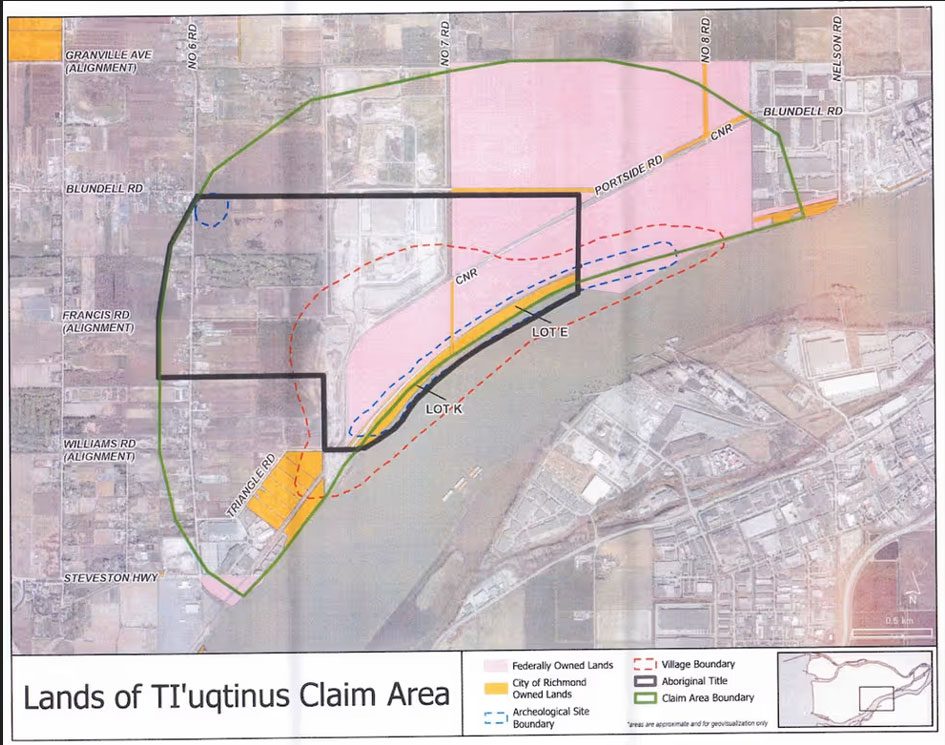
The Tl’uqtinus village site has been developed in ways that would make it unrecognizable to the Cowichan of 150 years ago.
It is covered by highways and farmland, industrial warehouses and federal port facilities, a golf course and private homes.
The lands are divided in the Cowichan claim between publicly owned lands – which are held by the City of Richmond and the federal government and its port authority – and those private lands acquired by individual homeowners and businesses.
Chief Thomas, of the Cowichan Nation, said the future of the publicly owned properties is clear: “That’s easy – the land is going to be transferred over to us, and we’re going to own it outright.”
For those privately owned businesses and homes, the province is on the hook to negotiate a settlement, even while it appeals the Cowichan decision.

Prof. Hamilton says nobody involved in Canadian law around Indigenous rights and title should be surprised by the Cowichan decision. He has been one of the legal scholars writing on this topic since Tsilhqot’in teetered on the edge of bringing it before the SCC.
“Everybody knew that this was one of the possible outcomes, that scenarios would arise where Aboriginal title and private property would come into conflict,” he said. Private property rights were always destined to get caught up in title cases; the only question was what path the court would take.
“I think Justice Young has worked hard to structure a path that would lead to negotiated solutions,” he said, adding a push was needed because government wasn’t going to resolve the Cowichan’s loss of its own volition. “What in the past 150 years of experience leads you to think that governments are just going to willingly come to the table to negotiate, absent some kind of a legal lever that a First Nation holds?” he asked.
Mr. Reynolds, part of the Musqueam legal team, says the higher courts may reverse the trial court’s conclusions in the Cowichan decision, given the negative impact broadly on reconciliation that the decision has had.
“There’s no shortage of technical legal arguments that could be used, in my view, to overturn Cowichan,” he said. “The legal argument that led to where Justice Young ended up was strong, but it’s a maze. Aboriginal law is so new. All the twists and turns haven’t been worked out.”
Chief Thomas agrees that there are still details to be determined. For her, though, the most important part of the court decision has already taken effect. The Cowichan are exercising their fishing rights on the Fraser River again. “The next day we were out on the water,” she said. “Everybody’s freezer is full now.”
Refer also to:
Bravo! BC Court of Appeal rules Nuchatlaht First Nation has land title, recognizing its full claim