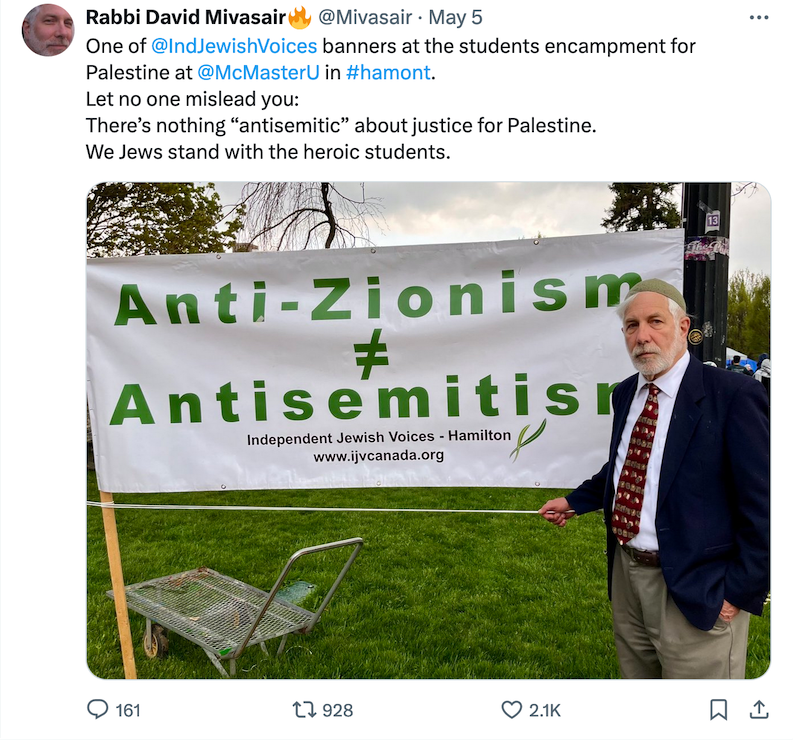
Rabbi David Mivasair:
Let no one mislead you:
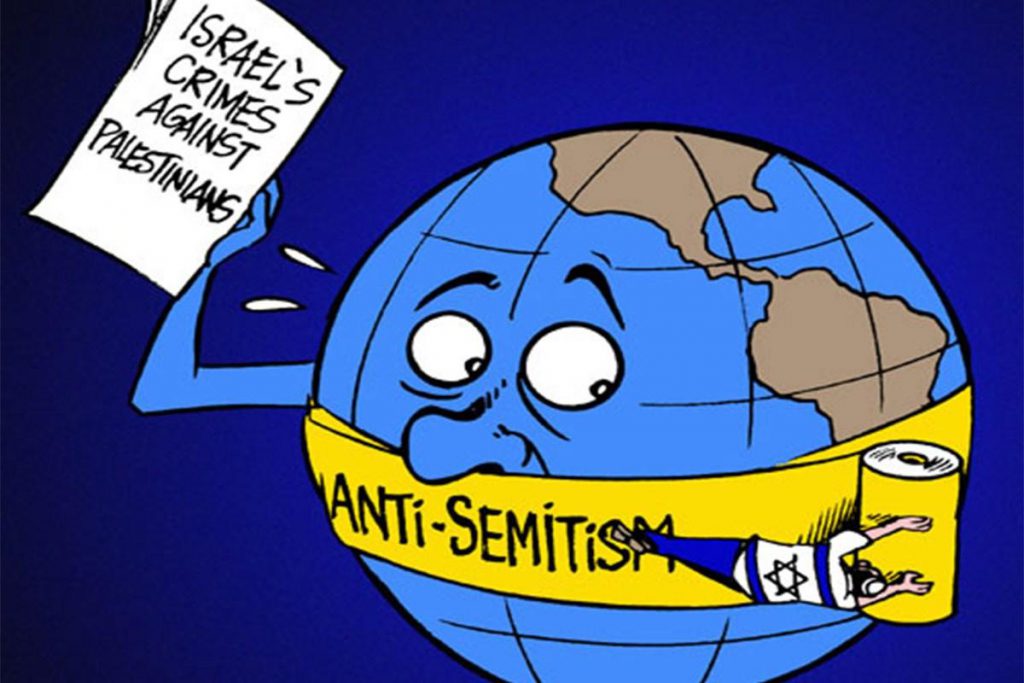
There’s nothing “antisemitic” about justice for Palestine.
We Jews stand with the heroic students.
@journodale.bsky.social:
Using a vulnerable population with complex needs as guinea pigs for digital asbestos? What could possibly go wrong?
Also, when they insist humans will always make the final decisions, I do not believe them for one minute.
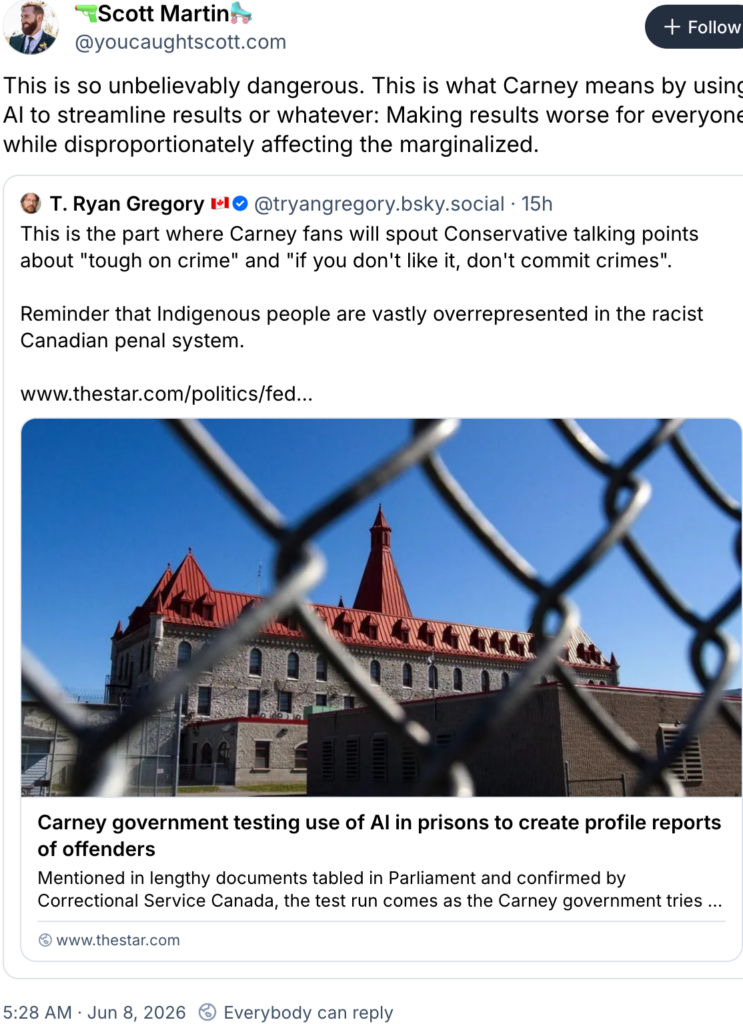
@youcaughtscott.com:
This is so unbelievably dangerous. This is what Carney means by using AI to streamline results or whatever: Making results worse for everyone while disproportionately affecting the marginalized.
@tryangregory.bsky.social:
This is the part where Carney fans will spout Conservative talking points about “tough on crime” and “if you don’t like it, don’t commit crimes”.
Reminder that Indigenous people are vastly overrepresented in the racist Canadian penal system. Like Harper, Carney is deeply racist as all Zionists are, especially racist against Indigenous people like First Nations and Palestinians, and he’s is extraordinarily cruel, evil and misogynistic. A perfect Nazi.

@GumptionAndCo:
When I see 60k Canadians march in a pro genocide, pro Apartheid, pro ethnic cleansing, pro racism, pro illegal occupation, pro torture/rape, pro barbarity March, I literally feel like I am going insane.
Like, what’s going on here, people? What are we even doing?Rot, hate and cruelty by religion.
Canada’s Anti-Hate Consensus Is a Shield for Zionism by Alex MacMillan, June 4, 2026, Spark Solidarity
The Canadian Covenant turns antisemitism into federal anti-hate architecture while Islamophobia and anti-Palestinian racism remain subordinate, named only when they do not threaten the state’s preferred framework.
On June 1, 2026, Prime Minister Mark Carney stood at Holy Blossom Temple in Toronto and delivered a speech he called “The Canadian Covenant.” The speech announced the Ministerial Advisory Council on Rights, Equality, and Inclusion, chaired by Marc Miller and joined by Senator Marc Gold. It reaffirmed Canada’s use of the International Holocaust Remembrance Alliance definition of antisemitism. It tied the federal anti-hate framework to Bill C-9, the Combatting Hate Act. It turned one community’s fearand racisminto state architecture.
Carney also directed a specific line to the Jewish community: “naming these assaults is not equivalence.” That sentence governed the entire speech. Other forms of hate were acknowledged, but not placed on the same institutional level. Islamophobia appeared. Burning churches appeared. Transphobia appeared. They appeared in the closing list and then disappeared from the machinery the government actually built.
The new Advisory Council came with a four-point mandate: reassess the nature and scale of antisemitism, coordinate a whole-of-government approach to antisemitism, improve hate-incident data collection, and measure the impact of federal anti-hate efforts. Carney also pointed to $75 million through the Canada Community Security Program for synagogues, Jewish day schools, and community centres, with allocations extended to institutions of other faith communities.
The distinction is the article. Antisemitism received mandate, funding, legislation, definition, enforcement, and advisory infrastructure. Islamophobia and anti-Palestinian racism received recognition without comparable architecture. That is not a rhetorical imbalance. It is a governing decision.
Architecture versus acknowledgement
The Canadian Covenant shows the difference between architecture and acknowledgement. Architecture is what the state creates when it decides a community’s safety should reorganize law, policy, enforcement, and institutional training. Acknowledgement is what the state offers when it names harm but refuses to build around it.
Antisemitism received six pieces of legislation, an advisory council with an antisemitism-first mandate, $75 million in security funding, an IHRA reaffirmation, and a new criminal offence framework. Islamophobia received a place in the speech’s closing moral inventory. Anti-Palestinian racism received even less. It was not made structurally visible at all.
That hierarchy matters because Canada already has a documented Islamophobia crisis. The Standing Senate Committee on Human Rights report on Islamophobia held 21 public meetings and heard from 138 witnesses. It found that Islamophobia is a daily reality for many Muslims in Canada and recorded witness testimony that Canada leads the G7 in targeted killings of Muslims motivated by Islamophobia.I expect that pleases Nazi Carney
The record is not abstract. In 2017, six Muslim men were killed at the Islamic Cultural Centre of Quebec City. In 2021, four members of the Afzaal family were murdered in London, Ontario because they were Muslim. These were mass-casualty events. They permanently marked Muslim life in Canada. They did not produce an equivalent federal architecture.
That is the measure of the Covenant. It does not simply condemn hate unevenly. It builds unevenly.
The data does not settle the hierarchy
Statistics Canada’s 2024 police-reported hate-crime data shows that 70 percent of religion-motivated hate crimes targeted Jewish Canadians, or 920 incidents. Muslim Canadians were targeted in 17 percent of religion-motivated incidents, or 229 incidents. These numbers are real. They matter. They do not authorize the political operation being performed with them.
Police-reported hate-crime statistics measure more than harm. They measure reporting patterns, police classification, institutional trust, community relationships with law enforcement, and the political definitions used to make hate legible to the state. The data records what reaches police and survives police categorization. It does not measure the full distribution of fear, surveillance, grief, or state exposure.
Treating the numbers as a neutral moral ranking is a political act. It turns one type of state-recognized reporting into the master index of suffering. It lets the government say it is following the evidence when it is actually deciding which forms of vulnerability will reorganize federal power.
The Covenant does not merely respond to hate-crime data. It selects which data becomes architecture.
IHRA manages legitimacy
The pivot of Carney’s speech is the IHRA reaffirmation. Canada adopted the IHRA working definition of antisemitism in 2019. Carney repeated the standard assurance that the definition allows legitimate criticism of any government, including Israel. The assurance is necessary because the definition’s political use has made it necessary.
IHRA does not need to ban all criticism of Israel to discipline Palestine solidarity. Its power lies in making structural anti-Zionist politics permanently conditional. The IHRA examples include treating Israel as a racist endeavour and applying standards to Israel not demanded of other democratic states. That gives institutions a ready framework for reclassifying anti-Zionist analysis as antisemitism.
The problem is not theoretical. Canada’s IHRA Handbook presents the definition as Canada’s official anti-racism framework for antisemitism. Independent Jewish Voices, UJPO, and Jewish Faculty Network objected that the handbook treats a statement naming Zionism as racist, settler-colonial, and genocidal as an example of antisemitism under IHRA. That is the political function of the definition.
The issue is not whether antisemitism is real. It is. The issue is whether the state can name antisemitism without making Palestinian freedom a permanent hate-risk category. IHRA makes that separation harder. Carney’s speech makes IHRA more central to federal anti-hate architecture.
The anti-hate dialectic
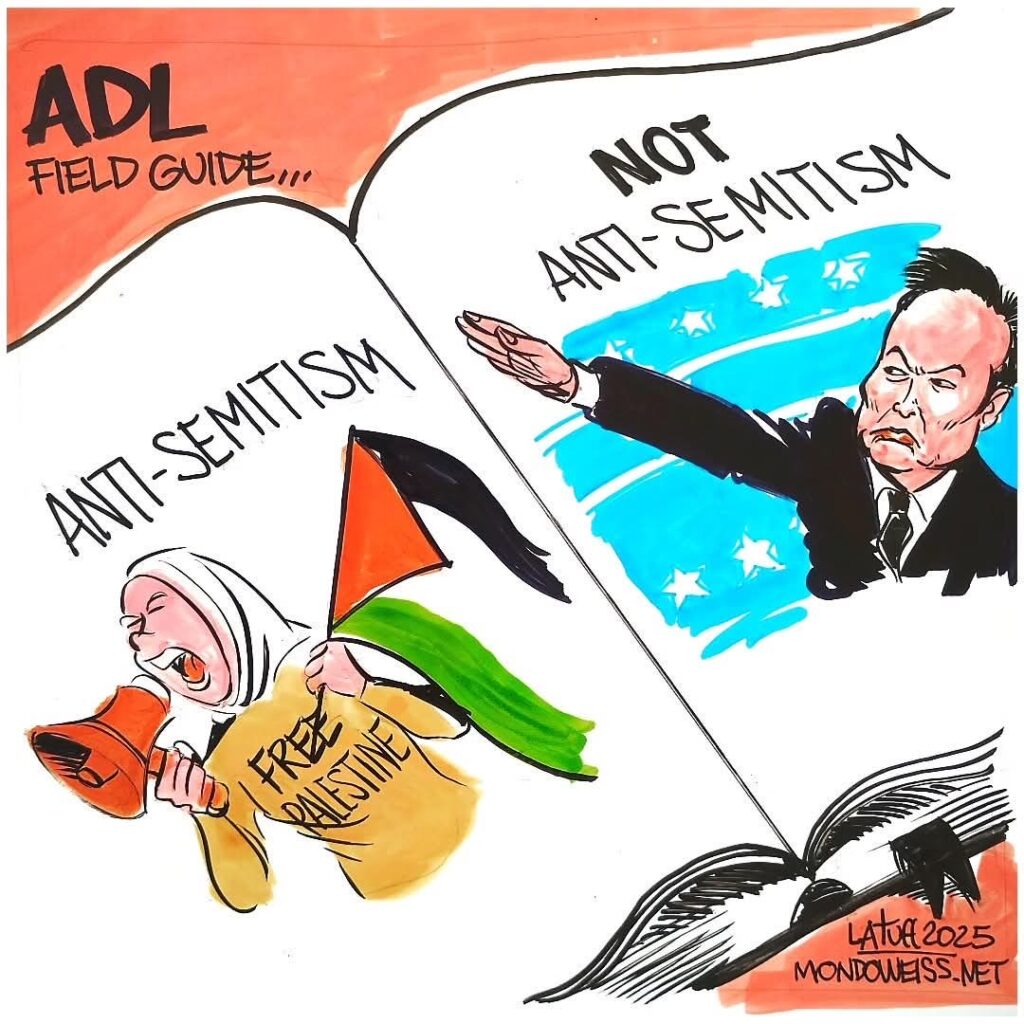
The Canadian Covenant is not an isolated speech. It is the federal proof of concept for a process already visible in Canada’s anti-hate infrastructure. A far-right threat appears. It is externalized and classified by expert organizations. The classification justifies expanded law, funding, policing, advisory bodies, and institutional training. Then the same architecture is used to discipline forms of political dissent that have nothing to do with fascism.
The process works because the far right is externalized. Fascism appears as a visible aberration: masked men, Nazi salutes, banners, street demonstrations, conspiratorial recruitment. The state condemns it. Anti-hate organizations classify it. Police monitor it. The spectacle creates moral clarity. Liberal governance presents itself as the barrier between civil society and barbarism.
But the architecture built in response does not remain confined to fascists. Once the legal and institutional machinery exists, the decisive question becomes who gets to define hate. That is where Israel-lobby power matters. Canada’s adoption and reaffirmation of IHRA did not simply add an anti-racist tool to federal policy. It embedded a definition of antisemitism that makes structural anti-Zionist politics vulnerable to state and institutional discipline.
This is the dialectic. The far right supplies the emergency image. Liberal institutions supply the anti-hate machinery. Zionist organizations shape the definitional framework. Police and prosecutors receive expanded tools. Palestine solidarity becomes the political activity most available for enforcement.
The Hamilton NS13 case showed the first half of the process. A white supremacist group appeared in public. Media cited the Canadian Anti-Hate Network for classification. Political leaders demanded vigilance. But the same trail revealed the institutional genealogy behind the classification system.
Bernie Farber, CAHN’s founding chair, spent decades as a registered federal lobbyist for the Canadian Jewish Congress, pushing expanded hate-crime architecture and later advocating IHRA adoption in Canadian institutions. He also publicly framed protest against Regavim, an Israeli settler organization involved in Palestinian displacement politics, as antisemitic. That history matters because it shows how anti-fascist legitimacy and Zionist boundary-setting became fused inside Canadian anti-hate politics.
The point is not that every anti-hate intervention is fraudulent. The point is that the apparatus does two things at once. It monitors fascism as an external threat while expanding the state’s capacity to treat Palestine solidarity as a hate problem.
Carney’s Canadian Covenant turns that process into federal architecture. Antisemitism supplies the organizing centre. IHRA supplies the definition. Bill C-9 supplies the criminal-law mechanism. Palestinians, Muslims, and anti-Zionist Jews are left to navigate a system built around the premise that their political language is already suspect.
Bill C-9 makes the dialectic enforceable
Bill C-9 is where the dialectic becomes enforceable. The Combatting Hate Act would create new Criminal Code offences for intimidation and obstruction at places of worship, schools, community centres, and other institutions associated with identifiable groups. It would also create a specific hate-crime offence and a new offence for wilfully promoting hatred through certain public displays of hate or terrorist symbols.I bet Israeli genocidaires visiting Canada, wanted by the ICC, arrogantly and hatefully wearing nooses, will not be punished in anyway
The Canadian Civil Liberties Association and 36 other civil society organizations have warned that Bill C-9 risks criminalizing peaceful protest near tens of thousands of locations in Canada. They argue that the bill gives police new tools to target political activity while removing safeguards around hate-propaganda prosecutions. The federal government says the bill does not ban peaceful protest.Carney and his Harper cons lie as often as Danielle Smith and Trump lie.
The stated purpose is not the problem. Jewish schools, synagogues, mosques, churches, community centres, and other institutions should be protected from threats, harassment, vandalism, and violence. The problem is the political overlap the bill refuses to confront. Many institutions associated with identifiable groups also act politically. They host state representatives. They fundraise. They lobby. They organize campaigns. They become sites of political power.
That matters for Palestine solidarity. A protest targeting a synagogue because Jews worship there is antisemitic intimidation. A protest targeting an institution because it fundraises for Israel, hosts Israeli officials, or lobbies against Palestinian rights is political protest. Bill C-9 and IHRA together make that distinction harder to defend in practice.and what when synagogues illegally sell lands Israel has stolen from Palestinians?
The state does not need to outlaw Palestine solidarity directly. It only needs to surround politically active Zionist institutions with criminal-law protections, define anti-Zionist language through IHRA suspicion, and let police decide which protests feel like intimidation.Who will always protect and enable the Zionists abusing, attacking, physically harming Muslims, Palestinians, citizens protesting for peace.
Anti-Palestinian racism is the absent centre
The most glaring absence in Carney’s framework is anti-Palestinian racism. The speech was delivered while Israel’s war on Gaza continued. Palestinian Canadians have spent years watching family members killed, displaced, starved, detained, and dehumanized while being expected to prove that their grief does not constitute extremism.
They are expected to denounce slogans before they mourn. They are expected to avoid naming Zionism before they describe displacement. They are expected to make supporters of Israeli policy feel safe before they can describe what Israeli policy has done. Their political expression is treated as a public-order problem before their suffering is treated as a civic fact.
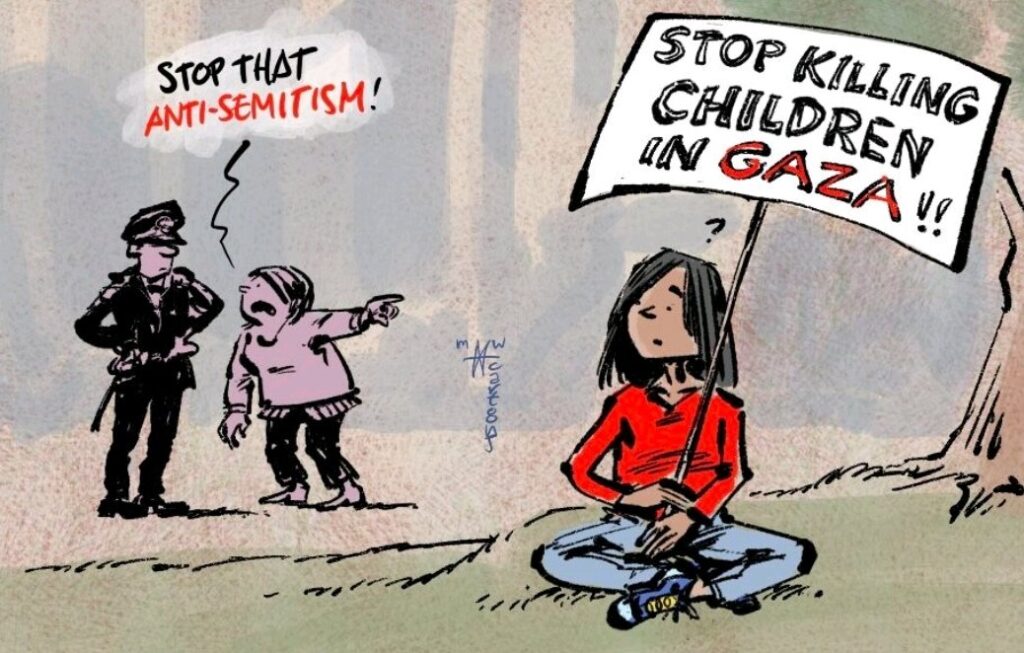
Anti-Palestinian racism appears when solidarity with Palestinians is described as hate before the violence that produced it is named. It appears when students face campus discipline for opposing genocide. It appears when the central political anxiety becomes not Palestinian death, but whether opposition to Palestinian death has made Zionists feel unsafe.
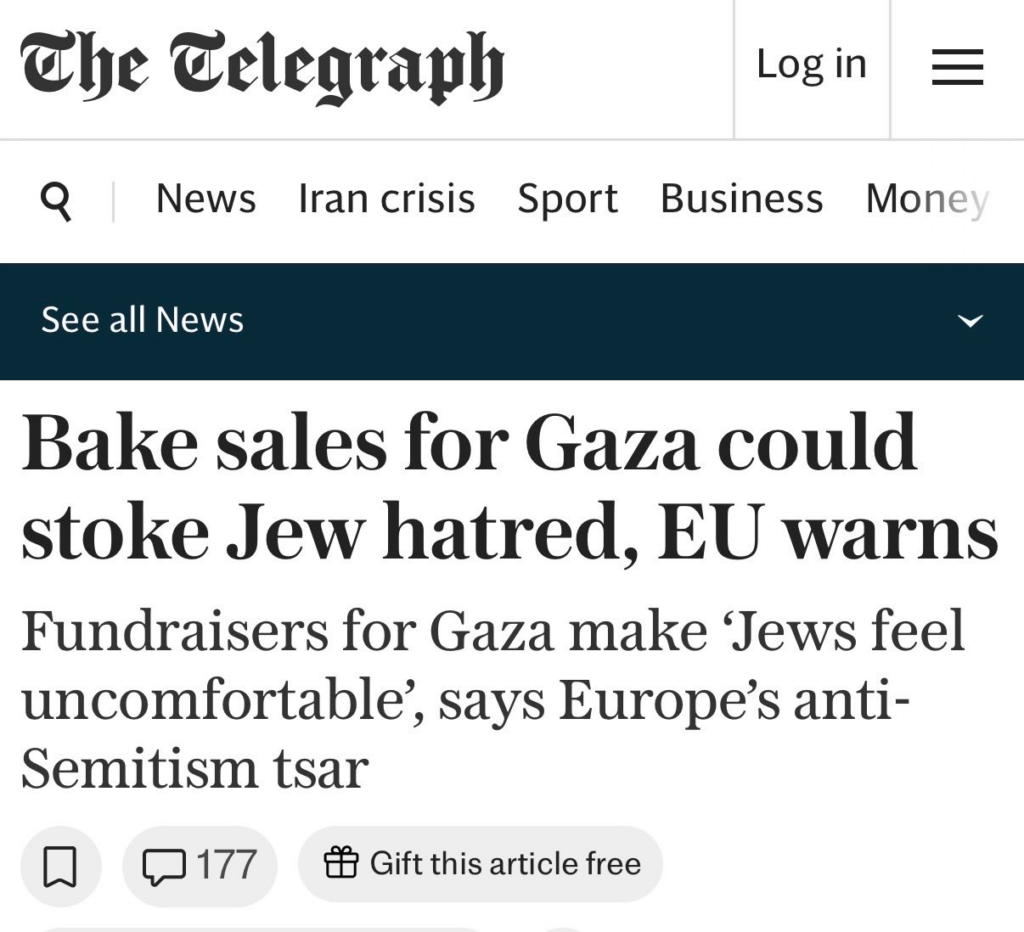
The Covenant makes no structural provision for this. Anti-Palestinian racism is not the council’s first mandate. It is not the organizing category of the speech. It is not the basis for a federal definition, an enforcement review, or a national advisory architecture. It is the absent centre around which the entire framework turns.
That absence is not accidental. Anti-Palestinian racism cannot be made central without confronting the role of Zionist institutions, Israel-lobby organizations, Canadian foreign policy, campus discipline, police surveillance, and the IHRA framework itself. The state cannot name the problem honestly without implicating the architecture it is building.
Islamophobia is named after the structure is built
Islamophobia receives a different form of containment. It is acknowledged as real but not allowed to reorganize the framework. Carney named it near the end of the speech, alongside burning churches and transphobia. That placement matters. It signals moral inclusion after institutional priority has already been assigned elsewhere.
The Senate Islamophobia report did not describe a minor or symbolic problem. It described daily fear, institutional discrimination, public hostility, and targeted killings. It recorded the Quebec City mosque massacre, the London attack on the Afzaal family, and the killing of Mohamed-Aslim Zafis outside the International Muslim Organization mosque in Toronto.
The Canadian state knows this record. Canadian Heritage’s own guide to understanding and combatting Islamophobia states that Islamophobia continues to affect Canadian Muslims and points to multiple tragic mass killings. The knowledge exists. The architecture does not match it.
This is how hierarchy is built while inclusion is performed. Islamophobia is named so the framework can appear universal. Antisemitism is centered so the framework can be operationalized through the institutions already demanding state power.
What the architecture says
The structure of the Canadian Covenant is not difficult to read. It is the anti-hate dialectic formalized at the federal level: visible fascism justifies anti-hate expansion, antisemitism becomes the organizing category, IHRA defines the boundaries of legitimate speech, and Palestinian solidarity becomes the political activity most exposed to discipline.
One community’s safety produced legislation, an advisory council, security funding, an official definition, and a prime ministerial address from a synagogue. Another community’s safety, despite Canada’s record of targeted anti-Muslim killings, produced acknowledgement. Palestinian safety, despite Gaza and the policing of solidarity in Canada, produced no comparable category at all.
That is a set of decisions about which communities’ fear organizes the state and which communities’ suffering remains background noise.
A non-exceptionalist anti-hate politics would separate antisemitism from anti-Zionism. It would refuse to treat Israeli state institutions and Zionist organizations as immune from protest when they act politically. It would track Islamophobia, anti-Palestinian racism, anti-Black racism, and anti-Indigenous racism through the same level of infrastructure it builds for antisemitism.
It would replace IHRA with an anti-racist framework capable of naming antisemitism without turning Palestinian freedom into a hate-risk category. It would recognize that the communities most exposed to state violence are often the communities whose fear least often produces federal architecture.
Carney’s Covenant acknowledged the possibility of equality. Then it built the opposite.
***
Mark Carney Was the First PM to Keynote the CANSEC Arms Fair by Alex MacMillan, May 29, 2026, Sparks
Mark Carney delivered the first-ever Canadian Prime Minister keynote at CANSEC on May 27, and put Canada on a path to 5% of GDP defence spending.
At 7 a.m. outside Ottawa’s Cohere Centre, protesters gathered at the entrances to CANSEC 2026, Canada’s largest arms and defence trade show. They blew whistles, banged drums, carried banners naming Palestinian children killed in Gaza, and confronted delegates as they entered the convention centre. Inside, military contractors, government officials, foreign delegations, police-linked security firms, AI companies, naval technology firms, aerospace manufacturers, and political leaders moved through the country’s most important weapons marketplace. Outside, demonstrators called it what it was: a place where war becomes business.
The coalition outside had been organizing the mobilization for weeks. Shut Down CANSEC, the Palestinian Youth Movement, Migrante Canada, World Beyond War Canada, Labour 4 Palestine, the International Coalition for Human Rights in the Philippines, and Peace Brigades International-Canada. Canadian Friends Service Committee Quakers held a silent vigil. Rosie Lucente of Shut Down CANSEC told the Ottawa Citizen that every deal made at CANSEC was a death sentence for colonized and working people. A few hours later, Mark Carney’s motorcade arrived. Defence Minister David McGuinty walked to the podium. Carney followed him onto the stage and opened with a fact.
The first PM at the lectern
This was the first time a Canadian Prime Minister had delivered the CANSEC keynote. CADSI has hosted the trade show since 1998 and every previous keynote had been given by a Defence Minister or a Procurement Minister. CADSI president Christyn Cianfarani sat in the room. Carney told the audience Canada had hit NATO’s 2% of GDP defence target ahead of schedule, was working toward 3.5% by 2035, and had already provisioned in the fiscal framework for 4% by the end of the decade. He committed Canada to additional provisions to achieve NATO’s 5% target on or ahead of schedule.
The ten-year package: $180 billion in direct defence procurement, $290 billion in defence and security-related infrastructure, $125 billion in downstream economic benefits. Defence sector revenues projected to grow 220%, exports 50%, the industry to add 125,000 new jobs to its existing 80,000. The Defence Investment Agency now centralizes federal procurement. A Defence, Security and Resilience Bank is in development with NATO allies to mobilize low-cost financing. Canada has become the first non-European country to join the EU’s Security Action for Europe procurement initiative. A new 90-day approval standard cuts procurement timelines.
The procurement announcement came at the end. Canada has entered negotiations to buy Saab’s Airborne Early Warning & Control Aircraft, built on Canadian Bombardier Global 6500 jets, at 3,000 aerospace jobs and at least forty aircraft over fifteen years. The platform’s existing operators, Carney specified at the podium, are France, Sweden, and the United Arab Emirates. The UAE was among the customers the coalition outside the building was naming. The Prime Minister named the same customer list inside.
The CADSI–Kraken–Elbit network
CANSEC is hosted by CADSI, whose board of directors draws from the industry the event exists to promote. Board member Bernard Mills became EVP Defence at Kraken Robotics on January 12, 2026, per Kraken’s December 2025 announcement. Kraken is a Canadian marine technology firm specializing in sonar and autonomous naval systems. In 2022 Kraken’s KATFISH towed synthetic aperture sonar was demonstrated integrated with Elbit Systems UK’s Seagull uncrewed surface vessel at a Royal Navy demonstration. Canadian sonar, Israeli uncrewed vessel, UK Royal Navy host.
Elbit Systems is not an outlier in CADSI’s 700-plus membership. The list includes Amazon Web Services, BAE Systems, Bell Textron Canada, Boeing, Cisco Systems Canada, Colt Canada, Elbit Systems Ltd., General Dynamics, L3 Harris, Leonardo DRS, Lockheed Martin Canada, Microsoft Canada, and Rheinmetall Canada. On May 22, five days before Carney’s keynote, the International Centre of Justice for Palestinians Canada and Just Peace Advocates formally asked the Canada Border Services Agency to deny entry to representatives of Elbit Systems and Israel Aerospace Industries. CBSA did not act. Both companies’ technologies were on the floor at CANSEC, as they have been for years.
$470 billion, against $1.9 billion for pharmacare
The numbers Carney delivered from the keynote stage sit against a contrast organizers have been making since the federal Pharmacare Act received Royal Assent in October 2024. That Act funds a first phase covering only contraception and diabetes medications, conditional on bilateral agreements with provinces and territories. The Parliamentary Budget Officer costed it at $1.9 billion over five years. The numbers from Carney’s CANSEC speech: $180 billion in defence procurement, $290 billion in defence infrastructure, over ten years. Roughly $470 billion total. Against $1.9 billion for the start of universal pharmacare.
The comparison is not the arithmetic. It is the velocity. Pharmacare requires bilateral agreements with every province, eligibility specifications, formulary work, phased rollout — the federal government has been clear the rest of the plan follows only as the negotiations conclude. The Defence Investment Agency Carney announced exists to compress timelines by removing the duplicate-approval bottlenecks the same finance ministry accepts as routine in health policy. The finance ministry has one speed for weapons and a slower one for medicine.
Ford and the day after
On the morning of May 28, Ontario Premier Doug Ford spoke at CANSEC and unveiled Ontario’s own provincial Defence Industrial Strategy. CPAC carried the remarks. The Ontario strategy runs parallel to the federal Defence Industrial Strategy Carney’s government launched in February 2026, structured to capture provincial industrial development from the federal procurement pipeline Carney had announced the day before. Ontario’s manufacturing base, aerospace cluster, automotive supply chains, and university-linked tech sector position the province as the largest provincial beneficiary of the trajectory.
Carney and Ford represent the federal Liberal and Ontario Progressive Conservative sides of a bipartisan defence consensus. Carney’s framing was sovereignty and Arctic security. Ford’s was jobs and industrial competitiveness. Both arrived at the same procurement pipeline. Neither speaker addressed the protest at the perimeter. Neither addressed the May 22 request to CBSA. The two government heads who delivered the trade show’s keynote programming did it across two days without acknowledging the people standing outside the building.

The media access question
CADSI’s accreditation policy treats CANSEC as a private event and reserves the right to deny press accreditation case-by-case, with decisions final. Ricochet was denied access to CANSEC 2026 on the grounds the outlet did not meet CADSI’s eligibility requirements. The Maple reported that multiple independent journalists and outlets, including The Maple itself, were denied accreditation. The Breach was denied in 2023 after publishing critical reporting on Canadian military bases, Saudi arms exports, and Canadian bank loans to Elbit Systems.
Carney’s remarks ran on CPAC. The PMO press office sent the speech transcript out that evening. The Saab GlobalEye announcement was a press release event. What was lost in the exclusion of critical outlets was the side material — the conversations on the floor, the composition of the foreign delegations, the contracts being negotiated between exhibitors and procurement officers, the names of the people moving through the building. The federal government is comfortable having that material reported only by the outlets CADSI clears.
The morning after the perimeter
By Friday morning the booths were being packed up. Foreign delegations were on flights home. The procurement officers had returned to the Defence Investment Agency to begin the contract work Carney had announced. The first-ever Canadian PM keynote at CANSEC produced $470 billion in commitments over ten years, the Saab GlobalEye deal with the UAE in its customer base, a defence-industrial bank in development with NATO allies, and the path to 4% then 5% of GDP on defence. The protesters at the perimeter on Wednesday morning had been describing accurately what was being announced inside.