My latest with @charlieangus104.bsky.social
on Kevin O’Leary’s “Wonder Valley” AI datacenter scam.
❌adds eq. of 7-12 million homes re: power usage
❌uses a Sylvan Lake amount of water annually
❌gives our data to the USA
❌owned by UAE investors who’s revenue is now nil.
THE KEVIN O’LEARY AND DANIELLE SMITH BOONDOGGLE SCHEME by Charlie Angus, Apr 12, 2026
In this episode, Meidas Canada looks at the traitor waltz of Kevin O’Leary and Danielle Smith continues. Pay attention Albertans – this scheme threatens to be the ultimate economic and environmental boondoggle.
New post: why are Canada’s politicians (both at the federal *and* Alberta level) seemingly so eager to get public pension funds to invest in AI data centres?
blundervalley.ca/blog/pension…
Your pension, up in smoke?
Kevin O’Leary has been looking for a way to get his hands on public pensions and sovereign wealth funds for a while now, and both Alberta and Ottawa seem to be on board with the idea

- by Dan Shannon,
- 09 January 2025
From Ottawa to Edmonton, politicians and bankers agree on one thing: funneling your retirement savings into risky AI gambles.
Recently there have been a few changes, and proposed changes, to the rules for how pension funds can invest your retirement savings.
And whether we’re talking about Freeland & Carney in Ottawa, or Smith & Harper in Alberta, one of the goals of those rule changes seems to be to get the managers of Canada’s public pension funds (who are supposed to have independence from government interference) to invest your retirement money into AI and data centres.
There’s a lot of hype around AI. But a lot of people are warning that AI is another tech investment bubble. So, why are these politicians so eager to fund these projects with your savings?
Pension funds got burned by the crypto bubble of 2021
Kevin O’Leary has been trying to find ways to crack open people’s nest eggs for a while. In 2022, when he was hauled in front of the US Senate to answer questions about the collapse of cryptocurrency exchange FTX, he said that “the potential of crypto is for it to be indexed with sovereign wealth and pension, where about 70% of the world’s wealth is actually managed.” (YouTube video, timestamp = 14:15)
In the two years since then, cryptocurrency prices have rebounded. But assets with wild, unpredictable swings (and in the case of crypto, with no underlying value) don’t tend to be very attractive to pension funds looking for stable long-term returns.
In the midst of the crypto craze of 2021, though, when everybody seemed convinced that the cryptocurrency market was for real, that use cases were going to be found any day now, and widespread adoption was just around the corner, some pension funds did take the bait:
- CDPQ ended up losing $150 million on a fraudulent crypto lending scheme called Celsius
- the Ontario Teachers’ Pension Plan (OTPP) lost all US$95 million of their investment in FTX
Guess who was hyping up FTX and crypto?
It seems noteworthy that the OTPP made their investment just three months after Kevin O’Leary had become a spokesperson for FTX, which means they invested at a time when O’Leary was singing the praises of CEO Sam Bankman-Fried, now a convicted fraudster serving a 25-year prison sentence for stealing billions in customer funds.
Meanwhile the CEO of Celsius, Alex Mashinsky, is serving 30 years for fraud and market manipulation. CDPQ chief executive Charles Emond, speaking during the first few days after Celsius declared bankruptcy, put it mildly, saying: “in these disruptive technologies, there’s ups and downs.”
A push in Ottawa to change pension fund rules
In late 2023, Evan Siddall wrote an op-ed in the Globe and Mail: Federal government should not be pushing pension funds to invest more in Canada. At that time, Siddall was the CEO of Alberta Investment Management Corp. (AIMCo), which manages the pension funds of public sector employees in Alberta including teachers, police, firefighters, and municipal workers. He argued that the federal government shouldn’t be using people’s retirement savings to compensate for their lack of investment in Canadian economic development, and was worried that the Fall Economic Statement of 2023 was opening the door to doing exactly that.
But business executives, whose salaries and bonuses are often connected to their companies’ stock prices, continued pressuring the federal government to put their thumb on the scale. And by April 2024, then-finance minister Chrystia Freeland had hired former Bank of Canada governor Stephen Poloz to find ways to coax pension funds into investing more in Canada.
By September, Brookfield Asset Management was making their pitch to Chrystia Freeland for a $50 billion investment fund that would be made up of money from pension funds and the federal government.
But this didn’t go over very well, partly because the pension funds didn’t like the idea, but also because Brookfield’s chair is Mark Carney, another former BoC governor who was also working as an advisor to the federal government.
Nevertheless, Poloz continued to work on crafting policy. One proposal was a program where the government would contribute up to $15 billion toward a $45 billion AI data centre investment fund (where pension funds could contribute up to $30 billion, and the feds would partially match the investment, adding $1 of public money for every $2 of pension money invested). AI and its sleazy lying thieving greedy billionaire creators know damn well they’ve created a bubble, a massive steal from ordinary people bubble, and evil fucks Carney and Smith are of course, all in, likely for their share of the rip off cut.
Interestingly, the original policy proposal included a requirement that data centres must be powered by renewables – but by the time the 2024 Fall Economic Statement was released in December, this requirement had vanished.
A pension fund takeover in Edmonton
Meanwhile in November, Premier Danielle Smith’s government suddenly fired the entire AIMCo board along with 4 top executives, including CEO Evan Siddall, who had written that op-ed criticizing the federal government’s attempt to influence pension funds’ investments.

Less than two weeks later, Stephen Harper was announced as the new chair of AIMCo’s board. This appointment immediately led to widespread worry (including from senior fellows at the staunchly conservative Fraser Institute) that the Alberta government was seeking to politicize AIMCo, which manages $169 billion in assets, most of which is workers’ retirement savings.
And as evidence that politicization was the goal, Premier Smith had reportedly been hoping to appoint Harper to the role “for some time“, which makes it pretty clear that AIMCo’s board was fired not due to mismanagement, but as a way for the province to seize control over the fund’s operations.
Kevin O’Leary shoots his shot
Enter Kevin O’Leary, with the perfect plan to snatch up Canadians’ pension money not only from the proposed federal AI data centre fund, but also from a newly politicized AIMCo, eager to invest in the expansion of fossil fuel infrastructure.
Premier Smith was immediately on board with O’Leary’s proposal, declaring, “this is fantastic news for Alberta. Our efforts to attract investment, grow our technology and innovation sector, and leverage our natural and human resources are being noticed. I’m excited to watch this project unfold in the months and years to come.”
But even putting aside the issues around pension funds, is this really “fantastic news for Alberta”?
Is AI a risky investment?
The most truthful answer is, “it depends”. There are definitely useful applications for some of the technologies that fall under the umbrella of things we lump together as ‘AI’. Machine learning, for example, has been quietly useful for decades, and is comparatively inexpensive to run.
On the other hand, there’s Generative AI (e.g. ChatGPT, Gemini, Copilot, Midjourney, Stable Diffusion). Companies that make GenAI systems are losing a massive amount of money every year; one of them, OpenAI, lost $5 billion in 2024. These systems require so much hardware and resources to run that they aren’t able to charge their customers enough to cover their costs.
“Ah,” the AI companies say, “but soon these systems will be far more useful, and won’t go telling users to eat deadly mushrooms, drink “aromatic water” (aka mustard gas, a chemical weapon) or put glue on pizza to keep the toppings from sliding off. We just need more money to build bigger data centres, and ten times as much data to train our models on!”Is that way sleazy fuck christian terrorist David Parker stole the private voter data of nearly 3 million Albertans? putting us at risk of harm, abuse, murder, theft, fraud, etc.
The problem with that: they’ve already scraped pretty much the entirety of the internet. Which means that no matter how much more money gets thrown at these Generative AI systems, they’re unlikely to get much better.
More and more people have been sounding the alarm, warning investors that the AI market is a speculative bubble. Here’s a few of the headlines:
- Goldman’s Top Stock Analyst Is Waiting for AI Bubble to Burst (Bloomberg)
- Will the artificial intelligence bubble burst in 2025? Here are 4 reasons it might. (USA Today)
- Broadcom Stock Drops as Chip Stocks Slide. Is the AI Trade Ending? (Barron’s)
- Even at $200/mo, Altman admits ChatGPT Pro struggles to turn a profit (The Register)
- Enterprises struggle to find business value with GenAI (TechTarget)
- Howard Marks sees cautionary signs of a bubble (CNBC)
Conclusion
To sum up: AI data centres are an incredibly risky investment at this stage. Be wary of any politician or entrepreneur trying to steer your retirement money (or our public funds) into these schemes. Over the last quarter-century, we’ve seen enough tech hype cycles (dot-com, crypto, NFTs, the metaverse, VR, just to name a few) to know how this story ends. Which raises a question: are these politicians and business leaders just suckers falling for the hype of the day? Or are they hoping to prop up the market with our retirement savings, so their pals can cash out before the bubble bursts?
US environmental groups urge EPA to reject new Pfas to cool datacenters, Coalition says Chemours downplayed health and climate risks in bid to fast-track the compound’s use by Tom Perkins, 27 Jul 2026, The Guardian
A coalition of 17 environmental groups is demanding the Environmental Protection Agency reject a new Pfas that chemical giant Chemours is attempting to fast-track for approval for use in cooling datacenters, and would almost certainly pollute regions around the facilities.
In formal comments submitted to the agency, the groups accuse Chemours of using bad science to downplay the chemical’s toxicity and climate risks. Approving Chemours’ application as it is would violate the law, the Earthjustice legal non-profit, a lead author of the comments, wrote.
Big tech has faced fierce opposition from across the political spectrum in communities where it plans to build datacenters, in part because some types of the facilities require huge quantities of water to cool.
Datacenter developers, like Google, have touted its two-phase cooling systems as an alternative that uses far less water, but few know that those typically use Pfas “forever chemical” gas instead of water.
The new chemical, Opteon 2P50, is probably more toxic and more of a risk to the climate than Chemours claims in its application, public advocates warn. Opteon 2P50 is also the first chemical for which industry has asked the Trump EPA to fast-track approval under the president’s legally dubious executive order that calls for expedited review of datacenter chemicals.
“The datacenter industry knows it is under fire for its enormous use of water so they cast themselves as the good guys by using alternative cooling, but they’re not telling [the public] that they’re using hazardous chemicals,” said Lenny Siegel, director of the Chips Communities United non-profit that works to rein in Pfas waste. “Some are toxic, some are greenhouse gases and some are both.”
Pfas are a class of about 16,000 compounds dubbed “forever chemicals” because they do not naturally break down, and accumulate in the human body and environment. The chemicals are linked to a range of serious health problems such as cancer, liver disease, kidney issues, high cholesterol, birth defects and decreased immunity.
“Two-phase” datacenter systems use Pfas gas, or f-gas, as a refrigerant coolant that is run through copper tubing.
Chemours in a statement said the comments failed to acknowledge that the two-phase systems were a “closed loop”, meaning there are no emissions from a stack, and the amount of gas that escapes is low.
F-gas is not intentionally released during use, though there are leaks, called “fugitive emissions” and it must be disposed of at the end of its life.
The datacenter industry has claimed that F-gas is not a threat because, once in the air, it often turns into a compound called TFA. TFA is considered a Pfas in most of the world, but not with the US EPA. Recent research has found it is more toxic than previously thought, and the European Chemical Agency this month classified it as a hazardous chemical, finding that it probably disrupts thyroid function, reduces sperm quality and is toxic to the liver, among other health impacts.
Chemours did not respond to the Guardian’s request for comment.
In its comments submitted to the EPA, Earthjustice noted that the agency must consider health risks as required by law despite Donald Trump’s executive order that seeks to prioritize datacenter chemicals.
“We’re worried that the EPA may interpret ‘priority review’ as ‘priority approval’, and we need to remind them that the executive order has no bearing on assessing health risk,” said Adriana Antezana, a scientist with Earthjustice.
The comments allege a litany of flaws in the science submitted by Chemours that claim Opteon 2P50’s health risks are low, including reliance on a type of lab rat that is less affected by Pfas’s toxic effects than humans. The comments also alleged a range of missing or limited toxicological data.
Chemours references an occupational inhalation limit intended to keep workers safe was developed by the partially industry-funded science group Tera, which has a long history of attacking chemical regulations and producing industry-friendly science. Earthjustice wrote that the Tera-organized committee failed to follow EPA best practices and did not include key pieces of data in its analysis. The level of exposure to Opteon 2P50 that workers would face if the Tera committee levels are adopted is probably unsafe, the comments claim.
The environmental groups also allege that Chemours has a history of releasing dangerous levels of pollution into communities around its plants, and US drinking water is already widely contaminated with Pfas. The approval of the new compound for wide use could present an unreasonable risk to the public under the nation’s toxic chemical laws because some already face high exposures, the comments state.
In its statement, Chemours accused the environmental groups of making “sweeping generalizations” about Pfas, each of which have slightly different chemistry. The “EPA’s new chemicals review is a rigorous evaluation process,” the statement said.Pffft! Liar! Trump’s pro polluter hench thug is at the top, EPA protects nothing now but rich polluters’ profits
If the EPA approves Opteon 2P50 for manufacture, it could more easily be approved for other uses in industry, or consumer products such as refrigerators, though that is hypothetical, Antezana said.
The EPA’s actions around the chemical could also lead to a test of Trump’s executive order powers. Earthjustice could potentially sue if the chemical is rammed through without following the law.
“We don’t want the government just to approve the chemicals because a company is saying it will help this industry, because that could go for any chemical,” Antezana said.
@sashafury.blackskycomra.de:
Carney: “When we build physically we also build inclusively and technologically, which is why we believe in AI for all.”
lol fuck this guy
@ssteingraber1.bsky.social:
Paywalled story in Bloomberg:
“Almost half of the US data centers planned for this year are expected to be delayed or canceled. One big reason is the shortage of electrical equipment, such as transformers, switchgear and batteries.”
(largely imported from China)
America’s AI Build-Out Hinges on Chinese Electrical Parts, The struggle to manufacture transformers, switchgear and batteries domestically has forced the US to rely on imports, delaying data center construction.
“Data centers have rapidly grown in size and now consume more electricity than their predecessors a decade ago. That demands bigger transformers, which safely pull electricity from the high-voltage grid to feed to tiny computer chips…”
“…Without the right transformers, there’s no way to make the data center work…The spike in demand from data centers and grid expansion have pushed up prices and extended delivery times to as much as five years.”
@joedmills2.bsky.social:
Hopefully Gandalf was correct when he said:
“Evil ofttimes defeats itself”
@kellymc4.bsky.social:
This is why the term “cognitive surrender” needs to start being used QUICKLY. It actually clearly defines what these fools want.
@preambulator.bsky.social:
Was this the price of getting into Mar a Lago and the photo op (meeting) with Mango Mussolini?

@missellie19.bsky.social:
Guess we taxpayers will be on the hook for some if not all of the financial support
@moreperfectunion.bsky.social April 8, 2026:
First the city council in this Missouri city approved a $6 billion data center, despite massive pushback.
Then, during yesterday’s election in Festus, MO, residents overwhelmingly voted to kick out the incumbents who voted for the project.
America is fed up with data centers.
@danharriscan.bsky.social:
Aren’t their data centres ALREADY forcing everyone to pay for their Water and Electricity???yep
@marysuesays.bsky.social:
Sam altman you bitchass, I already paid for my intelligence, it’s called “student loans”.
@redshan.bsky.social:
I don’t use AI, and if I want to gain intelligence, I will read a book.
@cchumphrey.bsky.social:
Everyone should be treating this fool’s ridiculous ideas with absolute contempt
@parismarx.com:
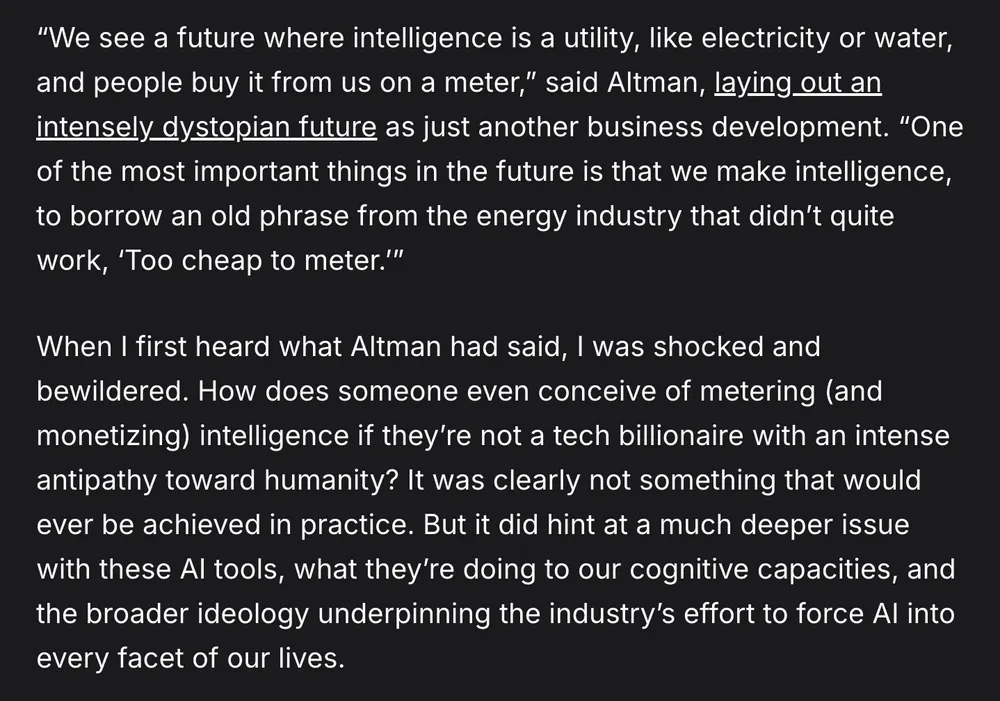
Sam Altman has a new plan to make money from generative AI: he wants intelligence to be treated like water or electricity — and we’ll all have to pay him for it.
His chatbots are degrading people’s ability to retain information and think critically. Now he wants to sell smarts back to us.
Altman made this declaration at an infrastructure summit hosted by BlackRock. It’s the latest in a long line of outrageous statements he’s made to try to justify the rollout of generative AI and the massive cost to power it.
AI boosters want us to see human intelligence and artificial intelligence as comparable and complementary, even though computers are not actually thinking — companies are just designing interfaces that trick us into believing they are.
As Altman talks about how ChatGPT will increase people’s intelligence, research and reporting shows the opposite: dependence on chatbots actually hurts people’s cognitive skills and reduces their ability to think critically. It can even threaten their mental health.
Drawing comparisons between human and artificial intelligence requires it to be quantified, which is likely one of the reasons tech billionaires are so big on IQ tests. It also plays into their bigger science fictional visions of merging our brains with machines.
But there’s another piece of that too: IQ tests are not actually a trusted measure of intelligence, and in the past they’ve been used to push a eugenic project that made white people appear more intelligent than people of color.
https://disconnect.blog/make-em-dumb-sell-em-smarts
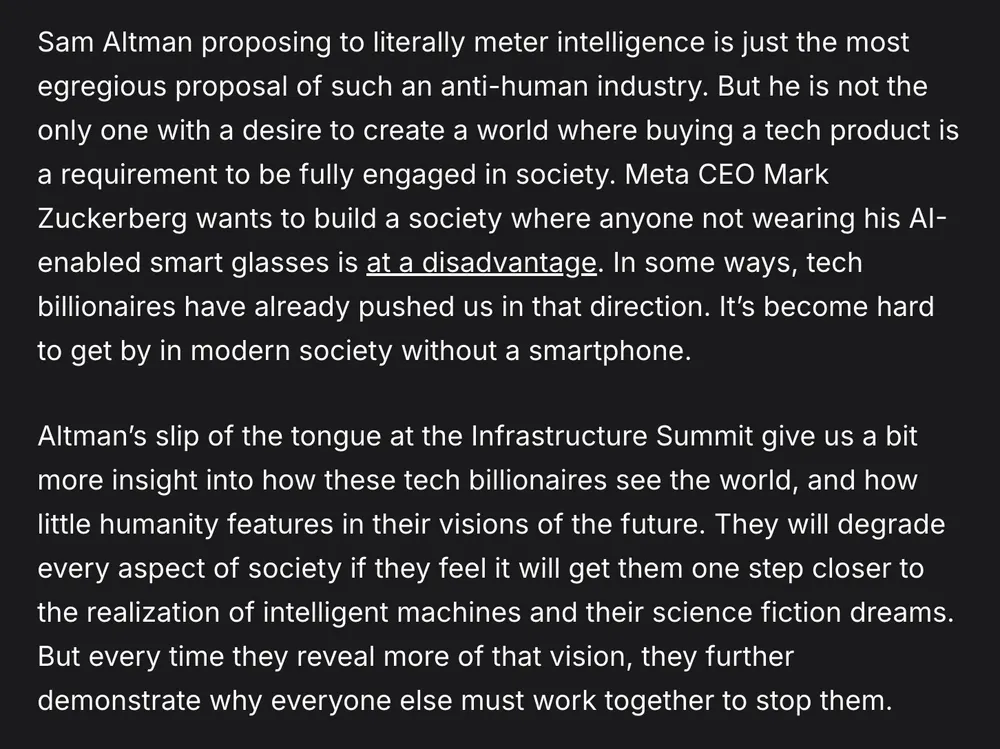
Altman’s statement about treating intelligence as a utility is another insight into the dystopian world tech billionaires are trying to build. It’s one with their power is enhanced as the rest of our realities is degraded and enclosed.
They must be stopped.
disconnect.blog/make-em-dumb…
@wonderbink.bsky.social:
I know AI psychosis isn’t an official DSM diagnosis (yet), but from what we’ve seen so far, this man is getting way high on his own supply.
@scalzi.com:
I prefer my intelligence local and artisanal and situated in my own brain, thank you. No subscription required!
@jucifer.blacksky.app:
preposterous Scooby-Doo villain behavior
@muteki-ish.bsky.social:
I’d be more convinced about buying a supply of intelligence from this Altman fellow were I convinced he had any
@voidhorn.bsky.social:
y’know that guy in the Lorax who is polluting the earth so he can continue selling air? thats him
@thebonelessone.bsky.social:
This is the equivalent of Nestle buying up all the fresh water in the world, but instead of bottling it and reselling it back they’re using it all up to power huge data centres that shit directly into your mouth
@x-sticks.bsky.social:
There are no “Data Centres” there are only “Surveillance Centres”.

@nkalamb.bsky.social:
The FBI is “proactively” identifying “domestic terrorists,” including anyone with critical views on “capitalism,” “Americanism,” “Christianity,” “migration,” “race,” “gender,” and “family.”
Essentially, every single Bluesky user.

Under Herr Harper Nazi Carney, coming soon to Canada. USA’s ICE is already here
@lujan_laur64348:
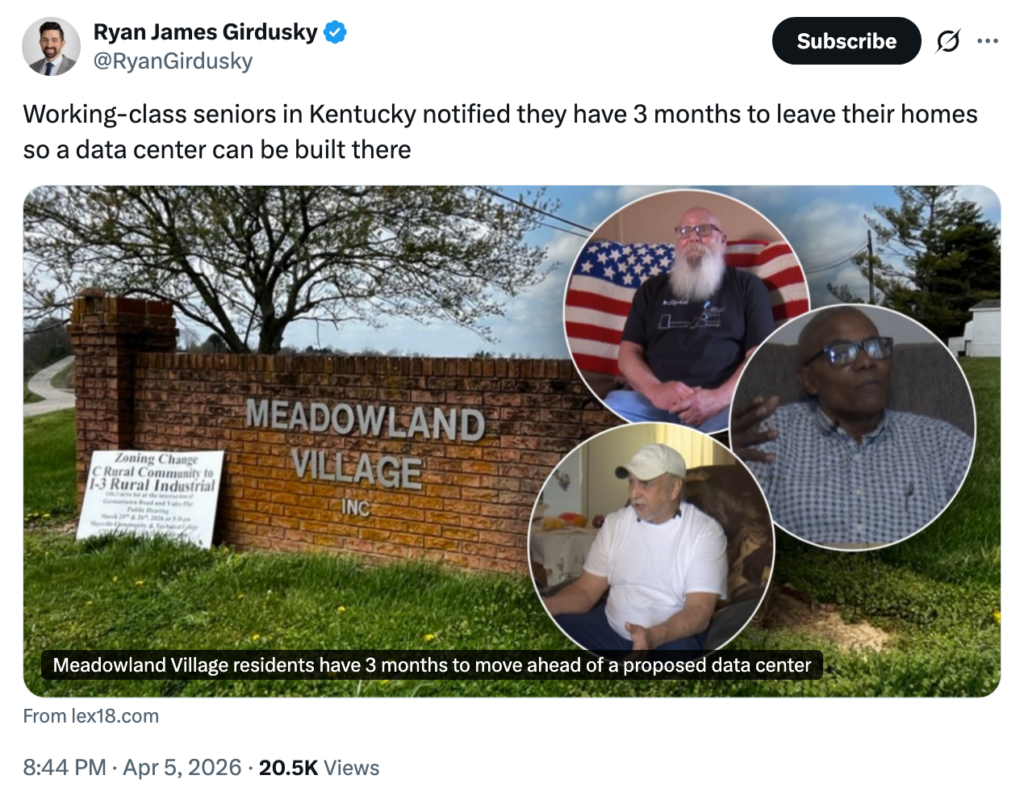
Shameful. Whatever they’re true intentions for these data centers must be truly dark look already what they do to the most vulnerable citizens not to mention, destroy the environment and create more poverty no doubt.
For every $100 in data centres, $80 leaves Australia almost immediately by David Swan, April 6, 2026, The Sydney Morning Herald
There’s a number the data centre industry doesn’t love talking about. For every $100 poured into a fully loaded hyperscale facility in Australia – the kind Amazon, Google and Microsoft are building to serve new AI tools – somewhere between $70 and $80 leaves the country almost immediately. It flows to semiconductor makers in Taiwan, server manufacturers in the United States and cooling equipment giants in Europe.
You wouldn’t know this from the way the industry talks about itself. The headline numbers sound intoxicating: $26 billion in baseline investment by 2030, potentially $52 billion more, according to a Deloitte report – commissioned and paid for by Google – that envisions turning Australia into Asia Pacific’s AI hub.On AI, Atlassian’s billionaire co-founder, Scott Farquhar, says Australia should be “exporting megawatts as megabytes and getting paid megabucks”.Dominic Lorrimer
The stakes are unusually high. Data centre investment decisions being made in the next two to three years will determine where this infrastructure sits for a generation, and to what degree Australia actually benefits. The promise is that Australian businesses will gain cheaper access to AI computing power, attract global tech talent, turbocharge productivity in industries from mining to healthcare, and catalyse billions in new renewable energy investment.
Atlassian’s billionaire co-founder, Scott Farquhar, reckons we should be “exporting megawatts as megabytes and getting paid megabucks”. Canva co-founder Cameron Adams says that data centres are the “biggest opportunity that I can see to add on an entirely new layer to Australia’s economy and kind of start diversifying us away from resources”. Steven Worrall, a former Microsoft executive now leading Telstra’s AI push, routinely calls it “one of the great economic opportunities for Australia”.
The Albanese government, too, has been ebullient. “Really, this technological revolution driven by AI is a huge focus of the cabinet,” Treasurer Jim Chalmers said last month, crediting data centres with single-handedly driving a rebound in national business investment. “There’s a lot of investment flowing.”
They might be right. But the Australian Bureau of Statistics is telling a different story, noting this year that the surge in data centre investment was “supported by a corresponding rise in imports, leading to a reduced impact on GDP”.
Translation: the money is passing through Australia like water through a pipe.
Follow the money
The leakage is significant, and structural. When a hyperscaler (think the likes of Amazon, Google) builds and fills its own facility, the IT equipment – the servers, GPUs, networking – eats 70 to 75 per cent of total cost, according to analysis from consulting firm Alpha Matica. Australia manufactures none of it – no chips, no servers and no racks. Every dollar goes straight overseas to the likes of chip companies Nvidia, AMD, Broadcom and their East Asian foundries.
From our partners
Of the remaining 25 to 30 per cent for the physical building, the Alpha Matica modelling suggests roughly another $12 to $15 of every $100 invested disappears offshore to buy power supply systems, cooling infrastructure and generators from Schneider Electric, Vertiv and their ilk. What stays? About $10 to $15. That goes towards costs such as real estate, concrete, sparky labour, project management – all of which is in high demand from other sectors of the economy.The NextDC data centre in Footscray. When Australian-founded operators such as NextDC, AirTrunk and CDC use co-location builds, the economics improve dramatically.Eddie Jim
The energy vampire next door: Life next to an AI mega-factory
The economics improve dramatically when Australian-founded operators like NextDC, AirTrunk and CDC are the ones building. Their model is different: they construct the physical facility – the shell, the power systems, the cooling – and then lease space to tenants who bring their own hardware.
Because the imported computing equipment isn’t part of their spend, modelled estimates from Morgan Stanley Research indicate that about $45 to $55 of every $100 stays onshore. The total investment is much smaller – you’re building the building, not filling it with GPUs – but the share captured by the domestic economy is higher.
The tax question is worse than you think
If it is a big tech multinational behind a data centre, that raises another question: what slice does the government get in return?
Take Google for example. The tech giant paid $92.6 million in income tax in Australia in 2022, the last year it reported the amount of “gross revenue” it made in the country, which totalled a staggering $8.4 billion.Google could be a big data centre investor in Australia. How much benefit that provides is another question.Bloomberg
Equinix, a US-headquartered data centre giant that operates major facilities in Sydney and Melbourne, has reported $246 million in Australian revenue while paying $6 million in tax. Of course, there are plenty of perfectly legal ways of minimising the amount of tax paid in a jurisdiction like Australia, such as agreements to pay related companies in lower tax jurisdictions offshore for intellectual property or debt.
The Australian Tax Office is challenging some of those arrangements, and new rules cap debt deductions at 30 per cent of a common measure of a company’s earnings. But let’s be real: these debt strategies have been a feature of multinational tech operations for two decades, and we’re still chasing the same problems.
Albanese government reaches deal with $550b AI giant in legal battle with Trump
Meanwhile, the same multinationals building data centres on Australian soil are fighting tooth and nail against proposed copyright reforms that would force them to pay Australian media companies for the content their AI models were trained on: a reminder that the struggle over who captures value from the digital economy extends well beyond tax.
For context, the mining sector paid $48 billion in company tax in 2023-24, which is more than half of all tax collected from large corporates. Industry-commissioned research from Data Centres Australia, the industry’s peak lobby group, claims data centres generate the highest gross value added per unit of energy consumed of any sector, at $12.6 billion per terawatt-hour, though that figure captures the economic activity data centres enable, not the value the facilities produce directly.
Still, the gap between value generated in Australia and value captured by Australia remains gargantuan, and will continue to widen unless something’s done about it.
The multiplier defence
The industry’s strongest argument – and the hardest to verify – is indirect returns. The Deloitte report argues that for every dollar spent on domestic construction, roughly three dollars of economic activity flows through the wider economy: through supply chains, logistics, materials, local services and wages. Applied to the full hub scenario, Deloitte models $134 billion in cumulative GDP uplift by 2050, with the biggest gains coming not from the building phase but from the productivity boost as cheaper, faster AI capability spreads across Australian industries.
Daniel Roberts, whose company Iren runs renewable-powered facilities for Microsoft, says: “All we need to do is monetise [renewable energy] into a more refined product like compute and export it.”Iren co-chief executive Daniel Roberts at the AFR Entrepreneur Summit in 2024.Oscar Colman
That’s a compelling vision, even when you consider Roberts’ biases. You can see it, if you squint a bit: Australia as a refiner of energy into intelligence, the way it once refined bauxite into aluminium. But the e61 Institute – a non-partisan economic research agency – offers a cold shower: “Data centre operators are capital-intensive and relatively small employers”, with only 11,500 workers in the entire sector.
The productivity dividend requires massive follow-through in software, research and development and skills. It doesn’t materialise just because you’ve poured a slab in western Sydney.
Then there’s energy. Data centres consume 2 per cent of grid electricity now. Australian Energy Market Operator projects 6 per cent by 2030 growing to 12 per cent by 2050. Without matched renewables, wholesale prices could jump some 26 per cent in NSW by 2035.A data centre in Huntingwood in western Sydney.Dominic Lorrimer
Put that in household terms: if you’re already struggling with your power bill, the unchecked expansion of data centres without concurrent investment in new generation capacity could make it meaningfully worse.
Farquhar points out Singapore has imposed a moratorium because it’s run out of power and land. His point is that Australia – a continent many hundreds of times Singapore’s size, with some of the best solar and wind resources on the planet – doesn’t face those constraints. Fair enough. But having advantages and monetising them are different things, and we haven’t demonstrated we can do both simultaneously.
The verdict
For every $100 in hyperscale data centre investment, Australia’s direct take as it stands currently is painfully thin. The way it shakes out, we get $10 to $15 retained, modest tax income and a handful of jobs.
The real return – multipliers, productivity, sovereign capability – is legitimate but conditional on policy choices we haven’t yet made.
“We absolutely haven’t missed it,” Roberts says. “But we absolutely could miss it.”
Casey Flint, an Australian venture capital investor who now serves as chief of staff at San Francisco-based AI start-up ReflectionAI, frets about a world where the AI and compute boom happens elsewhere, leaving Australia as a mere consumer.
“My main worry is that there’s like an offshoring event on a level with or on a magnitude we’ve never seen before,” she says.
In that scenario, the country sends its data, capital and talent to offshore data centre hubs then buys back AI capacity at a premium.
Google has signalled uncertainty about its $20 billion Australian data centre commitment, and told the government it needs clearer policy settings before proceeding. “Capital is mobile,” the company said. “And the competition to attract this investment is fierce.”
There’s widespread agreement that Australia needs access to this kind of infrastructure. But we should go in with clear eyes about who really captures the value.

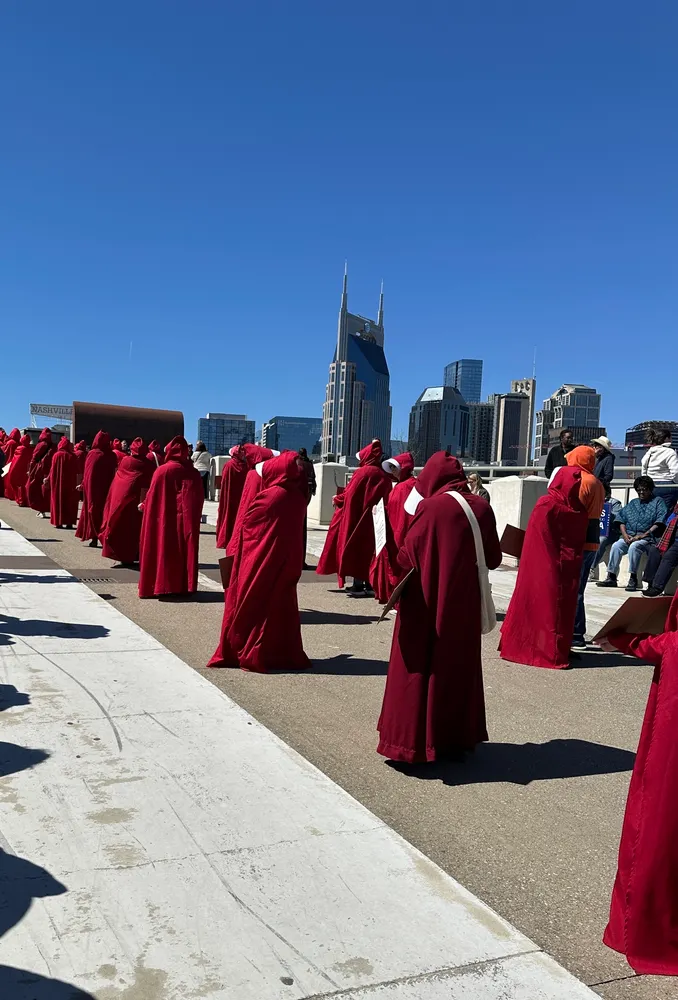
I wish that music wasn’t added. They were marching in silence.
Alberta scraps environmental assessment for Kevin O’Leary’s ‘world’s largest’ data centre by Marc Fawcett-Atkinson, April 3rd 2026


Alberta Premier Danielle Smith and Prime Minister Mark Carney on Nov 27, 2025 as Alberta and Ottawa sign a deal that includes rolling back environmental rules for the province’s data centres. Photo by Alberta Newsroom/FlickrI bet the Nazi fuckers will make Albertans pay the 90 billion dollars for billionaire Fuck Ass O’Leary’s stupid stolen spying Wonder Valley AI.
Danielle Smith’s government is exempting celebrity investor Kevin O’Leary’s massive Wonder Valley data centre near Grand Prairie, AB, from a provincial environmental assessment, Canada’s National Observer has learned.
A Tuesday letter, obtained by Canada’s National Observer and addressed to Paul Palandjian, CEO and co-general partner of O’Leary Ventures,from the Alberta environment ministry stated the project does not require a provincial environmental impact assessment. The project was announced in December 2024 but appears to still be largely in planning phases with no shovels in the ground.
The Wonder Valley data centre project “is not a mandatory activity for the purposes of environmental assessment,” wrote Karen Tomashavsky, acting manager of the province’s approvals program in the ministry of environment’s regulatory assurance section. “I have decided that a further assessment of the activity is not required. Therefore, a screening report will not be prepared and an environmental assessment report is not required.”
“This decision is based on the current information liesabout the project and that I reserve the ability to review this decision should different and/or new information come to light,” she wrote.
Set Canada back 20 years
When O’Leary (of Dragon’s Den fame) first announced the project a year and a half ago alongside municipal and provincial representatives, they described the project as “the world’s largest AI Data Centre Industrial Park.”
The project is slated to need about 7.5 GW of power when fully built.
That’s roughly seven times the amount of electricity generated by the Site C dam in northern BC.
Much of that power is poised to come fromfrac’d natural gas. The company’s initial announcements about the project claimed it would use geothermal power and gas. However, emails Canada’s National Observer obtained through a Freedom of Information request from the municipality where the project is located suggest O’Leary’s company rapidly ditched plans for geothermal power in favour of exclusively using natural gas. I bet you because Smith is giving the fucking Nazi billionaire our frac’g gas for free, or in another words, make Alberta families pay for it.
If the project is entirely powered by natural gas and doesn’t capture any of those emissions, it will set Canada back 20 years in carbon emissions reductions and wipe out the reductions gained by phasing out coal, according to Will Noel, senior analyst with the Pembina Institute’s electricity team.
and much worse, remove much of Alberta’s water permanently from the hydrogeological cycle, worsening the harms from global warming turning wildfires into monsters and droughts extreme.
A proportion (25% to 100%) of the water used in hydraulic fracturing is not recovered, and consequently this water is lost permanently to re-use, which differs from some other water uses in which water can be recovered and processed for re-use.
Wonder Valley’s proponents also estimate the centre will use about 24 million cubic meters of water annually — the equivalent of roughly 460,000 people’s lifetime consumption. A proportion (25% to 100%) of the water used in hydraulic fracturing is not recovered, and consequently this water is lost permanently to re-use, which differs from some other water uses in which water can be recovered and processed for re-use.and, contaminate it with PFAS, biocides, metals and other toxic shit, with Smith and Carney likely giving mother fucker O’Leary forever permit to dump the cancer causing waste directly into the watershed or bottle it and sell it as penis invigorator for the separatists
Court documents filed late last year by the Sturgeon Lake Cree Nation, on whose territory Wonder Valley is located, note that the nearby Little Smoky River has been placed under a no water withdrawal order in the past. The filing noted that the Little Smoky was Alberta’s most overdrawn watershed in 2016, with the Smoky River coming in second-most overdrawn.
The Municipal District of Greenview, where Wonder Valley is located, declared an agricultural disaster last summer because of drought.
In February 2024, Alberta issued a preliminary water licence to the Greenview Industrial Gateway (GIG), the industrial park developed by three local municipalities where O’Leary plans to build the data centre, to draw water from the nearby Smoky River. Smith, Carney and O’Leary are intentionally going to kill the river and every living being in it, and which relies on it.
But Fisheries and Oceans Canada has only allowed the GIG to divert six million cubic meters of water a year from the river, according to a letter the ministry sent to GIG’s executive director, Kyle Reiling, earlier this year Canada’s National Observer obtained through a Freedom of Information request. Never fear! Nazi Carney is here to neuter DFO, and let AI take all of Alberta’s water (and frac’d gas).
Canada’s National Observer asked Ryan Fournier, the press secretary for Alberta’s environment minister, what information O’Leary’s company shared with the ministry and why it decided an environmental assessment wasn’t necessary. He did not answer by deadline.
We asked Palandjian and Reiling what information O’Leary’s company shared with Alberta’s environment ministry, what measures O’Leary’s company will take to mitigate Wonder Valley’s environmental footprint, how much water the project will need and whether the current licenses meet that need. They did not respond by deadline.
A data centre boom
The province’s decision on the impact assessment comes as both the Alberta and federal governments are pushing for a data centre boom in the province.
However, about three quarters of Alberta’s proposed data centre projects are located in regions under high or extremely high water stress. That could lead to dramatic scenarios where farmers and ranchers wouldn’t be able to water their crops or animals in the summer because data centres would be using all the available water. and not a drop will run from family water taps and businesses.
Moreover, the November 2025 memorandum of understanding (MOU) between the federal government and Alberta promises the province will build “thousands of megawatts of AI computing power.”
Smith’s government is aiming to attract $100 billion in data centre investments within five years. there isn’t enough water or gas in Alberta to serve that.
The agreement includes exemptions for the province from federal Clean Electricity Rules, which would otherwise make it difficult for data centres to build gas generators if they are connected to the provincial grid. Data centres that generate their own power from gas but don’t feed into the grid, like Wonder Valley, fall under industrial carbon pricing rules. which are useless because Nazi Carney is weakening them like crazy to near nothing to serve fossil fuel polluters, and AI Nazis.
Alberta has its own industrial carbon pricing system, but it currently doesn’t meet the minimum federal carbon price. The MOU gave both governments until April 1, 2026 to negotiate a deal but missed the deadline.

Ottawa’s decision to roll back federal climate rules for Alberta’s AI industry comes after intense lobbying efforts by Capital Power, an Alberta electricity company building a gas-powered AI data centre. And Evan Solomon, Canada’s AI minister, has only met with mining and energy companies about the environmental impacts of AI data centres — but so far has ignored environmental groups.
There is still a chance that Wonder Valley will undergo an environmental assessment: In her letter to Palandjian, Tomashavsky noted that O’Leary’s company should contact the federal impact assessment agency to “discuss” whether it needs to undergo a federal review.
The Impact Assessment Agency of Canada did not respond by deadline to questions about whether the project will undergo a federal assessment.
This below is a MUST WATCH, especially if you trust AI or Mark Carney or Evan Solomon or the tech billionaire bros.
Sam Altman Gets Embarrassed by His Own AI (Then It Calls Him A Liar!) by 51-49 with James Li, April 5, 2026
@nigelb.bsky.social:
A classic example of a bit-by-bit project in which the individual bits may not trigger an assessment but taken together the cumulative effects will be significant. The “master plan” for Wonder Vally is massive; see Jody MacPherson’s coverage
Wonder Valley Watch: Inside the Calgary Petroleum Club to hear more of the origin story, Through the ‘rose-coloured’ looking glass, with trees, deer, and even moose doing their part by Jody MacPherson, Apr 03, 2026
My Scottish/Irish ancestors were immigrants who travelled by ship to the east coast of so-called “Canada” in the late 1700’s or early 1800’s, and were part of several waves of genocidal colonization of the Indigenous people on Turtle Island. We arrived uninvited on the traditional unceded territory of the Wəlastəkewiyik (Maliseet) whose ancestors along with the Mi’Kmaq / Mi’kmaw and Passamaquoddy / Peskotomuhkati Tribes / Nations signed Peace and Friendship Treaties with the British Crown in the 1700s. Growing up, I knew little about the true history and we didn’t really discuss this in my family. As a child in the 1970’s, my parents moved west to work in the oil sands industry and I grew up in the Nistawâyâw (Cree) Ełídlį Kuę́ (Dene) – Fort McMurray area within Treaty 8 territory, which his home to six First Nations and six Métis communities. Today, I am grateful to be writing this newsletter from Moh’kinsstis, and the traditional Treaty 7 territory of the Blackfoot confederacy: Siksika, Kainai, Piikani, as well as the Îyâxe Nakoda and Tsuut’ina Nations. This territory is also home to the Métis Nation within Alberta (including Nose Hill Métis District 5 and Elbow Métis District 6). The Treaties were an agreement to share the land and must be honoured. I begin this newsletter with my personal past so that you may know a little about me and what motivates me to keep writing this newsletter in the present. As a grandmother, I choose to write freelance articles about energy and the environment out of concern for the future of my own and all grandkids. I support land back as an act of reconciliation. Lands inhabited by Indigenous peoples contain 80% of the world’s remaining biodiversity. Indigenous Peoples’ traditional knowledge systems are critical to creating a more harmonious future for all.
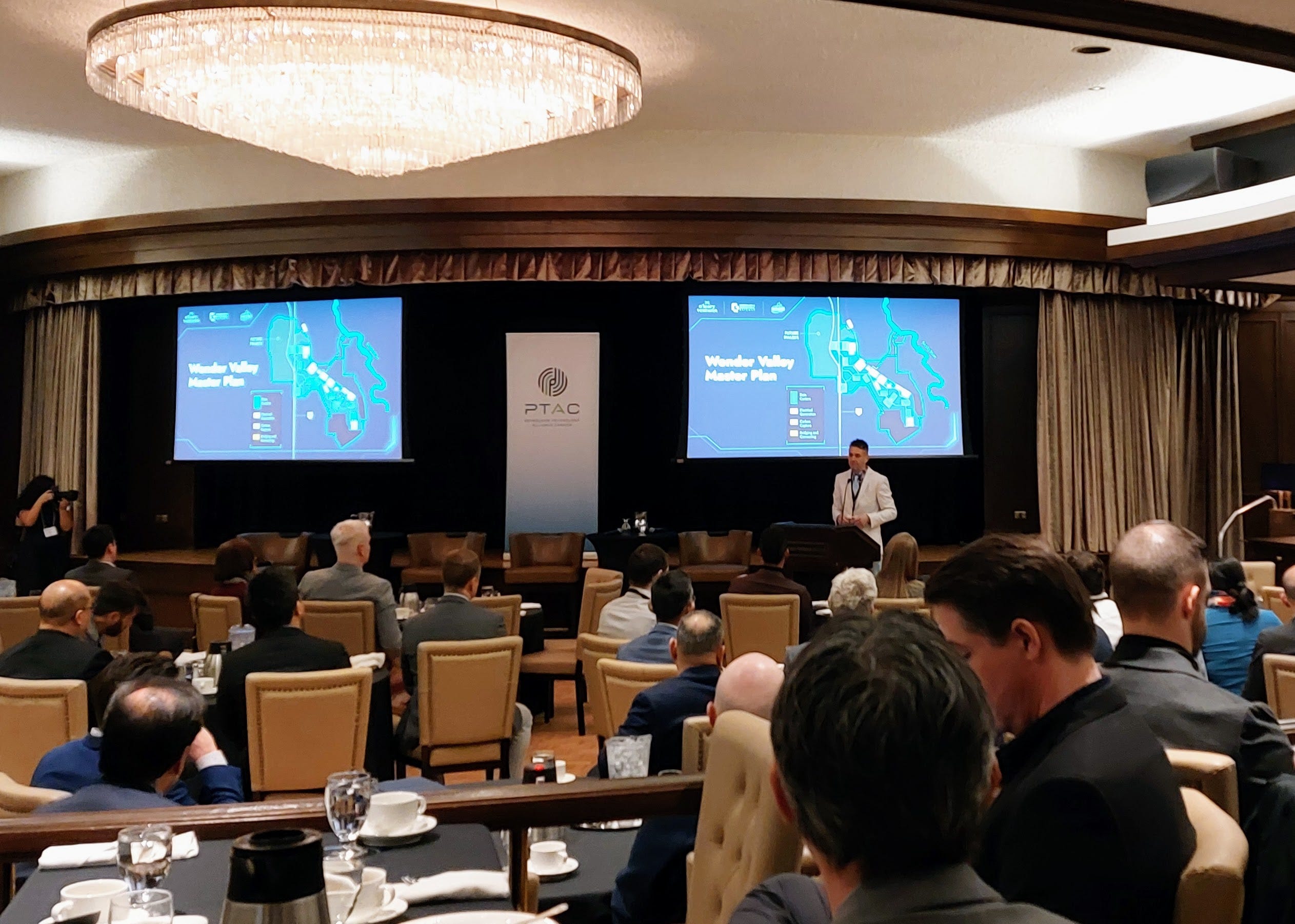
When Kyle Reiling, the executive director of the Greenview Industrial Gateway (GIG), was queuing up a video about Wonder Valley for an audience at the Calgary Petroleum Club in March, he hesitated slightly before pressing the play button.
Turning to a small audience of maybe 100 at the Petroleum Technology Alliance of Canada conference, he said apologetically, “I know some people are going to roll their eyes.”
From my seat at the media table near the back of the room, I can confirm that was the case, as some of the attendees chuckled nervously.
“It’s a little bit over the top, but it starts getting you thinking that this really is a different opportunity,” said Reiling, as he went on to compare it favourably to his early experiences in petrochemicals.
Kevin O’Leary’s Wonder Valley AI data centre dream was announced in December of 2024 for an immense area in northwestern Alberta where stranded gas is a concern. The gargantuan $70 billion gas-powered campus would sit on land that still has not been sold to O’Leary.
Reiling had opened his presentation with some personal history, including his role in the development of Alberta’s Industrial Heartland (AIH) when he worked with Strathcona County in his early 20’s as a recent university graduate.
The AIH is a 582 square kilometre area of the province that has seen $50 billion in capital investment and is home to more than 40 energy, fertilizer, power and petrochemicals companies. It’s surrounded by five Alberta municipalities, including the capital city of Edmonton, who work together catering to an environmentally-damaging cluster of hugely profitable companies such as Dow Chemical, TC Energy, Nutrien and Shell.
And, gives workers and neighbours cancer while vanishing water! Is Reiling proud of that too?
2015: Toxic taint: Tests in Alberta industrial heartland reveal air-quality concerns
Stackable incentive programs
Despite the wealth of these companies, the investor brochure claims (pdf) “stackable incentive programs” are available “across all levels of government.”
It’s like an all-inclusive corporate resort where companies can access taxpayer dollars, exploit natural resources, and conveniently plug into a regulatory concierge service to help quickly receive permits and approvals.
Nevertheless, Reiling said he found the whole process of creating the AIH frustrating because of the time it took to develop infrastructure. Despite having appreciated the mentorship of one of the pioneers of the AIH, Reiling said he soon left to go into private land development. Until he said was approached six years ago by the Municipal District of Greenview. And began modelling his newest project after the AIH that he’d left behind.Very bad news for any life in MD Greenview, and in the area.
A Simcity with plug and play petrochemicals
Here’s how Reiling described the opportunity:
“It was under the premise of, ‘we’ll empower you to create your own kind of Simcity, your own plug and play petrochemical development’ that was focused on the upgrading of natural gas.”
“Honestly, I named it the GIG because I didn’t know how long I’d be there there. I didn’t know if I could convince or bring along the region to make the necessary investment.”
Reiling then played the Wonder Valley video as the room became hushed. It seemed that more than a few had seen it already.
Here’s the script:
There’s a valley.
A valley where technology and nature will come together in perfect harmony.
Where the future will pulse and in return,
bursting with nature and wildlife,After O’Leary’s bigoted misogynistic women and kid abusing AI data centre invades, watch nature die and wildlife be driven out by the noise, if not killed by the toxic pollution and no more water to drink.
nurturing the present as it embraces the future.
A valley where the brightest minds unite.
Where electrons, machines and data come together in an algorithmic dance.
Wonder. It’s not just the name, it’s a mission.
A data centre campus that will sustainably marshal in a new era of innovation.
The single largest AI compute data centre park on Earth.
Nestled quietly within 7,000 acres of forest land with trails, wildlife, and recreation, and beauty.
Welcome to Wonder Valley. Yesterday is history. Tomorrow’s a mystery.
Let’s shape the future together.
That’s it. That’s the whole script. I recommend watching the AI-generated video that has been totally skewered online.
Reiling then began to walk through the trials and tribulations (so far) with developing the GIG, leading up to the present. Kevin O’Leary, had given Greenview a “letter of intent” to develop what he calls a “unicorn” of an opportunity, but Reiling wanted the audience to know that the “unicorn did not just appear” out of nowhere. He spent years working on it.
I would get up every single day and I would just start calling individuals that I had known, experts in the field and say, is this possible? And you know, it’s funny, I wrote carbon sequestration right at the top but I had absolutely no idea even what carbon sequestration was.
I hired McDaniel & Associates to do an entire assessment of the region and just say, are there aquifers in this region that are capable of handling world class carbon? And when that answer came back, it’s started opening up things.
I would start looking at linear infrastructure corridors, transportation and upgrades to Highway 40, rail power, pipeline capacity, the money, gas sources, fiber optics. This really has been a slow and steady process.
This is where he dropped a bit of a bombshell, revealing that the MD of Greenview had spent more than $70 million on the development of the GIG so far, with the “unwavering commitment” of the MD’s leadership and two consecutive Reeves.
Read my story for The Energy Mix about the $70 million.
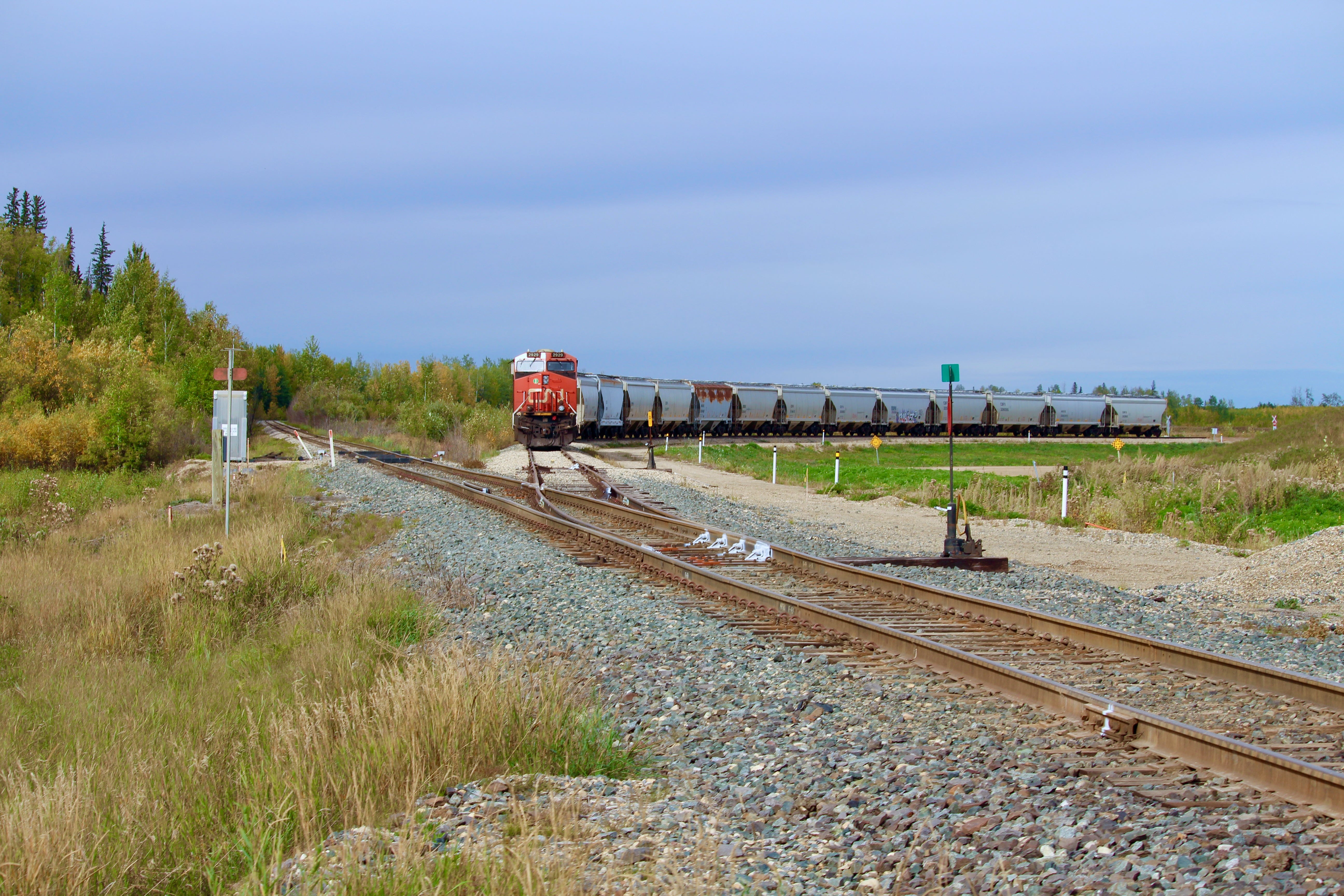
Phew! Almost went with the most toxic substances
Back in 2020, a memorandum of understanding was signed with then kill everything with industrial toxic pollution and noise Environment and Parks Minister Jason Nixon to develop a designated industrial area (later named the GIG). Reiling said the province led a consultation over two years with all communities in the area to create what then became the GIG Area Structure Plan and progressed to a heavy industrial land use designation permitting data centres and also petrochemical development.
“When I started designing this area, it was not for molecules to intelligence, it was for massive amounts of natural gas to get processed into commodities such as ammonia, methanol, ethanol. We were talking about taking massive amounts of natural gas and producing ammonia, one of the most toxic substances there is, and moving it on a secondary rail.
And I honestly say, fortunately that didn’t happen. It was a real letdown for the region and the region lost on multiple opportunities. We had interprovincial pipeline, interprovincial fuel solutions. They wanted to create the lowest carbon intensity gas, diesel. But we couldn’t get the development of the carbon hub created in time.”
After that disappointment, Reiling didn’t give up. They started talking about the natural gas supply all within a “four mile radius” of the GIG, about “25.3 trillion cubic feet,” and when zoomed out to the entire region, he said there are reserves of about “34.2 trillion cubic feet.”
Read the bad news about emissions from Wonder Valley here.
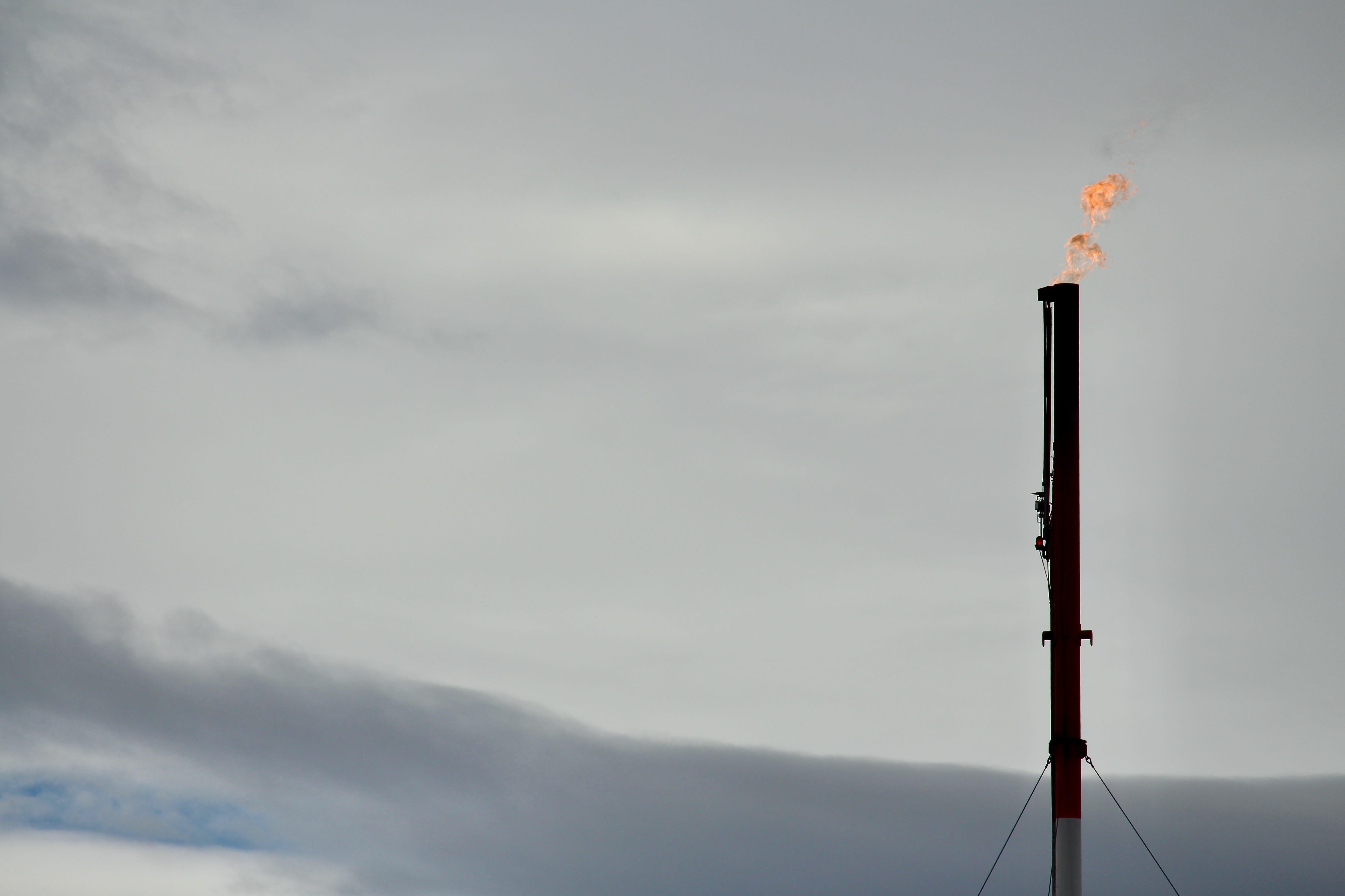
Also, he knew that a road was needed and that “you can’t just develop a road in a year here in Alberta.” He set to work pushing for improvements to Highway 40 that connects Grande Prairie to Grande Cache.
“We have an absolutely beautiful road into the GIG. And that was a commitment by council. Once I got through that day, it started rolling. This process has not been easy, but we have a functional plan that we’ve already developed with Alberta Transportation that looks at the long range planning.”
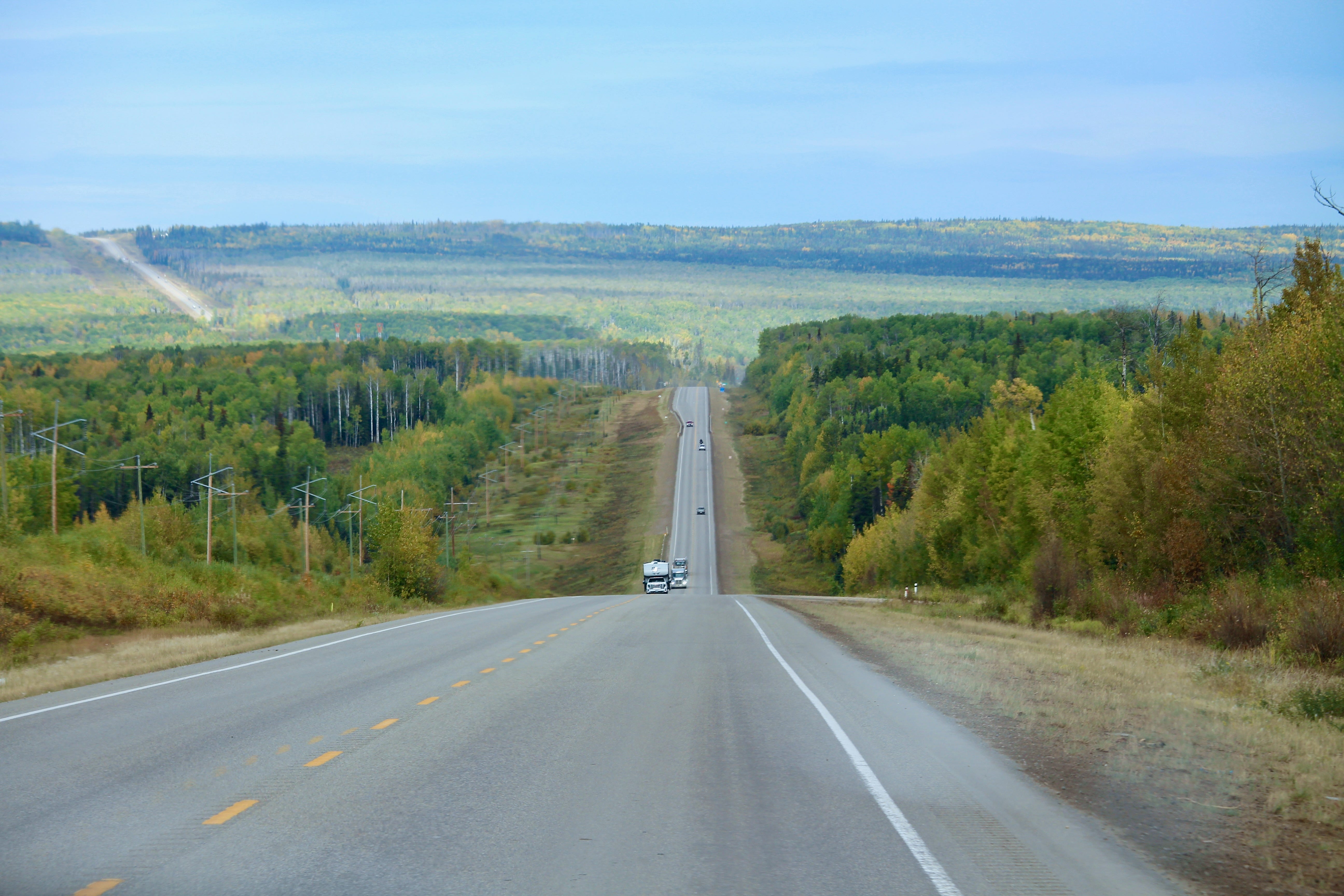
‘We’re rolling now’ with water flows quite low
Reiling said the initial plan was for multiple ammonia plants that would’ve required large amounts of water, and so he reached out to a company now called Hazen and Sawyer (formerly Water Smart) to find out if the water flow in the Smoky River could support ammonia production.
“I pulled some approvals and figured that, you know, if we take a different approach here and it’s more of a plug and play system, then each one of these developments only needs about 400-500 acres. Times that by four and I said, is there 20 million cubes in here?”
“When they came back and they said 20 million cubes equates 0.22% (of the total water flow) I thought, okay, we’re rolling now. That was based off of a 2,000 acre parcel. And now when we’re talking about Wonder Valley, we’re talking about 14,000 acres.”
“I’m not here saying that the Smoky’s flows are this grandiose thing. It actually is quite low and then it’s high for about four months and then slow. But we took that into consideration in the design. We actually spent an additional year and a half.”
“We waited for ice coverage of the smoky to be at 0.8 inches, which at that moment in time we could get a drill rig out there. We did a geotechnical analysis of the Smoky shore bed and then we refined our design and now there’s no need for a cofferdam. We’re designing it right into the structure of the bank.”
Based on previous experience with the Heartland initiative, Reiling wanted the MD to do things a little differently, so he pushed for the municipality to lead and cover the cost for a full engineering design of the outtake water facility at two locations along the Smoky River. He said it was rewarding that the design is now completely applicable to Wonder Valley.Just wait until your gas, electricity prices quadruple, and PFAS contaminated water feeds you and your loved ones, or, no water at all runs from your taps.
Read more about the Smoky River and regional water issues here.
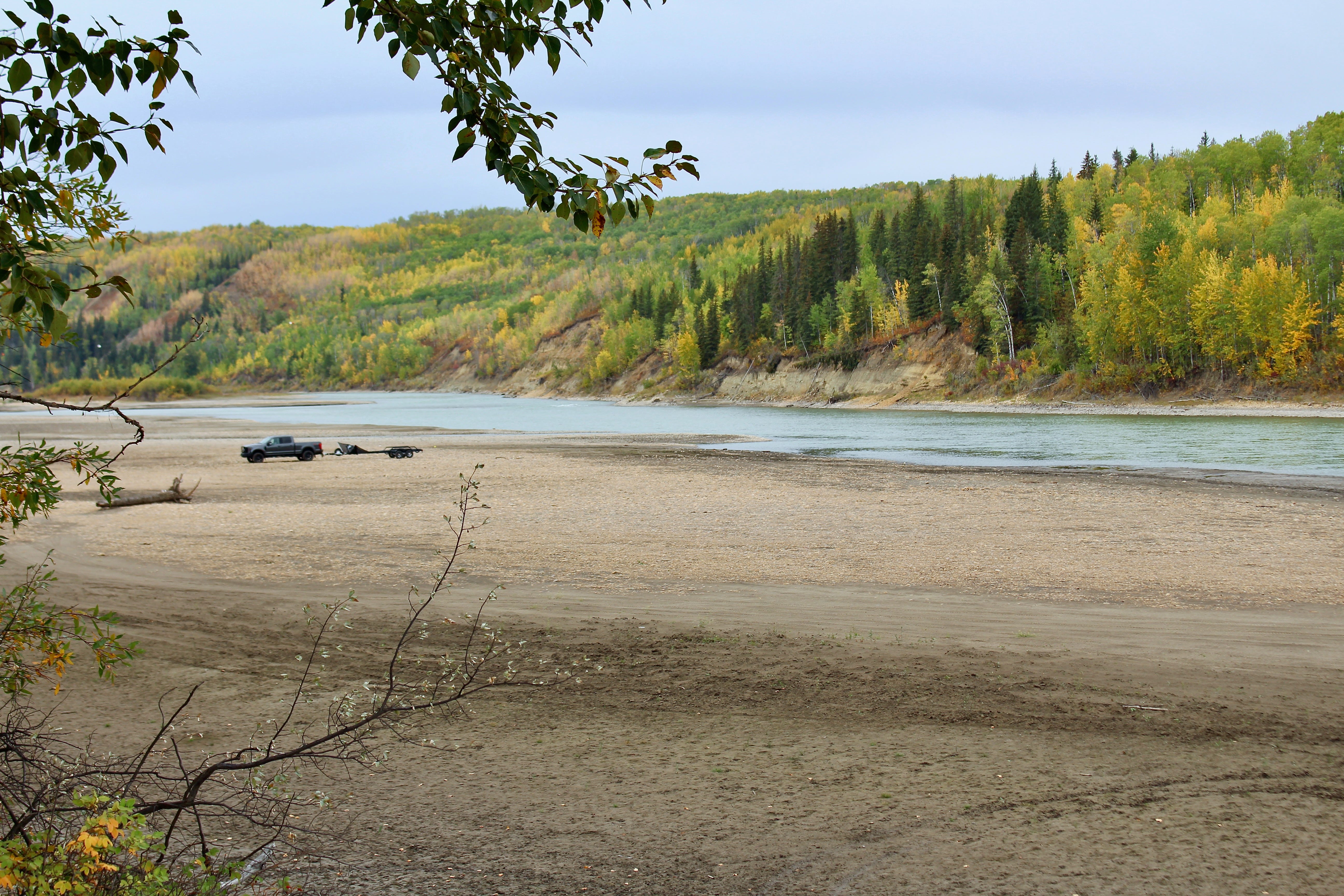
A Shark Tank pitch at Banker’s Hall
About a year and a half ago, Reiling said he got a phone call suggesting he meet a group that weekend in Calgary about a data centre development. He asked the co-founder of Canadian Fiber Optics, Jodi Bloomer to join him in the last-minute meeting saying he did some quick research on data centres and “figured fiber optics played a major role in it.”
“When we walked up on the top floor of Bennett Jones, we had our own Shark Tank and she (Bloomer) absolutely nailed it. She nailed it on the fiber optics and on the capacity, but she also nailed it on the entrepreneurial spirit of the Grand Prairie region and our workforce.”
“We spent four hours with them giving an overview of everything about the GIG and the region. They left and they told us to wait there. Then they came back and then spent another two hours with me.”
“Carl Agren, who is one of the foremost experts in data centre design, he was supposed to head back to Dubai, but I got a call later that day, and he said, change of plan. Can you meet me in Grand Prairie on Monday and I said, absolutely, let’s do this.”
Reiling said he invited Travis Toews, former Alberta Finance Minister, to join them in the helicopter for a tour of the Greenview site that was lit up in full fall colours that day.
“It was this beautiful sky. And as we’re flying over, literally, there’s deer and moose and Travis is looking at me like, wow, everyone’s showing up today and you can see that they fell in love with this. We landed, they got off that helicopter. And then it was a call to Kevin. It was like, we found it. And from that it’s been full go.”
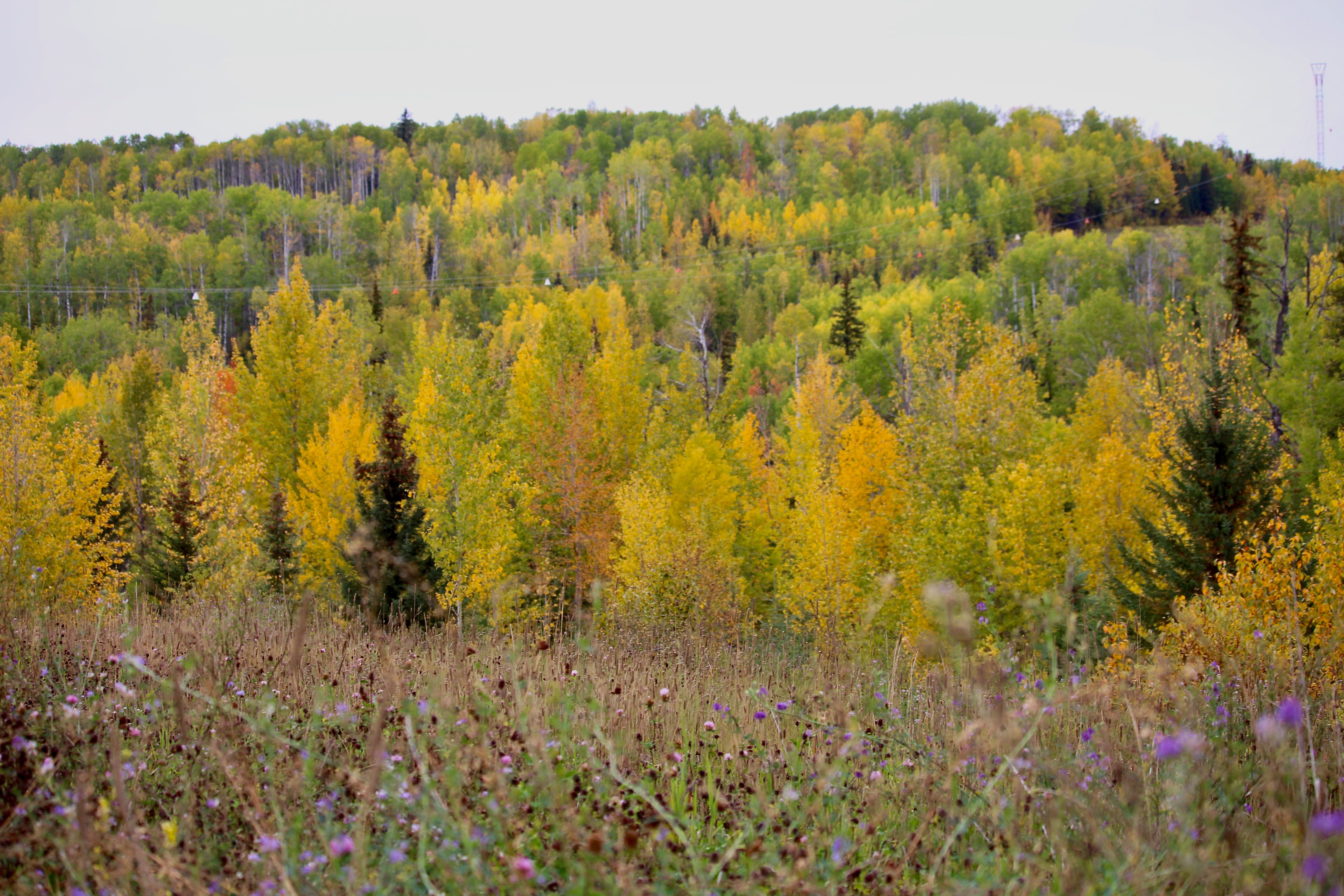
Except Reiling admitted O’Leary has still not moved ahead with any orders on power. There has not been a confirmed sales agreement on the land either.there best never be one
And local First Nations are not feeling the love for Wonder Valley for many good reasons (more news to come on this very soon!).
He ended his presentation with a bit of a reality check admitting that O’Leary also recently acquired a site in Utah (also named “Wonder Valley”) that people may have heard about, but said “this gas is not going anywhere.”
Undeterred by the twinning of Wonder Valley, Reiling reminded the audience for a second time, about the large number of construction workers needed to build two million square feet per year…8,000-12,000 people was his estimate.
He added that Greenview region is the “cheapest place in the world to produce electricity.”I bet that’s not true, and that Mother Fucker Reiling bloody well knows it. Frac’d gas permanently removes much of the water injected to frac from the hydrogeological cycle. PURE NAZI GREEDY FUCKING INSANITY with human pollution caused global warming heat extremes, multi year long droughts and continental drying driving more powerful and damaging and impossible to control wildfires. With the heat that data centres put off, I bet it’ll go up in smoke in no time after it’s operating.
Read more about Wonder Valley Utah here.
More of my writing about Wonder Valley:
- Wonder Valley Watch: We need to talk about Kevin – Feb. 22, 2026
- Second Wonder Valley Emerges in Utah as Alberta Project Stalls – Feb. 19, 2026
- Wonder Valley Watch: The US needs energy, CCS not a thing, and emissions ‘happen’ – Jan. 12, 2026 (#3 most viewed post)
- Wonder Valley Watch: ‘Unnoticed and unanswered,’ a Bitcoin conference, and nuclear missiles – Dec. 29, 2025 (#1 most viewed post)
- Wonder Valley Watch: A big win, a wonderful thing, a firing and a flight to Florida – Nov. 10, 2025
- Touching grass, visiting a river, and a warning from Cancer Alley – Oct. 21, 2025 (#2 most viewed post)
- Wonder Valley Watch: One can’t believe impossible things – Aug. 4, 2025
- Wonder Valley Watch: It’s marked out just like a large chessboard – July 1, 2025
- Wonder Valley Watch: Through the looking glass – May 23, 2025
Alberta Municipality Bets Tens of Millions on Wonder Valley Data Centre by Jody MacPherson, March 9, 2026, Full Story: The Energy Mix

Photo of Kyle Reiling speaking at the PTAC conference. Provided by PTAC.
This story is part of our ongoing investigative series,Hidden Wonder Valley.
A rural Alberta municipality has spent about C$70 million to lay the groundwork why the hell isn’t billionaire O’Leary paying for his own data centre pre work instead of ordinary tax payers barely able to afford to feed their families or put fuel in their machinery and cars? Corrupt and or stupid Greenview Co!!for ‘Wonder Valley,’ the proposed site for the world’s largest artificial intelligence data centre powered by North America’s largest gas-fired plant.
And while the municipality lacks a formal purchase agreement more than a year after the project was first announced, a local official says he’s confident it will move forward.I am quite sure the monstrosity will never happen, unless taxpayers are forced to pay for all of it, including the upkeep and energy costs, and after the Nazi fuckers kill the river, to haul in water from Manitoba and clean up when it goes tits up bankrupt like Trump is expert in.
The process has not been easy, Kyle Reiling, executive director of the Greenview Industrial Gateway (GIG), where Wonder Valley is being floated, told a gathering of the Petroleum Technology Alliance Canada (PTAC) in Calgary last week.
First announced by Kevin O’Leary in December, 2024, the vision for Wonder Valley is massive: the celebrity investor promised to raise $70 billion to build a 7.5-gigawatt gas-powered data centre on 14,000 acres in Greenview, about 460 kilometres northwest of Edmonton.best to never believe a billionaire, by the way, the traitor and coward lives in Nazi USA. He must not get one fucking penny from us, the people, for this insane mass surveillance centre which will stress the already heavily frac’d area, the water supply, and cause untold noise and toxic pollution, with no environmental assessment meaning no mitigation
At one point, when Reiling was balking at the plans for millions in spending, he said council told him to keep going: “‘we believe in this, we believe that this is the right thing to do, and we’re going to signal to the province and we’re going to signal to industry that we’re moving ahead with this.’”greedy fucking idiots.
Reiling said he modelled the industrial area after the Heartland Designated Industrial Zone northeast of Edmonton.
Heartland is a formalized agreement to streamline regulations translation, get rid of them and pollute us to death with carcinogensand cluster petrochemical infrastructure in one area. Five municipalities, some environmental groups, and more than 40 companies participate, with help and incentives from the provincial government.incentives (aka bribery) to cause us cancer and help destroy earth’s livability
Greenview is not a designated industrial zone but was originally the site intended for a petrochemical plant. The initial plan was to process gas into commodities like ammonia, methanol, and ethanol, but Reiling said the community “couldn’t get the carbon hub created in time.”
It was a “real letdown for the region” when the project did not go ahead, he said.
He added that the municipality has invested millions over the last decade on roads, water outtake from the nearby Smoky River, laser imaging, and geochemical and biophysical work on the industrial land.Not our fault you guys’ greed is bigger than your brains. It’s disgusting to make ordinary families pay for this.
Reiling, who is an employee of the municipality, is also actively involved in planning the Wonder Valley project.

“Our conference calls start very early because we have members in the United Arab Emirateswith vicious human rights violations, but we also have members in Indianapolis, New York, Florida, Louisiana, and Grand Prairie,” he told the PTAC audience. “And we get together with one common goal, and that’s to design Wonder Valley.”
Last month, O’Leary’s company announced a second Wonder Valley project in northern Utah that would be the same size as its Alberta twin. “The reality is that we’re competing against Utah, where they have given them a 12-week approval process on 13,000 acres,” Reiling said.never trust a fucking billionaire FFS. How stupid are these Greenview guys, or are they gambling addicts? O’Leary lives in Naziland. I highly doubt he’ll build this monstrosity. AI is a fucking bubble, popping all over, people DO NOT WANT IT.
The Alberta government has offered support to companies, including access to a provincial concierge service to help AI data centre proponents navigate the regulatory process.remove regulations completely if they’re American Nazi billionaires, and give free frac’d gas (paid for by the people of Alberta, whether they like it or not)
“We will work with you and bring the right people to the table at the right time and make sure that they have all the context that they need,” Technology and Innovation Minister piece of shit Nate Glubish said in his keynote speech to the PTAC forum.
Alberta is willing to work with proponents to make the process “super easy, super simple, super-fast,” Glubish added.another mother fucker
“We’ll connect you to the gas provider. We’ll pinch through the fibre. We’ll help you navigate your water licences. Whatever it is you need, we’ll help you with that.”
Court documents show the province’s Aboriginal Consultation Office advised Greenview to skip Indigenous consultation when it applied for a permit to withdraw water for two locations along the Smoky River for Wonder Valley.
The water permit was granted by Alberta Environment and Protected Areas in April of 2025 and Sturgeon Lake Cree Nation has appealed the decision through the Environmental Appeal Board, a legal challenge working its way through the courts for almost a year now.
Reiling said the project will still need approvals for a permanent outtake water facility on the Smoky River, which would follow “phase two consultation” with the six to seven Indigenous communities in the area. Consultation is under way and “will take time.”You evil racist Nazi piece of shit, I bet the Indigenous people will not be consulted on for that either – intentionally by you AI fuckers. Every fucking tech bro I’ve seen speak or write, cannot help but spew their Nazi hatred of anyone and everyone not white male christian.
He said the GIG is the “cheapest place in the world” to produce electricity, with gas reserves of 25.3 trillion cubic feet and more than 5,000 wells.A wise jurisdiction would save that gas, not waste it on stupid stolen AI. With humans refusing to quit making babies, and refusing to reduce their pollution, the future looks mighty terrible for all but the very rich.
The Wonder Valley site is directly on top of the Montney Formation, one of North America’s, if not the world’s, largest gas reservoirs. In 2024, said Reiling
the project would require 10% of all the gas supply available in Alberta once fully operational.
Glubish said AI data centres are a way to bypass the dilemma of building gas pipelines and get billions of cubic feet of natural gas to global markets “through ones and zeros, through fibre.”JFC, are you a stupid man. How many humans will you sicken and or kill, and other species will you wipe out with your stupidity and greed?
Experts say the Wonder Valley data centre alone could wipe out all of the gains Alberta made in reducing carbon emissions by phasing out coal-fired electricity 20 years ago.
***
Alberta regulator nixes power plant proposal for Canada’s largest AI data centre complex, ‘Momentary sigh of collective relief,’ says one Olds, Alta., resident by Rukhsar Ali, CBC News, Mar 06, 2026
The Alberta Utilities Commission (AUC) has rejected Synapse Real Estate Corp.’s application to construct a 1.4-gigawatt natural gas-fired power plant in the town of Olds, Alta., saying the application contained “significant deficiencies.”
The proposed plant — which would have generated roughly enough energy to power Edmonton — was intended to supply a massive future data centre campus in the southern Alberta town billed by Synapse as “Canada’s largest” project of its kind.
“The deficiencies include, but are not limited to, errors, insufficient or incomplete information, and internal inconsistency among the application documents. Collectively, the deficiencies create a significant lack of clarity as to whether application requirements have been met,” AUC’s Mar. 6 decision said.I sure as hell would not live near anything this doofus company builds or operates.
Rachel Sorenson, an Olds resident who opposed the proposal, said she’s “elated” at the news of AUC’s decision.
“I feel like I’ll be able to sleep again. I’m looking forward to the summer when we can have our windows open … without two years of construction and knowing that for now, we can rest easy,” she said.

Synapse’s campus was proposed to be built on 121 hectares of land in the town’s northeast at the corner of Highway 2A and Highway 27, close to residents. According to an information package provided to residents, the company had intended to put shovels in the ground for the data centre this month, had it received all regulatory approvals.
Despite the setback, Synapse is permitted to apply again to the AUC with an application that complies with legislative and regulatory requirements applicable to power plants.
In an emailed statement to CBC News, Synapse CEO and founder Jason van Gaal said, “The Synapse data centre project is designed to be a 100-year fixture in the Olds community. It is critical that we work closely with both regulators and our neighbours to ensure the project’s foundation is built on transparency and trust. Nice words buddy. Why the fuck didn’t you do what you say? And why treat the soon to be poisoned and driven insane by noise community with respect and proper consultation?
“We have taken the AUC’s guidance and our community’s feedback to heart, and we are pleased to launch synapsedatacenter.com/we-are-listening/ as a first second step in facilitating our long-term dialogue.”Gets the boot from AUC, and lies. What a fucker

At a February open house for the proposed development, several Olds residents voiced their concerns over potential environmental impacts, including excessive noise and water use, as well as a lack of transparency in Synapse’s and the town’s communications to residents.
Sorenson said she first heard about the data centre proposal over the radio, after Premier Danielle Smith had shared news about it.Fucking Hideous company to not consult with the community first!!
“We were caught completely off guard and in a complete panic state wondering how could this possibly be without us knowing and the Alberta government is announcing this,” she said.
“All of us were feeling betrayed as residents.”You were betrayed. Synapse is doing precisely what Encana/Ovintiv did to my community – after the company had already illegally frac’d our drinking water aquifers!
Errors and incomplete information
The regulator’s decision noted that the public consultation process with over 700 residences within an 800-metre radius from the property boundary began just 14 days before the application was filed.
The decision added that the participant involvement program (PIP) information package provided by Synapse lacked detail and did not address all the information requirements.
“For example, the proposed 600 units of backup diesel generators, each rated at 2.6 megawatts, do not appear to be discussed in the project information package, dated January 27, 2026,” the decision reads.Synapse is going to poison Olds and grossly pollute in Alberta. Not acceptable. And seems Synapse is also copying the dirty Elon Musk way with these back up polluters. Musk ended up screwing the communities, and using them non stop. Some “backup”
AUC’s decision also stated Synapse’s environmental evaluation was a draft document with missing information including “incomplete citations, missing figures and document mark-ups including highlighted text,” and that the evaluation was developed based on conclusions relating to wildlife and wetlands made from “incomplete field studies conducted during the winter.”
Additionally, a noise impact assessment provided by Synapse did not model worst-case scenarios, among other concerns, the decision said.
Residents prepare for a longer fight
Bek MacIntosh, an Olds resident who lives down the street from the proposed development site, said the news of the regulator’s decision isn’t a celebration.
“There’s no foot off the gas on this end,” MacIntosh said. “There was a momentary sigh of collective relief from the local residents who feel most passionately about this, given that it’s our specific homes and families that will be impacted.

“But it was an almost dawning awareness that this is so far down the road and such a large scale.”
MacIntosh said since learning about the proposed development, she and other community members have gone through a “shockingly stressful” experience trying to get answers about how they’d be impacted by the data centre complex and power plant.Worse, the stresses to community members, and the impacts to come, are for nothing but mass surveillance of innocent Canadians (eg all people on the left, people who despise Trump and his Nazi girl Danielle Smith, anyone concerned about climate change, environmental harms, thievery by the tech bros and fossil fuels etc.), to feed us lies and for disgusting men to use to make CSAM, illegally undress kids and women and make porn with them without their consent.