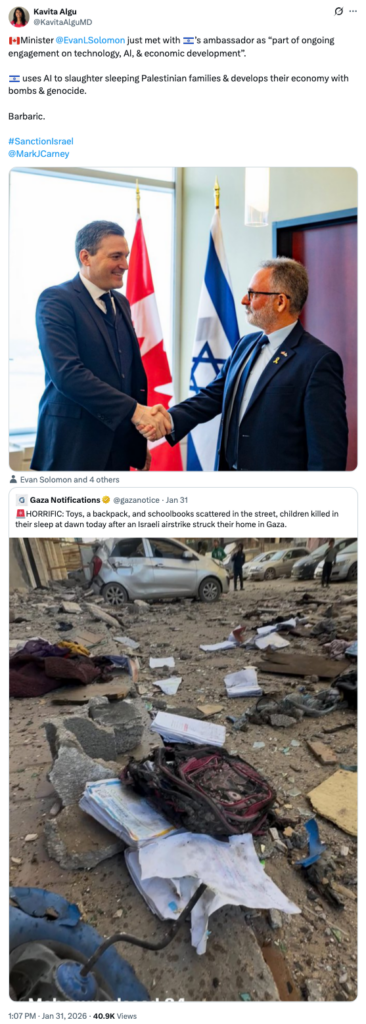
@drugdatadecoded.ca:
Carney appears to feel AI has more right to safe drinking water than First Nations
Palantir is deeply embedded in the scariest activities of the Trump regime – enabling everything from mass deportations and lawless assassinations in international waters to ethnic cleansing, genocide, and war crimes.
Investigative Journalism Foundation @theijf.org:
The Canadian government has spent more than $44 million on a secret contract with controversial American tech company Palantir.
CEO Alex Karp’s recent online manifesto is a truly disturbing, supremacist screed. One UK MP said it “sounds like the ramblings of a supervillain.”
The city of London, England recently canceled a contract with Palantir. Why is Canada handing nearly $50 million in public money to this creepy company? because Carney is an evil Nazi Zionist who serves Nazi genocidal USA/Israel, Nazi tech billionaires like creepy ass fuckers like democracy hating 6Shopify dude and Peter Thiel, et al
Doing business through a secretive contract with this MAGA-aligned tech giant is totally incompatible with the Prime Minister’s promise to defend Canadian sovereignty.Carney proved his royal Nazi ass a liar long before the election. He’s proven it hundreds of times since. He has no interest in Canada or Canadians, just our resources which he is eagerly giving away to rich fucking evil American rape companies like Palantir, oil, gas and frac, minerals, military, AI, etc. Because he and Pee Pee so swindled and conned the Canadian masses, most of those who voted for Carney, who is much more evil and more con than Harper, are now in a cult as sick as the Alberta separatists/Fucker Truckers and MAGAts. Doing business through a secretive contract with this MAGA-aligned tech giant is totally incompatible with the Prime Minister’s promise to defend Canadian sovereignty.
@pqpolitics.bsky.social:
The fact that the president of Palantir Canada advises Carney is almost as disturbing as that new DND contractand as evil as Irwin Colter, genocidaire, advising Carney on how to be pro genocide, pro Israel, pro Nazi, and Shopify fucker wanting to take the right to vote away from the poor and seniors, and Nazi Build Canada rotting Carney’s Nazi ear too.

HSRW101 @hsrw101.bsky.social:
Unless it was more than likely the banker was always full of it and took advantage of Maple MAGA’s boot licking the orange toad that got us to this position, all just to have the rich keep getting richer. Friggin power class at play again.
@beiman-nancy.bsky.social:
Peter Thiel is a disturbed and subversive man who has just moved to Argentina, which has no extradition treaties.Many Nazis fled to haven Argentina. Copy Cat Thiel following behind.
@solodeveloping.bsky.social:
All these people are working together to destroy the world
There is absolutely no reason for any government to do any of this
It’s not just that they do insanely corrupt shit
It’s also that this is a huge waste of money, they could do it in-house for a lot less, and give jobs to actual Canadians
… It’s insanely strange that they’re giving contracts to the US after all the shit the US is doing
@burwicke.bsky.social:
Mark Carney is fully conservative and anyone who supports him or voted for him got conned by the con conman.
Blubbering buffoons will say “bUt He’S nOt PiErRe pOiLiEvRe”, fully buying in to American-style two-party politics propaganda.
JD Vance, once an ‘angry atheist’, is America’s most powerful Catholic. How will he wield his faith? In his new memoir, the vice-president covers his conversion and politics – at a time when hardline Catholicism is ascendant in the US by J Oliver Conroy, 19 Jun 2026, The Guardian
… If Theil makes Vance President in 2028 (I believe the 2024 US election was rigged by Musk and billionaire tech, to make Musk hundreds of billions of dollars richer, and for Trump to destroy the USA, serving Putin; I also believe no future American election results will be trustworthy, likely not in Canada either. The fucking billionaires want to rule the world and control the bodies of women and girls (whom catholics hate and also want to control), putting a fake catholic and democracy and rights hater like fucker Vance into power will turn the world into a hellhole never previously experienced by humans on earth
Vance was impressed by an encounter with the venture capitalist Peter Thiel (who later helped him run for the US Senate in 2022), because Thiel, “possibly the smartest person I’d ever met”, also “identified very openly as a Christian. He defied the very simple social template I had constructed – that dumb people were religious and smart people were atheists.” …
The Carney government is NOT going to regulate AI.
@mrcranky.bsky.social:
It appears we have a an AI Minister who’s intelligence borders on the artificial.I think Herr Carney specially picked Solomon for his minimal, if any, ethics and tiny brain.
 You never asked me you Mother Fucker. I DO NOT WANT YOUR NAZI SLEAZY AMERICAN AI!
@genwil.bsky.social:
It’s such bullshit and one of the worst environmental abuses ever. The use of water might even be worse that the increase in energy demand, and that’s awful. How can you ignore those problems?Easy, when you’re a rich soulless Brookfield Nazi

MUST WATCH:
@anthonymoser.com:
great turn of phrase. Also his network literally funded a lot of this. AI is Epstein tech
it’s a good description bc it captures both how it gets made and what it’s used for
@danmcquillan.bsky.social:
AI is Epstein Tech (concentrated networks of masculine power, conspiracism, widespread apparatus of abuse).
ZackPolanski:
Nearly 100k people have joined our call to get dangerous US spy tech firm out of our NHS.
Palantir’s founder has called for the NHS to be ripped up. Now his company has access to millions of patient records.
Tell the government to end the contract!
To: Prime Minister Keir Starmer, Stop Palantir taking over our public services!
Campaign created by

Scrap all public contracts with Palantir – including ending the huge NHS database deal!
Why is this important?
A secretive US tech company called Palantir is embedding itself into our public services – including running a huge patient database for our NHS. Co-founded by a billionaire Trump donor, it provides tech to Trump’s ICE immigration agency and the Israeli military.
But right now we’ve got a major chance to get their NHS deal scrapped – and kick start a domino effect that sees ALL their contracts ended.
How? Ministers actually have the option to cancel the NHS deal early. But with these contracts flying under the radar, it’ll take all of us speaking up to make that happen. If you agree that our NHS and other public services shouldn’t be cutting deals with a private company that helps armies kill people, sign the petition now!
@infinite_jaz:
Ski slope where his nasal cavity should be
@gizmodo.com:
Palantir CEO Says Making War Crimes Constitutional Would Be Good for Business
@jacqueline99.bsky.social:
Cannot wait until the AI bubble bursts.
@SanaSaeed:
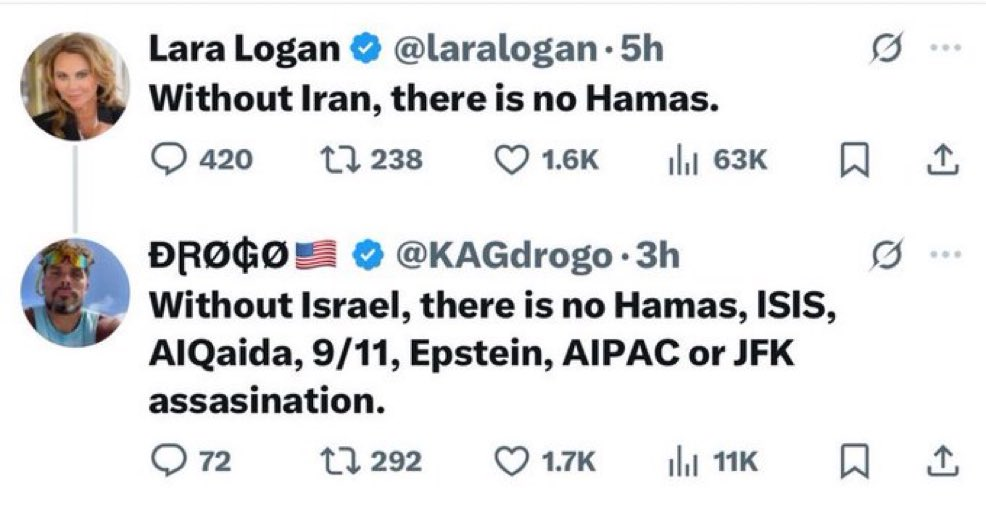
Every hell that can be inflicted on a people is being inflicted on the Palestinians.
BrianFlanagan1:
Palantir and Dataminr plus IDF – ‘Only do Evil’.
charliesaito22.bsky.social:
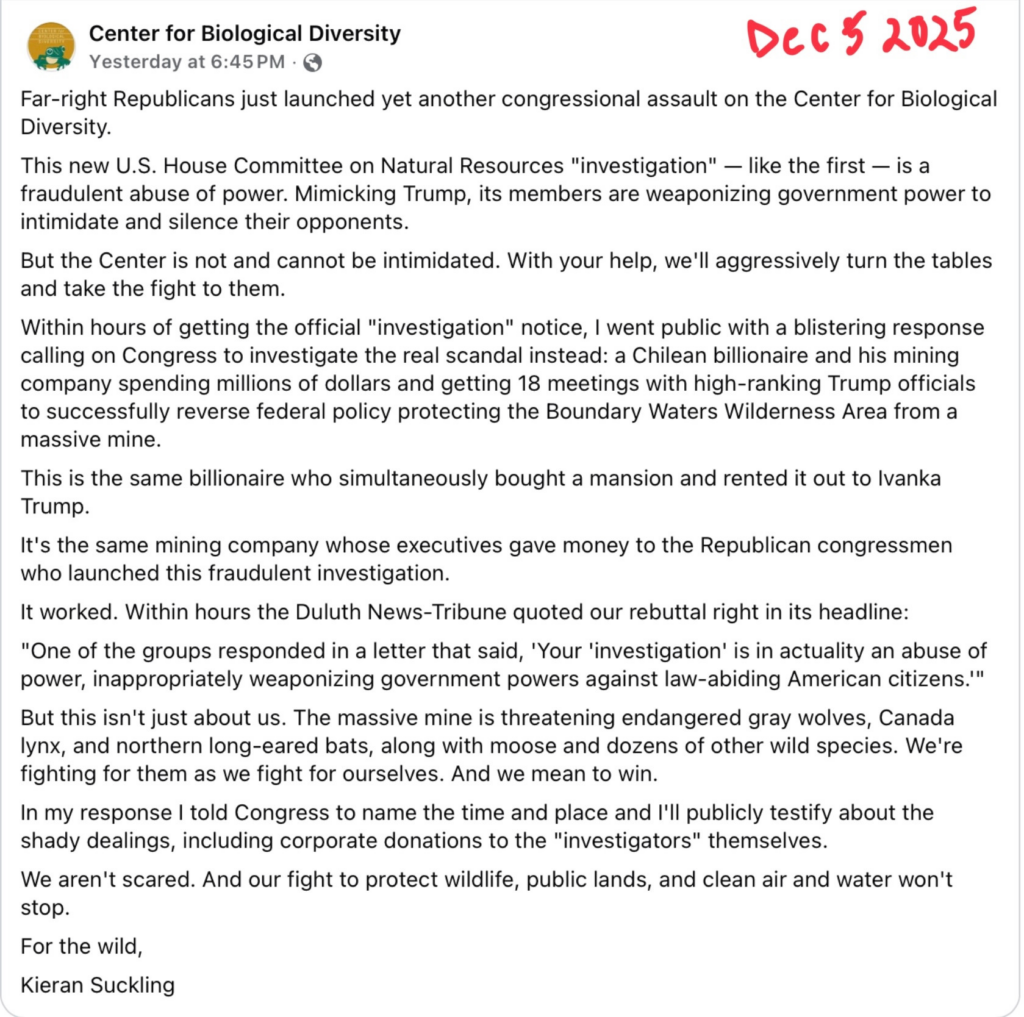
Congress has turned the unlimited power of the Federal GOV on the non-profit Center for Biological Diversity
Why? Bc the CBD is opposing a foreign-owned corporation from mining the Boundary Waters Canoe National Wilderness in MN
Old enough to remember when USFWS would be fighting this obscenity…
@DropSiteNews:
BREAKING: AI firms Palantir and Dataminr are rushing to claim their share of Gaza’s post-war landscape, +972 Magazine reports. Both firms are embedded inside the new U.S. military hub (the CMCC) in southern Israel, where Washington is building the security machinery for Trump’s Gaza plan, according to a seating chart seen by the outlet.
Palantir’s Maven, an AI “kill chain” optimizer, and Dataminr’s social-media scraping tools are being folded into the new occupation model – one that sidelines Palestinians and deepens Israeli control. Their AI systems will be used for real-time surveillance of phones, social media, and physical movement to flag people the system marks as suspicious, and track so-called threats inside the “Alternative Safe Communities” – the fenced, highly monitored compounds the U.S. and Israel plan to move Palestinians into.
The new setup mirrors the predictive surveillance Israel has used to target Palestinian families throughout the genocide. For Gaza, it points to a future of expanded digital policing powered by U.S. tech.And powered by Herr Hideous Harper’s Palestinian kid killing firm, AWZ, and I expect, some by Herr Hideous Zionist Mark Carney.
@972mag:
The presence of Palantir and Dataminr at the new U.S military compound in Israel suggests that Israel’s control over Gaza will remain deeply entrenched — with AI-powered surveillance and weapons systems at the center of post-war security architecture.
AI-powered surveillance firms are gunning for a share of the Gaza spoils, The presence of Palantir and Dataminr at the new U.S. military compound in Israel offers a glimpse of how tech companies are cashing in on the genocide by Sophia Goodfriend, November 28, 2025, 972Mag
Since mid-October, some 200 U.S. military personnel have been working out of a sprawling warehouse in southern Israel, around 20 kilometers from the northern tip of the Gaza Strip. The Civil-Military Coordination Center (CMCC) was ostensibly set up to facilitate the implementation of President Donald Trump’s 20-point “peace plan” — whose stated aims are to “disarm Hamas,” “rebuild Gaza,” and lay the groundwork for “Palestinian self-determination and statehood” — which last week received the endorsement of the UN Security Council.
Yet while no Palestinian bodies have been involved in the conversations surrounding Gaza’s future, at least two private U.S. surveillance firms have found their way into the White House’s post-war designs for the Strip.
According to a seating chart seen by +972 Magazine, a “Maven Field Service Representative” has been present at the CMCC. Built by the U.S. tech company Palantir, whose logo was visible in presentations given inside the Center, Maven collects and analyses surveillance data taken from warzones to speed-up U.S. military operations, including lethal airstrikes. The platform sucks information from satellites, spy planes, drones, intercepted telecommunications, and the internet, and “packages it into a common, searchable app for commanders and support groups,” according to U.S. defense outlets.
The U.S. military calls Maven its “AI-powered battlefield platform.” It has already been deployed to guide U.S. airstrikes across the Middle East, including in Yemen, Syria, and Iraq. Palantir has marketed its technology as shortening the process of identifying and bombing military targets — what the company’s CTO recently described as “optimizing the kill chain.” Over the summer, Palantir scored a $10 billion contract to update and refine the Maven platform for U.S. armed forces.
Palantir has also worked closely with Israel’s military since January 2024, when the two parties entered into a “strategic partnership” for “war related missions.” The company has been aggressively recruiting employees to staff its Tel Aviv office, which first opened in 2015 and has expanded significantly over the last two years. Justifying its stalwart commitment to Israel in spite of mounting charges of war crimes and genocide, Palantir CEO Alex Karp recently said his company was the first to be “completely anti-woke.”

Israeli military personnel listen as U.S. Army soldiers discuss civil-military operations, at the Civil-Military Coordination Center in Kiryat Gat, southern Israel, October 28, 2025. (U.S. Army photo by Spc. Kathryn Skonning/Wikimedia Commons)
In addition to Palantir’s Maven, the name of another U.S.-based surveillance firm showed up in recent presentations at the CMCC: Dataminr. The artificial intelligence start-up leverages close ties to social media platforms like X (formerly Twitter) to allow states and corporations to monitor internet users: “Real-time event, threat, and risk intelligence” is how the company advertises its services.
Dataminr got its start in the mid-2010s by offering the FBI access to the entire output of Twitter’s userbase to surveil and alert law enforcement of “criminal and terrorist activities.” Though sold as a tool to monitor violent incidents across major cities in real time, the company offered law enforcement and governments the ability to surveil any social media user’s “past digital activity” and “discover an individual’s interconnectivity and interactions with others on social media.” Twitter referred to Dataminr at the time as an “official partner” and owned a 5 percent stake in the company. The CIA’s venture capital fund, In-Q-Tel, was also an early investor.
In the decade since, Dataminr has worked closely with the U.S. military and law enforcement agencies across the country. During the first Trump administration, Dataminr partnered with local police forces to track Black Lives Matter protests, while under President Joe Biden, the U.S. Marshals used the firm’s services to monitor activists protesting the rollback of abortion protections. And this March, the Los Angeles Police Department used Dataminr to surveil protestors calling for a ceasefire in Gaza and to flag pro-Palestinian speech online.
The presence of Palantir and Dataminr at the CMCC suggests that despite vague mention of Palestinian self-determination in Trump’s plan, Israel’s control over Gaza will remain deeply entrenched — with AI-powered surveillance and weapons systems at the center of post-war security architecture.
For Palestinians on the ground, the first six weeks of the so-called ceasefire offer a window into what’s in store. U.S. military officials at the sprawling CMCC are monitoring Israeli troops in real time. Yet according to Gaza’s Health Ministry, Israeli soldiers have killed more than 340 Palestinians since the agreement took effect on Oct. 10 — some crushed in airstrikes and others shot by Israeli troops for approaching the “Yellow Line,” the fluctuating perimeter of the 58 percent of the Strip still under direct Israeli occupation.

Palestinians walk among buildings destroyed during the war, in Khan Younis, in the southern Gaza Strip, November 24, 2025. (Abed Rahim Khatib/Flash90)
“There isn’t much difference from the period before the ceasefire,” Mohammed Saqr, director of nursing at Nasser Hospital in Khan Younis, told The Guardian earlier this week. “Unfortunately, the bombing is still going on.”
AI-driven surveillance regime
As part of Trump’s plan, the United States will oversee the creation of an International Stabilization Force (ISF) composed of soldiers from various unnamed countries. The use of Palantir’s Maven system and Dataminr’s platforms will provide the United States and the ISF with capabilities comparable to key elements in Israel’s arsenal.
Maven mirrors the AI-assisted targeting systems Israel has relied on to guide airstrikes and operations on the ground across Gaza since the war began. Dataminr’s AI-powered social media scraping tools resemble the platforms Israel’s intelligence agencies have deployed to monitor Palestinian internet users for the last decade. And given the United States’ history of sharing and bolstering Israeli surveillance efforts across the Palestinian territories, it is unlikely the data compiled by Palantir and Dataminr will remain under Washington’s exclusive purview.
In 2013, American whistleblower Edward Snowden released a cache of documents revealing how the NSA transferred raw intelligence to Israeli intelligence units, including “unevaluated and unminimized transcripts, gists, facsimiles, telex, voice, and Digital Network Intelligence metadata and content” regarding Palestinian civilians. Under the first Trump administration, the two intelligence agencies operated “in virtual lock step” across the Middle East, according to the New York Times.
That collaboration has only deepened since October 7, with the United States sharing massive amounts of its own intelligence on Hamas activity in Gaza with Israeli forces — including “drone footage, satellite imagery, communications intercepts and [AI-powered] data analysis.”
These intrusive surveillance measures are posed to continue under Trump’s peace plan, as U.S.-manufactured technologies like Maven will scale up the ability of U.S.-backed forces to conduct surveillance and reconnaissance across the Strip.
U.S. Secretary of State Marco Rubio visits the U.S. Military’s Civil-Military Coordination Center, in Kiryat Gat, southern Israel, October 24, 2025. (Olivier Fitoussi/POOL)
Beyond facilitating intelligence cooperation, Palantir and Dataminr may also play a role in U.S.-Israeli security coordination in Gaza. Indeed, key among the Trump plan’s recommendations is the mass transfer of Palestinians from the areas of Gaza under Hamas control into compounds inside the Israeli-occupied enclaves, and collaborating with Israeli troops and intelligence agencies to manage them.
These “Alternative Safe Communities” would house approximately 25,000 Gazans, according to reports. Each enclave would be surrounded by patrol roads, fences, surveillance cameras, and military outposts managed by the ISF, which would coordinate with Israeli forces to determine who enters each compound — and once admitted, Israeli officials have proposed, Palestinians should not be able to leave.OMG! The world is stupid to ignore what Nazis USA and Israel are doing in the mideast, their terror will come for all of us, eventually. I am so fucking relieved I was wise enough to choose not to have any kids
Israel is further seeking that entry be contingent upon approval by the Shin Bet (Israel’s internal security agency), and the main criteria will be whether a person or their relatives have ties to Hamas, according to one Israeli official quoted in The Atlantic. But because Hamas has governed Gaza since 2007, hundreds of thousands of Palestinians have ties to the organization by virtue of working in the public sector, whether in healthcare, education, or policing.I bet Nazi Palantir will state their data proves all Palestinians, even two day old babies, have ties to Hamas
Israel has already relied on an AI-assisted surveillance tool called Lavender to identify all known and alleged Hamas affiliates as targets for assassination, including public sector workers like police officers, as previously reported by +972 Magazine. Lavender uses predictive analytics to rank Palestinians’ likelihood of being connected to Hamas and other militant groups, based on an opaque set of criteria. The new plans give Israeli intelligence agencies the incentive to continue amassing this information, and U.S. firms and platforms could further bolster these efforts.and fucking Nazi Carney is helping them by forcing AI on all Canadians. Douche Mother Fucker Nazi Carney
Maven and Dataminr will allow U.S.-managed forces to carry out surveillance on behalf of Israeli authorities, within and beyond internationally controlled compounds. The firms’ products can map connections between civilians and militant groups, compile lists of those to be detained or killed in military operations, and monitor the movement and communications of Palestinians en-masse. The use of similar technologies by Israeli forces over the last two years has turned Gaza into a site of unremitting horror, accentuated by endless aerial bombardment and dragnet surveillance.
A new occupation model
A bullet point in Trump’s plan that has garnered the ire of Israel’s ultra-right-wing government is the vague promise to phase out the Israeli military’s control of the Gaza Strip and facilitate the establishment of a Palestinian state. Yet this should be treated with skepticism, not only because of the absence of any real commitment to achieve Palestinian self-determination, but also because past plans that ostensibly aimed to bolster Palestinian sovereignty have only sharpened Israel’s domination over the occupied territories.

U.S. President Donald Trump and Israeli Prime Minister Benjamin Netanyahu shake hands after joint press conference announcing the U.S. peace plan for Gaza, in the White House, September 29, 2025. (Official White House Photo by Joyce N. Boghosian)
The Oslo Accords of the 1990s enshrined Israeli control of Palestinian telecommunications infrastructure, ensuring Israel’s intelligence units have almost limitless surveillance powers over the West Bank and Gaza. Israel’s “disengagement” from Gaza in 2005 allowed the Israeli military to maintain control via aerial surveillance and a policy of targeted assassinations — what Air Force officials at the time called an “aerially enforced occupation.”
Officials at the CMCC are now hashing out yet another paradigm of Israeli control over Gaza, and this one may outsource the work to U.S. military forces and their partners in the private sector. It is a mutually beneficial relationship: Companies like Palantir and Dataminr are eager to amass data and refine new military technologies with real-world testing. Israel’s military is keen to offload the work of aerial and ground occupation from its run-down and dwindling supply of reservists, all the while maintaining control of broad swaths of the Strip through intelligence sharing and security coordination.
‘Lavender’: The AI machine directing Israel’s bombing spree in Gaza
For the last decade, and certainly since October 7, U.S.-based firms like Palantir and Dataminr, alongside Microsoft, Google, and Amazon, boycott the murderous fuckers! have seized on the catastrophe of war as an opportunity for capital investment and growth. Israel’s unchecked power over Gaza converted it into the ideal incubator for an increasingly militarized AI industry. The unprecedented scale of destruction Israel inflicted over the last two years hinged in no small part on the steady supply of weaponry and computing power from the U.S. and its tech titans.
It is clear that this innovative ethos remains despite the ceasefire; U.S. officials describe the CMCC as a “chaotic start-up.” Meanwhile, the military tech industry’s corporate interests — namely, unfettered data extraction and lethal experimentation — will be permanently etched into the region’s political reality.
Palantir and Dataminr did not respond to requests for comment.
Sophia Goodfriend is an anthropologist who writes about automated warfare in Israel and Palestine. She is the Harry F. Guggenheim Research Fellow on Violence at the University of Cambridge’s Pembroke College. Twitter: @sopgood
The Most Dangerous Corporation in America
Please help spread the word
By Robert Reich | December 2, 2025
Friends,
The most dangerous corporation in America is one you may not have heard of.
It’s called Palantir Technologies, a Silicon Valley tech company that may put your most basic freedoms at risk.
Palantir gets its name from a device used in Tolkien’s The Lord of the Rings, in which a “palantir” is a seeing stone — something like a crystal ball — that can be used to spy on people and distort the truth. During the War of the Ring, a palantir falls under the control of the evil Sauron, who uses it to manipulate and deceive.
Palantir — co-founded by far-right billionaire Peter Thiel and its current CEO Alex Karp — bears a striking similarity.
It sells AI-based data platforms that let their clients, including governmentscreepy Carney’s included, militaries, and law enforcement agencies, quickly process and analyze massive amounts of your personal data.
Whether it’s social media profiles, bank account records, tax history, medical history, or driving records, the tools that Palantir sells are used to help clients identify and monitor individuals — like you.
Why should this matter to you? Billions of your tax dollars are going to Palantir, and what Palantir is working on could be used against you.
As Palantir’s Karp says: “Palantir is here to disrupt and make the institutions we partner with the very best in the world and, when it’s necessary, to scare enemies and on occasion kill them.”in my view, Palantir’s enemies include those that hate AI and refuse to use it.
Early in his current term, Trump signed an executive order requiring government agencies to consolidate all of their information about you into one giant database — something that has never been done before. To help process this massive amount of information, Trump chose Palantir.
Trump claims this is about “efficiency.” But as one Silicon Valley investor described it, Palantir is “building the infrastructure of the police state.”Kid rapist Trump is a Nazi, Carney is a Nazi, Danielle Smith is a Nazi as are her separatists – the more christian the more Nazi, Harper is a Nazi, Netanyahu is a Nazi, Pee Pee is a Nazi, and many Muslim hating Canadians and Americans are Nazis, etc etc etc.
Data privacy experts warn that when government data is pooled together, it can be used by a tyrant to intimidate or silence opposition. The possibilities for abuse are huge. One of Palantir’s major projects is a new immigrant surveillance system for ICE’s deportations.Those on the list in paragraph above are all tryants, eagerly working to destroy democracy and help make the richest richer
We’ve already seen Trump target people or organizations he considers enemies. Imagine if he could punish or deny services to individual Americans based on their political affiliation, whether they’ve attended a protest, or even posted an unflattering picture of him online.Coming soon to Nazi Canada under Herr Hideous Harper Carney – the bills he forces on Canadians keep getting more and more authoritarian and ugly, notably sharing our private data with fucking genocidal Nazi Trump Regime.
Palantir could be giving Trump the power to do just this.
Palantir co-founder and Trump ally Peter Thiel has made no secret of his disdain for democracy, writing “I no longer believe that freedom and democracy are compatible.”
But when he speaks of “freedom,” he isn’t thinking about you. To Thiel, “freedom” means that he and his fellow tech oligarchs get to do what they want, without consequences, while the rest of us live in an authoritarian police state.
It’s a match made in Mordor — Trump gets the infrastructure to go after his enemies. Thiel gets to end American democracy.
The danger of Palantir’s AI-powered super database on all Americans is amplified by the vast wealth and power of those associated with it, and their apparent disdain for democratic institutions.
To protect democracy and our individual freedoms, we need to elect leaders who will defend the public from corporations like Palantir — not partner with themlike Nazi Carney and his party of Harper Cons is eagerly doing
Tolkien’s palantir fell under the control of Sauron. Thiel’s Palantir is falling under the control of Trump.
How this story ends is up to all of us. Please, help spread the word by sharing this video:
VIDEO: How Palantir is Building Trump’s Police State (4:50) Dec 2, 2025, The AI surveillance state is real — and it’s being built by Palantir.

***
@truthdotphd:
AI companies showing up to Gaza faster than ambulances, because nothing says humanitarian like data mining contracts.
@InterstellarG0:
Whatever those companies can’t test here you best believe they are testing over there and scoping us out in the states at the same time.
Surveillance rules on Americans don’t apply when the hardware is overseas.
Don’t believe otherwise rebels.
@goldbugger:
It’s beta testing for what they’ll roll out stateside. These evil SOBs have to be stopped, but short-sighted Americans are too busy shoveling cash into the company to boost their paper 401k gains.
@decodedinst:
When AI firms move into conflict zones, the technology isn’t the story — the incentive architecture is.
Surveillance expands fastest where governance is weak and stakes are high, and it rarely
@jmhamiltonblog:
Given endless wars, violence, genocide, a pandemic of poverty, the failed capitalist/neoliberal paradigm, the trashing of the planet with pollution & fossil fuels… the megalomaniacal, psychotic nature of leadership (gov & private sector)… pathocracy…
Perhaps, it’s a really good time not to have children?It already was in the 50’s which is why I chose not to have any.
@RainbowwordsNFT:
American Money and Power
This is the future of governance: utilizing proprietary AI to create a fully controlled, predictable operating environment with minimized kinetic exposure. The CMCC deployment is a perfect synergy of political strategy and high-value tech
@zagrebbi:
Hats off to @PalantirTech for finding a technological solution for distinguishing terrorists from noncombatants in Gaza—making collateral damage against civilians less likely.
In a war where Hamas refuses to wear uniforms, precise targeting of terrorists is morally indispensable.
@2Stoned2GoHome:
So according to plan then,
@krasmanalderey:
Stasi’s wet dream coming true
@RantsWithChance:
This is the unspoken promise of artificial intelligence that will inevitably come home to be used at home.It already is
@dider_kamal:
The surveillance society being tested in Gaza will be one that will be implemented in the west once these companies have all the data they need to push it through law
@eyebright22:
Coming soon near YOU
They just got unfettered access to YOUR sensitive govt and health data
P&&estine is just the testing ground
@AbstractHermit:
So there is a literal A.I. specialized for monitoring, identifying, and killing…and we know this tech is smart enough to lie and manipulate. The shoddy billionaire AI tech is not smart enough to lie and manipulate. Its creators, all fucking evil shitheads, are teaching their tech to lie and manipulate, and even to urge people, including kids, to rape and or kill themselves, etc. WHAT COULD GO WRONG. This will end bad for everyone
@jaynedomain:
good god. Palestine is the testing ground. Whatever you let happen to them, will come home to roost.
@AliaSultanaPTI
Such a bad use of technology—shameful
Now everyone can understand why China (fully) and Russia (partially) don’t allow Western tech companies like Google, Meta, and xAI in their countries.
mmu4022:
They are building a high-tech concentration camp. Gaza is a test ground. Western countries will eventually be next if this isn’t stopped.
@iisshhooo:
With the way Palantir is being shorted and every major investor just sold millions of their stock. It won’t last long enough to matter.
@icp_ian:
Palantir, the world’s most dangerous business, coming to a town near you.
@MusicOfU:
These companies have signed the death warrant for the human race by weaponizing AI to commit genocide and mass murder. Not a single MSM dare ring the alarm bells. These elites are the greatest evil in history.I think humans have always been deeply evil. Nothing new, just billions more humans to create more evil shit. Homo naziens!
@richelle_steyn:
Criminal.
Palantir & Dataminr to the Hague (Nuremberg 2.0)Harper and his AWZ too; and the much more evil Carney and Solomon.
Zionists.
Arrogant dehumanising zionists.
@nps4work:
This is just a prototype digital fascism and colonization which later on will be used on every single citizen of the world in each and every country with soft or hard dictatorship.
@Toutapodcast:
iPhones aren’t just phones anymore.
With GPT-style models and xAI-powered systems, they’re becoming AI identity hubs.
Centralized device + centralized AI = leverage.
That’s why governments love it, and why people should question it.
@DealBeeOfficial:
Unremovable Israeli Spyware Found on Samsung Devices….
AppCloud, an Israeli-made app on Galaxy A & M phones, is reportedly embedded deep in the system, means you can’t fully remove it.
Even if disabled, it comes back after updates and can silently install other apps.
Massive privacy red flag!
@Jonathan_K_Cook:
California firm Skydio shipped 100s of AI drones to Israel, which battle-tested them in Gaza. Now nearly every big US city has signed up with Skydio and is using the drones to surveil their populations.And fucking Nazi Carney has USA drones doing experiments over Ottawa, Canada’s capital.
They’re not being used for executions – yet.
AI drones used in Gaza now surveilling American cities

@devawo.bsky.social:
The major AI companies are just a series of Enrons stacked in trench coats.
Refer also to:

AdameMedia:
I assume every politician that can’t condemn lsraeI is a pedophiIe.I assume same, so that includes Mark Carney, Steve Harper (not at all surprising in my view)
@danpjsheehan:
This article is terrifying.
Israel, with the help of companies like Microsoft and Palantir, has turned Gaza into a dystopian hellscape beyond imagining—a drone-patrolled, wiretapped wasteland where grieving, traumatized people are afraid to even text their surviving loved ones.
@mrmhawish:
I spent sixteen months reporting this story. It was deep, painful, and at times unbearable.
It follows how surveillance tech is rewriting Gaza in real time — and what it’s doing to the people inside it.
Read in @NYMag
@simonerzim:
This deeply intimate report on how Israeli surveillance technology has reshaped Palestinian life by @mrmhawish is absolutely gutting
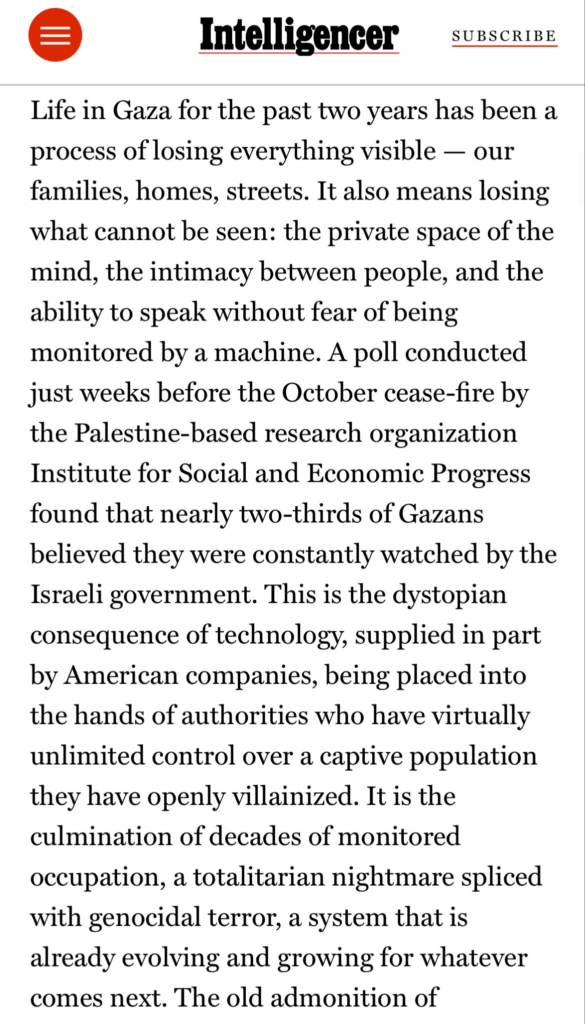
Watched, Tracked, and Targeted, Life in Gaza under Israel’s all-encompassing surveillance regime by Mohammed R. Mhawish, a Palestinian writer and journalist from Gaza, Dec. 3, 2025, Intelligencer
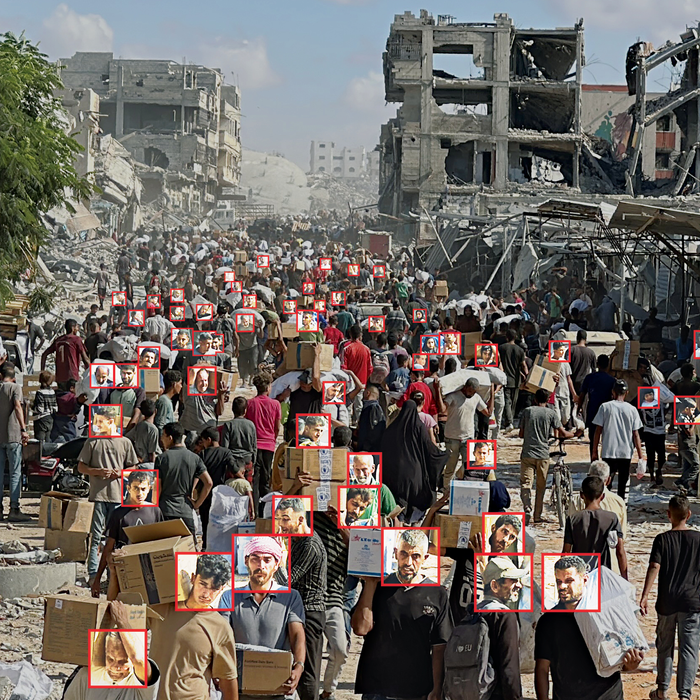
A crowd gathers for the aid trucks in Khan Yunis, Gaza, on October 12, 2025. Photo-Illustration: New York Magazine; Photo: Mahmoud Sabbah/Anadolu/Getty Images
In the days before we reached the Netzarim checkpoint in Gaza in early April 2024, my wife and I rehearsed a stripped-down version of ourselves. We had already lived through six months of war, but this would be the first time we stood before Israeli soldiers. After seeing journalists killed, hospitals bombed, and bullets ripping through children, we believed that how we told our story could mean everything — for our lives and our chances of getting out.
We would tell the truth. But we would keep it to the parts least likely to invite suspicion: that we were a displaced family obeying Israel’s orders, which often came via air-dropped flyers and anonymous, automated phone calls, to evacuate south after our neighborhood in Gaza City was left devastated by months of bombardment; that Asmaa was pregnant; and that our 2-year-old son, Rafik, was weak from malnutrition. We planned to avoid identifying ourselves as journalists. And we would say nothing to betray that we intended for this journey to be the start of our escape from Gaza, that we planned to exit into Egypt through the Rafah crossing. I practiced my answers until the words felt cold. I was prepared to speak only as a father and husband trying to survive.
We walked through a shell-scarred stretch of road by the Mediterranean. The stroller wheels scraped against broken concrete; drones hummed above. My hawiya — the green Israeli-authorized ID Gazans carry — was in my pocket. After about two hours of walking, we arrived at Netzarim. A coastal stretch where families once walked the beach, it was now a militarized corridor of tanks, berms, and scanners. Two tanks sat ahead of us, snipers stood above the mounds of debris, and a line of soldiers grew clearer with every step.
At the checkpoint, soldiers herded the crowd into groups of five. I kept my eyes on Rafik. A soldier motioned us forward toward a camera: a dark orb behind glass on a tripod, a red light blinking beneath its lens. While Asmaa gripped our son’s hand, soldiers watched a screen behind the camera. Asmaa and Rafik went first. We stared into it and held our breath, waiting for their thumbs-up — the signal soldiers had used for people to move on. Others were pulled aside.
The seconds stretched. “Mohammed,” the soldier finally said. I didn’t react at first. Mine is a common name. Then he said my last name. I felt my breath stop. The soldier, his face masked, a rifle slung across his chest, gestured for me to step forward. The fear wasn’t of what they might find out about me but of what they already knew. My ID was still in my pocket. The practiced version of myself went dead. None of it mattered now. I had just been confirmed.
Israel’s military assault that began in the aftermath of October 7, 2023, has left Gaza unrecognizable. The campaign of mass killing, of severing communities, of making homes unlivable, was pursued with bombs and bullets and tanks. It operated, too, through a system of watching, knowing, and collecting us: drones that hovered endlessly overhead, quadcopters that dipped near windows and entered houses, facial-recognition scans at checkpoints, movements followed through phone tracking, calls that broke with static before an air strike. The Israeli army was using artificial intelligence to generate kill lists, monitoring our social-media accounts, and storing in bulk the audio of our phone calls. Journalists, human-rights researchers, and legal scholars have mapped pieces of the surveillance apparatus in Gaza. What has largely been missing is how this technology landed on bodies, homes, and neighborhoods; how it reshaped daily life for people forced to live inside the matrix; how it reordered our minds.
In response to a list of questions, the Israel Defense Forces said that claims that the Israeli military uses “systems that employ artificial intelligence to autonomously select targets for attack” and that “they attack targets inconsistently with international law” are “completely false” and that Israeli forces “have never, and will never, deliberately target journalists.” An IDF spokesman added, “The IDF is committed to international law and operates accordingly.”
I managed to flee Gaza two days after my encounter with the Israeli soldiers at Netzarim. Over the past year, with the help of two colleagues still in Gaza, I heard from more than a dozen people living under this regime of ceaseless watching. One of these people, Marwan, a 60-year-old hospital administrator in Gaza City, at first objected to my line of questioning. (I’m using only first names. Giving their full names in a report about surveillance feels like an offering to the occupation.) “In the face of mass slaughter,” Marwan said, “what difference does it make that they can see my Facebook posts or hack my calls or monitor my home?”
But soon Marwan could not stop talking about how the constant awareness of being watched had twisted and narrowed his world. He said he now avoids calling his brother “lest he ask whether any rockets were fired from the area or whether the Israelis had arrived in the area,” and those words be misread or distorted by unseen listeners. He described the collapse of connection itself: the way fear moves into a family, one phone call at a time, until even expressions of love begin to feel dangerous.
Khaled, who worked for nearly three decades as an ambulance driver for Al-Awda Hospital, said that during an interrogation, an officer showed him a private text message he’d sent his family. “Everything we say, they can see,” Khaled said. The text was mundane; the point, he felt, was to show this 61-year-old father of seven how deeply they could peer into his private life. People told me they have even extinguished their own thoughts, as if the interrogators and listeners could see inside their heads. “Nobody doesn’t have political leanings,” one man named Mohammed told me. “But I’ve killed it. I’ve prohibited myself from speaking on this. I’ve locked it with a key.”
Everyone had stories of being watched. Mary, a 26-year-old writer, grew up in a two-story house on the more affluent side of Gaza City, where people went to stroll near the sea on streets lined with shops and airy schoolyards. It had a simple white façade, tall windows, a small balcony, and eight old araucaria trees her father had diligently cared for shading the gate. Before the war, passersby slowed to admire them. By this summer, the bombardment had cracked part of the roof open. At around 4:30 a.m. on July 27, while she slept in one of the remaining rooms, Mary woke to a faint buzz that seemed to come from just beside her. “I froze,” she told me. “I could not move. I could not scream.” A dark square hovered near the ceiling. She stared at it, motionless, until it drifted out of the room and exited through a window. If they could fly a drone to her bedside, they could see everything, she told me. Weeks later, her 35-year-old neighbor was shot dead by an armed drone while drying laundry on her balcony, standing beside her 4-year-old son, Mary said. “It is not death that we fear,” she told me. “It is the terror that comes before it.”
Life in Gaza for the past two years has been a process of losing everything visible — our families, homes, streets. It also means losing what cannot be seen: the private space of the mind, the intimacy between people, and the ability to speak without fear of being monitored by a machine. A poll conducted just weeks before the October cease-fire by the Palestine-based research organization Institute for Social and Economic Progress found that nearly two-thirds of Gazans believed they were constantly watched by the Israeli government. This is the dystopian consequence of technology, supplied in part by American companies, being placed into the hands of authorities who have virtually unlimited control over a captive population they have openly villainized. It is the culmination of decades of monitored occupation, a totalitarian nightmare spliced with genocidal terror, a system that is already evolving and growing for whatever comes next. The old admonition of authoritarian regimes everywhere — If you have nothing to hide, you have nothing to be afraid of — has no meaning in Gaza.
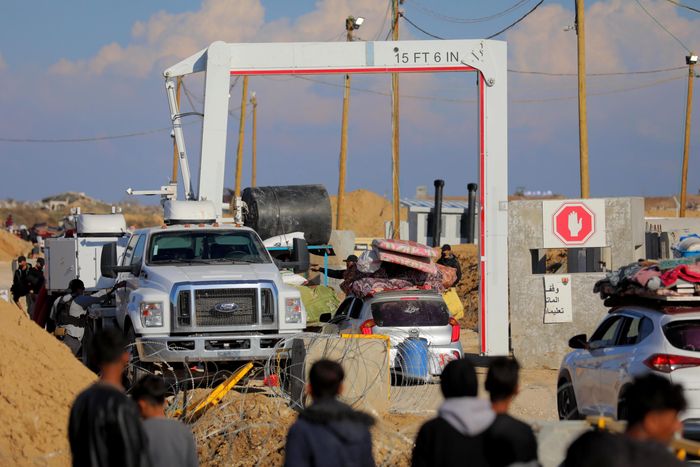
The Israeli military checkpoint at the Netzarim-corridor intersection. Photo: Hassan Jedi/Anadolu/Getty Images
My father was always suspicious, distrusting things most people treated as harmless. When neighbors bought smart TVs, he wouldn’t. “It’s another way they can see inside,” he said. He answered the phone in our Gaza City home only after a long pause, as if to catch the person he presumed was listening, and he would angle his chair away from the window when he spoke. Some of his fears came from stories he had heard years before I was born — stories that belonged to another generation but shaped his and then mine. My grandparents had been displaced from their home in Jaffa by Zionist forces in 1948, when Israel was created, and never saw it again. U.N. registration cards and aid lists became their new proof of existence as refugees. My grandmother used to say that even getting flour from an aid site required answering to a refugee file. Control came first through hunger, then through paperwork.
“Zionism was born as a surveillance regime,” Helga Tawil-Souri, a professor at New York University who studies technology and politics in Palestine, told me. From the start, she said, Israel inherited the British colonial systems as well as previous Ottoman systems: census files, aerial photography of villages, mapping, and centralized control of broadcasting and telecommunication lines. Many tools of managing a population were already in place before 1948, she said, and Israel just expanded them. Identification numbers, property registries, police records, tax rolls, house demolitions — all became instruments of classification and control.
In the early 1980s, my father worked inside Israel at a poultry factory with a daily permit, crossing Erez each morning and returning home to Al-Shujaiyya in eastern Gaza at night. The searches were slow. “They flipped through everything,” he once told me. “Even scraps of paper.” He also told me that during the first intifada, in the late 1980s, people returned from interrogations inside Israeli prisons shaken by how much the soldiers seemed to already know about them. They knew who they were friends with, what time they were home, and which room they slept in.
Even moments that promised autonomy tightened the net. The Oslo Accords of the 1990s, sold as a road map for Palestinian self-rule, codified Israel’s command over most frequencies and telecommunications. Palestinian cellular networks, telecommunication towers, and imported pieces of radio hardware required Israeli approval. Palestinian companies could build communications infrastructure but were not allowed to control the channels that carried the signal. At the very moment people around the world began carrying cell phones in their pockets, the ability to connect in Palestine became another way to be watched.
I was born in 2000 as the second intifada began. My childhood ran parallel to the rise of the digital age. I was 5 when Israel said it was “disengaging” from Gaza. Soldiers and settlers left the strip. But the occupation was merely changing shape. Israel no longer needed to have boots on the ground to monitor people. It only needed to be connected. Tawil-Souri called it “remote-control occupation” through cameras, databases, aerial feeds, and phone networks routed through Israeli servers. The border between Israel and Gaza became both invisible and absolute — the kind that doesn’t end at a fence but runs through our screens.
Even as a child, I felt that presence. During the blackouts that regularly descended on our neighborhood, when the phone bars dropped from one to none, my father would lower his voice. “Don’t say more than you have to,” he’d remind us. In Al-Shujaiyya, visiting my grandparents, I played soccer with other kids near the eastern fence, where our eyes invariably went to the surveillance mast that rose behind the field. We joked sometimes that even the wind might be listening.
Much of Israel’s surveillance technology was first tested across the occupied territory. In 2013, when Barack Obama visited Ramallah, Palestinians held protest signs calling for an end to U.S. support of Israeli apartheid along with a banner that joked the former president should not bring his smartphone because WE HAVE NO 3G IN PALESTINE! The West Bank received it five years later, while Gaza still doesn’t have it. According to the Palestinian digital-rights group 7amleh, the Arab Center for the Advancement of Social Media, Gaza is one of the only places in the world where mobile coverage is limited through explicit restriction, rather than the lack of infrastructure. Some say the throttled signal was part of the surveillance structure: Israel’s military operated on private high-speed networks, while on the ground in Gaza Palestinians were deliberately left with an insecure 2G network. Jalal Abukhater, a Palestinian digital-rights advocate from Jerusalem, told me that Palestinian SIM cards, fiber-optic lines, and satellite connections were controlled by Israel. If a cable breaks, he said, “Palestinian technicians cannot access and repair it without Israeli permission.”
By the time I was in my teens, we had learned which rooftops blinked red with antennas and which alleys were blind. Our cities were monitored by drones and surveillance balloons that floated like fixed stars above us and across the fence. The permits our families applied for were entered into databases that linked family names to addresses and faces. In 2019, a year before COVID hit, Israeli authorities launched a mobile app that digitized the system for permits. In order to check the status of their permits for 2020, some 50,000 early users had to share access to their phone’s camera, geolocation data, and stored messages and files. The one time I traveled before the war was in 2022, when I traveled to the UAE through Egypt for work. We knew from those who exited through Israel that the process often required a biography: affiliations, employers, phone numbers, and parents’ names. Submitting this information meant feeding their databases with more details of our lives. It was a trade — exposure for mobility.
By the 2020s, Gaza had become one of the most monitored territories on earth. The very things that connected us — to each other and to the outside world — put us at risk. Internet outages were reportedly synced with military operations on the ground. The phones and apps we used became maps of our movements.
People adjusted in small ways: swapping SIM cards, leaving devices at home when visiting friends and family, deleting photos before exits at the crossings.
After October 7, 2023, the system that had been built quietly over years revealed its full capacities. We learned that several western governments and some of the world’s largest tech companies had helped the Israelis watch and catalogue us. Microsoft was allowing Israel to warehouse millions of intercepted Palestinian calls in data centers in Europe that could be pulled up a month later and sometimes more. (Microsoft says it has since cut Israeli access to these services.) Palantir, which had purchased an ad in the New York Times proclaiming that PALANTIR STANDS WITH ISRAEL, entered into an agreement to provide Israel’s military with technology “in support of war-related missions,” according to Bloomberg. Israel’s military intelligence unit reportedly used Google Photos, combined with tech from Israeli company Corsight AI, to enable its facial-recognition program to identify faces from a crowd and footage. Google and Amazon, which supply the Israeli government with advanced cloud-storage services and AI capabilities, were reported to have included a covert system in their contract to warn Israel when foreign courts compelled the companies to hand over Israeli government data but barred them from notifying Israel directly. (In a statement, a Google spokesperson said Google Photos is “a free product which is widely available to the public” and does “not make general purpose facial recognition technology commercially available.” The spokesperson also said the company’s cloud services are “not directed at highly sensitive, classified, or military workloads relevant to weapons or intelligence services” and that the “idea that we would evade our legal obligations to the U.S. government as a U.S. company, or in any other country, is categorically wrong.” An Amazon spokesperson said, “We do not have any processes in place to circumvent our confidentiality obligations on lawfully binding orders.”)
A promotional video by Israel Aerospace Industries showed a quadcopter with engines manufactured by the British firm RCV Engines. (In a statement, RCV said it had provided only “prototype engines” to an Israeli developer and that it has “never provided technology to the Israeli military.”) A French tech company in the defense and aerospace sectors, Thales, reportedly supplied Israel with electronic equipment for surveillance drones.
With the help of these technologies, private funding from western venture capital for Israel’s own tech firms, such as Corsight AI and Cellebrite, and other partnerships, the Israeli government developed surveillance systems beyond our worst fears. Algorithms sorted people by perceived threat, according to reporting by +972 Magazine and Local Call. Each score could determine who would live or die. Intelligence sources told reporters that one of these systems, designed to score individuals by supposed affiliation with a Palestinian armed group, produced tens of thousands of names. Approval for a strike could reportedly take less than 30 seconds. Another program classified buildings by type and occupancy, marking them for strikes. AI tools, created in partnership with enlisted soldiers in Unit 8200 and reserve soldiers working at companies such as Google, Microsoft, and Meta, analyzed Arabic text messages and social-media posts, according to the New York Times. When those classifications were combined with targeting a suspected fighter at home rather than when alone, the result was the annihilation of families whose only fault was proximity. These advanced systems were mixed with older ones: the use of informants and spies and searches of homes and offices. I heard story after story of soldiers separating people, photographing them, and searching phones, part of broader screening and detention practices during the war. This machinery of surveillance merged with the machinery of death. We were used to drones watching us. Now lowflying quadcopters were carrying grenades. They came down to street level, circling over courtyards and balconies. According to reporting, drones had even mimicked voices of crying babies.
In Gaza, we call the drone zanana — “the buzz.” After October 2023, it became the soundtrack to our lives. We could tell the difference between the models that could kill and those that only watched. People in Gaza later told me they avoided the notorious Gaza Humanitarian Foundation distribution sites (which shuttered in November) not only because they feared being shot and killed, as hundreds of people were, but also because they feared the same cameras watching the crowds were matching their faces to databases — that even the act of seeking food could expose them. (In July, two unnamed contractors working as security for the distribution sites told the Associated Press that this is exactly what was happening.) A machine could look into people’s homes, register their presence, and flag them. If we tried to live our lives as if the surveillance did not exist, it could lead to our deaths.
Mohammed is 36, the father of two little girls. He worked before the war as a social-media and digital-marketing consultant for nongovernmental organizations. After October 7, Mohammed labored to make himself as close to transparent as possible. “We’ve adapted to having our entire lives under surveillance,” he said. He even avoided using opaque bags when going to the market. “I’d try to have a transparent bag,” he said. “I wouldn’t leave with a backpack, lest they misinterpret it.” In his apartment overlooking the sea, Mohammed struggled with whether to close the curtains to hide from the drones outside. Safety, he had come to believe, depended on leaving nothing to interpretation.
In March 2024, Mohammed was still living in his apartment building, which was in eyeshot of the Al-Shifa Hospital. Israeli troops had besieged the hospital, driving tanks and bulldozers through its grounds, detonating buildings, and crushing ambulances. Survivors say patients were killed, staff were detained, and the facility was declared out of service. Gunfire rattled the windows of Mohammed’s apartment late at night. “We couldn’t move at all or even lift our heads from the floor until 8 a.m.,” he said. Then came banging on the door. A man walked in — Palestinian, undressed, he recalled. “He told us the army was waiting and that all the men had to take their clothes off.” Someone asked if they should bring their IDs. The man told them to bring nothing. About 25 men from Mohammed’s building were ordered outside. It was cold and raining. The women and children were ordered to walk south. Soldiers positioned the men around a line of tanks. There were older men and men with disabilities. “They scanned our faces,” Mohammed said, “told us to look toward a light where I could clearly see a camera.” The orders came over a loudspeaker in fluent Arabic: “Stop. Look right, left. Look at the camera.” The voice even joked, “You must have failed seventh grade” when Mohammed stepped the wrong way. “We were humiliated for 12 hours,” he said.
At 8 p.m., after they were standing nearly naked in the rain with their wrists bound in plastic ties, a soldier instructed some of them to leave. Walking away in disbelief, Mohammed expected a bullet in his back. As they left, soldiers handed out blankets. He considered taking one, but then he refused. “If I covered myself, the soldiers down the road might not know I had been searched already,” he thought to himself. “So I decided to keep walking naked, as proof that I’ve just been released.” He walked over an hour through Gaza City, unclothed in the rain. “There were houses along the way, but I didn’t dare knock on any of the doors or look for a piece of cloth to cover myself with from the cold.” He walked until he arrived at the home of a friend, where he borrowed a phone and called his wife. She was safe.
When he talked later about that day, what horrified him was his faith that being an open book would somehow save him. “As soon as we learned they were going to scan our faces, I thought, That’s it, I’m going with the first group. I know who I am. Let them search me.” They would know he was not an insurgent and therefore wouldn’t hurt or harass him, he hoped. Months later, Mohammed was alerted to a video circulating online. It captured a group of men walking, nearly naked, outside Al-Shifa. He was in it. “I woke up and saw people had tagged me,” he said. “I cried. I was upset.” His visibility was no protection after all.
“If I find anything challenging in particular,” he said, “it’s the challenge of being human.”
A woman in her early 40s who asked to remain anonymous worked at a beauty salon before the war. She was detained as she was marching south from where she was sheltering in the north of Gaza. She was positioned before two devices to log features of her face: a phone to capture her image and another screen to process it, she surmised. She turned her head away, refusing to look at the camera. A soldier forced her face toward it. Then a rifle butt struck her skull.
Her full name surfaced instantly. A soldier read aloud her first name, her father’s name, her grandfather’s, and her family name. “He did not ask me for anything, no ID, nothing, to know who I was,” she said. An officer glanced at the result and said they were taking her. In a pen, soldiers stripped her to her undergarments, she said. When her blindfold slipped, she saw four soldiers pointing a camera at her. She screamed, tried to cover herself, cried, and was struck in the chest as the blindfold was yanked back over her eyes. They called her “slut,” shoved her into a small cage, and warned that she would be beaten if she disobeyed. “What if we publish these?” a soldier said in Arabic while photographing her. Phones, cameras, watches — everything around was recording, she believed.
Days into detention, she was taken to a room where officers had her file: her profession, where she lived, names of members of her family. The interrogation began as recruitment. “Do you work for a beauty salon? We’ll give you an Israeli ID, an American passport, a salary,” the officer said. They told her they would pay her well enough to live comfortably with her daughter and family. They even offered a jilbab — a long, modest piece of clothing (or outerwear) — so she could operate disguised as an informant. “Think about it,” they said. She refused. Then the blows began — head, chest, mouth. Each answer or silence drew another hit “until blood came from my mouth and nose.” The same bargain returned: collaboration for life. She persisted, and the beatings resumed. Then the questions jumped to new terrain. Where are our hostages? Where is your cousin? Where does the resistance hide?
She said she was shuttled between the cages, the Sde Teiman facility, and Damon prison in Israel. At Sde Teiman — now notorious for scores of reports of horrific abuse — she was raped four times, she said. During her period, guards mocked her bleeding and shouted, “You smell.” They knew she had a teenage daughter. They knew she had worked at a beauty salon. They cut off her hair. “They’ve weaponized our information,” she said. After 32 days in detention, she was released.
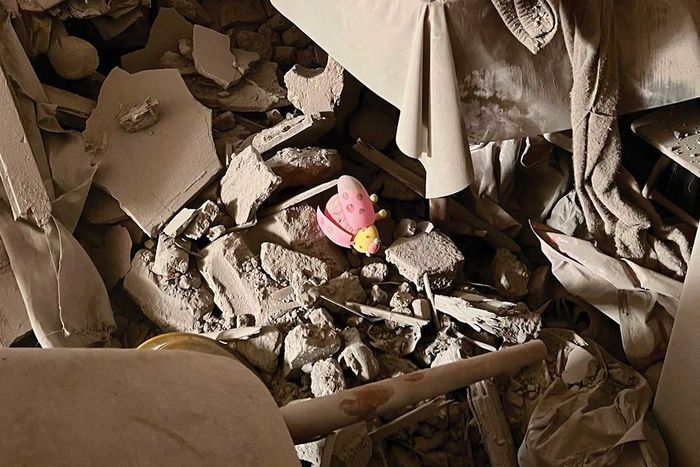
Mohammed R. Mhawish’s son’s toy lies in the ruins of their Gaza home after it was bombed on December 7, 2023. Photo: Courtesy of the Author
From the beginning of the war, I had been reporting from Gaza for outlets like Al Jazeera English, The Nation, and +972 Magazine. By late October 2023, my phone was filled with messages that quoted lines from my stories and warned I’d be killed. Some seemed to be written by bots. Almost every reporter I knew was getting a version of the same threats. For six days at the beginning of December 2023, I moved between Al-Shifa Hospital and the Al-Shujaiyya and Al-Daraj neighborhoods of Gaza City, sleeping in schools turned into shelters and sometimes in hospitals, filing stories from any corner with power. I kept my calls short and turned off my phone when I was working to limit the signal from places I was reporting. On December 6, I went home to check on my family. Shortly after I walked in, a caller speaking Arabic introduced himself as “David” from the Israeli military. He called me habibi — which means “my dear” in Arabic — and said we had 20 minutes to evacuate our three-story house crowded with family and neighbors. I had heard stories from others, including fellow journalists, that such calls could be hoaxes. It felt like another form of harassment. It could also have been a way to make us move when there was nowhere to go. So we stayed.
The next morning, around 7:30 a.m., I heard my son’s feet patter down the hallway as I was reaching for my tea. The blast came without warning. The house folded in on itself. I didn’t see the ceiling crack or the walls fall — just a sudden weight, concrete and metal pressing me flat. My arms pinned, legs trapped, and dust in my mouth and lungs. I called out for my wife, my son, and my parents. At first, nothing. Then a small voice from somewhere I couldn’t reach: “Baba.” He was alive. I couldn’t move to get to him. Time blurred. Stones shifted somewhere above. Voices faint. I must have blacked out. When rescuers finally broke through, light cut in and hands started peeling debris away. They pulled me out and then, moments after I regained consciousness, they pulled out my wife and my son.
Four people were killed: two cousins and two neighbors, one of whom happened to pass our door as the bomb fell.
They knew I was home — tracked me there, likely through my phone. The system had mapped me first, I believe, and everyone in the radius became part of the Israeli military’s calculation for what constituted allowable collateral damage, including my son. That day, we were taken to Al-Shifa and given only first aid; then we returned to our neighborhood and stayed with a neighbor. Two weeks later, we moved to a school shelter and, after that, kept moving through temporary shelters across Gaza City. From then on, I assumed total exposure. I kept publishing, but I erased drafts, wiped contacts, changed routes, and never said locations aloud. Still, I was inside their grid. Three months later, in a makeshift shelter, the phone rang again. “We told you to stop,” a rough voice in Arabic said. “You haven’t, so there will be consequences.”
We were all marked, threatened, surveilled — every journalist I know. Our experience in Gaza became the clearest example of how surveillance shades into warfare. It became apparent that some journalists were targeted for death by the Israeli military, even while they wore press vests, according to reporters on the ground and reports in international outlets. Since October 2023, the Committee to Protect Journalists’ preliminary count lists at least 206 Palestinian journalists and media workers killed in Gaza by Israel. CPJ recorded 2024 as the deadliest year for journalists since it began collecting data more than three decades ago, with Israel responsible for nearly 70 percent of the killings.
In such baleful conditions, it’s only natural that some journalists would stop reporting on Israel’s crimes in an attempt to save their own lives. One woman I know, a former English teacher, turned to journalism in 2023 only months before the war began. During a recent WhatsApp call before the cease-fire, she sat in a room looking out on Al-Rimal — once a vital downtown stretch in Gaza City, now a field of tents for the displaced and the rubble of high-rises. When the drone — zanana — bled into the call and dropped to a deeper pitch, her face froze and her jaw tightened. She kept her eyes on the window.
In January 2024, her family had fled their Zeitoun neighborhood in eastern Gaza City and moved into her aunt’s apartment toward the city’s west. She had an e-SIM card — the only way to connect during blackouts. Relatives staying with her in her aunt’s house begged her not to take photos once she switched it on or activated it. “I had to go up on the roof to catch some signal, and that terrified both me and them.” She stopped answering calls indoors. “I felt watched around the clock,” she said.
One day, after broadcasting live from Al-Shifa, she turned off cloud backups and erased all work contacts, knowing she wouldn’t be able to ask for their help later. Her family reinforced the limits. After a nearby blast, her aunt’s husband told her quietly, “Please don’t film it.” Weeks later in Al-Shujaiyya, when she raised her phone toward the ruins, an older man passed by whispering, “Be careful. Don’t film anything.”
She no longer trusted the social-media platforms where she had posted her reporting. She had learned that tech companies like Meta were suppressing speech on Palestine. She felt she had to disappear. She had come to see that those who shared images of death and destruction were targeted. Six journalists, including Al Jazeera’s Anas al-Sharif and Mohammed Qreiqeh, two of my colleagues, were killed by an Israeli strike near Al-Shifa in August. “I am not hiding. I cannot hide. I just stopped working as a journalist,” she said. “I chose my family, and I chose my safety.”
After my house was hit, I kept getting threats across WhatsApp and social media and over the phone. I understood they meant to target me again. We heard the crossing to Egypt might open for those who could pay a fee. With help from colleagues outside, we gathered the money and prepared to head south. That was how we ended up at the Netzarim checkpoint in April 2024. I’d thought over and over again about what it would be like to face the forces that were killing us — not the tank, not the drone, not the unknown voice on the phone, but a soldier. I thought and feared who and what they would see, and I wondered if by standing before a human, I would become legible as one too.
After the machine identified me, soldiers separated me from Asmaa and Rafik without a single question.
One soldier pointed to the ground, silently instructing me to place my phone, wallet, and keys there, and then gestured again for me to remove my shirt, undershirt, pants, and underwear. Rafik was trying to walk toward me. I could hear his soft voice: “Baba.” A voice to the side threatened to shoot our toddler if Asmaa didn’t take him and move on. They zip-tied my wrists, blindfolded me, and dragged me into a room.
The floodlights hummed overhead. The sand under my feet felt sharp, baked into gravel by the heat. I was then led inside by someone gripping my arm. I heard voices: Palestinian men and women pleading, arguing, that strained tone of people trying to convince someone they were not who the system said they were. The soldiers mostly spoke Arabic; a few words of American English and clipped Hebrew followed, fast, like orders being passed. I was pushed to the floor, hands bound behind my back, a soldier shoving my face down from behind. They left me. No one spoke for what felt like hours. When they lifted me, a hand took my arm and moved me a short distance before soldiers pressed my forehead to the hard, scorching wall. The clack of a gun being racked near my ear. Seconds later, they turned me around, and the cloth came off. I squinted into the light, still naked.
The man in front of me wore full gear, helmet unbuckled, notepad and phone on his knee. He smiled the way people do when they pretend there’s nothing to worry about. “Mohammed, how are you? We’ll take it one question at a time.” His Arabic was perfect, close enough to mine to be disarming. I answered in a disjointed mix of Arabic and English — English when I felt trapped and Arabic when I needed to feel like I belonged to myself.
He started to move through my life: studies and work as well as the places I’d reported from — Al-Shifa, Al-Awda, Al-Daraj — naming them in sequence. He asked me about my relatives. When I hesitated, he filled in my cousins’ names, naming a neighborhood where my family sheltered. Whether I answered or faltered, his notes absorbed it all the same. The interrogation lasted hours. Over those endless minutes, what became clear to me was that the interrogator held on the screen before him a copy of my life built from relentless watching, compiled from calls, cameras, and coordinates.
Then he began talking about my son. “Is Rafik still out there? How is his chest?” For a moment, my mind went blank. It was a question from inside my own house. It took me back to 2022, when Rafik was just 11 months old, during our time in the UAE. Rafik had contracted a lung infection and he spent two nights in a Dubai hospital. It was not a big deal. He was fine. But here it was, an episode from my life I’d never written about or broadcast. The interrogator said it like a box he was checking. Their knowledge of my son’s brief illness had to come from somewhere. Hospital records from the UAE? Recordings they’d kept of my phone calls? Copies of my emails? It felt like they had stepped inside my mind.
The interrogation intensified. A soldier behind me struck the base of my neck with his rifle when I denied participating in attacks on Israel. “Tell the truth,” he said in English. Each question from the interrogator landed like a test. I stuck to the mundane: that we’d moved south for food and that we were “following orders” — their phrase, returned to them in the hope it would spare my family. Then he brought up the bombing of our home. He called my reporting “advertisements.” He said I’d nearly gotten my family killed.
He reached for a thick tablet. I caught a glance; it seemed to have a dense, scrolling interface — no icons, only lists. He scrolled through it for a long time. When he spoke again, he asked if I had ever helped anyone carry out an “attack” or seen anyone who had. Then came an attempt to get me to collaborate: an offer to send Rafik for treatment inside Israel “immediately if needed.” For a split second, I wanted to believe him. It sounded almost kind.
Somewhere nearby, someone kept shouting names. Another soldier ate chips from an orange bag, chewing slowly, watching us like it was any other shift. Two more hours passed in the heat, blindfold back on. Then they dropped my clothes and wallet at my feet. My money was still there. The soldier who had struck me reappeared with a cold bottle of water and told me to drink. I was fasting for Ramadan but I drank anyway. “We’ll be in touch,” the interrogator said. “We already know how to reach you.”
I put on my clothes and stepped out into the glare, toward the same arena of black cameras. I didn’t see Asmaa or Rafik. Tanks idled behind berms. I kept walking, the way people do when they’re sure someone will call them back. When we finally reunited, Asmaa told me she’d wanted to wait outside the checkpoint for me, but she was forced to walk south, crying, our son clinging to her. Two strangers — one old, one young, both gray with dust — had helped carry our bags. Two days later, we arrived at the Rafah crossing.
In Gaza, there is no way to see the record that judges us — the file that decides if our names turn red. My friends and family at home hear warnings in ordinary sounds, like the international dial tone, or in the lens above a door. They tell me that even though the bombs have mostly stopped falling, they keep their calls brief, coded, and avoid making them unless necessary. The drones hum for hours, so routes through town are chosen by ear.
It is reasonable to imagine that much of the information that the Israelis gathered over the past two years will be a new baseline for an expanded archive, a standing watch list, a living map of who called whom and who slept where. “We are talking about long decades of information gathering,” Marwa Fatafta, policy director for the Middle East and North Africa region at the digital-rights group Access Now, told me. “Based on that history, Israel of course will not stop its systematic surveillance of Palestinians after the cease-fire.” The surveillance regime will likely get only bigger and more invasive, as it has at every stage in the occupation’s history.
There is evidence already, as Gaza’s future is planned by the Americans and their allies, that new forms of surveillance are taking shape. In the past few weeks, the U.S. has added an external layer of surveillance by flying drones to purportedly verify compliance with the cease-fire. The footage is reviewed by a U.S.-led Civil-Military Coordination Center in southern Israel. Meanwhile, Gaza has been cut in two by a so-called yellow line separating the area Israel controls from the rest. According to reports, only Palestinians who pass Israeli security vetting by Israel’s domestic intelligence agency will be permitted to pass into these “cleared” zones or into proposed new housing camps. It seems the surveillance apparatus used for air strikes may now govern who will be permitted to return home or find a bed to sleep in at all.
“Privacy has become a luxury for us, the people of Gaza, after our humanity has been crushed,” said Mary, the writer who woke up to a drone flying in her room. She described what they are living through as “a kind of ‘dissolving of the consciousness,’” borrowing a phrase coined by the late Palestinian writer and prisoner Walid Daqqa. “We’re never comfortable,” she said. “We monitor every word like it could harm us.” Ghadeer el-Shurafa, a clinical psychologist specializing in trauma in Gaza, told me that, even after the cease-fire, there has been no space for the mind to rest. “We are still being monitored,” she said. “There’s the possibility the war could come back. Because if they were really done, these quadcopter drones wouldn’t still be circling around us, still be present in the sky.”
The system of watching followed me out of Gaza in April 2024. I carried it to Rafah, where my family finally crossed the turnstiles packed with people, carrying our bags on foot before boarding the bus to Cairo. It was with me later that day, when an Egyptian officer called my name. After I had my passport stamped with an Egyptian entry visa, I breathed with relative comfort. I had survived. But small habits remained. Immediately after leaving Gaza, I changed SIM cards for no reason. I still register the presence of cameras in offices and other buildings and keep a clean phone separate from the one for daily use. I lower my voice near gates and conference mics and go silent on Zoom calls when the sound glitches.
I think about my son. His first image may already live in a database that will outlast us. I can’t audit the record that shadows us, but I can leave one of my own. So I write it all down: names, times, places — traces that belong to us, not to them. A file cannot be final when the people inside it keep authoring themselves.
This article was reported in partnership with the Palestine Reporting Lab, a project of Just Vision. Additional reporting was contributed by two reporters in Gaza who requested anonymity because of concerns for their safety.
@LailaAlarian:
Our show @AJFaultLines has made 6 documentaries about Gaza.
The talented cinematographer @DOPHussien worked on them.
Two years ago today, an Israeli soldier killed his 4-year-old daughter, Salma.
If you read anything today, please read his devastating words about losing her.