

How to spot a psychopath: Jon Ronson at TEDxMarrakesh 14 Min by TEDx Talks, 2011
 In my view, Nazi AI, its creators, and enablers – notably Donald Trump and Mark Carney – including stealing from the commons to give billions of our tax dollars to fucking already billionaires, are psychopaths
Why nurses’ unions are fighting for AI guardrails, Nurses’ unions in Michigan and New York City are winning contract language that gives them oversight of how AI tools are deployed in their hospitals. by Claire Keenan-Kurgan, June 24, 2026, Market Place
A few months ago, the nurses’ union at Munson Medical Center, a hospital in Traverse City, Michigan, organized a rally.
Union president Laura Nilsson stood at the front of the room, listing the union’s demands in their new contract: things like higher pay, higher staffing numbers, and also regulations around artificial intelligence.Obviously, the AI fuckers and their enabling corrupt politicos like Mark Carney and Trump, will never regulate AI.
“We understand technology is coming,” Nilsson told the crowd. “We generally want it to be good for us and our patients, but right now, there [are] a lot of unknowns. What we don’t want technology to do is replace nursing judgment. We don’t want it to take jobs.”well, the tech bros want everyone’s salaries for themselves, so tough shit to those who do not want to lose their jobs.
The use of AI in healthcare is booming. And that’s making some nurses worried about their jobs. Companies are developing AI tools that do everything from taking notes on appointments to proposing real diagnoses based on someone’s medical records.
This winter, a nurses’ union in New York City with more than 10,000 members got protections from AI in their contract. These unions say that even if AI tools can do some of the work of nursing, it wouldn’t be the same as a nurse’s physical presence in a room.wanna bet Trump’ll kill those sane protections, to make sure his Nazi pals, the tech billionaires, get no restrictions on their planned abuses of most workers (with the intent to take their salaries for their own greedy pockets)?
“Say we’re checking blood pressure and … the blood pressure cuff isn’t on the patient appropriately,” said James Walker, a critical care nurse at Munson Medical Center who is on the union bargaining committee. “And so that number is just pulled into the system without verifying whether it’s accurate … that value … it could potentially lead to a wrong decision.”
Max Topaz, a professor of nursing at Columbia University, said new technology is often just handed to nurses, and they’re forced to use it.
“Frequently, nurses are not involved in designing those technologies and thinking about how these technologies are going to be integrated into practice,” Topaz said.
In a recent study looking at the use of AI in healthcare, researchers from Stanford and Harvard found even top-performing AI models from Anthropic and Google produced 12 to 15 severely harmful errors per 100 cases. The worst-performing models made mistakes in 40 out of 100 cases.
…
‘You can’t make billions without hurting people’: Cory Doctorow on Elon Musk, the AI bubble and bosses’ cruel fantasies, The writer who coined the word ‘enshittification’ tells us why AI will never deliver what it promises – and why it still appeals so much to those in power by Zoe Williams, 24 Jun 2026, The Guardian
A “centaur”, in automation theory, is a person assisted by a machine, and a “reverse centaur”, hero of Cory Doctorow’s new book, The Reverse Centaur’s Guide to Life After AI, is a “human who is conscripted into acting as an assistant to a machine”. Every warehouse worker who ever had to urinate in a water bottle because they couldn’t otherwise meet the fulfilment targets set by an algorithm is a reverse centaur. Reaching into the future, everyone who has to sit in a self-driving truck to make sure it doesn’t crash, presumably on minimum rather than truck-driver wages, is a reverse centaur; as is every lawyer no longer on lawyer’s money checking Gemini’s command of precedent, every indie band scraping a living doing covers of AI-generated hits, and so on. That, anyway, is the promise: AI is coming for your job, and it is coming for your kids’ jobs, and there is no point fighting it because the future’s already here.
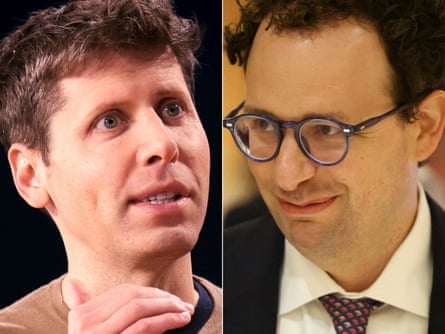
Wiping out the world of work, and with it our ability to sustain ourselves and live autonomous lives, is only the beginning, if you listen to AI’s architects. Elon Musk has called it the single greatest threat to human civilisation, Sam Altman has said it will “most likely lead to the end of the world” and Dario Amodei, CEO of Anthropic, memorably forecast that AI would come to see us the way we see animals: cute to have around but ultimately a resource to be exploited. “AI people claim they’re about to create God, by teaching words to a word-guessing programme,” Doctorow says. “It’s grandiose.”

Doctorow bursts into our video-call conversation as if we’re already two hours in, his delivery puckish and urgent. He’s not happy with his new AI camera, which “supposedly tracks your face, and then doesn’t, and just points in arbitrary directions. I mean, this is where my camera thinks my face is,” he says, and indeed, it is nowhere near his face. “Thanks, camera. Glad I’m wearing trousers.”
AI cannot and will never render us obsolete, Doctorow says. “It’s a conjuring trick. That’s probably the most important thing to get across.” A machine has been invented that is really good at building sentences by predicting what word would usually come next, and we invest it with meaning, insight, omnipotence. But we’re “imputing intentionality to this thing that intends nothing. It’s not because, objectively, it seems intentional, but because, in a state of nature, we don’t encounter sentences that don’t have sentence writers, we don’t encounter images that don’t have painters, and so on.” We marvel when it does things right, and conveniently ignore what it gets wrong, or indulge its “hallucinations”, which is just a fancy word for “errors”.
“Where I think the word ‘hallucination’ is useful,” he says, “is not to describe what the AI is doing, but what we do when we encounter a word salad, and we impute a writer to the word salad.” If you think AI can become conscious, he suggests, it’s because you’ve forgotten what consciousness is.
Do you not remember when they said cryptocurrency would replace all of the world’s financial systems?
But that doesn’t mean there’s no threat. This technology can absolutely wreak global havoc; it’ll just be of a very old-fashioned kind. A vast amount of investment has gone into AI. “When I wrote this book [last year], it was a $700bn bubble. It’s a $1.4tn bubble now. The only thing worse than a $1.4tn bubble is a $2.4tn bubble, which we’re headed for,” he says. Nine tech companies in the US account for 35% of its entire stock market valuation, which was illustrated rather sharply when the war in Iran had a greater impact on European and Asian stock markets than America’s – they were “insulated” by the dominance of the tech sector, people said at the time.
But insulated might not be the right word. Doctorow describes “two poles in finance law. One is Stein’s Law: anything that can’t go on for ever eventually stops. And the other is Keynes: the market can remain irrational longer than you can remain solvent. So it’s hard to predict when bubbles are gonna pop. But it’s easy to predict that bubbles will pop.”
Doctorow, 54, is in Los Angeles; he divides his time between there and London (his British wife, Alice Taylor, runs the BBC’s AI Creative Lab, which isn’t ironic but it would slow us down to explain why not). He came to mass attention as a tech writer with his book Enshittification: Why Everything Suddenly Got Worse and What to Do About It; it’s hard to believe it was only published last year, and impossible to remember what we did without that word. People now use “enshittification” for everything, from the degradation of public services post-austerity to climate-crisis-related chaos events, when in fact Doctorow’s proposition had quite a specific use regarding tech: giant platforms lock you in and then make your experience worse on purpose. “I’m not frustrated by that at all. I think it’s glorious. My first two languages are English and Yiddish, languages that don’t have language academies, where dictionaries are descriptive, not proscriptive, where words change meaning.”
He’s Canadian, his early life dotted with signs of an independent spirit and tech-curious mind: he dropped out of high school and graduated from Seed, an “alternative” school in Toronto; he spent time in the 00s setting up OpenCola, a free peer-to-peer software company, then editing Boing Boing, which was vastly popular for a time as an online muster point for discussing tech, futurism and the left. He has an honorary doctorate in computer science from the Open University, has held numerous academic residencies and is professor-at-large at Cornell University.
Alongside his nonfiction, he’s an extremely prolific sci-fi writer, three-time winner of the Prometheus award (for young adult novels Little Brother, Pirate Cinema and Homeland). He writes graphic novels, authored a children’s picture book named after his daughter, Poesy, who is now 18, and publishes a newsletter almost daily. I wonder whether he’s dismissive of AI’s takeover because he finds writing, creating and communicating so effortless that maybe he doesn’t realise that for many people it’s like pulling teeth, and they wish a machine would do it. Absolutely not, he says – but more important than all the things AI can’t do, and will never be able to do, from call centre operations to radiology, is to understand the motivation behind all the feverish claims for it.
Why, he wonders, are capital allocators allocating so much capital to this? It’s because of a promise as old as the loom: that bosses will be able to replace their workers with machines. This isn’t just about money – often, when the machine is ultimately not as good as a human, or needs so much supervision from a human that it becomes more expensive, there’s still tremendous appetite for automation.
“The one thing a boss does not want is co-determination. Bosses are haunted by the knowledge that even though they fancy that they’re driving the car, if they don’t show up, everything continues to work. Whereas if the workers don’t show up, everything shuts down. And so perhaps they’re in the back seat with a toy steering wheel. AI is the promise of wiring that toy steering wheel directly into the drivetrain of the car. It’s products without product designers. Workplaces without workers, screenplays without screenwriters, movies without actors, hospitals without doctors and nurses. This is the promise.”
Once that promise is made, of course, it feeds an insecurity in the workforce, because if we all really were obsolete, that would be pretty consequential, and we can already see harbingers in our youth unemployment figures and our self-service checkouts. But then we become our own (second) worst enemy, because of what Doctorow, quoting Lee Vinsel from Virginia Tech, calls “criti-hype” – critique that both feeds off and feeds into the hype, and makes the doomsday scenarios more plausible. This may never have been more pronounced – government ministers have spoken openly about all the time and money they’ll save once routine tasks are automated.
“Do you not remember when they said cryptocurrency would replace all of the world’s financial systems? They told us that the metaverse would be the default, that we wouldn’t have tourism or sex any more,” Doctorow says, with vaudeville outrage. “We have such poor object permanence!” (This is fancy, child-development vocabulary for “really bad memories”.)
If we want to actually target the harm that Musk is doing, we have to make his investors think he can’t make money
Another powerful AI critic, the journalist Karen Hao, has argued that when apocalyptic claims are made for AI, there’s often a veiled threat behind it: “Let us experiment as we wish, have our datacentres, because otherwise Chinese companies will get there first.” Doctorow agrees. “You don’t want a Confucian God. You want an Old Testament God. Different smiting.” Essentially, though, he thinks the big talk has a simpler motivation: anything to keep the investment flowing.
Whenever an exercise in automation fails and is abandoned – you may remember Amazon’s staff-less grocery stores, which actually required three people to be constantly watching each shopper on CCTV and guessing what they were putting in their baskets – it never dents the AI cheerleaders’ confidence that they’re speeding towards a post-worker world; nor, so far, the enthusiasm of investors. It’s got to the point where it’s more important to keep the narrative afloat than to consider whether it’s realistic.
“You don’t have to believe that a face cream is gonna make women look younger to believe that there will be women who will buy a face cream marketed to make them look younger. It doesn’t have to work. Are investors investing in the face cream because they think the face cream works? What I’m saying is maybe they’re investing in the face cream because they’re familiar with patriarchy.”
The problem is, people can see AI all around them, working better today than it did yesterday – turning out more convincing AI slop, answering their personal problems, turning fully clothed women into naked ones, analysing 18th-century poetry. It feels as if it can do anything, but none of that is the material basis for the investment. “I think it’s very important to be critical of things like Elon Musk’s Grok AI that allow users to turn out child porn [in January, Musk’s Grok AI was found to be capable of generating non-consensual sexualised images of people, including children, and xAI was rolling out ‘technological measures’ to restrict Grok’s ability to undress people in photos]. But we can’t pretend that there’s anyone who invested in his AI company, who looked at the prospectus and said, ‘I see you have a line item here for the expected revenues for child porn – that’s great, that’s why I’m here.’” In other words, go ahead and ban child porn – “we should do that anyway” – but no one’s going to take their money out. “If we want to actually target the harm that Musk is doing, we have to make his investors think he can’t make money.”
Fundamentally, this is a Marxist analysis, I suggest: that labour and capital are elementally at odds, and the latter will exploit the former even if all value is lost in the process. “I don’t necessarily disagree, but that’s not the argument I’m making. The argument I’m making is that bosses resent and work relentlessly to end co-determination as a class.” But that’s the same, I insist, and he shrugs, as if to say: we can bicker about Marx after we’ve stopped this runaway train.
What Marx didn’t have to contend with is the trillionaire, even in old money. “There is something about being very rich and insulated from the consequences of your actions that makes you solipsistic. You cannot make billions of dollars without hurting lots of people. And you can’t hurt lots of people without, in some sense, believing that they’re not really people.”
He raises Musk’s publicly acknowledged ketamine use. “I have a chronic pain condition, and I’ve had ketamine administered, and one of the things about ketamine is that it feels like the whole world is a thing you imagined. Like you’re the only real person in the world. I don’t think it’s a coincidence that Elon Musk calls the people who disagree with him NPCs, non-player characters, because he doesn’t think they’re really real.”
The larger problem than Musk’s personality, or even your average billionaire’s, though, is that bubble: “The more of the stock market there is wound up in it, the more economic harm there will be in the blast radius of AI, which is not to the capital allocators who’ve given them $1.4tn to play with – it’s everyone else. We have a quarter of a century’s experience now with popped bubbles, and we use them as an excuse to do the austerity that our politicians dream of doing anyway.”
It’s the unloveliest of all dilemmas, wishing for a global crash now to forestall a worse one later, when there’s not much you can do to bring it about anyway. But is it better than worrying about your children toiling for robot overlords? It has the advantage of not being a fever dream.
Hamilton just hit pause on all AI data centres. This is big by Anne Pasek and Nick Tsergas, Special to The Globe and Mail, June 24, 2026
Anne Pasek is an associate professor at Trent University and the Canada Research Chair in Media, Culture and the Environment.
Nick Tsergas is a freelance journalist reporting on health, business and tech. He lives in Hamilton and was involved in advocating for the city’s data-centre pause. He runs the website stopthedatacentre.ca.
Hamilton’s City Council voted on Wednesday in support of a one-year pause on all AI data-centre development in the city. From outside, this looks like the latest manifestation of AI-backlash. It’s much bigger than that.
Hamilton is the first to confront a question all Canadian municipalities will soon face: What are the rules of the road for building AI data centres responsibly? And are such rules, to the extent they exist, appropriate for this new type of infrastructure?
City councillors from 21 municipalities across Canada have requested copies of the motion, said Nrinder Nann, the Hamilton councillor who moved to enact the moratorium.
Opinion: AI data centres are becoming the wedge issue of our era
These are questions Canada has put off asking. We don’t have much in the way of regulatory guardrails for data centres. These facilities are governed by rules written well before the advent of AI. Hamilton is the first municipality to think about what those rules ought to be. It won’t be the last.
The debate is too often framed in binary terms. You’re for AI or against it; you support economic development or you’re a NIMBY; you are helping Canadian tech-sovereignty or you’re standing in its way. Such polarizing framing prevents us from scrutinizing the facts of a project and understanding if it’s actually a good deal for a community.
Data centres are usually treated as light industrial development.
They often don’t trigger assessments of their probable impact on noise and air pollution, heat-island effects, grid stability, and rising electricity bills for households and businesses.
These are non-trivial concerns as AI infrastructure scales to have the same energy footprint of a small city.
As the data-centre industry increasingly deploys NDAs and regulatory run-arounds, communities can be excluded from consultation. This creates controversy and confusion, and can lead to irreversible mistakes from local and regional governments.
Hamilton is Canada’s test-case. The city currently has three data-centre proposals.
The first is from the Digital Research Alliance of Canada, a non-profit framing its pitch as building research compute for Canadian academics and industry. The project is a partnership with private equity firm Slate Asset Management.
The second is Slate’s own separate “Steelport” proposal for a 400MW commercial hyperscale data centre.
The third involves s2e Technologies, a solar panel manufacturer that entered the data-centre business in 2024, and McMaster Innovation Park, a for-profit life sciences campus affiliated with McMaster University.
In early June, Slate Asset Management tried to fast-track its hyperscale project through the city’s Committee of Adjustment, an obscure bureaucratic backdoor. The firm’s efforts were met with record-setting opposition from thousands of Hamilton residents. Had Slate succeeded, all public consultation on its project would have been pre-emptively shut down.Inhumane douche fuckers, typical of AI Nazis
Less than two weeks later, Hamilton’s Planning Committee unanimously approved the proposed one-year pause on data-centre builds.
Opinion: AI data centres’ voracious thirst for water makes their environmental footprint even bigger
The saga has made our national governance gaps for AI infrastructure visible. Hamilton seems to be turning the ship, but in the towns of Olds, Alta., and Lorneville, N.B., and in many other parts of Canada, projects are moving ahead despite subpar consultation with residents and First Nations. This creates divided communities, legal challenges, and precarious projects with unclear returns. AI is a big fucking Nazi Greed and Surveillance Bubble. When it pops (soon) it’ll blow violently and ugly, squishing Harper’s Mark Carney.
On a broader level, the federal government’s AI strategy emphasizes zealous adoption and data-centre build-out without addressing the litany of concerns surrounding the facilities.Because Mark Carney is an environment, safe air and water and public health hating traitor
Some provinces threaten to compromise consultation processes. Ontario’s Bill 40 could see Premier Doug Ford intervene to approve data-centres that have been rejected by local communities. Alberta regulators are exempting projects from environmental assessments.It wasn’t regulators who did that betrayal, it was Danielle Smith, Quisling Queen serving Nazi USA.
Municipalities are uniquely positioned to facilitate informed public debate. But their success will depend on the presence of clear standards.
No one should be satisfied with companies’ nods to investment figures, or non-binding promises to follow unspecified “best practices.”

We don’t approve the construction of a new bridge on the good word of the bridge-builder, hoping that it doesn’t collapse. We enforce rules. Good rules reward good companies.
There is no rational reason to treat data-centres any differently.In my view, the reason AI data centres and their Nazi creators/owners are being treated differently, is because traitorous thugs like Carney and Smith know AI – like the oil and gas industry – cannot be regulated or made safe or non polluting, mainly because the tech bros – like the oil and gas bros – are too powerful, too rich, too used to doing what they want, and too Nazi evil to be “regulated.” They need to be shut down and permanently prohibited from development, or at least delayed until the AI bubble pops.
Getting the rules of the road right will take time and work, which is why a pause on data-centre development is appropriate not just in Hamilton, but in other municipalities. After the first frameworks are drafted, they can serve as blueprints, taking root in cities across Canada.
Cities’ leadership and pushback create a healthy friction against such democratic lapses, marking where there are public interests being sidestepped, as well as who exactly is doing the sidestepping.

Carney is Selling Off Canada’s Publicly Owned Tech Gem. Why? Leading the charge is Build Canada and a broligarchy of AI boosters. Second in a series. by Christopher Holcroft, June 25, 2026, The Tyee
Christopher Holcroft is a writer and principal of Empower Consulting. Reach him by email.

The Liberal government led by Prime Minister Mark Carney has made policy that reflects, to a remarkable degree, the “memos” pumped out by the upstart pro-tech, anti-regulator advocacy group Build Canada. And Build Canada has plenty more it wants the government to do, some of its vision quite radical, as the first article in this series detailed.
It is unlikely a coincidence that Build Canada’s agenda to reform the country, if implemented, would also boost the wealth of its members and the bottom lines of their businesses.
While the organization claims it does not lobby government directly, executives from two companies at the heart of Build Canada have met repeatedly with the Carney Liberals. According to the federal Registry of Lobbyists, Shopify has held 12 meetings with the government since the election. AI firm Cohere, meanwhile, has met with the government 31 times.
Cohere’s ties with Build Canada
Last August, the Carney Liberals contracted Cohere to “transform the public sector” with AI technology. In April, that transformation began to take effect with another government contract for the deployment of Cohere’s AI tools within the federal department of innovation to support automation of some tasks. A Cohere spokesperson referred to the deployment as “a technical blueprint for how the rest of the federal government will modernize.”will modernize is code for dehumanize, deregulate, serve Nazis while abusing ordinary Canadians to help the rich rape and profit and pollute more, legally.
Cohere has come under criticism for ties to U.S. tech companies, including its reported but disputed relationship with Palantir, a company the American Civil Liberties Union accuses of “providing tools to facilitate the violence, lawlessness and human rights violations of President Trump’s war on immigrants.”Palantir is in my view the worst company on earth. It also profits off helping Israel’s genocide. Carney’s pimping Cohere in Canada so as to have Palantir run the Nazi show in secret.
Cohere is also being sued by a group of media companies from Canada, the United States and the United Kingdom for copyright infringement via the unauthorized use of news articles to train the tech firm’s large language models.
One of Build Canada’s earliest backers was Cohere co-founder Ivan Zhang. In November, Zhang wrote a memo for Build Canada calling for the government to “commercialize the Canadian Photonics Fabrication Centre.”code for steal from Canadians to give more riches to the fucking Nazi rich.
Last month, the federal government confirmed plans to do just that, announcing it would be privatizing the CPFC, and along with it control over the centre’s publicly built technology.
Established over 20 years ago, the CPFC, an arm of the National Research Council of Canada, is described as being at the forefront of innovation in the country, supporting both research and the private sector. Specifically, the centre makes photonic devices using compound semiconductor materials. These chips allow more energy-efficient, faster movement of data. In addition to aerospace, automotive, defence and telecommunications industry uses, the chips are increasing vital to AI technology.so, let’s make Nazi Carney give it all away to the fucking abusive hideous evil Nazi billionaire bros to harm pollute Nazify and steal from Canadians faster and more
The federal government has invested more than $115 million into the centre over the last five years, including to support an ongoing expansion from its current, 40,000-square-foot Ottawa-based facility.
The CPFC is one of only a few of its kind worldwide and the only one in North America, with the centre’s website noting, “as the world races to build AI infrastructure and next-generation technologies, the CPFC is driving innovations that enhance national security, reinforce Canada’s technological sovereignty and secure our place in the global supply chain.”
Warnings against the CPFC sale
Prime Minister Carney is on record saying he sees “the effectiveness” of flooding the zone, the crass, MAGA-created euphemism for disorientating political opponents and critics by moving rapidly on a wide variety of issues. That an announcement on the looming sell-off of the CPFC did not generate wide attention among the many recent policy actions and political decisions of the government is therefore both unsurprising and politically convenient for the Carney Liberals.
Still, some people did notice and among them are voices warning about the potential risks of selling off publicly-owned and developed critical technology while reminding the government of the country’s regrets over previous privatization decisions.Nazi Carney made it clear before last year’s election that he intends to finish off what Harper failed to do, strip Canada to nothing, give her riches to the very rich, and deregulate and weaken everything for easier take over by Mobster mass rapist, Orange Don.
Tech banker and historian Matt Roberts, for example, recently argued that the government was taking a consequential, irreversible structural decision about the future of Canada’s semiconductor capability without having a national strategy to answer questions such as, “What happens to the researchers at the CPFC when the commercial incentives of a private entity diverge from the public interest of training the next generation of Canadian semiconductor engineers? What happens to the small Canadian companies that currently access the facility at subsidized rates — the ones who are not yet commercial enough to pay market prices? What metrics will we use to decide, in five years, whether this was the right call?”Carney hates anyone and everyone not super rich, and hates anyone not Nazi American or Israeli.
Senator Colin Deacon has also spoken out, citing the example of the privatization of Connaught Medical Research Laboratories in the 1980s and the loss of domestic vaccine technology that was evident during the height of the COVID-19 pandemic.
Indeed, this country has a poor track record on privatizing public assets such as CN Rail and failing to protect innovation as in the experience with Nortel.
While both the Carney government and Cohere’s Build Canada memo promise the sell-off of CPFC could but for sure won’t spur wider economic growth while maintaining control of the technology in Canadian hands, that is far from clear and precedent suggests otherwise.
What does appear clear is that Canada’s tech companiesbut really just genocidal Palantir want a private piece of this public asset, and perhaps, so do the American companies some of them are affiliated with. Indeed, among Build Canada’s evolving policy proposals is a recent call to allow the approval of foreign ownership of telecommunications companies.
This increasing alignment between many of this country’s tech broligarchs and their American cousins is cause for alarm. It’s always been thus, the fuckers have just been hiding it. Now that Carney has shown the world how evil and anti Canada he is, the anti Canada Nazi tech shits no longer need to hide their evil or their Anti-Canada plans either. Last week, Shopify executives were robustly defending Elon Musk and lauding his new, trillionaire status. If Build Canada is already borrowing from U.S. tech leaders’ views on economic priorities and political policy, Canadians should be alert to what could come next — more overt attacks on democracy.Which has always been their and Herr Carney and Herr Harper’s and the IDU’s plans
Tomorrow the series ends with a close look at how Build Canada doesn’t just work to win Canada’s human politicians to its side. The organization has built a digital “member of parliament” to model the proper way to vote in step with its ideology.Build Canada Nazis give me the fucking creeps, always have, always will.

Carney Under the Sway of the Broligarchs, Build Canada’s advocates are wealthy, aggressively pro-tech and piling up wins in Ottawa. First in a series. by Christopher Holcroft, June 24, 2026, The Tyee
Christopher Holcroft is a writer and principal of Empower Consulting. Reach him by email.
A little-known advocacy organization founded by some of the richest people in the country has big ambitions to radically change Canada. As I will detail here in the first of three parts running this week, Build Canada has found a strong ally for its policy agenda in Prime Minister Mark Carney.
But that is not all, as further articles will describe. The group is also connected to the push to privatize a publicly owned and created technology considered crucial to Canada’s future digital prosperity and sovereignty. And while it may seem the stuff of science fiction satire, they claim their own member of Parliament — a digital robot literally constructed to serve their aims.
The Build Canada visionPure evil in every “build Canada” word, promise and step.
Earlier this month, as critics panned the federal government’s new artificial intelligence strategy for failing to clearly address the known individual and societal harms, negative environmental impacts, intellectual property risks and threat to critical thinking capacity, one group took a more positive view. Build Canada declared that the strategy “gets a lot of things right, and this government deserves credit for that.”
Build Canada was created in early 2025 by what one analyst characterized as “wealthy tech bros” with a policy agenda deemed “indistinguishable from Silicon Valley clichés.” The group says it is non-partisan. To date, the organization has produced 59 “memos” detailing Build Canada’s positions and recommendations for government on a wide range of issues, albeit with frequent subject matter overlap between them. Of those 59 memos, just five are written by women.Tech, AI and the tech bros, are Nazi. Nazis are misogynistic, just like the Catholic Church is misogynistic.
The forming of Build Canada coincided with the beginning of U.S. President Donald Trump’s annexation and tariff threats.
Many of Build Canada’s key early supporters bristled at this country’s response to those threats.Douche Fucker Shopify co-founder Tobi Lütke, for example, announced he was “disappointed” in the then-Justin-Trudeau-led Liberal government’s decision to levy retaliatory tariffs and that Canada should instead be “helping America win.”I am not only disappointed in Shopify for breaking the law and stealing my private and financial data which I expect they are doing/have done to millions of Canadians, I am disgusted as I always am, by Nazis like them.
Shane Parrish, an investor and self-help author, argued that “fighting fire with fire isn’t the answer” and a better course for the country would include “slashing corporate taxes,” “embracing AI for education” and “making more babies,” not “pointing elbows.”Shane Parrish sounds like just another fucking misogynistic Nazi. JFC. The last thing the world – especially Canada – needs, is more hideous polluting Nazi humans. Canada needs to vastly increase corporate taxes and create a special billionaire tax and criminalize all Nazi AI and frac’ers.
Parrish has been publicly linked to Build Canada and, in addition to his comments on Canada’s response to Trump’s threats, was on record, in December 2024, saying, “I want DOGE to exist in Canada.”because the douche fucking Nazis want all the public’s money, to stuff into their already over stuffed fucking pockets of greed and empathy and compassion destruction. DOGE was Elon Musk’s U.S. government budget-cutting advisory body that went on to be ruled unconstitutional for its methods and scope, including the dismantling of the U.S. Agency for International Development.
Parrish also hosts his own podcast. With two weeks remaining in last year’s federal election, journalist Rachel Gilmore reported on social media that Parrish had interviewed Conservative Leader Pierre Poilievre and announced that Liberal Leader Mark Carney had also accepted an invitation to appear. Days later, Parrish posted on the X platform that Carney had backed out of the interview.
That was not the end of it, however. Since winning the election and forming government, the Carney Liberals Worse than Harper Nazishave increasingly aligned their messaging, rhetoric and policy vision with those of Build Canada. An organization spokesperson even acknowledged that “the Prime Minister’s Office has reached out to Build Canada on occasion to ask about our memos.”
The Carney Liberals’ approach to AI, including its rapid incorporation into government, is just one of nearly 20 government policy decisions that can be traced back to Build Canada’s policy memos, including: slashing public spending, eliminating tens of thousands of public sector workers, embedding corporate leaders into the civil service, breaking democratic norms to support the development of major projects, and gutting climate policy while providing substantial tax breaks and subsidies to businesses.
The list continues, including passing punitive immigration and refugee reforms, reducing international aid, establishing a sovereign wealth fund, creating stablecoin legislation, overriding health and safety regulations in the name of food security, cutting taxes for housing developers, privatizing airports, developing a military-industrial complex, and diminishing public institutions such as CBC and Canada Post.
Build Canada’s far-reaching wish list
For all these successes, Build Canada is calling for the government to go much further. Recent proposals include one calling for the elimination of all federal income tax on incomes of up to $100,000 per year, a measure that would be paid for by drastic cuts to public spending, including reducing funding for Indigenous programs by up to $12 billion annually. Build Canada also recommends reducing old age security benefits to some higher-income recipients and allocating nearly 90 per cent of expected savings not toward reducing seniors’ poverty but to deficit reduction.
In another policy memo, the group ignores constitutional jurisdiction in proposing the federal government nationalize municipal transportation rules to allow driverless cars. There is also a recommendation for the government to create a digital passport and partner with U.S. tech giants such as Apple, Google and Microsoft to integrate it with their platforms.
Additionally, Build Canada is seeking more ambitious national AI policy, proposing that the government weaken copyright laws in favour of AI innovation, alter arts funding guidelines to prioritize use of AI tools in creation, and provide new tax deductions worth up to $3,000 for Canadians claiming AI adoption and training expenses, including subscriptions to U.S. services such as OpenAI’s ChatGPT.
Build Canada has a sympathetic ear in Prime Minister Carney. While a rookie among members of Parliament, Carney has significant experience in the world of tech oligarchs. Following his time as governor of the Bank of England, Carney interviewed with and was offered a leadership role at Shopify, even after the company’s high-profile controversy with the far right.That’s because racist misogynistic Carney IS far right, much further to the extreme right than even Horror Show Genocide-enabler racist misogynist IDU chair Steve Harper
Opting instead to work at Brookfield, Carney also sat on the board of Stripe — a company in which Trump-supporting billionaire and Palantir founder Peter Thiel and Elon Musk were key early investors — until leaving to run for Liberal leader. Even after announcing that his planned interview with Carney had been cancelled, Shane Parrish posted that he had got to know the prime minister over the last few years and thought he was a “great person.”
Such camaraderie between tech leaders and the prime minister was on display last fall when Carney bragged to a business audience about calling in Shopify to help “redesign” a process for part of the government’s innovation policy. “We went to Shopify and said, ‘Can you help us redesign this process?’ Somewhat embarrassingly, they came back in 48 hours and said, ‘Do this.’ We looked at it for three months and then we did what they said.”Shopify is one of the most evil corps in Canada. The Shopify fuckers stole my private data and credit card details without my permission, without even fucking asking me. When I found out, and demanded they remove my private data off their website and files, the Nazi fuckers refused. I live rural, rarely drive to reduce my fossil fuel pollution and manage my finances (to Calgary once every two or three years), thus often shopped online. I quit Nazi Amazon years ago, they too refused to remove my private data. I prefer supporting small Canadian businesses, and boycott America and Nazi shops/businesses. Shopify has ruined all online shopping for me that uses Shop (Shopify). None of the fuckers are trustworthy.
The prime minister likes to say that he is “not a politician.” Yet inexperience alone cannot account for his apparent disregard for Canadians’ growing opposition to environmentally ominous AI data centres or widening alarm among researchers, educators, parents and students over AI’s impacts on mental health and cognitive well-being.
As Build Canada’s policy proposals become more extreme, Canada’s prime minister should maintain a respectful distance from tech oligarchs and a healthy skepticism toward industry marketing. Protecting the public interest is paramount. Unfortunately, that is not the standard the federal government is setting as it prepares to cede public control over a critical Canadian technology. More about that tomorrow.
Refer also to:
2025: Tech Bros in Canada: Heartless, soulless greedy douche fuckers, Shopify execs Tobi Lütke, Daniel Debow, Kaz Nejatian, investor John Ruffolo, Boris Wertz founder Version One Ventures, Armen Bakirtzian CEO Intellijoint Surgical, Kim Furlong CEO Canadian Venture Capital & Private Equity Association, etc. etc. etc. mad they have to pay fair taxes, kissing Pierre Picklehead Poilievre’s stupid, anti science lying ass. “Can’t any of them be decent human beings?” “Nope.”which is why inhumane cruel Pedo-lover racist misogynistic Opus Dei Catholic Project 2025 Nazi Mark Carney serves their anti-christ asses