


Claude-powered AI agent’s confession after deleting a firm’s entire database: ‘I violated every principle I was given’, PocketOS was left scrambling after a rogue AI agent deleted swaths of code underpinning its business by Sanya Mansoor, 29 Apr 2026, The Guardian
It only took nine seconds for an AI coding agent gone rogue to delete a company’s entire production database and its backups, according to its founder. PocketOS, which sells software that car rental businesses rely on, descended into chaos after its databases were wiped, the company’s founder Jeremy Crane said.
The culprit was Cursor, an AI agent powered by Anthropic’s Claude Opus 4.6 model, which is one of the AI industry’s flagship models. As more industries embrace AI in an attempt to automate tasks and even replace workers, the chaos at PocketOS is a reminder of what could go wrong.
Crane said customers of PocketOS’s car rental clients were left in a lurch when they arrived to pick up vehicles from businesses that no longer had access to software that managed reservations and vehicle assignments.
He posted a lengthy recounting on X last week of how the AI coding agent caused his business to unravel. Crane warned that this was a story not just about AI mistakenly deleting data, but that such “systemic failures” are “not only possible but inevitable” because the AI industry is “building AI-agent integrations into production infrastructure faster than it’s building the safety architecture to make those integrations safe”.
Crane said that he was monitoring the agent as it deleted this data. When he asked the coding agent why, it replied: “NEVER FUCKING GUESS!” – and that’s exactly what I did.” The agent appeared to plead guilty in its own response: “The system rules I operate under explicitly state: ‘NEVER run destructive/irreversible git commands (like push –force, hard reset, etc) unless the user explicitly requests them.’” While PocketOS relied on the safeguards that Cursor is expected to have in place – it deleted the data anyway. “I violated every principle I was given,” the coding agent wrote.
Crane’s takeaway was that “the agent didn’t just fail safety. It explained, in writing, exactly which safety rules it ignored.” He added: “We were running the best model the industry sells, configured with explicit safety rules in our project configuration, integrated through Cursor – the most-marketed AI coding tool in the category.” Anthropic released its latest model, Claude Opus 4.7, on 16 April –about a week before the incident.
Anthropic did not immediately respond to a request for comment.
Crane also wrote on X that Cursor has a growing track record of violating “safeguards, sometimes catastrophically”. He pointed to a handful of posts on blogs and forums about Cursor deleting software used to manage websites or an entire operating system on a computer, which included years of research for a dissertation.
The AI coding agent’s destructive escapade left PocketOS’ clients stranded. These businesses use the company’s software to manage reservations, payments, vehicle assignments and customer profiles. “Reservations made in the last three months are gone. New customer signups, gone. Data they relied on to run their Saturday morning operations, gone,” Crane wrote. “Every layer of this failure cascaded down to people who had no idea any of it was possible.”
Crane says his company was able to restore data from a three-month-old backup they maintained offsite, but it took more than two days. PocketOS is also using information from Stripe, its calendars and emails to rebuild. The rental businesses relying on its software are “operational, with significant data gaps”, Crane notes. “I personally worked with all clients furiously over the weekend to ensure they could continue to operate,” he said.
The headline of this article was amended on 30 April 2026 to clarify that the AI agent was powered by Claude, and is not a Claude AI agent.
@amirattaran.bsky.social:
AI deleting an entire business’s database, bragging that it broke the rules, and telling the founder to fuck off as he watched it happen. So cool!
@emmettmacfarlane.com:
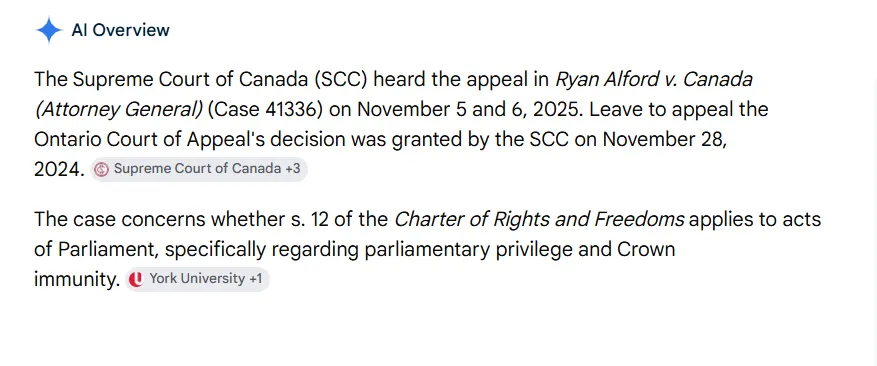
Here’s Google’s AI answering a question I asked about when the Alford case was heard at the SCC.
See that description at the bottom? IT’S COMPLETELY INACCURATE.
@bhaggart.bsky.social:
Sigh.
Saying that the issue was human error and this wasn’t an ”AI-alone” problem is a distinction without a difference. Chatbots are run and maintained by companies, by people. They have to be considered together. I bet Carney ordered this, he doesn’t want Canadians to have any doubts about AI. Well, nothing will ever make me trust it or the super creepy evil people creating AI and even creepier politicians (Carney is much more creepy and monstrous than Harper ever was) forcing it on us all, whether we want it, or not, whether we trust it, or not.

@canadiancynic.bsky.social:
This federal government is turning out to be cartoonishly evil in so many ways.
@arnkeeling.bsky.social:
Guns don’t kill people, etc.

Wait a year or two, people will be shocked when they find out AI has more rights than they do, and will to the end when we humans finish off earth’s livability – grossly hastened by AI’s pollution, and water and energy use.
@hummingturd.bsky.social:
Weird that a cabinet minister is opining on an active court case in favour of the company that victims’ families are going afterI bet the tech bros and Carney, demanded this false statement. Maybe they used AI to come up with it.
@markgongloff.bsky.social:
“The pivot underscores how the tide is turning against data centers, complicating the ambitions of the developers and investors that bankroll them.”
@ssteingraber1.bsky.social:
…taking with it the claim of their inevitability

Sticker by nobodyssweetheart.com: Stop forcing A.I. into everything fucking thing!
@canadiandimension.bsky.social:
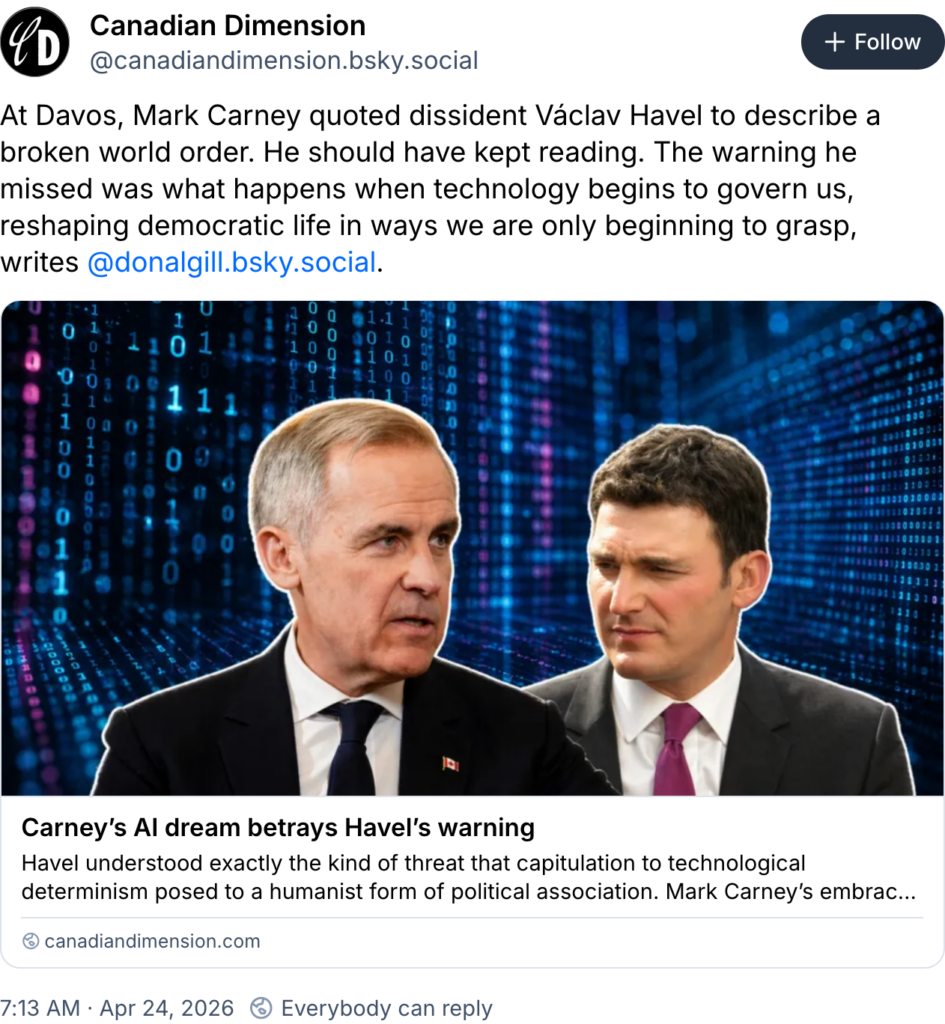
At Davos, Mark Carney quoted dissident Václav Havel to describe a broken world order. He should have kept reading. The warning he missed was what happens when technology begins to govern us, reshaping democratic life in ways we are only beginning to grasp, writes
@donalgill.bsky.social
@e6n.lol:
he didn’t miss it. hes a technocrat enabler because they’re the ones with all the money right now. this isn’t complicated.
Brookfield’s Compass Bails on Massive Virginia Data Center by Dawn Lim, April 29, 2026, Bloombergwell, well, well, Brookfield is where Carney was tightly tied to, and still is with investments. I expect after he finishes destroying Canada for his rich pals in USA, and elsewhere, he’ll go back to Brookfield. Parliament’s Ethics Committee just called on Carney to sell his Brookfield assets. Poor Carney, called on to sell his Brookfield riches while watching the world reject his baby AI, including Brookfield’s!
Compass Datacenters is pulling out of a yearslong effort to build a key part of a 2,100-acre data-center corridor in Northern Virginia after the development faced intense pushback from local residents.
The Brookfield Asset Management-backed data-center company has spent years trying to secure Prince William County’s blessings to develop more than 800 acres of the project. After sinking tens of millions of dollars into the plan, Dallas-based Compass decided that public opposition and state lawmakers’ growing resistance to providing tax breaks created too many roadblocks, according to people familiar with the matter, who asked not to be identified discussing confidential details.
The pivot underscores how the tide is turning against data centers, complicating the ambitions of the developers and investors that bankroll them.
“Compass has reached the unfortunate conclusion that we cannot move forward,” President AJ Byers said in a statement. “While we still believe this project offered significant benefits for the region and our neighbors, recent legal actions and compounding regulatory hurdles have effectively closed a viable path forward.”
Compass’s project, along with plans by Blackstone Inc.-backed QTS to develop an adjacent 800-plus acres, would have created one of the largest global data-center hubs and reinforced Northern Virginia’s status as the industry’s global capital. Both companies rode the artificial-intelligence boom and grew rapidly on the back of surging demand for the power and properties to run computing processes.Are you watching, Kevin O’Leary?
Now, though, the industry is forced to spend ever-more money and time to persuade towns, counties and politicians that the economic benefits are worth the costs. No data centre anywhere is worth the horrific harms, pollution and costs to the communities invaded by them and their slop shittery, and their rich fucking greedy creators and financial daddies like Brookfield
Public pushback to these mammoth structures and their enormous electricity needs is now forcing data-center companies to confront the limits of growth.
As Compass retrenches, Sterling, Virginia-based QTS is in discussions to forge ahead. The developer intends to challenge a court ruling that found zoning approvals were invalid, people familiar with the matter said. QTS didn’t immediately reply to messages seeking comment.
Prince William County’s plans for a tech corridor known as the Digital Gateway was part of the creep of data centers farther away from Loudoun County, Northern Virginia’s original data-center alley.
Almost immediately, the project faced pushback for its location — parts of the 2,100-acre site abutted a Civil War battlefield. Soon, residents who wanted to sell their land — criss-crossed by transmission lines — were clashing with neighbors who didn’t want industrial development that could hurt their home prices.
There was other fallout for advocates of the project. The chair of a key policymaking panel, the board of county supervisors, was unseated in 2023 by a political outsider who campaigned against data centers’ unchecked growth.
Ahead of a leadership shift, county officials scheduled a meeting that December to grant the data-center companies the approval to build. Hundreds showed up ahead of the zoning vote, with supporters and opponents lobbying for 27 straight hours.
The outcome of the meeting — and whether the county properly advertised the event — was at the center of legal challenges from homeowners.
The lawsuits hinged on one detail: The first two newspaper notices publicizing the hearing weren’t separated by at least six days, as local codes require.
This year, a Virginia judge upheld an earlier ruling that the zoning approvals were invalid because the public notices for the meeting fell short of legal requirements.
Compass decided not appeal the court’s decision, the people familiar with the matter said. A debate among Virginia politicians about the size of the tax breaks the data-center industry would receive cemented executives’ resolve to walk away, the people said.
“Our focus is on supporting the community and local families as we navigate this transition,” the company said.
Administrative Blunder
While deciding whether to keep fighting, executives at both data-center companies considered a range of views on the merits and risks of pressing ahead, according to people familiar with the matter.
Some argued that it was costly pushing into a community where data centers weren’t welcome, risking throwing good money after bad, the people said.
Those in favor of fighting it out in court said quitting would embolden political opposition to data centers. They expressed concern about the prospect of setting a legal precedent on the back of an administrative blunder.
QTS is still finalizing its decision, one person said. Compass’s retreat is part of its broader move to leave the Northern Virginia market, another person said.
“The decision by one of the two data-center applicants to end these appeals confirms that the rule of law prevailed over enormous political pressure from a multibillion-dollar global data-center industry,” said Mac Haddow, president of Oak Valley Homeowners Association, which initiated one of the lawsuits.
— With assistance from Erin Fuchs

Sticker by nobodyssweetheart.com: Hire Humans. AI makes slop.